

Scripture is always true, but it does not always communicate truth in the same way. Some passages describe literal events, commands, people, and places. Other passages use symbols, figures of speech, parables, poetry, or prophetic imagery to reveal spiritual truth. The key is to read each passage in context, according to its purpose, genre, and the way Scripture explains Scripture.
Symbolism does not mean “fake” or “less true.” Biblical symbolism points to something real. When Jesus says, “I am the door” in John 10:9, He is not literally made of wood; He is truly the only way of access and salvation. When John calls Jesus “the Lamb of God” in John 1:29, Jesus is not literally an animal; He is truly the sacrifice who takes away sin.
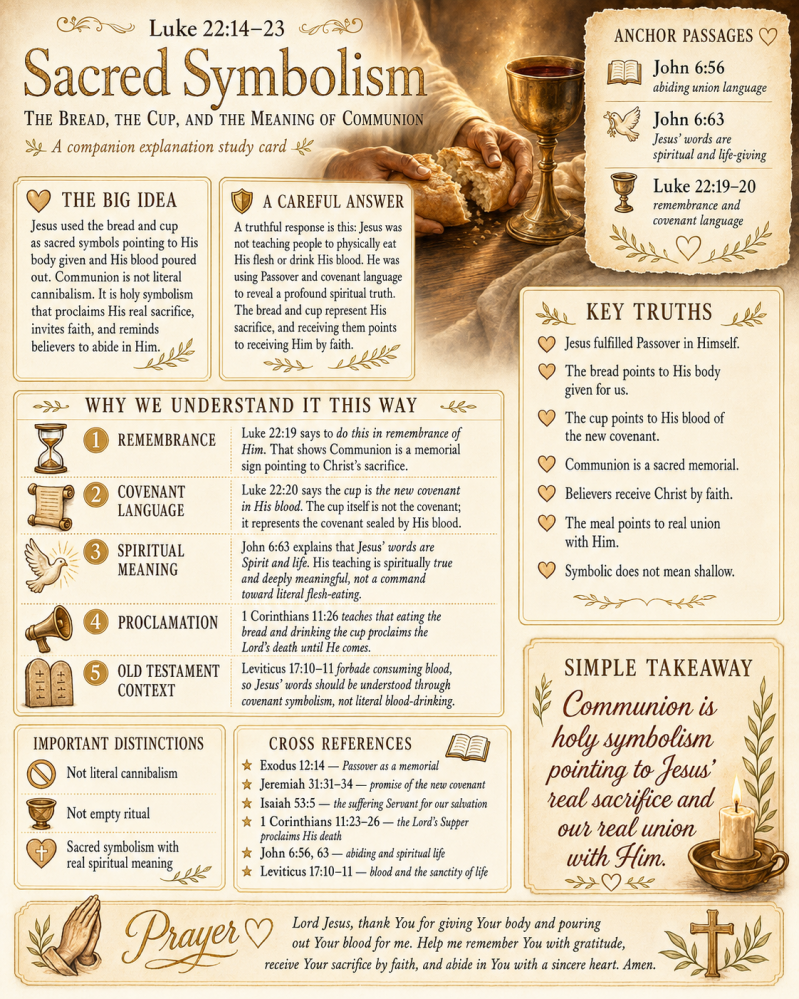
So with the bread and cup, the meaning is not physical cannibalism. It is sacred symbolism pointing to a real sacrifice, a real covenant, and real spiritual union with Christ.
The careful balance is: don’t make something symbolic just because it is uncomfortable, and don’t force something to be woodenly literal when the passage itself is using imagery.
Context is our guardrail. 🕊️
Study Notes
Sacred symbolism with real spiritual meaning. 🕊️
It is not literal in the sense of physically eating Jesus’ flesh or drinking His blood. It is symbolic language pointing to a very real spiritual truth.
The bread and cup represent His body and blood, and receiving them points to faith in His sacrifice.
A good way to look at it:
Jesus was using covenant and Passover language. The bread symbolized His body given for us, and the cup symbolized His blood poured out for the new covenant. He was not teaching literal cannibalism; He was showing that we must receive His sacrifice by faith and remain in Him.
The strongest clues are these:
Luke 22:19 — “This is my body given for you; do this in remembrance of me.”
That phrase “in remembrance” shows the meal is a memorial sign pointing back to His sacrifice.
Luke 22:20 — “This cup is the new covenant in my blood, which is poured out for you.”
The cup itself was not literally the covenant; it represented the covenant sealed by His blood.
John 6:56 — “Whoever eats my flesh and drinks my blood remains in me, and I in them.”
John 6:63 — “The Spirit gives life; the flesh counts for nothing. The words I have spoken to you—they are full of the Spirit and life.”
That helps explain John 6:56. Jesus was speaking spiritually, not calling people to physically consume Him.
1 Corinthians 11:26 — “For whenever you eat this bread and drink this cup, you proclaim the Lord’s death until he comes.”
Communion proclaims His death. It is a visible, physical act that points to a spiritual reality.
**Also, literal blood-drinking would have violated God’s law:
Leviticus 17:10-11 - "I will set my face against any Israelite or any foreigner residing among them who eats blood, and I will cut them off from the people. For the life of a creature is in the blood, and I have given it to you to make atonement for yourselves on the altar; it is the blood that makes atonement for one's life. Therefore I say to the Israelites, "None of you may eat blood, nor may any foreigner residing among you eat blood." God forbade the eating or drinking of blood because “the life of a creature is in the blood.”
So — symbolic, but not “only symbolic” in a shallow way. It is a sacred symbol. The bread and cup point to the deepest truth of our faith: Jesus gave His body, poured out His blood, made the new covenant, and gives life to those who receive Him by faith. 🕊️
"Whoever eats my flesh and drinks my blood has eternal life, and I will raise them up at the last day."
John 6:54

"For the bread of God is the bread that comes down from heaven and gives life to the world."
John 6:33
"Whoever eats my flesh and drinks my blood remains in me, and I in them.
John 6:56

"Very truly I tell you, the one who 'believes' has eternal life. I am the bread of life."
John 6:47-48
Add comment
Comments