

Matthew 26:20-30 is sacred ground: Jesus at the table, betrayal in the room, Passover being fulfilled, and the New Covenant being announced through His blood.
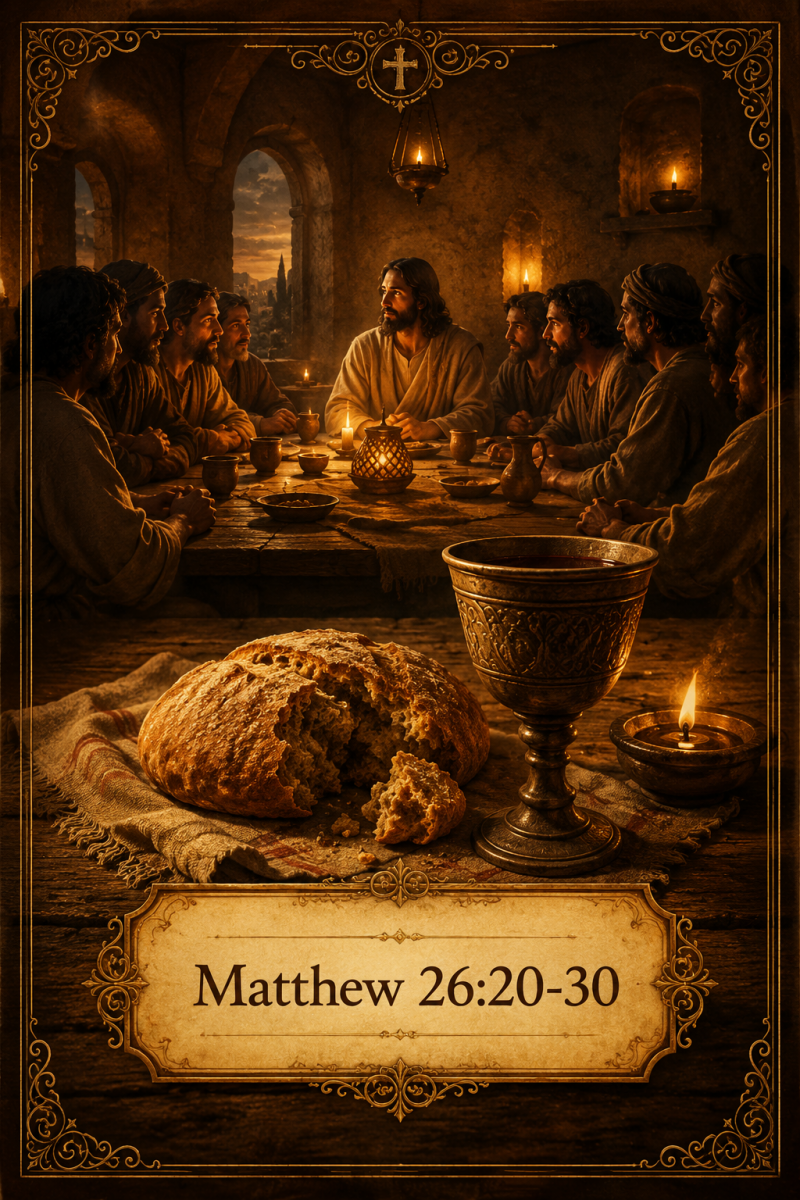
"When evening came, Jesus was reclining at the table with the Twelve. And while they were eating, he said, 'Truly I tell you, one of you will betray me.'
They were very sad and began to say to him one after the other, 'Surely you don't mean me, Lord?'
Jesus replied, 'The one who has dipped his hand into the bowl with me will betray me. The Son of Man will go just as it is written about him. But woe to that man who betrays the Son of Man! It would be better for him if he had not been born.' Then Judas, the one who would betray him, said, 'Surely you don't mean me, Rabbi?'
Jesus answered, 'You have said so.'
While they were eating, Jesus took bread, and when he had given thanks, he broke it and gave it to his disciples, saying, 'Take and eat; this is my body.'
Then he took a cup, and when he had given thanks, he gave it to them, saying, 'Drink from it, all of you. This is my blood of the covenant, which is poured out for many for the forgiveness of sins. I tell you, I will not drink from this fruit of the vine from now on until that day when I drink it new with you in my Father's kingdom.'
When they had sung a hymn, they went out to the Mount of Olives."
Study Notes
Matthew 26:20-30 — The Last Supper
Anchor Verse: Matthew 26:28
Matthew 26:28 — “This is my blood of the covenant, which is poured out for many for the forgiveness of sins.”
The setting: evening at the Passover table
Matthew 26:20 — “When evening came, Jesus was reclining at the table with the Twelve.”
This is not just a normal dinner. This is Passover, the meal that remembered how God delivered Israel from slavery in Egypt.
In the original Passover, the blood of the lamb marked the homes of God’s people, and judgment passed over them.
Exodus 12:13 — “The blood will be a sign for you on the houses where you are and when I see the blood, I will pass over you. No destructive plague will touch you when I strike Egypt.”
Now Jesus is sitting at the table as the true Passover Lamb.
1 Corinthians 5:7 — “Get rid of the old yeast, so that you may be a new unleavened batch - as you really are. For Christ, our Passover lamb, has been sacrificed.”
That means this meal is not only remembering the old deliverance from Egypt. It is revealing the greater deliverance from sin, death, and judgment.
Betrayal was already at the table
Matthew 26:21 — “And while they were eating, he said, ‘Truly I tell you, one of you will betray me.’”
This is heartbreaking. Jesus knows. He is not surprised. He is not fooled. He is not losing control.
Judas is sitting close enough to share the meal, yet his heart is already far from Christ.
Matthew 26:22 — “They were very sad and began to say to him one after the other, ‘Surely you don’t mean me, Lord?’”
The disciples’ response is worth noticing. They do not point first at Judas. They ask, “Is it me?”
That is a sober and humble response. True disciples should be willing to examine their own hearts before accusing someone else.
Psalm 139:23-24 — “Search me, God, and know my heart; test me and know my anxious thoughts. See if there is any offensive way in me, and lead me in the way everlasting.”
Judas calls Him “Rabbi,” not “Lord”
Matthew 26:25 — “Then Judas, the one who would betray him, said, ‘Surely you don’t mean me, Rabbi?’ Jesus answered, ‘You have said so.’”
This detail matters.
The others say:
Matthew 26:22 — “Surely you don’t mean me, Lord?”
But Judas says:
Matthew 26:25 — “Surely you don’t mean me, Rabbi?”
“Rabbi” means teacher. That is respectful, but it is not surrender.
Judas could sit near Jesus, eat with Jesus, hear Jesus, serve near Jesus, and still not truly yield to Jesus as Lord.
That is a warning for all of us: proximity to holy things is not the same as a surrendered heart.
The bread: His body given
Matthew 26:26 — “While they were eating, Jesus took bread, and when he had given thanks, he broke it and gave it to his disciples, saying, ‘Take and eat; this is my body.’”
Jesus takes ordinary bread and gives it covenant meaning.
The bread points to His body — not as cannibalism, not as woodenly literal eating of flesh, but as a sacred symbol of His real sacrifice.
His body would be beaten, pierced, and given.
Isaiah 53:5 — “But he was pierced for our transgressions, he was crushed for our iniquities; the punishment that brought us peace was on him, and by his wounds we are healed."
1 Peter 2:24 — “'He himself bore our sins ' in his body on the cross, so that we might die to sins and live for righteousness; 'by his wounds you have been healed.'”
The breaking of the bread points forward to the cross.
The disciples were eating a meal, but Jesus was showing them that He Himself would become the provision.
The cup: His blood of the covenant
Here is our anchor:
Matthew 26:27-28 — “Then he took a cup, and when he had given thanks, he gave it to them, saying, ‘Drink from it, all of you. This is my blood of the covenant, which is poured out for many for the forgiveness of sins.’”
This is huge.
Jesus does not say, “This is a motivational symbol.”
He says, “This is my blood of the covenant.”
That phrase reaches back into the Old Testament.
Exodus 24:8 — “Moses then took the blood, sprinkled it on the people and said, ‘This is the blood of the covenant that the Lord has made with you in accordance with all these words.’”
At Sinai, the old covenant was confirmed with blood.
At the Last Supper, Jesus announces the New Covenant — and it will be confirmed with His own blood.
Jeremiah 31:31 — “‘The days are coming,’ declares the Lord, ‘when I will make a new covenant with the people of Israel and with the people of Judah.’”
Jeremiah 31:34 — “No longer will they teach their neighbor, or say to one another, 'Know the LORD,' because they will all know me, from the least of them to the greatest, declares the LORD. 'For I will forgive their wickedness and will remember their sins no more.'"
Jesus is saying: that promised New Covenant is now arriving through Me.
“Poured out for many”
Matthew 26:28 — “This is my blood of the covenant, which is poured out for many for the forgiveness of sins.”
“Poured out” is sacrificial language.
His death was not accidental.
His blood was not taken from Him unwillingly.
He gave Himself.
John 10:18 — “No one takes it from me, but I lay it down of my own accord. I have authority to lay it down and authority to take it up again. This command I received from my Father.”
And He says it is poured out “for many.”
That echoes Isaiah’s prophecy about the suffering servant:
Isaiah 53:12 — “Therefore I will give him a portion among the great, and he will divide the spoils with the strong, because he poured out his life unto death, and was numbered with the transgressors. For he bore the sin of many, and made intercession for the transgressors."
Jesus is identifying Himself as the suffering servant who bears sin, carries guilt, and brings forgiveness.
“For the forgiveness of sins”
This is the heart of the passage.
Matthew 26:28 — “...for the forgiveness of sins.”
Jesus’ blood is not merely an example of love. It is the payment for sin.
Sin creates real guilt before a holy God. Forgiveness requires atonement.
Hebrews 9:22 — “In fact, the law requires that nearly everything be cleansed with blood, and without the shedding of blood there is no forgiveness."
That can sound severe, but it is actually mercy. God does not ignore sin. He deals with it through the sacrifice of His Son.
The cross means God is both just and merciful.
Romans 3:25-26 — “God presented Christ as a sacrifice of atonement, through the shedding of his blood - to be received by faith. He did this to demonstrate his righteousness, because in his forbearance he had left the sins committed beforehand unpunished - he did it to demonstrate his righteousness at the present time, so as to be just and the one who justifies those who have faith in Jesus."
Jesus looks beyond the cross to the Kingdom
Matthew 26:29 — “I tell you, I will not drink from this fruit of the vine from now on until that day when I drink it new with you in my Father’s kingdom.”
This is beautiful.
Jesus is hours away from betrayal, agony, arrest, mockery, and crucifixion — but He is already looking beyond the suffering.
He sees the Kingdom.
The cross is not the end. The resurrection is coming. The wedding supper is coming. The Kingdom is coming.
Revelation 19:9 — “Then the angel said to me, 'Write this: Blessed are those who are invited to the wedding supper of the Lamb!' And he added, 'These are the true words of God.'”
There is a future table coming.
This table in Matthew 26 points forward to that final, joyful table in the Kingdom.
They sang before the suffering
Matthew 26:30 — “When they had sung a hymn, they went out to the Mount of Olives.”
This verse always gets me.
Jesus sang before Gethsemane.
He knew what was coming, and He still worshiped.
The Lamb walked toward sacrifice with Scripture, prayer, obedience, and praise.
Many scholars believe the hymn was likely from the Passover Hallel Psalms, such as Psalms 113-118.
One line from that section is especially powerful:
Psalm 118:22 — “The stone the builders rejected has become the cornerstone.”
And another:
Psalm 118:24 — “The Lord has done it this very day; let us rejoice today and be glad.”
Jesus sang on the way to suffering because He trusted the Father completely.
Heart of the Passage
Matthew 26:20-30 shows us that Jesus was not trapped by betrayal, surprised by sin, or defeated by death.
He willingly gave His body.
He willingly poured out His blood.
He established the New Covenant.
He secured forgiveness.
He looked forward to the Kingdom.
And He worshiped on the way to the cross.
Anchor Truth
Matthew 26:28 — “This is my blood of the covenant, which is poured out for many for the forgiveness of sins.”
Jesus’ blood is the seal of the New Covenant.
Not our effort.
Not our goodness.
Not our religious performance.
His blood.
That is why forgiveness is not fragile when it rests in Christ. It is covenant-deep, blood-bought, and God-secured. ♥️
Simple personal takeaway
Lord Jesus, You did not merely teach forgiveness. You purchased it. You gave Your body and poured out Your blood so sinners could be brought near to God. Help me never treat the cup and the bread casually. Let me remember the cost, receive the grace, and live like someone covered by the covenant blood of Christ. - Amen🕊️
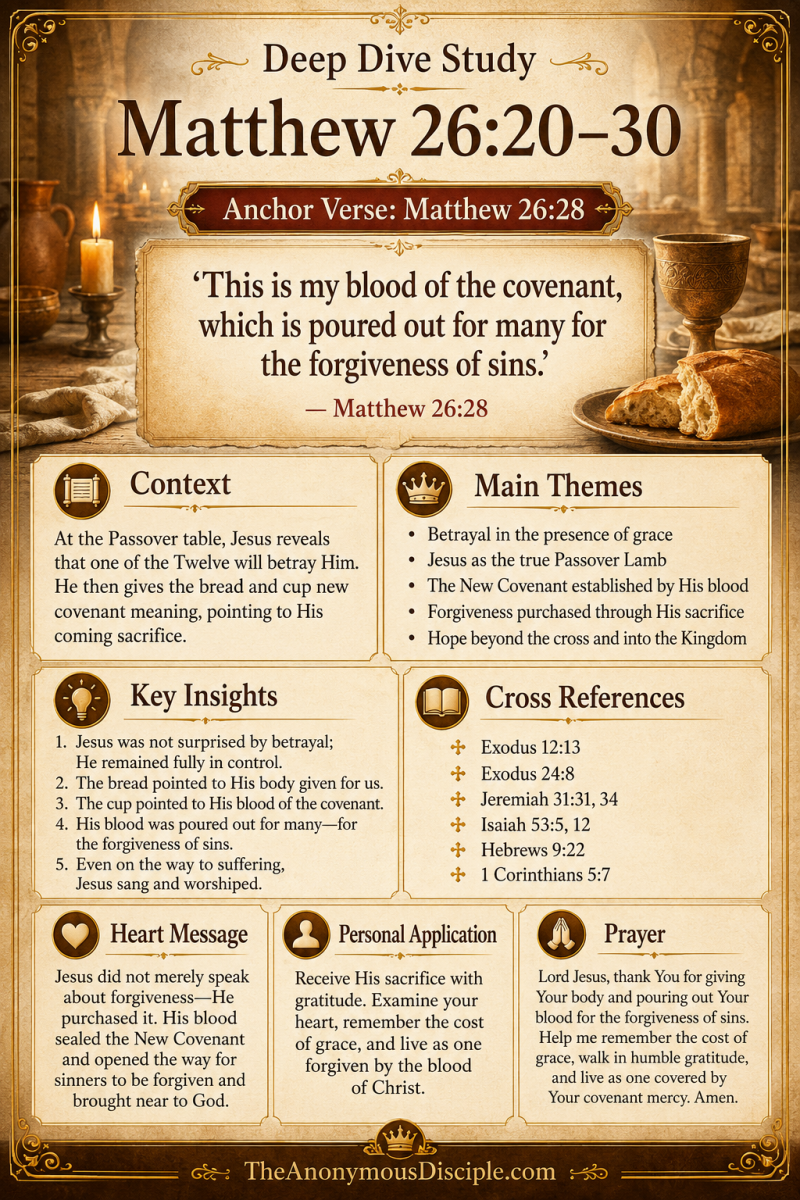
Study Card
Add comment
Comments