

Because Jesus rose and His Word cannot be chained, we can endure temporary hardship so others may share in eternal salvation and glory.
"You then, my son, be strong in the Grace that is in Christ Jesus. And the things you have heard me say in the presence of many witnesses entrust to reliable people who will also be qualified to teach others. Join with me in suffering, like a good soldier of Christ Jesus. No one serving as a soldier gets entangled in civilian affairs, but rather tries to please his commanding officer. Similarly, anyone who competes as an athlete does not receive the victor's crown except by competing according to the rules. The hardworking farmer should be the first to receive a share of the crops. Reflect on what I am saying, for the Lord will give you insight into all this.
Remember Jesus Christ, raised from the dead, descended from David. This is my gospel, for which I am suffering even to the point of being chained like a criminal. But God's Word is not chained. Therefore I endure everything for the sake of the elect, that they too may obtain the salvation that is in Christ Jesus, with eternal glory.
Here is a trustworthy saying:
If we died with him, we will also live with him;
if we endure, we will also reign with him.
If we disown him, he will also disown us;
if we are faithless, he remains faithful, for he cannot disown himself."
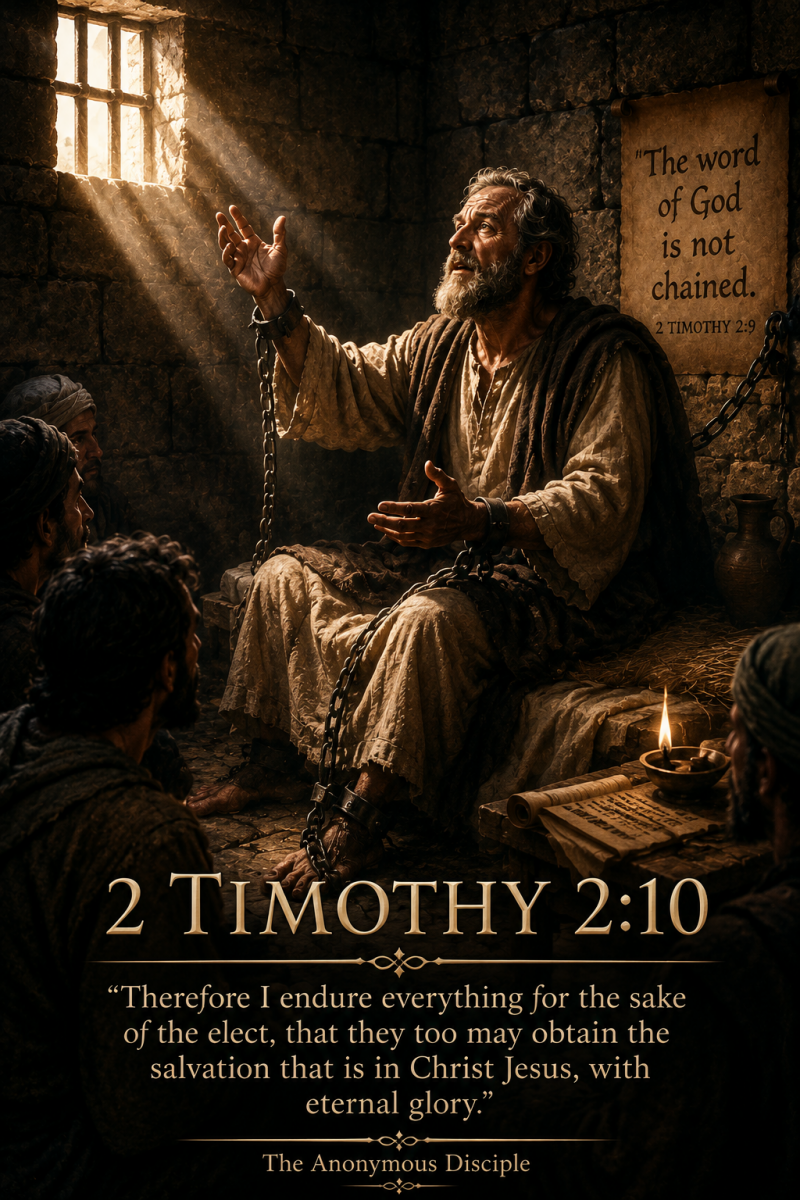
2 Timothy 2:1–13 — Endure for the Sake of the Chosen
Anchor: 2 Timothy 2:10
“Therefore I endure everything for the sake of the elect, that they too may obtain the salvation that is in Christ Jesus, with eternal glory.”
2 Timothy 2:10 (NIV)
Paul is writing from prison near the end of his life. He knows suffering, loneliness, opposition, and likely death are ahead—but his concern is not self-preservation. His concern is that Timothy remain faithful and that others hear the gospel.
The heart of this passage is: Christ’s servants endure hardship because the message is worth suffering for and souls are worth reaching.
Strength comes through grace
“You then, my son, be strong in the grace that is in Christ Jesus.”
2 Timothy 2:1 (NIV)
Paul does not simply tell Timothy, “Be strong.” He tells him where that strength comes from:
“Be strong in the grace that is in Christ Jesus.”
Timothy’s strength would not come from personality, confidence, intelligence, or willpower. It would come from continually drawing upon Christ’s grace.
Grace is not only how we are saved; it is also how we continue.
“My grace is sufficient for you, for My power is made perfect in weakness.”
2 Corinthians 12:9
God does not always remove weakness. Sometimes He displays His strength through it.
Heart truth
You do not have to feel strong to remain faithful. You need to stay close to the One who is strong.
Truth must be passed faithfully to others
“And the things you have heard me say… entrust to reliable people who will also be qualified to teach others.”
2 Timothy 2:2 (NIV)
There are four generations of discipleship in this single verse:
- Christ gave the truth to Paul.
- Paul taught Timothy.
- Timothy was to entrust it to reliable believers.
- Those believers would teach others.
Christian truth was never meant to stop with one person.
Paul tells Timothy to entrust the teaching—not merely mention it casually. The idea is that the gospel is a precious deposit placed into trustworthy hands.
This applies to parents, grandparents, teachers, pastors, and every believer who shares Scripture.
“Tell it to your children, and let your children tell it to their children, and their children to the next generation.”
Joel 1:3 (NIV)
Our responsibility is not to make God’s Word more fashionable. It is to pass it on faithfully.
Three pictures of faithful Christian service
Paul now gives Timothy three illustrations: a soldier, an athlete, and a farmer.
Each one reveals a different aspect of endurance.
The devoted soldier
“Join with me in suffering, like a good soldier of Christ Jesus.”
2 Timothy 2:3 (NIV)
Paul does not hide the cost of discipleship. He tells Timothy plainly: suffering may come.
The Christian life is not a promise of constant ease. It is a call to loyalty.
“No one serving as a soldier gets entangled in civilian affairs, but rather tries to please his commanding officer.”
2 Timothy 2:4 (NIV)
The warning is against becoming entangled.
This does not mean Christians cannot work, raise families, enjoy life, or participate in society. It means earthly concerns must not bind us so tightly that we become distracted from Christ’s commands.
The soldier’s primary concern is pleasing the one who enlisted him.
For the believer, that Commander is Jesus.
“If you love Me, keep My commands.”
John 14:15 (NIV)
The soldier teaches us:
Stay focused. Remain loyal. Seek Christ’s approval above the world’s.
The disciplined athlete
“Similarly, anyone who competes as an athlete does not receive the victor’s crown except by competing according to the rules.”
2 Timothy 2:5 (NIV)
Sincerity alone is not enough. The athlete must compete according to the rules.
In ministry and Christian living, we cannot pursue a supposedly good outcome through disobedient methods.
God cares both about what we do and how we do it.
We cannot distort Scripture, manipulate people, compromise truth, or excuse sin and then claim we are serving God.
“Do not merely listen to the word… Do what it says.”
James 1:22 (NIV)
The athlete teaches us:
Practice discipline. Obey God’s Word. Finish honorably.
The hardworking farmer
“The hardworking farmer should be the first to receive a share of the crops.”
2 Timothy 2:6 (NIV)
Farming requires labor, patience, and faith.
A farmer prepares soil, plants seed, removes weeds, and waits. Much of the work happens before there is visible evidence of fruit.
Christian service can feel the same way.
You may pray for someone for years. You may share Scripture without seeing immediate change. You may invest in your children or grandchildren and wonder whether anything is taking root.
But the farmer does not dig up the seed every morning to check whether it is growing.
“Let us not become weary in doing good, for at the proper time we will reap a harvest if we do not give up.”
Galatians 6:9 (NIV)
The farmer teaches us:
Work faithfully. Wait patiently. Trust God with the harvest.
Understanding comes through reflection and God’s help
“Reflect on what I am saying, for the Lord will give you insight into all this.”
2 Timothy 2:7 (NIV)
Paul joins together two things that should never be separated:
- Timothy must reflect carefully.
- God must give understanding.
Bible study requires thought, but spiritual understanding is also a gift from God.
We study carefully and pray humbly.
“Open my eyes that I may see wonderful things in Your law.”
Psalm 119:18 (NIV)
This is a beautiful prayer before opening Scripture.
Remember Jesus Christ
The center of endurance
“Remember Jesus Christ, raised from the dead, descended from David.”
2 Timothy 2:8 (NIV)
Paul tells Timothy to remember two truths:
Jesus was raised from the dead
Christ defeated death. Therefore, suffering and martyrdom cannot have the final word.
Jesus descended from David
He is the promised Messiah and rightful King.
This brief statement contains both the gospel and prophecy fulfilled: Jesus is the crucified and risen Savior, and He is the promised Son of David.
“He was promised beforehand through His prophets in the Holy Scriptures regarding His Son.”
Romans 1:2–3 (NIV)
When hardship makes us discouraged, Paul’s answer is not merely, “Try harder.”
His answer is: Remember Jesus Christ.
Remember who He is.
Remember what He endured.
Remember that He rose.
Remember that He reigns.
Paul was chained, but God’s Word was not
“This is my gospel, for which I am suffering even to the point of being chained like a criminal. But God’s word is not chained.”
2 Timothy 2:8–9 (NIV)
Paul was treated like a criminal, though he had faithfully preached Christ.
His body could be confined, but the gospel could not.
Governments can imprison preachers. Opponents can silence voices. Bibles can be banned. Believers can be persecuted.
But no human authority can imprison the power of God’s truth.
Paul was chained, yet his prison letters still teach the Church nearly two thousand years later.
The chains became part of the testimony.
“The word of our God endures forever.”
Isaiah 40:8 (NIV)
Powerful truth
The messenger may be restricted, but the message remains free.
Anchor Verse: 2 Timothy 2:10
“Therefore I endure everything for the sake of the elect, that they too may obtain the salvation that is in Christ Jesus, with eternal glory.”
2 Timothy 2:10 (NIV)
This verse reveals Paul’s motivation.
He does not endure because suffering is pleasant.
He does not endure to prove how tough he is.
He does not endure to earn salvation.
He endures because people need Christ.
“I endure everything”
Paul had experienced beatings, imprisonment, rejection, hunger, danger, betrayal, and hardship.
“I have worked much harder, been in prison more frequently, been flogged more severely, and been exposed to death again and again.”
2 Corinthians 11:23 (NIV)
Yet suffering did not make him abandon the mission.
“For the sake of the elect”
The “elect” refers to those whom God has chosen to belong to Christ.
Paul did not use God’s sovereignty as an excuse to stop evangelizing. Instead, it gave him confidence to continue.
God had people who would hear and believe—but Paul still had to preach.
“I have many people in this city.”
Acts 18:10 (NIV)
God’s purpose guarantees that gospel work is not pointless.
We do not know who will respond, so we share Christ broadly and faithfully.
“That they too may obtain salvation”
Salvation comes through Christ, yet God ordinarily uses human messengers to proclaim the gospel.
“How can they believe in the One of whom they have not heard? And how can they hear without someone preaching to them?”
Romans 10:14 (NIV)
Paul willingly bore temporary hardship so others could receive eternal life.
“With eternal glory”
Paul compares present suffering with eternal glory.
The suffering is temporary.
The glory is eternal.
“Our light and momentary troubles are achieving for us an eternal glory that far outweighs them all.”
2 Corinthians 4:17 (NIV)
This does not mean suffering feels light while we endure it. Paul means it is light when weighed against the greatness and permanence of eternity with Christ.
The heart of the anchor verse
Paul was willing to lose comfort so others could find Christ.
That is sacrificial love.
A trustworthy saying
United with Christ in death and life
“If we died with Him, we will also live with Him.”
2 Timothy 2:11 (NIV)
This includes our spiritual union with Christ and may also point toward believers who die faithfully for Him.
Through faith, the believer dies to the old life and receives new life in Christ.
“We were therefore buried with Him through baptism into death… we too may live a new life.”
Romans 6:4 (NIV)
Because Christ lives, His people will live.
Endurance and reigning
“If we endure, we will also reign with Him.”
2 Timothy 2:12 (NIV)
The Bible repeatedly connects present faithfulness with future participation in Christ’s kingdom.
“To the one who is victorious, I will give the right to sit with Me on My throne.”
Revelation 3:21 (NIV)
This does not teach that endurance earns salvation. Genuine endurance reveals living faith.
Those who belong to Christ continue clinging to Him, even through weakness and hardship.
The severe warning against denying Christ
“If we disown Him, He will also disown us.”
2 Timothy 2:12 (NIV)
This is not referring to a frightened moment followed by repentance, such as Peter’s denial.
Peter denied Jesus three times, but he wept bitterly, repented, and was restored.
“Do you love Me? … Feed My sheep.”
John 21:17 (NIV)
Paul is warning against settled, deliberate rejection of Christ—a person ultimately refusing to belong to Him.
Jesus gave the same warning:
“Whoever disowns Me before others, I will disown before My Father in heaven.”
Matthew 10:33 (NIV)
This warning should sober us, but it should not crush a repentant believer who fears they have failed God. The very desire to return to Christ is evidence of a heart being drawn back to Him.
God remains faithful
“If we are faithless, He remains faithful, for He cannot disown Himself.”
2 Timothy 2:13 (NIV)
This verse is comforting, but it must not be separated from the warning in the previous verse.
“God remains faithful” means God always remains true to His character, His promises, and His warnings.
He is faithful to forgive the repentant.
“If we confess our sins, He is faithful and just and will forgive us our sins.”
1 John 1:9 (NIV)
He is also faithful to judge persistent unbelief.
God cannot contradict Himself. He will never stop being holy, truthful, merciful, and just.
Our faith may tremble, but His character does not change.
Important distinction
A believer may experience moments of weak faith. God does not abandon His children every time they stumble.
But Scripture does not offer reassurance to someone who permanently rejects Christ without repentance.
Peter stumbled and returned.
Judas turned away and did not return.
The pattern of the passage
The entire section moves through a powerful progression:
2 Timothy 2:1 — Receive strength from Christ’s grace.
2 Timothy 2:2 — Pass the truth to others.
2 Timothy 2:3–6 — Endure like a soldier, athlete, and farmer.
2 Timothy 2:7 — Reflect and seek God’s understanding.
2 Timothy 2:8 — Remember Jesus Christ.
2 Timothy 2:9 — Trust that God’s Word cannot be chained.
2 Timothy 2:10 — Endure so others may receive salvation.
2 Timothy 2:11–13 — Remain faithful because eternal life and Christ’s kingdom are ahead.
What this means for us today
This passage teaches that Christian faithfulness is not passive.
We are called to:
- Depend on grace rather than personal strength.
- Preserve and pass on biblical truth.
- Refuse distractions that weaken our devotion.
- Obey God even when compromise seems easier.
- Labor patiently when fruit is not yet visible.
- Remember the risen Christ when suffering comes.
- Endure hardship because souls and eternity matter.
Paul’s life says:
“My suffering is temporary, but the salvation of others has eternal consequences.”
Heart message
2 Timothy 2:10 is the heart of a disciple who has stopped making personal comfort the highest priority.
Paul knew that faithfulness might cost him everything on earth—but he also knew no sacrifice made for Christ would be wasted.
Our endurance may not look like Paul’s prison chains. It may look like continuing to pray for someone who resists God, teaching Scripture when few respond, standing for truth when it is unpopular, or remaining faithful through grief, illness, exhaustion, and disappointment.
The world may never see the cost.
But Christ does.
“God is not unjust; He will not forget your work and the love you have shown Him.”
Hebrews 6:10 (NIV)
Prayer
Lord Jesus, strengthen us through Your grace. Keep us from becoming entangled in distractions, compromise, or fear. Make us faithful soldiers, disciplined servants, and patient workers in Your harvest. Help us remember that Your Word cannot be chained and that no suffering endured for Your name is wasted. Give us Paul’s heart—to care more about souls and eternal glory than temporary comfort. Keep us faithful until the end. In Jesus’ name, amen. 🙏

Add comment
Comments