

God does not restore us merely so we can feel better. He restores us so our lives can testify to His faithfulness.
The dancing is not the final destination.
Worship is. ❤️
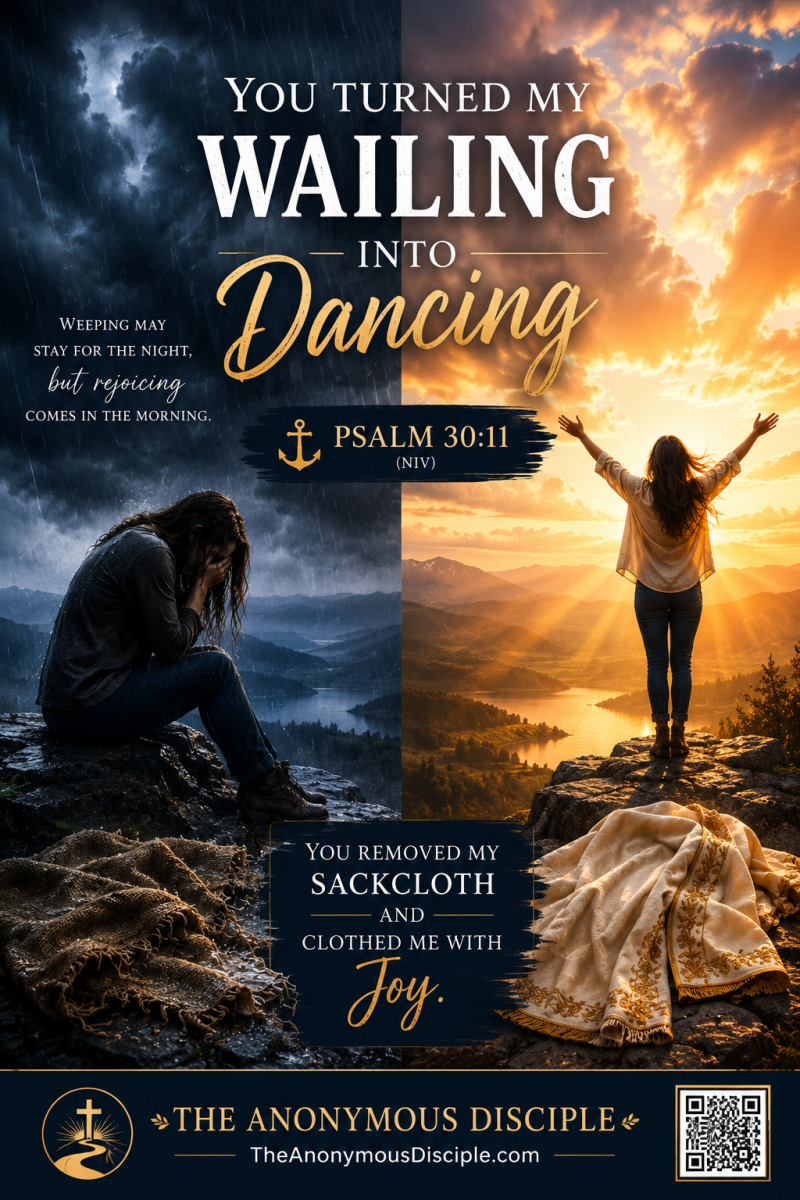
"I will exalt you, LORD, for you lifted me out of the depths and did not let my enemies gloat over me.
LORD my God, I called to you for help, and you healed me. You, LORD, brought me up from the realm of the dead; you spared me from going down to the pit.
Sing the praises of the LORD, you his faithful people; praise his holy name. For his anger lasts only a moment, but his favor lasts a lifetime; weeping may stay for the night, but rejoicing comes in the morning.
When I felt secure, I said, 'I will never be shaken.' LORD, when you favored me, you made my royal mountain stand firm; but when you hid your face, I was dismayed.
To you, LORD, I called; to the LORD I cried for mercy: "What is gained if I am silenced, if I go down to the pit? Will the dust praise you? Will it proclaim your faithfulness?
Hear, LORD, and be merciful to me; LORD, be my help.' You turned my wailing into dancing; you removed my sackcloth and clothed me with joy, that my heart may sing your praises and not be silent. LORD my God, I will praise you forever"
Psalm 30
✍️ Study Notes Below Cards📜

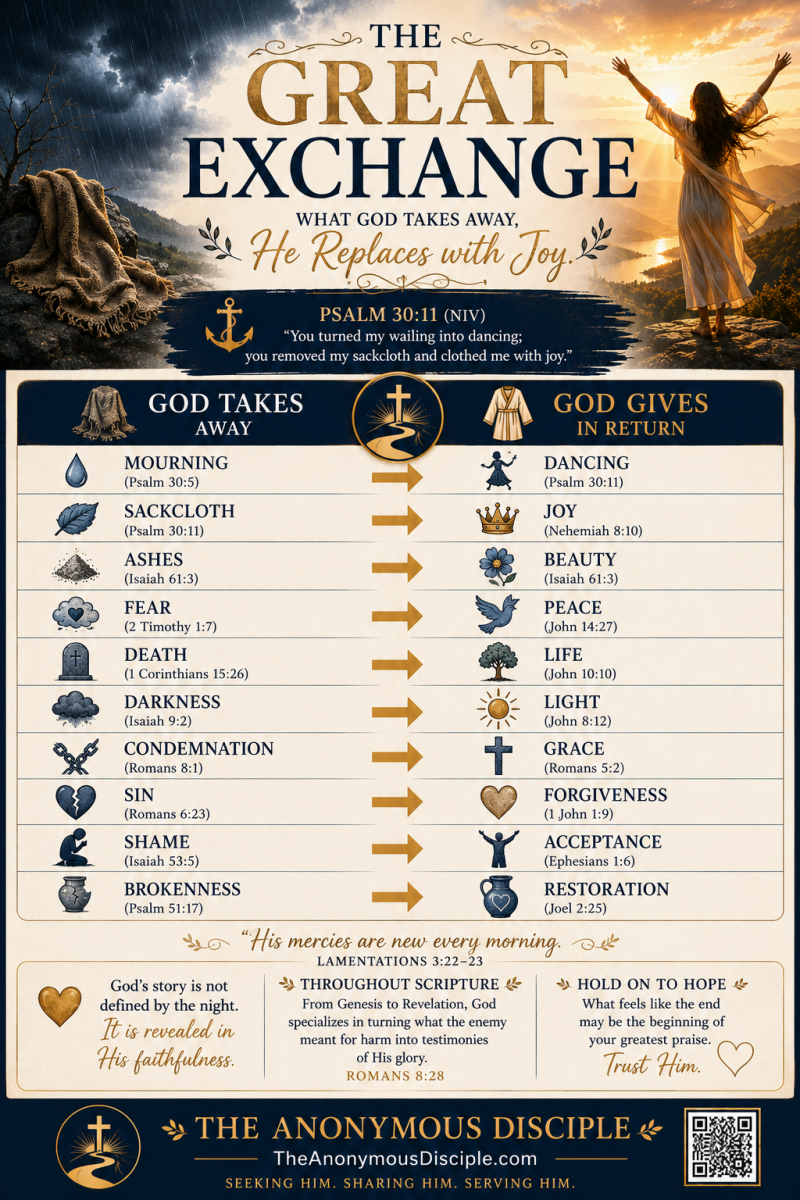
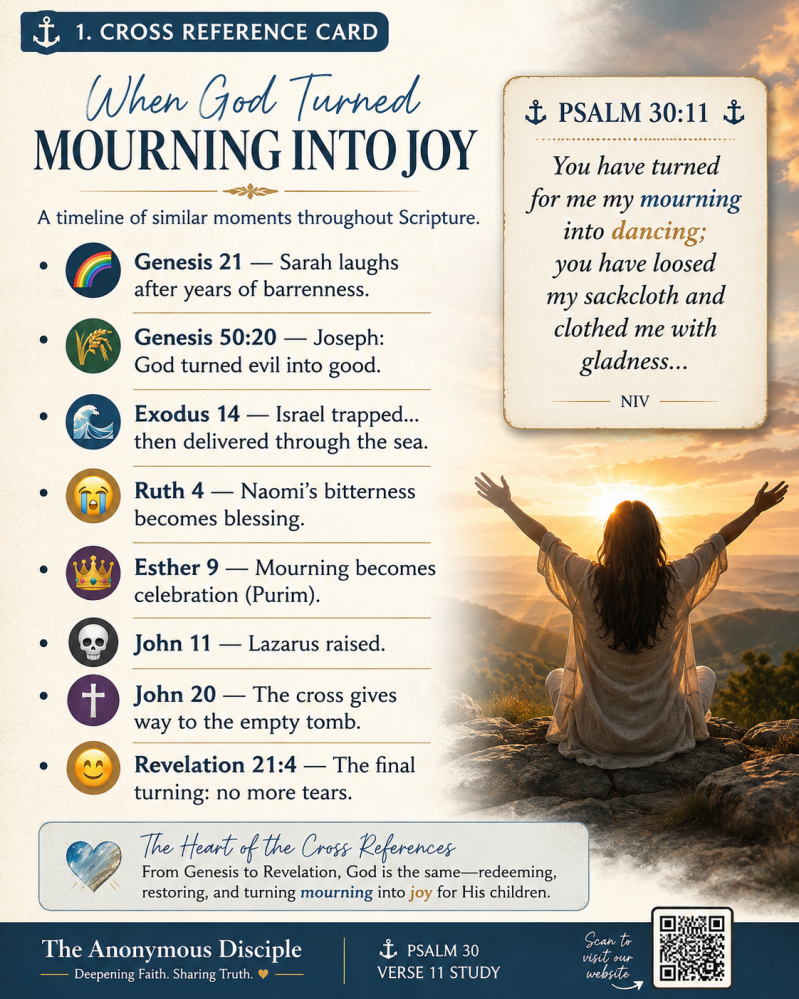
Psalm 30 study— From Mourning to Dancing
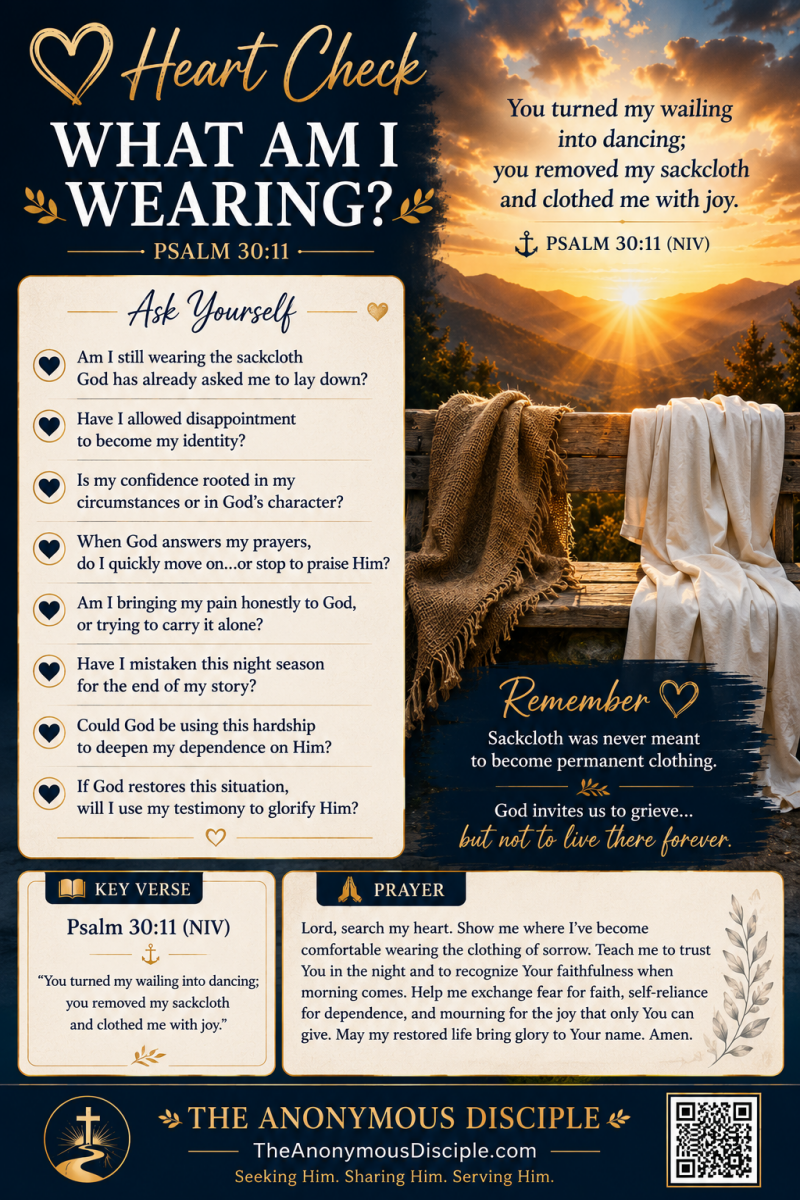
⚓️ Anchor Verse: Psalm 30:11
Psalm 30:11 (NIV)
“You turned my wailing into dancing;
you removed my sackcloth and clothed me with joy.”
Psalm 30 is David’s testimony that sorrow may be real, but it is not always final. The psalm moves through danger, prayer, correction, rescue, and praise. David is not pretending the pain never happened. He is praising God because the pain did not get the last word.
The setting of Psalm 30
The title identifies it as:
Psalm 30 — A psalm. A song. For the dedication of the temple. Of David.
David did not personally build the temple, but he prepared extensively for it, and the psalm may have been used later in a dedication setting. The exact historical crisis behind the psalm is not stated clearly. What is clear is that David had faced a situation severe enough to make him feel close to death.
Psalm 30 is both personal and public. David is praising God for rescuing him, but he also calls the faithful community to join him.
Psalm 30:4 (NIV)
“Sing the praises of the LORD, you his faithful people; praise his holy name.”
His deliverance became a testimony for others.
Psalm 30:1–3 — God brought David up
Psalm 30:1–3 (NIV)
“I will exalt you, LORD, for you lifted me out of the depths and did not let my enemies gloat over me.
LORD my God, I called to you for help, and you healed me.
You, LORD, brought me up from the realm of the dead; you spared me from going down to the pit.”
The phrase “lifted me out of the depths” pictures being drawn up from a well or pit. David felt trapped, helpless, and close to destruction, but God pulled him out.
Notice the movement:
David called. God heard. God healed. God lifted. God spared.
David gives God all the credit.
The “healing” in Psalm 30:2 may refer to physical healing, emotional restoration, rescue from danger, or a combination of these. In Scripture, healing language can describe the restoration of the whole person.
The “pit” does not necessarily mean David literally died. It means he believed death was near.
Cross-reference
Psalm 40:1–2 (NIV)
“I waited patiently for the LORD; he turned to me and heard my cry. He lifted me out of the slimy pit, out of the mud and mire.”
Both psalms portray God as the One who reaches down into places we cannot escape on our own.
Psalm 30:4–5 — Weeping has a limit
Psalm 30:5 (NIV)
“For his anger lasts only a moment, but his favor lasts a lifetime; weeping may stay for the night, but rejoicing comes in the morning.”
This verse does not mean every hardship disappears overnight. “Night” and “morning” are poetic pictures.
Night represents:
- grief
- correction
- fear
- confusion
- waiting
- silence
Morning represents:
- mercy
- restoration
- clarity
- renewed hope
- answered prayer
- the return of joy
The contrast is powerful:
A moment of discipline versus a lifetime of favor.
A night of weeping versus a morning of rejoicing.
God’s correction is real, but His covenant love is greater.
David is not saying, “Believers should never cry.” He is saying, “Crying is not the conclusion.”
Cross-reference
Lamentations 3:22–23 (NIV)
“Because of the LORD’s great love we are not consumed, for his compassions never fail. They are new every morning.”
Morning in Scripture often symbolizes fresh mercy. God’s compassion meets us again after the darkness.
Psalm 30:6–7 — The danger of feeling secure
Psalm 30:6–7 (NIV)
“When I felt secure, I said, ‘I will never be shaken.’ LORD, when you favored me, you made my royal mountain stand firm; but when you hid your face, I was dismayed.”
This is the turning point.
David had begun to confuse God’s blessing with his own stability. He felt secure and assumed that security would continue automatically.
His problem was not that he felt thankful or safe. His problem was self-confidence.
He effectively said:
“Nothing can touch me.”
Then God allowed him to feel how dependent he truly was.
David realized that the mountain stood firm because God made it stand firm.
This is one of the hardest spiritual lessons:
We can enjoy God’s gifts so much that we temporarily forget our dependence on the Giver.
Prosperity can make us feel self-sufficient. Trouble exposes that illusion.
Cross-reference
Deuteronomy 8:17–18 (NIV)
“You may say to yourself, ‘My power and the strength of my hands have produced this wealth for me.’ But remember the LORD your God.”
David had to remember that his security did not come from his throne, strength, army, health, or circumstances. It came from God.
Psalm 30:8–10 — David’s honest appeal
Psalm 30:8–10 (NIV)
“To you, LORD, I called; to the Lord I cried for mercy: What is gained if I am silenced, if I go down to the pit?
Will the dust praise you? Will it proclaim your faithfulness? Hear, LORD, and be merciful to me; LORD, be my help."
David is reasoning with God from the desire to glorify Him. He is not bargaining as though God owes him rescue. He is pleading:
“Lord, if my life ends here, I can no longer praise You among the living or tell others what You have done. Preserve me so my life can continue declaring Your faithfulness.”
“What is gained if I am silenced?”
David asks what purpose would be served by allowing him to die at that moment. The word “silenced” refers to death—the end of his audible praise on earth.
This reveals something beautiful about David’s heart: he does not merely ask God to save him so he can return to comfort. He asks to live so he can continue praising and proclaiming God.
His request is moving from:
“Save me because I am frightened”
to:
“Save me so my life can honor You.”
That is a deeper kind of prayer.
“Will the dust praise You?”
David is speaking from an Old Testament understanding of the grave. He is not denying resurrection or saying that God will never be praised after death. He is contrasting the visible, public praise of the living with the silence of the grave.
The dead could no longer stand among Israel’s worshiping congregation and testify aloud about God’s faithfulness.
A similar prayer appears elsewhere:
Psalm 6:5
“Among the dead no one proclaims your name. Who praises you from the grave?”
And again:
Psalm 115:17–18
“It is not the dead who praise the LORD… it is we who extol the LORD, both now and forevermore.”
David is essentially saying:
“Let me remain among the living so I can tell people how faithful You have been.”
“Will it proclaim Your faithfulness?”
This may be the most important phrase in the appeal.
David is concerned with God’s faithfulness—His truth, steadfast love, reliability, and covenant loyalty. David wants his rescued life to become evidence that God hears cries for mercy.
And that is exactly what Psalm 30 becomes.
The psalm itself is the testimony David asked for the opportunity to give. God rescued him, and David recorded the praise so that generations—including us this morning—would hear about God’s faithfulness.
His prayer was answered far beyond his own lifetime.
“Hear, LORD, and be merciful to me”
David does not claim entitlement. He asks for mercy.
That matters because earlier David admitted that he had become overly confident:
Psalm 30:6
“When I felt secure, I said, ‘I will never be shaken.’”
David recognizes that rescue is not something he can demand based on his goodness. He needs God’s compassion.
This is the humble posture of genuine prayer:
“Lord, I have no strength to rescue myself, and I cannot claim that I deserve it. Please be merciful.”
“LORD, be my help”
David does not merely ask God to send help. He asks God to be his help.
That distinction is powerful.
He does not say:
- Give me stronger circumstances.
- Give me more capable people.
- Give me a better plan.
- Give me control again.
He says, in effect:
“Lord, You are what I need.”
This echoes:
Psalm 121:1–2
“I lift up my eyes to the mountains—where does my help come from? My help comes from the LORD, the Maker of heaven and earth.”
Psalm 30:8–10 is the cry between David’s collapse and his restoration. He has not reached the dancing yet. He is still wearing the sackcloth. But he directs his desperation toward God.
That teaches us something important:
Faith is not always celebrating after the answer. Sometimes faith is crying for mercy while the answer has not yet appeared.
And then comes our anchor verse—the breathtaking reversal:
Psalm 30:11
“You turned my wailing into dancing; you removed my sackcloth and clothed me with joy.”
The God David asked to “be my help” did not merely quiet his sorrow. He transformed it. ❤️
Psalm 30:12 (NIV)
“that my heart may sing your praises and not be silent. LORD my God, I will praise you forever.”
Verse 11 tells us what God did:
- turned wailing into dancing
- removed sackcloth
- clothed David with joy
Verse 12 tells us why:
So David would praise Him.
The phrase “that my heart may sing” can also carry the sense of David’s glory or whole inner being praising God. This is not shallow happiness. His entire restored life becomes worship.
There is also a beautiful connection back to verse 9:
Psalm 30:9
“What is gained if I am silenced…?”
David had pleaded not to be silenced by death. Now, after God’s rescue, he says:
Psalm 30:12
“that my heart may sing your praises and not be silent.”
That is deliberate. David asked for life so he could praise God, and when God restored him, he kept that promise.
The movement is:
“Do not let me be silent in the grave”
to
“I will not be silent in praise.”
And then he ends personally:
“LORD my God.”
Not merely the Lord, but my God. The trial deepened the relationship. David came through the sorrow knowing God more personally.
Then:
“I will praise you forever.”
His praise is no longer tied only to whether life feels stable. Earlier he said, “I will never be shaken,” because his circumstances felt secure. Now his confidence rests somewhere better: not in comfort, but in God.
Add comment
Comments