


The Big Picture
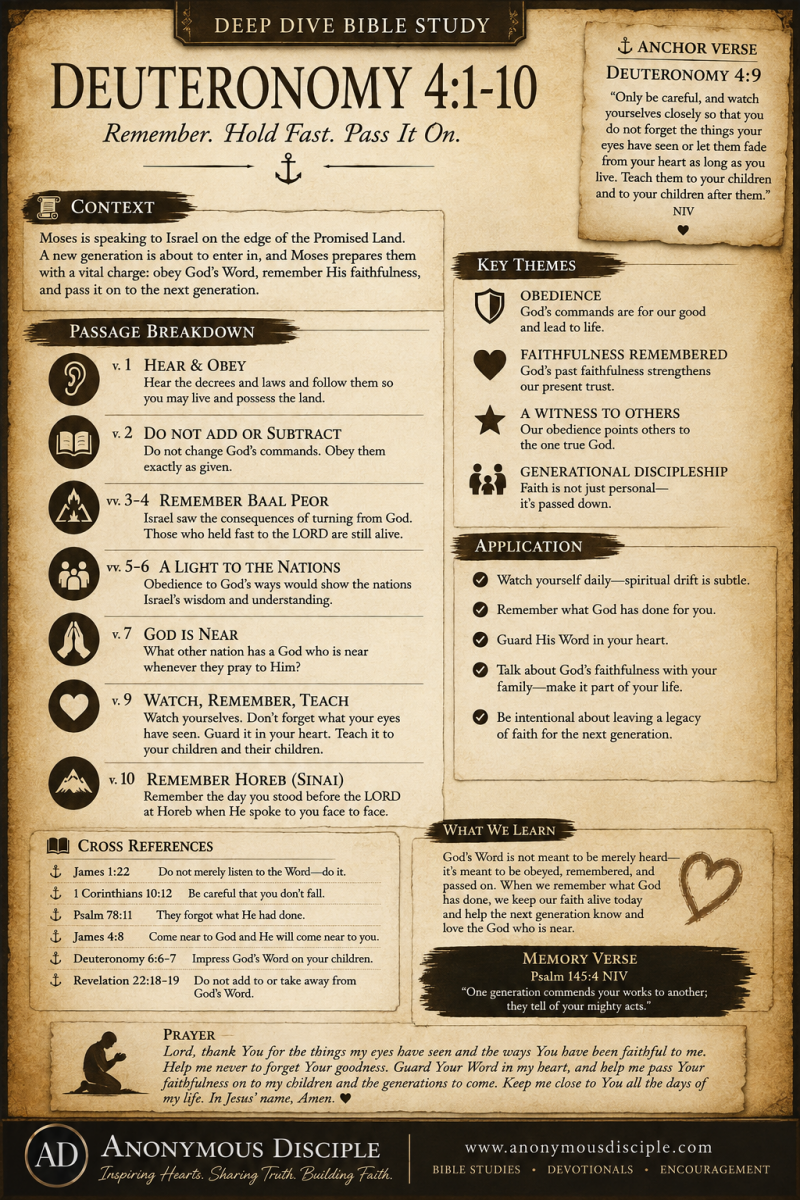
Moses is talking to the people of Israel right before they enter the Promised Land. He’s reminding them of everything God has already done and taught them. The main point is: Don’t forget what you’ve seen God do, keep it alive in your heart, and pass it on to your kids and grandkids.
Verse 9 ⚓️
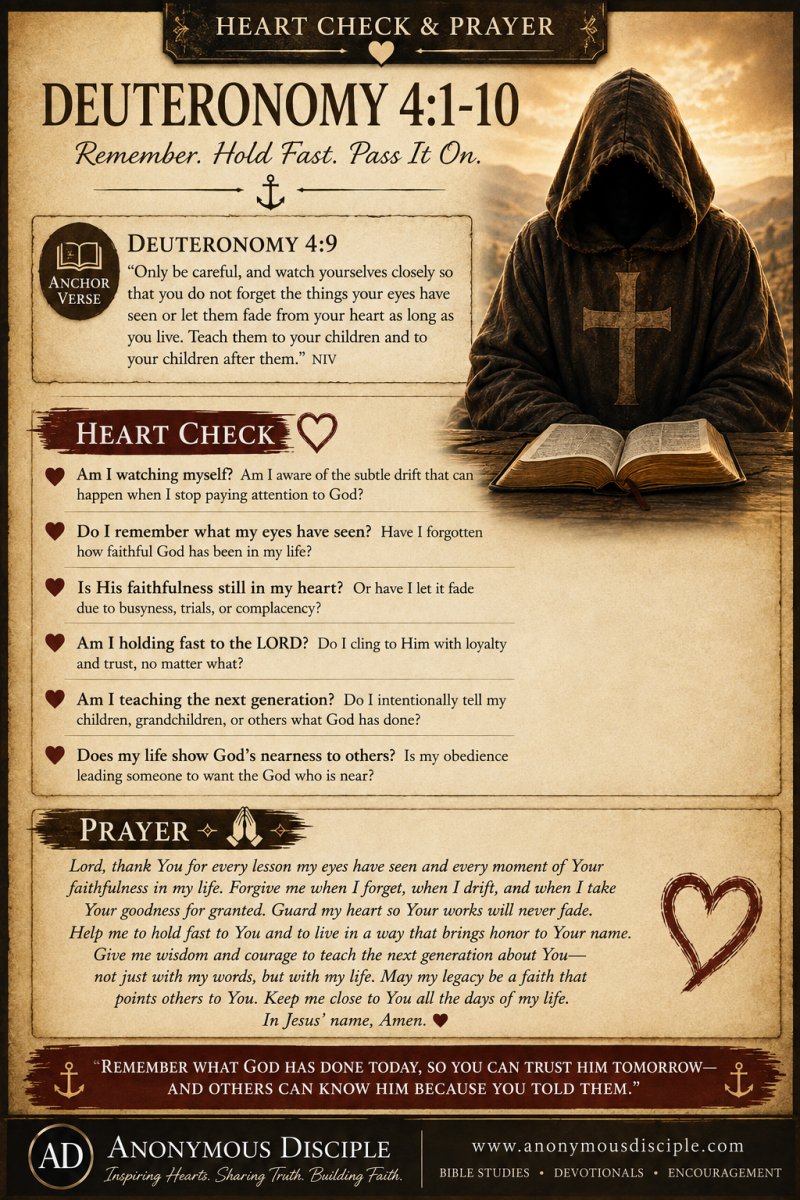
This is the key verse: “Only be careful, and watch yourselves closely so that you do not forget the things your eyes have seen or let them fade from your heart as long as you live. Teach them to your children and to their children after them.”
In everyday words: Be very careful with your own heart and mind. Don’t let the amazing things God has done for you slip away or grow cold. Keep those memories fresh and alive inside you your whole life. Then make sure you pass them on to your children and grandchildren.
Forgetting is dangerous. When people forget what God has done, their hearts grow cold, and they start drifting toward other things. So Moses says: Guard your memory of God’s works like it’s the most important treasure you have. And don’t keep it to yourself—teach the next generation so the truth doesn’t die with you.
Putting It Together
Verses 1–8 tell them what to do and why it matters. Verse 9 tells them how to keep it going: by carefully remembering and by teaching the next generation. Verse 10 gives the foundation of that memory—the day God Himself spoke to them at the mountain.
The heart of the passage is simple and serious: What God has shown you must not fade. Keep it living in your heart, and hand it carefully to those who come after you. That is how faith stays strong from one generation to the next.
Study Notes
📖 DEEP DIVE — Deuteronomy 4:1–10
⚓️ Anchor: Deuteronomy 4:9
Deuteronomy 4:9 (NIV)
“Only be careful, and watch yourselves closely so that you do not forget the things your eyes have seen or let them fade from your heart as long as you live. Teach them to your children and to their children after them.”
That verse almost gives us the outline:
WATCH YOURSELF → REMEMBER → KEEP IT IN YOUR HEART → TEACH IT FORWARD.
🏜️ 1. THE SETTING — A GENERATION STANDING AT THE BORDER
Verses 1–2 Moses says: Listen carefully to the laws and commands I’m teaching you. Do them so you can live and take the land God is giving you. Don’t add anything to God’s Word and don’t take anything away. Just keep what He said.
Deuteronomy records Moses addressing Israel shortly before they enter Canaan.
The generation that left Egypt has largely died in the wilderness. Moses himself will not enter the land.
So this is more than another sermon.
It is essentially an aging servant of God telling the next generation:
“Before you go forward, remember what God has already shown you.”
And notice where Moses begins:
Deuteronomy 4:1 (NIV)
“Now, Israel, hear the decrees and laws I am about to teach you. Follow them so that you may live and may go in and take possession of the land the LORD, the God of your ancestors, is giving you.”
There is a progression here:
👂 Hear.
📖 Learn.
🚶 Follow.
🌿 Live.
Biblically, hearing God's Word was never intended to stop at obtaining information.
Truth heard becomes truth obeyed.
Compare:
James 1:22 (NIV)
“Do not merely listen to the word, and so deceive yourselves. Do what it says.”
Thousands of years later, the principle remains.
📜 2. DON'T ALTER WHAT GOD HAS SAID
Deuteronomy 4:2 (NIV)
“Do not add to what I command you and do not subtract from it, but keep the commands of the LORD your God that I give you.”
That's a serious warning.
Israel wasn't given permission to reshape God's commands according to what was convenient, popular, or comfortable.
Don't add.
Don't subtract.
Obey what God actually said.
And Sherri, look where that idea eventually appears again:
Revelation 22:18–19 (NIV)
“If anyone adds anything to them, God will add to that person the plagues described in this scroll. And if anyone takes words away from this scroll of prophecy, God will take away from that person any share in the tree of life and in the Holy City…”
Genesis to Revelation, there is a consistent principle:
God's Word belongs to God.
Our responsibility isn't to improve it.
It's to faithfully receive it. 📖
⚠️ 3. REMEMBER BAAL PEOR
Verses 3–4 He reminds them of a hard lesson they already saw with their own eyes. At a place called Baal Peor, some of the people chased after a false god. God judged those who did that. But the ones who stayed faithful to the Lord were still alive. It’s a clear warning: stick with God.
Then Moses points backward.
Deuteronomy 4:3–4 (NIV)
“You saw with your own eyes what the LORD did at Baal Peor. The LORD your God destroyed from among you everyone who followed the Baal of Peor, but all of you who held fast to the LORD your God are still alive today.”
He's referring to Numbers 25:1–9.
Israel became entangled with Moabite women, participated in sacrifices to their gods, and joined in worship of Baal of Peor.
Moses essentially says:
You saw where abandoning God leads.
But I especially love the wording of verse 4:
“held fast to the LORD.”
The Hebrew verb is dabaq — to cling, stick, hold tightly.
It's the same basic word used in:
Genesis 2:24 (NIV)
“That is why a man leaves his father and mother and is united to his wife…”
There is an intimacy and loyalty in the word.
Don't merely acknowledge God.
Cling to Him. ❤️
🌎 4. GOD'S PEOPLE WERE SUPPOSED TO LOOK DIFFERENT
Verses 5–8 Moses says, “I’ve taught you God’s ways so you can live by them in the new land.” If they carefully obey, the other nations will notice and say, “What a wise and understanding people!” He points out two special blessings:
- No other nation has a God who is so near and listens when they pray.
- No other nation has laws as good and right as the ones God gave Israel.
Now Moses says something fascinating.
Deuteronomy 4:5–6 (NIV)
“Observe them carefully, for this will show your wisdom and understanding to the nations…”
Israel's obedience was supposed to become a witness.
Other nations were meant to look at them and recognize something different.
And then:
Deuteronomy 4:7 (NIV)
“What other nation is so great as to have their gods near them the way the LORD our God is near us whenever we pray to him?”
That's beautiful.
Israel's greatest treasure wasn't ultimately Canaan.
It wasn't military victory.
It wasn't prosperity.
It wasn't even the Law itself.
Their treasure was the God who was near them. ❤️
And that echoes wonderfully into the New Testament:
James 4:8 (NIV)
“Come near to God and he will come near to you.”
⚓️ 5. “ONLY BE CAREFUL…”
Verse 9 (the anchor) This is the key verse: “Only be careful, and watch yourselves closely so that you do not forget the things your eyes have seen or let them fade from your heart as long as you live. Teach them to your children and to their children after them.”
In everyday words: Be very careful with your own heart and mind. Don’t let the amazing things God has done for you slip away or grow cold. Keep those memories fresh and alive inside you your whole life. Then make sure you pass them on to your children and grandchildren.
Forgetting is dangerous. When people forget what God has done, their hearts grow cold, and they start drifting toward other things. So Moses says: Guard your memory of God’s works like it’s the most important treasure you have. And don’t keep it to yourself—teach the next generation so the truth doesn’t die with you.
Our anchor.
Deuteronomy 4:9 (NIV)
“Only be careful, and watch yourselves closely…”
Moses recognizes something about the human heart.
We drift.
Not necessarily through some dramatic decision to abandon God.
Sometimes it's much quieter.
We simply stop paying attention.
That's why Scripture repeatedly tells God's people to watch themselves.
1 Corinthians 10:12 (NIV)
“So, if you think you are standing firm, be careful that you don’t fall!”
Spiritual drift is often subtle.
Yesterday's dependence can become today's complacency.
Yesterday's gratitude can become today's expectation.
Yesterday's miracle can become today's forgotten memory.
Which leads to Moses' warning…
👀 6. “DO NOT FORGET THE THINGS YOUR EYES HAVE SEEN”
Israel had seen things.
Think about what these people collectively carried in their history.
🌊 The Red Sea divided.
🍞 Manna appearing.
🔥 God's presence in fire.
☁️ The cloud guiding them.
💧 Water from the rock.
⚡ Sinai trembling.
They had evidence of God's faithfulness everywhere behind them.
Yet Moses says:
Don't forget.
That's remarkable.
Because apparently it is possible to experience God's faithfulness…
…and eventually live as though it never happened.
Psalm 78 describes exactly this tragedy:
Psalm 78:11 (NIV)
“They forgot what he had done, the wonders he had shown them.”
That's one of the dangers Moses is trying to prevent.
❤️ 7. “OR LET THEM FADE FROM YOUR HEART”
This may be my favorite part.
Moses doesn't merely say:
Don't forget intellectually.
He says:
Don't let it leave your heart.
There is a difference between remembering that God did something…
and continuing to live in light of what God did.
We can remember the story while losing the wonder.
We can know the verse while losing the awe.
We can remember the miracle while forgetting what it taught us about the Miracle-Giver.
So biblical remembrance isn't nostalgia.
Remembrance keeps yesterday's faithfulness alive in today's faith.
❤️🔥
👩👧👦 8. “TEACH THEM TO YOUR CHILDREN…”
And then Moses turns remembrance into responsibility.
Deuteronomy 4:9 (NIV)
“…Teach them to your children and to their children after them.”
This is generational discipleship.
God's works weren't supposed to die with the generation that witnessed them.
Tell your children.
Then tell your grandchildren.
And shortly afterward Moses expands this beautifully:
Deuteronomy 6:6–7 (NIV)
“These commandments that I give you today are to be on your hearts. Impress them on your children…”
Faith was supposed to become part of the rhythm of ordinary life.
Talk about God.
Talk about what He has done.
Talk about His Word.
Talk about His faithfulness.
Not just at worship.
At home.
❤️📖
🔥 9. REMEMBER HOREB
Verse 10 Moses points back to one of the biggest moments they experienced: the day they stood at Mount Horeb (also called Sinai). God told Moses to gather the people so they could hear His words. The purpose was that they would learn to revere (deeply respect and fear) the Lord all their lives—and then teach their children to do the same.
Verse 10 finally tells us one particular memory Moses doesn't want Israel to lose.
Deuteronomy 4:10 (NIV)
“Remember the day you stood before the LORD your God at Horeb…”
That's Sinai.
And God said:
“…Assemble the people before me to hear my words so that they may learn to revere me as long as they live in the land and may teach them to their children.”
Look at that sequence:
God speaks → people hear → people fear/revere God → people teach the next generation.
And then the next generation does it again.
And again.
And again.
That is how testimony becomes legacy.
🧵 THE THREAD THROUGH DEUTERONOMY 4:1–10
I think the entire passage can almost be drawn like this:
God speaks
↓
👂 We listen
↓
🚶 We obey
↓
👀 We experience His faithfulness
↓
❤️ We remember
↓
🗣️ We tell the next generation
↓
👂 They hear
And the cycle begins again.
But if one generation forgets…
the chain can break.
That's why verse 9 carries so much weight.
⚓️ ANCHOR TRUTH — DEUTERONOMY 4:9
DON'T LET GOD'S FAITHFULNESS BECOME A FORGOTTEN STORY.
Remember what He has done.
Keep it in your heart.
Tell the people coming behind you.
Because your testimony isn't only about where you've been.
It may become part of how someone else learns who God is. ❤️
And there's something especially beautiful about Moses saying this.
He knows he isn't going with them.
His journey is nearly finished.
So what does he do?
He prepares the next generation to remember God after he's gone.
That makes Deuteronomy 4:9 not merely a verse about memory.
It's a verse about legacy. 🕊️
And I think that might be the heart of our study today:
⚓️ WATCH YOURSELF • REMEMBER HIS WORKS • GUARD THEM IN YOUR HEART • TEACH THEM FORWARD
Add comment
Comments