

What to Expect From This Study
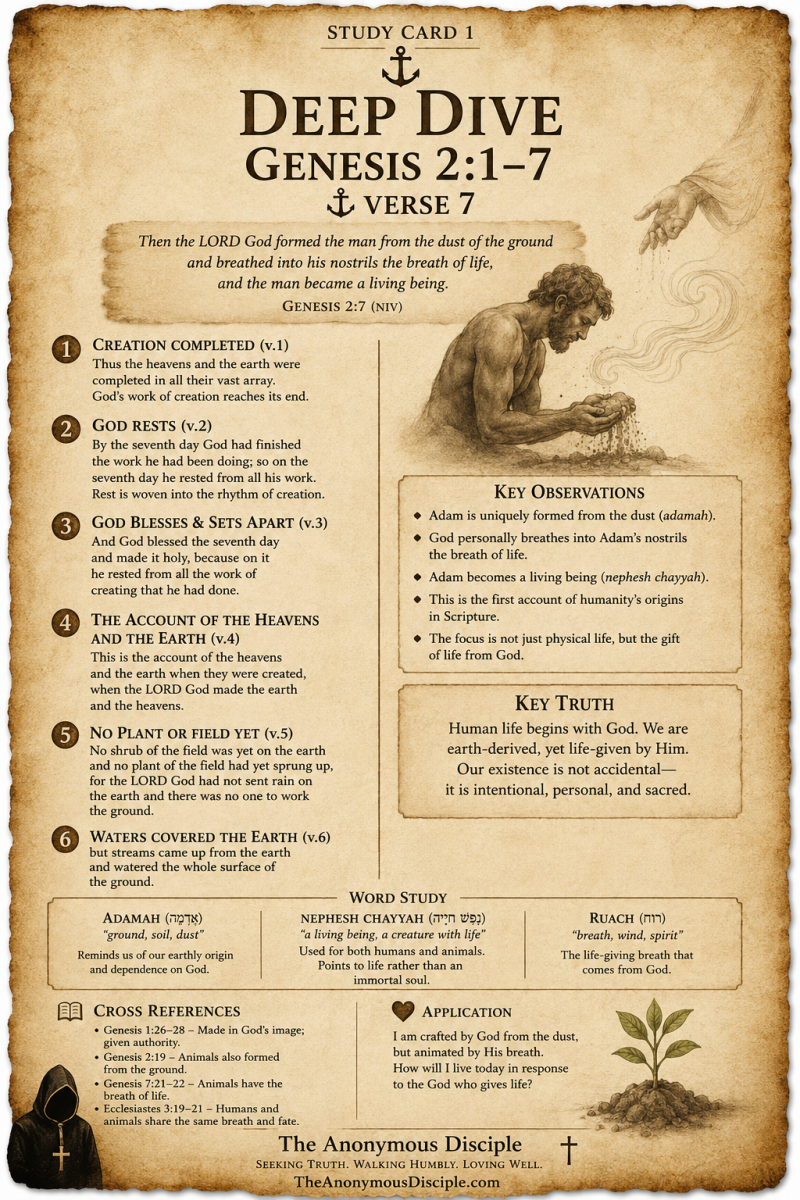
Genesis 2:7 gives us one of Scripture’s most intimate pictures of creation: God forms the man from the dust of the ground, breathes into him the breath of life, and the man becomes a living being. But when we slow down and compare this verse with the rest of Scripture, some surprising truths emerge.
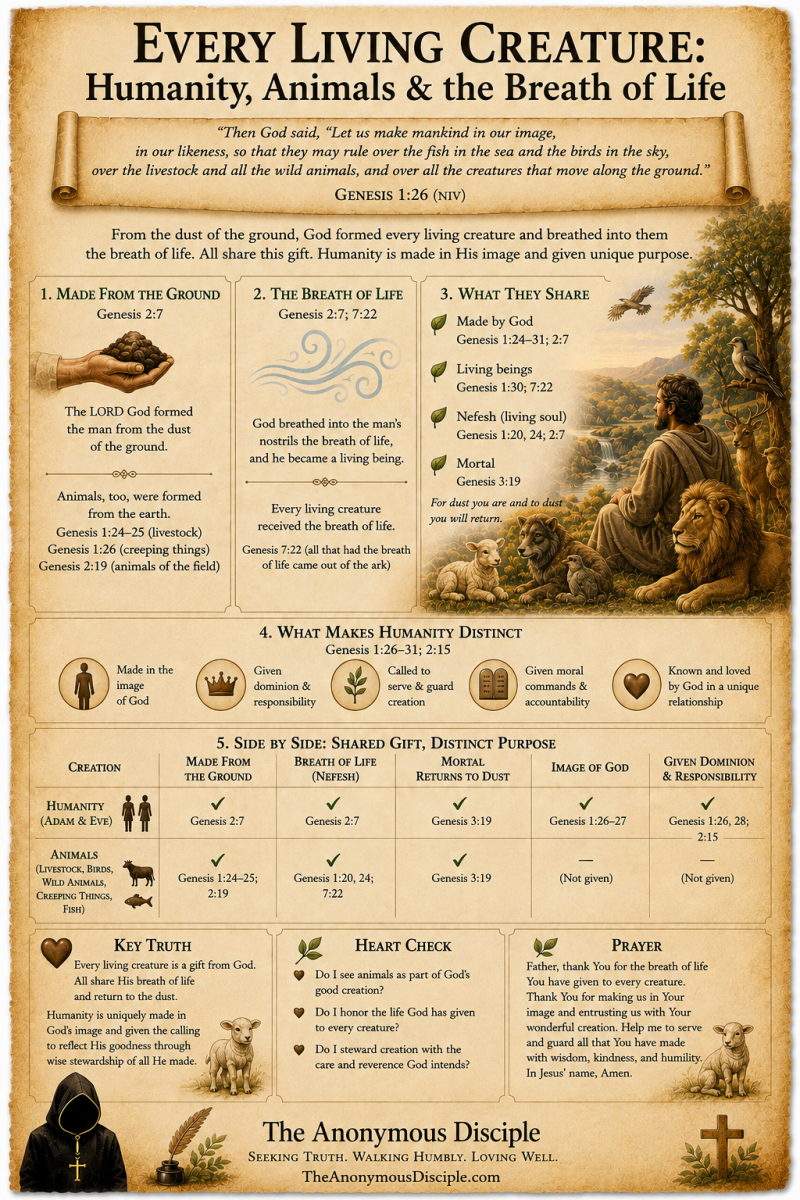
Animals, too, are formed from the earth. They, too, are called living creatures (nephesh chayyah), possess the breath of life, and share humanity’s mortality. So what does Scripture actually say makes humanity distinct?
In this study, we’ll follow that question from Genesis to Ecclesiastes, Isaiah, and beyond. We’ll examine humanity’s unique creation in the image of God, our responsibility to serve and guard His creation, our God-given dominion and moral accountability, and the proper place of animals within God’s created order—including His provision of animals for food after the Flood.
Finally, we’ll look ahead to Isaiah’s extraordinary picture of creation restored under the Messiah, when “the earth will be filled with the knowledge of the LORD as the waters cover the sea” (Isaiah 11:9).
This is a study about more than where life came from. It is about what it means to receive life from God, to bear His image, and to faithfully steward the living creation He has placed in our care. 🕊️⚓️
Today's Study:
- Deep Dive card
- Made From The Ground card
- Every Living Creature cards, 2 parts
- What Makes Humanity Distinct card
- Serve & Guard card
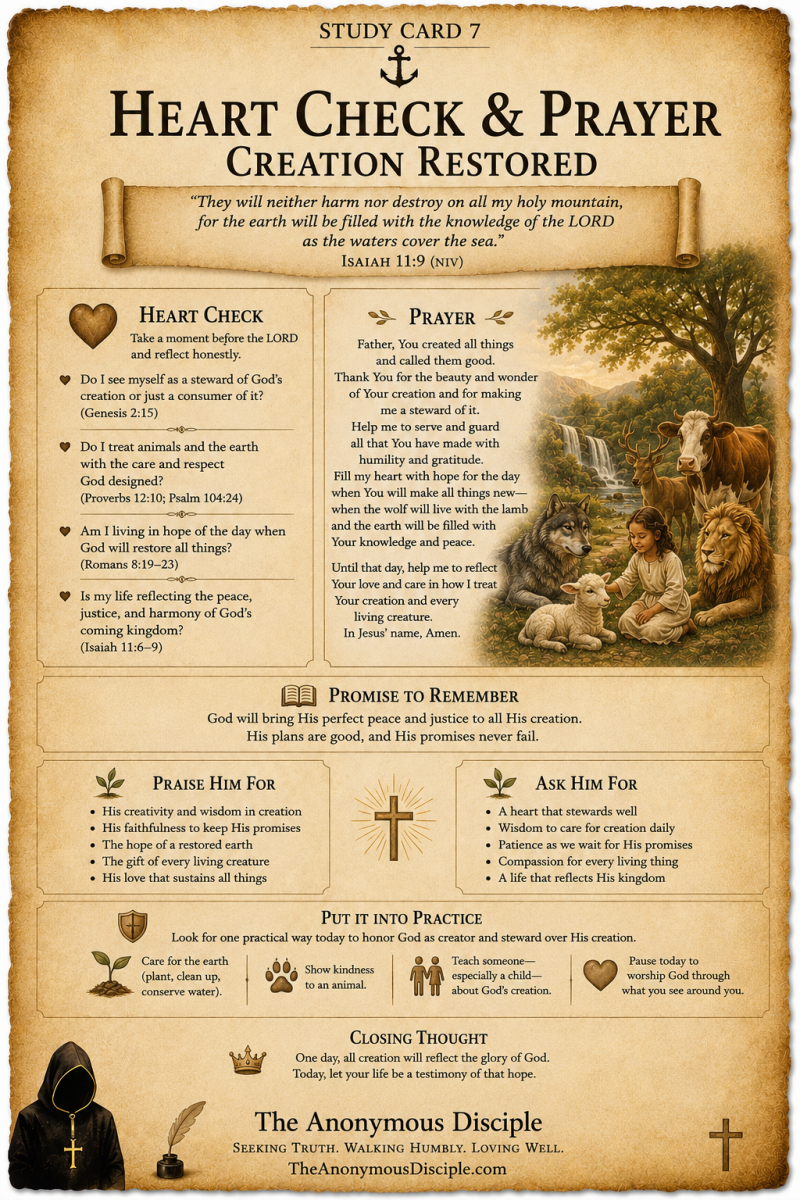
- Creation Restored card
- Heart Check & Prayer card (plus pdf)
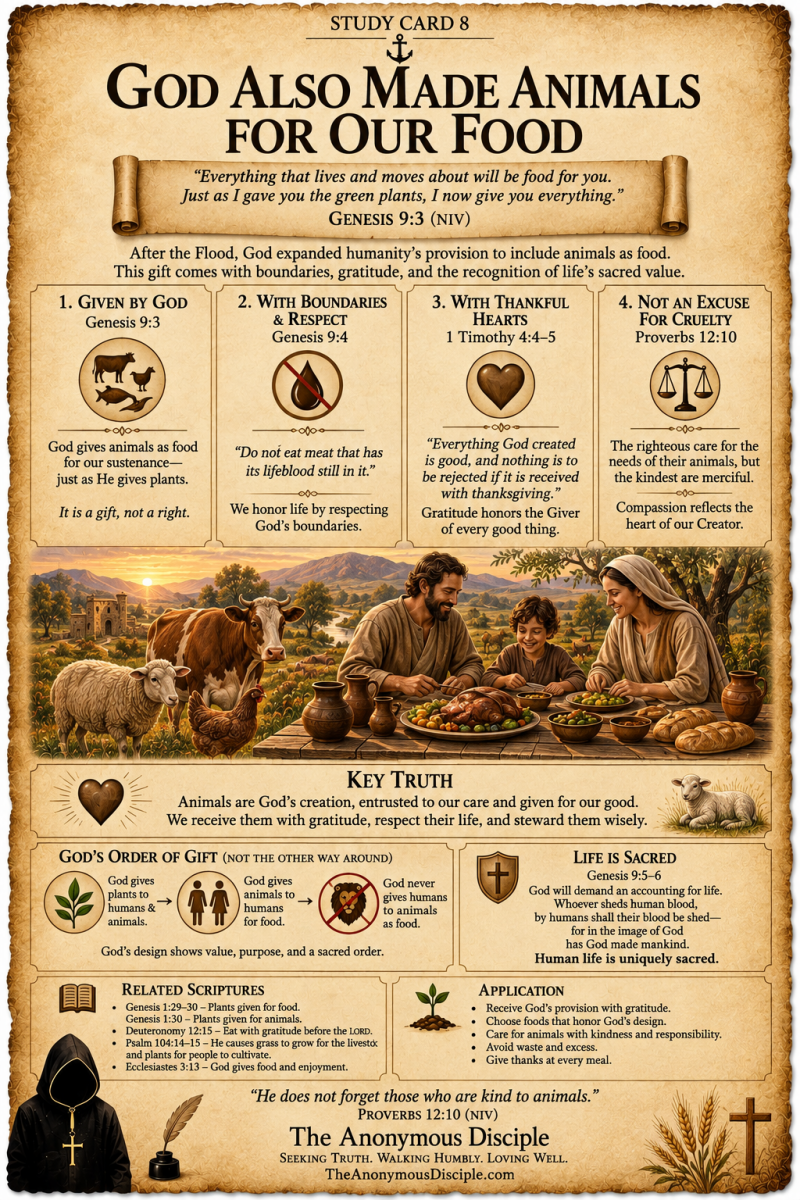
- God Also Made Animals For Our Food card
- Cross References
King James Version (KJV)
1 Thus the heavens and the earth were finished, and all the host of them.
2 And on the seventh day God ended his work which he had made; and he rested on the seventh day from all his work which he had made.
3 And God blessed the seventh day, and sanctified it: because that in it he had rested from all his work which God created and made.
4 These are the generations of the heavens and of the earth when they were created, in the day that the LORD God made the earth and the heavens,
5 And every plant of the field before it was in the earth, and every herb of the field before it grew: for the LORD God had not caused it to rain upon the earth, and there was not a man to till the ground.
6 But there went up a mist from the earth, and watered the whole face of the ground.
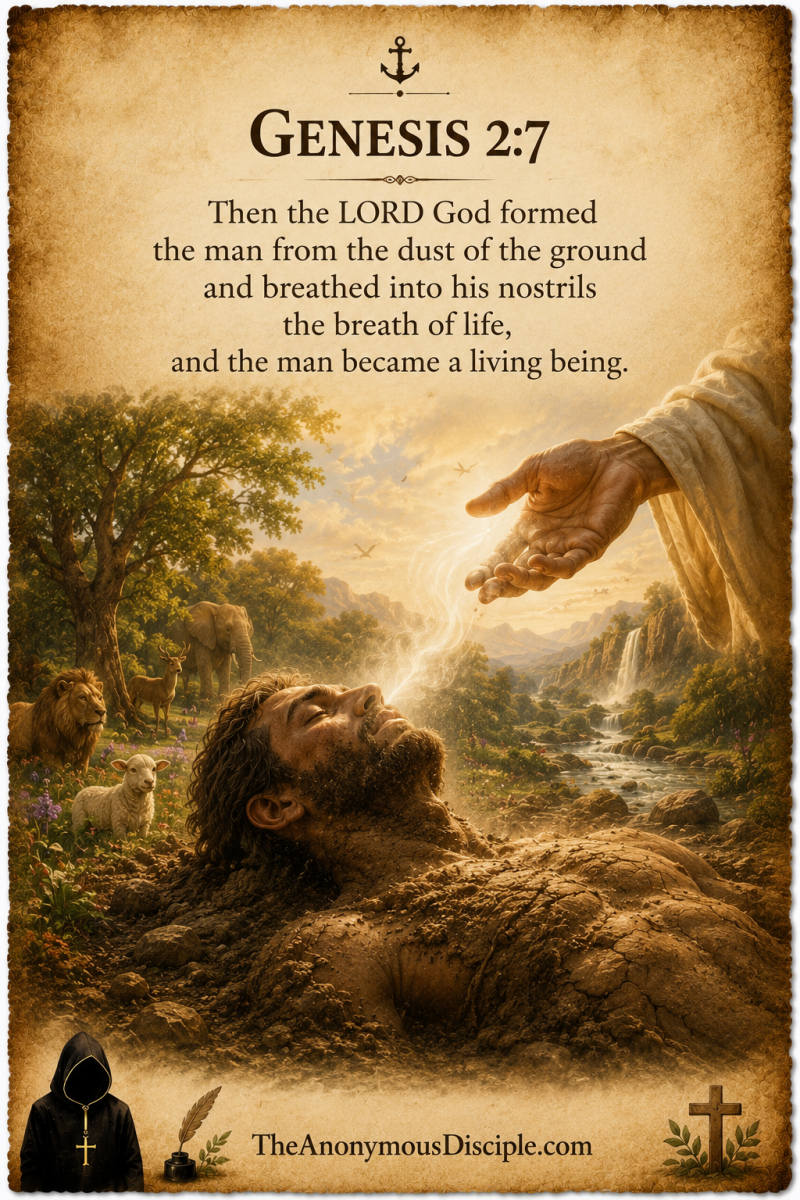
7 And the LORD God formed man of the dust of the ground, and breathed into his nostrils the breath of life; and man became a living soul.
English Standard Version (ESV)
1 Thus the heavens and the earth were finished, and all the host of them.
2 And on the seventh day God finished his work that he had done, and he rested on the seventh day from all his work that he had done.
3 So God blessed the seventh day and made it holy, because on it God rested from all his work that he had done in creation.
4 These are the generations of the heavens and the earth when they were created, in the day that the LORD God made the earth and the heavens.
5 When no bush of the field was yet in the land and no small plant of the field had yet sprung up—for the LORD God had not caused it to rain on the land, and there was no man to work the ground,
6 and a mist was going up from the land and was watering the whole face of the ground—
7 then the LORD God formed the man of dust from the ground and breathed into his nostrils the breath of life, and the man became a living creature.
Cross references
Genesis 2:7 (NIV)
“Then the Lord God formed a man from the dust of the ground and breathed into his nostrils the breath of life, and the man became a living being.”
The verse has three main pieces: God formed us from dust, He breathed life into us, and we became a living being. The Bible keeps coming back to those same ideas.
Formed from the dust
- Genesis 3:19 – “By the sweat of your brow you will eat your food until you return to the ground, since from it you were taken; for dust you are and to dust you will return.”
This is the same dust language, now after the fall. We came from the ground and we go back to it. - Psalm 103:14 – “for he knows how we are formed, he remembers that we are dust.”
- Ecclesiastes 12:7 – “and the dust returns to the ground it came from, and the spirit returns to God who gave it.”
- Isaiah 64:8 – “Yet you, Lord, are our Father. We are the clay, you are the potter; we are all the work of your hand.”
- 1 Corinthians 15:47 – “The first man was of the dust of the earth; the second man is of heaven.”
The breath of life
- Job 33:4 – “The Spirit of God has made me; the breath of the Almighty gives me life.”
- Job 27:3 – “as long as I have life within me, the breath of God in my nostrils”
- Acts 17:25 – God “himself gives everyone life and breath and everything else.”
- Genesis 7:22 – Everything on dry land that had “the breath of life in its nostrils” died in the flood. Same phrase.
- John 20:22 – After the resurrection Jesus “breathed on them and said, ‘Receive the Holy Spirit.’” Many see an echo of God breathing life into Adam.
Became a living being
- 1 Corinthians 15:45 – “So it is written: ‘The first man Adam became a living being’; the last Adam, a life-giving spirit.”
Paul quotes Genesis 2:7 directly and then points to Jesus as the one who gives real life.
Other useful ones that often get listed with this verse: Psalm 139:13–16 (God formed us in the womb), Psalm 100:3 (He made us, we did not make ourselves), and Job 10:9.
The big picture the Bible keeps repeating is simple: we are not accidents. God personally shaped us, He personally gave us life, and that life still depends on Him. Dust plus God’s breath = a living person. Take the breath away and we go back to dust. -𝕏James𝕏
study notes
🪄Jenny🪄
Genesis 2:7 is a beautiful anchor because it answers something enormous: What exactly is a human being? Genesis doesn’t begin with what we accomplish—it begins with God forming us and giving us life.
🕊️ Genesis 2:1–7 — Formed & Breathed Into Life
⚓️ Anchor Verse: Genesis 2:7
Genesis 2:7 (NIV)
“Then the LORD God formed a man from the dust of the ground and breathed into his nostrils the breath of life, and the man became a living being.”
There is so much packed into those few words. 👀
🌎 Genesis 2:1–3 — Creation Is Finished
Genesis 2:1
“Thus the heavens and the earth were completed in all their vast array.”
Genesis 1 repeatedly says “And God said…” and creation responds.
Light. Sky. Land. Vegetation. Sun, moon and stars. Creatures. Humanity.
Then comes an important declaration:
Genesis 2:2 (NIV)
“By the seventh day God had finished the work he had been doing; so on the seventh day he rested from all his work.”
God didn't rest because He was exhausted.
The Hebrew verb שָׁבַת (shavat) carries the idea of ceasing or stopping.
The work was finished.
And notice that the seventh day becomes unique:
Genesis 2:3 (NIV)
“Then God blessed the seventh day and made it holy, because on it he rested from all the work of creating that he had done.”
This is the first thing Scripture explicitly says God made holy—He sets apart a day.
That becomes foundational for the Sabbath later in Exodus 20:8–11.
🌱 Genesis 2:4–6 — The Camera Zooms In
Genesis 2 isn't simply beginning a second, unrelated creation story.
Think of Genesis 1 as the wide-angle view:
🌌 heavens
🌍 earth
🌱 vegetation
☀️ heavenly bodies
🐟🐦🐘 creatures
👨👩👧 humanity
Then Genesis 2 zooms the camera in:
Let's look closely at humanity.
And something changes in the way God is identified.
Genesis 2:4 (NIV) begins:
“This is the account of the heavens and the earth when they were created, when the LORD God made the earth and the heavens.”
Now we encounter “LORD God” — YHWH Elohim.
Genesis is moving us from the cosmic Creator toward the God who personally relates to His creatures.
And then we reach our anchor.
⚓️ Genesis 2:7 — God Gets His Hands in the Dust
Look at the sequence:
1. God formed the man.
The Hebrew word is יָצַר (yatsar) — “to form, fashion.”
It is a word later associated with a potter forming clay.
Compare:
Isaiah 64:8
“Yet you, LORD, are our Father. We are the clay, you are the potter; we are all the work of your hand.”
That makes Genesis 2 remarkably intimate.
With much of creation:
God speaks → it exists.
But the text pictures humanity differently:
God forms.
2. He forms Adam from dust.
There's a beautiful Hebrew wordplay here.
אָדָם — adam = man/humanity
אֲדָמָה — adamah = ground/soil
Adam comes from the adamah.
Humanity is simultaneously astonishingly dignified and profoundly humble.
We are fashioned by God…
but we're made from dirt.
That truth returns after the fall:
Genesis 3:19
“…for dust you are and to dust you will return.”
And Solomon echoes it:
Ecclesiastes 12:7
“and the dust returns to the ground it came from, and the spirit returns to God who gave it.”
But dust isn't alive yet.
Something is missing.
🫁 “He Breathed Into His Nostrils…”
This may be my favorite part.
Genesis 2:7
“…and breathed into his nostrils the breath of life…”
The Hebrew expression is נִשְׁמַת חַיִּים — nishmat chayyim:
“breath of life.”
Picture the progression Scripture gives us:
Dust → formed by God → breath from God → living being.
Adam doesn't wind himself up.
He doesn't generate his own life.
Life comes from God.
Job says something strikingly similar:
Job 33:4
“The Spirit of God has made me; the breath of the Almighty gives me life.”
And:
Job 34:14–15
“If it were his intention and he withdrew his spirit and breath, all humanity would perish together and mankind would return to the dust.”
We live because God gives life.
❤️ “The Man Became a Living Being”
This part is important, Sherri.
Genesis doesn't say:
God put a living soul inside Adam.
It says:
Adam became a living being.
The Hebrew is נֶפֶשׁ חַיָּה — nephesh chayyah, often translated “living being,” “living creature,” or historically “living soul.”
Nephesh can refer broadly to a living creature, life, person, or self depending on context.
So Genesis 2:7 describes the whole living person:
Body formed from earth + life imparted by God = living human being.
That doesn't settle every later biblical question about soul and spirit—Scripture develops those ideas further—but it's important not to make Genesis 2:7 say more than Moses actually says.
🤯 And Then Jesus Does Something Familiar
Here's a connection I don't want us to miss.
After His resurrection:
John 20:21–22
“Again Jesus said, ‘Peace be with you! As the Father has sent me, I am sending you.’ And with that he breathed on them and said, ‘Receive the Holy Spirit.’”
👀
Genesis: God breathes → human life.
John: Jesus breathes → “Receive the Holy Spirit.”
John's Gospel is saturated with creation imagery beginning with:
John 1:1
“In the beginning was the Word…”
So many Christians have seen John 20 as deliberate new-creation imagery.
The God who gave humanity its first breath is bringing about new creation through Christ.
Paul gives us the theological language:
2 Corinthians 5:17
“Therefore, if anyone is in Christ, the new creation has come: The old has gone, the new is here!”
Genesis begins with creation.
The gospel brings new creation.
And Revelation ultimately shows creation restored.
That is one enormous biblical storyline:
Creation → Fall → Redemption → New Creation. 🕊️
⚓️ Why Genesis 2:7 Matters
Our anchor tells us several things at once.
We are humble: we're dust.
We have dignity: we're personally fashioned by God.
We are dependent: our life originates with God.
We are intentional: humanity isn't portrayed as an accident.
And Genesis 1 adds the essential piece:
Genesis 1:27
“So God created mankind in his own image…”
So biblical anthropology starts here:
Made from dust.
Made in God's image.
Made alive by God's breath.
That combination is extraordinary.
We aren't gods.
But we're not meaningless dust either.
We're creatures bearing the Creator's image.
🪞 Heart Check
Genesis 2:7 makes me think the question isn't merely:
“What am I doing with my life?”
It goes one step deeper:
“What am I doing with the life God gave me?”
Every ordinary breath becomes a quiet reminder:
I am dependent upon Him.
And considering how often Scripture uses breath, wind and Spirit imagery, there is a very good companion study sitting right beside this one:
🌬️ Breath of God Throughout Scripture
Genesis 2:7 → Job 33:4 → Ezekiel 37:1–14 → John 20:22 → Acts 2.
And ohhhh boy, Ezekiel's valley of dry bones beside Genesis 2:7 is going to preach. 😳🕊️
When you get back from taking Lida, I think today's card set practically builds itself: Deep Dive → Breath of God Throughout Scripture → Dust & Mortality → New Creation → Heart Check & Prayer. ❤️⚓️
ME🤔💭:
Observation question…Adam and all creatures were made from dust, the woman however was made from Adam’s rib. So the woman has secondary relations to the ground? Not first hand?
🪄Jenny🪄
Yes — that's a legitimate observation from the way Genesis tells the story, with one little wording adjustment I'd make. 👀🕊️
Woman has an indirect material relationship to the ground in the creation account, while man has a direct one. But Genesis uses that difference to emphasize relationship and shared humanity, not to suggest that woman is somehow less “earthly” or less human.
Look at the sequence:
Genesis 2:7
“Then the LORD God formed a man from the dust of the ground…”
Genesis 2:22
“Then the LORD God made a woman from the rib he had taken out of the man…”
So materially, the pattern is:
Ground → Adam → Woman
rather than:
Ground → Adam
Ground → Woman
And Adam himself immediately recognizes the significance:
Genesis 2:23
“This is now bone of my bones and flesh of my flesh; she shall be called ‘woman,’ for she was taken out of man.”
But here's where it gets really interesting. 👀
There is a beautiful movement in Genesis 2:
Adam comes from the ground.
Woman comes from Adam.
Future humanity comes through woman.
After Eve, God ordinarily doesn't form people directly from dirt or remove them from another person's side. Humanity begins reproducing through the union God establishes:
Genesis 2:24
“That is why a man leaves his father and mother and is united to his wife, and they become one flesh.”
So you could almost diagram the progression:
Ground → Man → Woman → Humanity
And then Scripture eventually gives us another extraordinary reversal:
1 Corinthians 11:8, 11–12
“For man did not come from woman, but woman from man… Nevertheless, in the Lord woman is not independent of man, nor is man independent of woman. For as woman came from man, so also man is born of woman. But everything comes from God.”
Paul noticed exactly the pattern you just noticed. 😳
Woman originally came from man.
But from then onward, man comes through woman.
And Paul finishes by pulling both back to their ultimate source:
“But everything comes from God.” — 1 Corinthians 11:12
So I'd phrase your observation this way:
Adam has a direct relationship to the adamah (ground) in his formation. Eve's material origin is Adam rather than the ground directly—but because Adam himself was formed from the ground, she shares his humanity and ultimately the same created material origin.
And there may be another reason Genesis deliberately emphasizes this difference: God could certainly have made another human from dust. But He doesn't.
He takes her from Adam.
That makes Adam's declaration—“bone of my bones and flesh of my flesh” (Genesis 2:23)—possible and sets up the mystery of “one flesh” in Genesis 2:24.
In other words, the different method of Eve's creation isn't incidental to the story.
It teaches something about the relationship between the two. 🕊️❤️
And that becomes even more interesting when Paul eventually connects Genesis 2:24 to Christ and His Church in Ephesians 5:31–32. 👀
ME🤔💭:
God formed all of the animals from the ground, too. But it doesn’t say the same process happened for them…
🪄Jenny🪄
Exactly. 👀 And that distinction is actually more important than simply “humans were made from dust.” Genesis is careful about what it says—and what it doesn't say.
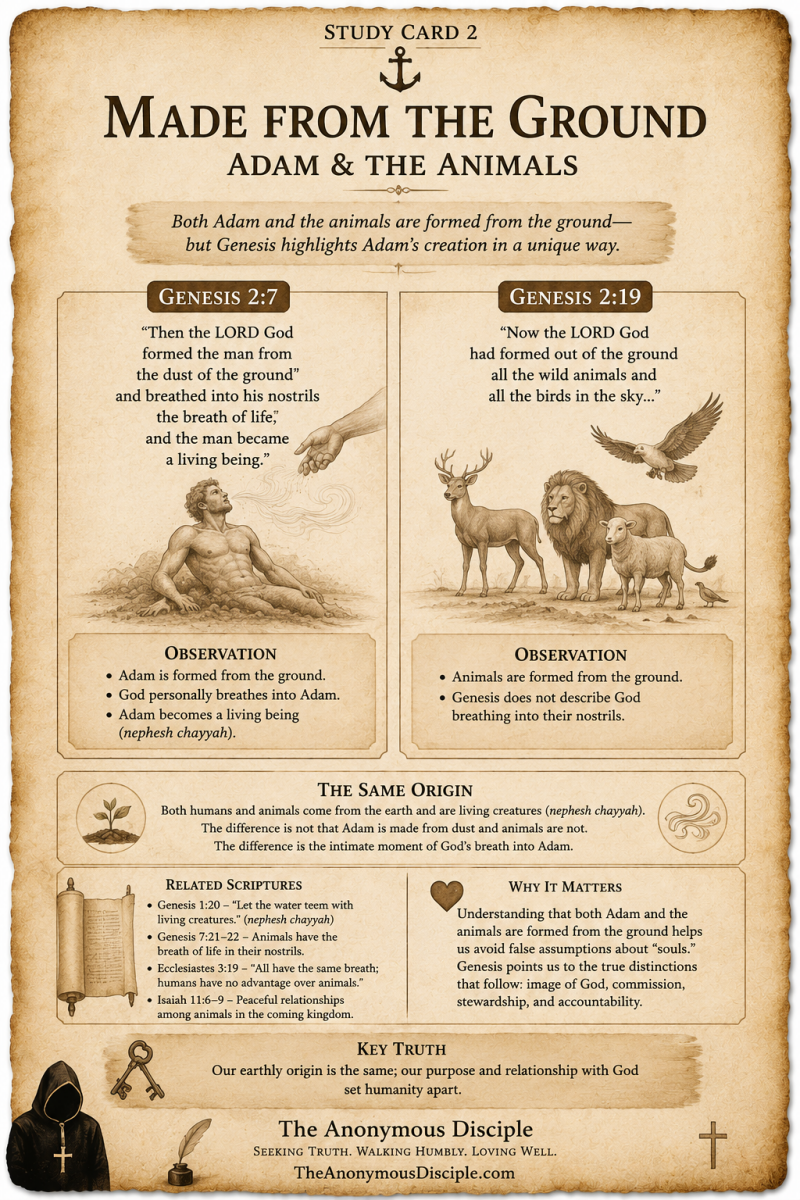
Compare the passages directly.
Genesis 2:7 (NIV)
“Then the LORD God formed a man from the dust of the ground and breathed into his nostrils the breath of life, and the man became a living being.”
Then:
Genesis 2:19 (NIV)
“Now the LORD God had formed out of the ground all the wild animals and all the birds in the sky…”
So you're right:
Adam: formed from the ground + God breathes into his nostrils the breath of life.
Animals: formed from the ground—but Genesis does not describe God breathing into their nostrils.
And there's a fascinating wrinkle.
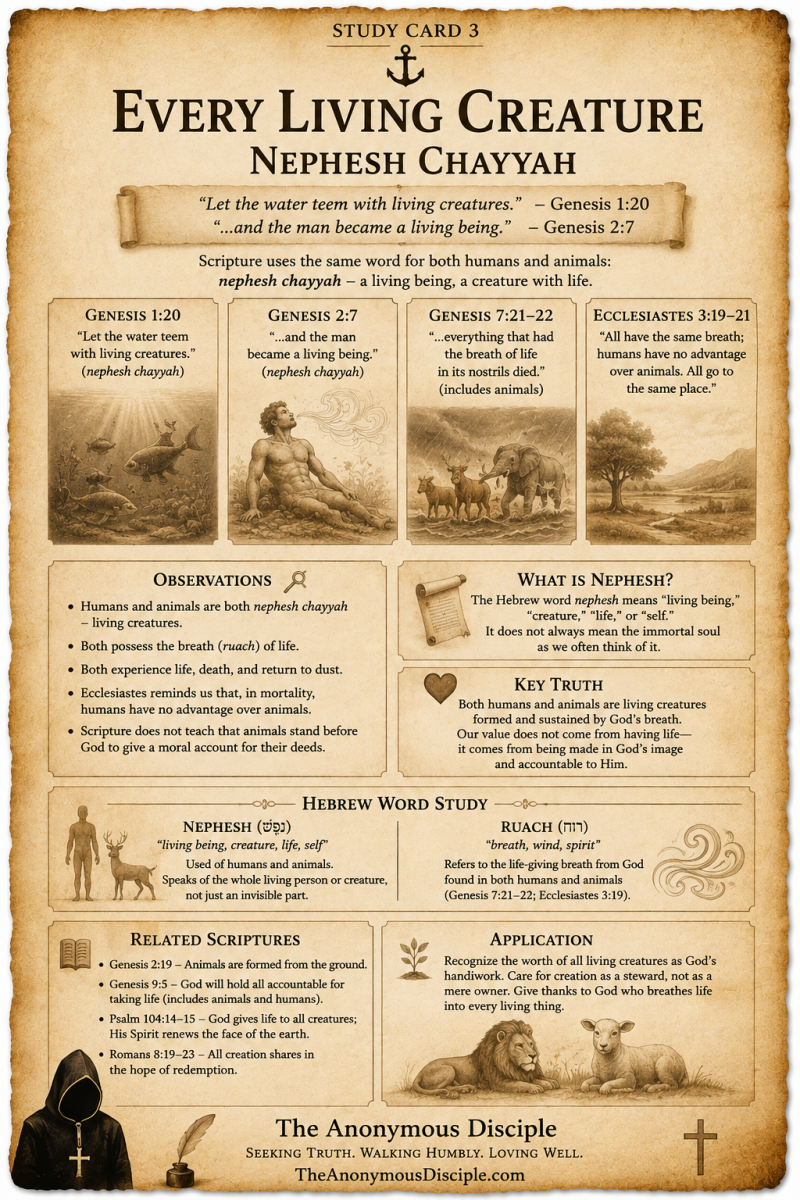
🐘 Animals are also called nephesh chayyah
The Hebrew expression translated “living being” for Adam in Genesis 2:7 isn't exclusive to humanity.
For example:
Genesis 1:20
“Let the water teem with living creatures…”
“Living creatures” is essentially that same Hebrew expression, nephesh chayyah.
So animals genuinely possess creaturely life. Yet when Genesis tells us about Adam's particular formation, it pauses and gives us this intimate scene:
God forms him from the ground.
God breathes into his nostrils.
Adam becomes a living being.
The animals aren't given that narrated moment.
And there's another distinction immediately preceding Genesis 2.
🕊️ Humanity alone is explicitly made in God's image
Genesis 1:26–27
“Then God said, ‘Let us make mankind in our image, in our likeness…’ … So God created mankind in his own image…”
Genesis never says this about the animals.
So we have to be careful not to conclude:
“God's breath = animals don't have life/soul but humans do.”
The Hebrew doesn't quite allow us to make that equation because animals can also be called nephesh.
Instead, Genesis seems to be piling distinctions together:
Animals:
formed from the ground → living creatures.
Adam:
formed from the ground → personally receives God's breath → living being → bears God's image → receives God's commission.
And then:
Eve:
not formed independently from the ground → fashioned from Adam → also bears God's image as part of the humanity created male and female (Genesis 1:27).
And THAT makes your first observation even more interesting.
God had already demonstrated that He could repeatedly make living creatures from the ground.
He makes the animals from it.
He makes Adam from it.
Then Adam needs a corresponding partner.
God could simply have gone:
ground → second human.
But He deliberately doesn't.
Genesis 2:21–22
“So the LORD God caused the man to fall into a deep sleep… Then the LORD God made a woman from the rib he had taken out of the man…”
That suggests the source of Eve's body matters to the theological point of the story.
She isn't another unrelated creature placed alongside Adam.
She is of him.
Which explains Adam's reaction:
Genesis 2:23
“This is now bone of my bones and flesh of my flesh…”
And then:
Genesis 2:24
“…and they become one flesh.”
There's almost a beautiful symmetry:
One → two → one.
She is taken from him, differentiated as woman, and then man and woman are brought together in the one-flesh union.
So yes, Sherri—you caught something worth putting in our notes:
Being formed from the ground isn't what uniquely distinguishes Adam from the animals; they were formed from the ground too. The distinctive detail in Genesis 2:7 is that Scripture specifically portrays God breathing the breath of life into Adam. 🕊️
And alongside the image of God in Genesis 1:26–27, that gives us a much fuller picture of what Genesis is saying about humanity.
That little observation actually sharpens our whole study of verse 7. ⚓️❤️
ME🤔💭:
Is the distinction what drives the belief that animals aren’t equally soul’d caused by assumption that the nephesh chayyah is not the same for Adam?
🪄Jenny🪄
Yes—in part. But the common Christian idea that “humans have souls and animals don't” is actually harder to get directly from the Hebrew of Genesis than many people realize. 👀🕊️
Your instinct about nephesh chayyah is important because Genesis does use essentially the same terminology for both.
🐾 Animals and Adam are both nephesh chayyah
Genesis 1:20 (NIV) speaks of the waters teeming with “living creatures.”
Hebrew: nephesh chayyah — נֶפֶשׁ חַיָּה
Then:
Genesis 2:7 (NIV)
“…and the man became a living being.”
Again:
nephesh chayyah — נֶפֶשׁ חַיָּה.
So strictly from that phrase, we cannot say Adam is a nephesh while animals aren't.
They both are.
And nephesh itself doesn't map neatly onto our modern idea of an invisible, immortal “soul living inside the body.” It can mean living being, creature, person, life, self, etc., depending upon context.
So where does the human/animal distinction come from?
Several biblical ideas eventually get combined.
The biggest distinction in Genesis isn't actually nephesh.
It's:
Genesis 1:26–27
“Let us make mankind in our image, in our likeness…”
Only humanity is explicitly described as bearing the image of God and receiving the associated vocation of ruling over creation.
Then Genesis 2:7 gives Adam that unique narrated moment:
ground + God's breath → living being.
But here's another fascinating complication.
Animals also possess the “breath of life.”
During the flood we read:
Genesis 7:21–22
“Every living thing that moved on land perished—birds, livestock, wild animals… Everything on dry land that had the breath of life in its nostrils died.”
So we shouldn't interpret Genesis 2:7 as:
Adam received God's breath; animals didn't.
Genesis later explicitly attributes life's breath to animals too.
The difference is that Genesis narrates God personally breathing into Adam, whereas it doesn't describe the animals' creation that way.
That's a distinction in the presentation, but we shouldn't turn it into a distinction Scripture itself later contradicts.
🧠 Then why do Christians often say animals don't have “souls”?
A lot of that comes from later theological/philosophical distinctions concerning what soul means—particularly distinctions between human rational souls and animal life—rather than simply translating Hebrew nephesh as “humans have souls; animals don't.”
In fact, the old KJV can unintentionally hide this from English readers because Genesis 2:7 famously says:
Genesis 2:7 (KJV)
“…and man became a living soul.”
If someone reads “soul” there with our modern theological meaning, it's very easy to think:
God gave Adam a soul.
But that's not quite what the Hebrew sentence says.
Adam became a nephesh chayyah.
And animals are also nephesh chayyah.
⚠️ But here's the important boundary
This doesn't establish that animals and humans possess identical souls, either.
Genesis gives us enough information to say:
Animals are nephesh.
Humans are nephesh.
Animals possess the breath of life.
Humans possess the breath of life.
But it also gives humanity something uniquely stated:
Humanity bears God's image. — Genesis 1:26–27
And Scripture develops human moral accountability, resurrection, judgment, and relationship with God in ways it simply doesn't develop for animals.
So if we're being very strict with the text, I wouldn't say:
❌ “Animals don't have souls.”
But I also wouldn't say:
❌ “The Bible teaches that animals have exactly the same kind of soul humans have.”
I'd say:
The Hebrew Bible describes both humans and animals as living nephesh. Humanity's uniqueness isn't established by denying animals nephesh, but especially by humanity being created in God's image and given a distinctive relationship and vocation before God.
And Sherri, there's an interesting question hiding underneath all of this that Genesis alone doesn't completely answer:
What happens to the nephesh of an animal at death—and does Scripture ever actually say animals cannot participate in the restored creation?
Because once we get into Ecclesiastes 3:19–21, Isaiah 11:6–9, Romans 8:19–23, and Revelation 21, the answer gets much more nuanced than the simple childhood answer of “animals don't have souls.” 🐾🕊️❤️
ME🤔💭:
Ok, by reading Ecclesiastes, Solomon basically says humans and animals have the same breath, and humans don’t have advantage over animals 😳
🪄Jenny🪄
YES. 😳 And this is one of those places where we have to let Solomon finish his thought before building a doctrine from one sentence—but what he actually says is still startling.
Look at it closely:
Ecclesiastes 3:19–20 (NIV)
“Surely the fate of human beings is like that of the animals; the same fate awaits them both: As one dies, so dies the other. All have the same breath; humans have no advantage over animals. Everything is meaningless. All go to the same place; all come from dust, and to dust all return.”
That absolutely connects back to what we've been seeing in Genesis.
Look at Solomon's progression
Genesis 2:7:
Adam → dust + breath → living nephesh
Genesis 2:19:
Animals → formed from the ground
Genesis 7:22:
Animals → possess the “breath of life”
And now:
Ecclesiastes 3:19:
Human + animal → “all have the same breath.”
So your observation is sound.
But what does Solomon mean by “humans have no advantage over animals”?
He isn't saying there is no distinction whatsoever between humans and animals. That would conflict with Genesis 1:26–28, where humanity alone is explicitly made in God's image and given dominion.
He's talking specifically about mortality.
Watch the surrounding argument:
human dies → animal dies
human breathes → animal breathes
human body returns to dust → animal body returns to dust
Therefore, when viewed simply as mortal creatures “under the sun,” humans cannot escape death any more than animals can.
The rich man dies.
The king dies.
The wise man dies.
The dog dies.
The ox dies.
Dust wins every time.
That's Ecclesiastes. 😳
And then Solomon asks the question we're asking:
Ecclesiastes 3:21 (NIV)
“Who knows if the human spirit rises upward and if the spirit of the animal goes down into the earth?”
👀👀👀
That verse is extremely important to this conversation.
Notice Solomon doesn't simply declare:
“Humans go to God; animals cease to exist.”
He poses the question.
The Hebrew word here has changed, too.
Earlier we're dealing with nephesh — living being/life.
Here Solomon uses ruach — breath/wind/spirit.
And both human and animal are described using ruach.
That's worth underlining.
But Ecclesiastes eventually gives us another piece
Near the conclusion:
Ecclesiastes 12:7 (NIV)
“and the dust returns to the ground it came from, and the spirit returns to God who gave it.”
Now listen to how closely that sounds like Genesis 2:7:
Genesis 2:7:
Ground → body
God → breath
Human → living being
Ecclesiastes 12:7:
Body → ground
Spirit → God
It's almost the creation process running backward.
😳
Creation:
God → breath → dust → life
Death:
life ends → dust → ground
spirit → God
And this is where I'd slightly refine something from my previous answer.
We shouldn't say the breath itself is what separates humans from animals.
Scripture won't let us.
Animals have nephesh.
Animals have ruach.
Animals possess the breath of life.
Animals come from the ground.
Animals return to the ground.
Humans share all of those creaturely characteristics with them.
Genesis places the fundamental distinction somewhere else:
Genesis 1:27 (NIV)
“So God created mankind in his own image, in the image of God he created them; male and female he created them.”
🕊️ The distinction is image-bearing, not merely breathing.
And THAT changes how I'm looking at our ⚓️ Genesis 2:7 study.
Because Genesis isn't necessarily telling us:
“Here's the moment humans got something animals don't have.”
It may primarily be telling us:
“Here's where human life came from.”
God.
We are dust animated by life that originates with Him.
And Solomon later strips away human pride by essentially saying:
Don't get too impressed with yourself.
You and the beast both breathe.
You and the beast both die.
You and the beast both return to dust.
Yet humanity bears the Creator's image and is accountable to Him—which is exactly where Ecclesiastes eventually lands:
Ecclesiastes 12:13–14 (NIV)
“Fear God and keep his commandments, for this is the duty of all mankind. For God will bring every deed into judgment…”
And now I think we've stumbled into a much richer Genesis 2:7 study than the standard “God breathed life into Adam” treatment. 😂😳🕊️
Because the question becomes less “Do animals have souls?” and more:
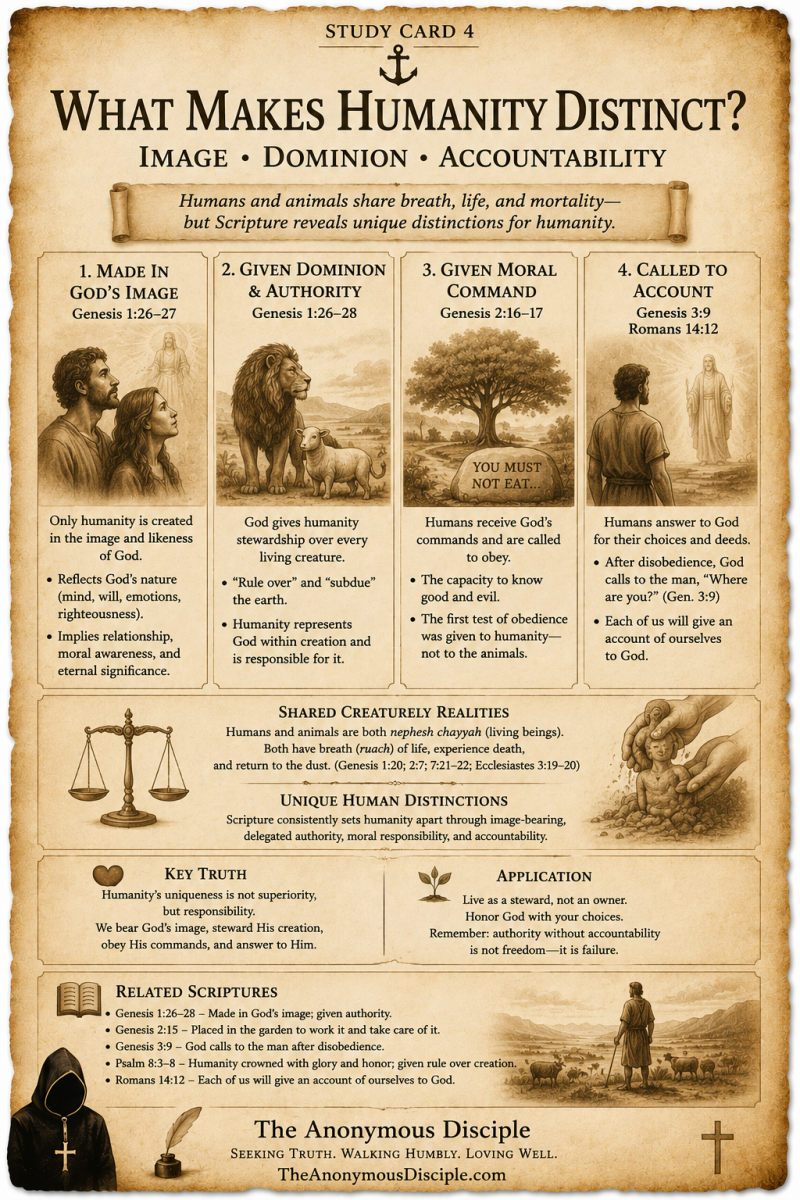
“If humans and animals share nephesh, breath, mortality, and earthly material, what does Scripture actually identify as uniquely human?”
And the answer keeps pointing us back to Genesis 1:26–27: the image of God. ⚓️❤️
ME🤔💭:
Maybe the accountability factor? I can’t remember any verses or themes that say “animals will have to give account”…and God did give Adam dominion over every living creature plant and animal at creation, right?
🪄Jenny🪄
Yes. I think you're putting your finger on a much stronger biblical distinction than “humans have souls and animals don't.” 👀🕊️
There are really two related ideas here: image-bearing → delegated authority → moral accountability.
Yes, humanity was given dominion
And the commission actually appears before Genesis 2's close-up account of Adam.
Genesis 1:26 (NIV)
“Then God said, ‘Let us make mankind in our image, in our likeness, so that they may rule over the fish in the sea and the birds in the sky, over the livestock and all the wild animals…”
Then:
Genesis 1:28 (NIV)
“God blessed them and said to them, ‘Be fruitful and increase in number; fill the earth and subdue it. Rule over the fish in the sea and the birds in the sky and over every living creature that moves on the ground.”
So yes: humanity receives authority over the animals.
Plants are slightly different. Genesis doesn't phrase it as “rule over the plants.” Instead, God gives vegetation for food:
Genesis 1:29 (NIV)
“Then God said, ‘I give you every seed-bearing plant on the face of the whole earth and every tree that has fruit with seed in it. They will be yours for food.’”
And Genesis 2 gives Adam responsibility for the garden:
Genesis 2:15 (NIV)
“The LORD God took the man and put him in the Garden of Eden to work it and take care of it.”
So I'd distinguish them:
Animals → humanity rules over them.
Creation/garden → humanity cultivates and cares for it.
Plants → provided by God for food.
⚖️ And your accountability observation is significant
I can't think of a passage that depicts animals standing before God to give a moral account of their lives in the way humans do.
But Scripture repeatedly says humans will.
Jesus:
Matthew 12:36 (NIV)
“But I tell you that everyone will have to give account on the day of judgment for every empty word they have spoken.”
Paul:
Romans 14:12 (NIV)
“So then, each of us will give an account of ourselves to God.”
And:
2 Corinthians 5:10 (NIV)
“For we must all appear before the judgment seat of Christ…”
And Revelation culminates with humanity being judged:
Revelation 20:12 (NIV)
“The dead were judged according to what they had done as recorded in the books.”
There's nothing comparable where God says:
Every animal will answer for what it did during its life.
That distinction is substantial.
And Genesis establishes it almost immediately.
God gives Adam a command:
Genesis 2:16–17 (NIV)
“You are free to eat from any tree in the garden; but you must not eat from the tree of the knowledge of good and evil…”
That's moral responsibility.
Then Adam violates the command.
And what happens?
Genesis 3:9 (NIV)
“But the LORD God called to the man, ‘Where are you?’”
That's essentially the Bible's first scene of human accountability before God.
God doesn't summon the livestock.
He summons the humans who violated His command.
🐍 Although there's one fascinating complication...
The serpent is judged.
Genesis 3:14 (NIV)
“So the LORD God said to the serpent, ‘Because you have done this, cursed are you above all livestock and all wild animals!’”
And later, under the Noahic covenant, God even says:
Genesis 9:5 (NIV)
“And for your lifeblood I will surely demand an accounting. I will demand an accounting from every animal. And from each human being, too…”
😳
That's important enough that I wouldn't want us to say flatly, “Animals are never held accountable.”
But Genesis 9:5 concerns an animal taking human life. Under the law this becomes concrete:
Exodus 21:28 (NIV)
“If a bull gores a man or woman to death, the bull is to be stoned to death…”
That's very different from Scripture's developed concept of human moral judgment before God.
We don't see animals judged according to their deeds, answering for sin, called to repentance, commanded to believe, or standing before the judgment seat.
Humans repeatedly are.
🧩 So look at what our Genesis investigation has uncovered
This is fascinating because several things we might initially assume distinguish humanity actually don't:
Made from the ground?
Humans AND animals. — Genesis 2:7, 19
Called nephesh chayyah—living beings?
Humans AND animals. — Genesis 1:20; 2:7
Possess the breath/ruach of life?
Humans AND animals. — Genesis 7:21–22; Ecclesiastes 3:19
Return to dust?
Humans AND animals. — Ecclesiastes 3:20
But then Scripture starts separating humanity:
Made in God's image?
➡️ Humanity. — Genesis 1:26–27
Given dominion?
➡️ Humanity. — Genesis 1:26–28
Given moral command?
➡️ Humanity. — Genesis 2:16–17
Called to account after disobedience?
➡️ Humanity. — Genesis 3:9–19
Ultimately judged morally before God?
➡️ Humanity. — Ecclesiastes 12:13–14; Romans 14:12; Revelation 20:12
And I think there may be a relationship between those things:
Image → Authority → Responsibility → Accountability
God gives humanity extraordinary dignity and therefore extraordinary responsibility.
Dominion isn't merely “You're better than the animals, so they're yours.”
It's more like:
“You bear My image. You are My representative within creation. Therefore I entrust creation to you—and you answer to Me for what you do.”
That makes imago Dei—the Image of God—look increasingly central to the distinction we've been trying to identify. 🕊️
And there's a gorgeous irony here, Sherri:
Solomon says we have no advantage over the animals when it comes to escaping death (Ecclesiastes 3:19).
Yet humanity has been given greater responsibility before God.
So our elevated position isn't merely a privilege.
It's a stewardship.
And suddenly God's question to Adam—“Where are you?” (Genesis 3:9)—hits considerably harder. 😳⚓️❤️
ME🤔💭:
Man is charged with toiling the plants and tending to them…that’s not required of animals, right?
🪄Jenny🪄
Yes—with one important wording distinction. ❤️🕊️
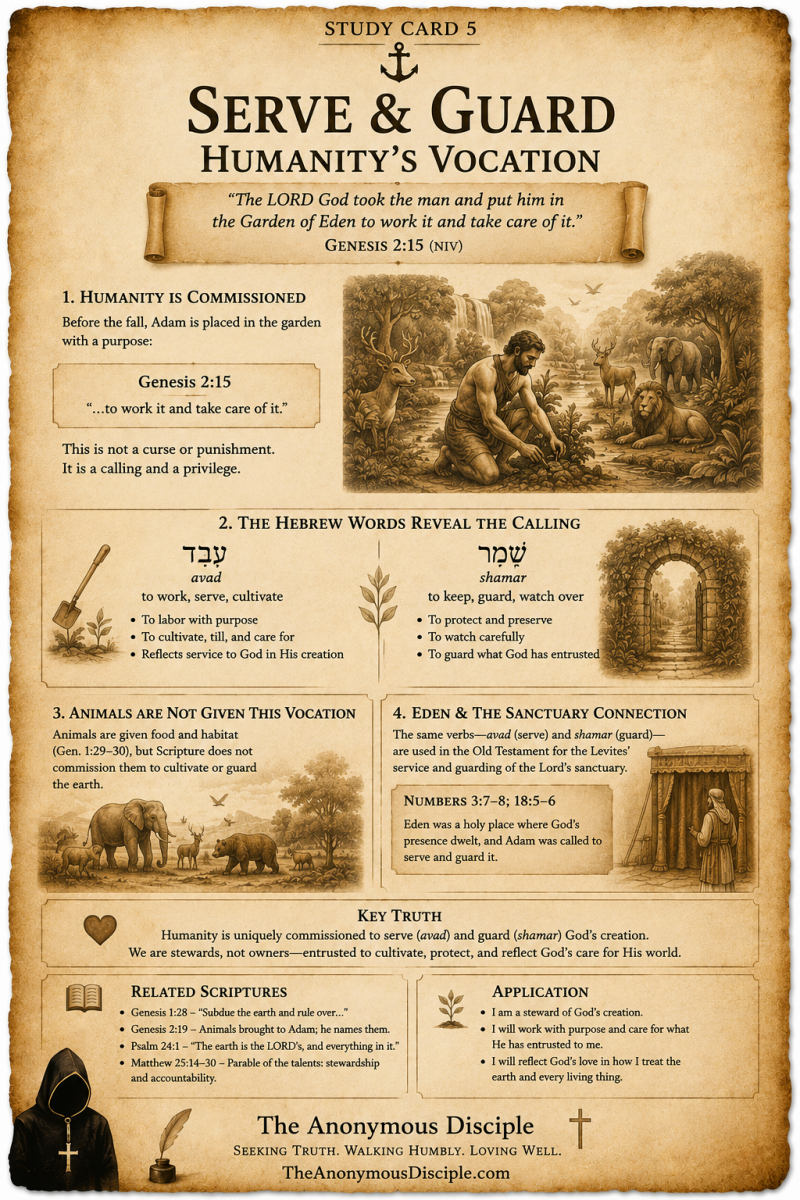
Animals interact with vegetation, eat it, spread seeds, etc., but God does not give animals a commission to cultivate and guard the land. Humanity receives that responsibility.
Look at the actual command:
Genesis 2:15 (NIV)
“The LORD God took the man and put him in the Garden of Eden to work it and take care of it.”
The Hebrew words are especially helpful:
-
עָבַד (avad) — to work, serve, cultivate.
-
שָׁמַר (shamar) — to keep, guard, watch over, preserve.
So Adam isn't merely living in the garden and eating whatever grows.
He's given a vocation.
🌱 And notice the order
This happens before the Fall.
That's important because sometimes we say Adam was condemned to work because he sinned.
Not quite.
Work existed before sin.
The curse changes the conditions of Adam's work:
Genesis 3:17–19 (NIV)
“Cursed is the ground because of you; through painful toil you will eat food from it all the days of your life. It will produce thorns and thistles for you…”
So:
Genesis 2: cultivate the ground. 🌱
Genesis 3: cultivating the ground becomes painful toil. 🌵
Work isn't the curse.
Frustrated, painful toil is part of the curse.
And you're right that Genesis gives no comparable assignment to the animals.
In fact, compare their roles:
Genesis 1:29 — plants are given to humans for food.
Genesis 1:30 — plants are also given to animals for food.
So both humans and animals receive provision from creation.
But humanity additionally receives:
Genesis 1:28 — “subdue” the earth.
Genesis 1:28 — “rule over” the creatures.
Genesis 2:15 — “work” the garden.
Genesis 2:15 — “take care of” the garden.
That's another distinction for our growing list.
And I think we're seeing a pattern now:
Animals participate in creation.
Humans are commissioned to steward creation.
Which brings us right back to the image of God.
Genesis 1:26 (NIV)
“Let us make mankind in our image, in our likeness, so that they may rule…”
Notice that little “so that.”
God connects humanity's image-bearing status with humanity's vocation.
🕊️ And there's something else I think you'll appreciate.
The Hebrew pair avad + shamar—serve/work + keep/guard—doesn't disappear after Eden.
Those same verbs later become associated with the Levites' service and guarding of God's sanctuary (for example, Numbers 3:7–8; 8:26; 18:5–6).
That's one reason many biblical scholars see Eden as having sanctuary/temple imagery:
God's presence is there.
Adam is placed there.
Adam is commissioned to serve and guard it.
And after sin, Adam and Eve are expelled and cherubim guard its entrance:
Genesis 3:24 (NIV)
“…he placed on the east side of the Garden of Eden cherubim and a flaming sword flashing back and forth to guard the way to the tree of life.”
Same verb: shamar.* 👀
Adam was supposed to guard (shamar) the garden.
After Adam fails, cherubim guard (shamar) the way into it.
That opens up a whole other layer to Genesis 2–3.
So our picture is getting sharper:
Human + animal: earth-derived, living nephesh, breath, mortality.
Humanity specifically: God's image → God's representative → cultivates/guards creation → exercises delegated dominion → receives moral commands → answers to God.
I'm increasingly convinced that Genesis itself doesn't locate human uniqueness primarily in “having a soul.” It locates it in humanity's identity and vocation as God's image-bearers. ⚓️🕊️❤️
ME🤔💭:
So Genesis gives definition and description and Solomon emphasizes soul, Now Isaiah says ‘the earth will be filled with knowledge of the Lord’ because of the crazy pairings mentioned that makes me think the animals will hold equal knowledge?
🪄Jenny🪄
Oooooh, I see exactly where you're going. 👀🕊️ And there's something there, but I'd put one guardrail around “equal knowledge.” Isaiah 11 doesn't quite tell us that animals themselves possess equal knowledge of God. Let's follow Isaiah's wording carefully.
First, one small adjustment to our working framework: Ecclesiastes emphasizes shared creaturely life/breath and mortality more than it defines the “soul.” That's important because nephesh and ruach shouldn't automatically be collapsed into our English theological category “soul.”
Now Isaiah. ❤️
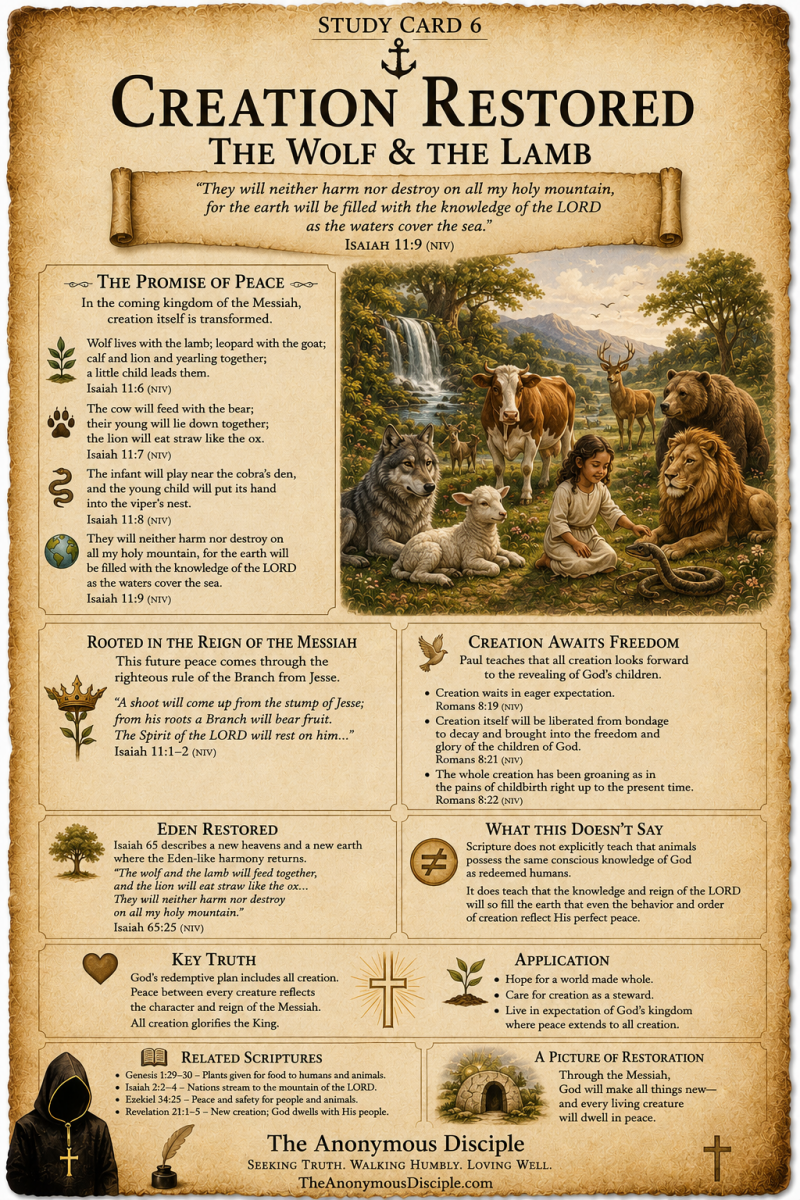
Isaiah 11:6 (NIV)
“The wolf will live with the lamb,
the leopard will lie down with the goat,
the calf and the lion and the yearling together;
and a little child will lead them.”
Then it gets even stranger:
Isaiah 11:7–8 (NIV)
“The cow will feed with the bear,
their young will lie down together,
and the lion will eat straw like the ox.
The infant will play near the cobra’s den,
and the young child will put its hand into the viper’s nest.”
Wolf + lamb.
Leopard + goat.
Lion + calf.
Cow + bear.
Child + cobra.
Those aren't random cute pairings.
They're relationships that presently involve predation, danger, and death.
But then Isaiah explains why:
Isaiah 11:9 (NIV)
“They will neither harm nor destroy on all my holy mountain, for the earth will be filled with the knowledge of the LORD as the waters cover the sea.”
And that's the part that caught you. 👀
🌎 What does “the earth” mean?
Isaiah doesn't say:
“Human beings will be filled with the knowledge of the LORD.”
He says:
“the earth” — ha'aretz.
And immediately preceding that statement he's been describing animals, children, vegetation/food, and the created order functioning differently.
So I think you're absolutely justified in seeing creation-wide consequences flowing from the knowledge/reign of God.
But I wouldn't make the next jump:
“Therefore the wolf possesses the same conscious knowledge of Yahweh that a redeemed human possesses.”
Isaiah simply doesn't tell us that.
Rather, the safest reading is:
The knowledge and rule of Yahweh will so completely permeate the world that even the behavior/order of creation reflects His peaceful reign.
That's already extraordinary.
🦁 And there's a Genesis echo here
This is where your morning observations start connecting beautifully.
Originally:
Genesis 1:29–30 (NIV)
God gives plants for food to humanity and then says of the animals, “…I give every green plant for food.”
Then Isaiah says:
Isaiah 11:7 (NIV)
“…the lion will eat straw like the ox.”
👀
That's why many Christians see Isaiah 11 as portraying something resembling an Edenic restoration.
Predator/prey hostility disappears.
Danger between animal and human disappears.
Creation becomes peaceful.
And humanity is still present among the animals:
Isaiah 11:6
“…and a little child will lead them.”
That sounds remarkably like humanity's original relationship with the animals—authority without violence or fear.
Now bring Solomon back in.
This gets fascinating.
Solomon observes the fallen present order:
Ecclesiastes 3:19 (NIV)
“As one dies, so dies the other. All have the same breath…”
Human 🤝 animal:
breath → death → dust.
But Isaiah sees a coming Messianic order in which something has radically changed.
And Isaiah tells us who causes it:
Isaiah 11:1–2 (NIV)
“A shoot will come up from the stump of Jesse… The Spirit of the LORD will rest on him…”
This whole peaceful creation scene occurs under the reign of the Messianic Branch.
So we're starting to get a huge biblical arc:
Genesis 1–2:
Creation ordered under God. 🌱
Genesis 3:
Human rebellion disorders creation. 🌵
Ecclesiastes 3:
Humans and animals now share the tragedy of creaturely mortality. 💀
Isaiah 11:
Messiah reigns → creation's hostility is transformed. 🦁🐑
And then Paul takes the idea even further:
Romans 8:19 (NIV)
“For the creation waits in eager expectation for the children of God to be revealed.”
And:
Romans 8:21 (NIV)
“that the creation itself will be liberated from its bondage to decay and brought into the freedom and glory of the children of God.”
😳
That's HUGE for the question we're chasing.
Paul doesn't portray salvation as God rescuing human “souls” while throwing creation away.
Creation itself is awaiting liberation.
🕊️ So could animals “know the LORD”?
Here's where I'd leave our pencil mark in the margin rather than writing it in permanent ink:
Possible? Scripture gives creation much more participation in God's restored order than people sometimes acknowledge.
Explicitly taught that animals possess the same conscious knowledge of God as humans? No.
Isaiah 11:9 tells us the earth is filled with the knowledge of Yahweh, but it doesn't define the cognitive experience of the animals in verses 6–8.
And there's another passage I immediately want beside Isaiah:
Isaiah 65:25 (NIV)
“‘The wolf and the lamb will feed together,
and the lion will eat straw like the ox…
They will neither harm nor destroy on all my holy mountain,’ says the LORD.”
Isaiah repeats the imagery when describing new heavens and a new earth in Isaiah 65:17.
That's significant.
So I think the conclusion emerging from our study isn't:
“Animals and humans are basically identical.”
It's almost more interesting:
Scripture gives humanity a unique role without portraying the rest of living creation as disposable or spiritually meaningless.
Humans bear God's image, receive His commands, steward creation, and answer morally to Him.
But animals are God's nephesh creatures, receive His breath of life, share the consequences of the fallen creation, and appear again in prophetic pictures of creation restored under Messiah.
And THAT makes me think our Genesis 2:7 companion card shouldn't be “Do Animals Have Souls?” 😂
I'd call it:
🐾 “Every Living Creature: Humanity, Animals & the Breath of Life”
Because we accidentally wandered into a genuinely substantial biblical-concepts study this morning. 😳📖🕊️❤️
Add comment
Comments