


Today we’re diving into Galatians 2:19–21, anchoring on Galatians 2:20—one of the clearest pictures in Scripture of what it means to belong to Christ.
Paul’s message is not that the Christian life is about trying harder, becoming more religious, or earning God’s approval. It is about something far deeper: the old self has been crucified with Christ, and a new life has begun. We no longer live by our own righteousness or strength. Christ lives in us, and the life we now live is lived by faith in Him.
At the center of it all is grace. Galatians 2:21 reminds us that if righteousness could come through the law, then Christ died for nothing. Our salvation is not something we achieve—it is something Jesus accomplished for us.
And Paul makes it deeply personal in Galatians 2:20: Jesus is the Son of God “who loved me and gave himself for me.” The crucified life is not cold surrender to a set of rules. It is a response to the overwhelming love of the One who gave Himself for us.
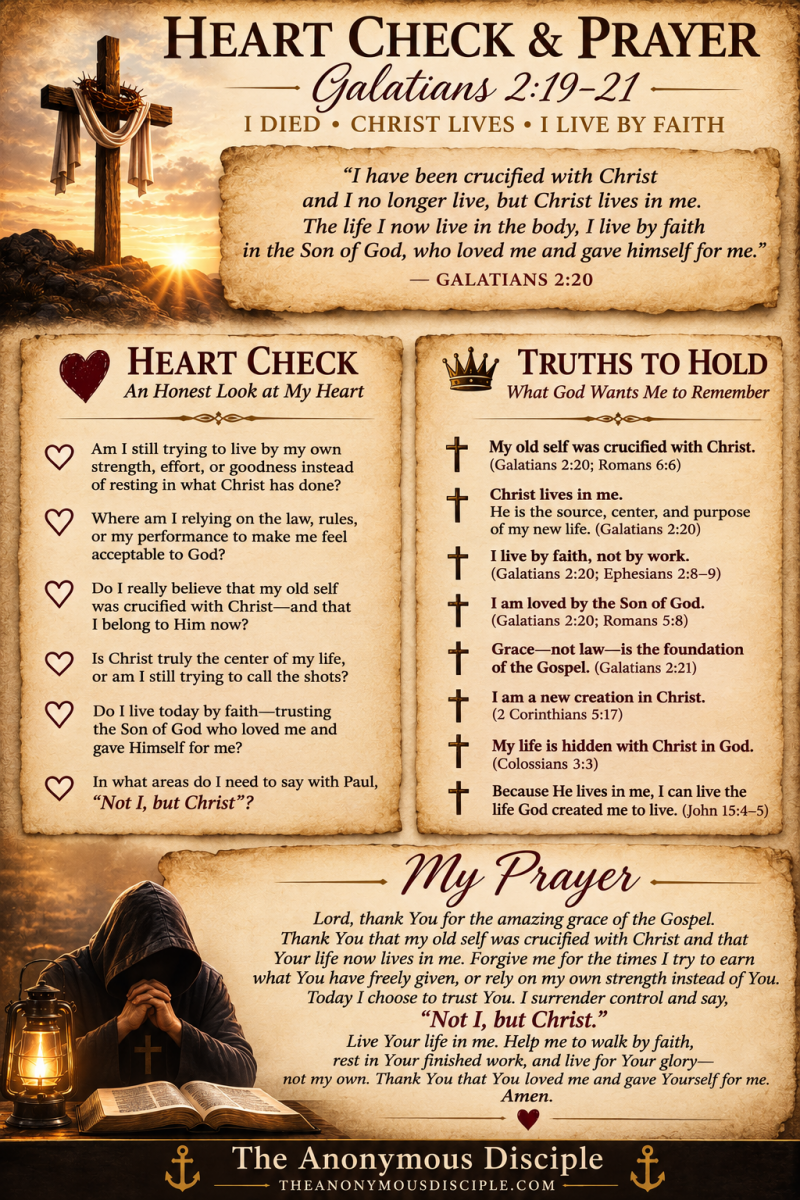
Today’s lesson brings us back to a simple truth:
I died.
Christ lives.
I live by faith.
Grace reigns.
Not I, but Christ. ❤️⚓️
Today's Study:
- KJV v CSB translation comparison
- Historical Notes
- Deep Dive Study card
- Layman's verse by verse breakdown
- Not I, But Christ card
- Passage & Anchor Verse Cross References
- Grace, Not Law card
- Loved Me & Gave Himself For Me card
- Union With Christ Throughout Scripture card
- Heart Check & Prayer card (plus pdf)
- Deep Study Notes with Jenny
Study cards/Deep Dive Study/Illustrations: 🪄Jenny🪄
Historical Notes/Cross References/Bible Translations/Layman breakdown/Illustrations: 𝕏James𝕏
King James Version (KJV)
19 For I through the law am dead to the law, that I might live unto God.
20 I am crucified with Christ: nevertheless I live; yet not I, but Christ liveth in me: and the life which I now live in the flesh I live by the faith of the Son of God, who loved me, and gave himself for me.
21 I do not frustrate the grace of God: for if righteousness come by the law, then Christ is dead in vain.

Christian Standard Bible (CSB)
19 For through the law I died to the law, so that I might live for God.
20 I have been crucified with Christ, and I no longer live, but Christ lives in me. The life I now live in the body, I live by faith in the Son of God, who loved me and gave himself for me.
21 I do not set aside the grace of God, for if righteousness comes through the law, then Christ died for nothing.
Who wrote it
The apostle Paul. Almost everyone agrees on that. He names himself right at the start (Galatians 1:1).
To whom it was written
“The churches of Galatia” (Galatians 1:2). These were groups of believers Paul had already preached to and planted.
There are two main views about exactly where those churches were:
- South Galatia view (the one many Bible teachers hold today): churches in the southern part of the Roman province of Galatia. These would be the churches Paul started on his first missionary journey—places like Pisidian Antioch, Iconium, Lystra, and Derbe (you can read about that trip in Acts 13–14). That area is in modern-day Turkey.
- North Galatia view: churches farther north, among the ethnic Galatians (Celtic people who had settled around what is now Ankara).
Either way, they were mostly Gentile (non-Jewish) believers who had come to faith in Jesus.
When it was written
Scholars do not all agree on the exact year because it depends on which churches Paul was writing to.
- If it went to the southern churches, many date it around AD 48–49, possibly from Antioch in Syria, and possibly just before the big meeting in Jerusalem recorded in Acts 15.
- If it went to the northern churches, it is usually dated later, in the mid-50s AD, during Paul’s third missionary journey.
So the letter is one of Paul’s earliest writings—written roughly 15–20 years after Jesus’ death and resurrection.
Where it was written from
Paul does not say. The two most common suggestions are:
- Antioch in Syria (if the early date is correct)
- Ephesus or another city on a later journey (if the later date is correct)
Why it was written
After Paul left, other teachers came in. They were telling the Galatian believers, “Faith in Jesus is good, but it’s not enough. You also need to be circumcised and keep the Law of Moses to be fully accepted by God.”
Paul saw that as a different gospel. He wrote this letter in strong, urgent language to say:
- You are made right with God by faith in Jesus, not by keeping the Law.
- Adding the Law on top of grace actually empties the cross of its power (that is why verse 21 is so sharp).
- Christ living in you (verse 20) is the new way—not going back to the old rule-keeping way.
He was fighting to keep the gospel of grace clear for those churches—and for us.
That is the setting behind Galatians 2:19–21. Paul is not just sharing a nice thought; he is defending the very heart of the good news.
layman's verse by verse breakdown with 𝕏James𝕏
Here is a simple, verse-by-verse look at Galatians 2:19-21 in everyday language. I’ll use the NIV mainly (with the ESV close beside it). Verse 20 is the heart of the passage—the one that holds the others together.
**Context in a nutshell:**
Paul is explaining why we are made right with God by faith in Jesus, not by keeping the Law of Moses. Some people were trying to add rules back in. Paul says that would actually empty the cross of its meaning.
---
**Verse 19**
NIV: “For through the law I died to the law so that I might live for God.”
ESV: “For through the law I died to the law, so that I might live to God.”
Plain meaning:
The Law showed Paul (and shows us) that we cannot measure up. It pointed out our sin so clearly that it “killed” any hope of earning God’s approval by our own performance. Once that old way of trying died, Paul was free to live for God instead of living to satisfy a list of rules.
Think of it like this: the Law was like a doctor’s report that said, “You are terminally sick.” It didn’t heal him—it just told the truth so he would look for the real Healer.
---
**Verse 20 (the anchor verse)**
NIV: “I have been crucified with Christ and I no longer live, but Christ lives in me. The life I now live in the body, I live by faith in the Son of God, who loved me and gave himself for me.”
ESV: “I have been crucified with Christ. It is no longer I who live, but Christ who lives in me. And the life I now live in the flesh I live by faith in the Son of God, who loved me and gave himself for me.”
This is the center. Let’s take it piece by piece:
- “I have been crucified with Christ”
When Jesus died on the cross, something real happened to Paul (and to every believer). His old self—the one that tried to be good enough on its own—was put to death with Jesus. That old identity is finished.
- “I no longer live, but Christ lives in me”
The person who used to run the show is gone. Now Jesus Himself lives inside the believer by His Spirit. It is not “try harder, Paul.” It is “Christ in you.”
- “The life I now live in the body, I live by faith in the Son of God”
Paul still has a real body and a real everyday life. But the way he lives that life is by trusting Jesus, not by trusting his own effort.
- “who loved me and gave himself for me”
This is personal. Jesus didn’t just die for “the world” in a general way. He loved *me*. He gave Himself *for me*. That love is the reason the old self could die and the new life could begin.
This verse is why Christians talk about “union with Christ.” We are so joined to Jesus that His death becomes our death to the old way, and His life becomes our new life.
---
**Verse 21**
NIV: “I do not set aside the grace of God, for if righteousness could be gained through the law, Christ died for nothing!”
ESV: “I do not nullify the grace of God, for if righteousness were through the law, then Christ died for no purpose.”
Plain meaning:
If we could become right with God by keeping rules, then Jesus’ death was a waste. Paul refuses to treat God’s undeserved kindness (grace) as if it were optional or extra. The cross was necessary precisely because we could not save ourselves.
---
**How the three verses fit together**
- Verse 19: The Law did its job—it showed me I was dead and needed new life.
- Verse 20: That new life came when I was crucified with Christ and He began to live in me.
- Verse 21: Therefore I will not go back to the old system. That would say the cross was pointless.
The whole passage is Paul saying, “I died to the old way so I could live the new way—Christ living in me by faith, because He loved me enough to give Himself for me.”
Here are helpful cross-references. I’ll keep them grouped so they are easier to follow. These are the verses that most often sit beside Galatians 2:19–21 in study Bibles.
For the whole passage (Galatians 2:19–21)
- Died to the law so we can live for God
Romans 7:4–6
Romans 6:2, 11
Colossians 2:20 - Crucified with Christ / old self put to death
Romans 6:6
Galatians 5:24
Galatians 6:14
Colossians 3:3 - Christ lives in the believer
Romans 8:10
2 Corinthians 13:5
Colossians 1:27
Ephesians 3:17 - We live by faith, not by the law
Galatians 2:16
Galatians 3:11
Romans 1:17
Habakkuk 2:4 - Jesus loved me and gave Himself for me
Galatians 1:4
Ephesians 5:2, 25
Titus 2:14
1 John 4:10 - If righteousness came by the law, Christ died for nothing
Galatians 3:21
Galatians 5:2–4
Romans 3:20–24
Hebrews 7:18–19

Especially for the anchor verse — Galatians 2:20
These are the closest companions:
- Romans 6:4–11 — buried with Him, raised to new life, consider yourselves dead to sin but alive to God
- Romans 8:10 — if Christ is in you…
- 2 Corinthians 5:14–15 — He died for all, so those who live should no longer live for themselves
- Colossians 3:3–4 — you died, and your life is now hidden with Christ in God
- Galatians 5:24 — those who belong to Christ Jesus have crucified the flesh
- Galatians 6:14 — the world has been crucified to me, and I to the world
- Philippians 1:21 — for to me, to live is Christ
- John 15:4–5 — remain in Me… apart from Me you can do nothing
The Romans 6 passage is probably the fullest explanation of what Paul means by “I have been crucified with Christ… Christ lives in me.”

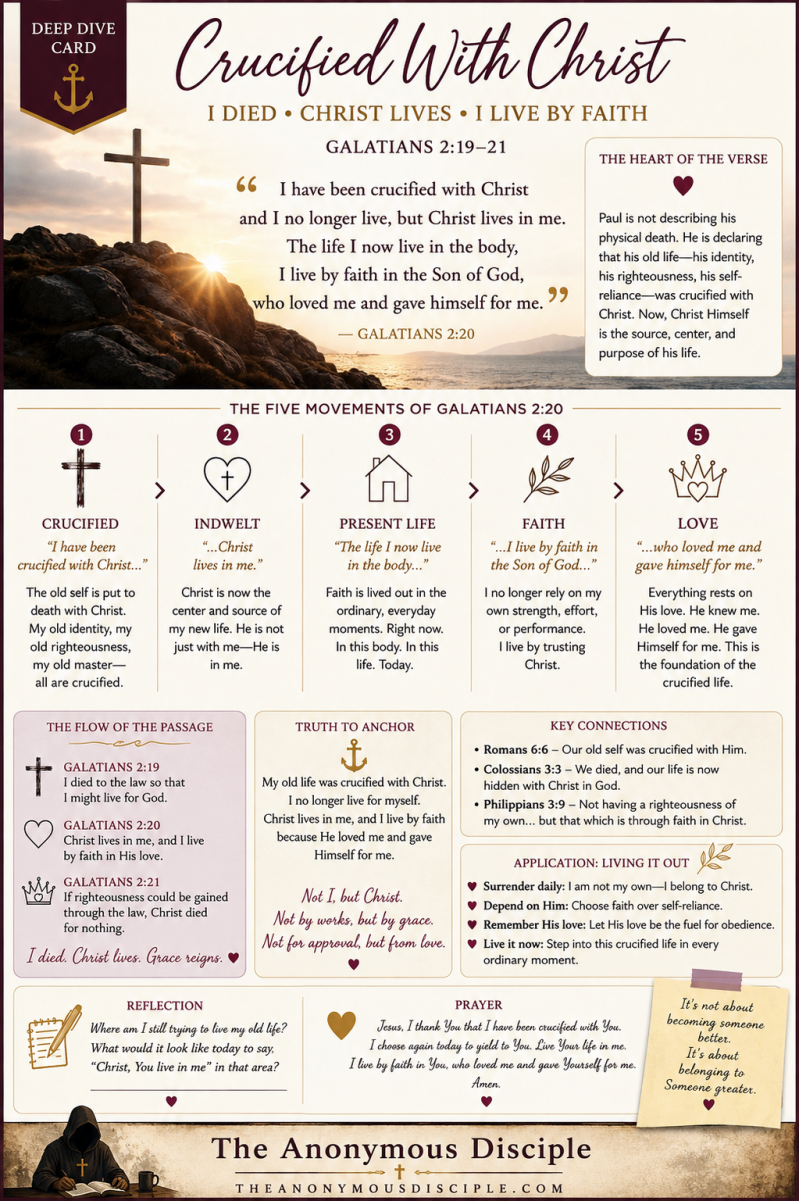
deep Study Notes with 🪄Jenny🪄
🪄Jenny🪄-
Galatians 2:19–21 is one of those passages where Paul packs the whole Christian life into three verses—and Galatians 2:20 is an incredible anchor. ⚓️
Galatians 2:19–21 — Dying to Live
Galatians 2:19 — Paul says that through the law he died to the law so that he might live for God.
That sounds almost contradictory until we follow Paul’s argument. The Law showed Paul something he could never escape: he could not make himself righteous. The Law could expose sin, define sin, and pronounce judgment on sin—but it could not give him the righteousness he needed.
So Paul stopped trying to stand before God on the basis of his own obedience.
In a sense, the Law brought him to the end of himself.
And that is exactly where Christ meets him.
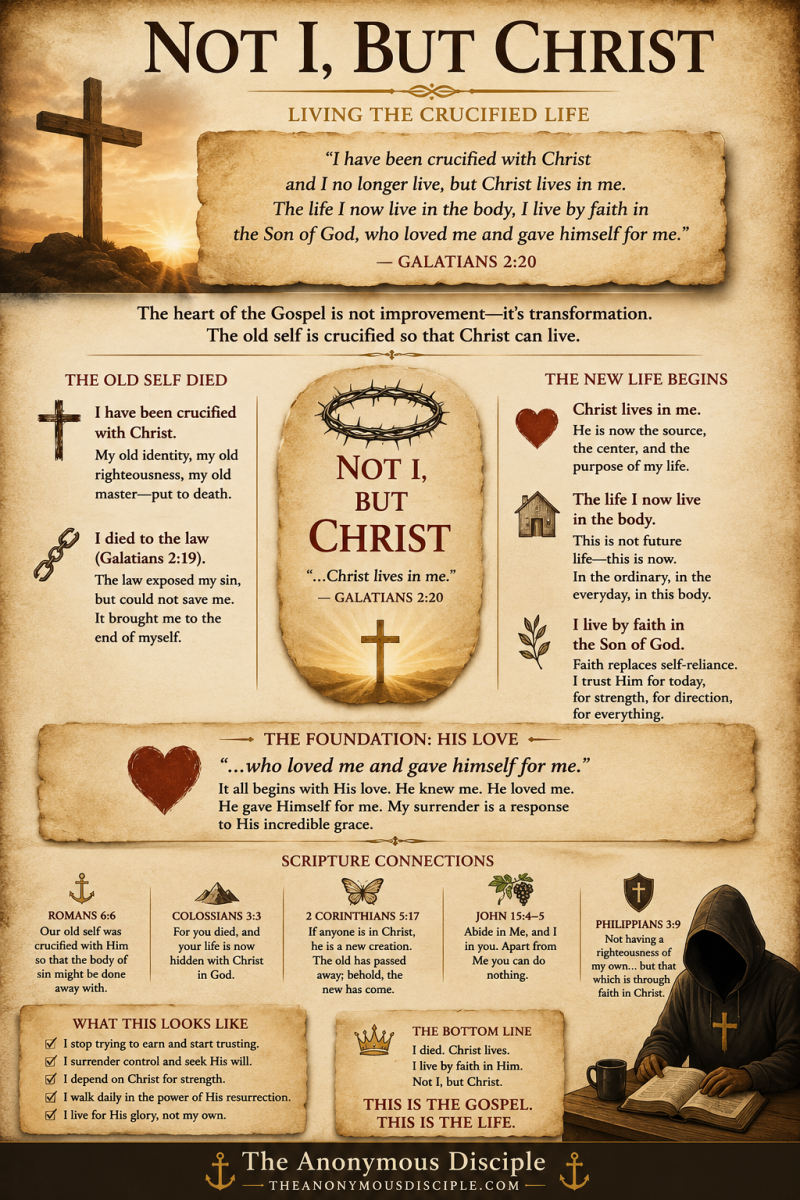
⚓ Galatians 2:20 — “I have been crucified with Christ…”
This is the heart of the passage. ❤️
Paul isn't saying his physical body died with Jesus. He means that the old Paul—the man whose identity, righteousness, and standing before God depended upon himself—was put to death with Christ.
That connects beautifully with:
Romans 6:6 — our old self was crucified with Christ.
Colossians 3:3 — “For you died, and your life is now hidden with Christ in God.”
Christianity isn't merely Jesus helping us become slightly better versions of ourselves.
It is death and resurrection.
Old identity → crucified.
Old righteousness → abandoned.
Old master → dethroned.
New life → Christ.
And then Paul says something astonishing:
“I no longer live, but Christ lives in me.” — Galatians 2:20
Paul obviously still lives—he's writing the letter! 😄
So what does he mean?
Paul is no longer the source or center of his life. Christ is.
His ambitions belong to Christ.
His obedience belongs to Christ.
His identity belongs to Christ.
His future belongs to Christ.
That doesn't erase Paul's personality. It changes who sits on the throne.
“…the life I now live in the body…”
I love that Paul includes this phrase because Christianity isn't merely about some future heavenly existence.
He means right now.
The life I live…
today.
In this body.
In this house.
In this marriage.
In this struggle.
In this ordinary Monday morning. ☕️❤️
The crucified life isn't theoretical theology. It becomes everyday discipleship.
“…I live by faith in the Son of God…”
Here's the replacement for self-reliance:
faith.
Not:
“I'll try hard enough.”
Not:
“I'll become worthy enough.”
Not:
“I'll keep enough rules.”
But:
I trust Christ.
Paul moves from self-righteousness to Christ-dependence.
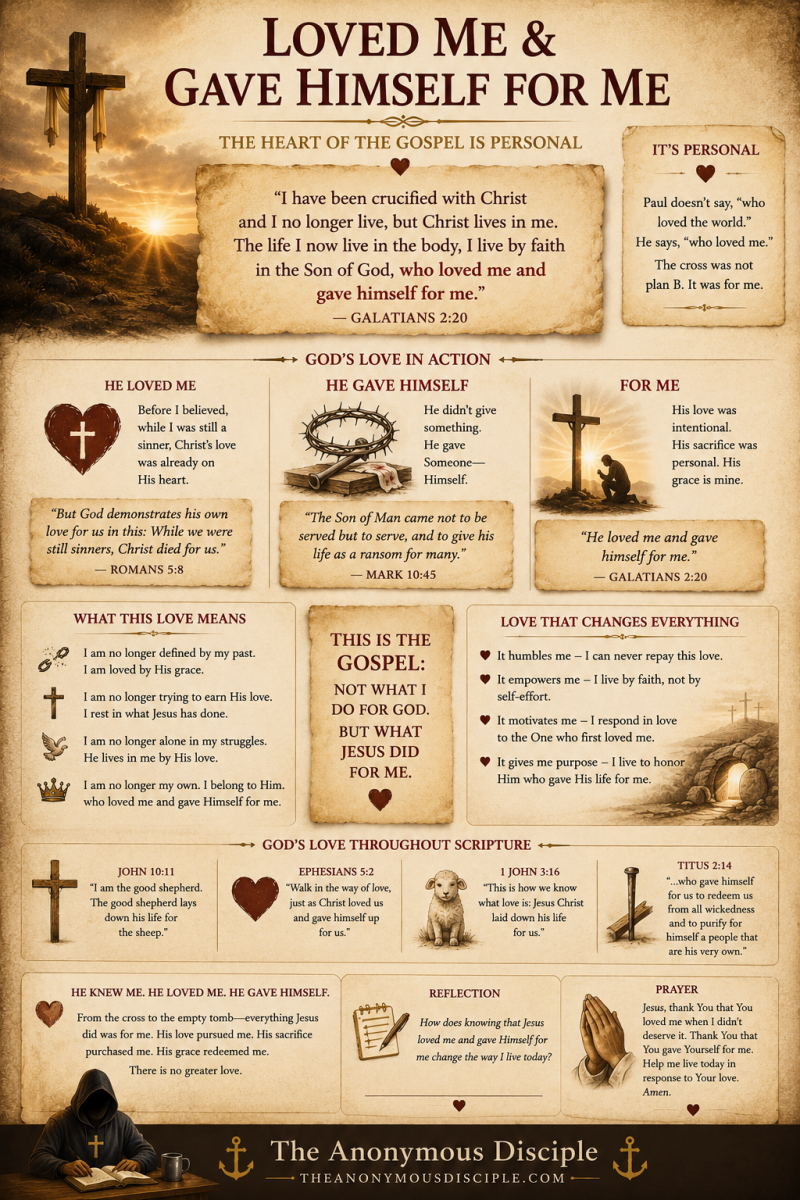
And then comes the part that makes Galatians 2:20 deeply personal:
“…who loved me and gave himself for me.” — Galatians 2:20
Notice Paul doesn't merely say:
Christ loved the world.
That's true.
But Paul says:
He loved me.
He gave Himself for me.
Paul—former persecutor of Christians—understood something enormous about grace.
The Cross wasn't an abstract theological event.
Paul looked at Jesus and essentially said:
He knew me.
He loved me.
And He gave Himself for me.
❤️
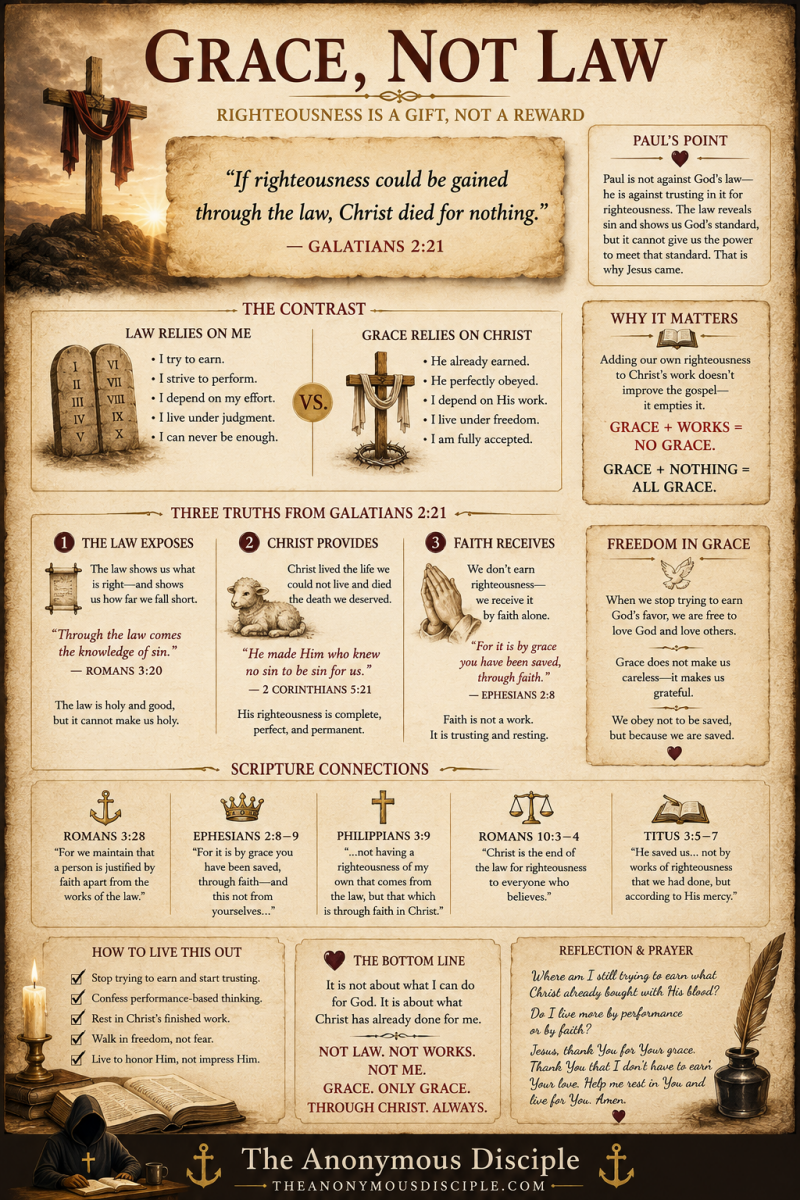
Galatians 2:21 — Don't Set Grace Aside
Then Paul finishes with a theological hammer:
Galatians 2:21 — if righteousness could be gained through the law, Christ died for nothing.
That's Paul's argument against legalism.
If human beings could earn righteousness by keeping God's Law, then there would have been no reason for the Son of God to go to the Cross.
But we couldn't.
So He did.
That means adding human merit to Christ's sacrifice doesn't strengthen the gospel.
It actually undermines grace.
Paul's gospel is:
Not Christ + my righteousness.
Christ is my righteousness.
Compare:
Philippians 3:9 — Paul wants to be found in Christ, “not having a righteousness of my own that comes from the law, but that which is through faith in Christ.”
⚓ Galatians 2:20 — The Movement of the Verse
I think there are five beautiful movements in our anchor verse:
1. CRUCIFIED
“I have been crucified with Christ…”
The old life dies.
2. INDWELT
“…Christ lives in me.”
Jesus becomes the center of the new life.
3. PRESENT LIFE
“The life I now live in the body…”
Faith is lived in ordinary everyday life.
4. FAITH
“…I live by faith in the Son of God…”
Dependence replaces self-reliance.
5. LOVE
“…who loved me and gave himself for me.”
At the foundation of everything is Christ's love.
And I think that last one is worth sitting with this morning:
The crucified life begins with realizing you are loved.
Paul isn't surrendering himself to a distant tyrant.
He is surrendering himself to the One “who loved me and gave Himself for me.”
That's why surrender isn't loss.
It's life. ❤️
And there is a line running straight through these three verses:
Galatians 2:19
I died.
⬇️
Galatians 2:20
Christ lives in me.
⬇️
Galatians 2:21
Therefore I live by grace—not my own righteousness.
Or even shorter:
I died.
Christ lives.
Grace reigns.
⚓️❤️
Add comment
Comments