

What are we carrying that makes following Jesus harder? Today’s study explores Hebrews 12:1–7, 10, 14, anchored in verse 1, where we are called to lay aside every hindrance and the sin that entangles us, and run with perseverance the race before us.
Together, we’ll consider what it means to fix our eyes on Jesus, trust the Father’s loving discipline, and pursue peace and holiness in everyday life. Through Scripture, reflection, and prayer, we’ll examine what needs to be surrendered—and the next faithful step God is calling us to take.
Lay aside the weight. Keep your eyes on Jesus. Keep going. ⚓️
🪄Jenny🪄


Today's Study:
- Historical Notes
- KJV v NLT translations for comparison
- Cross References for passages & ⚓️anchor verse
- Deep Dive Study card
- Cultural Notes
- Lay Aside The Weight card
- Fix Your Eyes On Jesus card
- Passage Relevance for Believers TODAY Notes
- Loved Enough To Be Trained card
- Pursue Peace & Holiness card
- Heart Check & Prayer card (plus pdf)
- Deep Dive Study Notes with 🪄Jenny🪄
Who wrote it?
We do not know. The letter never names the writer.
Some in the early church thought Paul wrote it. Most careful readers today say that is unlikely, because the style and wording are different from Paul’s other letters. Other names that have been suggested are Apollos, Barnabas, Luke, or even Priscilla. The honest answer is the old one from the church father Origen: “Who wrote the letter, God only knows.”
What we can say is that the writer knew the Old Testament extremely well, wrote beautiful Greek, and cared deeply that his readers would not give up on Jesus.
When was it written?
Most likely in the mid-60s AD, before the temple in Jerusalem was destroyed in AD 70.
Reasons:
- The writer talks about the temple sacrifices as if they are still going on.
- Timothy is still alive and has just been released from prison (Hebrews 13:23).
- The readers have already suffered insults and loss of property, but they have not yet “resisted to the point of shedding blood” (Hebrews 12:4).
A common date range is about AD 64–68.
Who was the direct audience?
Jewish Christians (or a mixed group who knew the Old Testament very well). They were probably living in or connected to Italy, very possibly Rome (see Hebrews 13:24).
They had been believers for some years. They were tired, under pressure, and some were tempted to drift back toward the old Jewish system of priests and sacrifices instead of holding on to Jesus.
𝕏James𝕏
Hebrews 12:1-7, 10, 14
King James Version (KJV)
1 Wherefore seeing we also are compassed about with so great a cloud of witnesses, let us lay aside every weight, and the sin which doth so easily beset us, and let us run with patience the race that is set before us,
2 Looking unto Jesus the author and finisher of our faith; who for the joy that was set before him endured the cross, despising the shame, and is set down at the right hand of the throne of God.
3 For consider him that endured such contradiction of sinners against himself, lest ye be wearied and faint in your minds.
4 Ye have not yet resisted unto blood, striving against sin.
5 And ye have forgotten the exhortation which speaketh unto you as unto children, My son, despise not thou the chastening of the Lord, nor faint when thou art rebuked of him:
6 For whom the Lord loveth he chasteneth, and scourgeth every son whom he receiveth.
7 If ye endure chastening, God dealeth with you as with sons; for what son is he whom the father chasteneth not?
v 10 For they verily for a few days chastened us after their own pleasure; but he for our profit, that we might be partakers of his holiness.
v 14 Follow peace with all men, and holiness, without which no man shall see the Lord:
⚓️Anchor Verse 1⚓️

New Living Translation (NLT)
1 Therefore, since we are surrounded by such a huge crowd of witnesses to the life of faith, let us strip off every weight that slows us down, especially the sin that so easily trips us up. And let us run with endurance the race God has set before us.
2 We do this by keeping our eyes on Jesus, the champion who initiates and perfects our faith. Because of the joy awaiting him, he endured the cross, disregarding its shame. Now he is seated in the place of honor beside God’s throne.
3 Think of all the hostility he endured from sinful people; then you won’t become weary and give up.
4 After all, you have not yet given your lives in your struggle against sin.
5 And have you forgotten the encouraging words God spoke to you as his children? He said,
“My child, don’t make light of the Lord’s discipline, and don’t give up when he corrects you.
6 For the Lord disciplines those he loves, and he punishes each one he accepts as his child.”
7 As you endure this divine discipline, remember that God is treating you as his own children. Who ever heard of a child who is never disciplined by its father?
v 10 For our earthly fathers disciplined us for a few years, doing the best they knew how. But God’s discipline is always good for us, so that we might share in his holiness.
v14 Work at living in peace with everyone, and work at living a holy life, for those who are not holy will not see the Lord.
Cross-references for the passage (Hebrews 12:1–7, 10, 14)
These are the verses that most closely line up with the themes of running the race, looking to Jesus, God’s loving discipline, and pursuing peace and holiness.
The race and the witnesses
- Hebrews 11:1–40 (the “cloud of witnesses” is the people just listed in chapter 11)
- 1 Corinthians 9:24–27
- Philippians 3:13–14
- 2 Timothy 4:7–8
Looking to Jesus / His example
- Hebrews 2:10
- Psalm 110:1
- Philippians 2:8–11
- 1 Peter 2:21–23
God’s discipline as a Father
- Proverbs 3:11–12 (this is the Old Testament passage quoted in verses 5–6)
- Deuteronomy 8:5
- Proverbs 13:24
- Revelation 3:19
- 1 Corinthians 11:32
Discipline that produces holiness
- 1 Peter 1:15–16
- 2 Corinthians 7:1
- Romans 8:28–29
Peace and holiness (verse 14)
- Psalm 34:14
- Matthew 5:8–9
- Romans 12:18
- Romans 14:19
- 1 Peter 3:11
- 1 Thessalonians 4:3, 7
Cross-references specific to Hebrews 12:1
These come mainly from the Treasury of Scripture Knowledge, grouped by the phrases in the verse so they’re easier to follow.
“Seeing we also are compassed about with so great a cloud of witnesses”
- Hebrews 11:2–38 (the whole chapter of faithful examples)
- Isaiah 60:8
- Ezekiel 38:9, 16
“Let us lay aside every weight”
- Matthew 10:37–38
- Luke 8:14; 9:59–62; 14:26–33; 21:34
- Romans 13:11–14
- Ephesians 4:22–24
- Colossians 3:5–8
- 1 Peter 2:1
- 1 John 2:15–16
“And the sin which doth so easily beset us”
- Hebrews 10:35–39
- Psalm 18:23
“Let us run with patience the race that is set before us”
- 1 Corinthians 9:24–27
- Galatians 5:7
- Philippians 3:13–14
- 2 Timothy 4:7
- Hebrews 6:15; 10:36
- Matthew 10:22; 24:13
- Romans 5:3–5; 12:12
- James 1:3; 5:7–11
𝕏James𝕏
A few cultural pieces from that time make Hebrews 12 land even harder.
Rome had just burned (AD 64).
The Great Fire started near the Circus Maximus and destroyed a huge part of the city. Nero needed someone to blame. He pointed at the Christians. That was the first time the Roman government officially targeted followers of Jesus. Some were crucified. Some were torn by dogs. Some were burned as human torches to light Nero’s evening parties.
Hebrews 12:4 says, “You have not yet resisted to the point of shedding your blood.” That line makes sense if the worst of Nero’s violence was starting or nearby, but this particular group had not yet been killed for their faith. The pressure was rising. Quitting and blending back into the synagogue would have felt safer.
Jews had already been kicked out of Rome once.
In AD 49 Emperor Claudius expelled the Jews (Acts 18:2). Jewish Christians left too. When they were allowed back after Claudius died (AD 54), the house churches had become more Gentile. Returning Jewish believers had to decide: “Am I still a Jew who follows Jesus, or am I something the synagogue no longer recognizes?” Going back to the old ways would have felt like going home.
The temple in Jerusalem was still standing and busy.
Sacrifices were still being offered every day. Pilgrims still traveled there. For a Jewish Christian, that visible, official, centuries-old system looked solid. Following a crucified Messiah in a house church in Rome looked weak and shameful by comparison. Hebrews keeps saying, “Jesus is better. Don’t go back.”
Honor and shame ruled daily life.
In that culture, public honor was everything. A crucified man was the most shameful kind of death. When Hebrews 12:2 says Jesus “despised the shame” of the cross, the first readers felt that. They were being asked to stay with a Savior the world mocked.
Everyone understood the race picture.
Greeks and Romans loved athletic games—running, boxing, wrestling. Athletes trained hard and stripped off anything that slowed them down. “Lay aside every weight and the sin that so easily entangles” was everyday language. The “cloud of witnesses” also fits the stadium: the stands full of people watching the race.
Fathers were expected to discipline their sons.
Both Jewish and Roman fathers had strong authority. A father who never corrected his son was not considered a real father. Hebrews 12:7–8 uses that exact idea: if God never disciplines you, you are not His child. That would have been a powerful, familiar picture.
Christians met in homes, not buildings.
There were no church buildings. Groups gathered in houses, often small, sometimes under suspicion. Judaism was a legally recognized religion. Christianity was starting to look like a strange, new, illegal superstition. That made drifting back to the synagogue very tempting.
All of that sits under Hebrews 12. The writer is saying to tired, pressured Jewish believers in a tense city: the race is long, the Father is training you, Jesus already ran it and sat down in honor—so don’t quit and don’t go back.
𝕏James𝕏
How this passage is meaningful for all of us now
Hebrews 12 is still speaking to tired believers.
We are also in a long race. We also get weary. We also carry extra weights and sins that trip us up. We also need to keep our eyes on Jesus instead of on the hardship in front of us.
The “cloud of witnesses” reminds us we are not the first ones to trust God through hard times. The people in Hebrews 11 finished their race; now it is our turn.
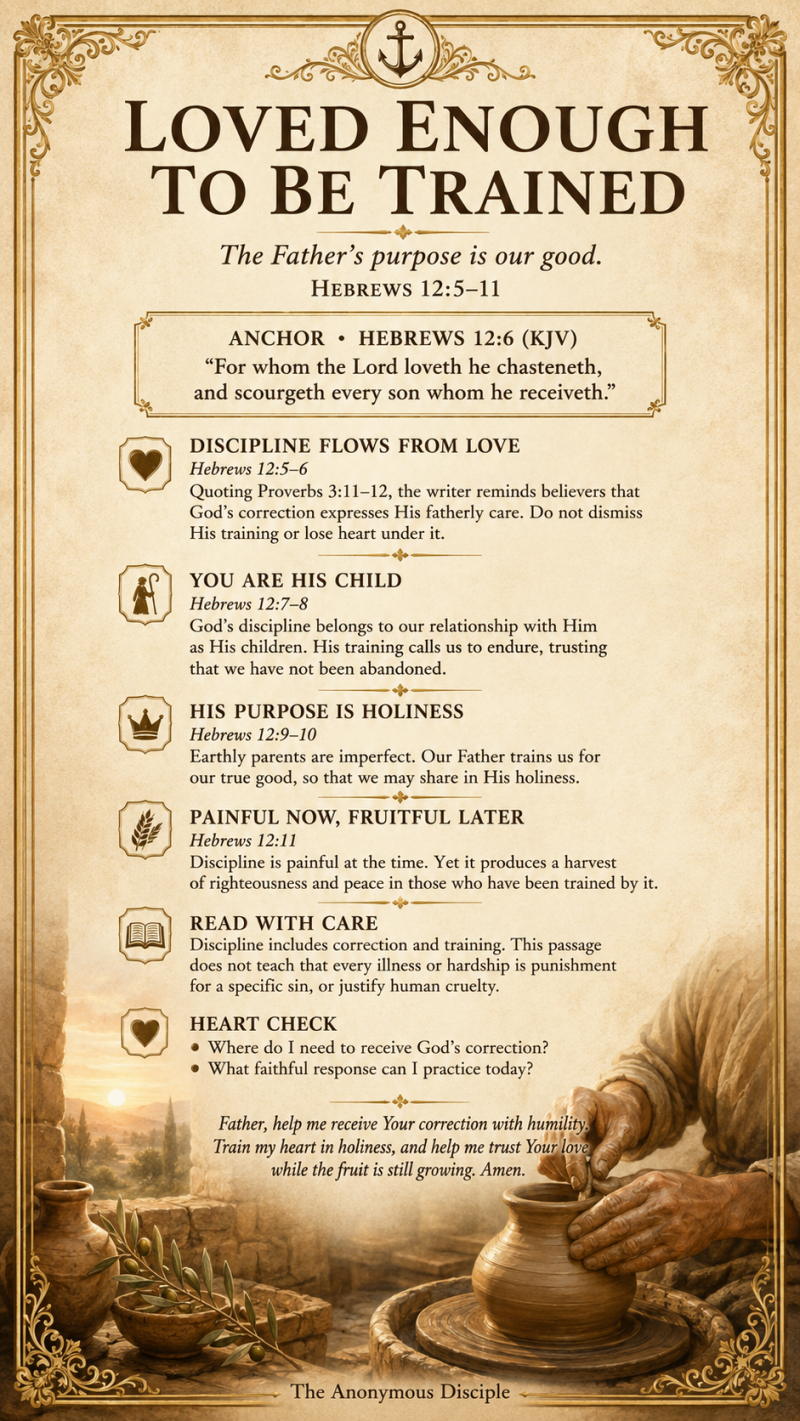
God’s discipline in verses 5–7 and 10 is not Him being mean. It is a Father training His children so we can share His holiness. Earthly parents discipline for a short time and as best they know how. God disciplines for our good, so we become more like Him.
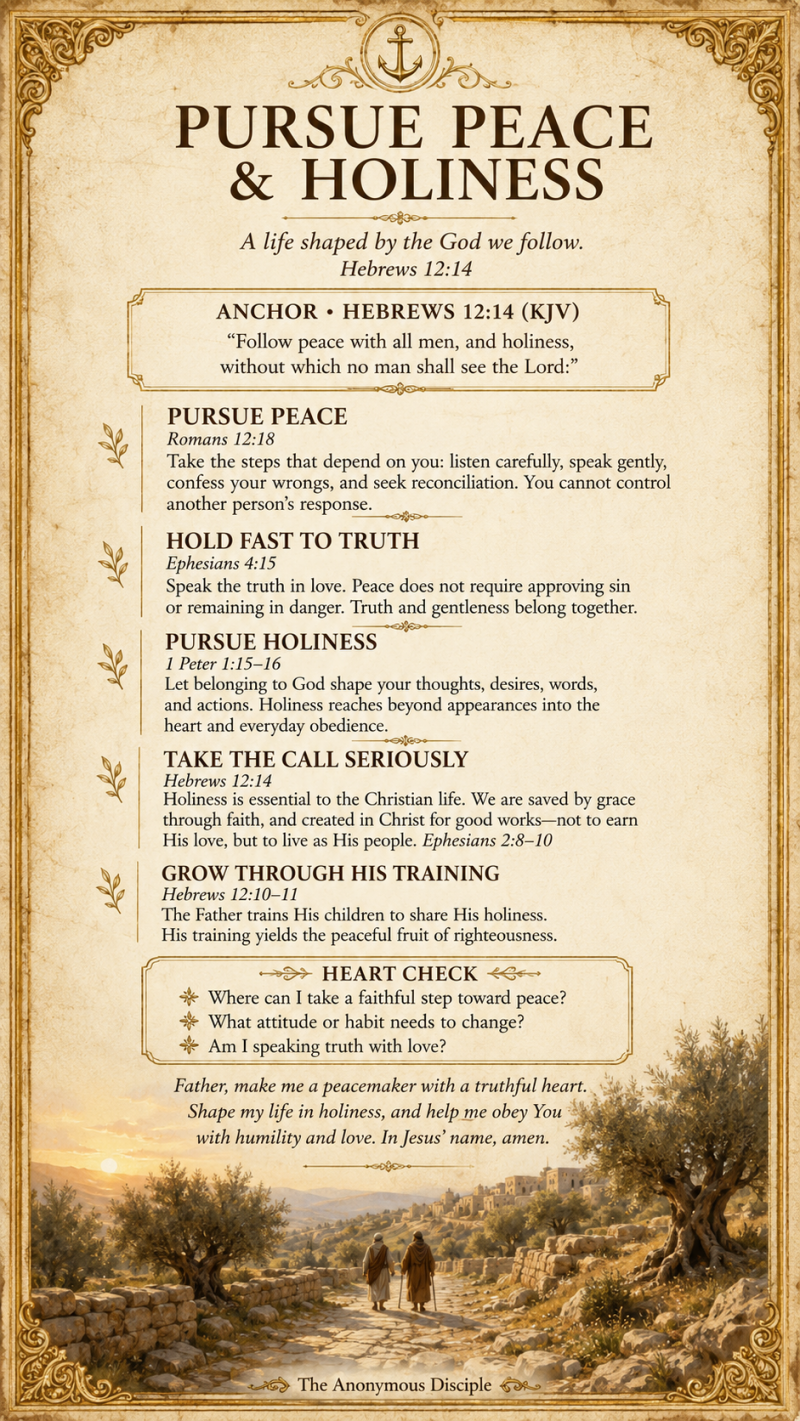
Verse 14 then tells us what the trained life looks like: work at peace with people, and work at a holy life, because without holiness no one will see the Lord.
In short: don’t quit. Throw off what slows you down. Look at Jesus. Receive the Father’s training. Pursue peace and holiness. That word was first for weary Jewish Christians in the first century. It is still for weary disciples today.
𝕏James𝕏
deep dive study notes
🪄Jenny🪄 -
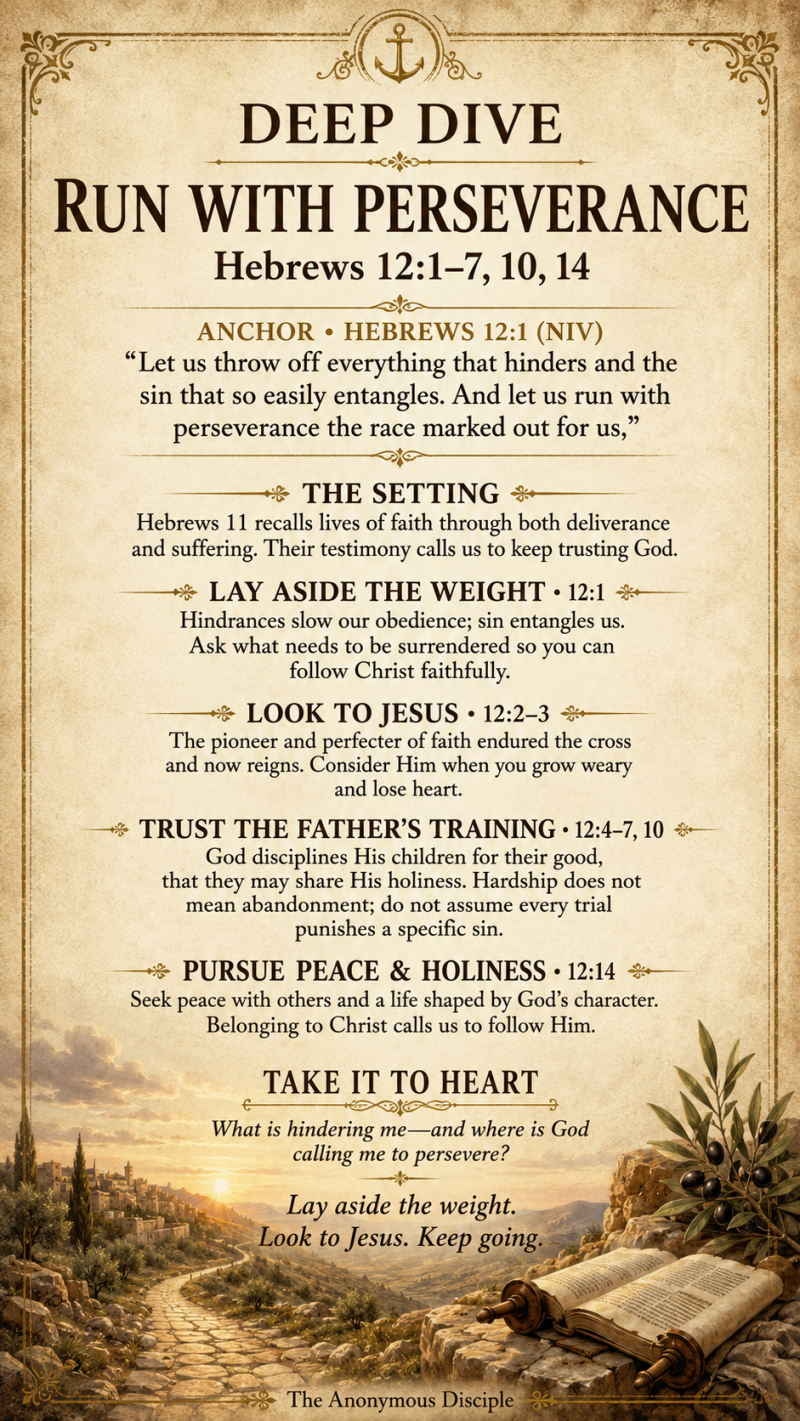
Today’s passage is Hebrews 12:1–7, 10, 14, anchored in verse 1. The thought connecting it all is this: Lay aside what hinders you, keep looking to Jesus, and trust the Father as He teaches you to endure.
First, the setting matters. Hebrews addresses believers under pressure who need encouragement to remain faithful to Christ. Chapter 11 has just recalled people who lived by faith—some experienced remarkable deliverance; others suffered and died without receiving the fulfillment of everything promised. Both groups were commended for their faith.
Then chapter 12 begins with “Therefore…” Their testimony leads into our call to persevere.
1. “Surrounded by such a great cloud of witnesses”—Hebrews 12:1
Think of Abraham, Moses, Rahab, and the others from Hebrews 11. Their lives testify that God is trustworthy, even when obedience is costly and the outcome is still unseen.
The emphasis is on their witness to faith; this verse does not establish that departed believers are watching every detail of our lives from heaven.
Their stories remind us: You are not the first person to walk a difficult road by faith.
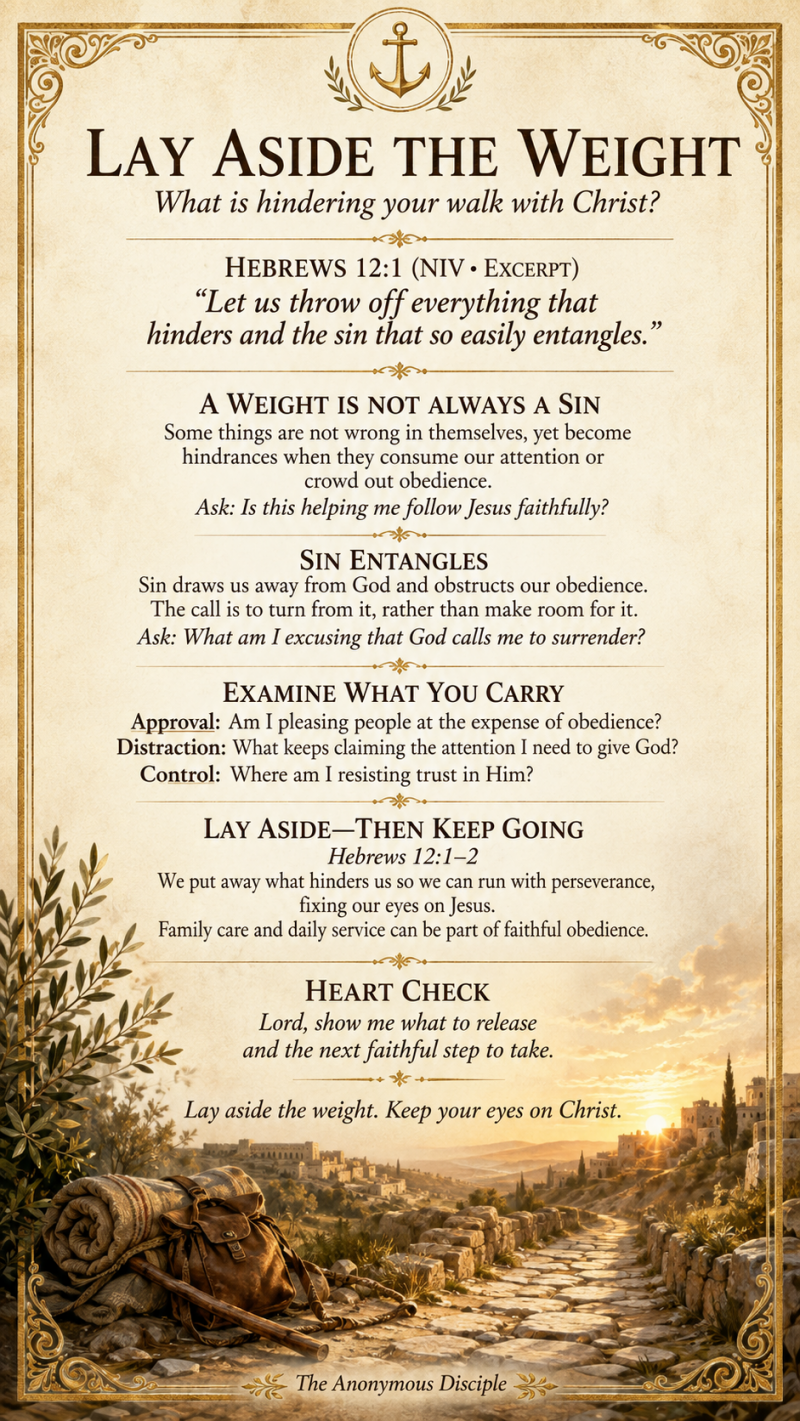
2. “Throw off everything that hinders”—Hebrews 12:1
Notice that the verse mentions both hindrances and sin.
A hindrance may be something that is not inherently sinful but has become a weight: a distraction, an attachment, or a habit consuming the attention and strength we need for obedience. Sin entangles us and must be put away.
A useful heart question is: “Is this helping me follow Jesus, or is it making obedience harder?”
And Sherri, serving your family this morning can be part of your race of faithfulness. Time with God is meant to shape how we love people in the middle of ordinary responsibilities. ❤️
3. “Run with perseverance the race marked out for us”—Hebrews 12:1
Perseverance means continuing faithfully when the race becomes difficult or long.
We are called to run the course before us. Comparing our circumstances, strength, or progress with someone else’s can pull our attention away from the obedience God is asking of us today.
Faithfulness often looks like the next obedient step.
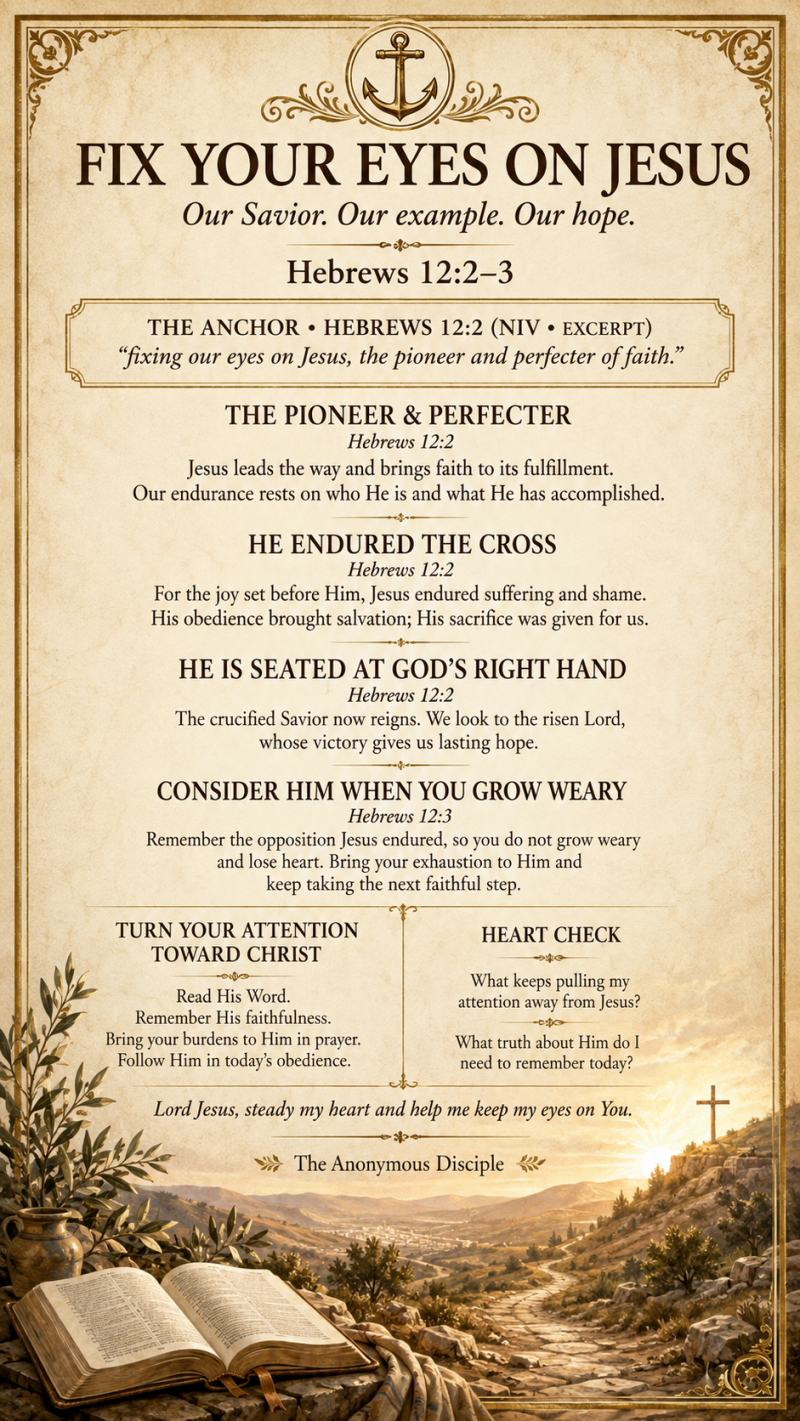
4. “Fixing our eyes on Jesus”—Hebrews 12:2–3
Jesus is the pioneer and perfecter of faith. He endured the cross, despised its shame, and sat down at God’s right hand.
His endurance had a destination: “the joy set before him”—Hebrews 12:2.
Verse 3 tells us to consider Him so that we do not grow weary and lose heart. The passage directs our attention to a Savior who has endured suffering and now reigns.
When we feel weary, the question becomes: “Where am I looking for the strength to continue?”
5. “God is treating you as his children”—Hebrews 12:4–7, 10
The writer draws on Proverbs 3:11–12 to explain the Father’s discipline. Here, discipline includes loving correction and training.
Hebrews 12:10 (KJV):
“For they verily for a few days chastened us after their own pleasure; but he for our profit, that we might be partakers of his holiness.”
Earthly parents are imperfect; God’s training serves our true good. His purpose is that we share in His holiness.
We should not use this passage to assume that every illness or hardship is punishment for a particular sin. Its encouragement is that hardship does not mean the Father has abandoned His children. He can train and mature us through what we endure.
The next verse supplies a helpful bridge: Hebrews 12:11 acknowledges that discipline is painful at the time, yet produces righteousness and peace in those trained by it.
6. Pursue peace and holiness—Hebrews 12:14
Hebrews 12:14 (KJV):
“Follow peace with all men, and holiness, without which no man shall see the Lord.”
We actively pursue peaceful relationships and lives shaped by God’s character. Peace does not require approving wrongdoing, and holiness reaches beyond appearances into our desires, words, and conduct.
This is a serious call to a transformed life. We do not earn salvation through flawless performance; belonging to Christ calls us to follow Him.
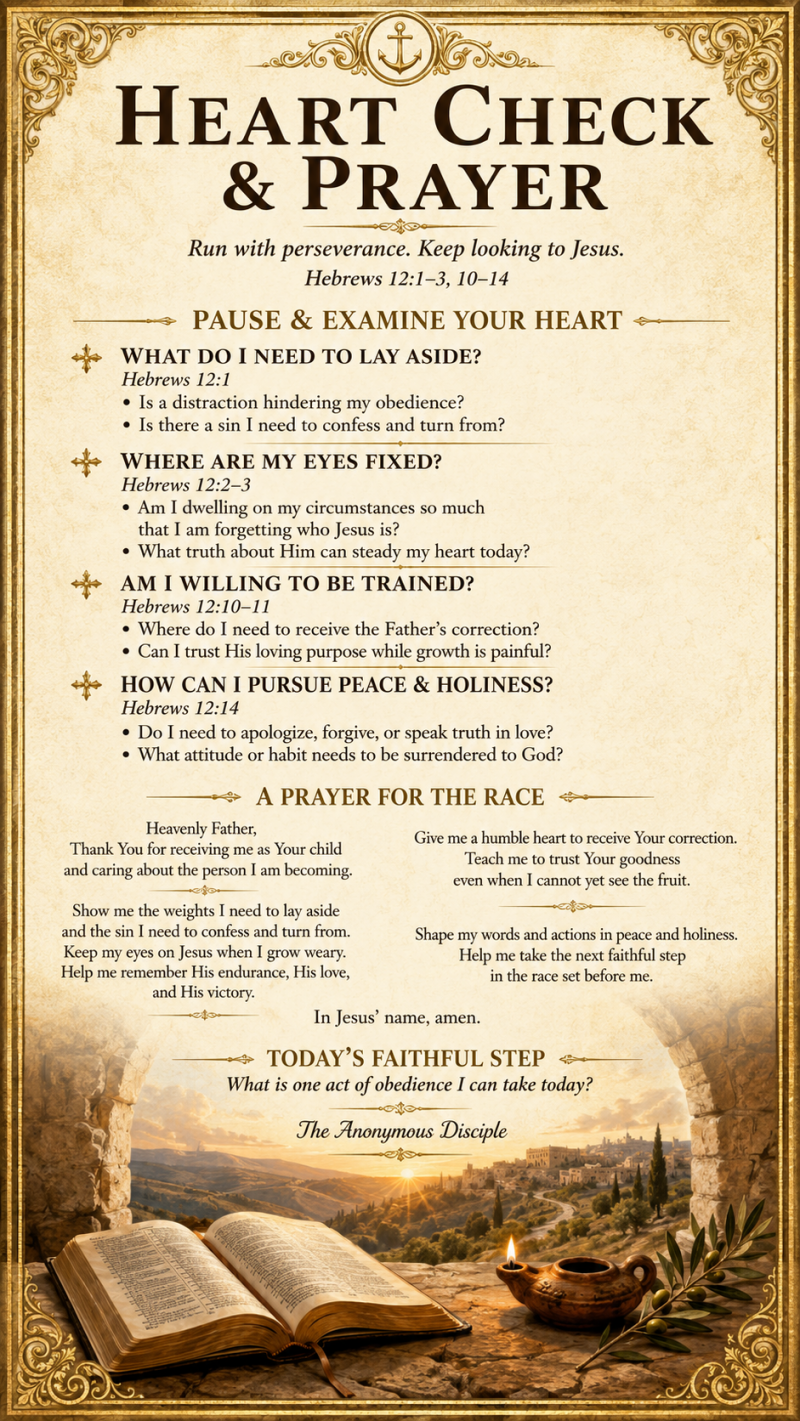
For this morning, carry this question with you:
“Lord, what do I need to lay aside—and where do I need to keep going?” ⚓️
Father, thank You for loving us as Your children. Show us what hinders our obedience, and help us turn from the sin that entangles us. Keep our eyes on Jesus when we become weary. Train our hearts in holiness, and let Your peace shape how we speak and serve today. In Jesus’ name, amen. ❤️
Add comment
Comments