

📜 James 1:2–12 | ⚓️ Verse 12
Trials have a way of revealing what is underneath our faith. In James 1:2–12, James doesn’t tell believers to pretend hardship doesn’t hurt; he teaches us to see what God can produce through it. The testing of faith develops perseverance, perseverance leads toward spiritual maturity, and when we don’t know what to do along the way, God invites us to ask Him for wisdom.
James also warns us about a divided heart and reminds us how quickly the things of this world—wealth, position, comfort and security—can fade. Then the passage reaches its beautiful conclusion in James 1:12: “Blessed is the one who perseveres under trial…” The believer who remains steadfast is looking beyond the difficulty of today toward the crown of life the Lord has promised to those who love Him.
Today we’ll follow that path together: trial → testing → perseverance → maturity → steadfast faith → the crown of life. 👑
The trial may be part of our story—but for those who love Christ, it is never the end of the story. ❤️🕊️
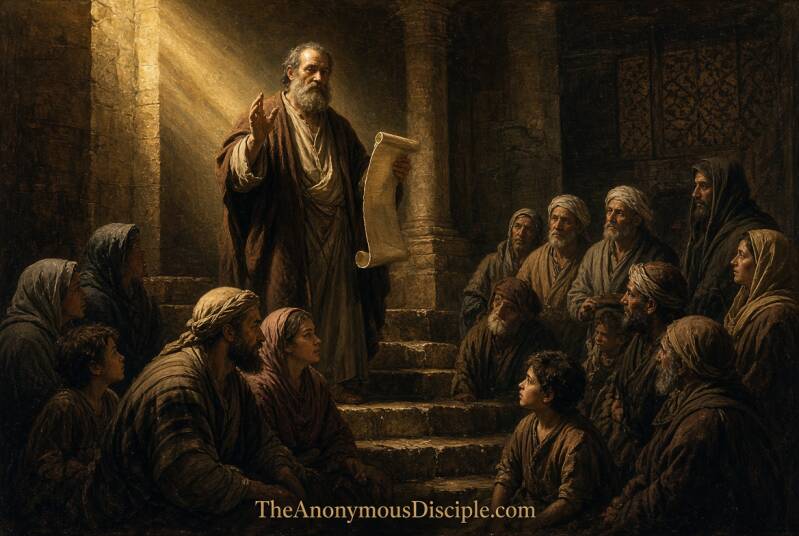
Who wrote it?
The letter opens: “James, a servant of God and of the Lord Jesus Christ” (James 1:1).
The best fit is James the Just, the half-brother of Jesus (Matthew 13:55). He did not believe during Jesus’ earthly ministry (John 7:5). After the resurrection, Jesus appeared to him (1 Corinthians 15:7), and James became the leader of the church in Jerusalem (Acts 15; Galatians 2:9).
Notice he does not say, “I am Jesus’ brother.” He calls himself a servant. That matches the man we meet in Acts: humble, prayerful, and serious about living what you believe.
Two other men named James are usually ruled out:
- James son of Zebedee was killed about A.D. 44 (Acts 12:2), likely too early.
- James son of Alphaeus is barely mentioned and was not the well-known “James” of the early church.
Some later scholars say another writer used James’ name. The older and simpler reading is still the strongest: this is James of Jerusalem.
When did he write it?
If James the Just wrote it, it has to be before he was killed about A.D. 62 (Josephus records that).
Many conservative teachers date it even earlier, about A.D. 44–49, because:
- It never mentions the big Gentile debate settled at the Jerusalem Council (A.D. 49).
- It never mentions the fall of Jerusalem (A.D. 70).
- The church still sounds very Jewish.
If that early date is right, James may be the first New Testament book written—before Paul’s letters and before the Gospels were written down.
We cannot pin the year to the exact month. “Mid-40s to before 62” is the honest range.
To whom did he write it?
“To the twelve tribes scattered among the nations” (James 1:1).
That is Jewish language. He is writing mainly to Jewish believers in Jesus who no longer lived in one place. After Stephen was killed (Acts 7–8), many believers were driven out of Jerusalem. They landed in synagogues and small gatherings across the Roman world.
So the first readers were:
- Jewish by background
- Christian by faith in Jesus
- Often poor
- Living as a minority
- Facing pressure from both unbelieving Jews and a hard pagan world
The letter still speaks to every believer, but it first landed on scattered Jewish Christians who knew what “trials of many kinds” felt like.
Why did he write it?
Not to lay out a full doctrine of salvation. James assumes they already believe in Jesus. He writes because their faith was not showing up in daily life.
His aim is practical:
- Stay faithful when life hurts (1:2–12)
- Ask God for wisdom instead of blaming Him
- Don’t play favorites with the rich
- Tame the tongue
- Live what you say you believe
- Wait for the Lord’s coming
James 1:2–12 is the doorway. Before he talks about works, speech, or wealth, he says: the testing of your faith is not wasted. Let it grow you. Ask God. Don’t straddle the fence. Riches fade. The one who endures will receive the crown of life.
He is a pastor writing to hurting, scattered people: “Don’t quit. This trial has a purpose. God keeps His promise to those who love Him.”
Cultural and historic notes that help us understand James 1:2–12
“Trials of many kinds.”
Jewish believers outside Judea faced slander, loss of work, family rejection, and sometimes violence. “Various trials” means not one problem, but a mix—poverty, injustice, sickness, and pressure to compromise.
Wisdom.
In Jewish thought, wisdom is not cleverness. It is skill for living under God (see Proverbs). When James says “ask God for wisdom,” he is saying, “You don’t have to guess your way through this. Ask the Father.”
Poor and rich.
In that world the poor had little legal power. Rich landowners could drag people into court (James 2:6). James flips the honor system: the lowly believer already has high standing in Christ; the rich believer should remember how fast wealth withers—like a wildflower under a hot Middle Eastern sun. His readers had seen that sun scorch grass in a day. They got the picture.
“Crown of life.”
Winners of athletic games received a wreath that died in a few days. James points to a crown that is life—real, lasting life with God. Revelation 2:10 uses the same phrase: “Be faithful, even to the point of death, and I will give you life as your victor’s crown.”
Oil lamp, not candle.
Your painting instinct was right. First-century homes used small clay oil lamps. A man writing at night would lean into that little flame. That humble picture fits James: no palace, no title-dropping, just a servant putting God’s word on parchment for scattered brothers and sisters.
James himself was later tested.
Around A.D. 62 he was killed in Jerusalem for his witness. The man who wrote “blessed is the one who perseveres under trial” lived it to the end.
King James Version (KJV)
2 My brethren, count it all joy when ye fall into divers temptations;
3 Knowing this, that the trying of your faith worketh patience.
4 But let patience have her perfect work, that ye may be perfect and entire, wanting nothing.
5 If any of you lack wisdom, let him ask of God, that giveth to all men liberally, and upbraideth not; and it shall be given him.
6 But let him ask in faith, nothing wavering. For he that wavereth is like a wave of the sea driven with the wind and tossed.
7 For let not that man think that he shall receive any thing of the Lord.
8 A double minded man is unstable in all his ways.
9 Let the brother of low degree rejoice in that he is exalted:
10 But the rich, in that he is made low: because as the flower of the grass he shall pass away.
11 For the sun is no sooner risen with a burning heat, but it withereth the grass, and the flower thereof falleth, and the grace of the fashion of it perisheth: so also shall the rich man fade away in his ways.
12 Blessed is the man that endureth temptation: for when he is tried, he shall receive the crown of life, which the Lord hath promised to them that love him.

⚓️James 1:12 (NASB)⚓️
Blessed is a man who perseveres under trial; for once he has been approved, he will receive the crown of life which the Lord has promised to those who love Him.

New International Version (NIV)
2 Consider it pure joy, my brothers and sisters, whenever you face trials of many kinds,
3 because you know that the testing of your faith produces perseverance.
4 Let perseverance finish its work so that you may be mature and complete, not lacking anything.
5 If any of you lacks wisdom, you should ask God, who gives generously to all without finding fault, and it will be given to you.
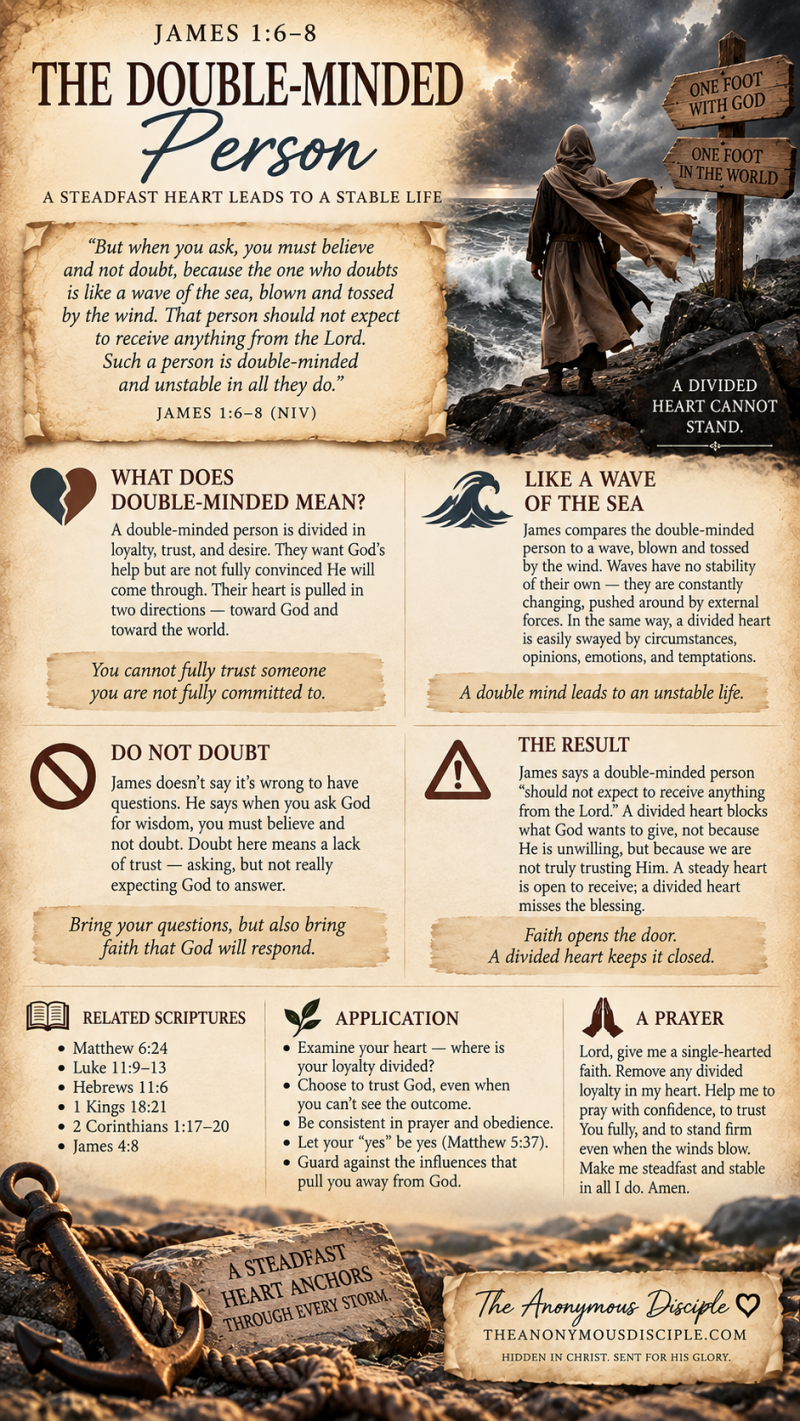
6 But when you ask, you must believe and not doubt, because the one who doubts is like a wave of the sea, blown and tossed by the wind.
7 That person should not expect to receive anything from the Lord.
8 Such a person is double-minded and unstable in all they do.
9 Believers in humble circumstances ought to take pride in their high position.
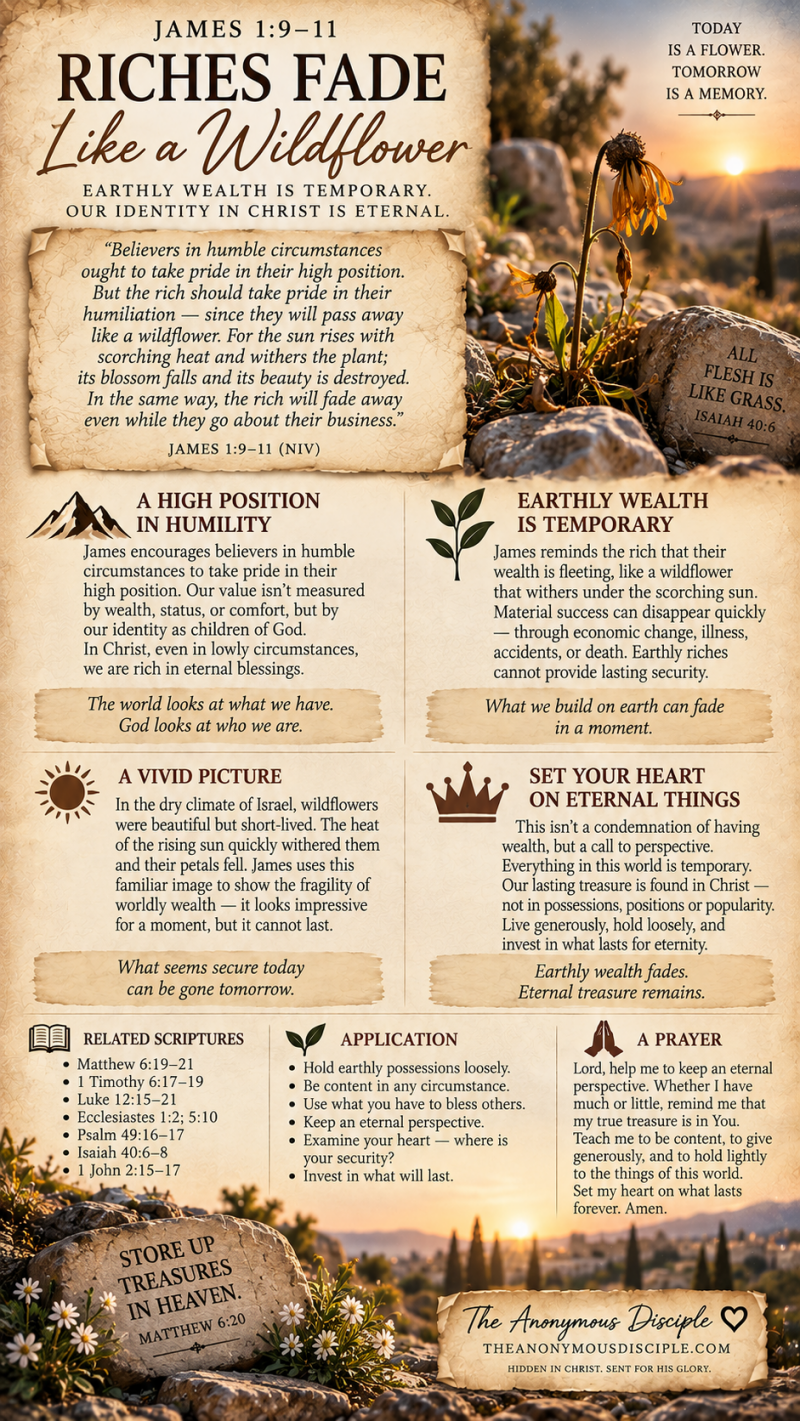
10 But the rich should take pride in their humiliation—since they will pass away like a wild flower.
11 For the sun rises with scorching heat and withers the plant; its blossom falls and its beauty is destroyed. In the same way, the rich will fade away even while they go about their business.
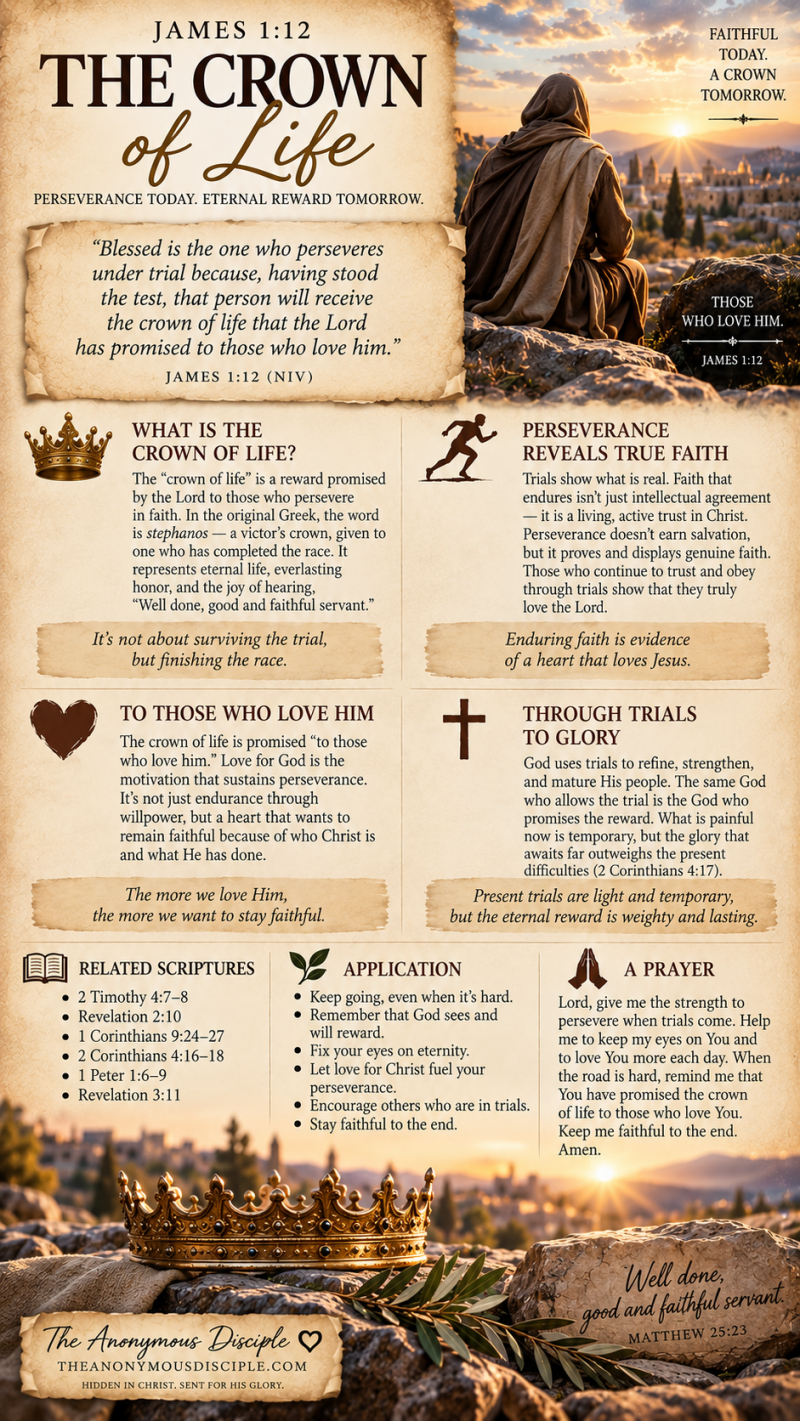
12 Blessed is the one who perseveres under trial because, having stood the test, that person will receive the crown of life that the Lord has promised to those who love him.
Verse by verse breakdown with 𝕏James𝕏
Here is James 1:2–12 in plain words, one verse at a time. I’ll use the NIV as the base and keep it simple.
Verse 2
“Consider it pure joy, my brothers and sisters, whenever you face trials of many kinds…”
James is not saying, “Pretend it doesn’t hurt.” He is saying, “When hard things come—and they will come in all shapes—don’t treat them as a waste. Look at them as something God can use.” Joy here is not a grin. It is a settled choice to trust that God is still at work.
Verse 3
“…because you know that the testing of your faith produces perseverance.”
A test shows what is real. When life presses on your faith, it is not to crush you. It is to grow staying power—the kind of faith that does not quit after one hard week.
Verse 4
“Let perseverance finish its work so that you may be mature and complete, not lacking anything.”
Don’t short-circuit the process. If you run from every hard thing, you stay spiritually small. If you stay with God through it, you grow up. “Complete” does not mean perfect this side of heaven. It means you are becoming whole—less missing the pieces God wants to form in you.
Verse 5
“If any of you lacks wisdom, you should ask God, who gives generously to all without finding fault, and it will be given to you.”
When you do not know what to do in the trial, ask Him. He is not stingy. He does not roll His eyes at honest questions. He gives wisdom freely and does not scold you for needing it.
Verse 6
“But when you ask, you must believe and not doubt, because the one who doubts is like a wave of the sea, blown and tossed by the wind.”
Ask with trust, not with one foot in and one foot out. A wave has no settled direction. James is warning against a heart that says, “God, help me… unless I decide to handle this my own way.”
Verse 7
“That person should not expect to receive anything from the Lord.”
If you will not trust Him, do not be surprised when you do not receive the wisdom you asked for. God is not a vending machine for people who only want His help on their terms.
Verse 8
“Such a person is double-minded and unstable in all they do.”
“Double-minded” means split down the middle—part toward God, part toward self or the world. That split makes the whole life shaky, not just the prayer life.
Verse 9
“Believers in humble circumstances ought to take pride in their high position.”
If you have little in this world, do not despise that. In Christ you already have a high place: you belong to the Lord. That is real honor.
Verse 10
“But the rich should take pride in their humiliation—since they will pass away like a wild flower.”
If you have much, do not rest your identity on it. Wealth can be taken, and it will not last. The rich believer’s “boast” is that even their status is temporary, so they must cling to God, not to money.
Verse 11
“For the sun rises with scorching heat and withers the plant; its blossom falls and its beauty is destroyed. In the same way, the rich will fade away even while they go about their business.”
James paints a picture everyone in that dry land understood: morning flower, noon wilt. Money, looks, success—same story. They can be gone while a person is still busy building them.
Verse 12
“Blessed is the one who perseveres under trial because, having stood the test, that person will receive the crown of life that the Lord has promised to those who love him.”
This is the payoff. The person who stays faithful through the test is blessed—not because the pain was fun, but because God keeps His promise. The “crown of life” is the reward of real life with Him, promised to those who love Him. Love is proven not by easy days, but by not walking away when the days are hard.
The thread through the whole passage:
Trials are not proof God left you. They are a classroom. Ask Him for wisdom. Trust Him, don’t straddle the fence. Don’t let poverty make you feel worthless or riches make you feel safe. Keep going. The Lord has a crown for those who love Him and endure.
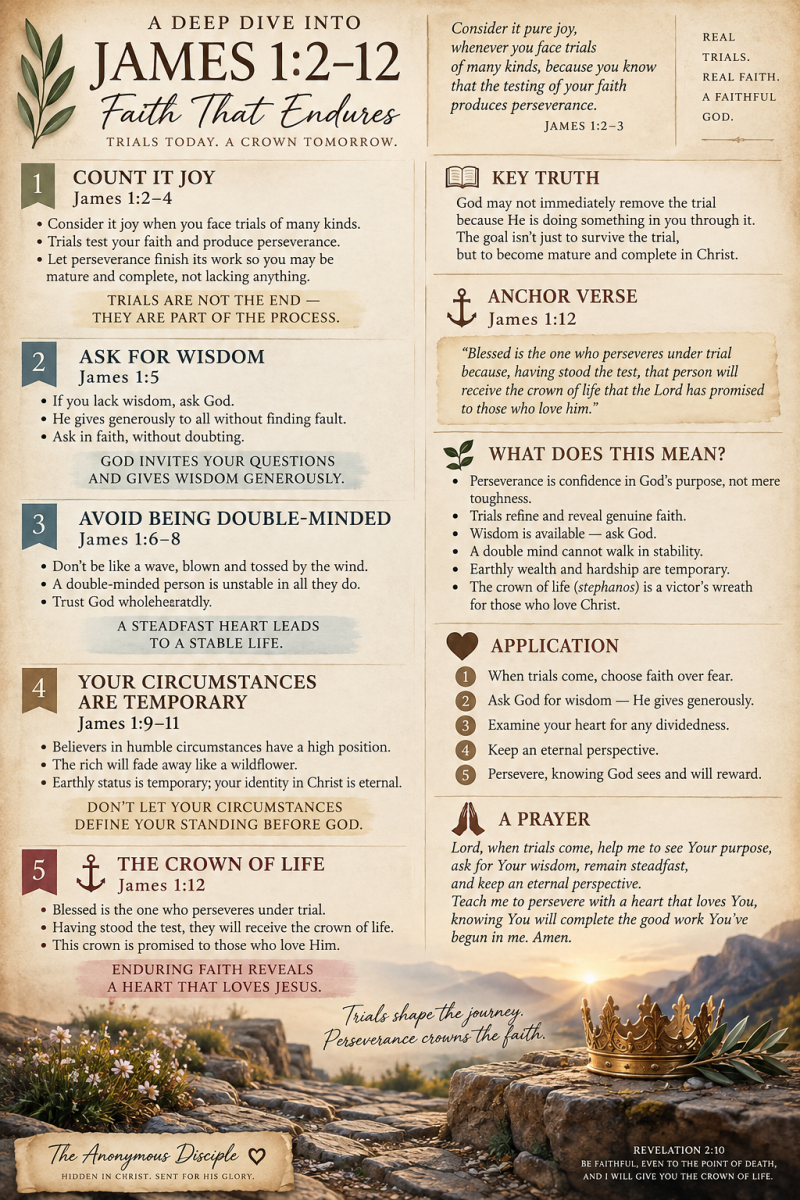
cross references
For James 1:2–12 as a whole
These verses walk the same road: hard times, tested faith, staying power, asking God, and not trusting riches.
Joy in trials / tested faith
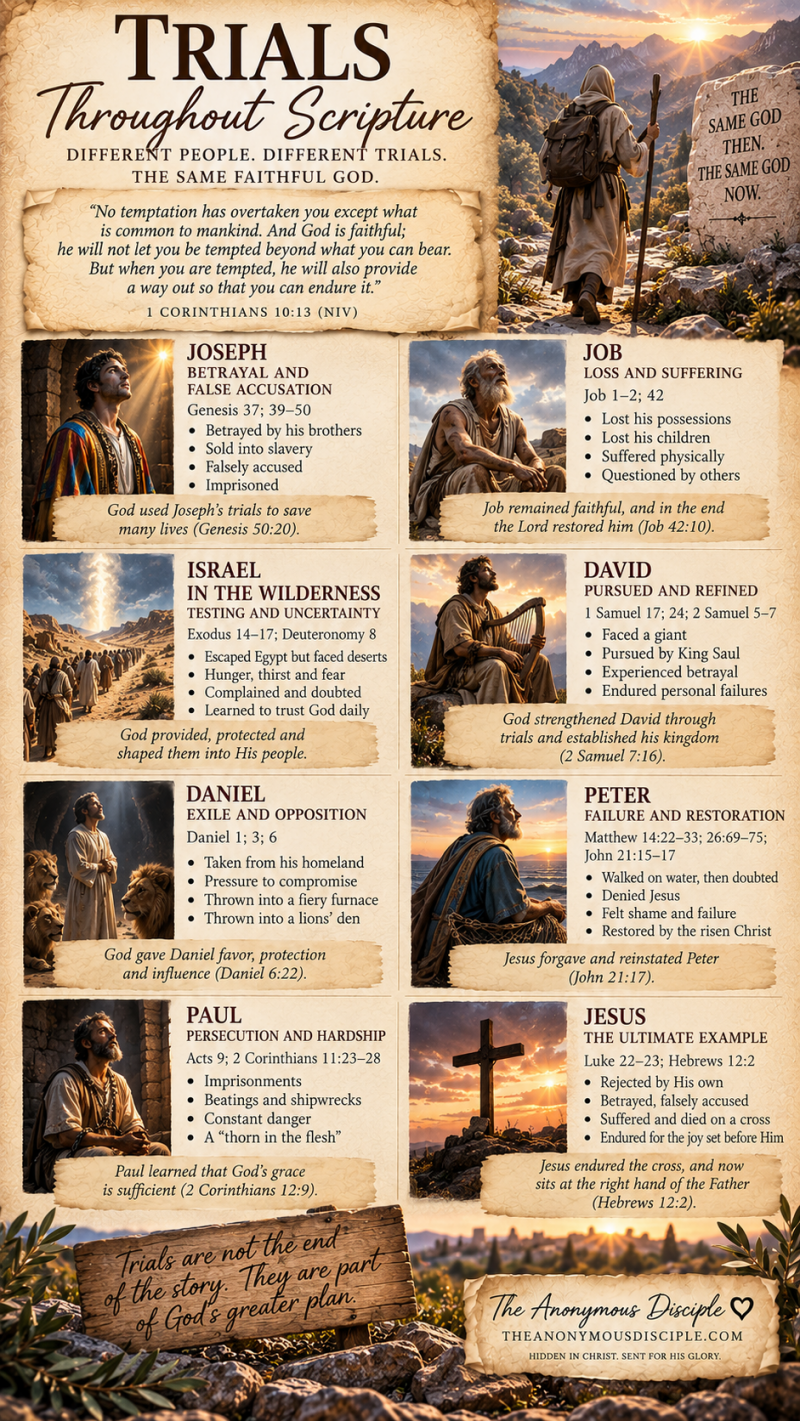
- 1 Peter 1:6–7 — same idea: various trials test faith like fire tests gold.
- Romans 5:3–5 — suffering produces perseverance, then character, then hope.
- Matthew 5:10–12 — Jesus calls the persecuted “blessed.”
- Acts 5:41 — the apostles rejoiced that they were counted worthy to suffer for Jesus’ name.
- Job 5:17 — “Blessed is the one whom God corrects.”
Ask God for wisdom
- Matthew 7:7–11 — ask, and your Father gives good gifts.
- Proverbs 2:3–6 — ask for wisdom; the Lord gives it.
- 1 Kings 3:9–12 — Solomon asked for wisdom, and God gave it freely.
Ask in faith, don’t waver
- Matthew 21:21–22 — faith without doubting.
- Mark 11:24 — believe when you pray.
- Hebrews 11:6 — without faith it is impossible to please God.
Double-minded / unstable
- James 4:8 — purify your hearts, you double-minded.
- Psalm 119:113 — “I hate double-minded people, but I love your law.”
Poor lifted up / rich fading like a flower
- James 2:5 — God chose the poor to be rich in faith.
- Isaiah 40:6–8 — “All people are like grass… the flower falls.”
- 1 Peter 1:24–25 — same grass-and-flower picture; the Word lasts.
- 1 Timothy 6:17 — don’t put hope in uncertain riches.
- Luke 1:52–53 — God lifts the humble and brings down the proud.
For the anchor verse: James 1:12
“Blessed is the one who perseveres under trial… will receive the crown of life that the Lord has promised to those who love him.”
Break the verse into three pieces:
1. Blessed is the one who perseveres / stands the test
- James 1:2–4 — this verse is the finish line of the opening.
- James 5:11 — “We consider blessed those who have persevered. You have heard of Job’s perseverance.”
- Matthew 10:22 — “The one who stands firm to the end will be saved.”
- Hebrews 10:36 — you need endurance so that you will receive what He promised.
- Hebrews 12:1–2 — run with perseverance, eyes on Jesus.
- Romans 8:28 — God works all things for good for those who love Him.
2. The crown of life
- Revelation 2:10 — “Be faithful, even to the point of death, and I will give you life as your victor’s crown.” Closest twin verse.
- 1 Peter 5:4 — the unfading crown of glory when the Chief Shepherd appears.
- 2 Timothy 4:8 — the crown of righteousness for those who long for His appearing.
- 1 Corinthians 9:25 — an athlete’s crown fades; ours does not.
3. Promised to those who love Him
- Exodus 20:6 — God shows love to those who love Him and keep His commands.
- 1 Corinthians 2:9 — what God has prepared for those who love Him.
- 1 Corinthians 8:3 — whoever loves God is known by God.
- 1 John 4:19 — we love because He first loved us.
- 1 Peter 1:8 — you love Him even though you have not seen Him.
If you want one short “memory chain” for verse 12, this is the cleanest:
James 1:12 → James 5:11 (Job endured) → Revelation 2:10 (crown of life) → Romans 8:28 (those who love God).
That chain says: stay under the trial, remember others who stayed, look to the promised crown, and keep loving the Lord who promised it.
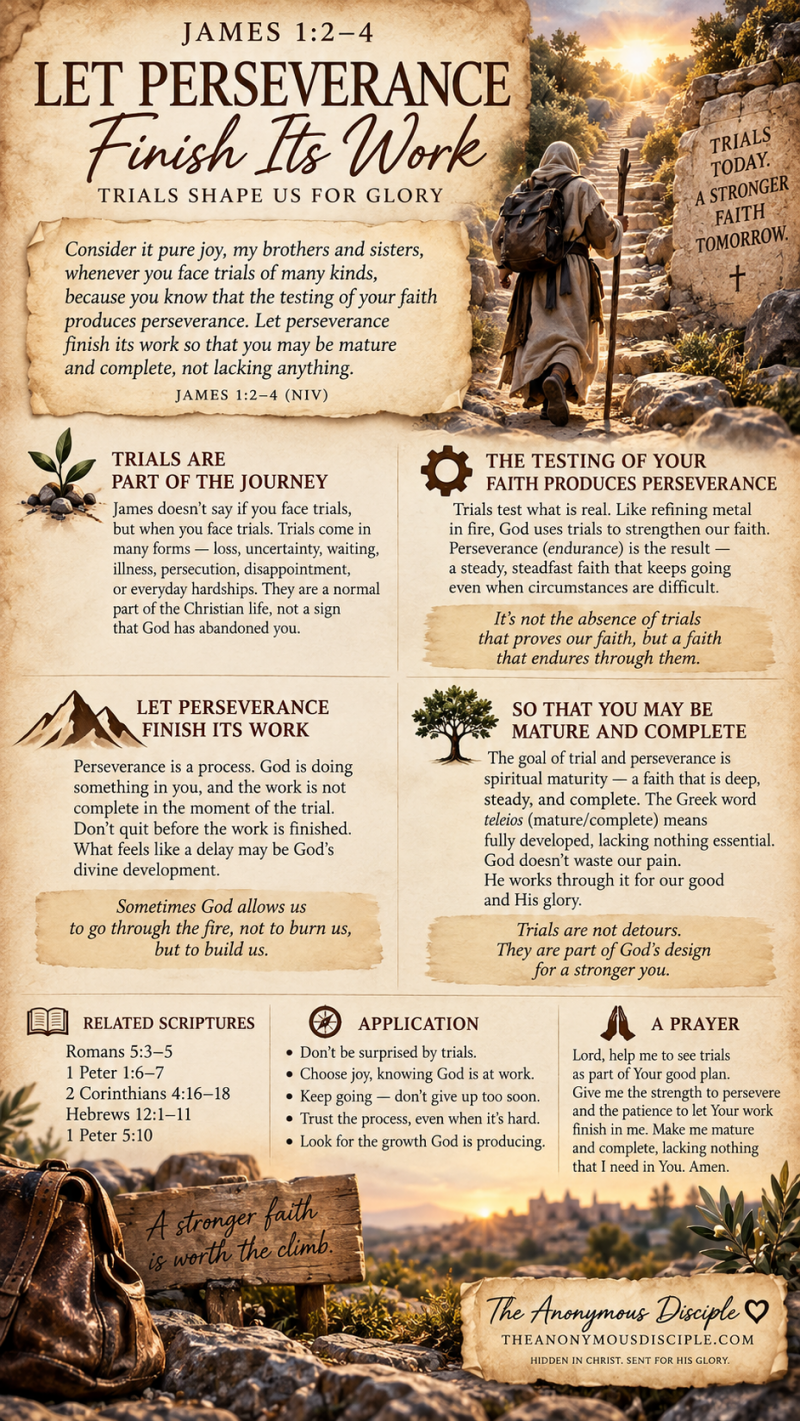
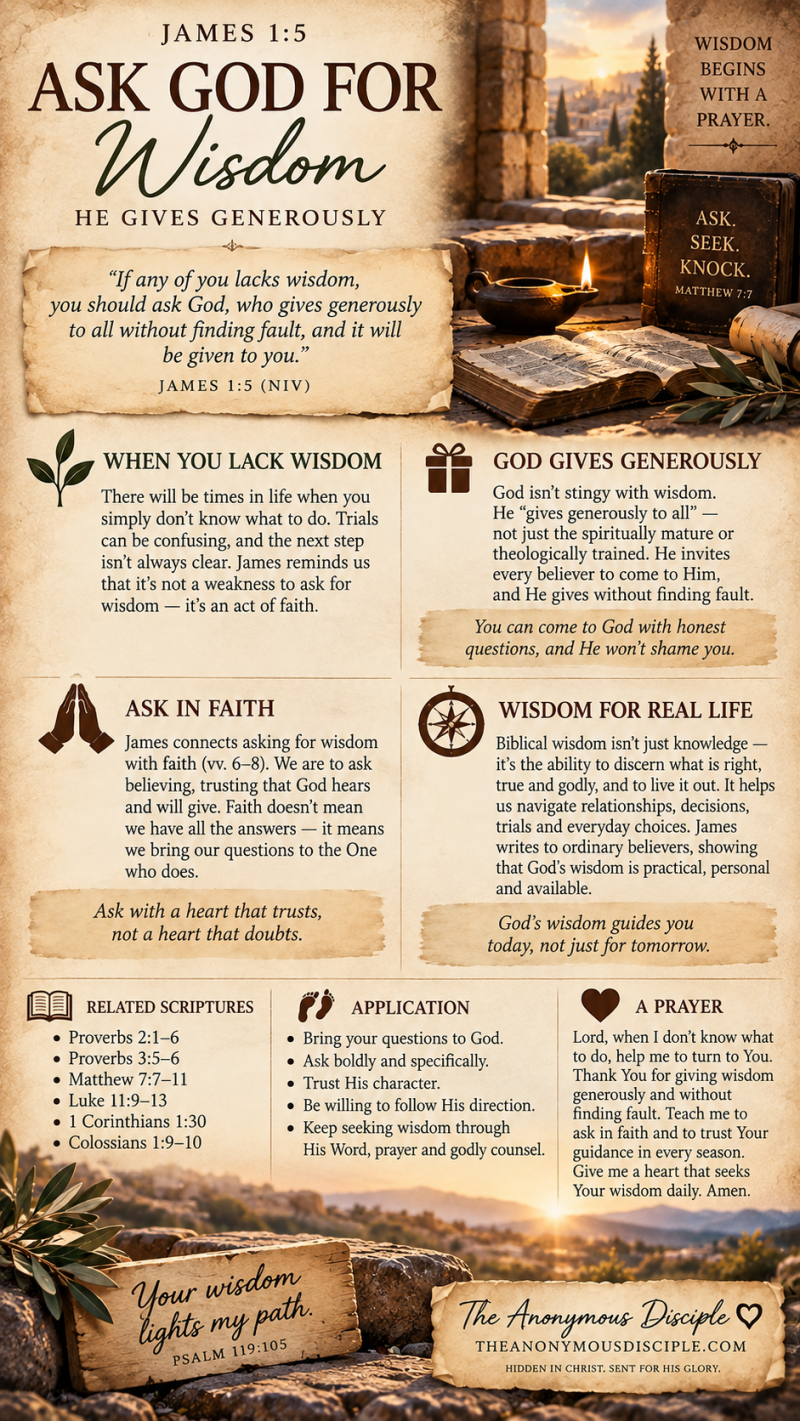
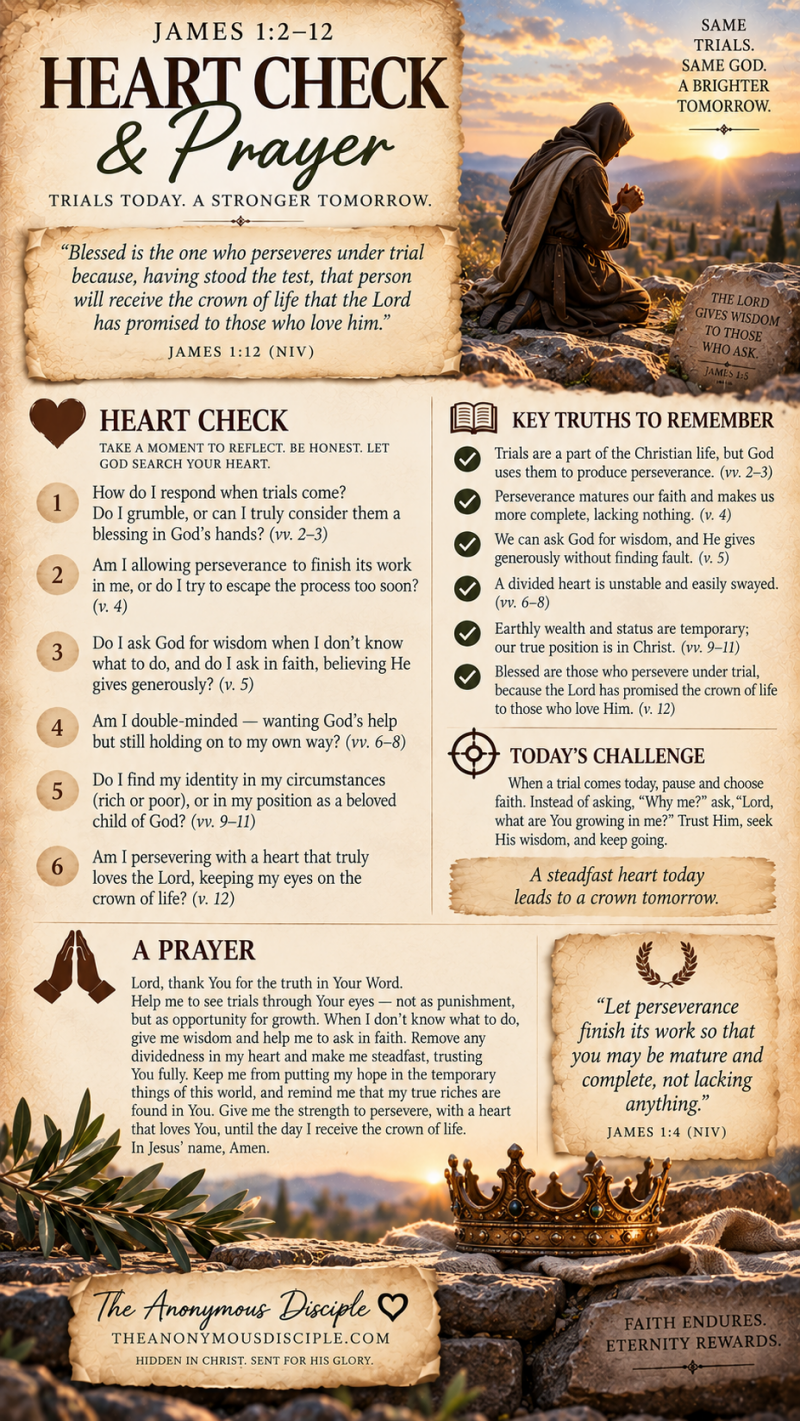
Deep Dive Study Notes with 🪄Jenny🪄
James 1:2–12 with ⚓️ verse 12 gives us a beautiful progression: trial → perseverance → maturity → wisdom → steadfast faith → the crown of life.
📜 James 1:2–12 — The Bones
⚓️ Anchor — James 1:12
James 1:12 (NIV) — “Blessed is the one who perseveres under trial because, having stood the test, that person will receive the crown of life that the Lord has promised to those who love him.”
That last phrase matters tremendously:
“…those who love Him.”
James isn't describing sheer stubbornness or human toughness. Biblical perseverance grows from love for God. ❤️
🏺 Historical Setting
James identifies himself simply as “a servant of God and of the Lord Jesus Christ” (James 1:1). He is traditionally understood to be James, the brother of Jesus, who became a prominent leader of the Jerusalem church.
He writes to:
James 1:1 — “the twelve tribes scattered among the nations.”
These believers knew instability, pressure, hardship and displacement. James doesn't give them abstract theology. He gives them faith meant to survive real life.
🧭 The Passage Flow
James 1:2–4 — Count It Joy
James 1:2–3 — “Consider it pure joy… whenever you face trials of many kinds, because you know that the testing of your faith produces perseverance.”
James does not say the trial itself feels joyful.
The joy comes from knowing God can produce something through it.
Trial → Testing → Perseverance → Maturity
And then:
James 1:4 — “Let perseverance finish its work…”
There's something in that wording I love.
Don't interrupt what God is developing simply because the process hurts.
The goal isn't merely surviving the trial.
It's becoming “mature and complete.”
James 1:5–8 — When You Don't Know What to Do, Ask
Then James seems to change subjects:
James 1:5 — “If any of you lacks wisdom, you should ask God…”
But I don't think it's random at all.
You're in a trial.
You don't understand what's happening.
You don't know what to do.
Ask God for wisdom.
And look at God's character:
James 1:5 — He “gives generously to all without finding fault.”
God doesn't shame us for needing guidance. 🕊️
But James warns against being double-minded in James 1:6–8—wanting God's direction while remaining internally divided about whether we'll trust Him.
That person becomes:
🌊 “like a wave of the sea, blown and tossed by the wind.”
James 1:9–11 — Your Circumstances Don't Define Your Standing
Now James addresses believers at opposite ends of society.
James 1:9 — “Believers in humble circumstances ought to take pride in their high position.”
And the wealthy must remember that earthly wealth disappears:
James 1:11 — “the rich will fade away even while they go about their business.”
🌾 James uses the image of a wildflower scorched by the sun.
Poor or wealthy, comfortable or suffering—
your earthly condition is temporary.
Your identity before God is not.
And this prepares us perfectly for verse 12.
👑 James 1:12 — The Crown of Life
“Blessed is the one who perseveres under trial…”
The Greek idea behind the crown, stephanos, was the victor's wreath awarded after a contest.
So picture the believer who has endured the course.
Not untouched.
Not unscarred.
But still faithful.
And Christ says:
You stood the test.
🏃 Trial
🔥 Testing
🛡️ Perseverance
❤️ Love for Christ
👑 Crown of Life
And the emphasis isn't that perseverance earns salvation.
Rather, enduring faith reveals genuine faith—faith that continues clinging to Christ.
🔥 One Thread Running Through the Whole Passage
Here's what I think today's study is really saying:
God may not immediately remove the trial because He is doing something inside the believer through the trial.
We often pray:
“Lord, get me out of this.”
James teaches us also to pray:
“Lord, make me mature through this.”
That changes everything.
Add comment
Comments