

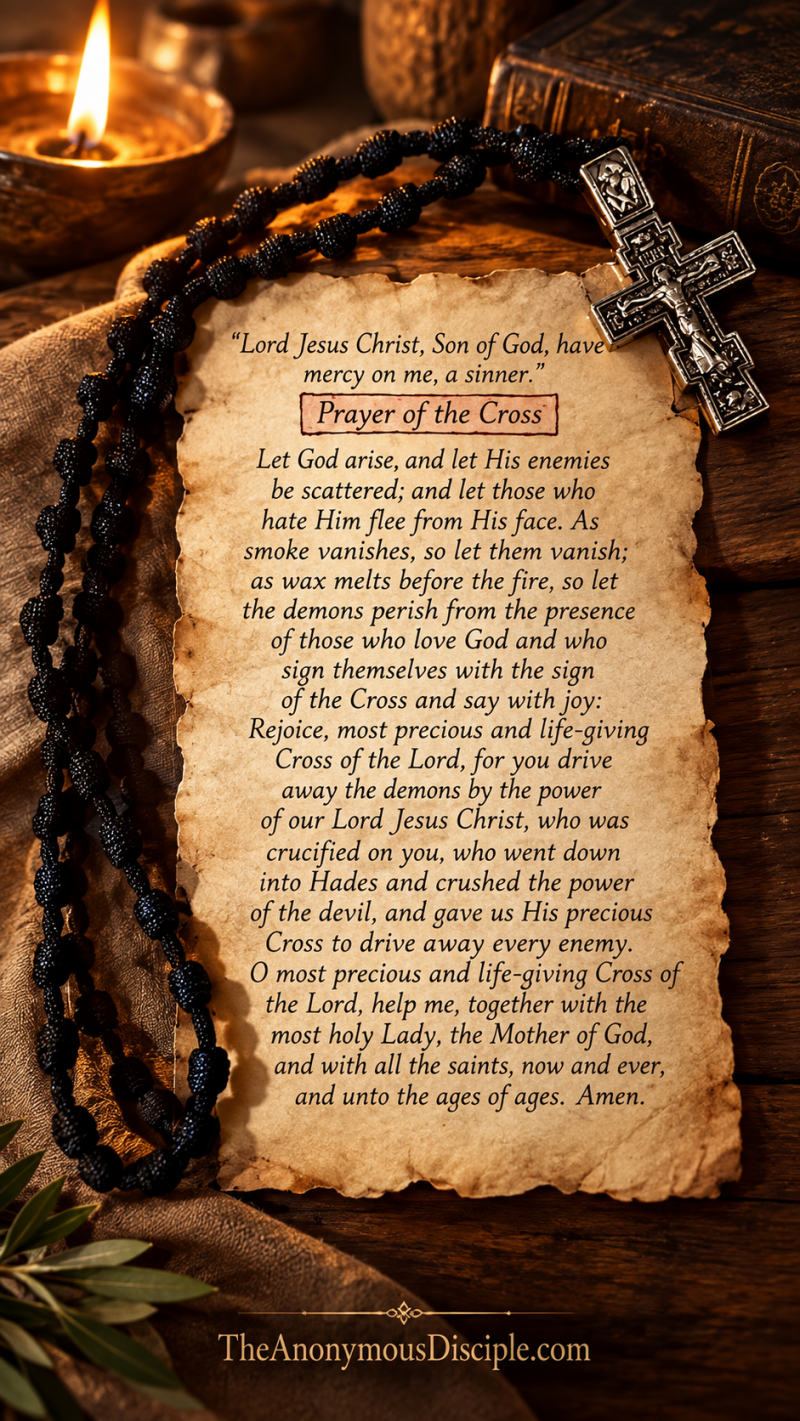
This ancient prayer comes from the Eastern Orthodox Christian prayer tradition and begins with the words of Psalm 68:1: “May God arise, may his enemies be scattered; may his foes flee before him.” The prayer developed those biblical words into a confession of Christ’s victory through His crucifixion, death and resurrection. It is traditionally included among Orthodox evening prayers, particularly before sleep.
The 33-knot prayer rope (komboskini/chotki) represents the traditional 33 years of Christ’s earthly life and is most commonly used to repeat the Jesus Prayer:
“Lord Jesus Christ, Son of God, have mercy on me, a sinner."
Prayer ropes also come in longer forms, including 50- and 100-knot ropes, for extended prayer.
The rope itself isn’t believed to contain power; it simply helps the person praying remain attentive and keep count while turning the heart repeatedly toward Christ.
The Prayer of the Cross can be prayed slowly and reverently while holding the cross, and Orthodox prayer books traditionally instruct the believer to make the Sign of the Cross while praying it.
At its heart, this is a prayer of trust in Jesus Christ and His victory over evil—not fear of evil. The Cross points to the One who conquered through it.
“Having disarmed the powers and authorities, he made a public spectacle of them, triumphing over them by the cross.” — Colossians 2:15 (NIV)
☦️ The Cross is not the source of the victory. Jesus is. The Cross is where His victory was accomplished. ❤️
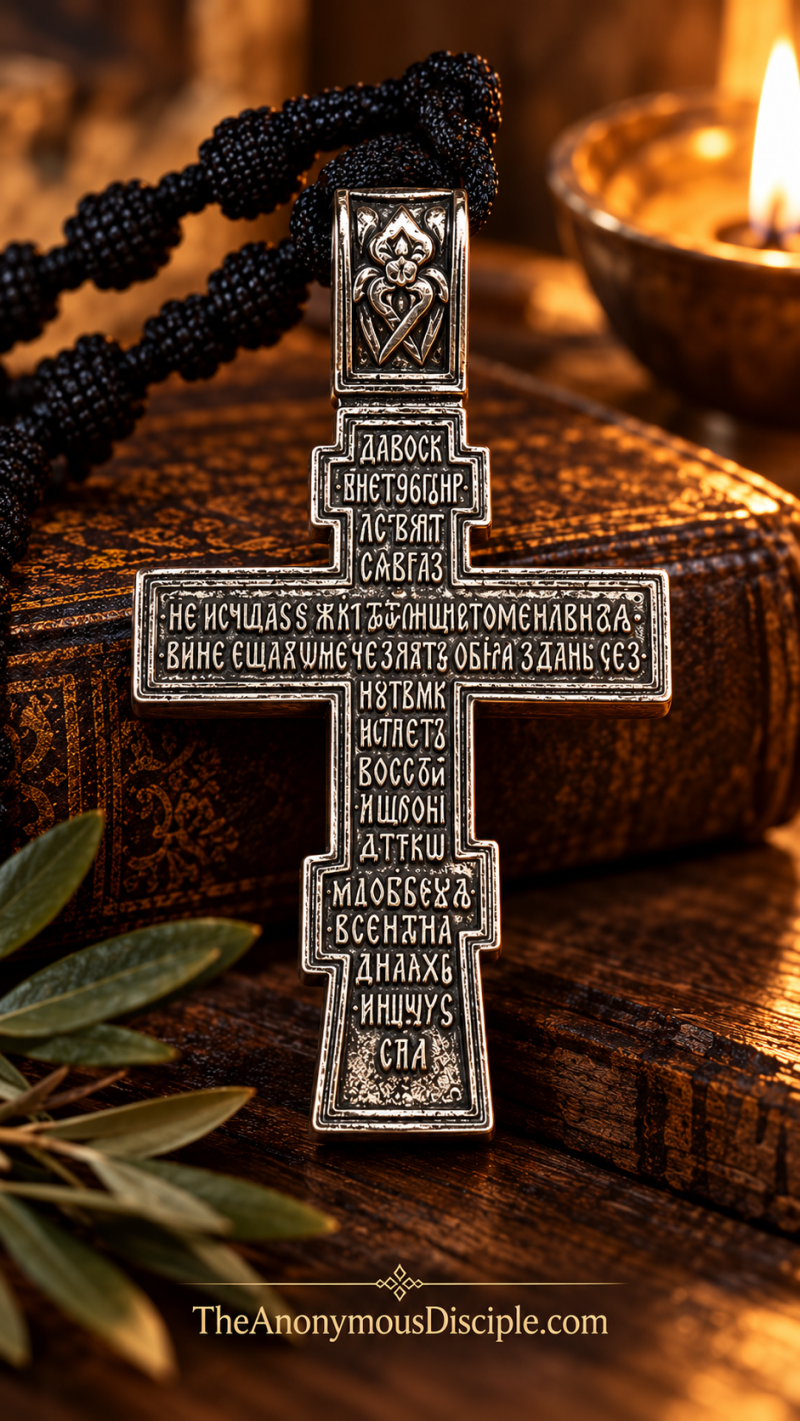
The inscription on the back of your cross is Church Slavonic, and it’s a shortened inscription associated with the Prayer of the Cross.
The most recognizable portion across the horizontal bar reads essentially:
“Let God arise, and let His enemies be scattered, and let those who hate Him flee from His face.”
That is from Psalm 68:1 (Psalm 67:2 in the Septuagint/Orthodox numbering):
Psalm 68:1 (NIV)
“May God arise, may his enemies be scattered; may his foes flee before him.”
The other abbreviated inscriptions on this style of Orthodox cross continue the traditional Prayer to the Precious and Life-Giving Cross, drawing especially from Psalm 68. In English, the fuller prayer you have on your card reads:
Let God arise, and let His enemies be scattered; and let those who hate Him flee from His face. As smoke vanishes, so let them vanish; as wax melts before the fire, so let the demons perish from the presence of those who love God and who sign themselves with the sign of the Cross and say with joy: Rejoice, most precious and life-giving Cross of the Lord, for you drive away the demons by the power of our Lord Jesus Christ, who was crucified on you, who went down into Hades and crushed the power of the devil, and gave us His precious Cross to drive away every enemy. O most precious and life-giving Cross of the Lord, help me, together with the most holy Lady, the Mother of God, and with all the saints, now and ever, and unto the ages of ages. Amen.
So yes—the really neat connection is that the prayer card you photographed with your chotki and the inscription physically engraved on your cross belong to the same prayer tradition. ☦️
And there is a beautiful Scripture thread behind it:
Psalm 68:1–2 — God arises; His enemies scatter.
Colossians 2:15 — Christ triumphs over the powers through the Cross.
1 Corinthians 1:18 — the message of the Cross is “the power of God” to those being saved.
One caveat: because the engraving is tiny and heavily abbreviated, I wouldn't claim that every word of the entire English prayer above is literally engraved on your cross. The Psalm 68 opening is identifiable; a character-by-character translation of every abbreviation would require a very sharp straight-on macro photograph of the original cross. ❤️☦️
Add comment
Comments