

Job 38:31-41 ⚓ 38:33
Job has spent many chapters asking God to explain his suffering. When God finally answers from the whirlwind, He does not immediately explain why Job suffered. Instead, God begins revealing who He is.
God’s questions are not meant merely to embarrass Job. They expose the enormous difference between Job’s limited perspective and God’s complete wisdom.
The message is:
“Job, you cannot see everything I govern—but everything is still governed.”
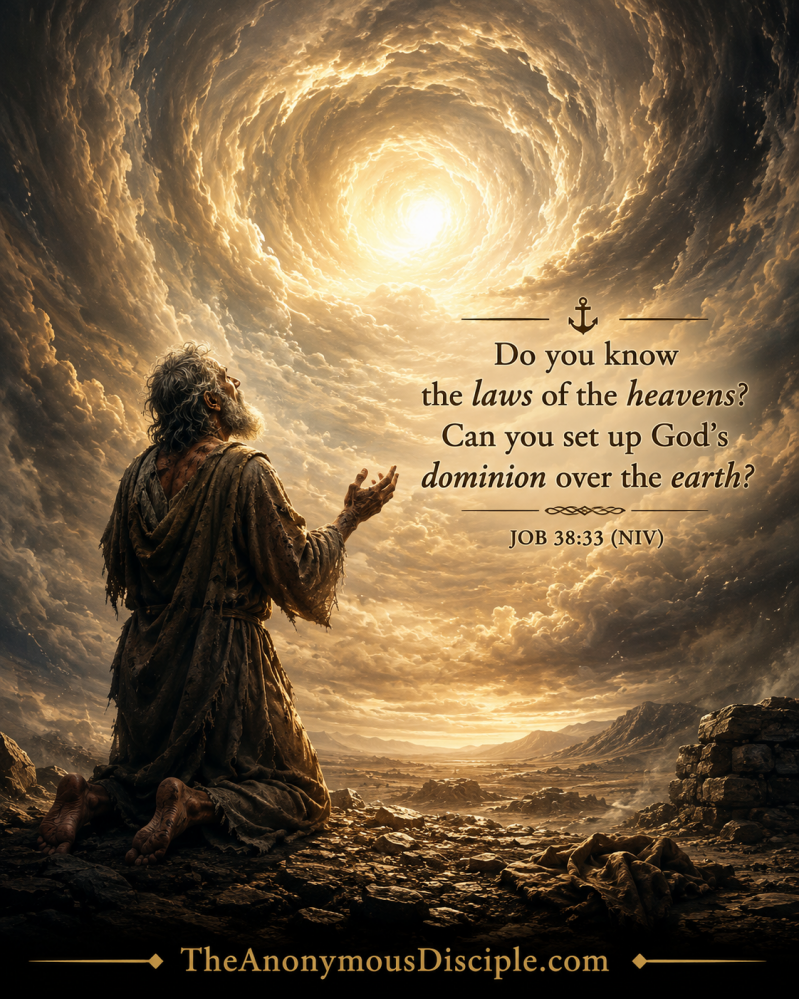
"Can you bind the chains of the Pleiades? Can you loosen Orion's belt? Can you bring forth the constellations in their seasons or lead out the Bear with its cubs? Do you know the laws of the heavens? Can you set up God's dominion over the earth? Can you raise your voice to the clouds and cover yourself with a flood of water? Do you send the lightning bolts on their way? Do they report to you, 'Here we are'? Who gives the ibis wisdom or gives the rooster understanding? Who has the wisdom to count the clouds? Who can tip over the water jars of the heavens when the dust becomes hard and the clods of earth stick together? Do you hunt the prey for the lioness and satisfy the hunger of the lions when they crouch in their dens or lie in wait in a thicket? Who provides food for the raven when its young cry out to God and wander about for lack of food?"
- Job 38:31-41
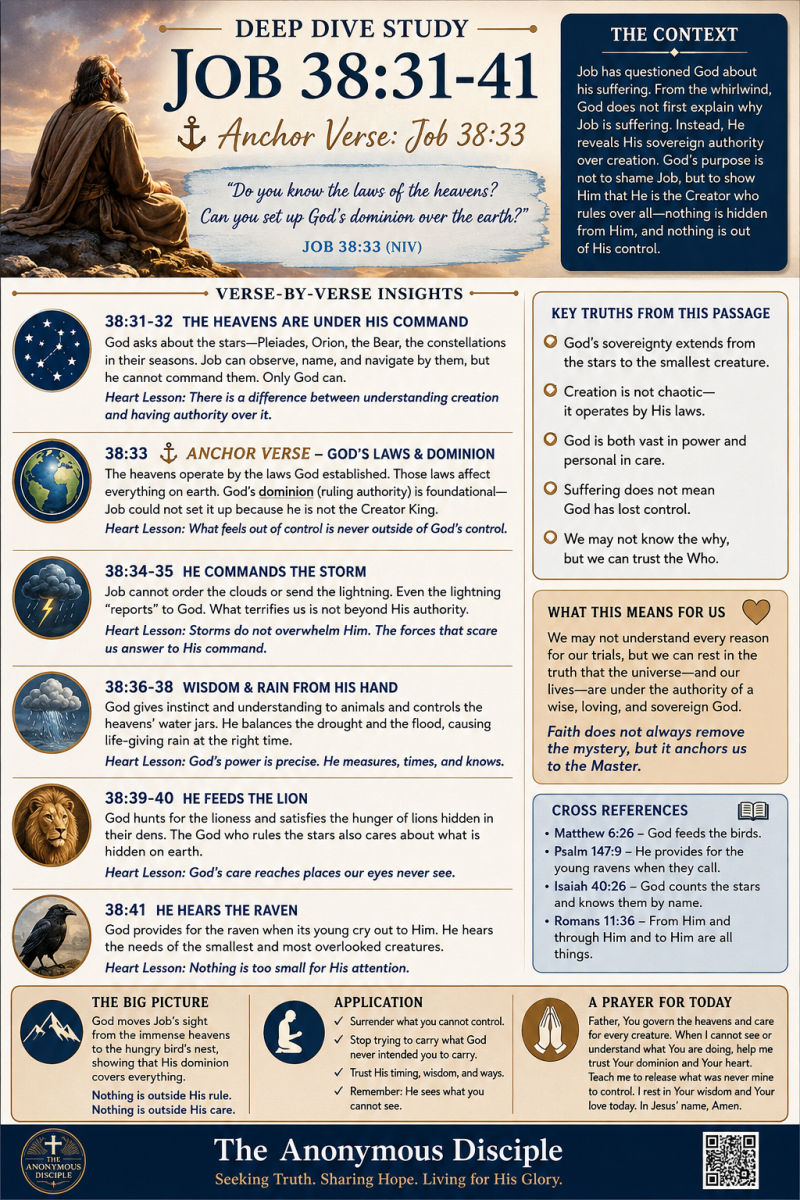
Deep Dive: Job 38:31–41 - (Study card below)
⚓ Anchor: Job 38:33
Job 38:33: “Do you know the laws of the heavens? Can you set up God’s dominion over the earth?”
Job 38:31–32 — God governs the heavens
Job 38:31: “Can you bind the chains of the Pleiades? Can you loosen Orion’s belt?”
Job 38:32: “Can you bring forth the constellations in their seasons or lead out the Bear with its cubs?”
God points Job toward recognizable groups of stars.
- Pleiades appears as a tightly clustered group.
- Orion is a prominent constellation.
- The Bear probably refers to a northern constellation such as Ursa Major.
- “The constellations in their seasons” emphasizes their orderly appearance at appointed times.
Job could observe the stars, name them and navigate by them—but he could not command them.
God can.
Human beings may discover the patterns of creation, but we did not establish those patterns. We can calculate an orbit, but we cannot command it into existence.
Heart lesson
There is a difference between understanding part of God’s creation and possessing authority over it.
Job could see the heavens, but only God could govern them.
⚓ Job 38:33 — The laws and dominion of God
Job 38:33: “Do you know the laws of the heavens? Can you set up God’s dominion over the earth?”
This verse joins two truths:
- The heavens operate according to laws established by God.
- Those heavenly laws affect and govern life on earth.
The sun, moon, seasons, weather patterns, tides and the ordering of time are not independent powers. They function within boundaries God established.
The word dominion points to ruling authority. Creation is not sovereign; God is sovereign over creation.
Job could not establish the heavens’ authority over the earth because Job was not the King who designed the system.
Why this matters in Job’s suffering
Job’s life felt chaotic, but God showed him that the universe was not chaotic.
The stars had boundaries.
The seasons had appointments.
The rain had direction.
The animals had provision.
Therefore, Job’s suffering was not proof that God had abandoned His throne.
This is the anchor for us too:
Something may feel out of control without ever being outside God’s control.
We often want God to explain the particular event. God sometimes responds by reminding us of His universal authority.
He does not always tell us why the storm came, but He shows us that the storm has never removed Him from His throne.
Job 38:34–35 — God commands rain and lightning
Job 38:34: “Can you raise your voice to the clouds and cover yourself with a flood of water?”
Job 38:35: “Do you send the lightning bolts on their way? Do they report to you, ‘Here we are’?”
Job could pray for rain, watch clouds develop or seek shelter from lightning. But he could not order the clouds to release their water.
The picture in Job 38:35 is almost like servants reporting to their master:
“Here we are. Where shall we go?”
Lightning appears wild and uncontrollable to us, yet even it is portrayed as responding to God’s command.
Heart lesson
What terrifies us is not terrifying to God.
Storms do not overwhelm Him. The forces that make us feel powerless remain servants under His authority.
Job 38:36–38 — God provides wisdom and controls the waters
Job 38:36: “Who gives the ibis wisdom or gives the rooster understanding?”
Job 38:37: “Who has the wisdom to count the clouds? Who can tip over the water jars of the heavens”
Job 38:38: “when the dust becomes hard and the clods of earth stick together?”
The precise identification of the creatures in Job 38:36 is debated in different translations, but the central meaning is clear: instinct and understanding come from God.
Animals sense changing conditions and behave according to abilities God has placed within them.
Then God returns to rainfall. He describes the clouds as heavenly water jars being tipped over until dry dust becomes firm ground.
Notice the balance:
- Too little rain brings drought.
- Too much rain brings flooding.
- The right amount brings life.
Job could neither count the clouds perfectly nor control how much water they carried. God could.
Heart lesson
God possesses not only power, but also precision.
His rule is not reckless strength. It is wisdom, timing, measurement and purpose.
Job 38:39–40 — God feeds the lion
Job 38:39: “Do you hunt the prey for the lioness and satisfy the hunger of the lions”
Job 38:40: “when they crouch in their dens or lie in wait in a thicket?”
God now moves Job’s attention from the enormous heavens to a hungry animal hiding in a den.
That shift is important.
The God who governs constellations also notices hunger.
God is not so occupied with the movement of stars that He overlooks the needs of creatures on earth. His sovereignty is both vast and attentive.
Jesus later taught a similar truth:
Matthew 6:26: "Look at the birds of the air; they do not show or reap or store away in barns, and yet your heavenly Father feeds them. Are you not much more valuable than they?"
Jesus’ point in Matthew 6:26 is that the Father feeds the birds, even though they cannot sow, harvest, or store crops. Then Jesus asks whether we are not worth far more to Him.
That fits beautifully with Job 38:39–41.
Job 38:39–40 — God feeds the lions
God asks Job whether he is the one who hunts food for the lioness or satisfies the hunger of young lions waiting in their dens.
Of course, Job cannot do that. Most people never even see those hidden animals, yet God knows exactly where they are and what they need.
The lesson is tender:
God’s care reaches places human eyes never see.
A lion may be hidden in a thicket. A raven’s nest may be high and unnoticed. But neither is hidden from God.
Job 38:41 — God hears the raven’s cry
Job 38:41: “Who provides food for the raven when its young cry out to God and wander about for lack of food?”
The raven was often viewed as an unclean and ordinary bird, yet God still mentions its young crying to Him.
They may not understand prayer as we do, but their cries of hunger rise before their Creator. God hears the need expressed in creation.
This reminds us of:
Psalm 147:9: “He provides food for the cattle and for the young ravens when they call.”
God does not care only for majestic lions. He also cares for small, vulnerable ravens.
He is Lord over:
- the constellation in the heavens,
- the lightning in the storm,
- the lion in the den,
- and the hungry bird in the nest.
Nothing is too vast for His authority, and nothing is too small for His attention.
The movement of Job 38:31–41
Look at how God leads Job’s eyes:
Stars → weather → wisdom → rain → lions → ravens
God moves from the immeasurable heavens all the way down to hungry baby birds.
It is as though God is saying:
“Job, I govern what is above you, what surrounds you, and what is hidden from you.”
That speaks directly to suffering. Job could not see what was happening in the heavenly realm. He could not understand why tragedy had entered his life. But his inability to see did not mean God had stopped ruling.
Returning to our anchor
Job 38:33: “Do you know the laws of the heavens? Can you set up God’s dominion over the earth?”
Job could not establish God’s dominion because God’s dominion was already established.
God was not asking Job to hold the world together. He was showing Job that the world had never been resting on Job’s shoulders.
And neither is it resting on ours.
We often exhaust ourselves trying to mentally manage things that belong to God:
- tomorrow,
- unanswered questions,
- the actions of other people,
- frightening possibilities,
- outcomes we cannot control.
Faith does not mean pretending those things are easy. Faith means recognizing whose hands they are actually in.
A powerful contrast
Job wanted an explanation.
God gave him a revelation.
Job asked, in effect, “Why is this happening?”
God answered, in effect, “Look at who is governing everything you cannot govern.”
Sometimes knowing every reason would still not give us peace. But knowing the One who rules, provides, measures, commands, and sees can steady us while the reasons remain hidden.
Heart message
The same God who keeps the stars in their appointed places also sees the personal concerns that feel buried deep in your heart.
He does not overlook the hidden den.
He does not ignore the empty nest.
He does not lose control of the storm.
And He does not lose sight of His child.
You may not know the laws by which God is presently working, but you can know the God whose dominion remains over it all.
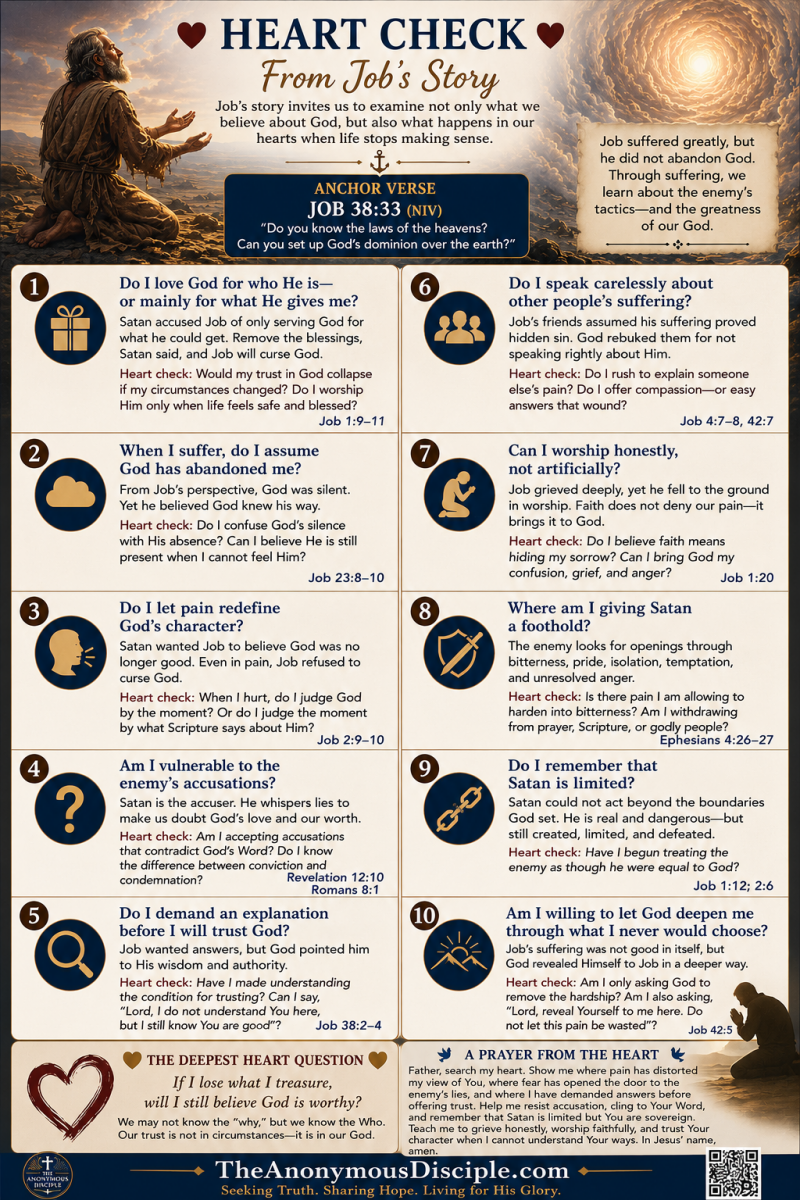
Why would God permit Satan to devastate an innocent man just to prove a point? - (additional study cards below)
[I still don’t understand the why. I get that God is on His throne and that nothing is hidden from Him. I just don’t get why God gave Satan the reins long enough to destroy everything at Job’s expense.]
First, Satan was not given unrestricted control
God permitted Satan to act, but imposed boundaries:
Job 1:12: “Very well, then, everything he has is in your power, but on the man himself do not lay a finger.”
Later, the boundary was expanded, but Job’s life was still protected:
Job 2:6: “Very well, then, he is in your hands; but you must spare his life.”
So Satan never truly held the reins. He operated on a leash. But—and this matters—the leash was long enough to cause horrifying loss. Saying that God placed limits does not make Job’s suffering feel small or easy to accept.
What was Satan actually accusing God of?
Satan’s charge was not merely, “Job will fail.”
He accused Job’s faith of being purchased:
Job 1:9–11: “Does Job fear God for nothing? … You have blessed the work of his hands… But now stretch out your hand and strike everything he has, and he will surely curse you to your face.”
In effect, Satan said:
“Job does not love You. He loves what You give him. Remove the gifts, and his worship will disappear.”
That accusation also dishonored God. It suggested God could obtain worship only by bribery.
Job’s endurance demonstrated something Satan denied: a human being can genuinely love God even while receiving no visible benefit from Him.
Job 13:15: “Though he slay me, yet will I hope in him.”
I would be careful about saying God allowed all this only to win an argument with Satan. The book never says Job’s children died merely so God could prove a point. That explanation is too neat for the weight of the story.
Job was not told about the heavenly conversation
This is one of the hardest features of the book.
We—the readers—see Job 1–2, but Job apparently never does. Throughout the book, Job begs for an explanation, yet God never says:
“Here is what Satan claimed, and here is why I allowed it.”
Why withhold that from him?
Perhaps because even knowing about Satan would not answer everything. Job could still ask:
“Why did You allow the accusation to be tested this way? Why my children? Why this much suffering?”
Knowing the immediate cause is not the same as understanding God’s ultimate reason.
The book corrects one false answer
Job’s friends believed suffering always worked like a simple equation:
Good people prosper; sinful people suffer.
Therefore, they assumed Job must have committed hidden wickedness.
But God says they misrepresented Him:
Job 42:7: “You have not spoken the truth about me, as my servant Job has.”
Job therefore teaches that intense suffering is not automatically evidence of personal punishment. Job was not suffering because he had secretly earned it.
Job 1:1: "...This man was blameless and upright; he feared God and shunned evil.”
That does not fully explain why God permitted it, but it prevents us from giving the cruel answer Job’s friends gave.
Did God use Job without caring about the cost?
This is where I think we need to resist tidy religious language.
Job’s children were real people. His grief was real. His wife suffered too. Even after Job received more children in Job 42:13, the first ten were not replaceable. A new child does not erase the death of another child.
The restoration at the end shows that evil and loss do not receive the final word, but it does not make the earlier deaths insignificant.
The Bible allows Job to grieve fiercely:
Job 3:3: “May the day of my birth perish.”
Job 7:20: “Why have you made me your target?”
Job 10:1–2: “I loathe my very life… I will say to God, Do not condemn me, but tell me what charges you have against me.”
God does not strike Job dead for asking. Job speaks from anguish, and God continues engaging with him. That tells us God is not threatened by an honest question like ours.
What Job eventually receives
Job does not receive a detailed explanation. He receives a deeper encounter with God:
Job 42:5: “My ears had heard of you but now my eyes have seen you.”
Before the suffering, Job genuinely knew God. Afterward, he knew Him in a way that could not have been gained merely through information.
But we must say this carefully: suffering is not automatically good, and tragedy is not holy simply because God can bring revelation through it. Satan’s intention was destruction. God’s wisdom was able to bring something enduring out of what Satan intended for evil.
That resembles Joseph’s words:
Genesis 50:20: “You intended to harm me, but God intended it for good.”
The same event can contain two opposing intentions: Satan intends ruin; God permits it while intending a purpose that evil cannot finally defeat.
The most honest answer
Why did God allow Satan to go that far?
Scripture does not fully tell us.
It tells us:
- Job’s suffering was not punishment for hidden sin.
- Satan’s accusation was false.
- Satan remained under God’s authority.
- Job’s faith was genuine.
- God was present even when Job could not perceive Him.
- God ultimately vindicated Job.
- The suffering produced a deeper revelation of God.
But Scripture never gives us a sentence that makes the deaths of Job’s children emotionally tidy. I do not believe we are meant to look at that devastation and say, “Well, now it all makes perfect sense.”
The book leaves us standing at the boundary between what God has revealed and what remains hidden:
Deuteronomy 29:29: “The secret things belong to the LORD our God, but the things revealed belong to us and to our children forever.”
And that may be part of Job’s painful lesson: faith is not always receiving a satisfying explanation. Sometimes it is refusing to call God evil while still admitting that His permission is deeply difficult to understand.
We are not failing to understand Scripture. We have reached the place where Scripture itself leaves tension. We can believe God is good and still say, with tears, “Lord, I do not understand why You allowed that.” 🕊️❤️
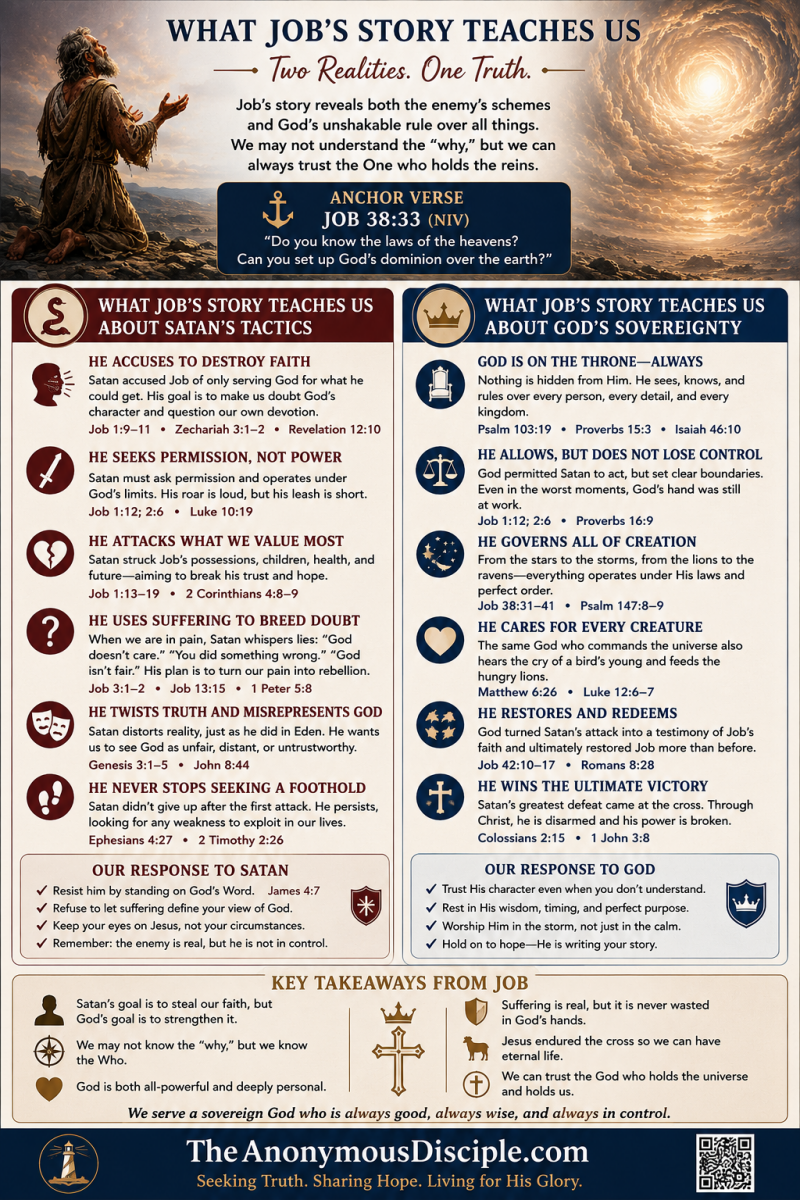
["The devil really does want to steal our chances of eternity with God, doesn’t he? By any means necessary at that?"]
Yes—that is exactly his aim: to separate people from trust in God, distort God’s character, entice them into sin, and keep them from repentance.
John 10:10: “The thief comes only to steal and kill and destroy…”
1 Peter 5:8: “Your enemy the devil prowls around like a roaring lion looking for someone to devour.”
Revelation 12:9: Satan is described as the one “who leads the whole world astray.”
But there is an important balance here: Satan is dangerous, but he is not equal to God, and he cannot simply snatch away someone who belongs to Christ.
John 10:28–29: Jesus says no one can snatch His sheep out of His hand or the Father’s hand.
Romans 8:38–39: Neither spiritual powers nor anything else in creation can separate believers from the love of God in Christ.
So yes, the enemy will use accusation, temptation, fear, suffering, pride, distraction, false teaching—whatever may draw a person away from God. In Job’s case, Satan specifically wanted suffering to make Job curse God. His strategy was: “Make God look untrustworthy, and perhaps Job will walk away.”
That strategy has not changed.
But Christ has already defeated the enemy’s ultimate claim over those who trust Him:
Colossians 2:15: Jesus “disarmed the powers and authorities” through the cross.
James 4:7: “Submit yourselves, then, to God. Resist the devil, and he will flee from you.”
The enemy may attack faith, but he does not hold our eternity in his hands. Jesus does. 🕊️⚓️❤️
Prayer
Father, when we cannot understand what You are doing, help us remember who You are. You govern the heavens, command the storms, and hear the cries of even the smallest creatures. Teach us to place into Your hands what was never ours to control. Help us trust that nothing in our lives is hidden from Your sight or beyond Your dominion. Steady our hearts beneath Your wisdom and remind us that Your care is both mighty and personal. In Jesus’ name, amen. 🕊️⚓️❤️
Add comment
Comments