

The Central Lesson:
Lamentations 3 does not teach:
“Stop being sad and think positively.”
It teaches:
When sorrow overwhelms you, deliberately call God’s character back to mind.
Jeremiah’s circumstances had not changed when he declared God’s faithfulness.
Jerusalem was still ruined.
The people were still suffering.
The Temple was still destroyed.
Yet Jeremiah remembered:
- God’s love had not ended.
- God’s compassion had not failed.
- God’s mercy would meet him again.
- God was still his portion.
- God heard him from the pit.
- God would not abandon him forever.
That is mature faith.
Not denying the ruins—but finding God among them.
📜 Verse by verse breakdown follows the study card below 📜

Anchor Truth
Lamentations 3:21
“Yet this I call to mind and therefore I have hope.”
Hope began when Jeremiah intentionally remembered what pain had caused him to forget.
And the truth he remembered was this:
Lamentations 3:22–23
"Because of the LORD'S great love we are not consumed, for his compassions never fail. They are new every morning; great is your faithfulness."
God’s faithful love had not run out, His compassion had not failed, and fresh mercy would meet him again in the morning. ❤️🕊️
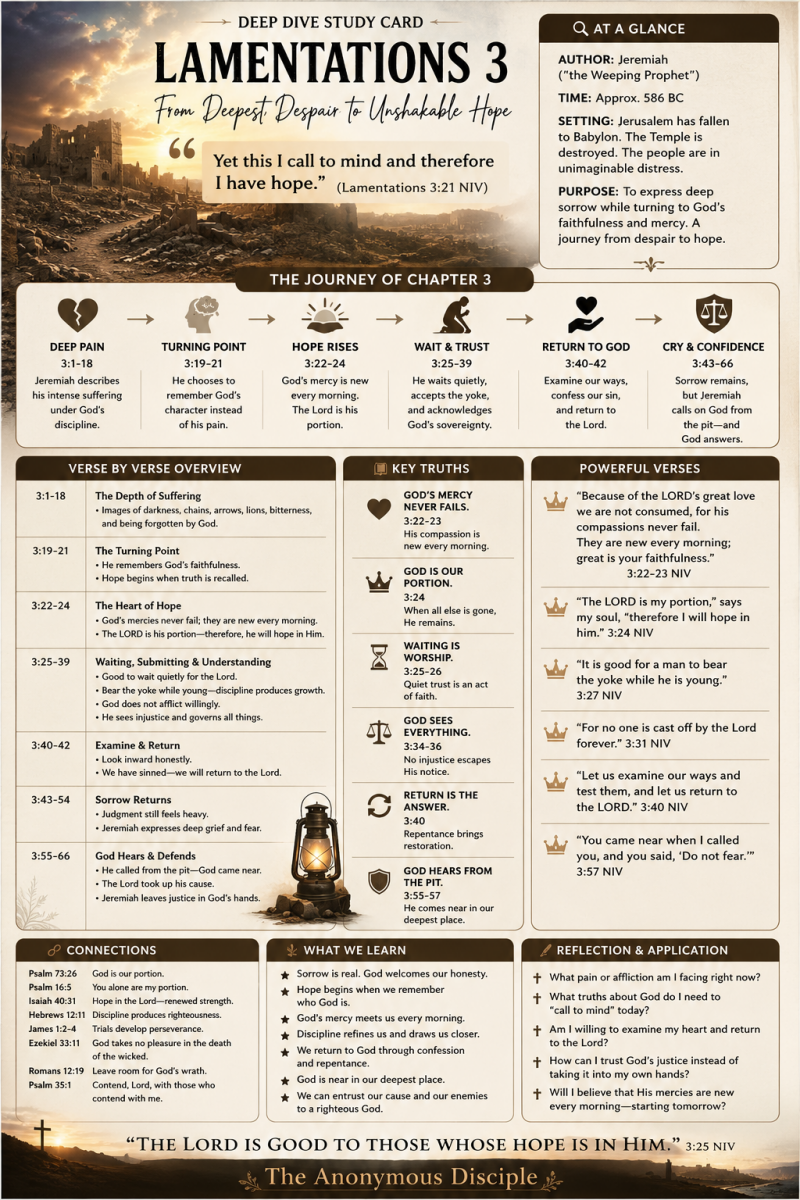
📖 Deep Dive: Lamentations 3
Author: Traditionally Jeremiah ("the Weeping Prophet")
Book: Lamentations
Setting:
Jerusalem has fallen to Babylon (586 BC). The Temple is destroyed. Thousands have been killed or taken captive.
Jeremiah isn't writing theory.
He's standing in the middle of the ruins.
Structure of Chapter 3
Unlike the first two chapters that focus mainly on the nation's suffering,
Chapter 3 becomes deeply personal.
Jeremiah says repeatedly:
"I..."
He's speaking as one who has experienced God's discipline firsthand.
Yet the chapter slowly changes from sorrow...
to confidence.
Part One — The Depth of Suffering
Lamentations 3:1–18
Jeremiah describes feeling as though God Himself has become his enemy.
Lamentations 3:1 (NIV)
"I am the man who has seen affliction by the rod of the Lord's wrath."
This is covenant discipline—not random suffering.
He feels:
- abandoned
- trapped
- unheard
- broken
- exhausted
- hopeless
Images Jeremiah uses
- Darkness
- Broken bones
- Chains
- Bear lying in wait
- Lion attacking
- Arrows piercing him
- Bitter herbs
- Gravel in his mouth
- Dust
These are powerful poetic images showing complete devastation.
One of the saddest verses
Lamentations 3:18 (NIV)
"So I say, 'My splendor is gone and all that I had hoped from the Lord.'"
Notice...
He doesn't hide this from God.
The Bible never teaches us to pretend everything is okay.
The Turning Point
Everything changes with one word.
Lamentations 3:21
"Yet this I call to mind and therefore I have hope."
Jeremiah doesn't suddenly feel better.
He chooses what he will remember.
Feelings don't lead him.
Truth does.
The Heart of the Chapter
Lamentations 3:22–23 (NIV)
"Because of the LORD'S great love we are not consumed, for his compassions never fail. They are new every morning; great is your faithfulness."
Lamentations 3:24 — “The LORD is my portion”
Jeremiah says, in effect:
“The LORD is all I truly have; therefore, I will hope in Him.”
Jerusalem had lost nearly everything:
- The city was ruined.
- The Temple was destroyed.
- Homes were burned.
- Families were scattered.
- The nation had lost its security and independence.
Yet Jeremiah realized that even when every earthly possession is stripped away, God Himself remains.
The word “portion” refers to someone’s inheritance, allotted possession, or share. Jeremiah’s portion was not land, comfort, wealth, or security.
His portion was the Lord.
This echoes:
Psalm 73:26
“My flesh and my heart may fail, but God is the strength of my heart and my portion forever.”
Psalm 16:5
“LORD, you alone are my portion and my cup; you make my lot secure”
Jeremiah’s hope was not based on circumstances improving. His hope rested in the character and presence of God.
Waiting for God
Lamentations 3:25–26
Jeremiah teaches that the Lord is good to those who:
- Hope in Him.
- Seek Him.
- Quietly wait for His deliverance.
This kind of waiting is not passive resignation.
Biblical waiting means remaining faithful while trusting that God is still working, even when there is no visible evidence yet.
Isaiah 40:31
"but those who hope in the Lord will renew their strength."
Psalm 27:14
“Wait for the LORD; be strong and take heart.”
There are seasons when God tells us to act, but there are also seasons when our greatest act of faith is simply to remain steady and wait.
That can be painfully difficult.
Jeremiah is saying:
God’s silence is not proof of God’s absence.
The Yoke in Youth
Lamentations 3:27–30
Jeremiah says it is good for a person to bear the yoke while young.
A yoke represents hardship, discipline, submission, and responsibility.
He is not saying suffering is pleasant. He is saying that suffering can teach lessons comfort rarely teaches:
- Endurance.
- Humility.
- Dependence on God.
- Self-control.
- Compassion for others.
- Spiritual maturity.
The person is pictured sitting silently, accepting the burden, bowing low, and even turning the cheek to insult.
This does not mean abuse or injustice is morally good. It describes humble submission to God’s refining work rather than proud resistance against Him.
Hebrews 12:11
God’s discipline may feel painful at the time, but afterward it can produce righteousness and peace.
James 1:2–4
Trials develop perseverance and spiritual maturity.
Sometimes the burden we begged God to remove becomes the very instrument He uses to strengthen us.
God Does Not Reject Forever
Lamentations 3:31–33
This is another major turning point.
Lamentations 3:31
“For no one is cast off by the Lord forever.”
Jeremiah recognizes that God’s discipline has a purpose and a limit.
Judah’s suffering was severe, but rejection was not God’s final word.
Lamentations 3:32
Though God permits grief, He also shows compassion according to the abundance of His faithful love.
God’s compassion is greater than the suffering He allows.
Lamentations 3:33
Jeremiah explains that God does not willingly bring affliction or grief.
This means God is not cruel, sadistic, or pleased by human misery.
Sometimes judgment is necessary because God is righteous. Sometimes discipline is necessary because God loves His people. But suffering is not something God delights in for its own sake.
Ezekiel 33:11
God says He takes no pleasure in the death of the wicked, but desires that they turn and live.
God may wound in discipline, but His heart is restoration.
God Sees Injustice
Lamentations 3:34–36
Jeremiah lists three injustices:
- Crushing prisoners.
- Denying someone their legal rights.
- Twisting justice in court.
Then he asks, essentially:
Would the Lord not see these things?
God is not indifferent when people are mistreated.
Human rulers may overlook injustice. Courts may fail. Powerful people may manipulate circumstances. But none of it escapes God’s notice.
Proverbs 15:3
The eyes of the Lord are everywhere.
Psalm 10:14
God sees trouble and grief and takes it into His hands.
Delayed justice is not unseen justice.
Nothing Happens Outside God’s Sovereignty
Lamentations 3:37–39
Jeremiah asks who can speak and make something happen unless the Lord has permitted it.
This is a strong declaration of God’s sovereignty.
Babylon believed it had conquered Judah through its own power, but Jeremiah understood that Babylon could do nothing outside the boundaries God allowed.
That does not mean every evil act reflects God’s moral approval. It means evil never escapes His ultimate authority.
Then Jeremiah asks:
Why should people complain when they are suffering the consequences of their sins?
This is not a statement about every kind of suffering. Scripture clearly shows that people may suffer without having personally caused it—Job is an obvious example.
But in Judah’s situation, the nation had repeatedly rejected God, ignored His prophets, practiced idolatry, and committed injustice. Their suffering was connected to long-term rebellion.
Jeremiah calls them to stop blaming God and honestly examine themselves.
Examine and Return
Lamentations 3:40–42
Lamentations 3:40
“Let us examine our ways and test them, and let us return to the LORD.”
This is the proper response to God’s discipline.
Not merely:
- Feeling guilty.
- Feeling sorry.
- Complaining about consequences.
- Making excuses.
But genuinely returning to God.
Repentance involves both an inward and outward movement:
- Examine our ways.
- Admit our sin.
- Lift our hearts toward God.
- Turn back to obedience.
Jeremiah confesses:
We have sinned and rebelled.
Notice he says “we.”
Although Jeremiah had faithfully warned the people, he still identified himself with them in confession. He did not stand above the nation and say, “They sinned.”
He humbly said, “We have sinned.”
That is the heart of an intercessor.
Daniel 9:5
Daniel also confessed the sins of Israel as “we,” even though he personally remained faithful.
The Pain Returns
Lamentations 3:43–47
After reaching such a beautiful statement of hope, Jeremiah returns to describing judgment.
That may feel surprising, but it is emotionally honest.
Grief does not always move in a straight line.
A person can declare God’s faithfulness one moment and weep again the next.
Faith does not mean sorrow never returns.
It means sorrow no longer has the final word.
Jeremiah describes:
- God’s anger.
- Unanswered prayer.
- Public disgrace.
- Fear.
- Ruin.
- Destruction.
His hope is real, but his circumstances remain painful.
Rivers of Tears
Lamentations 3:48–51
Jeremiah says streams of tears flow from his eyes because his people have been destroyed.
He says his tears will continue without relief until the Lord looks down from heaven and sees.
Jeremiah’s grief was not merely personal.
He was broken over what had happened to others.
This is why he is often called the Weeping Prophet.
His tears reveal that spiritual maturity does not produce emotional coldness. Jeremiah was strong precisely because he cared deeply.
Jeremiah 9:1
Jeremiah wished his head were a spring of water so he could weep continually for his people.
Luke 19:41
Jesus also wept over Jerusalem.
Tears are not the opposite of faith.
Sometimes tears are evidence that a heart has not become hardened.
Hunted Without Cause
Lamentations 3:52–54
Jeremiah describes enemies hunting him like a bird, throwing him into a pit, and casting stones down upon him.
This may reflect Jeremiah’s personal experience.
Jeremiah 38:6
Jeremiah was lowered into a muddy cistern because the leaders hated his message. He sank into the mud and was left there.
In Lamentations 3, he describes water closing over his head and believing he was about to die.
This chapter is therefore not abstract poetry. Jeremiah knew what it felt like to be:
- Rejected.
- Imprisoned.
- Mocked.
- Threatened.
- Abandoned.
- Left for dead.
Yet even from the pit, he called upon God.
God Heard Him From the Pit
Lamentations 3:55–57
Jeremiah called on the name of the Lord from the depths.
God heard him.
Lamentations 3:57
“You came near when I called you, and you said, ‘Do not fear.’”
Jeremiah was not rescued before he entered the pit.
God came near to him inside it.
Sometimes we expect God’s presence to mean that the pit will never happen. But Scripture often shows God meeting His people in the very place they feared:
- Joseph in prison.
- Daniel in the lions’ den.
- The three Hebrews in the furnace.
- Jonah in the fish.
- Paul and Silas in jail.
- Jeremiah in the cistern.
God’s nearness does not always prevent suffering.
But His presence makes suffering unable to destroy our hope.
And His message was:
“Do not fear.”
Not because Jeremiah’s danger was imaginary, but because God was nearer than the danger.
God Took Up His Cause
Lamentations 3:58–60
Jeremiah declares that the Lord defended his cause and redeemed his life.
He asks God to see the wrong committed against him and to judge his case.
Jeremiah did not seek personal revenge. He handed his cause over to God.
Romans 12:19
Believers are instructed not to take revenge but to leave room for God’s justice.
Psalm 35:1
“Contend, LORD, with those who contend with me.”
There is peace in knowing that we do not have to win every argument, correct every accusation, or personally punish every wrong.
God sees.
God knows.
God can defend His servant far better than we can defend ourselves.
Jeremiah Gives His Enemies to God
Lamentations 3:61–66
Jeremiah tells God that He has heard the insults, threats, and plots of his enemies.
They mocked him continually and made him the subject of their songs.
Then Jeremiah asks God to repay them according to what they had done.
These verses can sound harsh, but they must be understood in context.
Jeremiah is not taking vengeance himself. He is asking the righteous Judge to deal with wickedness.
This is an imprecatory prayer—a prayer asking God to bring justice against persistent evil.
Jeremiah leaves judgment in God’s hands.
That is far different from personally retaliating.
The Spiritual Movement of Lamentations 3
The chapter moves through a remarkable pattern:
Lamentations 3:1–18
“I have suffered, and I feel hopeless.”
Lamentations 3:19–21
“I remember my affliction—but I also choose what truth to remember.”
Lamentations 3:22–24
“God’s mercy remains. God Himself is my portion.”
Lamentations 3:25–39
“I will wait, submit, and trust His character.”
Lamentations 3:40–42
“I will examine my heart and return to God.”
Lamentations 3:43–54
“My grief is still real.”
Lamentations 3:55–57
“I cried from the pit, and God came near.”
Lamentations 3:58–66
“I place my life, my enemies, and my justice into God’s hands.”
Add comment
Comments