

💡 When something in your life feels overwhelming and you have no strength left, God invites you to shift the weight of the battle onto His shoulders. Your job is not to figure it all out or fight harder in your own power. Your job is to seek Him, stand firm in faith, keep your eyes on Him, and worship—even before you see the answer.
The battle truly belongs to the Lord. And when He fights, the outcome is already settled.

14 Then the Spirit of the Lord came on Jahaziel son of Zechariah, the son of Benaiah, the son of Jeiel, the son of Mattaniah, a Levite and descendant of Asaph, as he stood in the assembly. 15 He said: “Listen, King Jehoshaphat and all who live in Judah and Jerusalem! This is what the Lord says to you: ‘Do not be afraid or discouraged because of this vast army. For the battle is not yours, but God’s. 16 Tomorrow march down against them. They will be climbing up by the Pass of Ziz, and you will find them at the end of the gorge in the Desert of Jeruel. 17 You will not have to fight this battle. Take up your positions; stand firm and see the deliverance the Lord will give you, Judah and Jerusalem. Do not be afraid; do not be discouraged. Go out to face them tomorrow, and the Lord will be with you.’” 18 Jehoshaphat bowed down with his face to the ground, and all the people of Judah and Jerusalem fell down in worship before the Lord. 19 Then some Levites from the Kohathites and Korahites stood up and praised the Lord, the God of Israel, with a very loud voice. - 2 Chronicles:14-19
🎺Today’s declaration 🎺
The battle may be in front of me, but God is already there. My responsibility is faithful obedience; the outcome belongs to Him.
Judah is facing a massive enemy army that is way too big for them to handle. King Jehoshaphat and the whole nation are scared. They don’t know what to do, so they gather together, fast, and cry out to God with honest hearts: “We’re powerless… our eyes are on You.”
Right in the middle of that desperate prayer meeting, God answers. The Spirit of the Lord comes on a quiet Levite named Jahaziel, and he speaks these life-changing words (our anchor in verse 15):
“Do not be afraid or discouraged because of this vast army. For the battle is not yours, but God’s.”
That’s the heart of the whole passage.
God doesn’t say the problem isn’t real. He doesn’t pretend the army isn’t huge. He simply takes ownership of the fight. Then He gives simple instructions: Go out tomorrow, take your positions, stand firm, and watch Me deliver you. You won’t even have to fight.
And what do the people do? They don’t wait until they see the victory. They immediately fall on their faces and worship. Then some of the singers stand up and praise God with loud voices—while the enemy is still on the way.
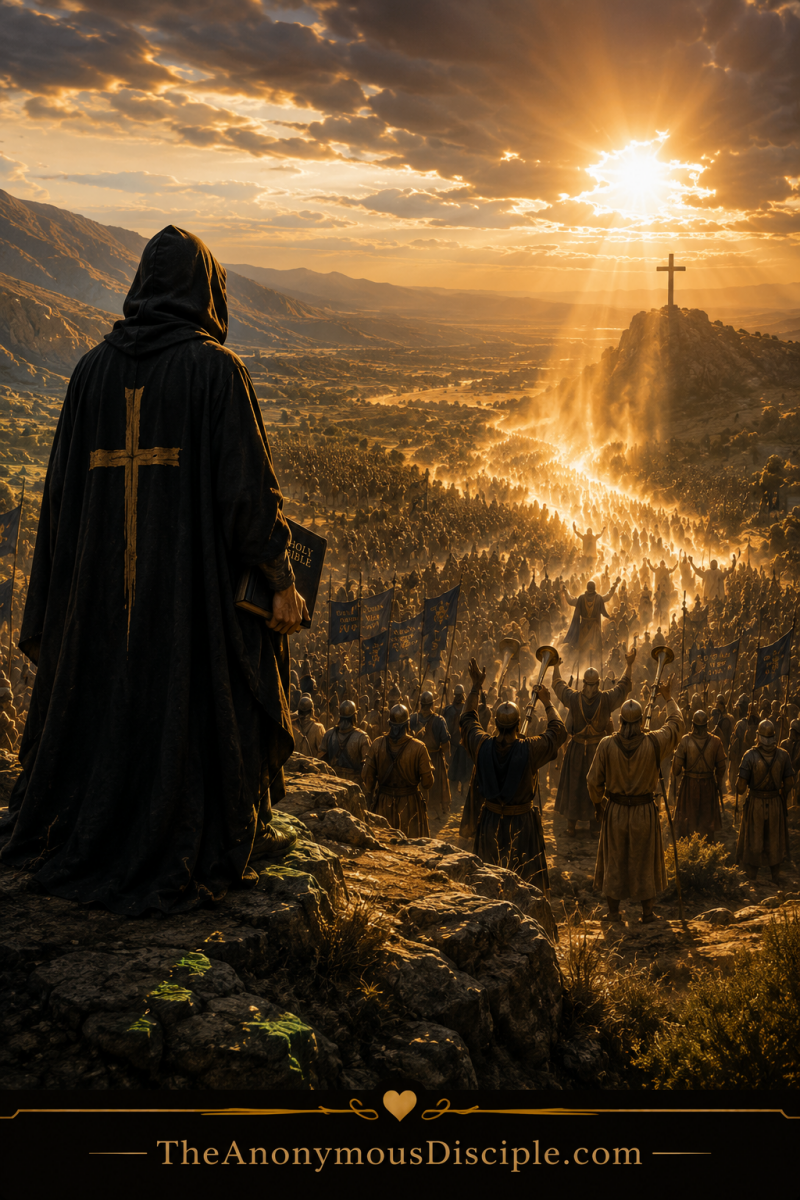
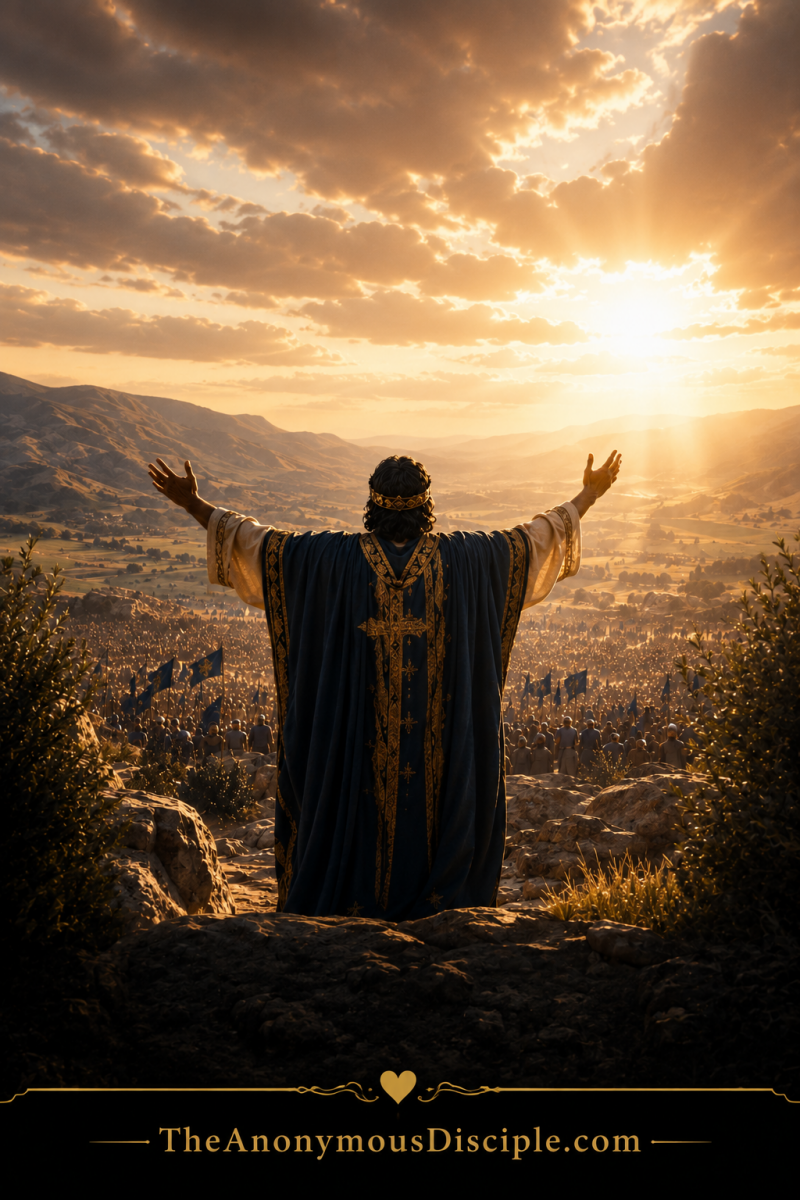
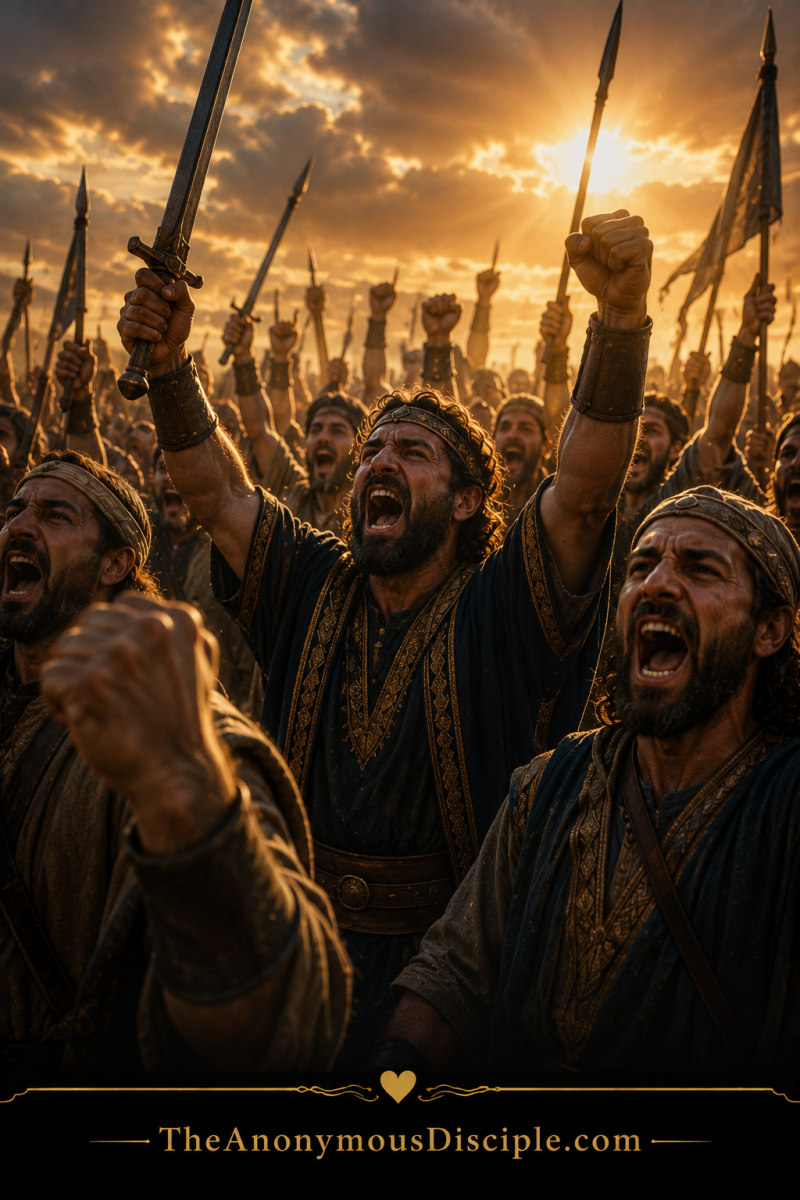
Core cross-references for “the battle is not yours, but God’s” (v. 15)
- 1 Samuel 17:47 – David tells Goliath and the whole army: “the battle is the Lord’s.” Same truth, different giant.
- Exodus 14:13-14 – At the Red Sea, Moses says: “Do not be afraid. Stand firm and you will see the deliverance the Lord will bring you today… The Lord will fight for you; you need only to be still.” Almost the exact same language of standing firm and watching God deliver.
- 2 Chronicles 32:7-8 – King Hezekiah (later in Judah’s history) uses very similar words when facing the Assyrian army: “Be strong and courageous. Do not be afraid or discouraged… With him is only the arm of flesh, but with us is the Lord our God to help us and to fight our battles.”
“Do not be afraid or discouraged” (v. 15 & 17)
- Deuteronomy 31:6 & 31:8 – Moses to the people (and later to Joshua): “Be strong and courageous. Do not be afraid or terrified… for the Lord your God goes with you; he will never leave you nor forsake you.”
- Joshua 1:9 – God to Joshua: “Be strong and courageous. Do not be afraid; do not be discouraged, for the Lord your God will be with you wherever you go.”
“Stand firm and see the deliverance” (v. 17)
- Back to Exodus 14:13 again (the strongest parallel).
- Also Deuteronomy 20:1-4 – God’s instructions for when Israel faces a bigger army: do not be afraid, because “the Lord your God is the one who goes with you to fight for you.”
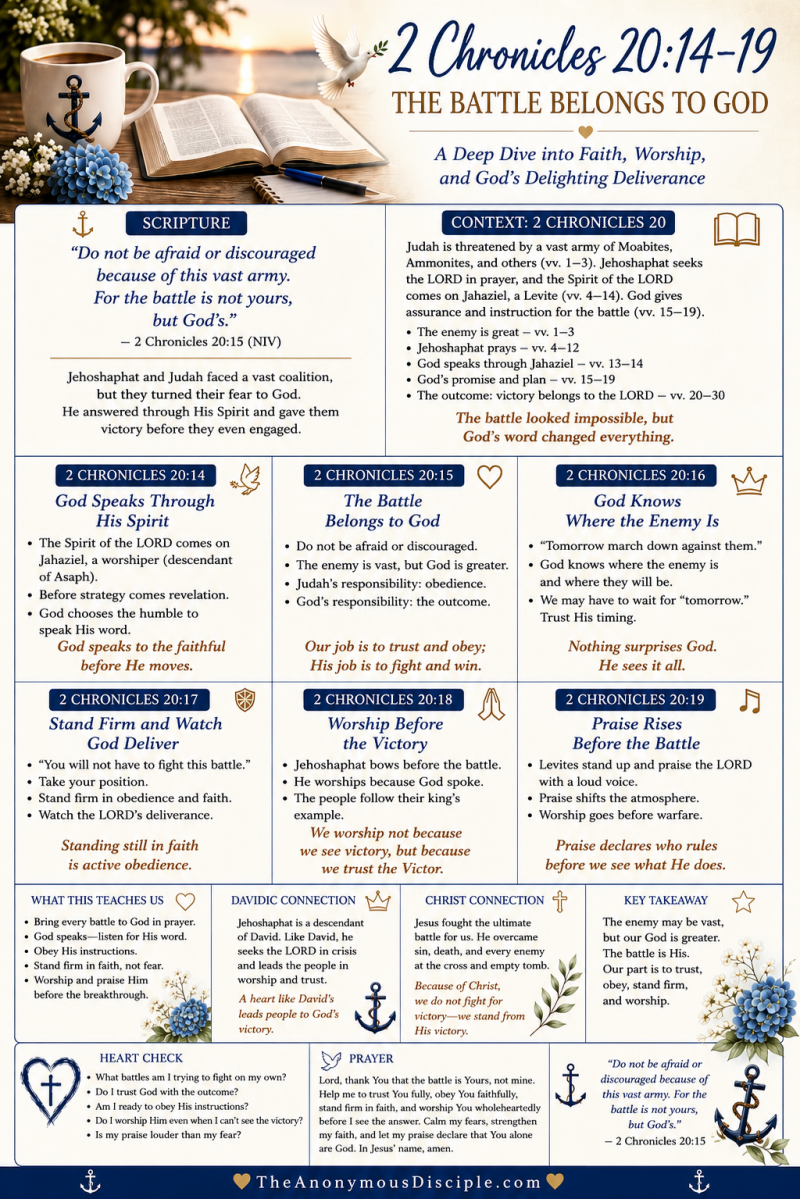
Why This Matters
A beautiful pattern:
- Honest prayer that admits “we don’t know what to do.”
- God speaking a clear word through His Spirit.
- The core truth: the battle belongs to the Lord.
- Simple obedience—stand firm and watch.
- Worship and loud praise before the answer arrives.
When you face something that feels too big—spiritual pressure, family worries, fear, or anything that looks like a “vast army”—these verses invite you to the same place: eyes on the Lord, heart settled on the truth that the battle is His, and a response of worship even before you see the deliverance.
The Lord is the same yesterday, today, and forever. He still speaks, still owns the battle, and still invites us to stand firm and watch Him work.
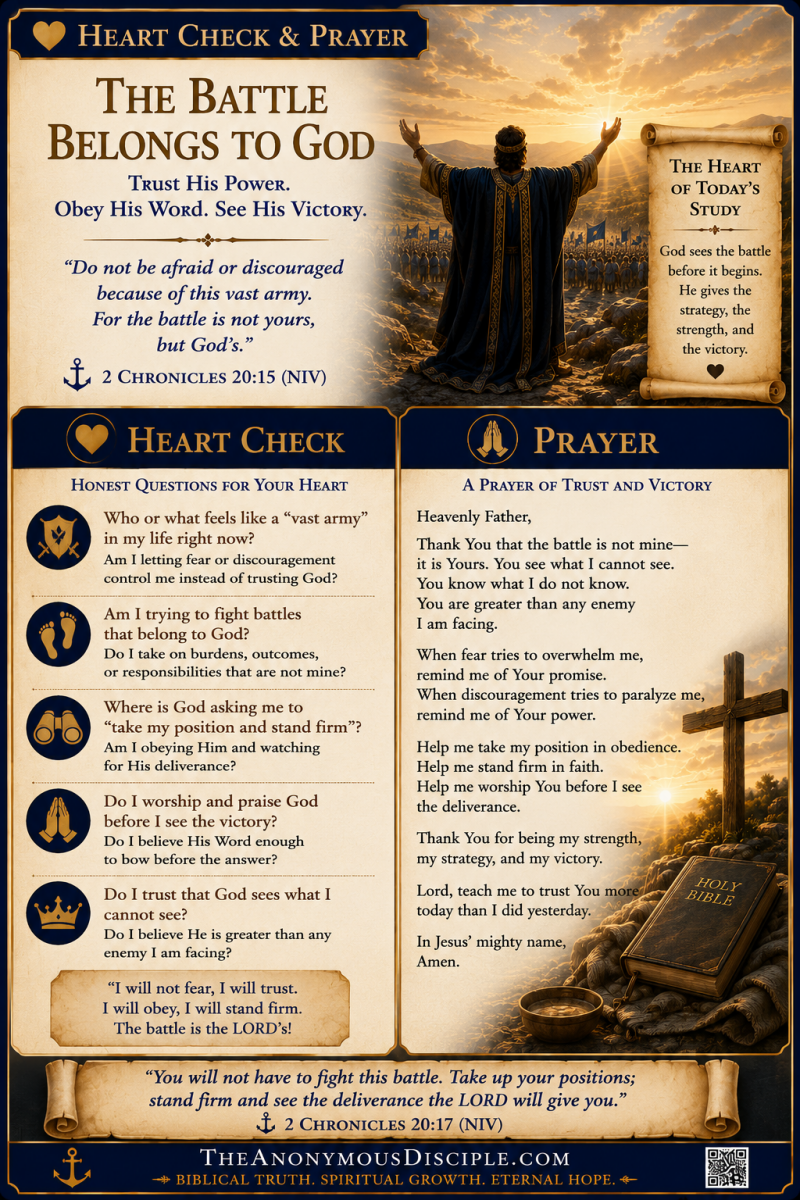
Study Notes
Deep Dive: 2 Chronicles 20:14–19
⚓ Anchor Verse: 2 Chronicles 20:15
“Do not be afraid or discouraged because of this vast army. For the battle is not yours, but God’s.” —2 Chronicles 20:15, NIV
The setting
King Jehoshaphat and Judah were facing a terrifying coalition of enemies—the Moabites, Ammonites, and others. Humanly speaking, Judah was greatly outnumbered.
Jehoshaphat did not pretend everything was fine. He was genuinely alarmed, but he immediately turned his fear toward God:
“We do not know what to do, but our eyes are on you.” —2 Chronicles 20:12, NIV
The entire nation stood before the Lord—including their wives and children—waiting for Him to answer. Then God’s Spirit came upon Jahaziel in the middle of the gathered assembly.
Verse-by-Verse
2 Chronicles 20:14 — The Spirit of the Lord speaks
“Then the Spirit of the LORD came on Jahaziel…” —2 Chronicles 20:14, NIV
God answered through Jahaziel, a Levite descended from Asaph.
This detail matters. Jahaziel was not the king, the commanding general, or Judah’s most powerful warrior. God placed His message in the mouth of a worshiper.
Before Judah received a military strategy, they received a word from God.
Sometimes we desperately want God to change the circumstances, but His first answer is to change how we see those circumstances.
The enemy had not disappeared. The army remained vast. But now Judah possessed something stronger than military strength: God’s promise.
God speaks through an ordinary Levite The Spirit of the Lord suddenly comes on Jahaziel. He’s not a famous prophet or a big-name leader. He’s a Levite from the family line of Asaph (the same family that led temple music and praise). God chooses to speak through someone standing right there in the crowd.
This reminds us that the Lord can use anyone who is available. The message isn’t coming from human wisdom—it’s the Spirit of God speaking.
⚓ 2 Chronicles 20:15 — The battle belongs to God
“Do not be afraid or discouraged… For the battle is not yours, but God’s.” —2 Chronicles 20:15, NIV
God addresses two internal enemies before addressing the armies outside Jerusalem:
Fear: “What if we are destroyed?”
Discouragement: “There is no point in trying.”
Fear looks at the size of the enemy. Faith looks at the greatness of God.
God was not saying that the danger was imaginary. He called it a vast army. Faith does not deny reality; faith refuses to believe that reality is greater than God.
“The battle is not yours”
This did not mean Judah had no involvement. They still had to gather, march out, take their positions, and face what frightened them.
But they were not responsible for producing the victory.
That distinction is powerful:
- Judah’s responsibility was obedience.
- God’s responsibility was the outcome.
We often exhaust ourselves trying to carry responsibilities that belong only to God. We try to control another person’s heart, foresee every outcome, prevent every hardship, or solve every family struggle.
God may tell us to pray, speak, forgive, prepare, stand firm, or take one faithful step—but the battle itself remains His.
The heart of the whole passage (our anchor) Jahaziel turns and addresses the king and every person in Judah and Jerusalem:
“Do not be afraid or discouraged because of this vast army. For the battle is not yours, but God’s.”
This is the clear, steady word God wants them (and us) to hear.
- The army is real and overwhelming.
- Fear and discouragement are natural feelings.
- But the battle does not belong to Jehoshaphat, the army, or the people. It belongs to the Lord.
God is taking ownership of the fight. That changes everything.
2 Chronicles 20:16 — God gives specific direction
“Tomorrow march down against them…” —2 Chronicles 20:16, NIV
God told them exactly where the enemy would be.
The God who knew where Judah was standing also knew where the enemy was hiding.
Nothing about the situation surprised Him. The battle felt sudden to Judah, but it was never sudden to God.
Notice that God said, “Tomorrow.” They had to wait through the night with the enemy still approaching. Receiving God’s promise does not always mean immediate relief. Sometimes faith means resting overnight because God has already spoken about tomorrow.
2 Chronicles 20:17 — Take your position and stand firm
“You will not have to fight this battle. Take up your positions; stand firm and see the deliverance the LORD will give you.” —2 Chronicles 20:17, NIV
These instructions seem almost contradictory:
- You will not fight.
- Take your position.
- Stand firm.
- Watch God deliver you.
Standing still is not the same as doing nothing.
Biblical stillness is confident obedience. Judah was not told to hide in Jerusalem. They were told to walk toward the battlefield and stand where God commanded them to stand.
Sometimes our “position” is:
- Continuing to pray when nothing seems to change.
- Remaining loving without compromising truth.
- Refusing to retaliate.
- Obeying the next clear instruction.
- Staying rooted in Scripture.
- Waiting without attempting to manipulate the outcome.
“See the deliverance”
They were going to witness something only God could accomplish.
When God brings victory, He often does it in such a way that no one can reasonably say, “We saved ourselves.”
Verses 16–17 – Clear instructions with a promise God doesn’t just say “Don’t worry.” He gives specific directions:
- March out tomorrow.
- You’ll meet them at a certain place (the Pass of Ziz / Desert of Jeruel).
- You will not have to fight this battle.
- Take up your positions.
- Stand firm.
- Watch the deliverance the Lord will give you.
- Do not be afraid or discouraged.
- Go out to face them, and the Lord will be with you.
Notice the balance: God fights the battle, but His people still have a part. They must show up, take their positions, stand firm in faith, and keep their eyes open to see what God does. They are not passive, but they are not the ones carrying the weight of victory either.
2 Chronicles 20:18 — Jehoshaphat bows before the victory
“Jehoshaphat bowed down with his face to the ground…” —2 Chronicles 20:18, NIV
The battle had not yet occurred, but Jehoshaphat worshiped.
He did not wait to see whether God’s promise would work before honoring Him. He bowed because God had spoken.
This is worship rooted in faith:
“Lord, I do not see the victory yet, but I trust the One who promised it.”
The people followed their king’s example and fell down before the Lord.
Jehoshaphat’s posture taught the nation: before we face the enemy, we bow before God.
2 Chronicles 20:19 — Praise rises before the battle
“Then some Levites… stood up and praised the LORD… with a very loud voice.” —2 Chronicles 20:19, NIV
They moved from fearful silence to loud praise.
Nothing visible had changed:
- The enemy was still coming.
- Judah was still outnumbered.
- The battlefield was still waiting.
But God had spoken, and His word changed the atmosphere before it changed the circumstances.
Their praise was not an attempt to convince themselves that everything would be okay. It was a declaration that God is trustworthy whether or not they could yet see what He was doing.
In the following verses, the worshipers would even be sent ahead of the army:
“Give thanks to the LORD, for his love endures forever.” —2 Chronicles 20:21, NIV
Praise did not deny the battle. Praise declared who ruled over it.
Verses 18–19 – The people’s response Jehoshaphat and the whole nation immediately bow facedown and worship. Then some of the Levites (from the Kohathite and Korahite clans) stand up and praise God with a very loud voice.
They haven’t seen the victory yet. The enemy is still out there. But they worship and praise before the battle even begins. That is faith in action—thanking and glorifying God for what He has already promised to do.
The movement of the passage
Watch the spiritual progression:
Fear → Seeking God → Hearing God → Believing God → Bowing before God → Praising God → Witnessing God’s deliverance
The circumstances did not change first.
The people’s focus changed first.
That is often how God works in us. Before He removes the battle around us, He establishes His peace within us.
What “the battle belongs to God” does—and does not—mean
It does not mean:
- Ignore genuine responsibilities.
- Refuse wise action.
- Avoid difficult conversations.
- Assume every outcome will match our personal preference.
- Use spiritual language to escape obedience.
It does mean:
- We obey without believing everything depends upon us.
- We refuse to let fear become our master.
- We entrust what we cannot control to God.
- We stand on God’s character when we cannot see His plan.
- We worship before the outcome is visible.
How this points us toward Jesus
The greatest battle we could never win ourselves was the battle against sin and death.
Jesus fought that battle for us through His death and resurrection:
“He disarmed the powers and authorities… triumphing over them by the cross.” —Colossians 2:15, NIV
We could not rescue ourselves, erase our guilt, or defeat death. Christ accomplished the victory we were powerless to achieve.
Because of Jesus, believers do not fight for ultimate victory; we stand from His victory.
“In all these things we are more than conquerors through him who loved us.” —Romans 8:37, NIV
That does not mean Christians never experience pain or opposition. It means no enemy can separate us from Christ, overturn His promises, or possess the final word over our lives.
Heart Check ♥️
Where am I carrying a battle as though everything depends upon me?
Am I concentrating more on the “vast army” than on the greatness of God?
Has fear pushed me toward panic, control, anger, or discouragement?
What position has God asked me to take today—prayer, patience, truth, forgiveness, courage, or stillness?
Can I worship God before I see the answer?
Prayer
Father, You see every battle before me and every fear within me. Forgive me for carrying things You never asked me to control. When the opposition looks vast, turn my eyes away from its size and toward Your greatness.
Help me hear Your voice above my anxious thoughts. Show me the position You want me to take, and give me courage to stand firm without striving in my own strength. Teach me to obey You faithfully while trusting You completely with the outcome.
Lord Jesus, thank You for winning the battle against sin and death that I could never win for myself. Let Your victory steady my heart. Help me worship before I see the answer, praise You while I am still waiting, and remember that no battle is greater than the God who stands with me.
The battle is not mine—it belongs to You. In Jesus’ name, amen. ♥️
Add comment
Comments