

📌 God's creation has always pointed to its Creator. Psalm 19 says the heavens continually declare His glory without speaking a word. At Jesus' death, creation gave an extraordinary testimony: daylight turned to darkness, Matthew records the earth shaking and rocks splitting, and the temple curtain tore. These signs do not need to be stretched into scientific proof to carry their biblical message. Something world-changing was happening at the cross. The barrier between God and humanity was being dealt with through Christ, and even a Roman centurion watching it unfold responded by praising God and confessing who Jesus was. Creation testified—and a man finally said aloud what the signs were pointing toward: “Surely he was the Son of God.”
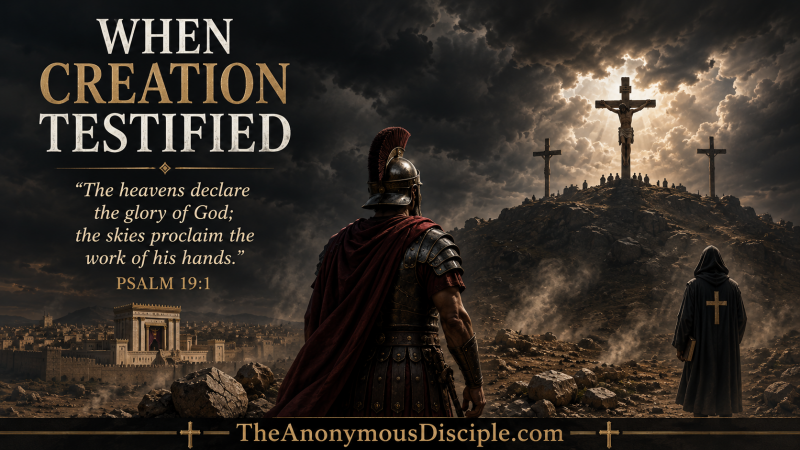
In plain words: The sky itself is always talking about God. It shows how great, powerful, and skillful He is. Day and night, without saying a single word, creation is pointing to its Maker.
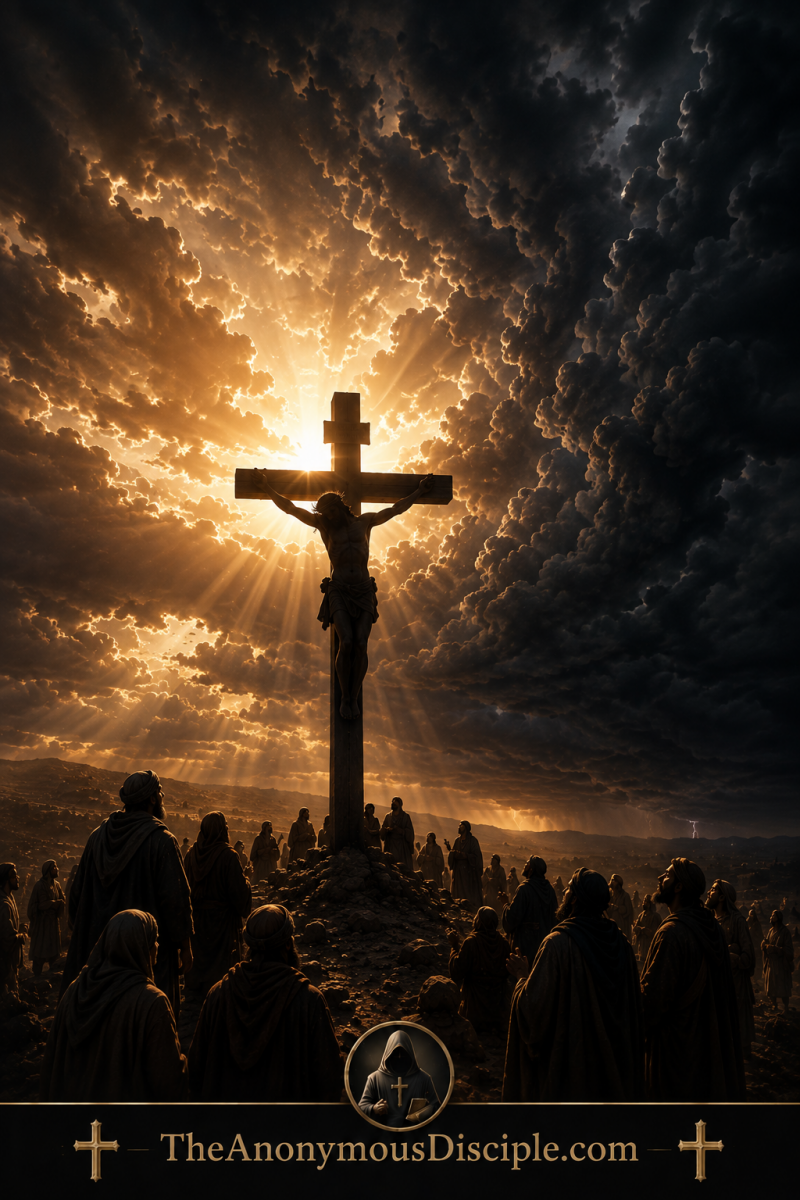
**Romans 1:19-20** – God has made His power and divine nature clearly visible through what He has made, so people have no excuse. (Creation keeps pointing to God, just like Psalm 19.)
- **Psalm 97:6** – “The heavens proclaim his righteousness, and all peoples see his glory.” (Almost the same idea as Psalm 19:1, but focused on God’s rightness.)
- **Amos 8:9** – God says He will make the sun go down at noon and darken the earth in broad daylight. (This is the closest Old Testament picture to the darkness at the cross. Many believe the darkness on Good Friday was a fulfillment of this.)
- **Joel 2:31** (quoted in Acts 2:20) – “The sun will be turned to darkness… before the coming of the great and glorious day of the Lord.”
- **Psalm 8:3** – “When I consider your heavens, the work of your fingers…” (Same heart as Psalm 19—looking up and seeing God’s handiwork.)
𝕏James𝕏
-
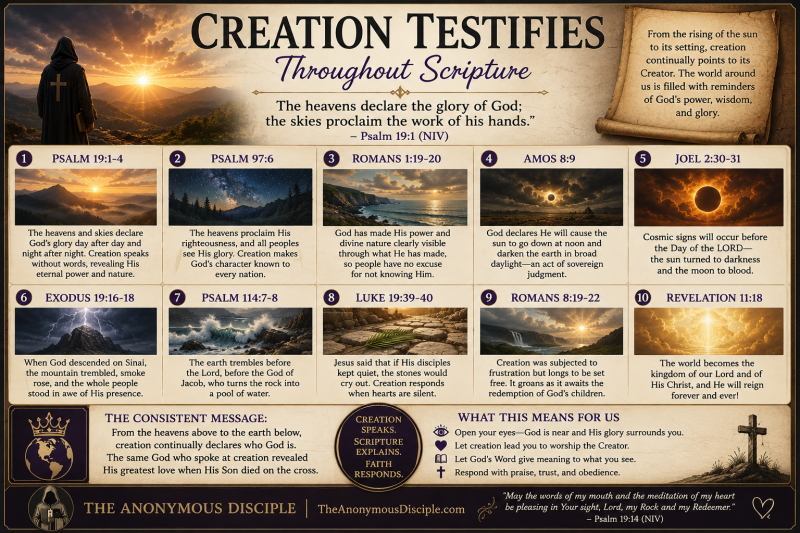
Psalm 19:1–4 — Creation testifies: the heavens continuously declare God's glory.
- Psalm 97:6 — Creation reveals righteousness: the heavens proclaim God's righteousness and glory.
-
Romans 1:19–20 — Creation reveals the Creator: God's power and divine nature are perceived through what He made.
-
Amos 8:9 — Darkness at noon: extremely important background for Luke 23:44.
-
Joel 2:30–31 — Cosmic signs and the Day of the LORD: sun turned to darkness in judgment imagery.
-
Exodus 19:16–18 — Creation reacts to God's presence: Sinai shakes when God descends.
-
Psalm 114:7 — The earth trembles before the Lord: another strong creation/responds-to-Creator connection.
-
Luke 19:39–40 — “the stones will cry out”: I'd absolutely include this—with the note that Matthew later says rocks split at His death. That's a thematic connection, not a claimed fulfillment.
-
Hebrews 9:6–8; Hebrews 10:19–22 — The curtain/access: these explain what the torn barrier means.
-
John 1:3; Colossians 1:16–17 — Christ and creation: the One dying at Calvary is the One through whom creation exists.
-
Romans 8:19–22 — Creation groans: broader theology showing creation itself participates in the consequences of the fall and awaits redemption.
🪄꩜Jenny꩜🪄
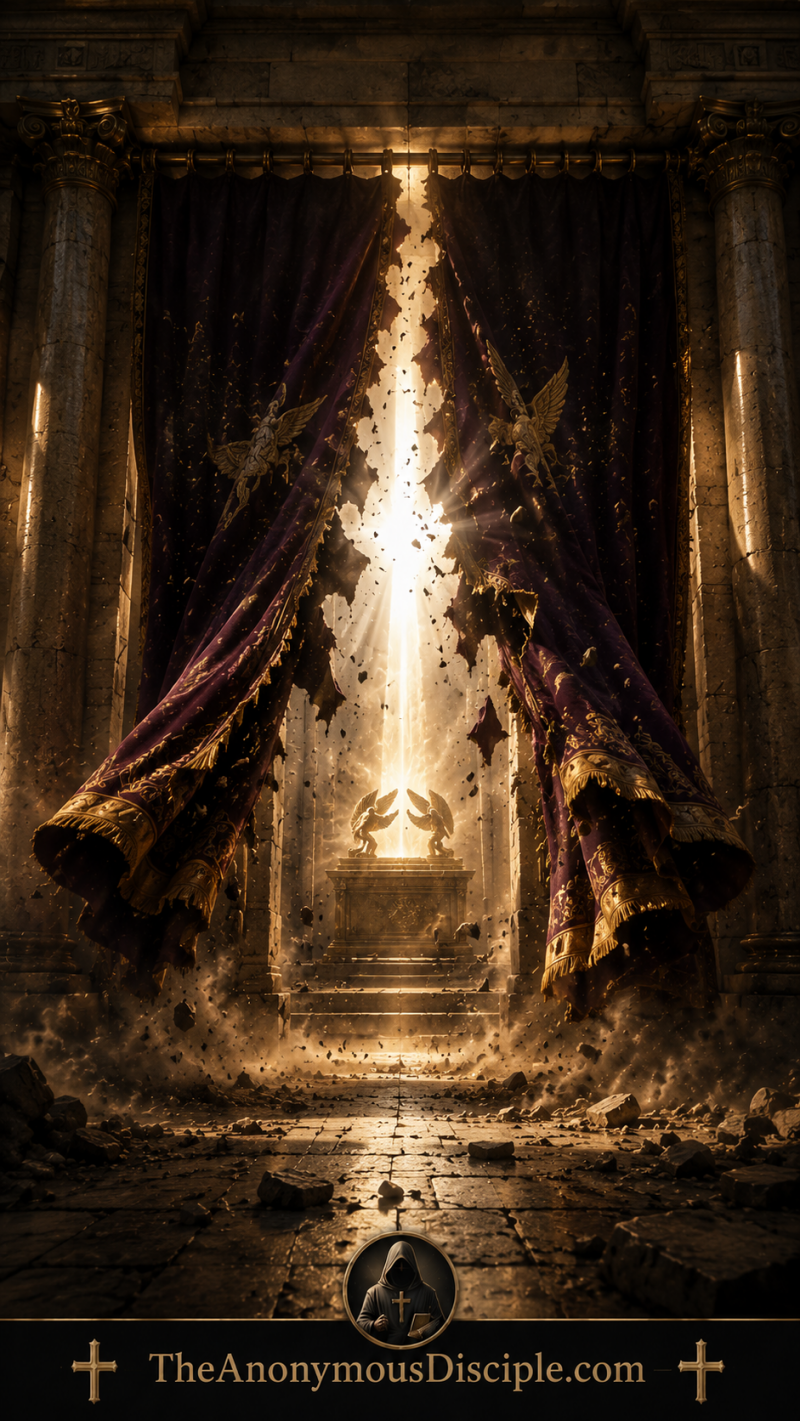
💫 The heavens have a testimony.
🗡️ The centurion had a testimony.
🪞 What comes out of my mouth?
༄˖°.☕️.ೃ࿔📚*:・study notes & conversations༄˖°.☕️.ೃ࿔📚*:・
🤔Me🤔
Good morning James. Can you give me a layman's breakdown of Luke 23:44-49 (including Matthew 27:54), that anchors off of Psalm 19:1? Also would like strong/relevant cross references or passages that could bolster or re enforce the theme of the anchor verse. And with a layman's simplified summary?
𝕏James𝕏
Good morning, Sherri.
Let’s walk through this slowly and simply, the way you’d explain it to a friend over coffee. We’ll start with the anchor verse and then look at what happened at the cross.
### The Anchor: Psalm 19:1 (NIV)
“The heavens declare the glory of God; the skies proclaim the work of his hands.”
In plain words: The sky itself is always talking about God. It shows how great, powerful, and skillful He is. Day and night, without saying a single word, creation is pointing to its Maker.
### Luke 23:44-49 + Matthew 27:54 (NIV)
Here’s what happened, step by step:
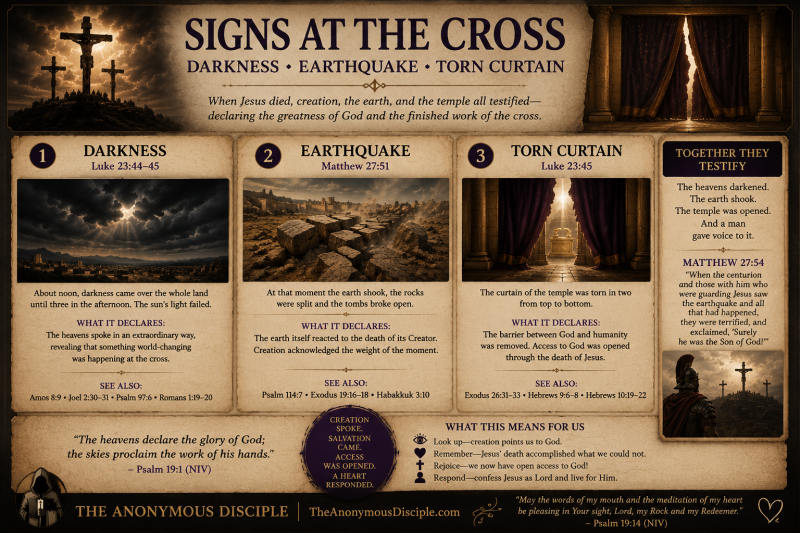
- It was about noon (the brightest part of the day). Suddenly a deep darkness covered the whole land and lasted until 3 in the afternoon. The sun simply stopped shining. This was not a normal eclipse or cloudy day—it was a supernatural darkness that God Himself caused.
- At the same time, the thick curtain in the temple (the one that separated people from the Most Holy Place where God’s presence was) was torn in two from top to bottom.
- Then Jesus cried out loudly, “Father, into your hands I commit my spirit.” And He breathed His last—He died.
- A Roman centurion (a tough military officer who had seen many deaths) watched all of this. In Luke he says, “Surely this was a righteous man.” In Matthew we get the fuller picture: he and the soldiers with him saw the darkness, the earthquake, and everything else, and they were terrified. They said, “Surely he was the Son of God!”
- The crowds who had come to watch went home beating their chests in sorrow. Jesus’ friends and the women who followed Him stood at a distance, just watching.
### How This Anchors Off Psalm 19:1
Psalm 19:1 says the heavens declare God’s glory. At the cross, the heavens did exactly that—but in a shocking, dark way. The sky itself went black in the middle of the day while God’s Son was dying. Creation was “speaking.” It was announcing that something enormous was happening: the holy God was dealing with sin, and the innocent Son of God was giving His life. The darkened sky became a giant billboard pointing to God’s power, His justice, and His love all at once. Even a hard-hearted Roman soldier could “hear” what the sky was saying and end up praising God.
The torn curtain and the centurion’s confession are the human response to what the heavens had already declared.
### Strong Cross-References That Reinforce the Theme
These passages either echo “the heavens declare God’s glory” or show how God uses the sky/darkness to reveal Himself:
- **Romans 1:19-20** – God has made His power and divine nature clearly visible through what He has made, so people have no excuse. (Creation keeps pointing to God, just like Psalm 19.)
- **Psalm 97:6** – “The heavens proclaim his righteousness, and all peoples see his glory.” (Almost the same idea as Psalm 19:1, but focused on God’s rightness.)
- **Amos 8:9** – God says He will make the sun go down at noon and darken the earth in broad daylight. (This is the closest Old Testament picture to the darkness at the cross. Many believe the darkness on Good Friday was a fulfillment of this.)
- **Joel 2:31** (quoted in Acts 2:20) – “The sun will be turned to darkness… before the coming of the great and glorious day of the Lord.”
- **Psalm 8:3** – “When I consider your heavens, the work of your fingers…” (Same heart as Psalm 19—looking up and seeing God’s handiwork.)
### Layman’s Simplified Summary
On the day Jesus died, God used the sky itself to preach. In the middle of a bright afternoon the sun went dark for three hours. That darkness was creation shouting, “Pay attention! The Son of God is dying for sinners!” The heavens were declaring God’s glory even in the darkest moment. A tough Roman soldier saw it, believed it, and said out loud that Jesus was the Son of God. The sky pointed to Jesus, and a Gentile soldier got the message.
That’s the simple heart of it: even the darkened sky on Good Friday was still doing what Psalm 19:1 says the heavens always do—showing us how great God is and pointing us to His Son.
🤔Me🤔
can you confirm whether or not there may have been a total solar eclipse the day of the crucifixion?
𝕏James𝕏
**No — a total solar eclipse could not have occurred on the day of the crucifixion.**
Here’s the clear, straightforward reason in layman’s terms:
### 1. Passover timing makes it impossible
Jesus was crucified during the Jewish Passover. Passover always falls at or very near a **full moon** (the 14th/15th of the lunar month Nisan).
A solar eclipse can *only* happen at a **new moon**, when the Moon is between the Earth and the Sun and can block its light. At full moon the Moon is on the opposite side of the Earth from the Sun, so it is geometrically impossible for it to cover the Sun.
### 2. The length of the darkness doesn’t match
The Gospels say the darkness lasted about **three hours** (from noon until about 3 p.m.).
Even the longest possible total solar eclipse lasts only about **7½ minutes** of total darkness (and far less at Jerusalem’s latitude). The whole event from start to finish is much shorter than three hours.
### 3. Historical astronomy confirms it
Modern calculations (using NASA-level data) show no total solar eclipse visible in the Jerusalem area during the possible years of the crucifixion (roughly AD 29–36) that fits the timing or location.
**Note on lunar eclipses:** There *may* have been a lunar eclipse (which can turn the moon reddish, sometimes called a “blood moon”) on one of the candidate dates, such as the evening of April 3, AD 33. That could relate to other biblical language, but a lunar eclipse happens at night and does **not** darken the daytime sky the way the Gospels describe.
### Bottom line
The three-hour darkness at the cross was **not** a natural solar eclipse. Scripture presents it as a supernatural sign accompanying Jesus’ death—something the heavens themselves declared, just as Psalm 19:1 speaks of the heavens declaring God’s glory. The sky going dark in broad daylight while the Son of God died was God’s own dramatic testimony to what was taking place.
🤔Me🤔
what possible arguments are there toward the validity of the earthquake, the sun being blocked and the torn curtain?
𝕏James𝕏
**Yes, there are several reasonable arguments that support the historical validity of these three events** (the darkness/sun being blocked, the earthquake, and the torn temple curtain). I’ll keep this straightforward and in plain language.
### 1. The Darkness (the sun being blocked for about three hours)
- **Multiple early Gospel accounts**: Matthew, Mark, and Luke all independently report it. These are early sources rooted in eyewitness or near-eyewitness testimony from the first generation of believers.
- **Non-Christian ancient writers mentioned something unusual**:
- A historian named **Thallus** (writing around the mid-1st century, only a couple of decades after the event) referred to a darkness and tried to explain it as a solar eclipse. The Christian writer Julius Africanus later quoted him and correctly pointed out that an eclipse was impossible at Passover.
- Another writer, **Phlegon of Tralles** (early 2nd century), reported a major darkness around AD 32/33 in which day turned to night at noon so that stars appeared, along with an earthquake.
These outside references show the report of unusual midday darkness was known early enough that people felt the need to explain it away. That is the opposite of a late legend that nobody had heard of.
Because a normal solar eclipse is ruled out (wrong moon phase and far too short), the darkness stands as something extraordinary that was widely noticed.
### 2. The Earthquake
- Matthew specifically records an earthquake at the moment of Jesus’ death (rocks split, tombs opened).
- **Geological evidence** from the Dead Sea region supports a real earthquake in the right time window. Scientists studying sediment cores (layers of mud and minerals that record shaking) found a clear “seismite” (earthquake-disturbed layer) dated to about AD 31, give or take about five years. That range easily covers the most likely years for the crucifixion (around AD 30–33).
- The area sits on an active fault system (the Dead Sea Transform), so moderate earthquakes are not rare. A quake strong enough to be felt in Jerusalem and leave a mark in the Dead Sea sediments is entirely plausible.
This is independent scientific data that lines up with Matthew’s report.
### 3. The Torn Temple Curtain
- All three Synoptic Gospels (Matthew, Mark, and Luke) report that the thick curtain separating the Holy Place from the Most Holy Place was torn from top to bottom at the moment of Jesus’ death.
- The curtain was enormous and extremely heavy (ancient descriptions say roughly 60 feet high and several inches thick). Tearing it cleanly from the top down is not something people could easily do by hand.
- Jewish sources (the Talmud) record strange events in the Temple beginning about 40 years before it was destroyed in AD 70—i.e., around AD 30. These include doors opening by themselves and other unusual signs. While they do not name the curtain specifically, they show that Jewish tradition remembered something disruptive happening in the Temple around the time of Jesus.
- Theologically it fits perfectly: the New Testament (especially Hebrews) teaches that Jesus’ death opened direct access to God. The torn curtain is the physical sign of that spiritual reality. Early, consistent reporting of a detail that matches the core Christian message strengthens the case that it was remembered because it actually happened.
### Putting the three together
When you look at them as a set, the arguments gain strength:
- Multiple independent early sources (the Gospels).
- Outside ancient writers who felt the need to comment on the darkness and an accompanying earthquake.
- Modern geological data that confirms seismic activity in the exact time window.
- Jewish tradition that remembered unusual things happening in the Temple around AD 30.
- The events form a coherent picture of dramatic signs accompanying Jesus’ death—exactly what one would expect if the Creator of the heavens (Psalm 19:1) was acting at that moment.
These are **arguments toward validity**, not airtight courtroom proof. Honest skeptics can still suggest coincidence, literary emphasis, or later exaggeration. But the combination of early testimony, outside references, and supporting geology gives solid reasons to take the reports seriously rather than dismiss them as pure invention.
In short, the darkness, the earthquake, and the torn curtain have real historical footing that can be examined and defended.
🪄꩜Jenny꩜🪄
Good morning, Bible nerd. ☕️📖❤️ This one has layers.
My first instinct after reading ODB, your questions, James’s answers, and then checking the historical claims is: don’t make today’s study primarily an apologetics study about proving the darkness and earthquake. They’re worth examining, but I think there is a much richer biblical thread sitting right in front of us.
I would build today around this:
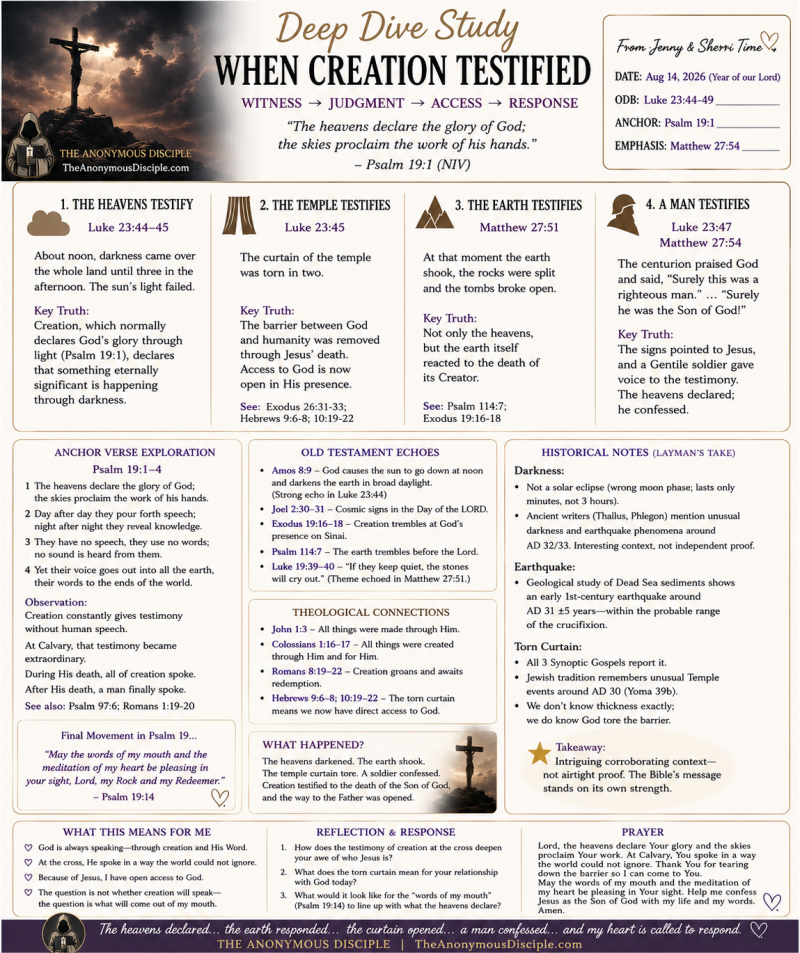
WHEN CREATION TESTIFIED
Luke 23:44–49
⚓ Psalm 19:1
👀 Matthew 27:54
And I think our four words for the study are:
Witness → Judgment → Access → Response
That Matthew 27:54 emphasis you wanted? I think it becomes the payoff of the whole study. 😳
🌌 Start with Psalm 19—not the crucifixion
Psalm 19:1 (NIV):
“The heavens declare the glory of God; the skies proclaim the work of his hands.”
But I want us to read Psalm 19:1–4, not only verse 1.
David's point is fascinating: creation is giving testimony without human speech. Day after day and night after night, God's creation communicates something true about its Creator. Psalm 19 then moves from God's revelation in creation in verses 1–6 to God's revelation through His Word in verses 7–11, and finally to the human heart's response in verses 12–14. (Bible Gateway)
That's important because I would slightly change James's wording.
I wouldn't say Psalm 19:1 is predicting the darkness at Calvary. It isn't. But Psalm 19 gives us a biblical framework for understanding creation as a witness to God.
Then Luke takes us to the cross...
…and suddenly creation is doing something extraordinary.
🌑 Luke 23:44–45 — the heavens testify
Luke 23:44–45 says darkness covered the land from about noon until three in the afternoon, the sun's light failed, and the temple curtain was torn. (Bible Gateway)
Noon matters.
This wasn't darkness arriving naturally with evening. It came when the sun should have been high.
And this is where I think Amos 8:9 deserves much more attention than James gave it.
Amos 8:9 describes God causing the sun to go down at noon and darkening the earth in broad daylight. Luke 23 is actually cross-referenced to Amos 8:9 in the NIV. (Bible Gateway)
Now—I would be careful with our language.
I would not write:
“Amos 8:9 was fulfilled at the crucifixion.”
Amos is speaking within a particular oracle of judgment against Israel.
I would write:
“Luke's darkness strongly echoes Old Testament imagery in which supernatural darkness accompanies divine judgment.”
That is stronger Bible study because we're letting Scripture establish the pattern without forcing a prophecy claim.
And suddenly Psalm 19 gets interesting.
Normally:
The heavens declare God's glory through light.
At Calvary:
the heavens declare that something is terribly, cosmically significant through darkness.
Same creation.
Same Creator.
Different testimony.
😳 And here's the thought that grabbed me...
Who is hanging on that cross?
According to John 1:3, everything that was made was made through Him.
According to Colossians 1:16–17, all things were created through Christ and for Christ and hold together in Him.
So the One through whom the heavens were created is hanging beneath those heavens.
And the heavens change.
I'm not saying Scripture explicitly says, “the sky recognized its Creator.” We shouldn't put words into the text.
But canonically?
Good grief, Sherri.
The created order is behaving extraordinarily while its Creator is being crucified.
That belongs in our study. ❤️
✂️ Luke 23:45 — then the testimony moves from heaven to temple
Luke immediately tells us:
the temple curtain was torn in two. (Bible Gateway)
Matthew and Mark specifically say it tore from top to bottom; Mark places it immediately after Jesus breathed His last. (Bible Gateway)
This is our second movement:
Darkened heaven → opened access.
The curtain had represented separation from the Most Holy Place; Exodus 26:31–33 establishes that barrier, and Hebrews 9:6–8 later explains its theological significance. Then Hebrews 10:19–22 explicitly connects believers' access to God's presence with the blood of Jesus. Luke's own cross-reference trail points in exactly this direction. (Bible Gateway)
So I think the torn curtain is much more important to our study theologically than trying to prove historically how thick it was.
And that's one place I would correct James.
I would drop the “several inches thick” claim entirely. That's frequently repeated in sermons and apologetics, but it isn't something I'd feel comfortable presenting as established first-century fact.
We don't need it anyway.
God tore the barrier.
That's the important part.
🌎 Then Matthew supplies something Luke doesn't mention: the earth moves
Matthew 27:51–54 adds the earthquake, splitting rocks, and the reaction of the centurion and those guarding Jesus. Matthew says that when they saw the earthquake and what had happened, they were terrified and confessed:
Matthew 27:54 — “Surely he was the Son of God!” (Bible Gateway)
And this is where I think your subtle Matthew 27:54 emphasis should become the center of the whole thing.
Watch the progression:
The heavens testify.
Then...
the earth testifies.
Then...
the temple testifies.
And finally...
a man testifies.
😳
Sherri, that's our study.
Psalm 19 says creation gives testimony to God without words.
At Calvary, the sky darkens and the earth shakes.
And eventually a pagan Roman soldier puts words to the testimony:
“Surely he was the Son of God.”
Luke gives another angle: the centurion praised God and declared Jesus righteous. Matthew and Mark preserve the confession concerning the Son of God. I wouldn't necessarily combine those into one exact sentence the centurion spoke; I'd say the Gospel writers preserve complementary emphases about his response. (Bible Gateway)
That's much more precise.
And boy does it preach. 😂❤️
Now, about the history stuff 🧐
James is absolutely right on the solar eclipse question.
A normal solar eclipse requires a new moon; NASA confirms that geometry. Passover occurs around the middle of Nisan, near the full moon. And totality in an ordinary solar eclipse lasts minutes, not three hours. So a conventional solar eclipse is not a credible explanation for Luke's three-hour darkness. (NASA Science)
Where James gets too confident is the external evidence.
Thallus: Interesting, yes. Strong independent confirmation? No. Thallus's original work is lost. The claim comes through Julius Africanus, whose work is itself preserved through later transmission, and scholars disagree over exactly what Thallus originally said and whether he was referring to the crucifixion at all. Even the dating commonly given for Thallus is debated. (Tertullian Project)
Phlegon: Also interesting but not a slam dunk. Origen says Phlegon wrote about an eclipse and earthquakes during Tiberius's reign, but surviving descriptions associate the earthquake with Bithynia/Nicaea, far from Jerusalem. So I wouldn't say, “Phlegon independently confirmed the crucifixion darkness.” I'd say an ancient writer preserved a report of unusual darkness/earthquake phenomena in the relevant general era, and later Christians connected it with the crucifixion. (Christian Classics Ethereal Library)
The earthquake: This one is genuinely interesting. A peer-reviewed geological study identified an early-first-century seismic disturbance in Dead Sea sediments, tentatively dated around AD 31 ±5 years. That overlaps the likely crucifixion period—but the evidence cannot tell us, “This sediment layer is Matthew 27:51.” It supports the plausibility of an earthquake in the right period, not identification of the exact biblical quake. (Taylor & Francis Online)
The Talmud: This is fascinating as a side note, not proof. Yoma 39b preserves a tradition that during the forty years before the Temple's destruction, several unusual Temple signs occurred, including sanctuary doors opening by themselves. It does not say the crucifixion curtain tore, and the rabbinic text was compiled much later. Still, the roughly AD 30 timing makes it an interesting historical-theological curiosity. (Sefaria)
So my margin note would be:
Historical evidence: intriguing corroborating context, not independent proof.
And frankly, I think that's a stronger position. We don't need shaky apologetics to defend Scripture. ❤️
📖 Where I'd take our cross-references
I think these are stronger than simply assembling “sky verses”:
-
Psalm 19:1–4 — Creation testifies: the heavens continuously declare God's glory.
-
Psalm 97:6 — Creation reveals righteousness: the heavens proclaim God's righteousness and glory.
-
Romans 1:19–20 — Creation reveals the Creator: God's power and divine nature are perceived through what He made.
-
Amos 8:9 — Darkness at noon: extremely important background for Luke 23:44.
-
Joel 2:30–31 — Cosmic signs and the Day of the LORD: sun turned to darkness in judgment imagery.
-
Exodus 19:16–18 — Creation reacts to God's presence: Sinai shakes when God descends.
-
Psalm 114:7 — The earth trembles before the Lord: another strong creation/responds-to-Creator connection.
-
Luke 19:39–40 — “the stones will cry out”: I'd absolutely include this—with the note that Matthew later says rocks split at His death. That's a thematic connection, not a claimed fulfillment.
-
Hebrews 9:6–8; Hebrews 10:19–22 — The curtain/access: these explain what the torn barrier means.
-
John 1:3; Colossians 1:16–17 — Christ and creation: the One dying at Calvary is the One through whom creation exists.
-
Romans 8:19–22 — Creation groans: broader theology showing creation itself participates in the consequences of the fall and awaits redemption.
And I particularly like Luke 19:40 → Matthew 27:51.
Jesus had said:
Luke 19:40: if His disciples were silent, the stones would cry out.
Days later, when Jesus dies:
Matthew 27:51: the rocks split.
Again—we're not calling that a prophecy fulfillment.
But as a literary/canonical echo?
👀 👀 👀
I'd write that one in the margin.
❤️ My layman's summary for today's study
God's creation has always pointed to its Creator. Psalm 19 says the heavens continually declare His glory without speaking a word. At Jesus' death, creation gave an extraordinary testimony: daylight turned to darkness, Matthew records the earth shaking and rocks splitting, and the temple curtain tore. These signs do not need to be stretched into scientific proof to carry their biblical message. Something world-changing was happening at the cross. The barrier between God and humanity was being dealt with through Christ, and even a Roman centurion watching it unfold responded by praising God and confessing who Jesus was. Creation testified—and a man finally said aloud what the signs were pointing toward: “Surely he was the Son of God.”
And I think our deepest heart question is already peeking out:
If creation declares who He is…do I?
Because Psalm 19 starts with the heavens declaring God's glory...
…but ends with David concerning the words of his own mouth.
Psalm 19:14.
Ohhhh, come on. 😳
There's the ending of the whole study.
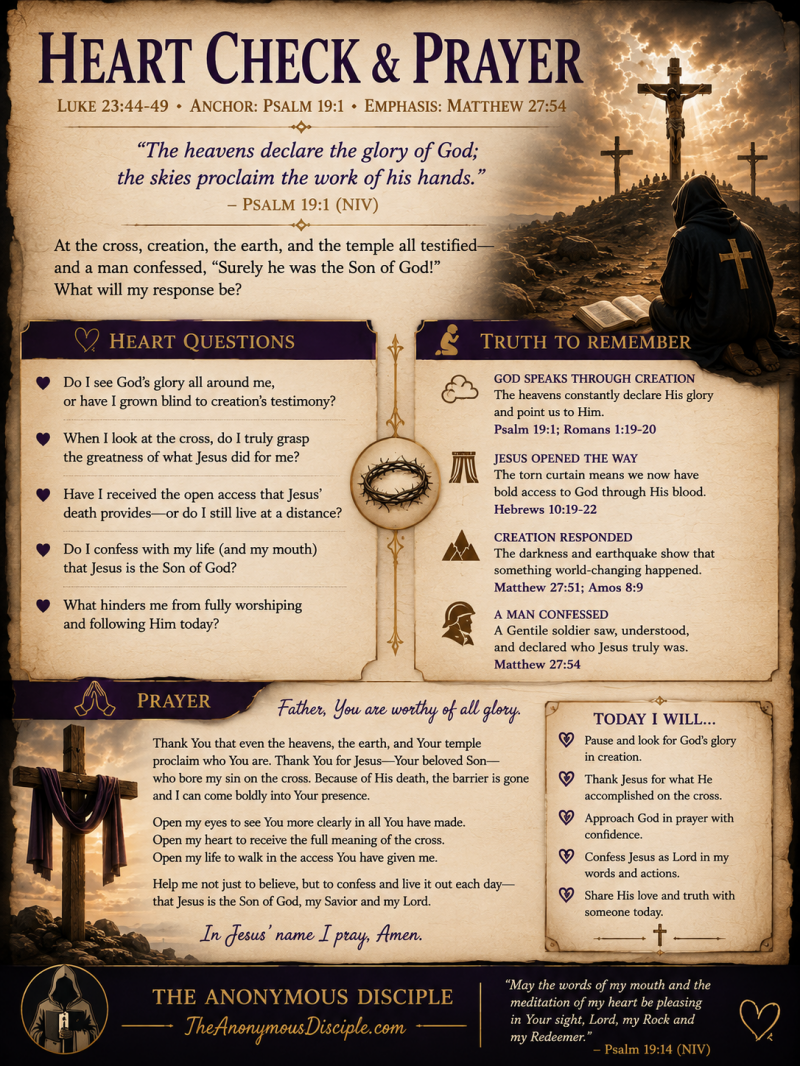
The heavens have a testimony.
The centurion had a testimony.
What comes out of my mouth?
That gives us a beautiful arc from Psalm 19:1 → Matthew 27:54 → Psalm 19:14.
I think that's where Jenny & Sherri are going this morning. ☕️📖❤️ And from here, I see a Deep Dive study, then a “Creation Testifies Throughout Scripture” card, and I am very tempted by a separate “Signs at the Cross: Darkness • Earthquake • Torn Curtain” card because those three signs deserve to be seen together.
Add comment
Comments