

In everyday terms, Jesus is saying that the kind of heart that gets into God’s kingdom is the heart of a child—simple trust, dependence, humility, and openness. A little child doesn’t try to earn their place or impress anyone. They just come. That’s the attitude Jesus wants from all of us.
In short, the culture around Jesus often treated children as low-status and easily overlooked. Jesus turns that thinking upside down: "Receive the Kingdom of God like a little child, or you will never enter it." - Mark 10:15
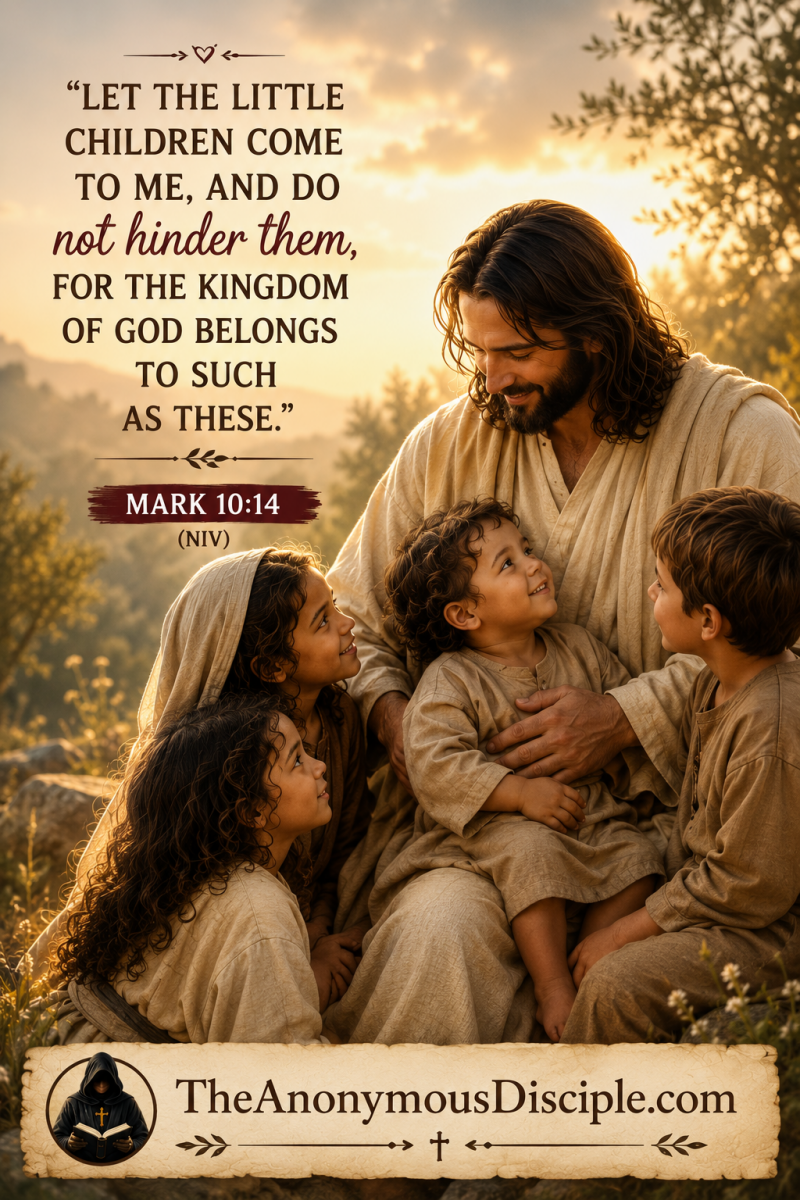
Today's study:
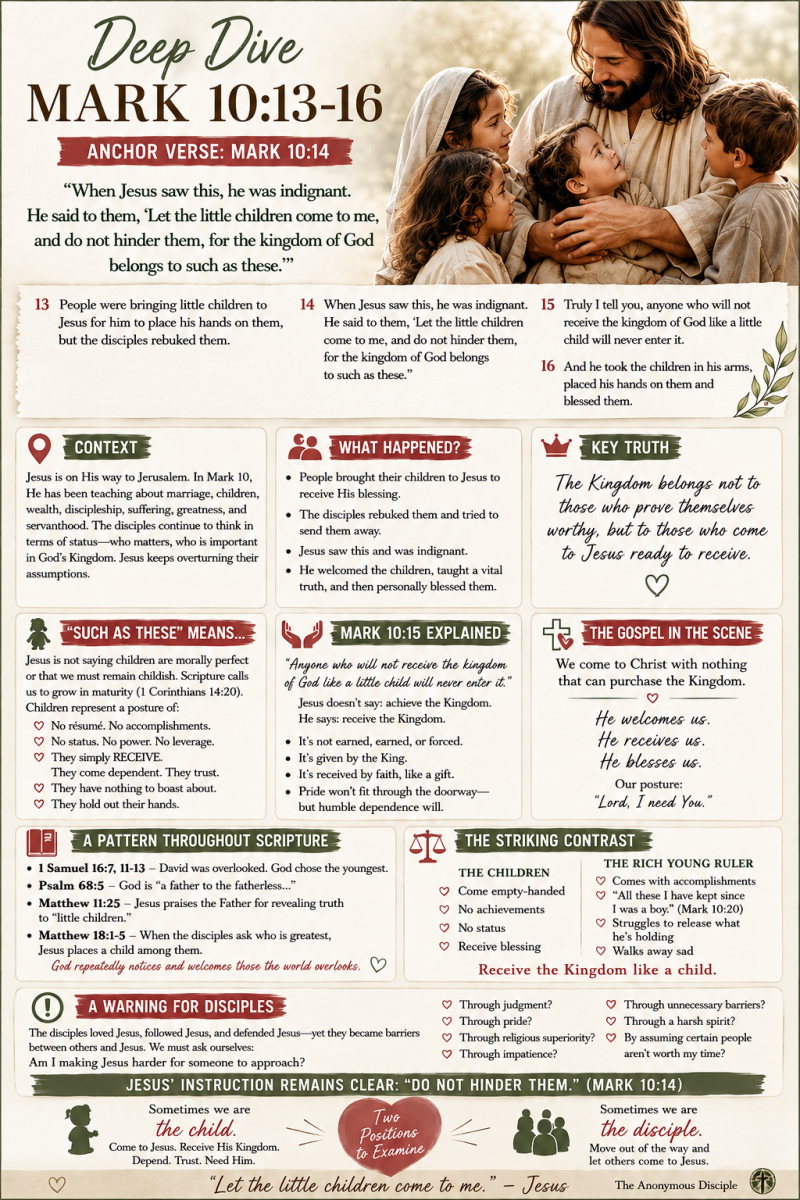
- Deep Dive
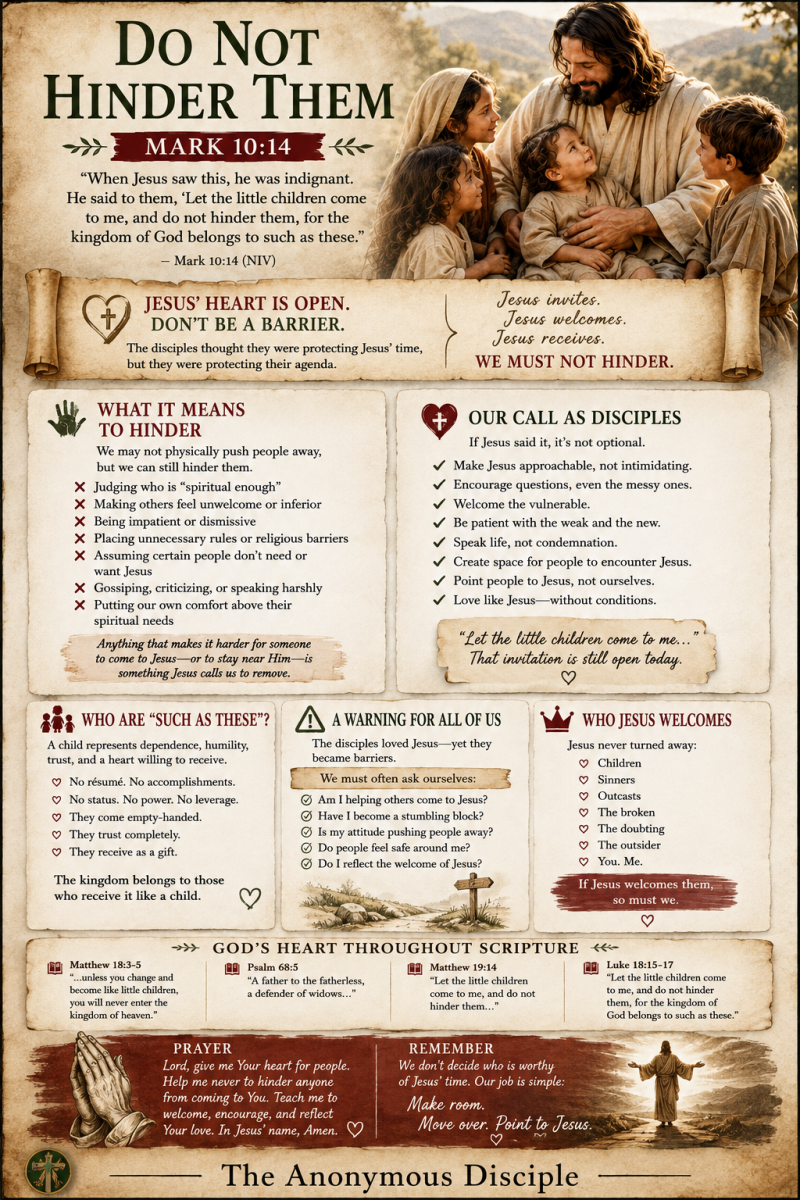
- Do Not Hinder Them
- Receive The Kingdom Like a Child
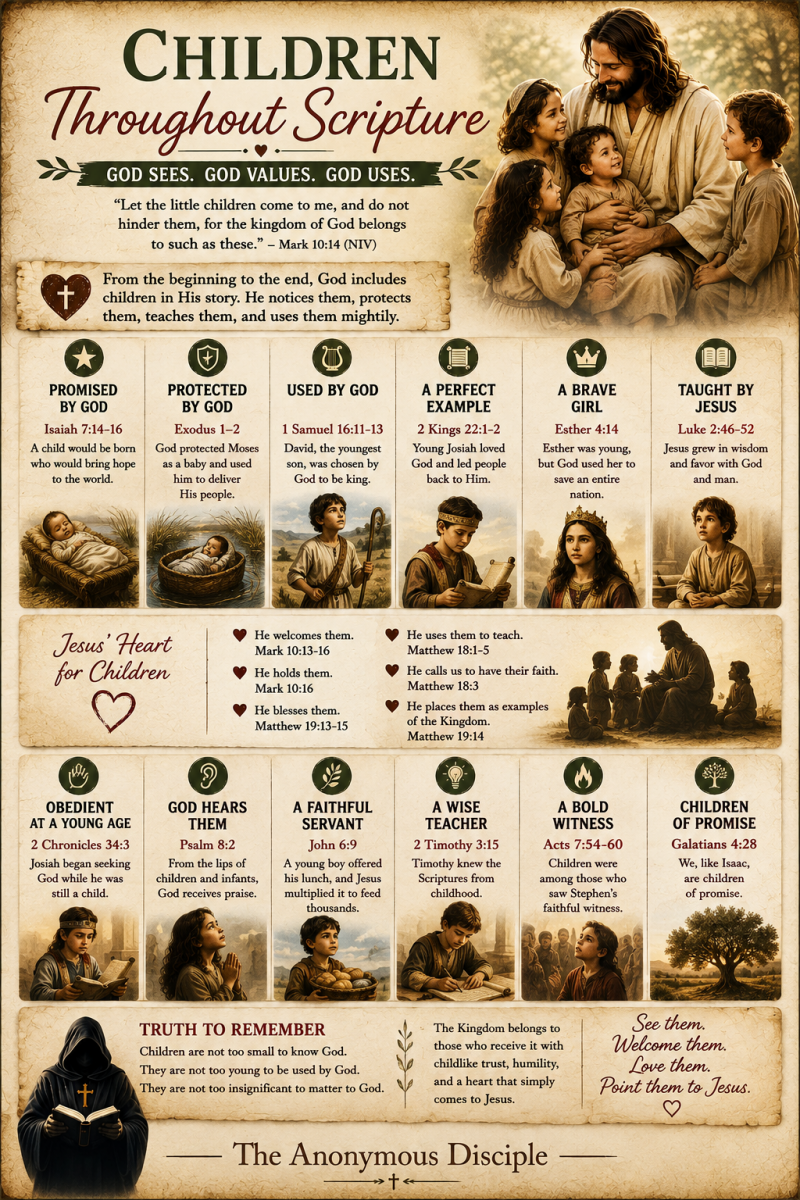
- Children Throughout Scripture
- Heart Check & Prayer (pdf available)
- Various Translations
- Cross References
- Study Notes
NIV
People were bringing little children to Jesus for him to place his hands on them, but the disciples rebuked them. When Jesus saw this, he was indignant. He said to them, “Let the little children come to me, and do not hinder them, for the kingdom of God belongs to such as these. Truly I tell you, anyone who will not receive the kingdom of God like a little child will never enter it.” And he took the children in his arms, placed his hands on them and blessed them.
KJV
And they brought young children to him, that he should touch them: and his disciples rebuked those that brought them. But when Jesus saw it, he was much displeased, and said unto them, Suffer the little children to come unto me, and forbid them not: for of such is the kingdom of God. Verily I say unto you, Whosoever shall not receive the kingdom of God as a little child, he shall not enter therein. And he took them up in his arms, put his hands upon them, and blessed them.
Parallel Accounts (the same event told in other Gospels)
These are the closest matches:
- Matthew 19:13-15 People brought little children to Jesus for Him to place His hands on them and pray, but the disciples rebuked them. Jesus said, “Let the little children come to me, and do not hinder them, for the kingdom of heaven belongs to such as these.” Then He placed His hands on them.
- Luke 18:15-17 People were also bringing babies to Jesus for Him to place His hands on them. When the disciples saw this, they rebuked them. But Jesus called the children to Him and said, “Let the little children come to me, and do not hinder them, for the kingdom of God belongs to such as these. Truly I tell you, anyone who will not receive the kingdom of God like a little child will never enter it.”
Other Related Passages on Childlike Faith & Humility
These connect to the same idea Jesus taught:
- Matthew 18:1-5 The disciples asked who is the greatest in the kingdom of heaven. Jesus called a little child and said, “Truly I tell you, unless you change and become like little children, you will never enter the kingdom of heaven. Therefore, whoever takes the lowly position of this child is the greatest in the kingdom of heaven. And whoever welcomes one such child in my name welcomes me.”
- Mark 9:36-37 He took a little child and had him stand among them. Taking him in His arms, He said to them, “Whoever welcomes one of these little children in my name welcomes me; and whoever welcomes me does not welcome me but the one who sent me.”
- Luke 9:46-48 An argument started among the disciples as to which of them would be the greatest. Jesus, knowing their thoughts, took a little child and had him stand beside Him. Then He said to them, “Whoever welcomes this little child in my name welcomes me; and whoever welcomes me welcomes the one who sent me. For it is the one who is least among you all who is the greatest.”
Extra Related Verses
- Matthew 18:10 – “See that you do not despise one of these little ones. For I tell you that their angels in heaven always see the face of my Father in heaven.”
- Psalm 131:1-2 – A beautiful Old Testament picture of childlike trust: “My heart is not proud, Lord, my eyes are not haughty… But I have calmed and quieted myself, I am like a weaned child with its mother; like a weaned child I am content.”

The Common Cultural View in the First Century
In both Jewish and Roman society at that time, children were loved by their own families, but they held a very low place in the wider social order.
- Children were seen as incomplete. A child was not yet a full person in the eyes of society. They had almost no status, no voice, and no rights of their own. Adults made all the decisions. Children were expected to be quiet, obedient, and out of the way.
- They were dependent and vulnerable. Everyone understood that children needed constant care. That dependence was often viewed as weakness rather than something positive. In the Roman world especially, unwanted babies could even be left outside to die (a practice called exposure). Jewish culture valued children more highly as gifts from God, yet even there they ranked near the bottom of the social ladder.
- Important people did not waste time on children. Rabbis, teachers, and men of status focused on other adults—especially other men. Children were not considered worth a busy teacher’s attention. That is why the disciples tried to stop the parents. In their minds, they were protecting Jesus’ dignity and His limited time. Bringing little children to a respected rabbi for a blessing was not unheard of, but the disciples clearly thought it was inappropriate or unimportant.
Why Jesus’ Words and Actions Were So Different
Against that background, Jesus did something shocking:
- He became indignant (deeply upset) when the disciples pushed the children away.
- He said the kingdom of God belongs to people like these children.
- He took the children into His arms and blessed them.
Jesus was turning the cultural ranking upside down. He was saying that the very qualities the world looked down on in children—their dependence, their trust, their lack of status—are exactly the qualities needed to enter God’s kingdom.
In short, the culture said, “Children are small and unimportant.” Jesus said, “Become like them, or you will miss the kingdom altogether.”
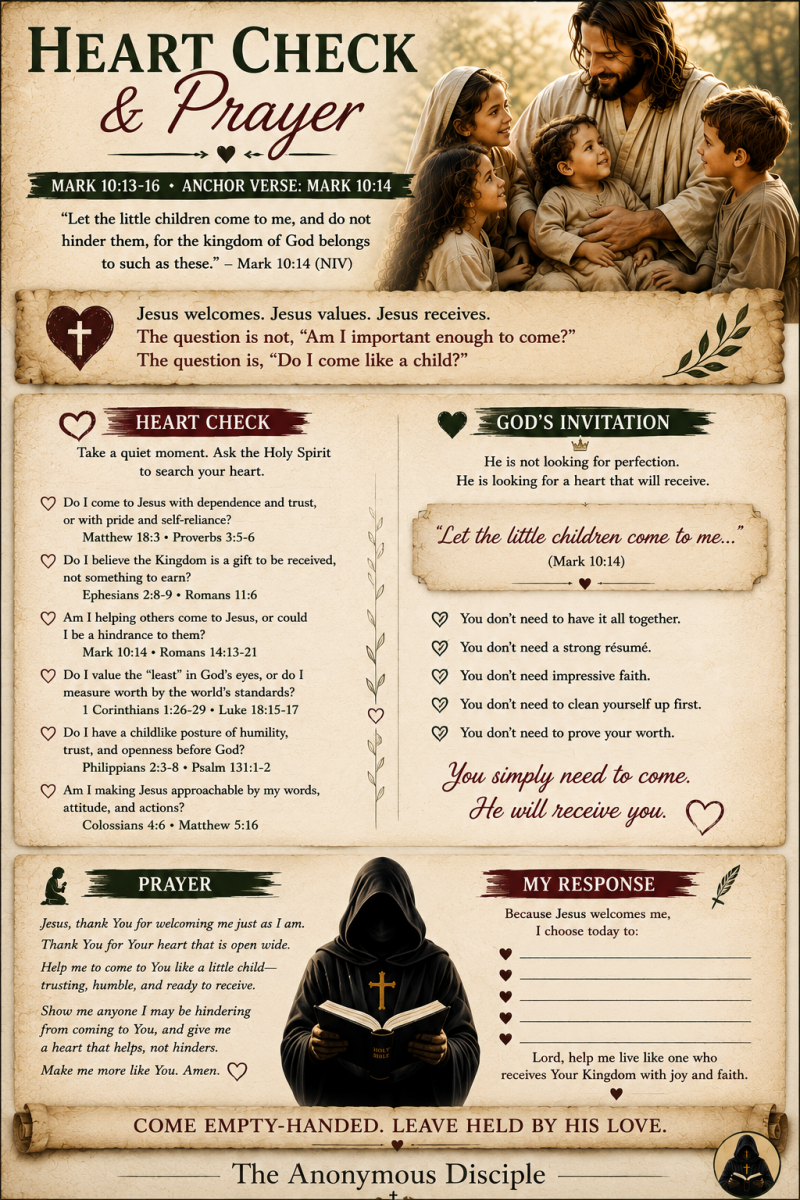
study notes
𝕏James𝕏
Good morning,
Here’s a simple, plain-language look at Mark 10:13-16.
What was happening People were bringing little children to Jesus so He could put His hands on them and bless them. This was a common, loving custom. But the disciples tried to stop it. They thought Jesus was too important or too busy for little kids.
Jesus’ reaction Jesus wasn’t just mildly annoyed—He was truly upset (the word means He was indignant or deeply displeased). He made it very clear: “Let the little children come to me. Don’t get in their way.”
The big point Jesus made He said the kingdom of God belongs to people who are like these children. Then He added something even stronger: unless a person receives the kingdom of God the way a little child does, they will never enter it at all.
In everyday terms, Jesus is saying that the kind of heart that gets into God’s kingdom is the heart of a child—simple trust, dependence, humility, and openness. A little child doesn’t try to earn their place or impress anyone. They just come. That’s the attitude Jesus wants from all of us.
What Jesus did next He didn’t just talk about it. He took the children in His arms, put His hands on them, and blessed them. He showed with His actions that children (and people with childlike hearts) are welcome and precious to Him.
Bottom line The disciples were trying to protect Jesus’ time and status. Jesus showed that His heart is open to the least important people in society. He values simple, trusting faith far more than status, knowledge, or self-importance.
🪄꩜Jenny꩜🪄
Good morning—Mark 10:13–16 with Mark 10:14 as the anchor is such a good deep dive. There’s much more happening here than “Jesus loves children.” The disciples are accidentally revealing how they think the Kingdom works…and Jesus corrects them sharply.
📖 Deep Dive — Mark 10:13–16
⚓ Anchor Verse: Mark 10:14
Mark 10:14 (NIV) — “When Jesus saw this, he was indignant. He said to them, ‘Let the little children come to me, and do not hinder them, for the kingdom of God belongs to such as these.’”
📜 The Passage
Mark 10:13 (NIV) — “People were bringing little children to Jesus for him to place his hands on them, but the disciples rebuked them.”
Mark 10:14 (NIV) — “When Jesus saw this, he was indignant. He said to them, ‘Let the little children come to me, and do not hinder them, for the kingdom of God belongs to such as these.’”
Mark 10:15 (NIV) — “Truly I tell you, anyone who will not receive the kingdom of God like a little child will never enter it.”
Mark 10:16 (NIV) — “And he took the children in his arms, placed his hands on them and blessed them.”
🔎 Context: What Just Happened?
Jesus is traveling toward Jerusalem.
We are getting very close to the final portion of His earthly ministry. In Mark 10, Jesus teaches about marriage, children, wealth, discipleship, suffering, greatness, servanthood, and eventually His approaching death.
And there is a recurring problem:
The disciples still think in terms of status.
Who matters?
Who deserves Jesus' time?
Who is important in God's Kingdom?
Jesus keeps dismantling their assumptions.
That makes this little scene far more significant than it initially appears.
👶 Mark 10:13 — “People were bringing little children…”
Notice what the parents or caregivers wanted:
“…for him to place his hands on them.”
They weren't bringing the children for theological instruction.
They wanted Jesus' blessing.
Touching someone while blessing or praying for them had deep biblical precedent.
For example:
Genesis 48:14–16 — Jacob places his hands upon Ephraim and Manasseh while blessing them.
The people apparently recognize something about Jesus:
If Jesus blesses my child, I want my child near Him.
And then comes the surprise.
“…but the disciples rebuked them.”
😳
Not strangers.
Not Pharisees.
The disciples.
The very men entrusted with helping people come to Jesus are now preventing people from coming to Jesus.
And that becomes one of the major warnings buried inside this passage.
⚠️ The Disciples Became a Barrier
They probably thought they were helping.
Jesus was important.
Jesus was busy.
Jesus had serious matters to attend to.
Surely He didn't need to be bothered by children.
But they had made a terrible calculation:
They decided for Jesus who was worth His attention.
That is precisely what Jesus refuses to tolerate.
⚓ Mark 10:14 — “When Jesus saw this, he was indignant.”
This word matters.
Jesus wasn't mildly annoyed.
He was indignant.
There is genuine displeasure here.
Why?
Because somebody was standing between vulnerable people and Jesus.
And He says:
“Let the little children come to me…”
Beautifully simple.
Let them come.
Don't screen them.
Don't rank them.
Don't decide they're unimportant.
Don't make them prove themselves first.
Don't make approaching Jesus harder than Jesus Himself makes it.
❤️
Then:
“…and do not hinder them…”
That's the knife-edge of this passage for disciples.
The question isn't only:
Am I coming to Jesus?
There's another question:
Am I helping others come to Jesus—or could something about me be hindering them?
That's uncomfortable.
But Jesus clearly cares about it.
👑 “For the kingdom of God belongs to such as these.”
Notice Jesus does not simply say:
“The kingdom belongs to children.”
He says:
“such as these.”
Now He's using the children to teach everybody watching.
And we have to be careful here.
Jesus is not saying children are morally perfect.
He is not commanding childishness.
He is not saying:
- be uninformed,
- be gullible,
- never question,
- never mature,
- abandon wisdom.
Scripture repeatedly tells believers to mature.
1 Corinthians 14:20 — Paul says not to remain children in our thinking.
So what does Jesus mean?
Look at what a little child represents in this scene.
A child comes with:
No résumé.
No accomplishments.
No religious status.
No power.
No leverage.
No argument about deserving anything.
The child simply receives.
And that leads directly into verse 15.
👐 Mark 10:15 — “Receive the kingdom…”
This may be the key to understanding everything.
Jesus doesn't say:
achieve the Kingdom.
He says:
receive the Kingdom.
That is massive.
The Kingdom of God isn't something we force God to give us because we have accumulated enough righteousness points.
It is something received from the King.
And how does a little child receive a gift?
They don't hand you a résumé first.
😂
They hold out their hands.
That is the posture Jesus is pointing toward.
Childlike faith is not intellectual emptiness.
It is dependence.
Childlike faith is not gullibility.
It is trust.
Childlike faith is not immaturity.
It is humility.
Childlike faith is not ignorance.
It is knowing:
I need what my Father gives me.
🚨 “Will never enter it.”
Jesus makes this extraordinarily strong.
Mark 10:15 — “…anyone who will not receive the kingdom of God like a little child will never enter it.”
That removes human pride from the doorway.
You can't enter God's Kingdom saying:
Look what I earned.
You enter saying:
Lord, I receive what You give.
That fits beautifully with the rest of the New Testament.
Ephesians 2:8–9 — salvation is by grace through faith, not from ourselves or by works so that no one can boast.
The child in Jesus' arms has nothing to boast about.
They simply allowed Jesus to hold them.
😭❤️
🤲 Mark 10:16 — Jesus Doesn't Merely Teach About Them
This verse gets me.
Jesus could have finished the lesson and moved on.
Instead:
“And he took the children in his arms…”
Mark gives us that visual deliberately.
The same Jesus who is moving toward Jerusalem…
The same Jesus who knows the cross is approaching…
The same Jesus carrying the burden of His mission…
stops and holds children.
He doesn't merely defend their right to approach Him.
He welcomes them personally.
Then:
“…placed his hands on them and blessed them.”
The disciples tried to send them away.
Jesus brought them closer.
That's the contrast.
🧵 A Pattern Running Through Scripture
God repeatedly notices the people society overlooks.
1 Samuel 16:7, 11–13
David isn't even initially brought before Samuel.
He is the overlooked youngest son.
God chooses him.
Psalm 68:5
God describes Himself as:
“A father to the fatherless…”
Matthew 11:25
Jesus praises the Father for revealing truth to the “little children” rather than merely to those considered wise and learned.
Matthew 18:1–5
When the disciples ask who is greatest in the Kingdom, Jesus places a child among them.
There it is again.
They ask:
Who is greatest?
Jesus responds:
Look at this child.
The Kingdom keeps overturning our rankings.
👀 Something Really Interesting Happens Right After This
Immediately after the children comes the rich young ruler.
Mark 10:17–22.
That placement is fascinating.
You essentially get two approaches to Jesus.
The children
Come empty-handed.
Receive blessing.
The rich man
Comes with accomplishments.
“All these I have kept since I was a boy.” — Mark 10:20
He has status.
Morality.
Possessions.
Achievement.
But he struggles to release what he is depending upon.
I don't think Mark's arrangement should be ignored.
You have just heard:
Receive the Kingdom like a child.
Then walks up a man with nearly everything society says should make someone secure.
And he walks away sad.
😳
The contrast is stunning.
✝️ The Gospel Hidden in the Scene
This little passage quietly pictures the gospel.
We come to Christ with nothing capable of purchasing the Kingdom.
Jesus welcomes us.
Jesus receives us.
Jesus blesses us.
The posture isn't:
“Jesus, look what I have earned.”
It is:
“Jesus, I need You.”
That's childlike faith.
🪞 The Disciple Warning
There is also a serious warning here for believers.
The disciples loved Jesus.
They followed Jesus.
They defended Jesus.
And still—
they temporarily became obstacles between other people and Jesus.
That means sincere believers should periodically ask:
Am I making Jesus harder for somebody to approach?
Through judgment?
Pride?
Religious superiority?
Impatience?
Unnecessary barriers?
A harsh spirit?
Assuming certain people aren't worth my time?
Because Jesus' instruction remains painfully clear:
“Do not hinder them.” — Mark 10:14
❤️ The Heart of the Passage
I think Mark 10:13–16 gives us two positions to examine.
Sometimes we are the child.
Jesus says:
Come.
You don't need status.
You don't need an impressive spiritual résumé.
Come dependent.
Come trusting.
Come needing Him.
But sometimes we are the disciple standing near Jesus.
Then Jesus says:
Move out of the way and let them come.
Whew. 😳
⚓ Anchor Verse — Mark 10:14
I think your choice of verse 14 is perfect because it captures both sides:
The heart of Christ:
“Let the little children come to me…”
The responsibility of disciples:
“…do not hinder them…”
The nature of God's Kingdom:
“…for the kingdom of God belongs to such as these.”
So if I were putting one sentence beneath the anchor for our study, I'd use:
Add comment
Comments