

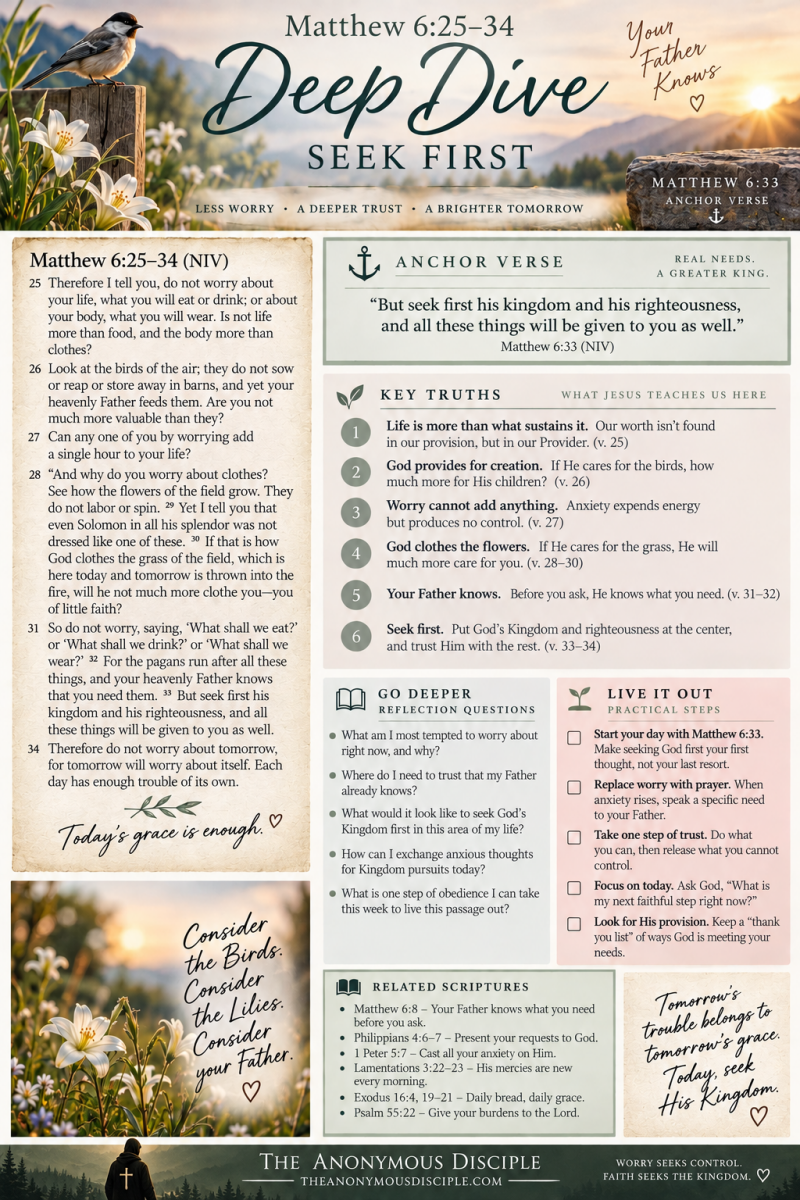
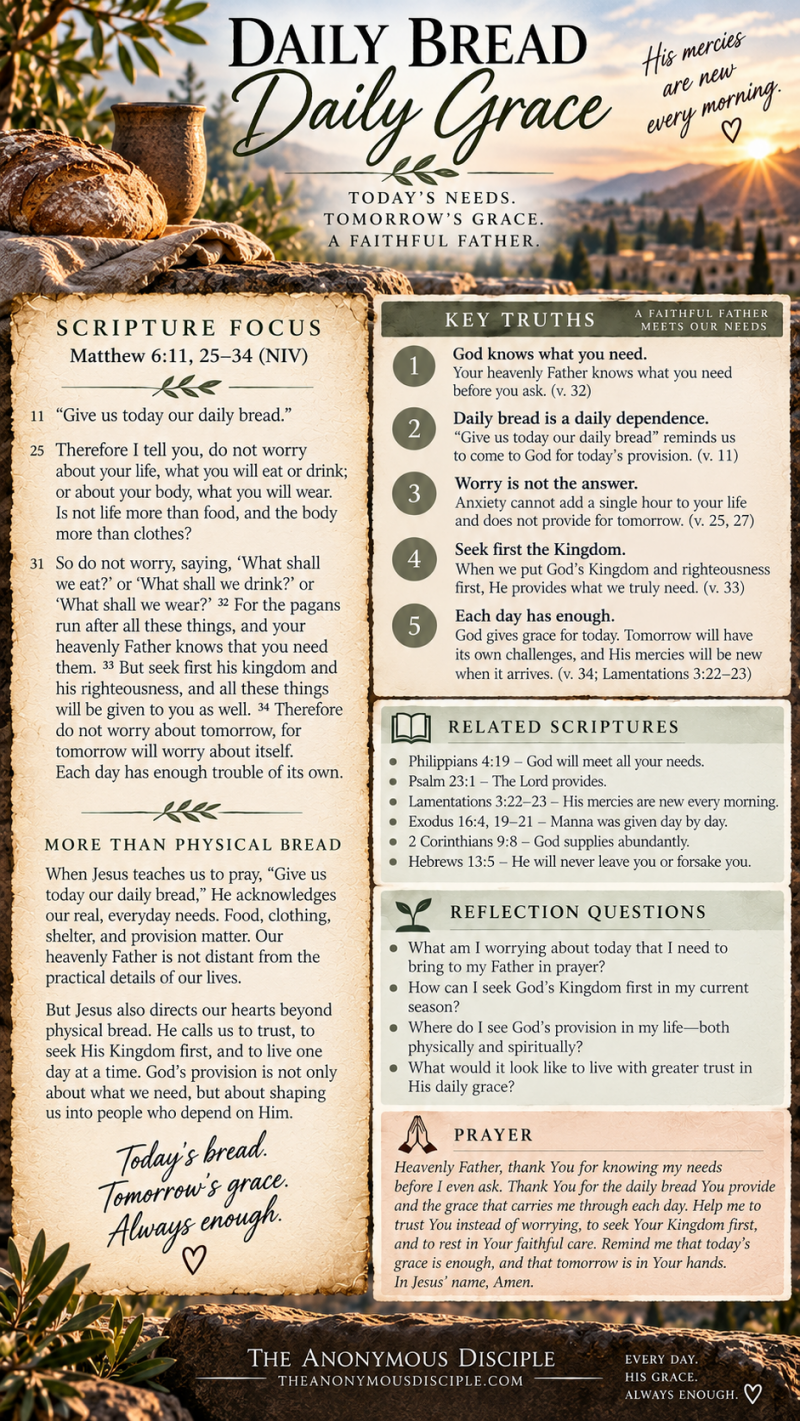
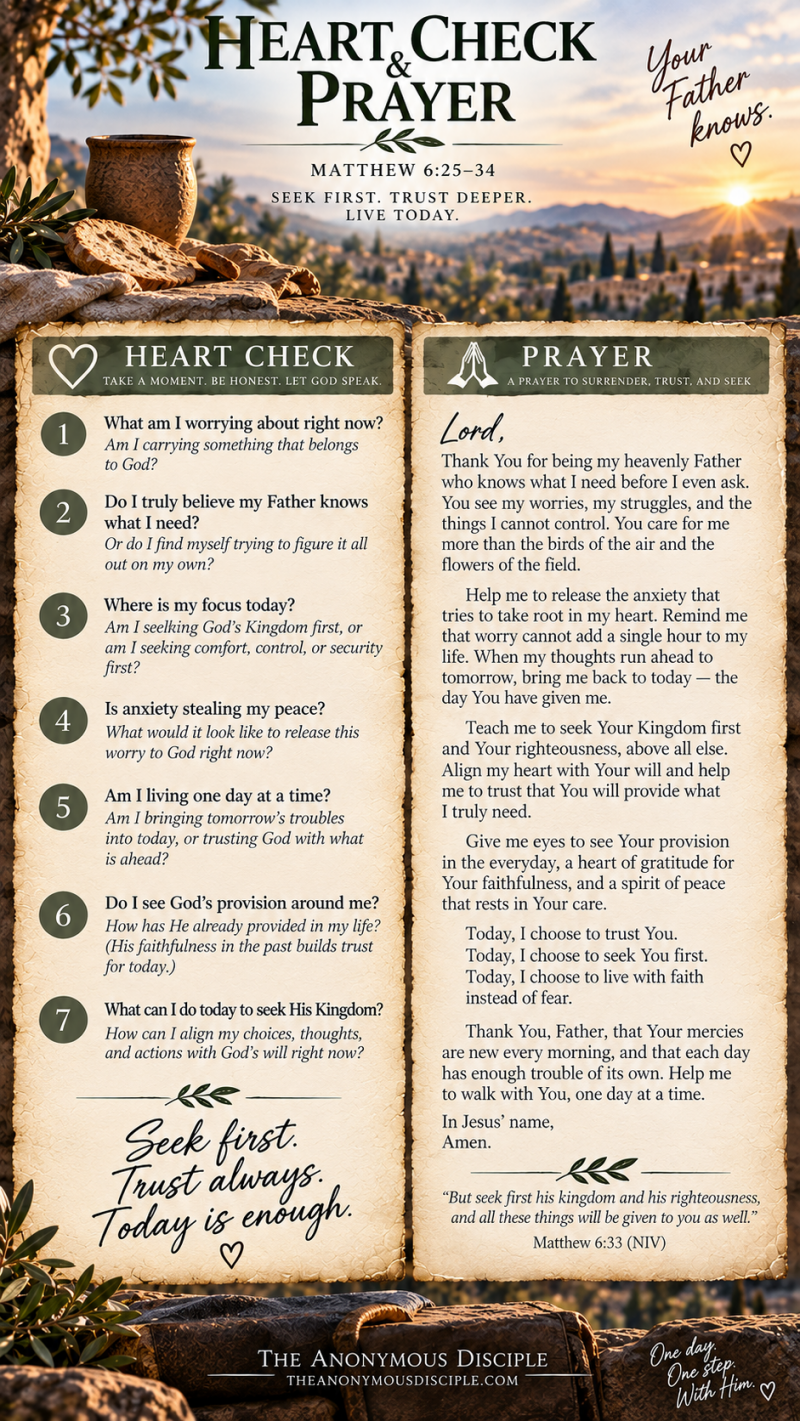
In Matthew 6:25–34, Jesus speaks directly to the anxious heart. He reminds us that the same Father who feeds the birds and clothes the flowers already knows what we need. Worry cannot add a single hour to our lives, and tomorrow was never meant to be carried today. Instead, Jesus gives us a better focus: seek first His Kingdom and His righteousness (Matthew 6:33). This passage is not a call to ignore real needs or responsibilities—it is an invitation to trust the Father who sees, knows, and provides. One day at a time. Daily bread. Daily grace. Kingdom first. ❤️
📜Matthew 6:25-34📜
King James Version (KJV)
25 Therefore I say unto you, Take no thought for your life, what ye shall eat, or what ye shall drink; nor yet for your body, what ye shall put on. Is not the life more than meat, and the body than raiment?
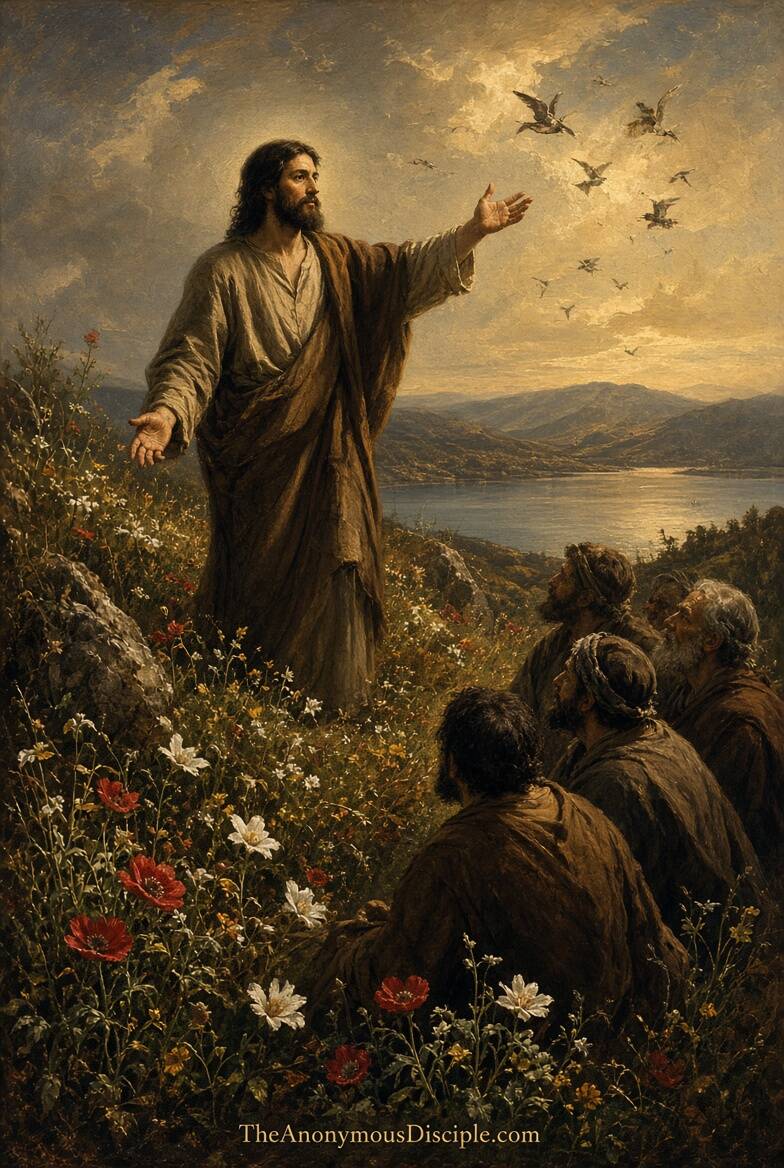
26 Behold the fowls of the air: for they sow not, neither do they reap, nor gather into barns; yet your heavenly Father feedeth them. Are ye not much better than they?
27 Which of you by taking thought can add one cubit unto his stature?
28 And why take ye thought for raiment? Consider the lilies of the field, how they grow; they toil not, neither do they spin:
29 And yet I say unto you, That even Solomon in all his glory was not arrayed like one of these.
30 Wherefore, if God so clothe the grass of the field, which to day is, and to morrow is cast into the oven, shall he not much more clothe you, O ye of little faith?
31 Therefore take no thought, saying, What shall we eat? or, What shall we drink? or, Wherewithal shall we be clothed?
32 (For after all these things do the Gentiles seek:) for your heavenly Father knoweth that ye have need of all these things.
33 But seek ye first the kingdom of God, and his righteousness; and all these things shall be added unto you.
34 Take therefore no thought for the morrow: for the morrow shall take thought for the things of itself. Sufficient unto the day is the evil thereof.
English Standard Version (ESV)
25 “Therefore I tell you, do not be anxious about your life, what you will eat or what you will drink, nor about your body, what you will put on. Is not life more than food, and the body more than clothing?
26 Look at the birds of the air: they neither sow nor reap nor gather into barns, and yet your heavenly Father feeds them. Are you not of more value than they?
27 And which of you by being anxious can add a single hour to his span of life?
28 And why are you anxious about clothing? Consider the lilies of the field, how they grow: they neither toil nor spin,
29 yet I tell you, even Solomon in all his glory was not arrayed like one of these.
30 But if God so clothes the grass of the field, which today is alive and tomorrow is thrown into the oven, will he not much more clothe you, O you of little faith?
31 Therefore do not be anxious, saying, ‘What shall we eat?’ or ‘What shall we drink?’ or ‘What shall we wear?’
32 For the Gentiles seek after all these things, and your heavenly Father knows that you need them all.
33 But seek first the kingdom of God and his righteousness, and all these things will be added to you.
34 “Therefore do not be anxious about tomorrow, for tomorrow will be anxious for itself. Sufficient for the day is its own trouble.”
Behind the Passage
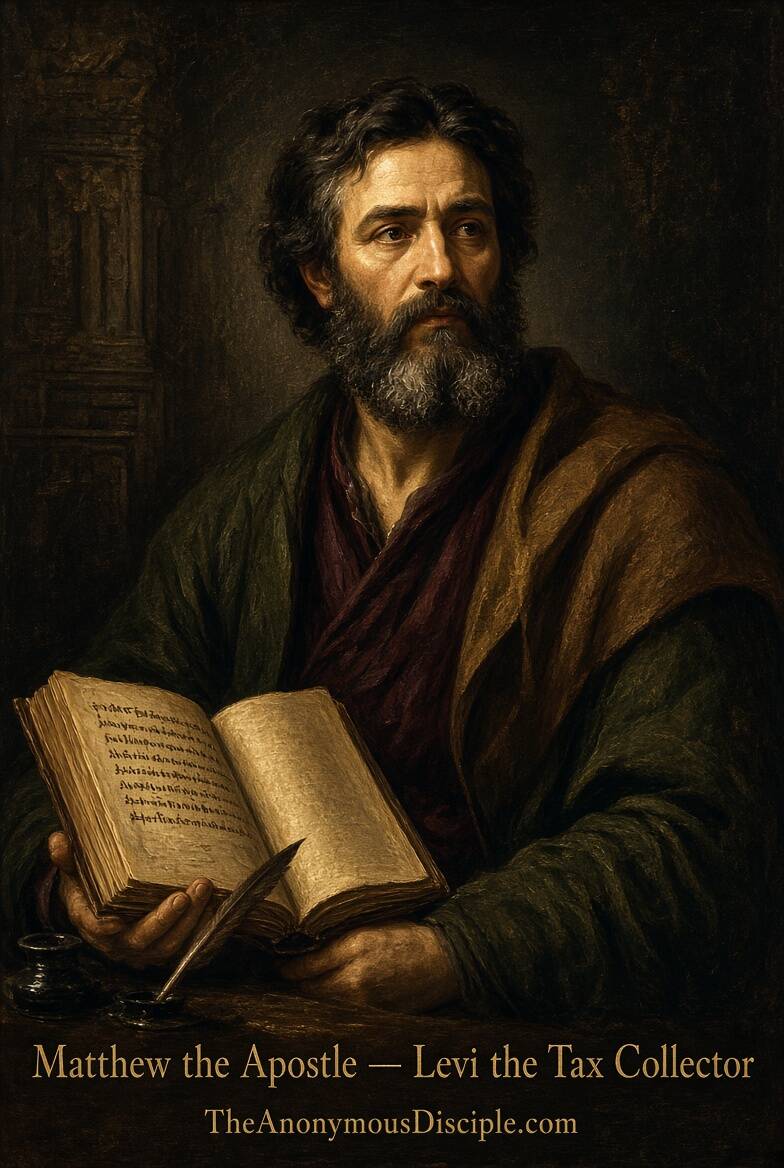
The writer of the Gospel is Matthew.
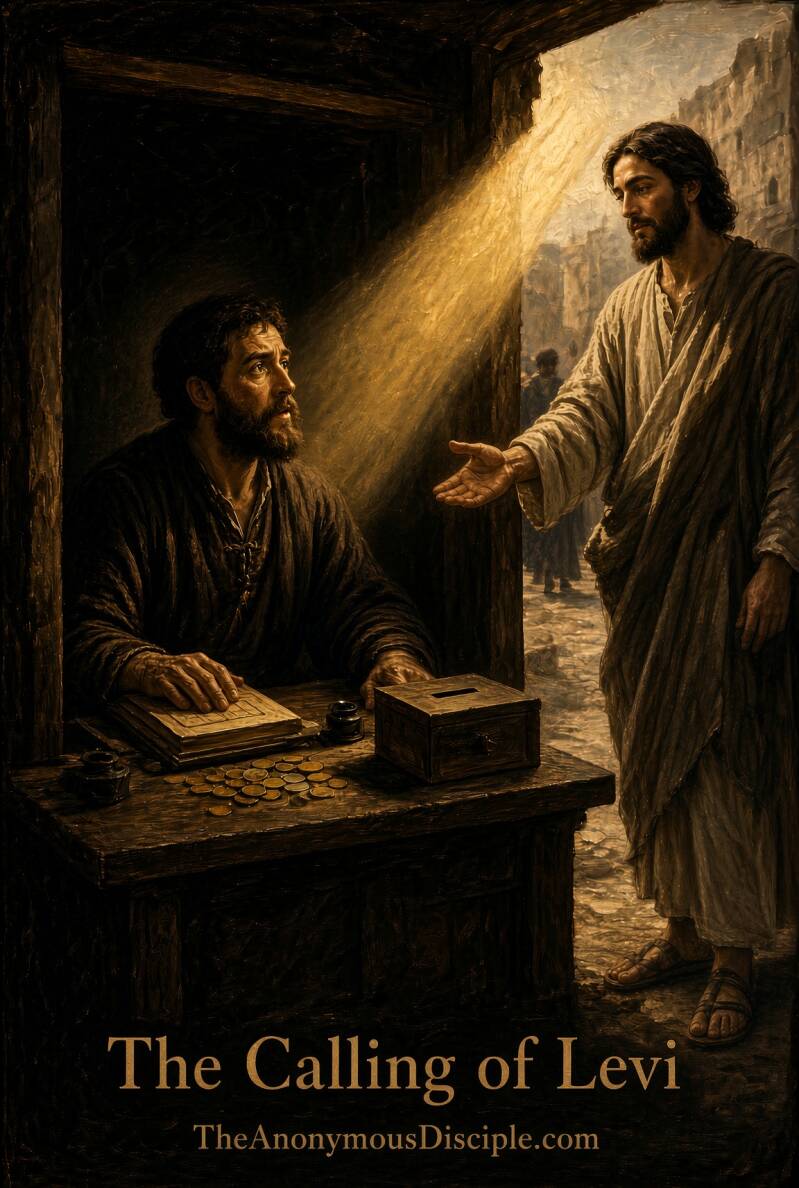
Matthew was one of the twelve apostles. Before Jesus called him, he was Levi the tax collector. He wrote this Gospel so people would know that Jesus is the promised King and Messiah.
So in this passage:
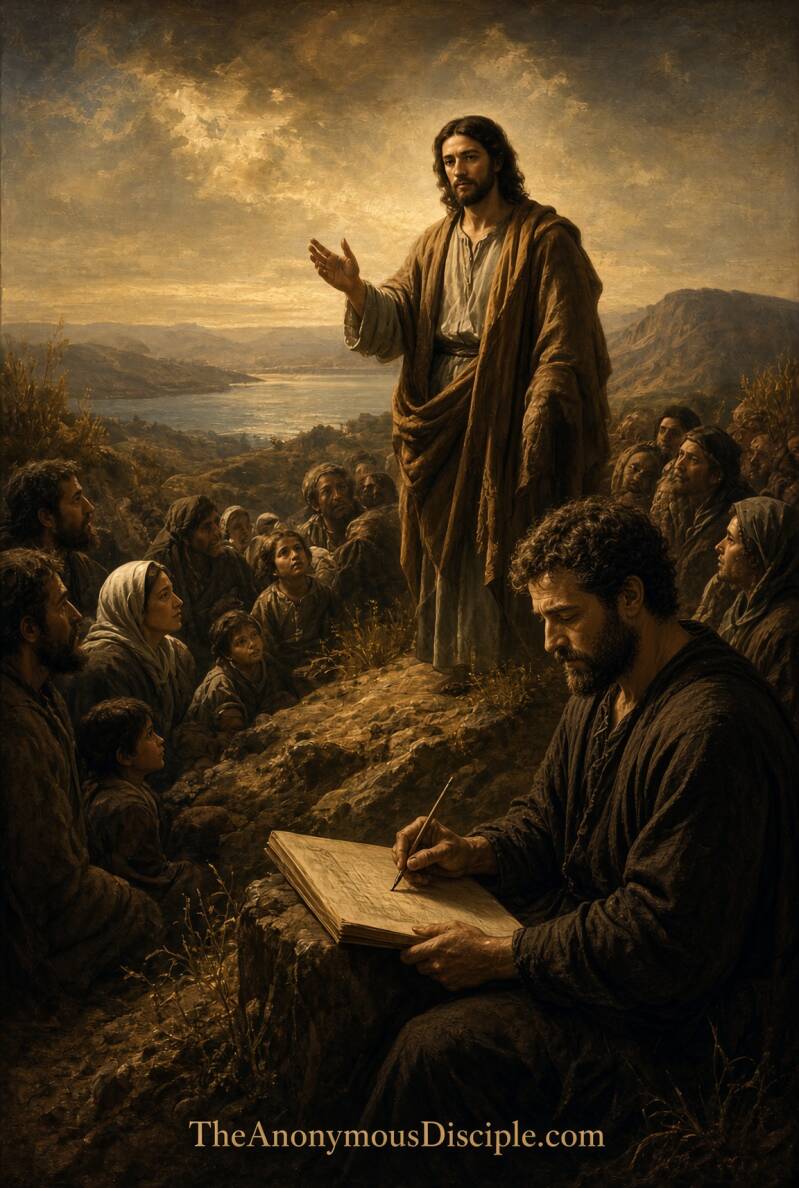
- Jesus spoke the words on the mountainside.
- Matthew wrote them down later, under the guidance of the Holy Spirit, as part of his Gospel.
That is why we say, “Matthew 6:25–34.” Matthew is the human author. Jesus is the One teaching. God is the One who made sure these words were kept for us.
Who
Jesus is speaking.
The first listeners are His disciples, with a larger crowd also hearing the Sermon on the Mount. He is talking to people who already follow Him, not to strangers off the street. That matters: this is family talk from the King to His own.
When
During Jesus’ earthly ministry, fairly early on, while He is teaching in Galilee.
Matthew places this in the Sermon on the Mount (chapters 5–7). It comes right after He talks about treasure in heaven and the choice between God and money (6:19–24). So the timing in the sermon is important: because you cannot serve two masters, therefore do not live anxious about food, drink, and clothes.
Where
On a mountainside in Galilee.
Tradition usually points to a hillside near the Sea of Galilee, not far from Capernaum. It is outdoor teaching—ordinary people sitting on the ground, listening to Jesus talk about birds, wildflowers, and tomorrow’s trouble.
Why
Jesus is training His followers how to live when daily needs feel loud.
He has just told them not to store up earthly treasure as their security and not to serve money as a second master. Now He answers the fear that rises next: “If I put God first, who will take care of me?”
So He gives them:
- a picture (birds and lilies),
- a question (can worry add an hour to your life?),
- a contrast (pagans run after these things; you have a Father who already knows),
- a command (seek first His kingdom and His righteousness),
- and a boundary (do not borrow tomorrow’s trouble today).
The “why” in one sentence:
Jesus does not want His people living like orphans in a hard world. He wants them living like children of a Father who knows what they need.
That is still the why for us. The setting was a hillside in Galilee. The need is the same in Tucson, in a kitchen, in a doctor’s waiting room, or at 2 a.m. when the mind will not rest.
Verse by verse breakdown with 𝕏James𝕏
Here is a simple verse-by-verse walk through Matthew 6:25-34 (NIV), with a plain-English meaning and how it still lands in everyday life.
Verse 25
“Therefore I tell you, do not worry about your life, what you will eat or drink; or about your body, what you will wear. Is not life more than food, and the body more than clothes?”
Jesus is saying worry is not just an emotion—it can become a habit that takes over the heart. Food, drink, and clothes are real needs, but they are not the whole of life. Today that sounds like grocery prices, rent, medical bills, and “what will people think of how I look.” The point is not that those things don’t matter. It is that they are not supposed to own us.
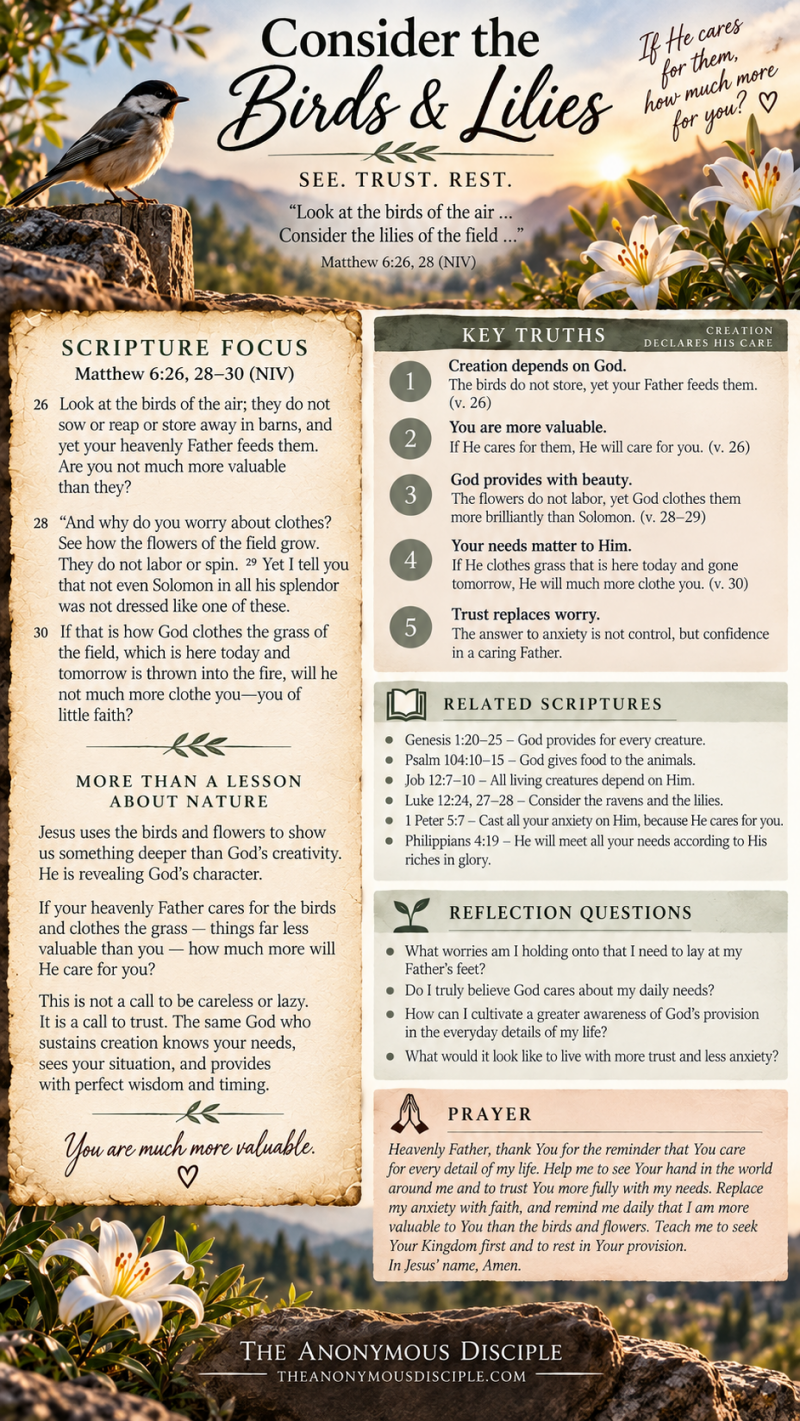
Verse 26
“Look at the birds of the air; they do not sow or reap or store away in barns, and yet your heavenly Father feeds them. Are you not much more valuable than they?”
Birds don’t have 401(k)s or pantry stockpiles, yet they eat. Jesus is not telling us to be lazy. He is saying God is already a Provider. If He feeds sparrows, He has not forgotten you. In a world of “if I don’t hustle I will be left behind,” this verse quietly asks: Do I believe I am more precious to God than a bird?
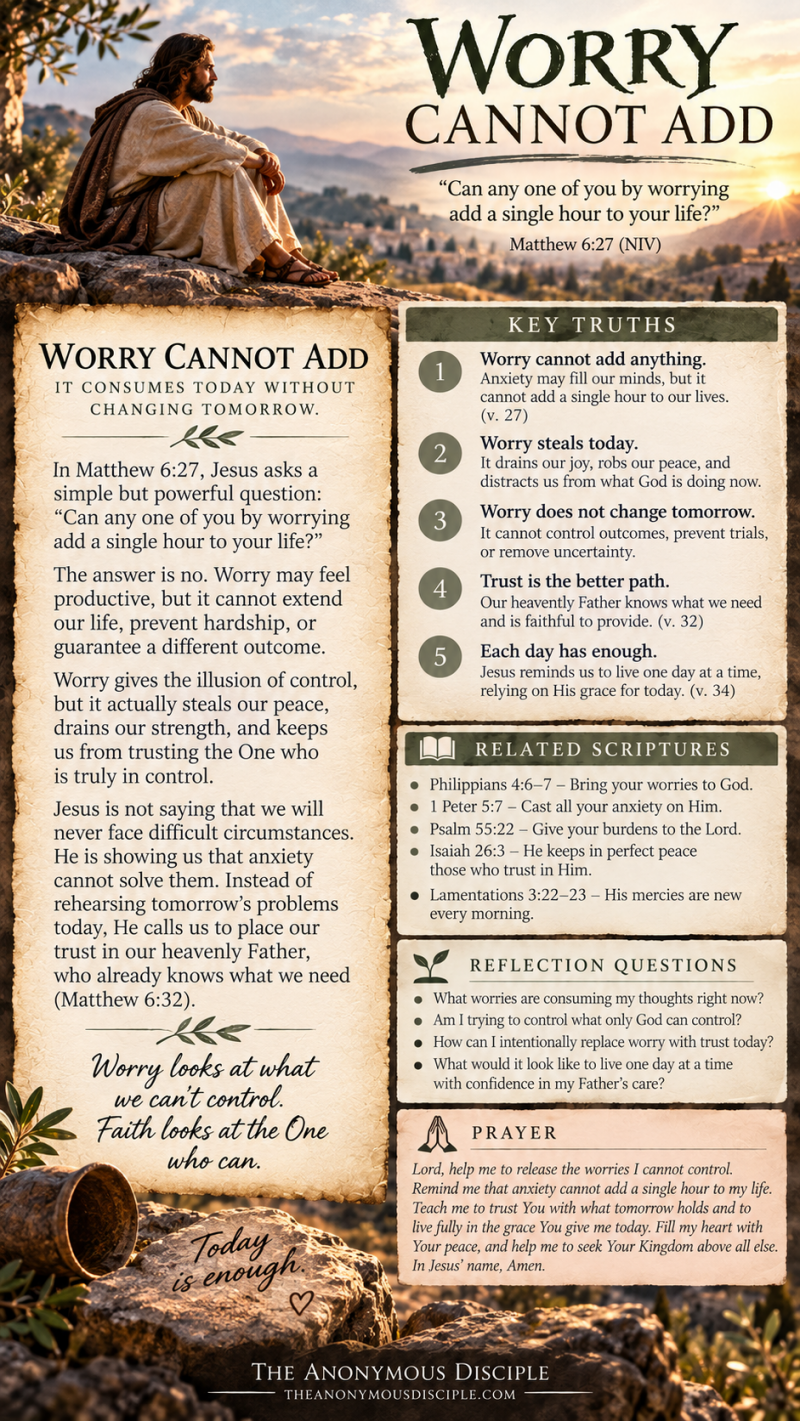
Verse 27
“Can any one of you by worrying add a single hour to your life?”
Worry cannot add time. It usually steals it. We replay “what if” until we are exhausted, and nothing extra is gained. Today that looks like lying awake over a bill, a doctor’s appointment, or a child’s future. Jesus is being practical: anxiety is a poor tool. It does not lengthen life; it just makes the hours heavier.
Verses 28–29
“And why do you worry about clothes? See how the flowers of the field grow. They do not labor or spin. Yet I tell you that not even Solomon in all his splendor was dressed like one of these.”
Wildflowers do not shop, sew, or compare outfits, yet God dresses them more beautifully than King Solomon. Jesus is talking about more than fabric. He is talking about our fear of not measuring up—looking right, fitting in, keeping up. The flowers are a picture: God can clothe what is passing and small. How much more will He care for you?
Verse 30
“If that is how God clothes the grass of the field, which is here today and tomorrow is thrown into the fire, will he not much more clothe you—you of little faith?”
Grass is temporary. People last longer and matter more. “Little faith” here is not an insult so much as a diagnosis: we often trust God for heaven and then panic about Tuesday. Today that is trusting Him with salvation while still treating grocery money, clothing, and reputation as if they are solely on our shoulders.
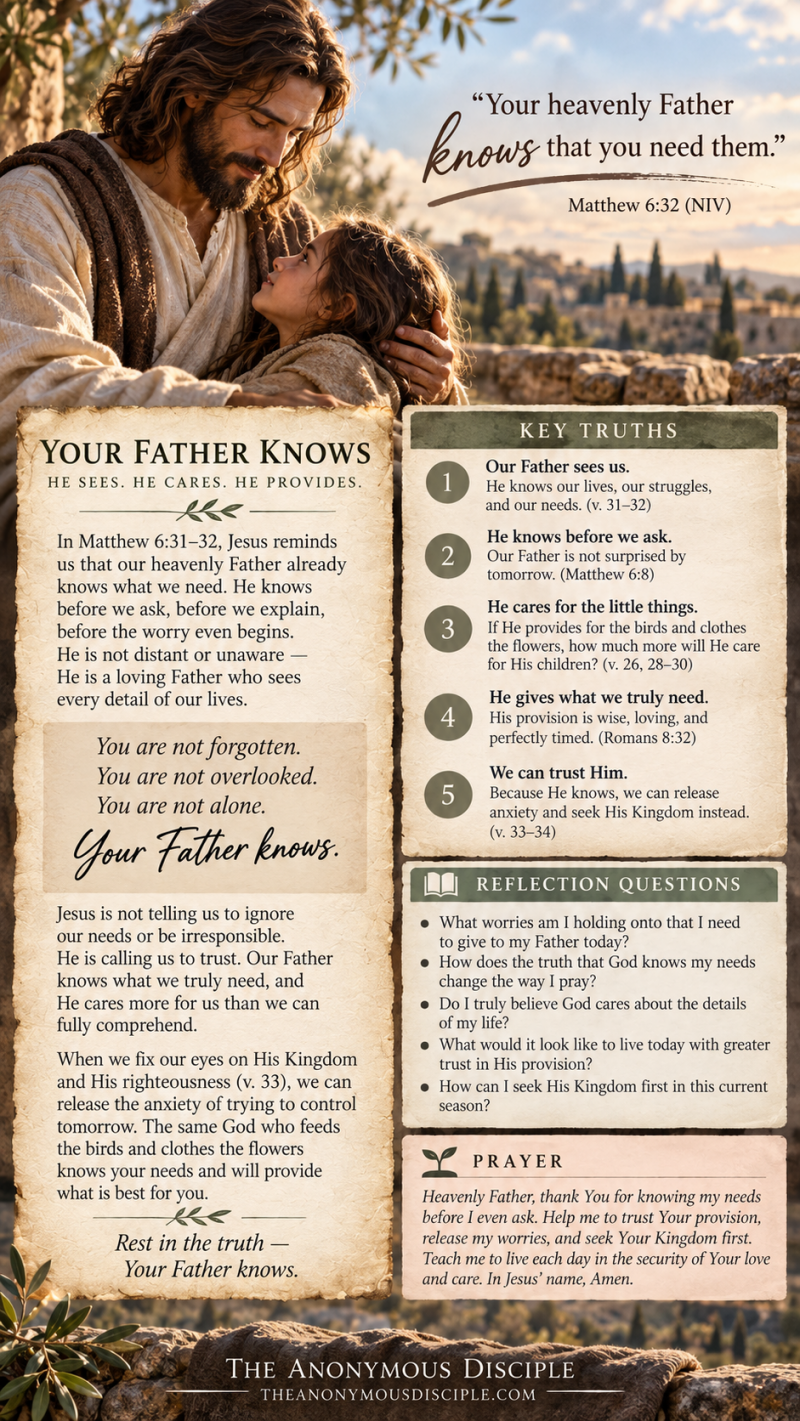
Verses 31–32
“So do not worry, saying, ‘What shall we eat?’ or ‘What shall we drink?’ or ‘What shall we wear?’ For the pagans run after all these things, and your heavenly Father knows that you need them.”
Jesus is not against planning. He is against the anxious running that treats God as if He does not know or care. “Pagans” here means people who live as if there is no Father watching. The difference for a believer is not that we never have needs. It is that we have a Father who already knows them.
Verse 33
“But seek first his kingdom and his righteousness, and all these things will be given to you as well.”
This is the hinge of the whole passage. “Seek first” means put God’s rule and God’s right way of living at the front of the line—not as a hobby, but as the main aim. Then the daily needs are not ignored; they are placed in His hands. Today that looks like asking, “What would faithfulness look like in this decision?” before asking, “How do I protect myself first?”
Verse 34
“Therefore do not worry about tomorrow, for tomorrow will worry about itself. Each day has enough trouble of its own.”
Jesus is not saying tomorrow will be easy. He is saying do not borrow it early. Today already has its own load. Carrying tomorrow’s imagined disasters on top of today’s real ones is extra weight God never asked us to pick up. The invitation is to live this day with Him, and let tomorrow arrive when it arrives.
The thread through all of it is this: worry treats God as distant or uninterested. Trust treats Him as Father. That does not mean bills vanish or bodies never wear out. It means we are not orphaned in the middle of those things.
Here are the main cultural and tradition notes around Matthew 6:25–34. These help us hear Jesus the way His first listeners would have heard Him.
Daily life was thin.
Most of the people on that hillside were not wealthy. Many were farmers, fishermen, and day laborers. Food depended on rain, harvest, and a day’s wage. Clothing was homemade—wool or flax that had to be sheared, spun, and woven by hand. A spare tunic was a real possession. So when Jesus talked about “What shall we eat? What shall we wear?” He was not talking about luxury. He was talking about the fears of ordinary households.
Birds were a living object lesson.
In Galilee you could look up and see birds anytime. They did not plant, harvest, or store grain in barns. Jewish hearers already knew from the Psalms that God feeds the birds and the young ravens (Psalm 147:9; Job 38:41). Jesus is using what they can see with their eyes and what they already sang in worship.
“Lilies of the field” were wildflowers.
The Greek word is broad. It likely means the bright spring flowers that carpet Galilean hillsides—anemones, poppies, and similar blooms—not a florist’s lily in a vase. They burst out after the rains, look stunning for a short time, then dry up. Jesus is pointing at something cheap, common, and temporary… and saying even Solomon could not dress like that.
Grass in the oven was normal fuel.
Homes used small clay ovens. Dried grass, weeds, and leftover stalks were burned as kindling. “Here today, thrown into the fire tomorrow” was not poetry first. It was kitchen life. God dresses even the fuel. How much more will He care for His children?
Solomon was the picture of royal glory.
Every Jewish listener knew 1 Kings 10: gold, robes, servants, the queen of Sheba stunned by the splendor. Jesus uses the richest king in Israel’s memory and says a wildflower outshines him. That would have landed hard. God’s quiet work in a field beats human luxury.
Spinning was women’s work—and hard work.
“They do not toil or spin” would have been vivid to the women in the crowd. Making cloth was long, tiring labor. Jesus is not mocking work. He is saying beauty does not finally come from our grinding effort. God gives it.
“Gentiles” meant people without the Father.
In that setting, “Gentiles” (or “pagans”) were those who did not know the God of Israel as Father. They ran after food and clothing as if provision were only up to them. Jesus is saying His followers must not live like people who have no covenant God.
“Little faith” was a family word.
Jesus uses it for disciples, not outsiders. It does not mean “you do not believe at all.” It means “your trust is still small.” That is important. He is correcting His own people, not shaming strangers.
This sits next to the Lord’s Prayer.
Just a few verses earlier Jesus taught them to pray, “Give us today our daily bread” (Matthew 6:11). Then He says, do not be anxious about bread. Prayer and trust belong together. Ask the Father. Do not panic as if He were absent.
He is not forbidding planning.
In their world, sowing, reaping, and storing in barns were normal and good. Birds do not farm; people do. Jesus is not telling them to stop working. He is telling them to stop living as if work and worry were their savior.
A later church note.
Christians have long read this passage on days of fear about money, illness, and the future. It became a teaching about providence—God’s fatherly care. The danger in later tradition was twisting it into “never plan and never work.” That is not what Jesus said. He said: work, pray, and do not let anxiety become your master.
In short: Jesus took the hillside in front of them—birds, flowers, ovens, cloth, and King Solomon—and used ordinary Galilean life to teach one thing: you have a Father. Live like it.
Seeking His Kingdom & His Righteousness Today
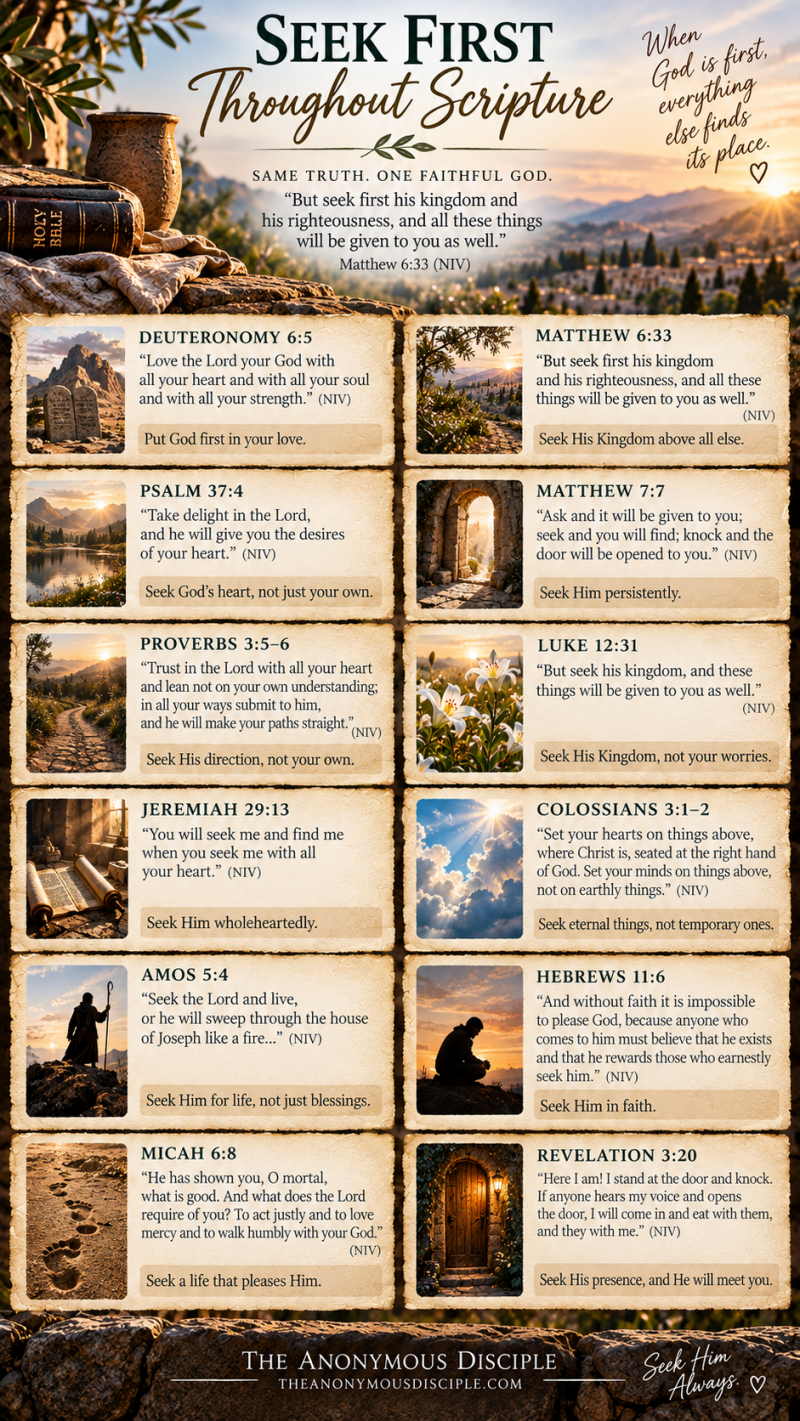
“But seek first his kingdom and his righteousness, and all these things will be given to you as well.” (NIV)
In plain words: put God’s rule and God’s right way of living at the front of the line. Then the daily needs—food, drink, clothes, the ordinary stuff—are not forgotten. They come along as we walk with Him.
“Seek first” does not mean “think about God for five minutes and then go back to worrying.” It means the first question of the day is not “How do I survive this?” but “What would it look like to live under God’s care and in His ways right here?”
Here is what that can look like in an ordinary week, without making it fancy.
Monday morning
Before the news, the bank app, or the to-do list, a short pause: “Father, this day belongs to You. Help me treat people the way You treat me.” That is seeking His kingdom first—not a long prayer, just turning the face toward Him before the day starts pulling.
When money feels tight
Seeking first does not mean ignoring the bill. It means refusing to let the bill become god. You still pay what you can, you still plan, but you also refuse the inner voice that says, “If I don’t control this, I am finished.” You bring the need to the Father who already knows it.
When someone is hard to love
His righteousness includes how we speak and how we forgive. Seeking first might look like biting back the sharp reply, or praying for the person instead of rehearsing the argument. That is not weakness. That is living under a different King.
When the future feels loud
Verse 34 already told us not to borrow tomorrow. Seeking first His kingdom today means doing the next faithful thing in front of you—the meal, the phone call, the quiet work—without demanding that God show you the whole map first.
When you fail
Seeking His righteousness is not pretending you are already good. It is coming back quickly when you snap, worry, or hide. His righteousness includes mercy. The kingdom is not a performance. It is a Father and His children learning to walk.
A simple test for the week:
“Is this choice moving me toward trust and obedience, or toward self-protection and fear?”
You will not get it perfect. Jesus already knew that when He said “you of little faith.” The invitation is not perfection. It is direction.
Seek first does not cancel grocery lists, doctor visits, or hard conversations. It puts them in their place. God is not asking you to stop being human. He is asking you not to live as if you have no Father.
🔗Cross References🔗
Cross references for Matthew 6:25–34 as a whole
These passages sing the same song: do not let anxious care about daily needs push God out of first place.
- Luke 12:22–31 — The closest twin passage. Jesus says almost the same words: do not worry about food and clothes; seek His kingdom, and these things will be given as well.
- Philippians 4:6–7 — “Do not be anxious about anything, but in every situation, by prayer and petition, with thanksgiving, present your requests to God.” Worry is replaced by prayer.
- 1 Peter 5:7 — “Cast all your anxiety on him because he cares for you.” Same invitation in different words.
- Psalm 55:22 — “Cast your cares on the Lord and he will sustain you.”
- Psalm 37:3–5 — Trust, do good, dwell in the land, and He will give you the desires of your heart—when those desires are lined up with Him.
- Hebrews 13:5–6 — Be content; the Lord is your helper, so you do not have to live in fear.
- Matthew 6:19–24 — The verses right before our passage. You cannot serve God and money. That is why Jesus then says, “Therefore, do not worry…”
Together they show that Jesus is not inventing a new idea. He is gathering what Scripture already taught: God knows, God cares, and anxious grasping is not the way of His children.
Cross references specifically for Matthew 6:33
“But seek first his kingdom and his righteousness, and all these things will be given to you as well.”
These verses help us see what “seek first” means and what God promises when we do.
The closest echo
- Luke 12:31 — “But seek his kingdom, and these things will be given to you as well.” Same teaching, slightly shorter.
What “His kingdom” looks like
- Matthew 13:44–46 — The kingdom is like treasure in a field or a pearl of great price. A person sells everything else to have it. That is “first.”
- Matthew 3:2; 4:17 — “Repent, for the kingdom of heaven has come near.” Seeking the kingdom starts with turning toward the King.
- Romans 14:17 — “The kingdom of God is not a matter of eating and drinking, but of righteousness, peace and joy in the Holy Spirit.” The kingdom is not mainly stuff. It is God’s rule in the heart.
What “His righteousness” looks like
- Matthew 5:6 — “Blessed are those who hunger and thirst for righteousness, for they will be filled.” Same hunger Jesus is talking about in 6:33.
- Romans 1:17 — The righteousness of God is revealed from faith to faith. We do not manufacture it; we receive it and then live it out.
The promise that “these things will be added”
- Psalm 34:9–10 — “Those who fear him lack nothing… those who seek the Lord lack no good thing.”
- Psalm 37:25 — David says he has never seen the righteous forsaken or their children begging bread.
- Psalm 84:11 — “No good thing does he withhold from those whose walk is blameless.”
- 1 Kings 3:11–13 — Solomon asked for wisdom to rule well, not for riches. God gave him wisdom and the things he did not ask for.
- Mark 10:29–30 — Those who leave things for Jesus’ sake receive much more in this life (with persecutions) and eternal life in the age to come.
A matching New Testament call
- Colossians 3:1–2 — “Set your hearts on things above, where Christ is… Set your minds on things above, not on earthly things.” Same direction: first things first.
In short:
The whole passage says, “Stop living like you have no Father.”
Verse 33 says, “Put the Father’s rule and the Father’s right way of living first—and He will not forget the groceries.”
The cross references keep repeating that same two-part truth: seek Him first, and He takes care of His own.
Deep Dive Study Notes with 🪄Jenny🪄
This passage is such a beautiful one for today. Jesus isn’t pretending we don’t have real needs—He’s teaching us where those needs belong in the order of our hearts.
📜 Matthew 6:25–34 — Seek First the Kingdom
⚓ Anchor: Matthew 6:33
Matthew 6:33 (NIV) — “But seek first his kingdom and his righteousness, and all these things will be given to you as well.”
The key word for me here is first.
Jesus doesn’t say, “Don’t think about food, clothing, bills, tomorrow, your children, your health, or anything else.” He says: don’t let those things occupy the throne.
🌿 Matthew 6:25 — Life Is More Than What Sustains It
Jesus begins:
Matthew 6:25 — Do not worry about your life…
And then He asks us to remember something easily forgotten:
Life itself came from God.
If God has already given the greater gift—life and the body—is He incapable of providing what those things need?
Jesus is reasoning from the greater to the lesser:
The God who gave you life can handle what your life requires.
🐦 Matthew 6:26 — Look at the Birds
Jesus literally points His listeners toward creation.
Matthew 6:26 — “Look at the birds of the air…”
They do not plant fields, harvest crops, or fill barns like humans do.
Yet:
“your heavenly Father feeds them.”
Then comes the question:
“Are you not much more valuable than they?”
That doesn't mean Christians never plan, work, save, prepare, or act responsibly. Birds themselves still search for food.
The lesson is about trust, not inactivity.
We work.
God provides.
⏳ Matthew 6:27 — Worry Cannot Add Anything
Matthew 6:27 asks whether worry can add even a single hour to our lives.
That one stings a little. 😳
Worry often feels productive because our minds are working so hard.
But Jesus exposes it:
Worry consumes energy without producing control.
It can rehearse tomorrow a thousand times and still cannot command tomorrow.
🌸 Matthew 6:28–30 — Look at the Flowers
Then Jesus says essentially:
Now look down.
Birds above.
Flowers below.
Creation everywhere is preaching the same sermon.
Matthew 6:28–29 points to the lilies, clothed with a beauty that surpassed even Solomon's splendor.
And then:
Matthew 6:30 — if God clothes grass that is here today and gone tomorrow, “will he not much more clothe you?”
There's that argument again:
If God cares for the lesser, how much more does He care for His children?
❤️ Matthew 6:31–32 — Your Father Knows
This may be one of the sweetest statements in the whole passage:
Matthew 6:32 — “your heavenly Father knows that you need them.”
Sherri, notice what Jesus doesn't say.
He doesn't say:
Your Father will know after you explain it perfectly.
Or:
Your Father knows if you've prayed hard enough.
Or:
Your Father will notice eventually.
No.
Your Father knows.
Before the anxiety.
Before the prayer.
Before the problem arrives tomorrow.
He knows.
That connects beautifully with:
Matthew 6:8 — “your Father knows what you need before you ask him.”
⚓ Matthew 6:33 — SEEK FIRST
Then Jesus gives the alternative to anxiety:
“But seek first his kingdom and his righteousness…”
This isn't simply:
Stop worrying.
It's:
Redirect your seeking.
Anxiety says:
Seek security first.
Jesus says:
Seek the Kingdom first.
Anxiety says:
Make sure everything is under control.
Jesus says:
Put yourself under the King's control.
Anxiety says:
What if I don't have enough?
Jesus says:
Your Father already knows what you need.
And importantly, “all these things” in Matthew 6:33 refers back to the basic necessities Jesus has been discussing—food, drink, clothing—not a promise that God gives every material thing we desire.
That's an important distinction.
Kingdom first.
Righteousness first.
Father first.
Then trust Him with the rest.
👑 What Does “Seek His Kingdom” Mean?
The Kingdom of God is God's reign—His rule, His will, His purposes.
So seeking His Kingdom means asking:
What does my King want here?
Not merely:
What makes me comfortable?
What protects my plans?
What eliminates every uncertainty?
But:
How can I live under the rule of Jesus today?
And seeking His righteousness means desiring a life increasingly aligned with God's character and ways.
That connects strongly with:
Matthew 5:6 — hunger and thirst for righteousness.
Matthew 5:10 — righteousness and the Kingdom.
Matthew 5:20 — righteousness greater than outward religious performance.
Jesus has been building toward Matthew 6:33 throughout the Sermon on the Mount.
🌅 Matthew 6:34 — Tomorrow Has Its Own Trouble
Then comes the landing:
Matthew 6:34 — “Therefore do not worry about tomorrow…”
Jesus does not say:
Tomorrow won't have trouble.
Actually, He says the opposite:
“Each day has enough trouble of its own.”
😂 Thanks, Jesus.
But there's enormous comfort buried in that realism.
Tomorrow's trouble belongs to tomorrow's grace.
God has given you what you need to walk with Him today.
When tomorrow becomes today, He will still be there.
This echoes:
Lamentations 3:22–23 — His mercies are new every morning.
And:
Exodus 16:4, 19–21 — manna was given day by day.
God repeatedly teaches His people:
Trust Me for today's bread.
Which brings us right back to:
Matthew 6:11 — “Give us today our daily bread.”
Ohhhh… 😳❤️
That is absolutely intentional.
Jesus teaches us to pray for daily bread before teaching us not to worry about tomorrow's bread.
🧵 The Pattern
There is a beautiful progression through the passage:
Matthew 6:25 — Don't worry about your life.
↓
Matthew 6:26 — Look at the birds.
↓
Matthew 6:28 — Look at the flowers.
↓
Matthew 6:32 — Your Father knows.
↓
Matthew 6:33 — Seek Him first.
↓
Matthew 6:34 — Live today's faith today.
And I think our central statement for the study might be:
Worry seeks control. Faith seeks the Kingdom.
Or maybe even:
Your Father already knows. Seek Him first.
❤️📜⚓️
Add comment
Comments