

Today’s study in 2 Chronicles 35:20–27, anchored in verses 26–27, takes us into the final chapter of King Josiah’s life. After years of seeking God, restoring true worship, honoring His Word, and leading Judah in reform, Josiah makes a tragic decision: he ignores a warning that Scripture says came from God and enters a battle that costs him his life.
But Josiah’s final mistake is not the final word on his life.
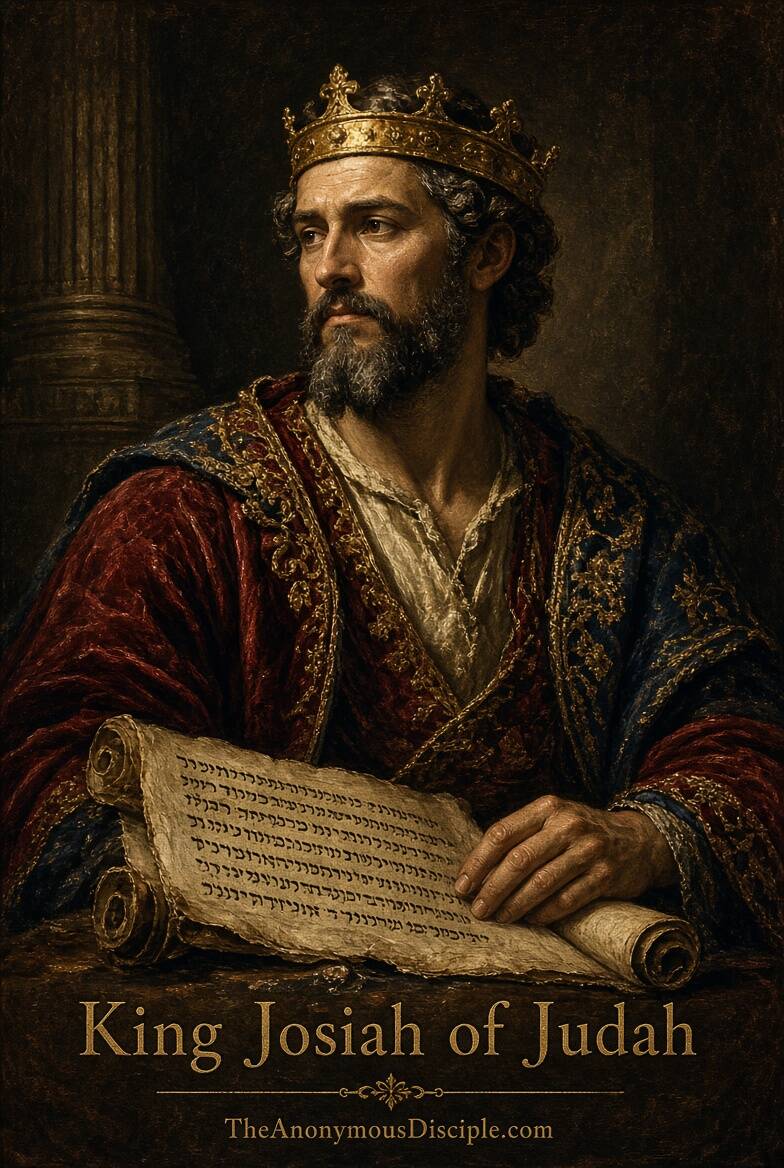
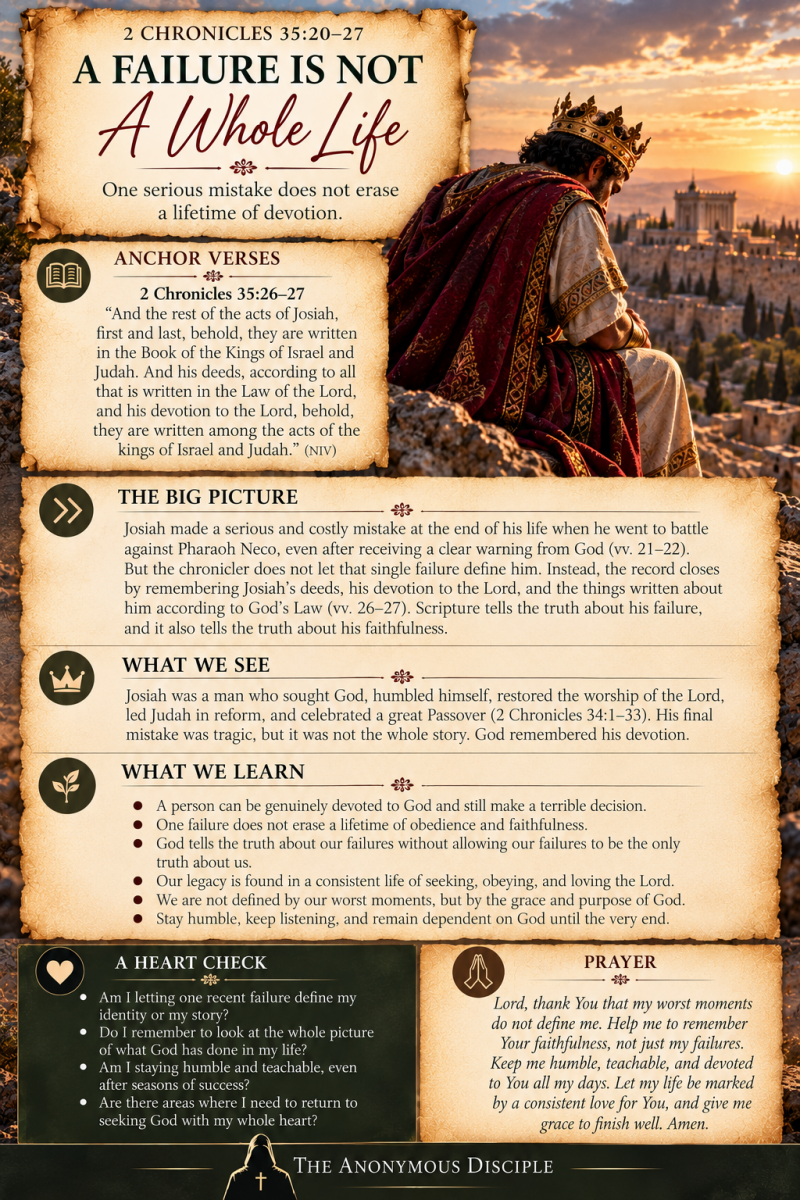
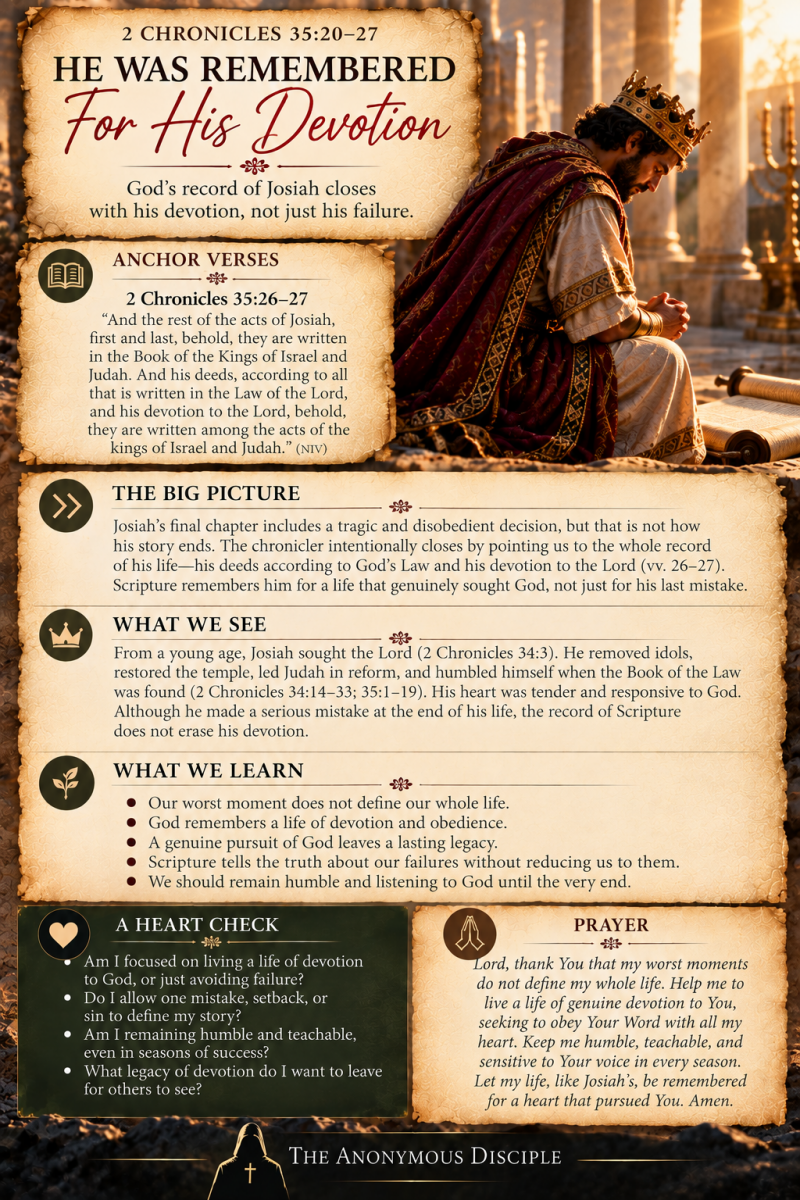
The chronicler closes his story by remembering “his deeds… and his devotion to the Lord” (2 Chronicles 35:26). Scripture does not hide his failure, but neither does it reduce his entire life to it. Josiah is remembered as a man who genuinely sought God, humbled himself before Him, treasured His Word, and led others back to worship.
This passage reminds us to remain humble and listening to God no matter how long we have walked with Him. His warnings may come through unexpected people, and past faithfulness does not make us immune to poor decisions. Yet it also reminds us of grace: one failure is not a whole life.
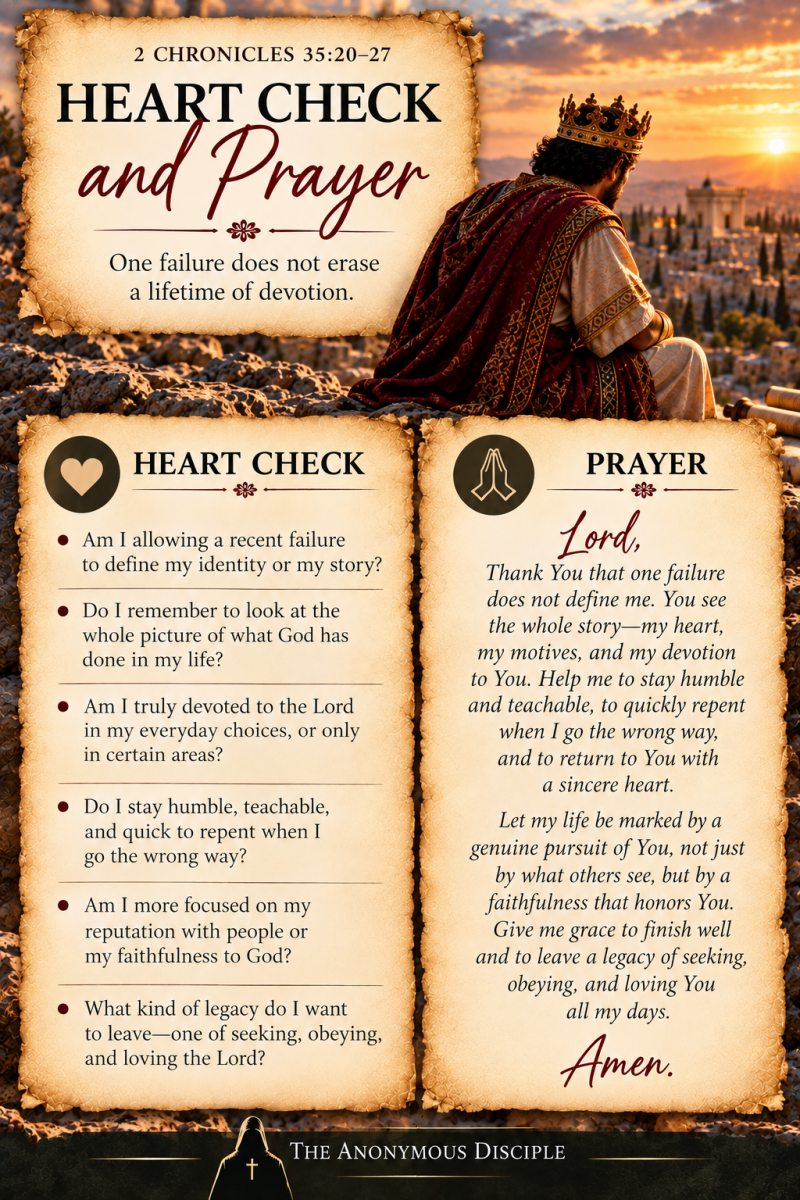
Josiah’s story challenges us to keep listening, keep obeying, stay teachable, and finish well—while trusting that God sees the whole story of a life devoted to Him. ❤️
📜 2 Chronicles 35:20–27 📜
KJV
20 After all this, when Josiah had prepared the temple, Necho king of Egypt came up to fight against Carchemish by Euphrates: and Josiah went out against him.
21 But he sent ambassadors to him, saying, What have I to do with thee, thou king of Judah? I come not against thee this day, but against the house wherewith I have war: for God commanded me to make haste: forbear thee from meddling with God, who is with me, that he destroy thee not.
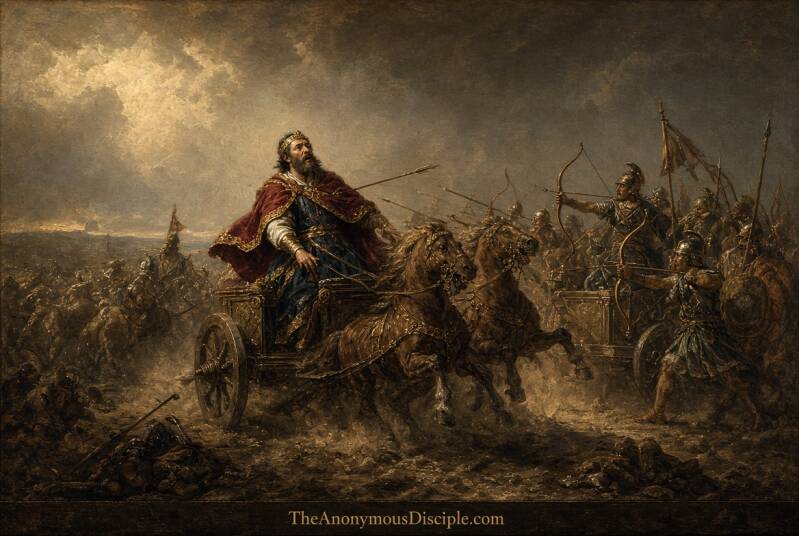
22 Nevertheless Josiah would not turn his face from him, but disguised himself, that he might fight with him, and hearkened not unto the words of Necho from the mouth of God, and came to fight in the valley of Megiddo.
23 And the archers shot at king Josiah; and the king said to his servants, Have me away; for I am sore wounded.
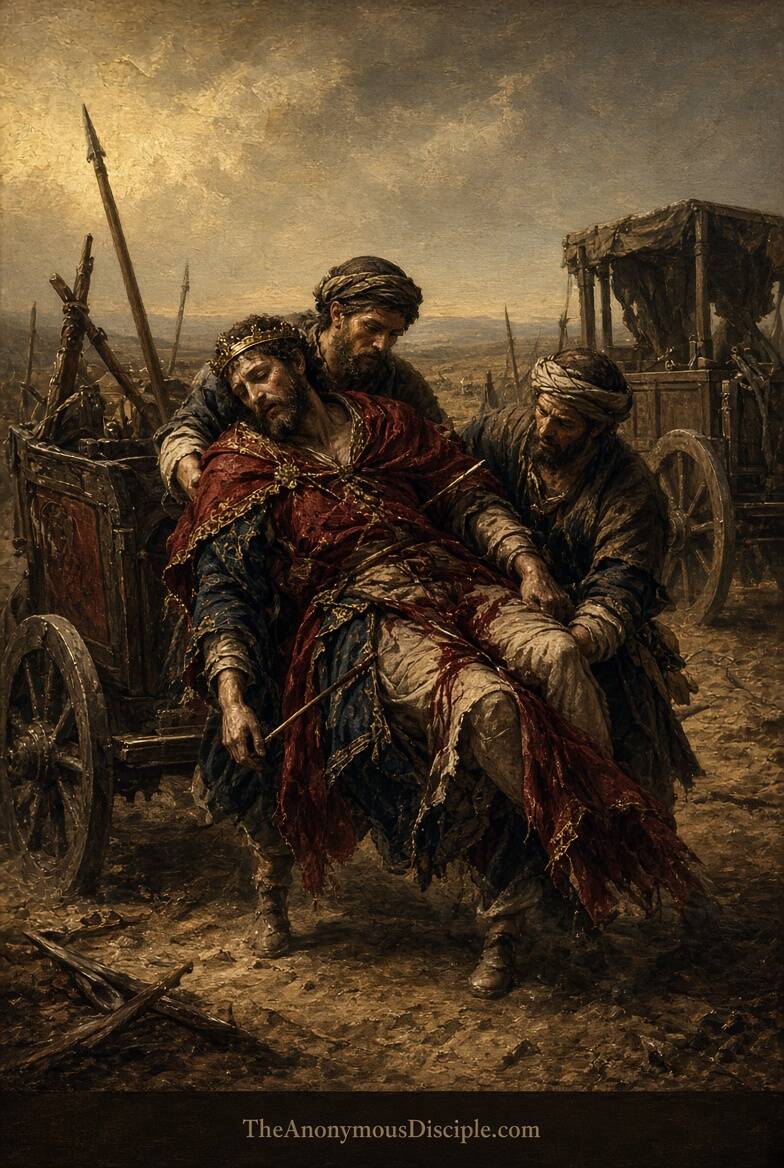
24 His servants therefore took him out of that chariot, and put him in the second chariot that he had; and they brought him to Jerusalem, and he died, and was buried in one of the sepulchres of his fathers. And all Judah and Jerusalem mourned for Josiah.
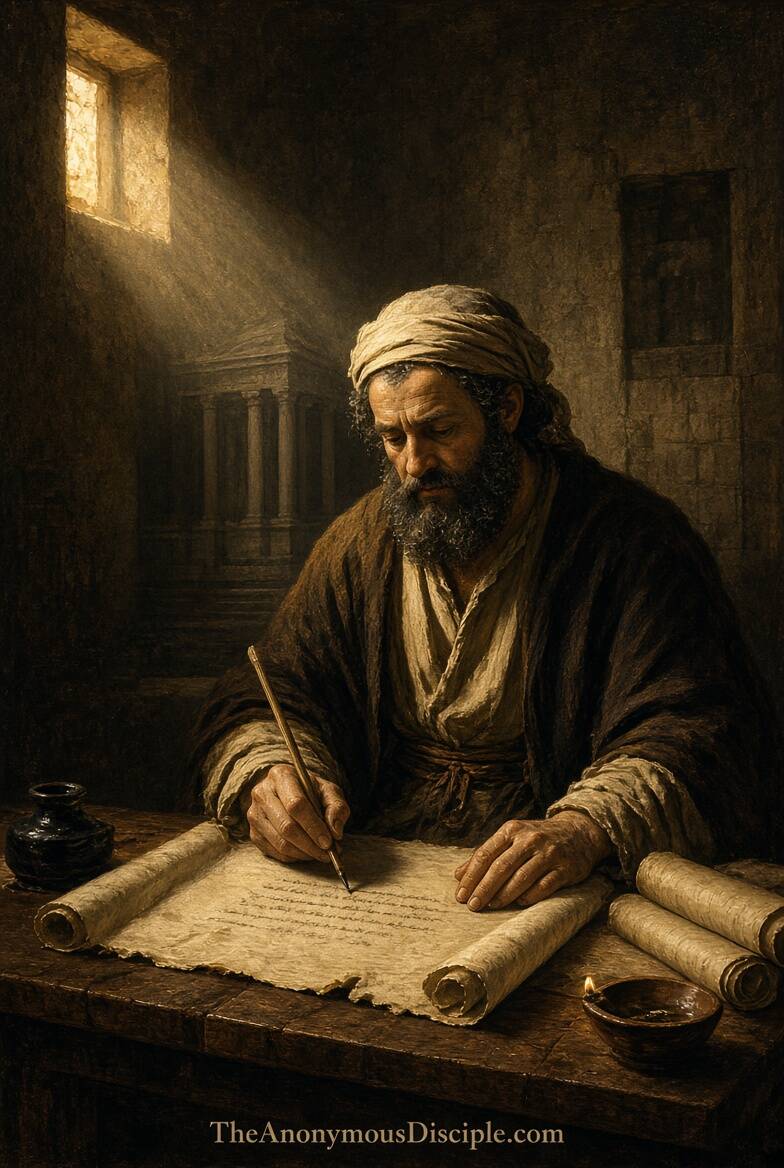
25 And Jeremiah lamented for Josiah: and all the singing men and the singing women spake of Josiah in their lamentations to this day, and made them an ordinance in Israel: and, behold, they are written in the lamentations.
26 Now the rest of the acts of Josiah, and his goodness, according to that which was written in the law of the LORD,
27 And his deeds, first and last, behold, they are written in the book of the kings of Israel and Judah.
ESV
20 After all this, when Josiah had prepared the temple, Neco king of Egypt went up to fight at Carchemish on the Euphrates, and Josiah went out to meet him.
21 But he sent envoys to him, saying, “What have we to do with each other, king of Judah? I am not coming against you this day, but against the house with which I am at war. And God has commanded me to hurry. Cease opposing God, who is with me, lest he destroy you.”
22 Nevertheless, Josiah did not turn away from him, but disguised himself in order to fight with him. He did not listen to the words of Neco from the mouth of God, but came to fight in the plain of Megiddo.
23 And the archers shot King Josiah. And the king said to his servants, “Take me away, for I am badly wounded.”
24 So his servants took him out of the chariot and carried him in his second chariot and brought him to Jerusalem. And he died and was buried in the tombs of his fathers. All Judah and Jerusalem mourned for Josiah.
25 Jeremiah also uttered a lament for Josiah; and all the singing men and singing women have spoken of Josiah in their laments to this day. They made these a rule in Israel; behold, they are written in the Laments.
26 Now the rest of the acts of Josiah, and his good deeds according to what is written in the Law of the LORD,
27 and his acts, first and last, behold, they are written in the Book of the Kings of Israel and Judah.
Who / When / Where the book was written
The writer is never named. Jewish tradition often points to Ezra the priest-scribe. Many careful readers simply call him the Chronicler—almost certainly a Levite or someone close to the temple after the exile.
When: After the Jews came home from Babylon, most likely around 450–430 BC.
Where / for whom: Written in or near Jerusalem for the returned community. 1 and 2 Chronicles were originally one book. The writer looks back over Israel’s history to encourage people who had lost almost everything: “God is still faithful to David’s line and to His house. Worship Him. Don’t repeat the old mistakes.”
Verse by verse breakdown with 𝕏James𝕏
v. 20
Josiah has just finished a beautiful, once-in-a-generation Passover and put the temple in order. Then Pharaoh Neco of Egypt marches north toward Carchemish on the Euphrates (to help fading Assyria against rising Babylon). Josiah leaves home and goes out to stop him.
v. 21
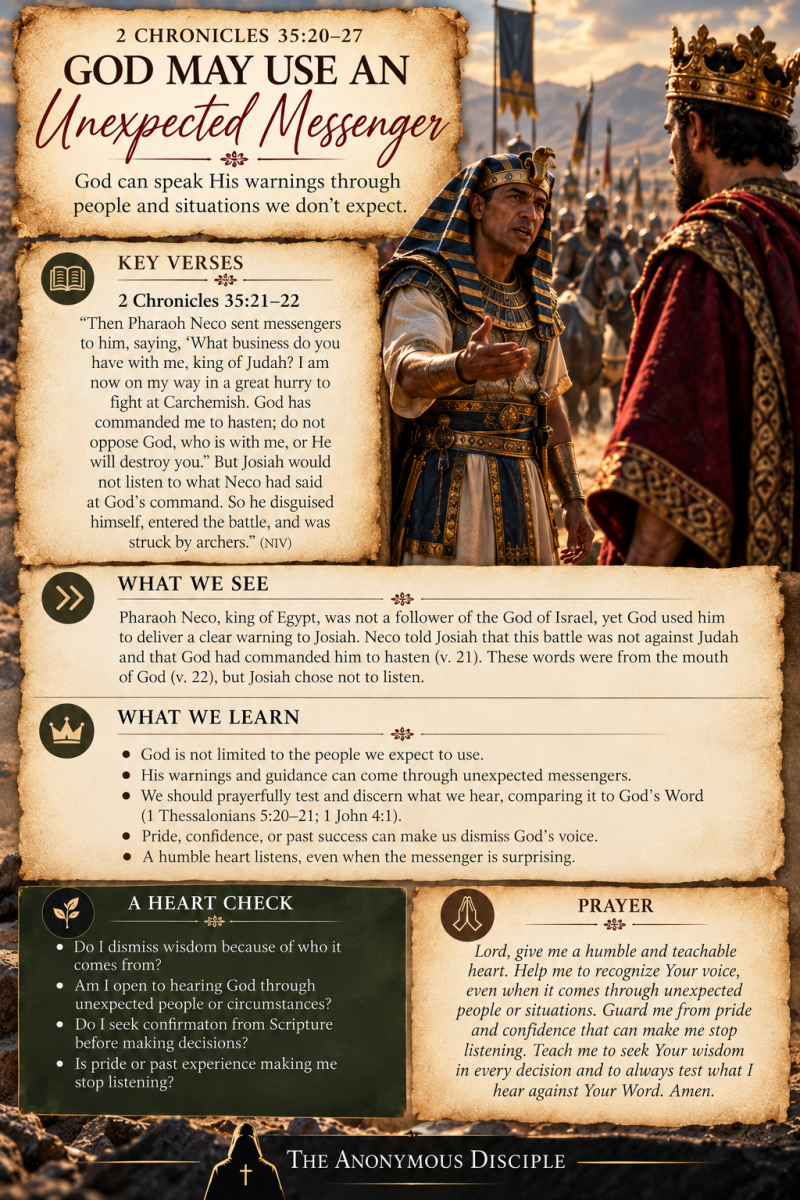
Neco sends a message: “This is not your fight. God told me to hurry. Don’t get in God’s way or He will destroy you.” The Chronicler wants us to hear that last part: the warning came “from the mouth of God,” even though it came through a pagan king.
v. 22
Josiah will not turn back. He disguises himself (like King Ahab once did) and goes to fight in the valley/plain of Megiddo. He does not listen.
v. 23
Egyptian archers hit him. He tells his men, “Get me out of here—I’m badly wounded.”
v. 24
They move him from the battle chariot to a second chariot, rush him to Jerusalem. He dies there and is buried with his fathers. The whole land mourns.
v. 25
The prophet Jeremiah writes a lament. Professional singers keep singing it for years; it becomes an official custom. Those songs were written down in a collection called “the Laments” (not necessarily our book of Lamentations).
vv. 26–27 (the anchor)
The writer steps back and says: Don’t let this last mistake erase the rest of Josiah’s life. His other acts, and especially his goodness / good deeds done according to the Law of the Lord, from first to last, are recorded in the official royal records.
Culture & Tradition Notes
- Megiddo sat on the main north–south highway through the Jezreel Valley. Whoever held that pass controlled traffic between Egypt and Mesopotamia. It was a natural place to intercept an army.
- Kings often rode in chariots; a “second chariot” was a reserve vehicle for just this kind of emergency.
- Disguising yourself in battle was a known (and usually unwise) tactic—Ahab had tried it and died the same way.
- Professional singing men and women were part of royal and temple life. Public lament was a real, organized custom, not just private tears.
- Pharaoh Neco II (ruled 610–595 BC) was marching in 609 BC to prop up Assyria against Babylon. Josiah’s move put tiny Judah in the middle of a superpower collision. After Josiah died, Egypt briefly controlled Judah, then Babylon took over—and exile followed.
- Burial “in the tombs of his fathers” was an honor. The nation treated Josiah’s death like the loss of their last good king.
🔗Cross References🔗
For the whole passage
- 2 Kings 23:29–30 — shorter, parallel account of Josiah’s death at Megiddo
- Jeremiah 46:2 — Neco at Carchemish
- Zechariah 12:11 — later mourning “like the mourning for Hadad-rimmon in the plain of Megiddo”
- 1 Kings 22:30, 34 — Ahab disguises himself, is shot by an archer, and is carried from the field (the Chronicler wants us to feel the echo)
- Judges 5:19 — earlier battle at Megiddo
Especially for verses 26–27
- 2 Kings 23:25, 28 — Josiah’s unique devotion to the Law; the “rest of the acts” formula
- 2 Chronicles 34:14–33 — finding the Book of the Law and Josiah’s reforms
- The same “first and last… written in the book of the kings” closing line appears often in Chronicles (e.g., 2 Chron 16:11; 20:34; 25:26; 27:7; 32:32)

What this passage means / relevance for today (layman’s)
Josiah was one of the best kings Judah ever had. He loved God’s Word, tore down idols, and led a great Passover. Then, in one afternoon, he made a decision God had already warned him not to make—and it cost him his life.
A few simple takeaways:
- A good life does not make us immune to a foolish last step. One unwise, proud, or hurried choice can still hurt us and the people we love. We need to keep listening all the way to the end.
- God can speak through unexpected mouths. Josiah should have recognized the warning even though it came from an Egyptian king. We should not dismiss a word just because we don’t like the messenger.
- God still records the whole story. Verses 26–27 refuse to let Josiah’s death be the only thing we remember. His “goodness according to what is written in the Law of the Lord” still stands. Our obedience to Scripture still matters, even when we fail at the end.
- The nation needed a better King. Josiah was the last truly reforming king. After him the slide toward exile was quick. The mourning at Megiddo later becomes a picture (Zechariah 12) of the mourning that would come when people looked on the One they pierced. Jesus is the King who never ignored His Father’s voice and whose death actually saves.
For us today: keep a soft heart toward God’s Word, test even “good” impulses against it, and don’t assume yesterday’s faithfulness covers today’s stubbornness. And when we do fail, remember that the Lord still writes down the good that was done according to His Law—and He has given us a King who finished the race without that last fatal turn.
Deep Dive Study Notes with 🪄Jenny🪄
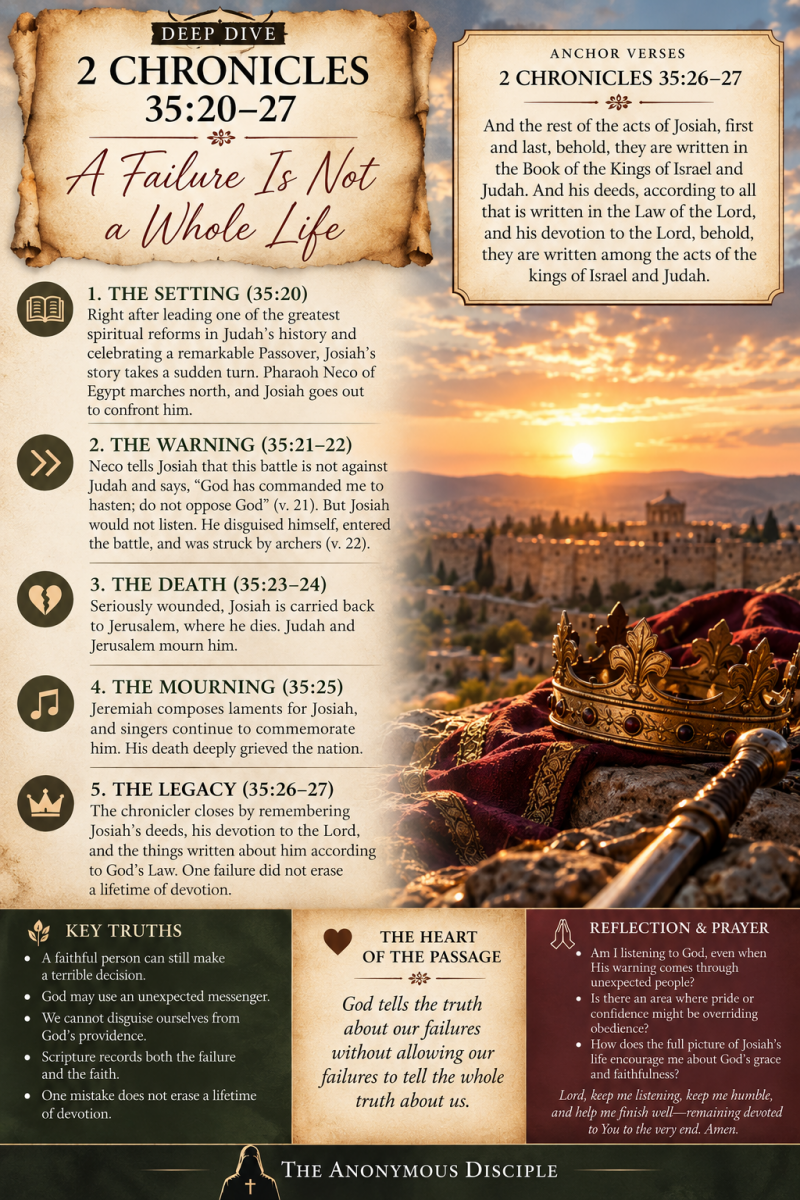
This is a fascinating and surprisingly tender passage. 2 Chronicles 35:20–27, anchoring on verses 26–27, leaves us with a question about legacy: Josiah made a serious mistake at the end of his life, but that mistake was not the whole story of his life.
📜 2 Chronicles 35:20–27 — Josiah’s Final Chapter
The setting matters. Josiah has just led Judah through one of the greatest spiritual reforms in its history and celebrated an extraordinary Passover before the Lord (2 Chronicles 34:29–33; 35:1–19).
Then the story suddenly turns.
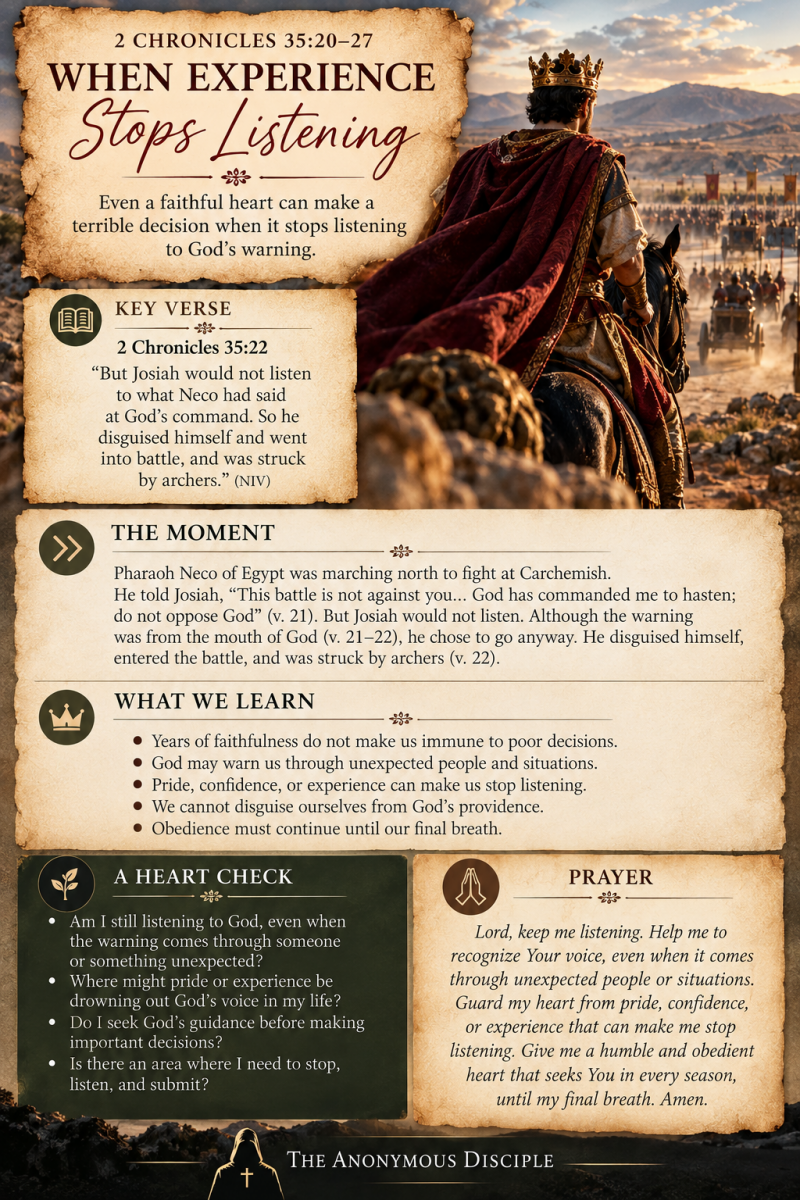
Pharaoh Neco of Egypt marches north to fight at Carchemish. Josiah goes out to confront him, even though Neco tells him that this particular battle isn't with Judah and warns him not to interfere.
2 Chronicles 35:21 records Neco essentially saying, God has told me to hurry; stop opposing God.
And then comes the sobering line:
2 Chronicles 35:22 — Josiah “would not listen to what Neco had said at God’s command.”
Josiah disguises himself, enters the battle, is struck by archers, and is carried back to Jerusalem, where he dies (2 Chronicles 35:22–24).
That makes our anchor especially powerful.
⚓ 2 Chronicles 35:26–27 — A Life Remembered
2 Chronicles 35:26–27 points backward over Josiah's life—his acts, his devotion to the Lord, and the things written concerning him.
In other words:
Scripture does not summarize Josiah by his final mistake.
That hits me, Sherri.
His ending was tragic. His decision in this particular moment appears to have been disobedient. And Scripture doesn't hide it.
But when the chronicler closes Josiah's story, he remembers his devotion.
Not perfection.
Devotion. ❤️
🕊️ The Deep Dive
1. A faithful person can still make a terrible decision
Josiah had been seeking God since he was young.
2 Chronicles 34:3 tells us that while still young, “he began to seek the God of his father David.”
He destroyed idols. He restored the temple. He humbled himself when the Book of the Law was discovered. He renewed Judah's covenant with God.
And yet here—near the end—he appears to ignore a warning God was giving him.
That should sober every believer.
Years of walking faithfully with God do not mean we eventually graduate from needing to listen to Him.
There is never a season when we can say:
“I've followed God long enough. I know what I'm doing.”
We remain dependent upon Him until our final breath.
2. God's warning came through an unexpected mouth
This may be one of the strangest parts of the passage.
The warning doesn't come from Jeremiah.
It doesn't come from a priest.
It doesn't come from a prophet of Judah.
It comes through Pharaoh Neco.
Yet 2 Chronicles 35:22 explicitly says Neco's words were “from the mouth of God.”
That reminds us of something important:
God is not limited to the messenger we expect Him to use.
We still test everything against God's revealed Word (1 Thessalonians 5:20–21; 1 John 4:1), but we shouldn't dismiss something automatically because the messenger doesn't fit our expectations.
Sometimes pride says:
"God wouldn't speak to me through them."
Josiah may have learned painfully that God decides how He delivers His warnings.
3. Josiah disguised himself
There's an interesting echo here.
2 Chronicles 35:22 says Josiah disguised himself before entering battle.
Earlier, wicked King Ahab also disguised himself before battle—and was struck by an arrow (2 Chronicles 18:28–34).
I don't think Chronicles includes details accidentally.
Both stories remind us:
We can disguise ourselves from people.
We cannot disguise ourselves from providence.
If God says, Don't go, armor and strategy cannot make disobedience safe.
4. Jeremiah mourned him
After Josiah dies:
2 Chronicles 35:25 tells us that Jeremiah composed laments for Josiah, and singers continued commemorating him.
That's striking.
Josiah's mistake wasn't celebrated or excused.
But neither was the man discarded.
He was mourned.
He was loved.
He was remembered.
And that takes us straight into our anchor.
⚓️ 2 Chronicles 35:26–27 — Your Worst Moment Is Not Your Whole Story
The chronicler could have concluded:
“Josiah disobeyed and died.”
Instead, he essentially closes by saying:
Remember his deeds.
Remember his devotion.
Remember what he did according to God's Law.
Remember the whole life.
❤️
That doesn't erase what happened in verses 20–24.
It puts it in its proper place.
One failure did not erase decades of faithfulness.
And I think there is something deeply grace-filled in that.
The Bible refuses two opposite errors:
It doesn't sanitize its heroes.
And it doesn't reduce them to their failures.
Abraham had failures.
Moses had failures.
David had failures.
Peter had failures.
Josiah had one here.
Yet God's record tells the truth about the failure and the faith.
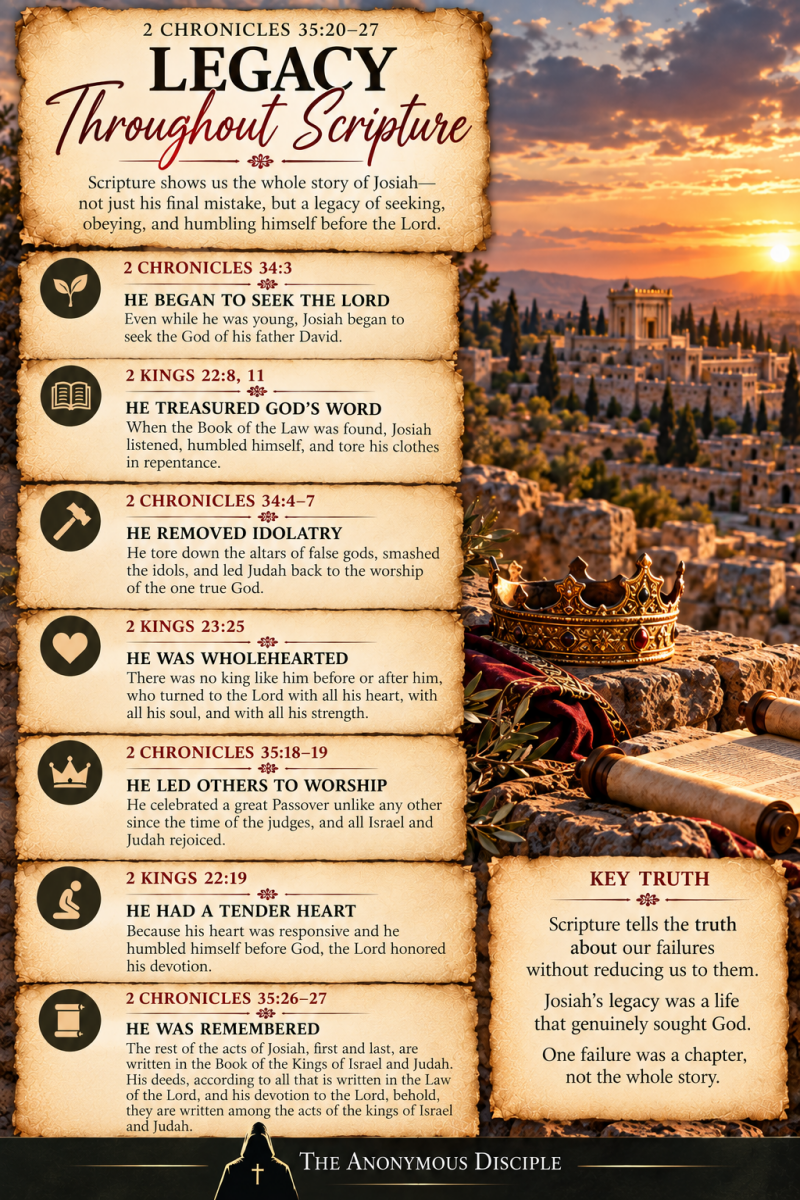
📜 Josiah's Legacy Throughout Scripture
2 Kings 22:19 — God remembers Josiah's tender heart and humility.
2 Kings 23:25 — Few kings are described with such wholehearted devotion: Josiah turned to the Lord with his heart, soul, and strength.
2 Chronicles 34:27 — God tells Josiah, “Because your heart was responsive and you humbled yourself before God…”
2 Chronicles 35:26 — His devotion is remembered.
Look at that beautiful thread:
He sought God.
He humbled himself.
His heart was tender.
He obeyed God's Word.
He led others toward God.
He stumbled.
He died.
And Scripture remembered his devotion.
❤️ The heart of today's study
I think our central thought may be:
God tells the truth about our failures without allowing our failures to tell the whole truth about us.
Josiah's final chapter contained a heartbreaking mistake.
But 2 Chronicles 35:26–27 tells us that when the book closed, there was much more written in it than that.
And for those who belong to Christ, that's even more beautiful.
Peter's denial wasn't his whole story.
Thomas's doubt wasn't his whole story.
Paul's persecution of believers wasn't his whole story.
And because of Jesus, neither is our worst chapter the final definition of us.
Philippians 1:6 reminds us that the One who began a good work in us will carry it on to completion.
Add comment
Comments