

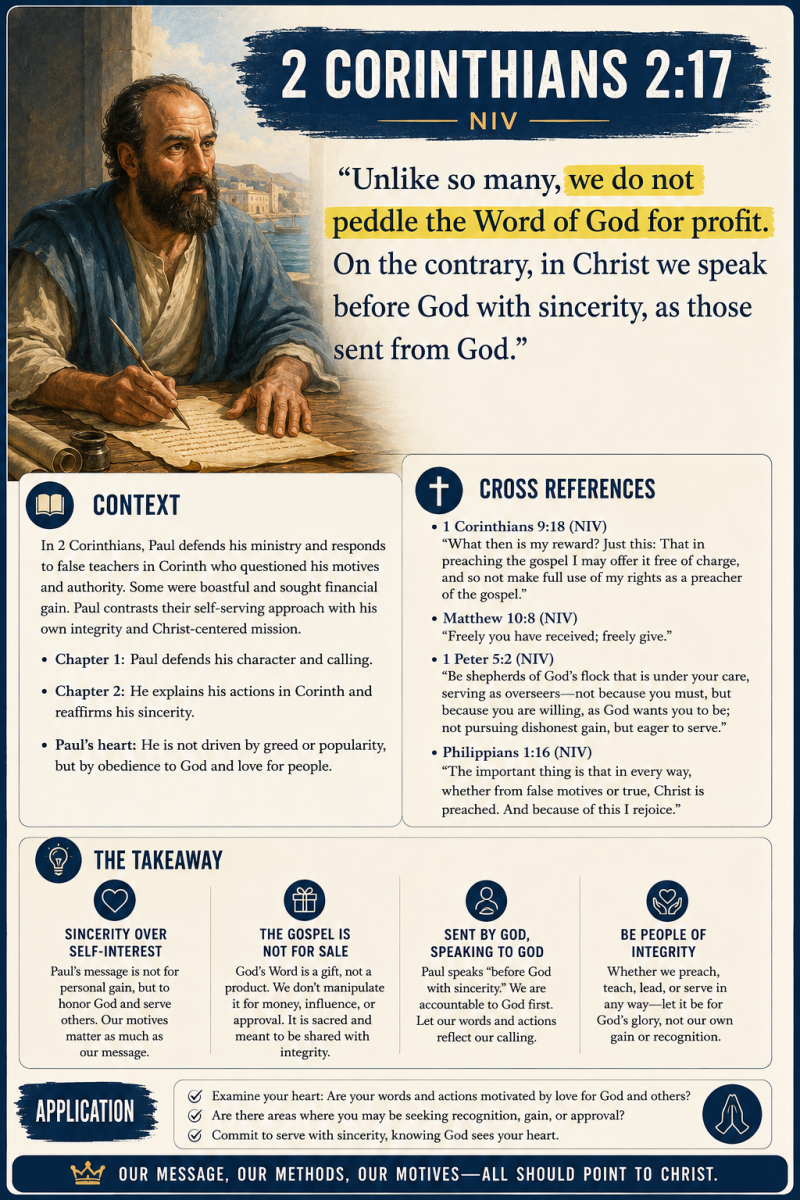
This verse is 2 Corinthians 2:17, and it is a powerful “motive check” verse for anyone who teaches, posts, studies, shares, or handles God’s Word. 🤍
2 Corinthians 2:17 — Deep Dive
2 Corinthians 2:17 says Paul is not like those who “peddle the word of God for profit” but instead speaks in Christ, before God, with sincerity, as one sent from God.
That one verse gives us four big tests for ministry:
1. Is the message being used as a product?
2. Are the motives sincere?
3. Is the speaker aware God is watching?
4. Is Christ being represented faithfully?
The Context
In 2 Corinthians 2:14–16, Paul says God leads believers in Christ’s triumph and spreads through them “the aroma of the knowledge of him.” Then Paul asks:
2 Corinthians 2:16 — “And who is equal to such a task?”
That question leads right into 2 Corinthians 2:17.
Paul’s answer is basically: No one is sufficient in himself. That is why we must not handle God’s Word like salesmen, performers, manipulators, or self-promoters.
He is contrasting two kinds of ministry:
False or corrupt ministry: uses God’s Word for personal gain, status, influence, money, applause, or control.
Faithful ministry: speaks from God, before God, in Christ, with sincerity.
“We Do Not Peddle the Word of God”
The word behind “peddle” carries the idea of a merchant selling something for gain. In the ancient world, it could also carry the sense of dishonest dealing, like watering down wine to make more profit.
So Paul is not only saying, “We do not make money from Scripture.” He is saying something deeper:
“We do not treat God’s Word like merchandise. We do not dilute it, twist it, package it for applause, or use it to enrich ourselves.”
That matters so much.
God’s Word is not a product.
The gospel is not bait.
Truth is not a performance.
Ministry is not self-promotion.
What Paul Is Not Saying
Paul is not saying that ministers can never be supported.
1 Corinthians 9:14 — Paul says those who preach the gospel have a right to receive support from gospel work.
1 Timothy 5:17–18 — Faithful elders who teach are worthy of honor, and “the worker deserves his wages.”
So the issue in 2 Corinthians 2:17 is not honest support. The issue is corrupt motive.
There is a difference between receiving provision while serving God and using God’s Word as a means of profit, platform, or manipulation.
That distinction is really important. 🕊️
“On the Contrary, in Christ We Speak”
Paul says faithful ministry happens “in Christ.”
That means the message, motive, authority, and aim are rooted in Jesus. Paul is not speaking as an independent influencer. He is not building a personal brand. He is not trying to make Paul look impressive.
He is speaking as someone united to Christ and accountable to Christ.
A faithful teacher should always make people more impressed with Jesus, not more dependent on the teacher.
That pairs beautifully with:
2 Corinthians 4:5 — “For what we preach is not ourselves, but Jesus Christ as Lord, and ourselves as your servants for Jesus’ sake.”
That is almost the companion verse to 2 Corinthians 2:17.
“Before God”
This phrase is weighty.
Paul is saying, “God is my witness. God sees my motives. God knows whether I am sincere.”
That should sober anyone who shares Scripture.
We can fool people with polished words.
We can impress people with knowledge.
We can make spiritual things look beautiful on the outside.
But we cannot hide our motives from God.
Hebrews 4:13 — Nothing in all creation is hidden from God’s sight.
Psalm 139:23–24 — David asks God to search his heart and reveal any offensive way.
So 2 Corinthians 2:17 is not only about false teachers “out there.” It invites each of us to pray, “Lord, keep my motives clean.”
“With Sincerity”
Sincerity means purity of motive. No hidden agenda. No double heart.
Paul’s ministry was not flawless in human weakness, but his aim was clean: obedience to God, love for people, and faithfulness to Christ.
This connects with:
1 Thessalonians 2:3–5 — Paul says his appeal did not spring from error, impurity, trickery, flattery, or greed.
Galatians 1:10 — Paul says if he were trying to please people, he would not be a servant of Christ.
1 Peter 5:2 — Shepherds are told to serve willingly, not pursuing dishonest gain.
“As Those Sent From God”
Paul saw himself as a steward, not an owner.
That is huge.
A steward does not get to rewrite the message.
A steward does not get to exploit the household.
A steward does not get to act like the treasure belongs to him.
1 Corinthians 4:1–2 — Paul says servants of Christ are entrusted with the mysteries God has revealed, and stewards must be faithful.
So the faithful messenger asks:
“Did I handle this the way God would want?”
“Did I point people to Christ?”
“Did I speak truthfully, humbly, and carefully?”
Cross References
2 Corinthians 4:5 — Paul says he does not preach himself, but Jesus Christ as Lord.
1 Corinthians 9:18 — Paul says his reward is offering the gospel freely and not abusing his rights.
1 Thessalonians 2:3–5 — Paul rejects trickery, flattery, impurity, and greed in ministry.
Galatians 1:10 — Paul refuses to make people-pleasing the goal of his calling.
1 Peter 5:2 — Shepherds must serve God’s flock willingly, not for dishonest gain.
Matthew 10:8 — Jesus says, “Freely you have received; freely give.”
1 Corinthians 4:1–2 — Those entrusted with God’s truth must be found faithful.
Philippians 1:15–18 — Paul acknowledges some preach from selfish ambition, but rejoices when Christ is truly preached.
Acts 20:33–35 — Paul reminds the Ephesian elders that he did not covet silver, gold, or clothing, but worked and helped the weak.
The Heart of the Verse
2 Corinthians 2:17 is a warning against treating holy things lightly.
Paul is saying:
“We do not sell God’s Word.
We do not twist God’s Word.
We do not use God’s Word to build ourselves.
We speak as people standing before God, sent by God, belonging to Christ.”
That is such a clean and beautiful standard.
Takeaway Meaning
The Word of God is sacred. We are not owners of it; we are servants under it.
So whether someone is preaching, teaching, posting, making cards, writing captions, leading a study, or simply sharing a verse with a friend, the heart should be:
Not for profit.
Not for applause.
Not for control.
Not for self.
But from sincerity, before God, in Christ.
A simple prayer from this verse could be:
“Lord, keep my hands clean and my motives pure as I handle Your Word. Let me never use Scripture for selfish gain, but only to honor Christ and serve others faithfully.”


Add comment
Comments