

Which Neighbor Are You?

"Do not seek revenge or bear a grudge against anyone among your people, but love your neighbor as yourself. I am the LORD." - Leviticus 19:18
Luke 10:29
Luke 10:29-37 (NIV)
On one occasion an expert in the law stood up to test Jesus. "Teacher," he asked, "what must I do to inherit eternal life?" "What is written in the Law?" he replied. "How do you read it?" He answered, "Love the Lord your God with all your heart and with all your soul and with all your strength and with all your mind, and, 'Love your neighbor as yourself.'" "You have answered correctly," Jesus replied. "Do this and you will live."
But he wanted to justify himself, so he asked Jesus, "And who is my neighbor?"
In reply Jesus said: "A man was going down from Jerusalem to Jericho, when he was attacked by robbers. They stripped him of his clothes, beat him and went away, leaving him half dead. A priest happened to be going down the same road, and when he saw the man, he passed by on the other side. So too, a Levite, when he came to the place and saw him, passed by on the other side. But a Samaritan, as he traveled, came where the man was and when he saw him, he took pity on him. He went to him and bandaged his wounds, pouring on oil and wine. Then he put the man on his own donkey, brought him to an inn and took care of him. The next day he took out two denarii and gave them to the innkeeper. 'Look after him,' he said, 'and when I return, I will reimburse you for any extra expense you may have.'
"Which of these three do you think was a neighbor to the man who fell into the hands of robbers?" The expert in the law replied, "The one who had mercy on him." Jesus' told him, "Go and do likewise."
Luke 10:29 is such a heart-searching verse because it exposes the difference between wanting to obey God and wanting to limit what obedience costs us.
Luke 10:29 — NIV
Luke 10:29 — “But he wanted to justify himself, so he asked Jesus, ‘And who is my neighbor?’”
Context
This verse comes right after an expert in the law asks Jesus:
Luke 10:25 — “Teacher, what must I do to inherit eternal life?”
Jesus points him back to Scripture, and the man answers with the two great commands:
Luke 10:27 — “Love the Lord your God with all your heart and with all your soul and with all your strength and with all your mind”; and, “Love your neighbor as yourself.”
Jesus tells him:
Luke 10:28 — “You have answered correctly… Do this and you will live.”
Then comes the problem:
Luke 10:29 — “But he wanted to justify himself…”
That phrase matters. He is not simply asking for clarity. He is trying to narrow the command. He wants a boundary line around love.
In other words:
“Who exactly counts as my neighbor?”
“Who am I required to love?”
“Where does my obligation end?”
And Jesus answers with the Parable of the Good Samaritan.
The Heart of the Verse
The man asked, “Who is my neighbor?”
But Jesus’ parable flips the question into:
“Will you be a neighbor?”
That is the conviction in this passage. Jesus does not let him keep love theoretical. He makes love visible, costly, compassionate, and merciful.
The priest and Levite saw the wounded man and passed by. The Samaritan saw him and had mercy.
Key Meaning
Luke 10:29 shows us how the human heart often tries to justify itself by making obedience smaller.
Instead of asking,
“Lord, how far can I go in love?”
we sometimes ask,
“Lord, how little can I do and still be okay?”
That is raw, but it is true. Jesus lovingly exposes that.
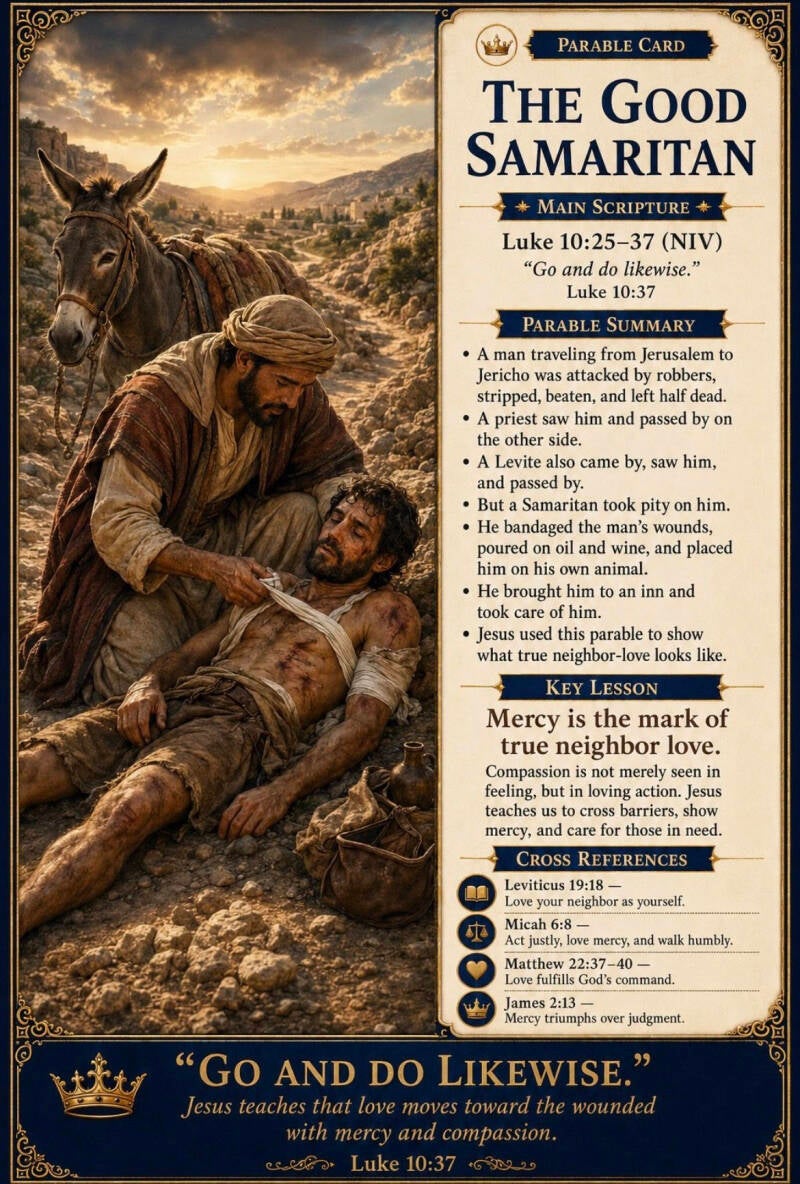
Cross References for Luke 10:29
Leviticus 19:18 — God commanded His people not to seek revenge or hold grudges, but to love their neighbor as themselves. This is the command the expert in the law had just quoted to Jesus.
Matthew 22:37-39 — Jesus identifies the greatest command as loving God completely, and the second as loving your neighbor as yourself.
Mark 12:31 — Jesus says loving your neighbor as yourself is one of the greatest commandments, right alongside loving God.
Romans 13:8-10 — Paul teaches that love fulfills the law because true love does no harm to a neighbor.
Galatians 5:14 — Paul summarizes the law with the command to love your neighbor as yourself.
James 2:8 — James calls loving your neighbor as yourself the “royal law,” meaning it reflects the heart of God’s kingdom.
1 John 3:16-18 — John teaches that love is not merely words or feelings, but action and truth, especially when we see someone in need.
1 John 4:20-21 — John warns that someone cannot claim to love God while refusing to love their brother or sister.
Matthew 5:43-48 — Jesus pushes love beyond the expected circle, teaching His followers to love even their enemies and pray for those who persecute them.
Proverbs 3:27-28 — Wisdom teaches us not to withhold good from someone when it is within our power to help.
Micah 6:8 — God desires His people to act justly, love mercy, and walk humbly with Him.
Hosea 6:6 — God says He desires mercy more than empty religious performance.
Luke 6:31 — Jesus teaches us to treat others the way we would want to be treated.
Luke 10:36-37 — After telling the parable, Jesus asks which man acted as a neighbor, and the answer is the one who showed mercy.
Why These Cross References Matter
The man in Luke 10:29 was asking, “Who qualifies as my neighbor?”
But Jesus’ answer shows that the better question is:
Am I willing to become a neighbor to the person God puts in front of me?
That is where the verse cuts deep. The lawyer wanted to define the limits of love. Jesus revealed the lifestyle of love.
Takeaway Meaning
Luke 10:29 reminds us that self-justification can hide behind religious questions.
Sometimes we ask questions because we want truth.
Sometimes we ask questions because we want a loophole.
This man already knew the command: love God and love your neighbor. But he wanted Jesus to narrow the definition of “neighbor.” Jesus widened it instead.
The Good Samaritan shows that mercy is not limited by race, class, convenience, comfort, history, or expectation. Mercy moves toward the wounded.
Heart Check
A good question for this verse is:
Lord, am I trying to define who deserves my love, or am I letting You teach me how to love like You?
Because Jesus does not merely call us to recognize neighbors.
He calls us to become neighbors — merciful, willing, compassionate, and moved by love. 🕊️



Add comment
Comments