

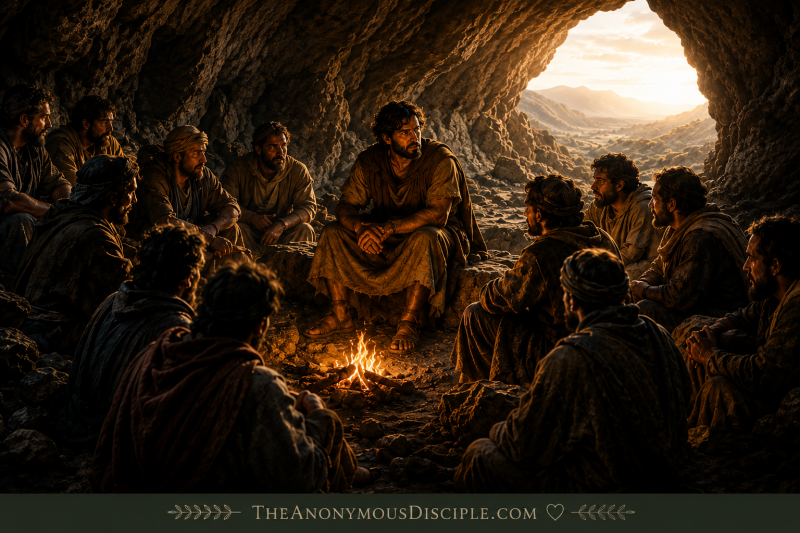
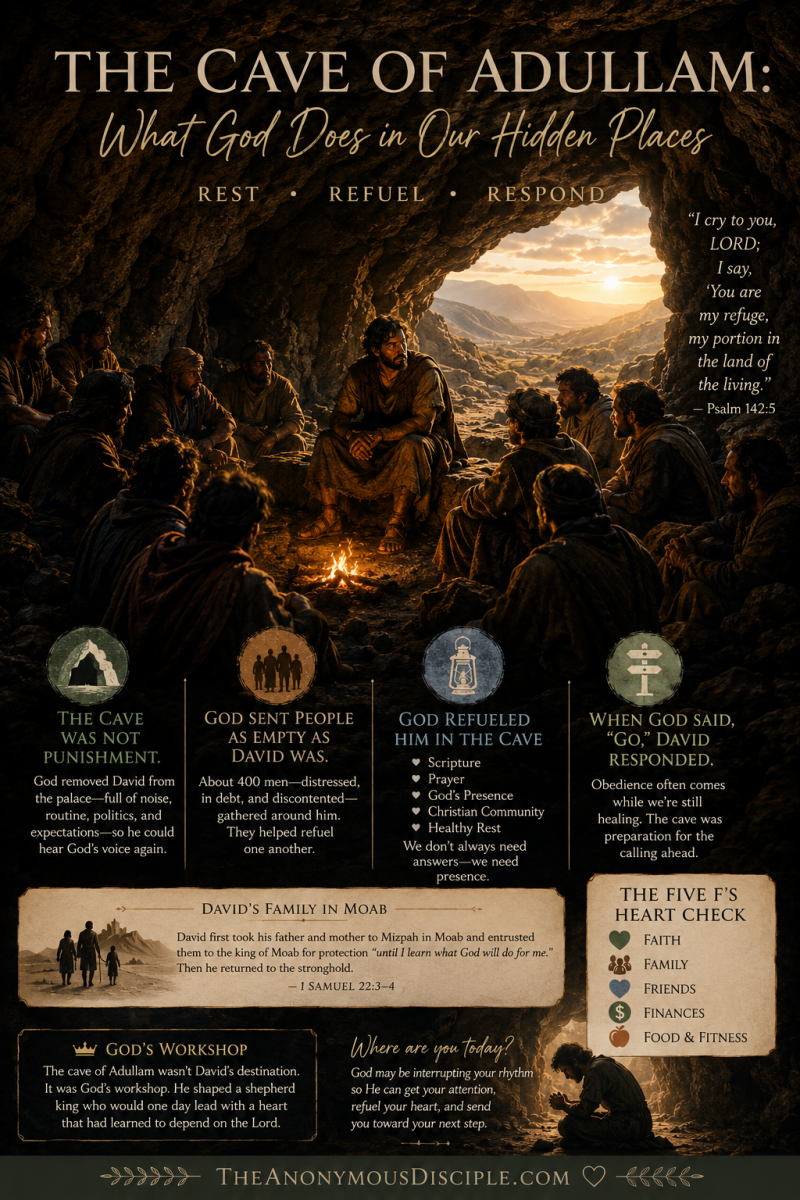
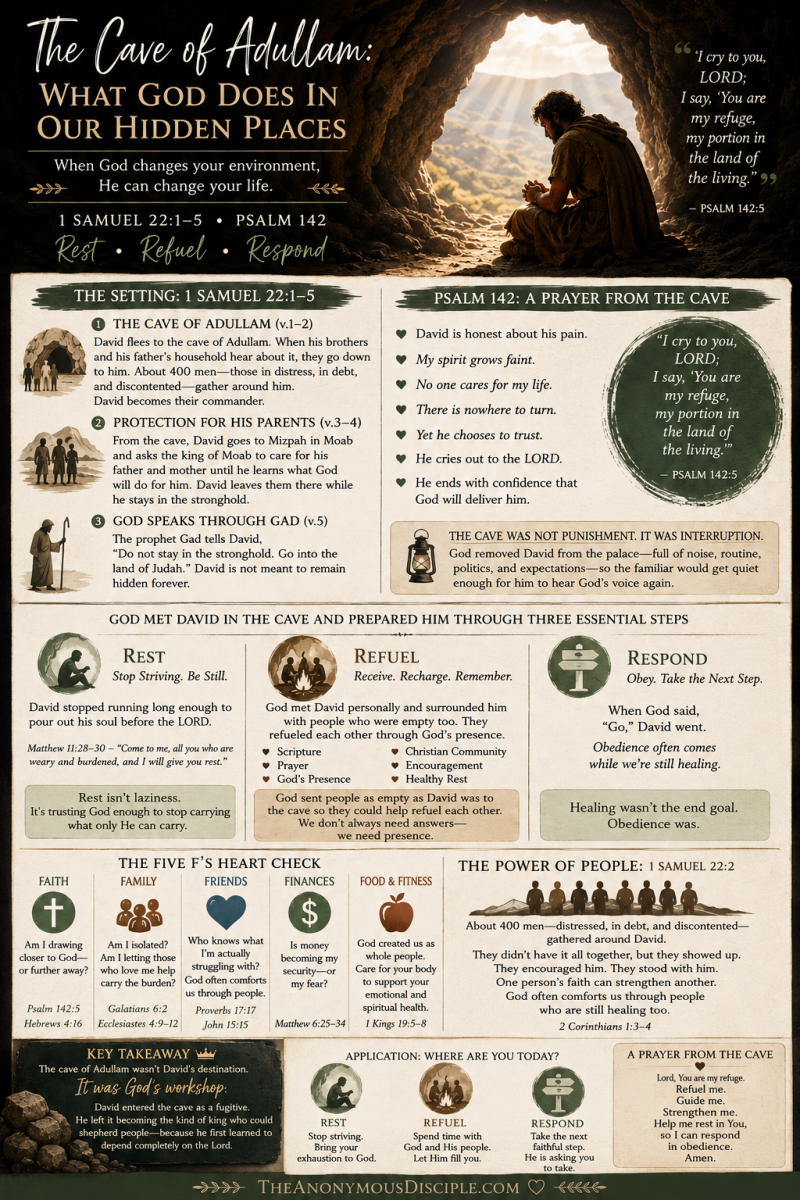
David's situation in 1 Samuel 22:1–5 is remarkable. He's fleeing Saul, hiding in the cave of Adullam, exhausted, uncertain, and carrying enormous emotional weight. Then Psalm 142 gives us a glimpse into what he was praying while he was in that cave.
📖 The Setting
⚓️ 1 Samuel 22:1–5 (NIV)
David escapes to the cave of Adullam. Instead of finding peace immediately:
- His distressed family joins him.
- About 400 men come to him:
- those in distress
- those in debt
- those who were discontented (bitter in soul)
David suddenly becomes responsible for broken people while he himself is hurting.
Then the prophet Gad tells him:
"Do not stay in the stronghold. Go into the land of Judah."
— 1 Samuel 22:5 (NIV)
God doesn't leave David hiding forever.
📖 Psalm 142
This is literally titled:
"A prayer when he was in the cave."
One of my favorite verses is:
Psalm 142:5 (NIV)
"I cry to you, LORD; I say, 'You are my refuge, my portion in the land of the living.'"
David doesn't pretend to be strong.
He admits:
- "My spirit grows faint."
- "No one cares for my life."
- "There is nowhere to turn."
Yet his prayer ends with confidence that God will deliver him.
Rest
David first stopped running.
Sometimes the most spiritual thing we can do is stop striving.
Jesus echoed this:
Matthew 11:28–30 (NIV)
"Come to me, all you who are weary and burdened, and I will give you rest."
Rest isn't laziness.
It's trusting God enough to stop carrying what only He can carry.
Refuel
David poured out his heart before he led anyone else.
He refueled through God's presence.
Today that may look like:
📖 Scripture
🙏 Prayer
⛪ Church
🤝 Christian community
😴 Healthy sleep
Quiet time with God isn't escaping life.
It's preparing for it.
Respond
David didn't remain in the cave forever.
When God said,
"Go."
David went.
Healing wasn't the end goal.
Obedience was.
Sometimes we wait until we "feel better" before obeying God.
David shows us that often obedience comes while we're still healing.
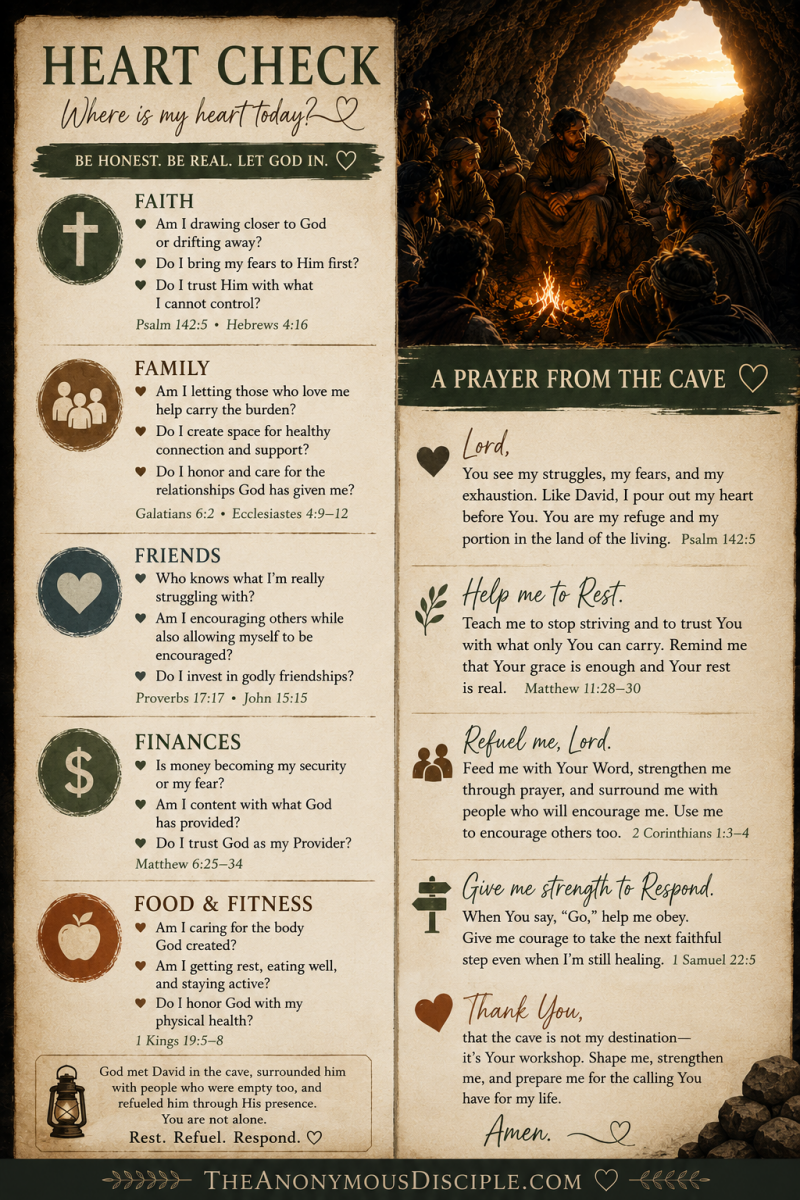
The Five F's
✝️ Faith
Am I drawing closer to God—or further away?
Psalm 142:5
Hebrews 4:16
👨👩👧👦 Family
Am I isolated?
Am I letting those who love me help carry the burden?
Galatians 6:2
Ecclesiastes 4:9–12
❤️ Friends
Who knows what I'm actually struggling with?
God often comforts us through people.
Proverbs 17:17
John 15:15
💵 Finances
Is money becoming my security—or my fear?
Jesus spoke about worry and provision repeatedly.
Matthew 6:25–34
🥗 Food & Fitness
God created us as whole people.
Sleep...
Nutrition...
Exercise...
These don't replace prayer—but they can support emotional resilience. Elijah's story in 1 Kings 19 is a wonderful example. Before correcting Elijah's thinking, God first gave him food, water, and rest.
❤️ Connection
This entire series seems to follow a beautiful progression:
- Notice → Admit what's happening.
- Name → Bring it honestly before God.
- Invite → Ask God into the struggle.
- Rest → Stop striving.
- Refuel → Spend time with God and His people.
- Respond → Take the next faithful step.
That mirrors David's journey almost perfectly.
David was not sent to the cave merely to be alone. God sent other wounded people there too.
1 Samuel 22:2 (NIV)
“All those who were in distress or in debt or discontented gathered around him, and he became their commander.”
They were not strong, polished, or spiritually “full.” They came distressed, indebted, and bitter in soul. David was depleted, and so were they. Yet God formed a community out of their emptiness.
They did not necessarily arrive with answers. They arrived with presence.
Sometimes God refuels us through people who are still healing too. One person’s faith strengthens another. One person’s honesty gives someone else permission to stop pretending. One person’s prayer carries the group when the others are too tired to pray.
2 Corinthians 1:3–4 (NIV)
“The God of all comfort… comforts us in all our troubles, so that we can comfort those in any trouble with the comfort we ourselves receive from God.”
They helped refuel one another, but God remained the source.
From the palace to the cave
The other point pastor made is powerful too.
The palace had noise, routine, danger, politics, expectations, and constant movement. David had lived near Saul, served Saul, played music for Saul, fought battles, and navigated palace life. That rhythm may have become so loud that David could no longer clearly hear what God was forming in him.
So God changed the environment.
The cave stripped away:
- position
- comfort
- reputation
- predictability
- the familiar rhythm of palace life
The cave was quiet enough for David to hear his own desperation—and God’s voice.
Psalm 142:1–2 (NIV)
“I cry aloud to the LORD; I lift up my voice to the LORD for mercy. I pour out before him my complaint; before him I tell my trouble.”
David did not write a polished palace prayer. He prayed a cave prayer—raw, honest, and undistracted.
And then God spoke through the prophet Gad:
1 Samuel 22:5 (NIV)
“Do not stay in the stronghold. Go into the land of Judah.”
That matters. God removed David from one rhythm, met him in the cave, refueled him through unexpected people, and then told him when it was time to move again.
The cave was not punishment. It was interruption.
Sometimes God disrupts our normal rhythm because the familiar has become too loud. We may interpret the change as loss, delay, or isolation, while God is creating space for us to hear Him again.
The deeper pattern
Rest — David stopped running long enough to pour out his soul.
Refuel — God met him personally and surrounded him with people who also needed grace.
Respond — When God said leave the stronghold, David obeyed.
And the people in the cave were not a distraction from David’s calling. They became part of it. God was already teaching David how to shepherd hurting people before he ever sat on the throne.
The palace showed David what kingship looked like from the outside.
The cave taught him what a shepherd-king needed on the inside. 🪨❤️
🔥 TAKEAWAY:
The cave of Adullam wasn't David's destination.
It was God's workshop.
David entered the cave as a fugitive. He left it becoming the kind of king who could shepherd people because he had first learned to depend completely on the Lord.
Add comment
Comments