

Psalm 55:12–13 is the pain of betrayal—not from an enemy, but from someone David trusted deeply.

The central truth
Betrayal hurts most when it comes from someone who once felt safe—but the failure of a trusted person does not mean God has failed you.
The companion may abandon.
The close friend may deceive.
The familiar relationship may change.
But God remains:
Psalm 55:22
The Lord sustains those who place their burdens upon Him.
And He will not allow betrayal to have the final word over a heart continually surrendered to Him. 🕊️
To the person sitting alone after a divorce, betrayal, abandonment, or even church hurt.
"You don't have to believe every voice that speaks into your pain."
The central lesson of Psalm 55
Betrayal is not just an event...
It's the beginning of a battle over which voice will define the rest of your life.
God says,
"Cast your cares on the LORD and he will sustain you." — Psalm 55:22
Satan says,
"Carry them yourself."
One voice leads to life.
The other only deepens the wound.
Remember 🗝️
The enemy leans in, whispers lies, tries to manipulate.
Jesus doesn't force Himself on us. He simply extends His hand and waits.
Jesus never competes by shouting louder. He calls. We choose whom we'll follow.
The whispers are close.
The Word is closer.
That's exactly what Jesus used in the wilderness. Every lie was answered with:
"It is written..."
— Matthew 4:4, 7, 10
That dusty ancient book on your shelf or coffee table is alive and active...The truth has always been within reach.

💡 Key Truth:
When we tell Jesus, “Someone I trusted wounded me,” we are not explaining an unfamiliar kind of suffering. He understands first hand the particular grief of being betrayed by someone close.

study notes
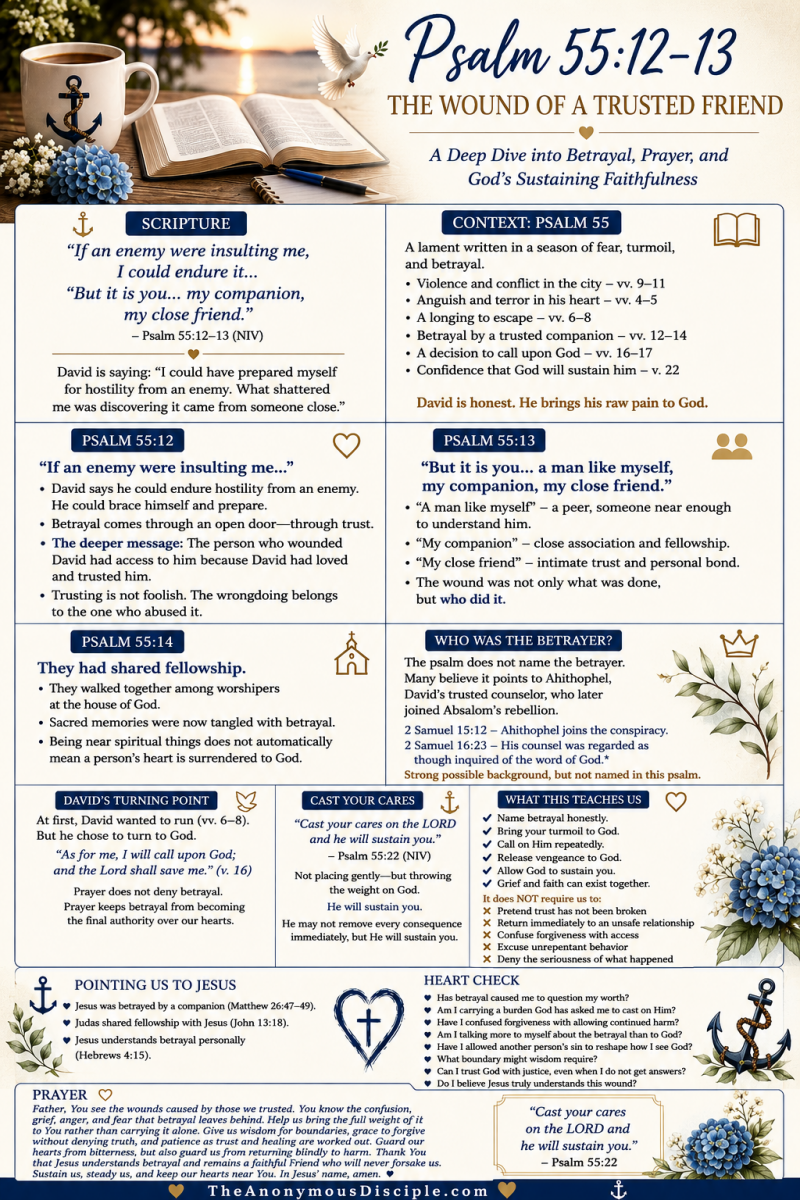
Psalm 55:12–13 — The wound of a trusted friend
Psalm 55:12–13 (NIV, excerpt)
“If an enemy were insulting me, I could endure it…”
“But it is you… my companion, my close friend.”
David is saying: “I could have prepared myself for hostility from an enemy. What shattered me was discovering it came from someone close.”
An enemy’s attack hurts, but betrayal carries an additional wound: the loss of what you believed the relationship was.
1. The setting of Psalm 55
Psalm 55 is a lament written during a season of fear, turmoil, and betrayal. David describes:
- violence and conflict in the city — Psalm 55:9–11
- anguish and terror within his own heart — Psalm 55:4–5
- a longing to escape everything — Psalm 55:6–8
- betrayal by a trusted companion — Psalm 55:12–14
- a deliberate decision to call upon God — Psalm 55:16–17
- confidence that God will sustain him — Psalm 55:22
David is not calmly reflecting on an old disappointment. He is writing from inside the pain.
Psalm 55:4–5
David says his heart is in anguish, terror has fallen upon him, and fear and trembling have overwhelmed him.
This is emotional honesty before God. David does not pretend that faith makes betrayal painless.
⚓️ Psalm 55:12 — “If an enemy were insulting me…”
David explains that opposition from an enemy would have been understandable.
“I could endure it”
He could brace himself for an enemy. He could recognize the danger, establish boundaries, and prepare for conflict.
But betrayal usually comes through an open door—through trust.
The deeper message is:
The person who wounded David had access to him because David had loved and trusted him.
That is why betrayal can make people question:
- their judgment
- their memories
- their ability to trust again
- whether the relationship was ever genuine
- whether they somehow caused the betrayal
Yet trusting someone is not automatically foolish. Trust is part of love. The wrongdoing belongs to the one who abused it.
⚓️ Psalm 55:13 — “But it is you…”
These words carry shock and grief.
David does not merely say, “Someone hurt me.” He says, in effect:
“You? Of all people—you?”
“A man like myself”
This suggests someone David regarded as a peer—someone near enough to understand him and share life with him.
“My companion”
The Hebrew idea points toward close association and fellowship. This was not a distant acquaintance.
“My close friend”
This was someone David knew intimately and trusted personally.
The wound was not only what the person did. The wound was who did it.
Psalm 55:14 makes the betrayal even more painful
Psalm 55:14
David remembers the close fellowship they once enjoyed as they walked together among worshipers at the house of God.
They had shared spiritual fellowship. They had worshiped together.
That means the betrayer likely knew David’s prayers, fears, strengths, weaknesses, and private struggles. Sacred memories were now tangled with betrayal.
This teaches us something painful but important:
Being near spiritual things does not automatically mean a person’s heart is surrendered to God.
Someone may worship beside us and still make destructive choices. Their hypocrisy does not make God unfaithful, and it does not make the worship we offered God meaningless.
Who betrayed David?
Psalm 55 does not name the betrayer directly. Many readers connect the psalm with Ahithophel, David’s trusted counselor, who later joined Absalom’s rebellion.
2 Samuel 15:12
Absalom sent for Ahithophel, David’s counselor, and the conspiracy gained strength.
2 Samuel 16:23
Ahithophel’s counsel was regarded as though someone had inquired of the word of God.
Ahithophel was not insignificant. He was respected, trusted, and close enough to advise David. His betrayal would have been devastating.
However, because Psalm 55 does not explicitly identify him, it is best to say that Ahithophel is a strong possible historical background rather than a certainty.
David wanted to run
Psalm 55:6–8
David longs for wings like a dove so he could fly away, find rest, and escape the storm.
That desire does not mean David lacked faith. It means he was overwhelmed.
Sometimes the first response to betrayal is not revenge—it is exhaustion:
“I just want to get away from all of this.”
God allows David’s words to remain in Scripture because He is not offended by honest grief. God would rather have us bring Him our unfiltered pain than withdraw from Him behind religious language.
David’s turning point
The psalm begins with distress, but David eventually makes a deliberate choice:
Psalm 55:16–17
David says that he will call upon God morning, noon, and evening, confident that God hears him.
Notice that the circumstances have not necessarily changed yet. David changes where he carries the burden.
He moves from:
“I need to escape”
to:
“I will call upon God.”
Prayer does not deny betrayal. Prayer prevents betrayal from becoming the final authority over our hearts.
“Cast your cares on the LORD”
Psalm 55:22 (NIV, excerpt)
“Cast your cares on the LORD and he will sustain you.”
The word picture is not of delicately placing a burden down. It is closer to throwing or hurling the weight onto God.
God does not say:
- Pretend it did not hurt.
- Immediately trust the person again.
- Ignore wisdom and boundaries.
- Carry the pain alone.
- Make yourself emotionally available to further harm.
He says: Give the weight to Me. I will sustain you.
God may not immediately remove every consequence, but He promises that the burden does not have to destroy the one carrying it.
How Psalm 55 points us to Jesus
David’s betrayal anticipates the deeper betrayal Jesus experienced.
Jesus was betrayed by a companion
Matthew 26:47–49
Judas arrived with an armed crowd and identified Jesus with a kiss.
The kiss was a sign of affection used as an instrument of betrayal.
Judas shared fellowship with Jesus
John 13:18
Jesus applied the Scripture about one who shared His bread and then turned against Him.
Judas had walked with Jesus, heard His teaching, witnessed His miracles, and eaten at His table.
Jesus understands betrayal personally
Hebrews 4:15
Jesus is able to sympathize with our weaknesses because He was tested in every way, yet without sin.
What Psalm 55 does—and does not—teach
Psalm 55 teaches us to:
- name betrayal honestly
- bring emotional turmoil directly to God
- seek God repeatedly, not only once
- release vengeance into God’s hands
- allow God to sustain us
- recognize that grief and faith can exist together
It does not require us to:
- pretend trust has not been broken
- return immediately to an unsafe relationship
- confuse forgiveness with access
- excuse unrepentant behavior
- deny the seriousness of what happened
Forgiveness releases personal vengeance to God. Reconciliation requires truth, repentance, and rebuilding. Trust is restored through demonstrated faithfulness—not demanded through pressure.
A deeper spiritual danger
The betrayer can become the center of our inner world. We may replay conversations, imagine what we should have said, or continually search for an explanation.
But Psalm 55 gradually redirects David’s attention:
- from the betrayer to God
- from the wound to prayer
- from panic to dependence
- from carrying the burden to casting it
- from instability to God’s sustaining hand
The betrayer may have changed David’s circumstances, but David refused to let the betrayer replace God as the ruler of his heart.
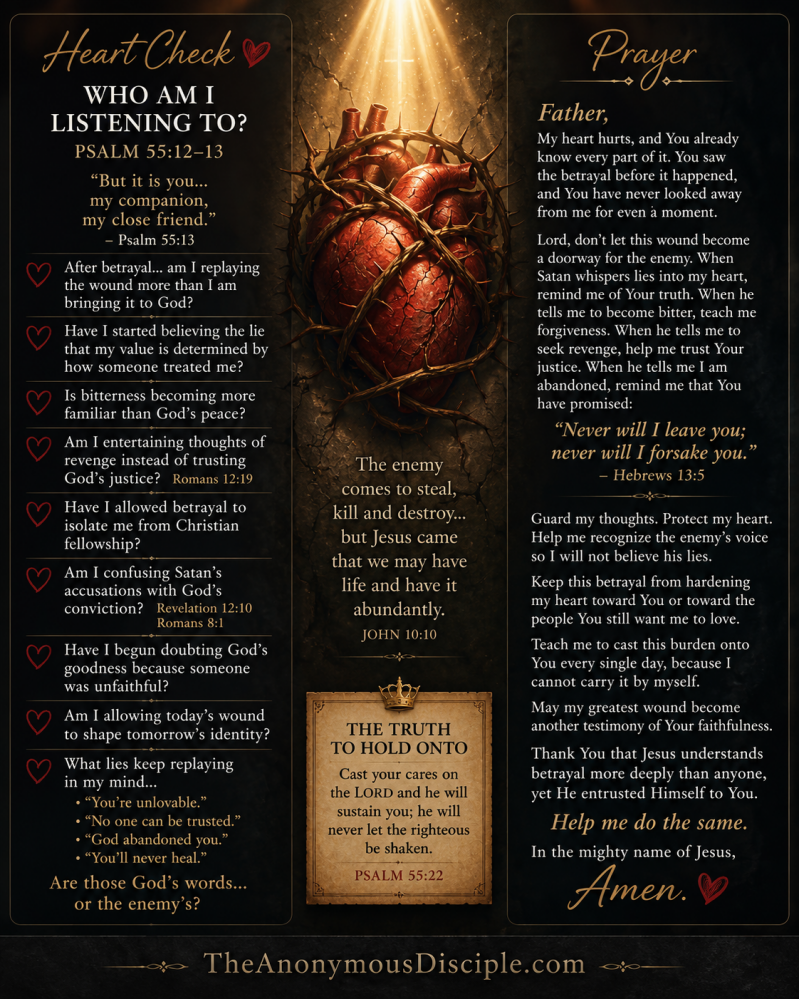
Heart check ❤️
- Has betrayal caused me to question my worth?
- Am I carrying a burden God has asked me to cast upon Him?
- Have I confused forgiveness with allowing continued harm?
- Am I talking more to myself about the betrayal than I am talking to God?
- Have I allowed another person’s sin to reshape how I see God?
- What boundary might wisdom require?
- Can I trust God with justice, even when I do not receive an explanation?
- Do I believe Jesus truly understands this wound?
Prayer
Father, You see the wounds caused by those we trusted. You know the confusion, grief, anger, and fear that betrayal leaves behind. Help us bring the full weight of it to You rather than carrying it alone. Give us wisdom for boundaries, grace to forgive without denying truth, and patience as trust and healing are worked out. Guard our hearts from bitterness, but also guard us from returning blindly to harm. Thank You that Jesus understands betrayal and remains a faithful Friend who will never forsake us. Sustain us, steady us, and keep our hearts near You. In Jesus’ name, amen. ❤️
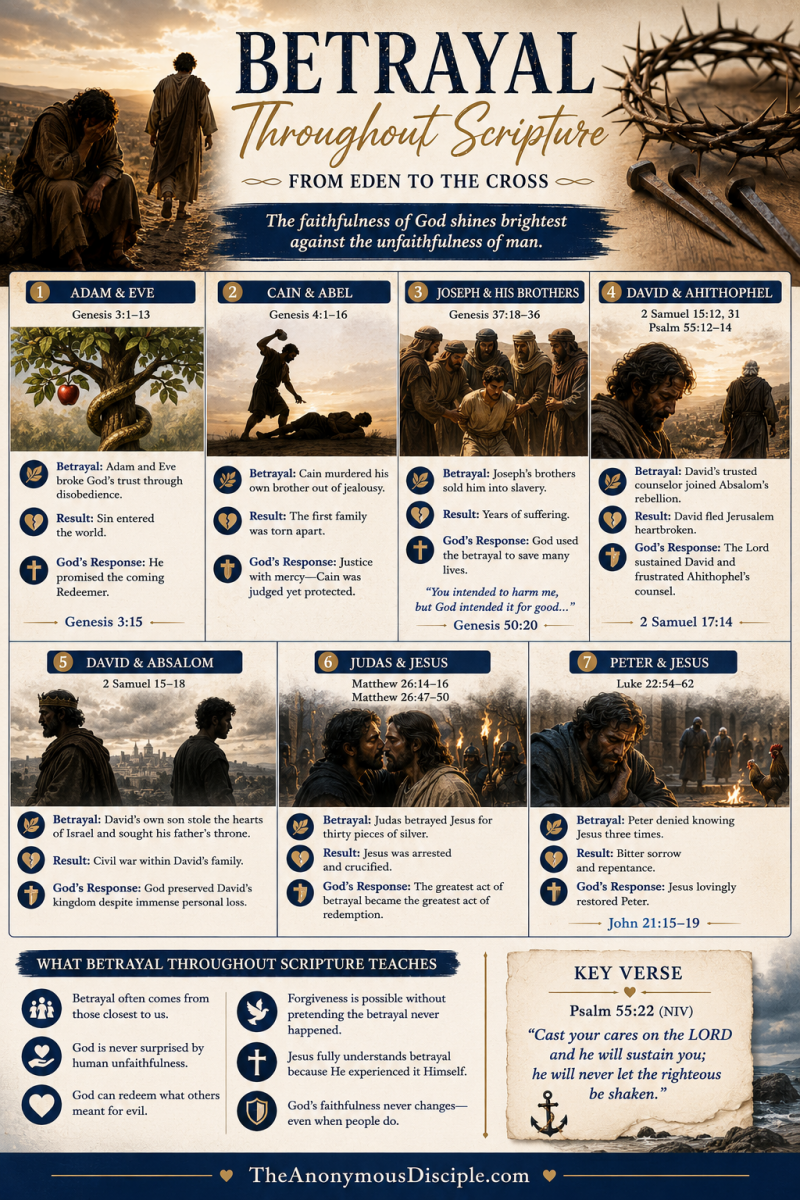
A thread through the whole Bible—from Adam's betrayal of God's command in Eden to Judas' betrayal of Christ—showing that while betrayal is a recurring human failure, God's faithfulness is the recurring divine answer.
Add comment
Comments