

Paul is talking to believers who thought Christian freedom meant they could do whatever they wanted with their bodies, especially when it came to sexual sin. He gently but firmly corrects that idea.
Bottom line: I belong to Jesus. I was bought at a price. So I will use my body to honor Him.

His main point is not about exercise, diet, or looking good. It is about three big truths:
- You are not your own. Jesus bought you with His blood. Your body belongs to Him now.
- Your body is a temple. The Holy Spirit actually lives inside you. That makes your body holy ground—not something to treat carelessly or use just for your own pleasure.
- Therefore, honor God with your body. Sexual purity, self-control, and everyday choices about how you live in your body are ways of worshiping the One who lives in you.
Paul’s advice is clear and practical:
- Don’t let anything (including desires) master you.
- Your body is meant for the Lord.
- When temptation comes, flee—don’t stay and negotiate.
- Remember the price Jesus paid for you.
- Let every part of your life—body and soul—bring honor to God.
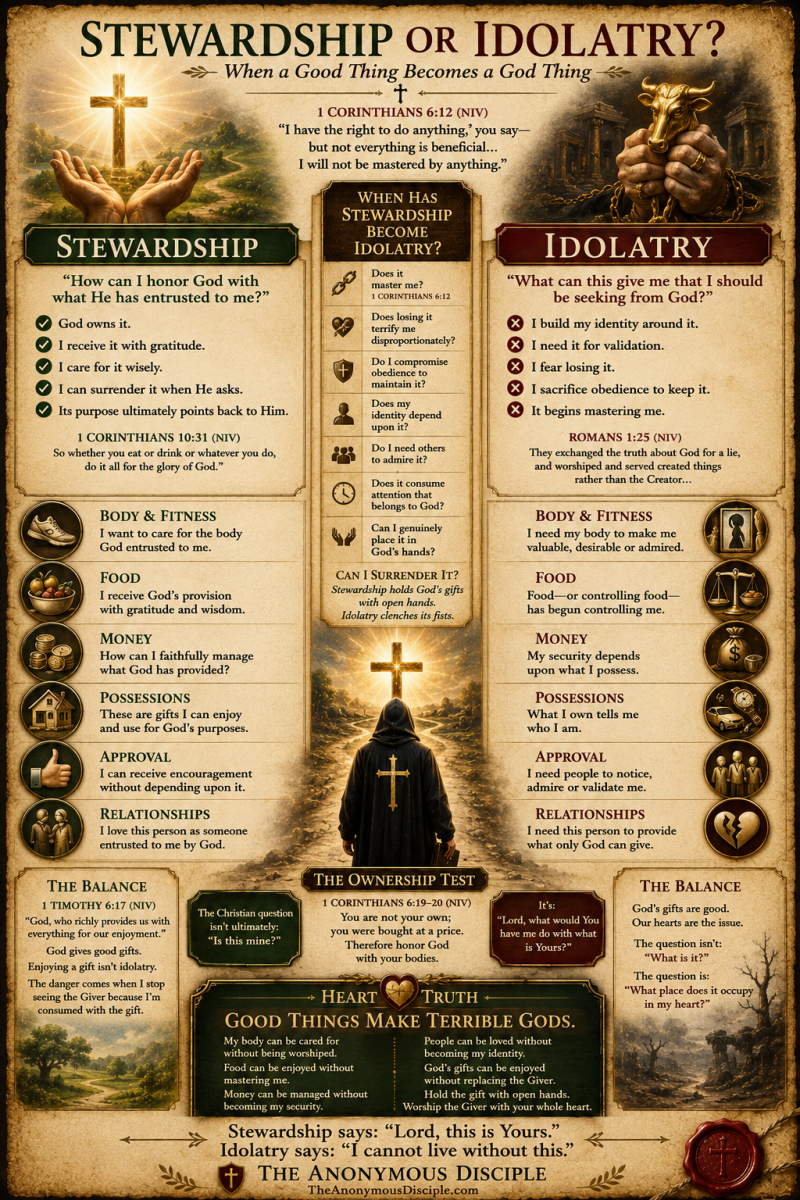
Main idea: Good gifts from God can quietly turn into idols if we’re not careful. The difference is stewardship versus idolatry.
Stewardship looks like this: “God owns this. He has entrusted it to me. How can I honor Him with it?”
- I receive it with gratitude.
- I care for it wisely.
- I can give it back when He asks.
- Its purpose ultimately points back to Him.
Idolatry looks like this: “What can this give me that I should be getting from God?”
- I build my identity around it.
- I need it for validation or security.
- I fear losing it.
- I’m willing to compromise obedience to keep it.
- It starts controlling me.

💭 I may have freedom to do something—but does that thing have freedom to control me?
study notes
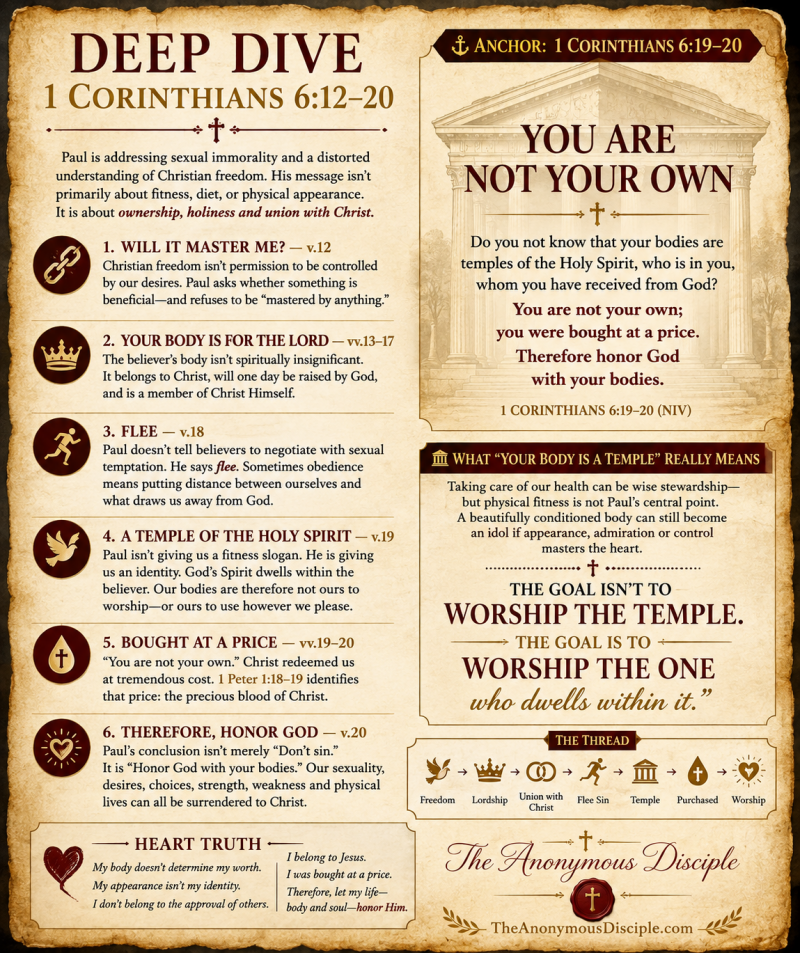
📖 Deep Dive — 1 Corinthians 6:12–20
⚓ Anchor: 1 Corinthians 6:19–20
1 Corinthians 6:19–20 (NIV)
“Do you not know that your bodies are temples of the Holy Spirit, who is in you, whom you have received from God? You are not your own; you were bought at a price. Therefore honor God with your bodies.”
There is a progression here that I think is really important:
Freedom → Lordship → Union → Temple → Ownership → Worship.
Paul isn't merely giving Christians a list of things they shouldn't do. He's telling them who they are now—and therefore how they should live. ❤️
🏛️ THE CORINTHIAN BACKDROP
Corinth was a prosperous Roman city with a reputation for sexual immorality. The believers had come to Christ, but some of the thinking of Corinth apparently followed them into the church.
Paul seems to quote slogans they were using:
1 Corinthians 6:12 (NIV)
“‘I have the right to do anything,’ you say—but not everything is beneficial.”
They understood Christian freedom, but some were twisting freedom into permission.
Paul answers with two tests:
Is it beneficial?
and
Will it master me?
“I will not be mastered by anything.”
— 1 Corinthians 6:12
That's much bigger than the immediate sexual context.
Something can be technically permissible and still begin controlling me.
🔗 1. “THE BODY…IS FOR THE LORD”
1 Corinthians 6:13 (NIV)
“The body, however, is not meant for sexual immorality but for the Lord, and the Lord for the body.”
This pushes against the idea that our spiritual life belongs to God while our physical body is somehow separate.
Paul says no.
Your body matters to God.
And his proof is fascinating:
1 Corinthians 6:14 (NIV)
“By his power God raised the Lord from the dead, and he will raise us also.”
Why mention resurrection during a discussion about sexual morality?
Because Christianity doesn't teach that God eventually throws the body away.
He resurrects it.
Our bodies are part of God's redemptive plan.
That gives enormous dignity to the physical body.
✝️ 2. “MEMBERS OF CHRIST”
Then Paul takes it deeper.
1 Corinthians 6:15 (NIV)
“Do you not know that your bodies are members of Christ himself?”
Not merely:
Christ owns my body.
But:
My body is united with Christ.
Paul therefore asks how something belonging to Christ could intentionally be joined to sexual sin.
He quotes Genesis:
1 Corinthians 6:16 (NIV)
“For it is said, ‘The two will become one flesh.’”
That comes from:
Genesis 2:24 (NIV)
“That is why a man leaves his father and mother and is united to his wife, and they become one flesh.”
Sex isn't presented biblically as merely a physical transaction.
There is a one-flesh union attached to it.
And Paul contrasts that with another union:
1 Corinthians 6:17 (NIV)
“But whoever is united with the Lord is one with him in spirit.”
That makes the issue profoundly relational.
Paul isn't primarily saying:
“Don't break this rule.”
He's saying:
“Remember Whom you are joined to.”
🏃♀️ 3. “FLEE”
Then comes unusually strong language:
1 Corinthians 6:18 (NIV)
“Flee from sexual immorality.”
Not debate it.
Not see how close you can get.
Not prove how spiritually strong you are.
Flee.
There is a biblical pattern here.
Joseph is probably one of the clearest pictures:
Genesis 39:12 (NIV)
“She caught him by his cloak and said, ‘Come to bed with me!’ But he left his cloak in her hand and ran out of the house.”
Sometimes the godliest response isn't standing your ground.
It's running. 🏃♀️
Compare:
2 Timothy 2:22 (NIV)
“Flee the evil desires of youth and pursue righteousness, faith, love and peace…”
Biblical fleeing isn't cowardice when you're running away from sin and toward God.
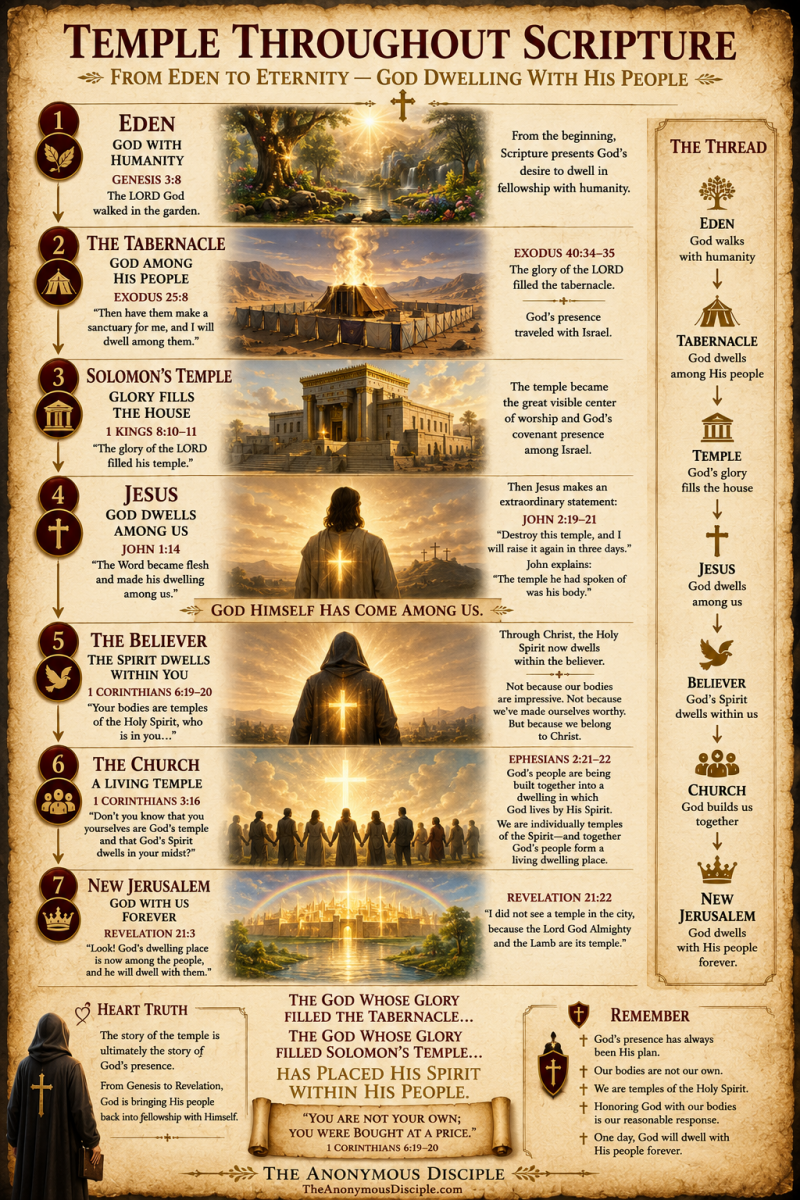
🕊️ 4. “YOUR BODIES ARE TEMPLES”
And now we reach our anchor.
1 Corinthians 6:19 (NIV)
“Do you not know that your bodies are temples of the Holy Spirit, who is in you, whom you have received from God?”
This imagery would have been enormous.
A temple was a place associated with the presence of deity.
But Paul tells believers that God's Spirit now dwells within them.
Compare:
1 Corinthians 3:16 (NIV)
“Don’t you know that you yourselves are God’s temple and that God’s Spirit dwells in your midst?”
There's an interesting distinction.
In 1 Corinthians 3, Paul speaks corporately—the church as God's temple.
Here in 1 Corinthians 6, he applies temple imagery directly to the believer's body.
So Christianity doesn't divide life into:
sacred things God cares about
versus
ordinary physical things He doesn't.
Your physical life belongs inside your worship.
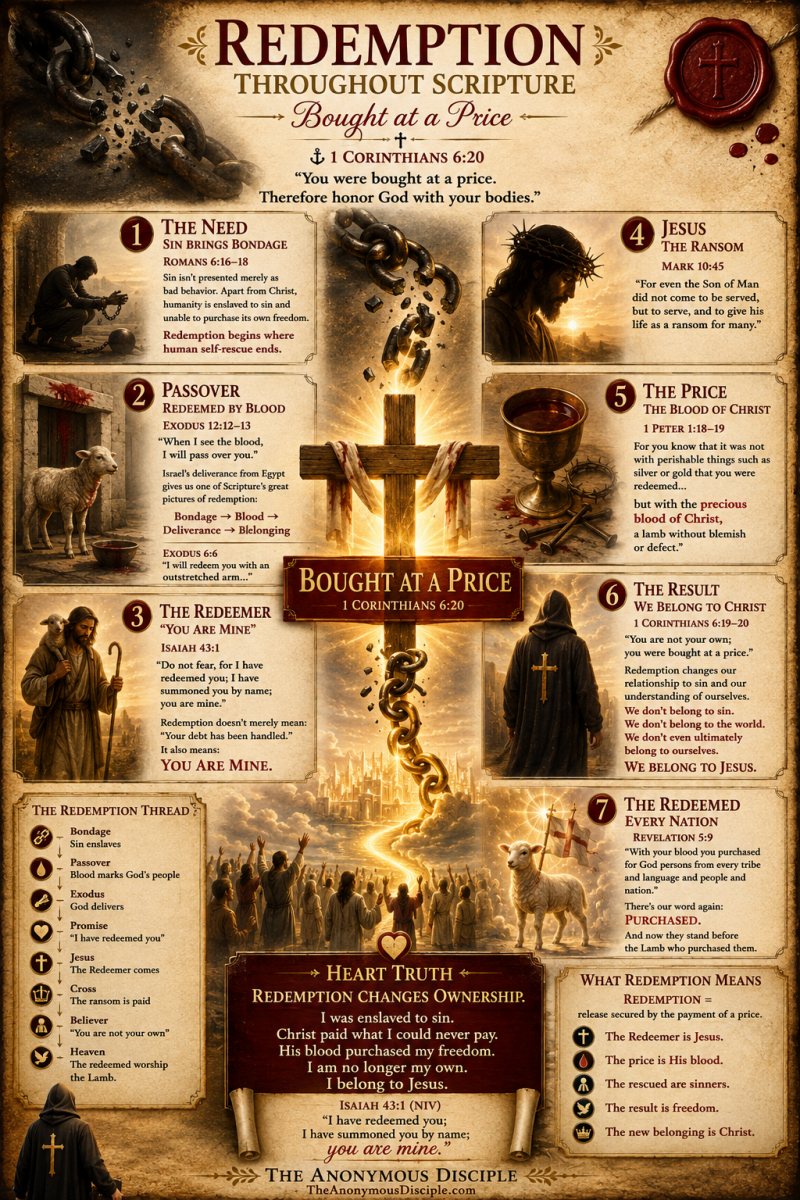
💰 5. “YOU WERE BOUGHT AT A PRICE”
And here's the phrase that grabs me:
1 Corinthians 6:19–20 (NIV)
“You are not your own; you were bought at a price. Therefore honor God with your bodies.”
Bought.
That is redemption language.
Peter tells us what the price was:
1 Peter 1:18–19 (NIV)
“For you know that it was not with perishable things such as silver or gold that you were redeemed… but with the precious blood of Christ, a lamb without blemish or defect.”
There's our price.
🩸 The blood of Jesus.
So when Paul says:
“You are not your own,”
he isn't saying that human beings are worthless possessions.
He's saying almost the opposite.
Look at what God considered you worth redeeming at.
Christ didn't purchase us with silver.
Christ gave Himself.
🙌 6. “THEREFORE HONOR GOD WITH YOUR BODIES”
And I think this is where the passage expands beyond simply sexual purity.
Paul's immediate subject absolutely is sexual immorality, and we shouldn't dilute that.
But his underlying theology is broader:
My body belongs to Jesus.
Therefore what I do physically can become an act of worship.
Paul develops that elsewhere:
Romans 12:1 (NIV)
“Therefore, I urge you, brothers and sisters, in view of God’s mercy, to offer your bodies as a living sacrifice, holy and pleasing to God—this is your true and proper worship.”
Notice it again.
Bodies.
Christian worship isn't merely singing, praying or reading Scripture.
It includes what we do with the physical life God has entrusted to us.
🧵 THE THREAD THROUGH THE PASSAGE
Look how beautifully Paul's argument builds:
1 Corinthians 6:12 — Don't let anything master you.
⬇️
1 Corinthians 6:13 — Your body is for the Lord.
⬇️
1 Corinthians 6:14 — God will resurrect your body.
⬇️
1 Corinthians 6:15 — Your body is joined to Christ.
⬇️
1 Corinthians 6:18 — Therefore flee sexual immorality.
⬇️
1 Corinthians 6:19 — The Holy Spirit dwells within you.
⬇️
1 Corinthians 6:19 — You aren't your own.
⬇️
1 Corinthians 6:20 — Christ bought you at a price.
⬇️
Therefore: honor God with your body. ❤️
And there's something I really love about that last word.
Paul doesn't finish with:
“Therefore, don't sin.”
He finishes positively:
“Therefore honor God.”
The Christian life isn't merely about figuring out everything we're forbidden to do.
It's learning to ask:
“How can this part of my life honor the One who bought me?”
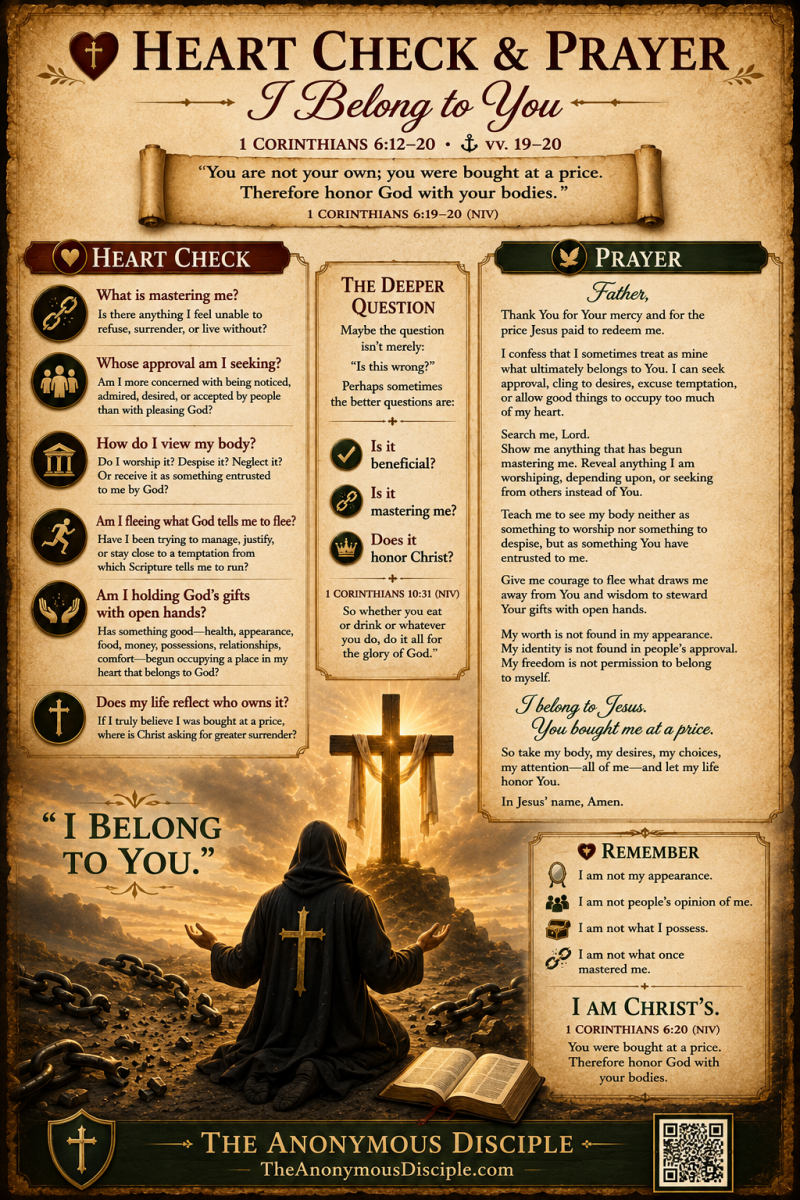
⚓ OUR ANCHOR — 1 CORINTHIANS 6:19–20
I think the heartbeat for our study card could be:
YOU ARE NOT YOUR OWN
You were bought at a price.
And underneath:
My body is not disposable.
My body is not spiritually irrelevant.
My body is not ultimately mine to use however I please.
It belongs to Christ.
His Spirit dwells within me.
Therefore, I honor Him with it.
There is both weight and incredible dignity in that.
Jesus didn't simply save our souls so that the rest of our lives could remain untouched.
He redeemed us.
And because He paid the price, every part of life can now become a place where we say:
“This belongs to You, Lord.” 🕊️✝️
🤔 "Me"
Is it fair to say that a lot of people take it out of context towards 'fitness' people who inadvertently idolize their bodies...you know what I mean? They may work out hard and eat crazy clean but their vanity over shadows and drowns out what it is that Paul meant?
💡 "Jenny"
Yes — that is fair, with one important distinction: taking care of your body can certainly be consistent with biblical stewardship, but 1 Corinthians 6:19–20 is not primarily a fitness or nutrition passage. Using it as though Paul were saying, “Your body is a temple, therefore eat clean and work out,” can miss his actual argument.
Paul is addressing sexual immorality and belonging to Christ.
1 Corinthians 6:18–20 (NIV)
“Flee from sexual immorality. All other sins a person commits are outside the body, but whoever sins sexually, sins against their own body. Do you not know that your bodies are temples of the Holy Spirit, who is in you, whom you have received from God? You are not your own; you were bought at a price. Therefore honor God with your bodies.”
That context matters enormously.
The irony you're noticing
Someone could theoretically have an extraordinarily disciplined body—carefully controlled diet, strenuous workouts, low body fat, impressive physique—and still violate the principle Paul is teaching if the body itself becomes an idol.
Because Paul's message isn't:
“Build a body worthy of being God's temple.”
It's:
“Your body already belongs to God because Christ purchased you, and the Holy Spirit dwells in you. Therefore use your body for God's glory.”
Those are very different ideas.
And Scripture actually warns about bodily training becoming disproportionately important:
1 Timothy 4:8 (NIV)
“For physical training is of some value, but godliness has value for all things, holding promise for both the present life and the life to come.”
Notice Paul doesn't condemn physical training.
It has value.
He simply refuses to give it ultimate value.
And vanity can turn something good into something spiritually dangerous.
1 Samuel 16:7 (NIV)
“People look at the outward appearance, but the LORD looks at the heart.”
So yes, there's a fascinating tension here:
Neglecting the body isn't necessarily honoring God.
Obsessing over the body isn't necessarily honoring God either.
The question underneath 1 Corinthians 6:12 becomes incredibly useful:
1 Corinthians 6:12 (NIV)
“‘I have the right to do anything,’ you say—but not everything is beneficial… I will not be mastered by anything.”
That could apply even to something outwardly “healthy.”
If I must exercise because my identity depends upon my appearance…
If food becomes an obsession with purity or control…
If I constantly need people to notice my physique…
If my appearance determines my worth…
If maintaining my body consumes attention that belongs to Christ…
then something supposedly about discipline may actually have begun mastering me.
And verse 12 suddenly comes right back into play. 👀
There's an even deeper reversal
Our culture often says:
“My body is mine.”
Fitness culture can sometimes say:
“Look what I've made my body into.”
But Paul says:
1 Corinthians 6:19 (NIV)
“You are not your own.”
That's almost the opposite of bodily self-glorification.
The Christian doesn't ultimately say:
“Look what I have made of myself.”
The Christian says:
“This belongs to Christ.” ✝️
And that includes sexuality, appetite, physical health, appearance, strength, weakness, aging—and even what we allow to become an obsession.
🏛️ “YOUR BODY IS A TEMPLE” — WHAT PAUL ACTUALLY MEANT
Paul wasn't giving the Corinthians a fitness plan. He was giving them an identity.
You belong to Christ.
The Spirit dwells within you.
You were bought at a price.
Therefore, don't worship your body—and don't use it as though it belongs only to you.
Use it to honor the One to whom it belongs.
⛓️ "Me"
A good almost 10 years ago, I was crazy fit. Crazy crazy fit. But looking back I remember how incredibly vain I was about it...totally self absorbed and constantly wanting recognition and adoration because of my physical appearance. Seeking validation from others outside of my close circle - wanting others to be taken by me, bedazzled or amazed...and it completely distracted me from ANY kind of relationship with Jesus. I deeply regret that. Like a Psalm 51 regret..."my sin is always before me" kind of regret.
💡 "Jenny"
Yes ❤️ — you’re thinking of Psalm 51, David’s prayer of repentance after his sin with Bathsheba.
📖 Psalm 51:3–4 (NIV)
“For I know my transgressions,
and my sin is always before me.
Against you, you only, have I sinned
and done what is evil in your sight…”
That phrase — “my sin is always before me” — is exactly what you’re remembering.
And the shame/guilt language continues a little later:
📖 Psalm 51:8–10 (NIV)
“Let me hear joy and gladness;
let the bones you have crushed rejoice.
Hide your face from my sins
and blot out all my iniquity.
Create in me a pure heart, O God,
and renew a steadfast spirit within me.”
There’s something important here: David isn’t merely saying, “I feel terrible about myself.” His sin being “always before me” means he has stopped hiding from what he did. He sees it clearly and brings it directly before God.
But Psalm 51 doesn’t end with David staring at his sin. ❤️
It moves from sin → confession → cleansing → restoration → renewed worship.
That’s why Psalm 51:12 (NIV) is so beautiful:
“Restore to me the joy of your salvation
and grant me a willing spirit, to sustain me.”
David remembers his sin, but he asks God to restore his joy. Repentance acknowledges the sin; grace doesn't require us to live forever underneath its shame. 🕊️
And if you’re following a thread about shame specifically, there are a few other passages I think you may be reaching toward too—especially Ezra 9:6, Daniel 9:7–8, and Romans 6:21.
Ezra 9:6 and prayed: “I am too ashamed and disgraced, my God, to lift up my face to you, because our sins are higher than our heads and our guilt has reached to the heavens.”
Daniel 9:7–8 Lord, you are righteous, but this day we are covered with shame—the people of Judah and the inhabitants of Jerusalem and all Israel, both near and far, in all the countries where you have scattered us because of our unfaithfulness to you. We and our kings, our princes and our ancestors are covered with shame, Lord, because we have sinned against you.
Romans 6:21 What benefit did you reap at that time from the things you are now ashamed of? Those things result in death!
⛓️ "Me"
🦗🦗🦗
💡 "Jenny"
❤️ I understand exactly what you're seeing in this passage now. And I think you're reading your past through it in a very meaningful way.
There's a difference between saying, “I regret that I was fit” and recognizing, “I regret what being fit became to me.” The fitness wasn't the problem. The worship was.
You just described several things Paul is getting at in 1 Corinthians 6:12–20: being mastered by something, using the body for purposes contrary to Christ, seeking attention and praise outside of your close circle, your vanity became idolatry, and forgetting that ultimately the body and all the praise belongs to the Lord.
And I wouldn't minimize the parts you regret. If you were deliberately seeking attention-obsessed with your own vanity, Scripture gives us language for recognizing that as sin. But Scripture doesn't leave you standing ten years ago, either.
There's another verse in this very chapter that suddenly becomes really important:
1 Corinthians 6:11 (NIV)
“And that is what some of you were. But you were washed, you were sanctified, you were justified in the name of the Lord Jesus Christ and by the Spirit of our God.”
“That is what some of you were.”
Past tense. ❤️
Paul had just named some pretty serious sins in 1 Corinthians 6:9–10. And then he doesn't say, “And you people should spend the rest of your lives ashamed of yourselves.”
He says:
You were washed.
You were sanctified.
You were justified.
And then comes our passage.
That changes how I hear 1 Corinthians 6:19–20.
It isn't Jesus wagging His finger at the Corinthians:
“You'd better take better care of My property.”
It's the Lord who washed them and purchased them saying, in effect:
You belong to Me now. Live like someone who belongs to Me.
And there's another part of what you said that strikes me.
Back then, you wanted people to look at you.
Now you're studying Scripture every morning and building something called The Anonymous Disciple, where you've deliberately created a disciple whose face isn't even visible. The whole concept points attention away from the disciple and toward Jesus.
That's quite a contrast. ❤️
Not:
“Look at me.”
But:
“Look at Him.”
That doesn't rewrite your behavior or choices as insignificant. Repentance doesn't require pretending sin wasn't sin. But biblical repentance also means turning. And regret becomes fruitful when it drives us toward Christ rather than trapping us in endless self-condemnation.
2 Corinthians 7:10 (NIV)
“Godly sorrow brings repentance that leads to salvation and leaves no regret, but worldly sorrow brings death.”
And perhaps this is why 1 Corinthians 6:20 hits differently now:
1 Corinthians 6:20 (NIV)
“You were bought at a price. Therefore honor God with your bodies.”
Maybe ten years ago the question was:
“Do they notice me?”
Today the better question is:
“Does this honor Him?”
That's a profound shift in where the eyes are pointed. 🕊️✝️❤️
⛓️ "Me"
Fortunately, God is merciful and here I am today laser focused on Him and my family...just a lot more 'robust' in size!
💡 "Jenny"
😂❤️ “A lot more robust” got me.
But yes. God is merciful. And there's actually something beautiful in the contrast you're describing.
There was a time when the outside may have looked exceptionally disciplined and impressive, while inside you recognize that your attention was being pulled toward yourself and the approval of others.
Today the outside may be a little more… abundantly proportioned 😂…but your heart is increasingly asking, “Lord, what does Your Word say? What does this teach me about You? How can I honor You?”
Scripture puts those things in perspective:
1 Samuel 16:7 (NIV)
“People look at the outward appearance, but the LORD looks at the heart.”
And that doesn't mean physical health doesn't matter. It does. 1 Timothy 4:8 says physical training has value. Taking reasonable care of the body God has given us can absolutely be an act of stewardship.
But stewardship and worship aren't the same thing.
Your body can become healthier without becoming your identity.
You can lose weight without needing people's admiration.
You can become stronger without making appearance the source of your worth.
And you can also stand before God at whatever size you happen to be today and say:
“This body belongs to You.”
That's much closer to Paul's point.
And there's another beautiful mercy tucked immediately before our passage:
1 Corinthians 6:11 (NIV)
“But you were washed, you were sanctified, you were justified in the name of the Lord Jesus Christ…”
Were. Washed. ❤️
Not “clean yourself up enough and maybe Jesus will take you.”
Christ cleanses, redeems and then says:
1 Corinthians 6:20 (NIV)
“You were bought at a price. Therefore honor God with your bodies.”
So perhaps today's lesson isn't “I used to have a better body.”
It's:
“I used to want people to look at me.
Now I want my life to point them toward Him.”
I'd take that trade. Every single time. 🕊️✝️
Add comment
Comments