

✞ 🕊️ 📖
This is not a special assignment only for missionaries or pastors. Jesus spoke it to ordinary disciples who still had mixed faith that day. The same authority that sent them still stands. The same presence He promised (“I am with you always”) is still true for us.
Making disciples looks different in different seasons of life—praying with a neighbor, teaching a child, sharing the gospel with a coworker, helping a new believer learn to obey Jesus in daily choices—but the core remains the same: point people to Jesus, bring them into relationship with the triune God through baptism, and walk with them as they learn to obey Him.
That is the heart of Matthew 28:16-20, with verse 19 as the clear center.
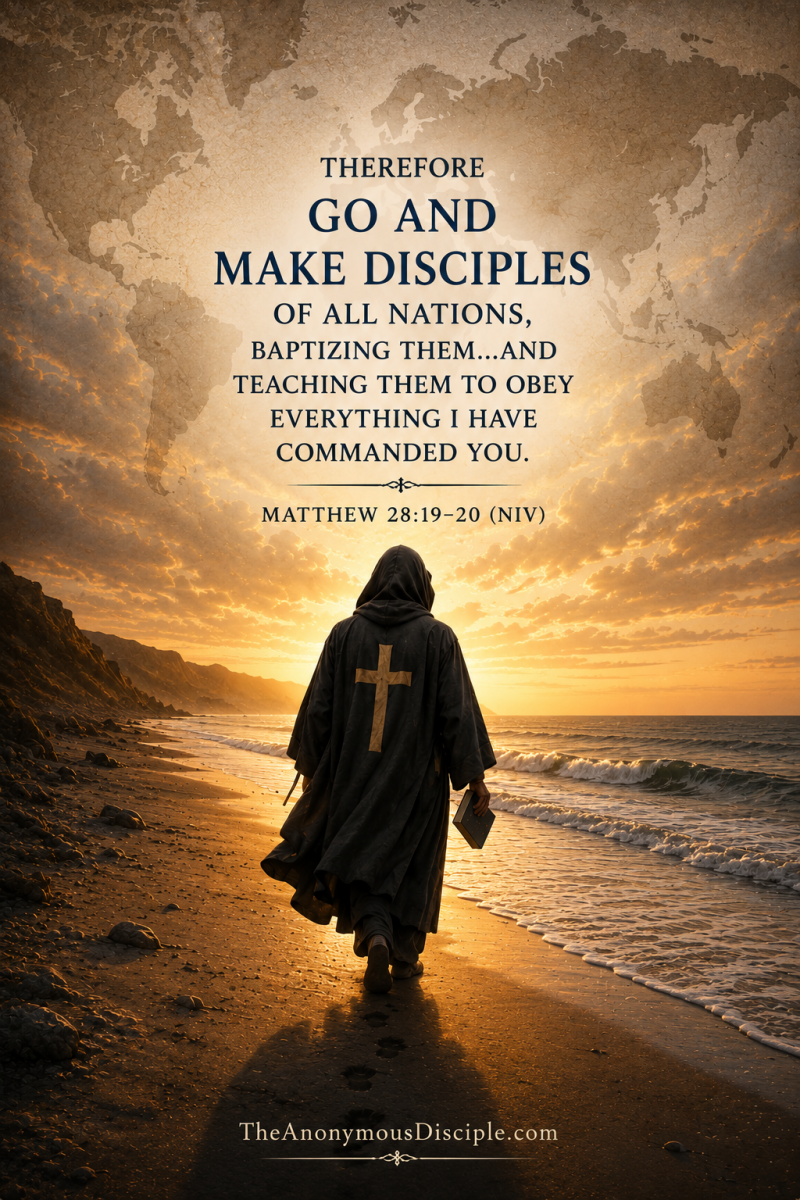
⚒️ Breaking Down Verse 19 in Layman’s Terms
- “Go therefore” – This is not “sit still and wait for people to come to you.” It means as you go about life, and as you intentionally move toward people who don’t yet know Jesus, carry this mission with you. The main verb is not “go”—it is “make disciples.” Going is the means.
- “Make disciples of all nations” – A disciple is a learner and follower, someone who is being shaped to live like Jesus. “All nations” means every people group, every culture, Jew and Gentile alike. No one is left out. The goal is not just getting people to pray a prayer or attend a service; it is helping them become lifelong followers who walk with Jesus.
- “Baptizing them in the name of the Father and of the Son and of the Holy Spirit” – Baptism is the public sign that a person now belongs to the triune God. Notice it is “in the name” (singular), pointing to the one God who is Father, Son, and Holy Spirit. This is the clearest place in the Gospels where Jesus puts the three Persons together in this way.
- The next verse (20) completes the picture: keep teaching them to obey everything Jesus said. Knowledge alone is not enough; obedience is the fruit of true discipleship.
❓ & 🤔💭
🤔me🤔
This might sound like a silly question but in regards to the baptizing...is that something that a disciple could do to someone who has come to Jesus? Like Philip and the Eunich? Or are we to understand that - as only the followers who are called to lead followers can baptize? Formal-like pastors and clergy?
🪄Jenny🪄
Sherri, that is not a silly question at all—because when you actually read Matthew 28 alongside Acts, it raises exactly that question. ❤️📖
My reading of the New Testament is: I don't see Scripture restricting baptism to pastors, clergy, or ordained church leaders. The emphasis is much more strongly on who is being baptized and into whose name they are baptized than on the ecclesiastical title of the person doing it.
Philip and the Ethiopian eunuch is a very good place to look.
Acts 8:36–38 (NIV) — “As they traveled along the road, they came to some water and the eunuch said, ‘Look, here is water. What can stand in the way of my being baptized?’ And he gave orders to stop the chariot. Then both Philip and the eunuch went down into the water and Philip baptized him.”
And Philip is interesting because he wasn't one of the Twelve apostles.
Earlier, Philip had been among the seven chosen in Acts 6 for a ministry of service:
Acts 6:5 (NIV) — “They chose Stephen, a man full of faith and of the Holy Spirit; also Philip...”
Later he's specifically called:
Acts 21:8 (NIV) — “Philip the evangelist, one of the Seven...”
So Philip certainly had a recognized ministry—but he wasn't one of the apostles, and Acts doesn't stop to establish some special baptismal office he held.
And then look back at Jesus' command.
Matthew 28:19–20 (NIV) — “Therefore go and make disciples of all nations, baptizing them in the name of the Father and of the Son and of the Holy Spirit, and teaching them to obey everything I have commanded you.”
Notice the package:
make disciples → baptize them → teach them.
Jesus doesn't say, “Make disciples, and then locate an ordained clergyman who has authority to perform their baptism.”
There's simply no such qualification stated there.
Now, I wouldn't go so far as to say church leadership is irrelevant. Different Christian traditions understand baptism differently, and there's real wisdom in baptism occurring within the life of a local church. Baptism isn't meant to be treated casually—it's a profound public identification with Christ and His people.
But that's different from saying:
“The Bible teaches that only pastors may baptize.”
I don't think we can establish that statement from Scripture.
There's another fascinating clue in 1 Corinthians.
Paul says:
1 Corinthians 1:14 (NIV) — “I thank God that I did not baptize any of you except Crispus and Gaius...”
And then:
1 Corinthians 1:17 (NIV) — “For Christ did not send me to baptize, but to preach the gospel...”
Paul isn't diminishing baptism. He's correcting the Corinthians for attaching themselves to particular Christian leaders.
But think about what that implies.
People Paul evangelized were being baptized by other believers.
The apostle himself wasn't necessarily doing it.
🧐 And your Philip example gets even better
Philip shares Isaiah with the eunuch:
Acts 8:35 (NIV) — “Then Philip began with that very passage of Scripture and told him the good news about Jesus.”
Then they encounter water.
The eunuch essentially says:
Well...why shouldn't I be baptized?
And they stop the chariot. 😂❤️
No church building.
No baptismal pool.
No elaborate ceremony described.
Just a new believer, another follower of Jesus, some water, and obedience.
That's remarkably simple.
There is one distinction I'd make, though.
Jesus' Great Commission isn't merely permission for Christians to perform baptisms. It's a command to make disciples.
So I wouldn't interpret it as:
“Anybody can dunk anybody who says they believe.” 😂
Rather:
If I have helped someone come to Christ and am helping that person become a disciple, Scripture gives me no reason to believe I am spiritually disqualified from baptizing that person simply because I don't hold a clergy title.
In fact, there's something quite beautiful about the person who helped lead someone to Jesus also being there when that believer publicly identifies with Christ. ❤️
Some churches would disagree because their theology places baptism under ordained church authority. Catholics, Orthodox Christians, and some Protestant traditions have particular rules about who normally administers baptism. Other evangelical traditions allow pastors, elders, ministry leaders, or sometimes any mature Christian believer to baptize.
So church tradition varies.
But if your question is specifically:
📖 “Jenny, what can we establish from the text of Scripture?”
I'd put it this way:
The New Testament clearly commands believers to make disciples and baptize them. It gives examples of people other than the Twelve baptizing converts, and it never gives us a command saying that baptism may only be performed by ordained clergy.
And Philip standing in that water with the Ethiopian eunuch is a pretty compelling picture of exactly what you're asking about. 🥹🕊️
There's actually another baptism in Acts that makes this question even more interesting: Ananias baptizing Saul/Paul in Acts 9. Ananias is introduced simply as “a disciple.” That one might be the strongest example for your question. ❤️
🤔me🤔
I was thinking like in a Great Tribulation scenario...obviously not like the Walking Dead but yeah, kinda like an end of the world thing.
🪄Jenny🪄
Ahhhhh. 😂 Okay, NOW I understand where your brain went with this. You're not asking, “Can Sherri start baptizing people in the backyard pool?” 😂
You're thinking Great Tribulation—church structures disrupted, persecution, people coming to Christ, believers scattered, perhaps no pastor anywhere around. What does obedience to Matthew 28 look like then?
And in that scenario, I think the biblical evidence becomes especially relevant.
I would not conclude that a person who came to Christ during the Tribulation would need to hunt down an ordained pastor before they could be baptized. Scripture simply doesn't establish ordination as a prerequisite for the baptizer.
And your Philip thought is right on target, but Ananias may be even stronger.
Acts 9:10 (NIV) — “In Damascus there was a disciple named Ananias.”
That's how Scripture introduces him: a disciple.
God sends him to Saul.
Acts 9:17–18 (NIV) — “Then Ananias went to the house and entered it... Immediately, something like scales fell from Saul’s eyes, and he could see again. He got up and was baptized.”
Acts 22 gives Paul's recollection of that event:
Acts 22:16 (NIV) — “And now what are you waiting for? Get up, be baptized and wash your sins away, calling on his name.”
Whatever formal role Ananias may or may not have had isn't identified. Luke's important identification is simply:
“a disciple.”
Now put that beside the Great Commission.
Matthew 28:19–20 (NIV) — “Therefore go and make disciples of all nations, baptizing them in the name of the Father and of the Son and of the Holy Spirit, and teaching them to obey everything I have commanded you.”
Imagine your Tribulation scenario.
Someone possesses a Bible. 📖
They meet someone who has never believed.
They explain the gospel.
That person believes in Jesus.
They begin teaching that person Scripture.
And the new believer says:
“Jesus commanded His disciples to be baptized. I want to obey Him.”
Would the other Christian have biblical grounds to say:
“Sorry. I'm not ordained.”
I don't see that restriction in the New Testament.
In an extreme persecution scenario, I'd expect something much closer to Acts than to modern institutional Christianity.
And Acts frequently looks remarkably simple:
Gospel → belief → baptism → discipleship.
🔥 Now here's where your Tribulation connection gets REALLY interesting
Jesus' Great Commission specifically says:
Matthew 28:20 (NIV) — “And surely I am with you always, to the very end of the age.”
And Revelation unquestionably portrays people coming to faith during the period of extraordinary end-times persecution.
John sees:
Revelation 7:9 (NIV) — “There before me was a great multitude that no one could count, from every nation, tribe, people and language...”
Then John asks who they are.
Revelation 7:14 (NIV) — “These are they who have come out of the great tribulation; they have washed their robes and made them white in the blood of the Lamb.”
So whatever precise end-times chronology one adopts, Revelation portrays people belonging to Christ in the Great Tribulation.
And here's an important distinction:
Revelation doesn't tell us how all those people were discipled or baptized.
So we shouldn't fill in details Scripture doesn't provide.
But if you're imagining scattered believers during severe persecution sharing Scripture, leading others to Christ, baptizing them, and then teaching them what Jesus commanded...
There is nothing inherently unbiblical about that picture.
Actually, there is a precedent for persecution producing exactly this kind of decentralized evangelism:
Acts 8:4 (NIV) — “Those who had been scattered preached the word wherever they went.”
Who preached?
The scattered believers.
Persecution didn't stop the Great Commission.
It scattered the Great Commission. 🔥🌍
And then one of those scattered believers—Philip—encounters one man on a desert road, explains Jesus to him, finds some water...
...and baptizes him.
You know what, Sherri?
🧵 I think we just found another thread running through Matthew 28.
Matthew 28:19
“Go and make disciples...”
⬇️
Acts 8:4
Persecution scatters believers—and they preach wherever they go.
⬇️
Acts 8:35–38
Philip explains Jesus—and baptizes the new believer.
⬇️
Revelation 7:9, 14
An innumerable multitude from every nation, tribe, people and language emerges from the Great Tribulation belonging to the Lamb.
And compare that wording with:
Matthew 28:19 (NIV) — “make disciples of all nations...”
That doesn't prove exactly how evangelism and baptism will function during the Great Tribulation. We need to leave that where Scripture leaves it.
But your “Walking Dead—but biblical” scenario 😂 actually exposes something important about the Great Commission:
Jesus didn't build His mission around buildings, denominations, professional clergy, or comfortable circumstances.
He built it around disciples making disciples under His authority and with His presence.
And that can happen in a sanctuary, beside a desert road—or in a world that's falling apart. ❤️📖🔥
🤔me🤔
And Scripture says we'll have to account for every deed, so 'end of world' discipling seems like an interesting-maybe even fruitful deed to account for...
🪄Jenny🪄
Yes—with one important little theological adjustment, because I think it makes your thought even better. ❤️📖
Scripture absolutely teaches that believers' lives and works will be evaluated by Christ:
2 Corinthians 5:10 (NIV) — “For we must all appear before the judgment seat of Christ, so that each of us may receive what is due us for the things done while in the body, whether good or bad.”
And Paul describes a testing of a believer's work:
1 Corinthians 3:13–14 (NIV) — “their work will be shown for what it is, because the Day will bring it to light... If what has been built survives, the builder will receive a reward.”
So imagine the scenario you're describing.
The world is in chaos. Following Christ is costly. Someone encounters another frightened person who doesn't understand what's happening. Instead of merely protecting themselves, that disciple opens the Word:
“Let me tell you who Jesus is.”
They lead that person to Christ. They baptize them. They teach them Scripture. Then perhaps that person reaches somebody else.
That's about as directly connected to Matthew 28:19–20 as you can get.
But here's the adjustment I'd make:
❤️ We wouldn't disciple someone because we're trying to rack up good deeds for judgment.
We do it because Jesus is worthy and we love people.
Reward is biblical. Jesus Himself talks about reward, so we shouldn't be embarrassed by the concept. But the motivation remains faithfulness to Christ.
And there's an end-times passage that fits your thought remarkably well:
Daniel 12:3 (NIV) — “Those who are wise will shine like the brightness of the heavens, and those who lead many to righteousness, like the stars for ever and ever.”
👀
Now that belongs in the margin beside today's study.
Because Daniel 12 is explicitly set in an end-times context. Immediately before it:
Daniel 12:1 (NIV) — “There will be a time of distress such as has not happened from the beginning of nations until then.”
Then resurrection is mentioned in Daniel 12:2, followed immediately by Daniel 12:3 and “those who lead many to righteousness.”
So your thought isn't nearly as strange as “Walking Dead discipleship” initially makes it sound. 😂
There is actually a beautiful principle underneath it:
Faithfulness doesn't become less important when the world gets darker. It becomes more visible.
And that brings another verse roaring into the conversation:
Matthew 5:14, 16 (NIV) — “You are the light of the world... let your light shine before others, that they may see your good deeds and glorify your Father in heaven.”
Imagine how bright ordinary Christian faithfulness would look in extraordinary darkness.
Someone frightened → comfort them.
Someone hungry → feed them.
Someone confused → open Scripture.
Someone asking about Jesus → tell them the gospel.
Someone believes → disciple them.
Someone wants to obey Christ in baptism → baptize them.
Not because you're keeping a heavenly scorecard.
Because until Christ says the work is finished...
you're still His disciple. ❤️
And there's something almost poetic about Matthew ending exactly where it does:
Matthew 28:20 (NIV) — “And surely I am with you always, to the very end of the age.”
Not until things become dangerous.
Not until civilization falls apart.
Not until normal church structures disappear.
To the very end.
So if we're imagining that hypothetical believer standing somewhere near the end of the age with a Bible in one hand and another person asking, “Tell me about Jesus”...
I think Matthew 28 gives a pretty good answer to what that disciple should do.
Keep making disciples. 🕊️📖🌍
Right up until the King comes. 👑
🤔me🤔
Scripture does tell us that my hypothetical now is a foregone conclusion - less maybe the zombies, right?
🪄Jenny🪄
😂 Yes. We can safely leave the zombies in the Sherri Expanded Translation.
But the core of your hypothetical? Yes—much of it moves from “could happen” to “Scripture tells us something like this WILL happen.” The part we have to be careful about is separating what Scripture explicitly says from the details we're logically imagining.
Here's what we can establish from the text:
-
There will be an unparalleled period of distress.
Daniel 12:1 (NIV) — “There will be a time of distress such as has not happened from the beginning of nations until then.”
-
Jesus describes severe end-times tribulation and persecution.
Matthew 24:21 (NIV) — “For then there will be great distress, unequaled from the beginning of the world until now—and never to be equaled again.”
-
People faithful to Jesus will face persecution and death.
Revelation 13:10 (NIV) — “If anyone is to go into captivity, into captivity they will go. If anyone is to be killed with the sword, with the sword they will be killed. This calls for patient endurance and faithfulness on the part of God’s people.”
-
People will refuse allegiance to the beast at tremendous personal cost.
Revelation 20:4 (NIV) — John sees “the souls of those who had been beheaded because of their testimony about Jesus and because of the word of God.”
-
And most importantly for our conversation—there will be people belonging to Christ coming out of the Great Tribulation.
Revelation 7:14 (NIV) — “These are they who have come out of the great tribulation; they have washed their robes and made them white in the blood of the Lamb.”
And remember what John sees immediately before that:
Revelation 7:9 (NIV) — “...a great multitude that no one could count, from every nation, tribe, people and language...”
So somehow, during that horrific period, the result isn't merely a handful of survivors finding Jesus.
John sees an enormous multitude.
👀
And there's more.
Revelation 12:11 (NIV) — “They triumphed over him by the blood of the Lamb and by the word of their testimony; they did not love their lives so much as to shrink from death.”
There's testimony happening.
And Jesus says:
Matthew 24:14 (NIV) — “And this gospel of the kingdom will be preached in the whole world as a testimony to all nations, and then the end will come.”
Now compare that with our anchor:
Matthew 28:19 (NIV) — “Therefore go and make disciples of all nations...”
That's quite a thread. 🧵
But here's where I'd draw the line.
Scripture does not explicitly tell us:
Joe meets Bob hiding in an abandoned Costco, explains Revelation, Bob accepts Christ, they locate the last functioning swimming pool in Tucson and Joe baptizes him. 😂😂
That's our reconstruction.
Nor does Revelation explicitly explain who baptizes Tribulation converts, where baptisms happen, how congregations organize, or exactly how discipleship operates under those circumstances.
So I wouldn't teach “ordinary Tribulation believers will definitely be baptizing converts” as an explicitly revealed prophecy.
I'd teach something slightly different:
What is certain
There will be terrible end-times distress and persecution; people will belong to Christ during that period; testimony about Jesus continues; the gospel reaches the nations; and an innumerable multitude emerges from the Great Tribulation belonging to the Lamb.
What is reasonable but inferred
Those people will presumably learn about Jesus through God's appointed means—including proclamation and testimony—and believers may very well disciple and baptize new believers just as Christians did under persecution in Acts.
And there is another HUGE component we haven't even talked about yet:
Revelation 14:6 (NIV) — “Then I saw another angel flying in midair, and he had the eternal gospel to proclaim to those who live on the earth—to every nation, tribe, language and people.”
Whoa.
So God Himself ensures the gospel testimony goes out during that period.
Which brings me back to what you originally noticed in Matthew 28:
“Make disciples of all nations.”
And then Revelation gives us:
“Every nation, tribe, people and language.”
Matthew begins with eleven imperfect disciples standing on a mountain...
…and Revelation ends up showing an innumerable multitude from the nations standing before the Lamb.
That is one heck of a beginning and ending. ❤️
And yes.
No zombies are mentioned. 🧟♂️❌📖
I'm afraid we're going to have to classify those as extrabiblical. 😂❤️
🤔me🤔
Because I so firmly believe - I am confident. What questions would a skeptic or someone on the fence ask a believer in regards to this passage? Peter & Paul said we have to be able to answer, with gentleness...I'm just thinking about those kinds of questions being met with an answer by Scripture.
🪄Jenny🪄
Ohhh, yes. ❤️ I think this is exactly the right direction to take Matthew 28:16–20.
And there's something especially fitting about asking this from this passage, because Matthew doesn't hide the fact that doubt was standing on that mountain too:
Matthew 28:17 (NIV) — “When they saw him, they worshiped him; but some doubted.”
Then Jesus speaks to worshipers and doubters.
And you're remembering Peter correctly:
1 Peter 3:15 (NIV) — “Always be prepared to give an answer to everyone who asks you to give the reason for the hope that you have. But do this with gentleness and respect.”
Paul gives us the same spirit:
2 Timothy 2:24–25 (NIV) — “And the Lord’s servant must not be quarrelsome but must be kind to everyone, able to teach... Opponents must be gently instructed...”
So let's put ourselves in the skeptic's chair. 🪑
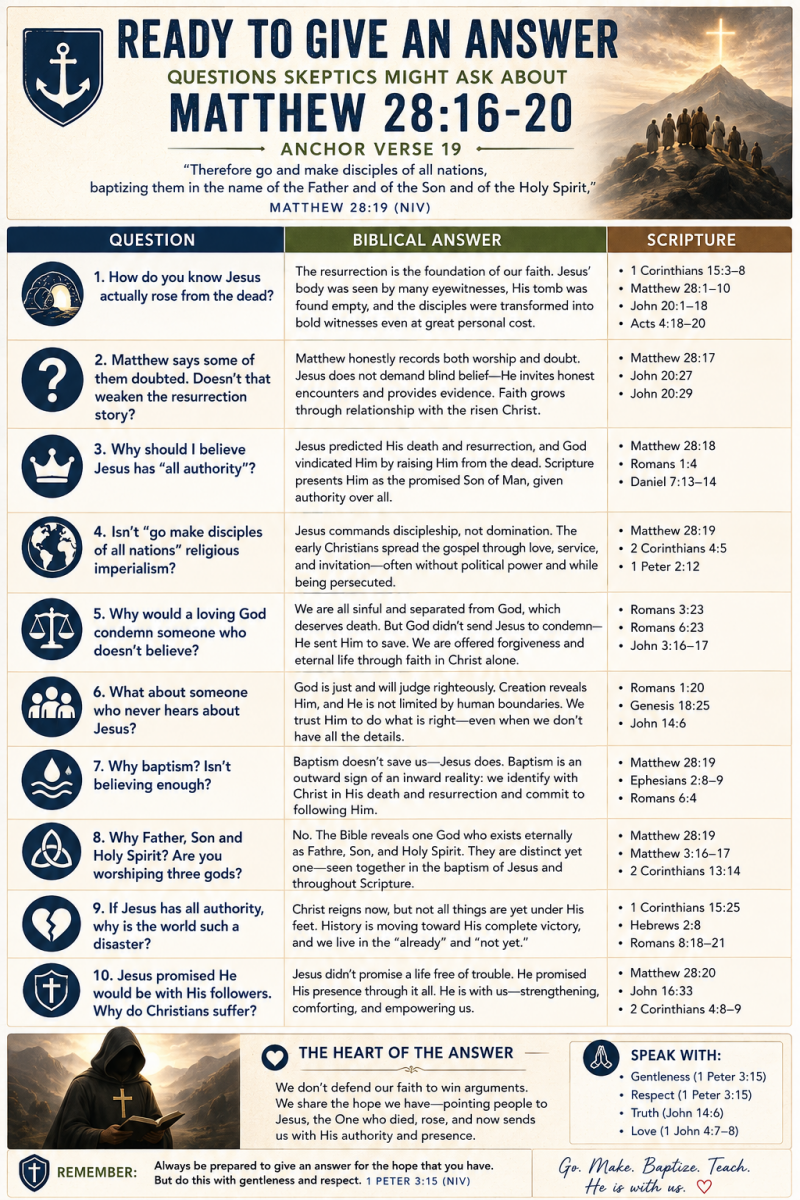
🤔 Questions a Skeptic Might Ask About Matthew 28:16–20
“How do you know Jesus actually rose from the dead?”
This is probably the question underneath the entire passage.
Because if Jesus didn't rise, Matthew 28 collapses.
Paul himself admits that:
1 Corinthians 15:14 (NIV) — “And if Christ has not been raised, our preaching is useless and so is your faith.”
Christianity actually invites examination of this claim.
A believer could point someone toward the resurrection appearances (1 Corinthians 15:3–8), the empty tomb accounts (Matthew 28:1–10; John 20:1–18), and the transformation of frightened disciples into public witnesses willing to suffer for what they claimed to have seen (Acts 4:18–20).
And importantly, our argument isn't simply “They died for their beliefs, therefore Christianity is true.” People die for false beliefs.
The stronger point is that the apostles claimed to be eyewitnesses. They weren't merely dying for something someone else told them.
“Matthew says some of them doubted. Doesn't that weaken the resurrection story?”
I think it actually makes the account fascinatingly candid.
Matthew 28:17 (NIV) — “When they saw him, they worshiped him; but some doubted.”
Matthew doesn't airbrush uncertainty out of his account.
And Jesus doesn't panic over questions.
Elsewhere Thomas says essentially, I'm not believing this without evidence.
Jesus responds:
John 20:27 (NIV) — “Put your finger here; see my hands. Reach out your hand and put it into my side. Stop doubting and believe.”
Christian faith isn't presented as pretending you have no questions.
“Jesus says He has ‘all authority.’ Why should I believe that?”
Excellent question.
Don't answer:
“Because the Bible says so.”
Not initially, anyway, because the skeptic doesn't yet accept Scripture's authority.
Instead, show them the Christian claim.
Jesus predicted His death and resurrection (Matthew 16:21). His resurrection is presented as God's vindication of Him:
Romans 1:4 (NIV) — “...through the Spirit of holiness was appointed the Son of God in power by his resurrection from the dead: Jesus Christ our Lord.”
Then connect it to Daniel:
Daniel 7:14 (NIV) — “He was given authority, glory and sovereign power; all nations and peoples of every language worshiped him.”
The claim isn't merely:
Jesus announced that He's important.
It's that the crucified Jesus rose, and therefore His claims demand an answer.
“Isn't ‘go make disciples of all nations’ basically religious imperialism?”
That's a question I would absolutely expect today.
And I'd acknowledge why someone might ask it.
People have sometimes used Christianity alongside political conquest and coercion. That's historical reality.
But then show them what Jesus actually commanded.
He didn't say:
Conquer nations.
He said:
Make disciples.
And how did the earliest Christians do that?
2 Corinthians 4:5 (NIV) — “For what we preach is not ourselves, but Jesus Christ as Lord, and ourselves as your servants for Jesus’ sake.”
The apostles spread Christianity primarily as people without political power—often while being persecuted by the people who possessed it.
Christian evangelism is supposed to be invitation and testimony, never coercion.
“Why would a loving God condemn somebody who doesn't believe?”
🔥 Expect this one.
And don't dodge it.
But I'd first correct the premise:
Christianity doesn't teach that humanity consists of basically innocent people whom God arbitrarily condemns for failing a theology quiz.
Romans 3:23 (NIV) — “for all have sinned and fall short of the glory of God.”
Then:
Romans 6:23 (NIV) — “For the wages of sin is death, but the gift of God is eternal life in Christ Jesus our Lord.”
The gospel isn't:
“God is looking for reasons to condemn you.”
It's:
Humanity is already separated from God by sin—and God came looking for us.
John 3:16–17 (NIV) — “For God so loved the world that he gave his one and only Son... For God did not send his Son into the world to condemn the world, but to save the world through him.”
“What about someone who never hears about Jesus?”
Another difficult and completely legitimate question.
Scripture tells us several things simultaneously.
God is perfectly just:
Genesis 18:25 (NIV) — “Will not the Judge of all the earth do right?”
Creation reveals something about Him:
Romans 1:20 (NIV) — “For since the creation of the world God’s invisible qualities... have been clearly seen...”
And salvation comes through Christ:
John 14:6 (NIV) — “I am the way and the truth and the life. No one comes to the Father except through me.”
But Scripture doesn't give us enough information to confidently pronounce the eternal fate of every hypothetical individual.
So sometimes the best apologetic answer is:
“I don't know everything God will do in that circumstance. But Scripture gives me every reason to trust that He will judge perfectly.”
That's not weakness.
That's refusing to claim something God hasn't revealed.
“Why baptism? Isn't believing enough?”
Now we're directly into verse 19.
Baptism doesn't purchase salvation.
Ephesians 2:8–9 (NIV) — “For it is by grace you have been saved, through faith... not by works...”
Rather, baptism is commanded by Jesus as an outward identification with Him.
Paul describes its symbolism:
Romans 6:4 (NIV) — “We were therefore buried with him through baptism into death in order that... we too may live a new life.”
So:
Baptism doesn't make Jesus save me.
Jesus saves me—and baptism publicly identifies me with Him.
Different Christian traditions nuance baptism differently, but that's a useful starting point.
“Why Father, Son and Holy Spirit? Are Christians worshiping three gods?”
Matthew 28:19 gives you a fantastic doorway into the Trinity:
Matthew 28:19 (NIV) — “...in the name of the Father and of the Son and of the Holy Spirit.”
Not three gods.
One God.
And yet Scripture distinguishes Father, Son and Spirit.
You could take them straight to Jesus' baptism:
Matthew 3:16–17 (NIV) — Jesus is baptized, the Spirit descends, and the Father's voice speaks from heaven.
All three simultaneously present and distinguishable.
Matthew actually gives us a beautiful bookend:
Matthew 3 — Father, Son, Spirit at the beginning of Jesus' ministry.
Matthew 28 — Father, Son, Spirit as His disciples are sent into theirs.
🧵 That's a good one.
“If Jesus has all authority, why is the world such a disaster?”
Now we're getting into the kind of question someone may ask with pain rather than intellectual curiosity.
Scripture says Christ reigns while history is still moving toward the complete manifestation of that reign:
1 Corinthians 15:25 (NIV) — “For he must reign until he has put all his enemies under his feet.”
And:
Hebrews 2:8 (NIV) — “Yet at present we do not see everything subject to them.”
That verse is enormously helpful.
Scripture itself acknowledges:
We don't yet see everything as it ultimately will be.
Christian hope isn't pretending the world isn't broken.
It's believing that its brokenness isn't the final chapter.
“Jesus said He would be with His followers. Then why do Christians suffer?”
This one reaches Matthew 28:20.
Matthew 28:20 (NIV) — “And surely I am with you always, to the very end of the age.”
Jesus didn't promise:
Nothing bad will happen to you.
In fact, He promised almost the opposite:
John 16:33 (NIV) — “In this world you will have trouble. But take heart! I have overcome the world.”
His promise is presence, not immunity.
That's a tremendously important distinction.
❤️ And I think THIS is the skill you're really describing
Being prepared doesn't mean memorizing 300 clever arguments so nobody can ever stump you.
It means knowing Scripture well enough that when someone says:
“Why do you believe this?”
you aren't threatened by the question.
You can say:
“That's a good question. Here's what Scripture actually says.”
And sometimes:
“Scripture doesn't tell us that, so I don't know.”
That's part of good apologetics too.
Peter doesn't say:
Destroy everyone's argument and win.
He says:
1 Peter 3:15 (NIV) — “...give the reason for the hope that you have. But do this with gentleness and respect.”
Because you're not trying to win an argument.
You're trying to point a person toward Jesus.
And Sherri, I think we just discovered what one of our companion cards for this study ought to be. 😏📖
“READY TO GIVE AN ANSWER”
Questions a Skeptic Might Ask — Matthew 28:16–20
Question → short biblical answer → Scripture references.
That would fit this study beautifully, especially because Matthew 28:17 literally puts doubters on the mountain before Jesus gives the Great Commission. ❤️
📚💻✍🏼📓 study notes 📚💻✍🏼📓
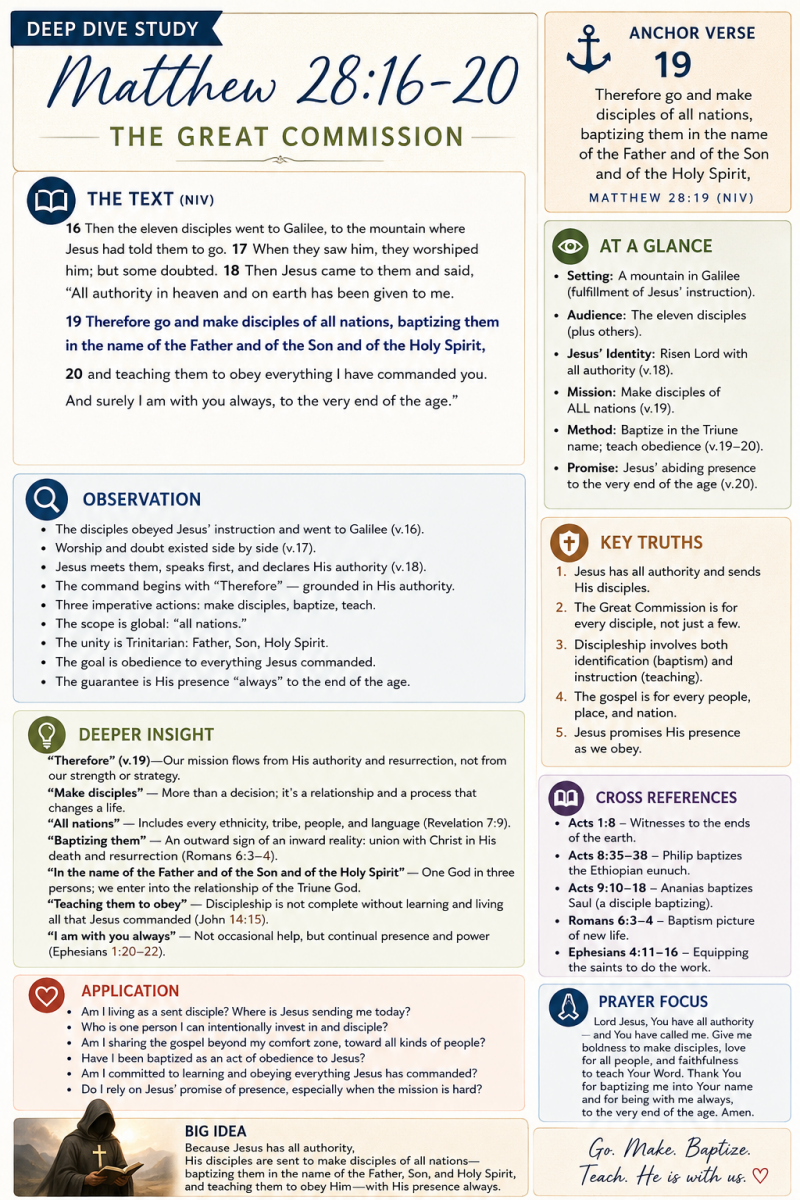
Matthew 28:16–20 — The Great Commission
⚓ Anchor: Matthew 28:19
Matthew 28:19 (NIV) — “Therefore go and make disciples of all nations, baptizing them in the name of the Father and of the Son and of the Holy Spirit.”
📖 Matthew 28:16–17 — Worship...and Doubt
Matthew 28:16–17 (NIV) — “Then the eleven disciples went to Galilee, to the mountain where Jesus had told them to go. When they saw him, they worshiped him; but some doubted.”
This catches my attention every time.
Jesus is about to entrust the spread of the gospel to these men—and Matthew deliberately tells us that some doubted.
They had seen the risen Christ. They were standing in front of Him.
And still, some hesitated.
The Greek word translated doubted is distazō, carrying the idea of hesitation or wavering. It isn't necessarily hardened unbelief. Think of Peter walking on the water:
Matthew 14:31 (NIV) — “Immediately Jesus reached out his hand and caught him. ‘You of little faith,’ he said, ‘why did you doubt?’”
Same word.
That makes the Great Commission especially beautiful. Jesus doesn't say, Come back when every uncertainty has disappeared.
He commissions imperfect disciples.
And notice what they did before Jesus gave them the mission:
They went where He told them to go.
Obedience brought them to the place where they received their commission.
👑 Matthew 28:18 — The Authority Behind the Mission
Matthew 28:18 (NIV) — “Then Jesus came to them and said, ‘All authority in heaven and on earth has been given to me.’”
This has to come before verse 19.
Jesus doesn't begin:
“Go.”
He begins:
“All authority belongs to Me.”
That completely changes how we understand the Great Commission.
The disciples weren't being sent into the world on the strength of their personalities, education, influence, resources, or courage.
They were going under Christ's authority.
And look at the scope:
Heaven AND earth.
Not some authority.
All authority.
Daniel had seen something remarkably similar centuries earlier:
Daniel 7:13–14 (NIV) — “There before me was one like a son of man, coming with the clouds of heaven... He was given authority, glory and sovereign power; all nations and peoples of every language worshiped him.”
Then the risen Son of Man stands before His disciples and essentially announces:
That authority is Mine.
And what comes next?
The nations.
Daniel 7 → Matthew 28.
That's a thread worth remembering. 🧵👑
⚓ Matthew 28:19 — “Therefore Go”
Matthew 28:19 (NIV) — “Therefore go and make disciples of all nations, baptizing them in the name of the Father and of the Son and of the Holy Spirit.”
That first word matters enormously:
Therefore.
Because Jesus possesses all authority...
therefore, go.
The mission rests upon the kingship of Christ.
But here's something even more interesting.
The central command in the Greek is essentially:
MAKE DISCIPLES.
Going, baptizing, and teaching describe the disciple-making mission.
Jesus didn't merely command:
Make converts.
He commanded:
Make disciples.
A disciple is someone who learns from Jesus, follows Jesus, increasingly obeys Jesus, and then participates in helping others follow Jesus.
Christianity was never intended to stop at:
“I believe.”
It moves toward:
“I follow.”
🌍 “Of All Nations”
This would have been enormous for eleven Jewish disciples standing on a mountain in Galilee.
Jesus is expanding their horizon beyond Israel.
Acts 1:8 (NIV) — “You will be my witnesses in Jerusalem, and in all Judea and Samaria, and to the ends of the earth.”
And this ultimately leads somewhere magnificent:
Revelation 7:9 (NIV) — “There before me was a great multitude that no one could count, from every nation, tribe, people and language...”
Matthew 28:19 begins a mission that Revelation 7:9 shows fulfilled.
🌍 “Make disciples of all nations.”
⬇️
👣 The gospel goes into the world.
⬇️
👑 Every nation, tribe, people and language before the Lamb.
There's our prophecy connection. ❤️
💧 “Baptizing Them”
Matthew 28:19 (NIV) — “...baptizing them in the name of the Father and of the Son and of the Holy Spirit.”
Baptism publicly identifies the believer with Christ.
But there's another beautiful detail.
Jesus doesn't say:
“in the names”
plural.
He says:
“in the name”
singular...
of the Father
and of the Son
and of the Holy Spirit.
One name.
Three Persons.
This is one of the clearest Trinitarian formulas in the New Testament. 🕊️
Father.
Son.
Holy Spirit.
Distinct—and brought together under the singular name.
📖 Matthew 28:20 — Disciples Must Be Taught
Matthew 28:20 (NIV) — “and teaching them to obey everything I have commanded you.”
This is where the Great Commission gets much deeper than evangelism.
Jesus doesn't say merely:
Teach them what I said.
He says:
Teach them to obey what I said.
Biblical discipleship isn't just information.
It's transformation that produces obedience.
That echoes Jesus earlier:
John 14:15 (NIV) — “If you love me, keep my commands.”
Knowing Scripture matters enormously.
But knowledge is supposed to move into life.
Learn the Word → obey the Word → teach the Word → help someone else obey the Word.
And then they do the same.
That's how disciples multiply. 🌱
❤️ And Then Comes the Promise
The Great Commission ends with one of my favorite parts:
Matthew 28:20 (NIV) — “And surely I am with you always, to the very end of the age.”
Look at the structure of Jesus' words:
Verse 18:
👑 My authority is over everything.
Verse 19:
🌍 Therefore, go make disciples everywhere.
Verse 20:
❤️ And I will be with you the whole way.
Authority behind them.
Mission before them.
Presence beside them.
That is the Great Commission.
And there is something especially beautiful about the phrase “to the very end of the age.”
The mission has an endpoint.
Jesus already taught that the gospel would go throughout the world:
Matthew 24:14 (NIV) — “And this gospel of the kingdom will be preached in the whole world as a testimony to all nations, and then the end will come.”
Matthew's Gospel therefore gives us a striking connection:
Matthew 24:14 — Gospel to all nations → the end will come.
Matthew 28:19 — Make disciples of all nations.
Matthew 28:20 — I am with you → until the end of the age.
That isn't accidental language.
🧵 The Bigger Biblical Thread
God's desire to reach the nations didn't begin in Matthew 28.
Way back with Abraham:
Genesis 12:3 (NIV) — “...all peoples on earth will be blessed through you.”
Then the Psalms:
Psalm 67:2 (NIV) — “so that your ways may be known on earth, your salvation among all nations.”
Then Isaiah:
Isaiah 49:6 (NIV) — “I will also make you a light for the Gentiles, that my salvation may reach to the ends of the earth.”
Then Jesus:
Matthew 28:19 (NIV) — “Therefore go and make disciples of all nations...”
Then Acts:
Acts 1:8 (NIV) — “...you will be my witnesses... to the ends of the earth.”
Then Revelation:
Revelation 7:9 (NIV) — “...a great multitude... from every nation, tribe, people and language...”
Genesis → Psalms → Isaiah → Jesus → Church → Revelation.
God has always been gathering a people for Himself from the nations. 🌎❤️
⚓ What Matthew 28:19 is really asking us
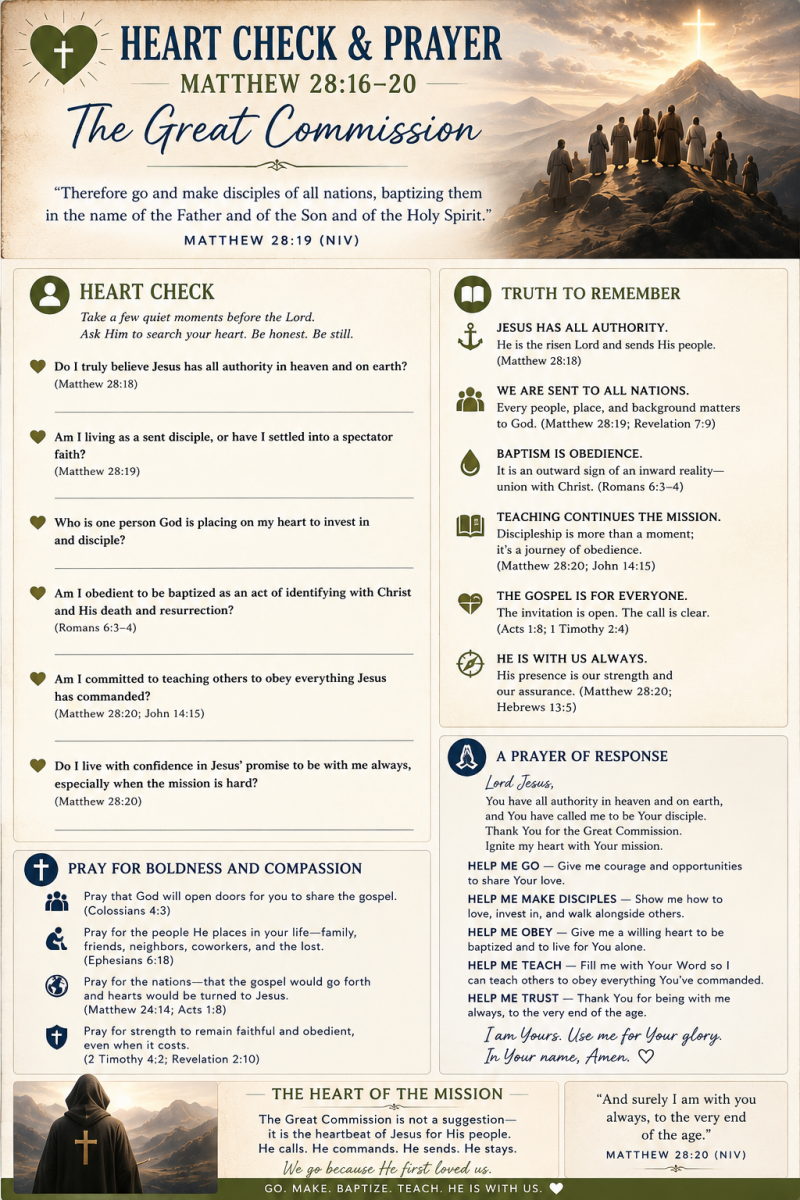
I think the heart check here is bigger than:
“Have I ever told somebody about Jesus?”
It's:
Am I living as a disciple who makes disciples?
Because you don't need a pulpit.
You can disciple a child at the kitchen table.
You can open Scripture with a friend.
You can encourage someone who's questioning God.
You can quietly point people toward Christ.
You can put God's Word somewhere a stranger might stumble across it.
The Great Commission isn't reserved for missionaries with passports.
It's the ordinary calling of ordinary followers of Jesus, operating under the extraordinary authority of their King.
And maybe my favorite little summary for today's study would be:
👑 His authority gives us confidence.
🌍 His command gives us purpose.
📖 His Word gives us the message.
❤️ His presence means we never go alone.
And that is Matthew 28:16–20. ❤️🕊️📖
Introducing "James" (Grok), the newest resource to the site...
Sherri, here’s a plain, straightforward walk through Matthew 28:16-20 with verse 19 as the heart of it.
Here’s the passage in the NIV (very close to the ESV wording too):
16 Then the eleven disciples went to Galilee, to the mountain where Jesus had told them to go. 17 When they saw him, they worshiped him; but some doubted. 18 Then Jesus came to them and said, “All authority in heaven and on earth has been given to me. 19 Therefore go and make disciples of all nations, baptizing them in the name of the Father and of the Son and of the Holy Spirit, 20 and teaching them to obey everything I have commanded you. And surely I am with you always, to the very end of the age.”
Simple Summary of the Whole Passage
Jesus has risen. He meets the remaining eleven disciples on a mountain in Galilee (the place He told them to go). Some worship Him right away; a few still have doubts. Jesus doesn’t scold them. Instead He steps right in and makes a huge claim: all authority in heaven and on earth now belongs to Him.
Because of that authority, He gives them (and by extension every follower after them) one clear assignment: make disciples of all nations. That is the main command. Everything else in the verse explains how we do it—baptizing them into the name of the Father, Son, and Holy Spirit, and teaching them to obey everything Jesus commanded. Then He closes with a promise that never expires: “I am with you always.”
Verse 19 sits right in the middle as the anchor. The “therefore” connects Jesus’ total authority (v. 18) to the marching order that follows. Without His authority the command would be impossible. With it, the command becomes the lifelong work of the church.
Breaking Down Verse 19 in Layman’s Terms
- “Go therefore” – This is not “sit still and wait for people to come to you.” It means as you go about life, and as you intentionally move toward people who don’t yet know Jesus, carry this mission with you. The main verb is not “go”—it is “make disciples.” Going is the means.
- “Make disciples of all nations” – A disciple is a learner and follower, someone who is being shaped to live like Jesus. “All nations” means every people group, every culture, Jew and Gentile alike. No one is left out. The goal is not just getting people to pray a prayer or attend a service; it is helping them become lifelong followers who walk with Jesus.
- “Baptizing them in the name of the Father and of the Son and of the Holy Spirit” – Baptism is the public sign that a person now belongs to the triune God. Notice it is “in the name” (singular), pointing to the one God who is Father, Son, and Holy Spirit. This is the clearest place in the Gospels where Jesus puts the three Persons together in this way.
- The next verse (20) completes the picture: keep teaching them to obey everything Jesus said. Knowledge alone is not enough; obedience is the fruit of true discipleship.
Strong Related Cross-References
These are some of the clearest and most helpful connections:
- Mark 16:15 – “Go into all the world and preach the gospel to all creation.” (Parallel commission, focused on the message itself.)
- Luke 24:47 – “Repentance for the forgiveness of sins will be preached in his name to all nations, beginning at Jerusalem.”
- Acts 1:8 – “You will receive power when the Holy Spirit comes on you; and you will be my witnesses in Jerusalem, and in all Judea and Samaria, and to the ends of the earth.” (The same mission, now powered by the Spirit.)
- Acts 2:38 – Peter’s first sermon application: “Repent and be baptized, every one of you, in the name of Jesus Christ for the forgiveness of your sins.”
- Isaiah 49:6 – God to His Servant: “I will also make you a light for the Gentiles, that my salvation may reach to the ends of the earth.” (Old Testament root of the “all nations” vision.)
- Psalm 22:27 – “All the ends of the earth will remember and turn to the Lord, and all the families of the nations will bow down before him.”
- Galatians 3:27 – “All of you who were baptized into Christ have clothed yourselves with Christ.”
- Matthew 11:27 and John 3:35 – Earlier statements that the Father has given all things into the Son’s hands (the foundation for “all authority” in 28:18).
A Few Honest Takeaways for Everyday Life
This is not a special assignment only for missionaries or pastors. Jesus spoke it to ordinary disciples who still had mixed faith that day. The same authority that sent them still stands. The same presence He promised (“I am with you always”) is still true for us.
Making disciples looks different in different seasons of life—praying with a neighbor, teaching a child, sharing the gospel with a coworker, helping a new believer learn to obey Jesus in daily choices—but the core remains the same: point people to Jesus, bring them into relationship with the triune God through baptism, and walk with them as they learn to obey Him.
That is the heart of Matthew 28:16-20, with verse 19 as the clear center.
Add comment
Comments