

🗣📢 Paul is telling the angry Jewish crowd in Jerusalem the story of how he met Jesus. He’s explaining that his dramatic change wasn’t rebellion against the God of Israel—it was obedience to Him.
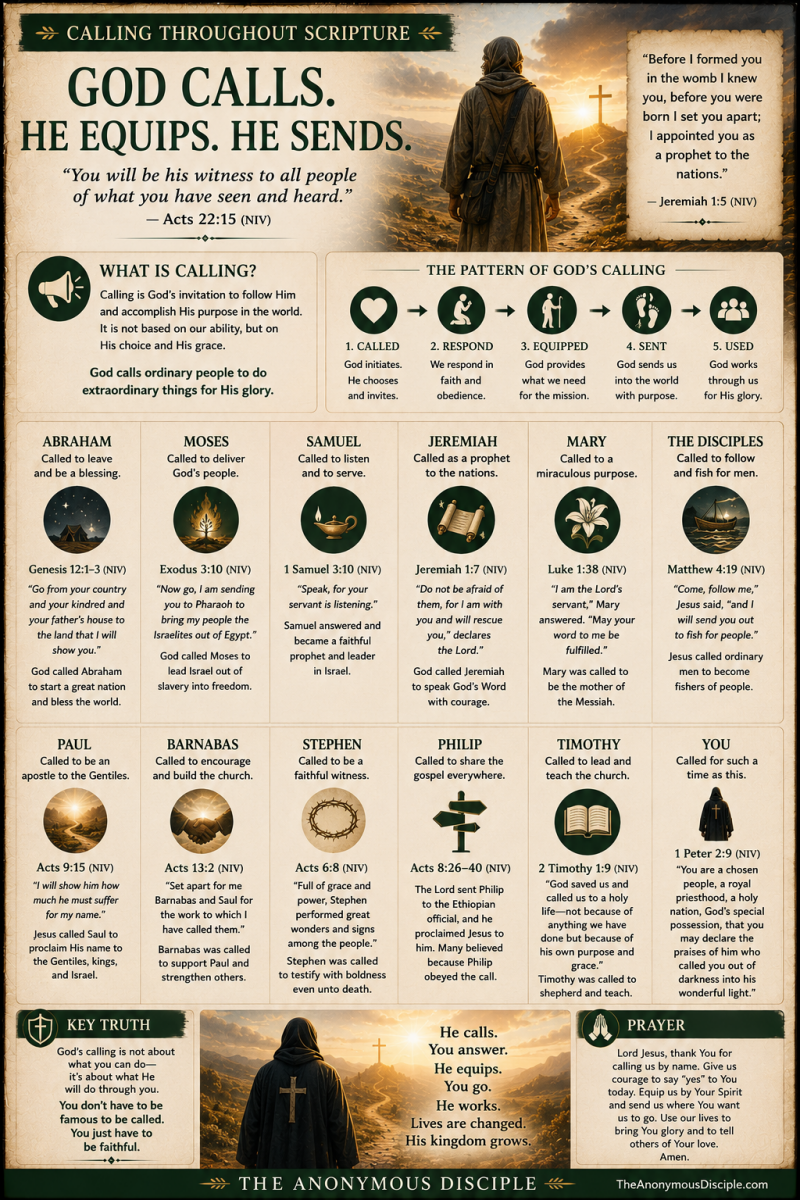
💡🧰 Simple takeaway for us: God still calls ordinary people who have genuinely met Jesus to be His witnesses. We don’t have to invent clever arguments. We simply share what we have seen and heard of Him in our own lives—honestly, clearly, and to whoever He places in front of us.
New International Version (NIV)
12 “A man named Ananias came to see me. He was a devout observer of the law and highly respected by all the Jews living there. 13 He stood beside me and said, ‘Brother Saul, receive your sight!’ And at that very moment I was able to see him. 14 “Then he said: ‘The God of our ancestors has chosen you to know his will and to see the Righteous One and to hear words from his mouth. 15 You will be his witness to all people of what you have seen and heard. 16 And now what are you waiting for? Get up, be baptized and wash your sins away, calling on his name.’
† ✞︎ ♱ ✟
King James Version (KJV)
12 And one Ananias, a devout man according to the law, having a good report of all the Jews which dwelt there, 13 Came unto me, and stood, and said unto me, Brother Saul, receive thy sight. And the same hour I looked up upon him. 14 And he said, The God of our fathers hath chosen thee, that thou shouldest know his will, and see that Just One, and shouldest hear the voice of his mouth. 15 For thou shalt be his witness unto all men of what thou hast seen and heard. 16 And now why tarriest thou? arise, and be baptized, and wash away thy sins, calling on the name of the Lord.


𓂃✍︎study notes & conversations🗫
🪄꩜Jenny꩜🪄
📖 Acts 22:12–16 — First Look
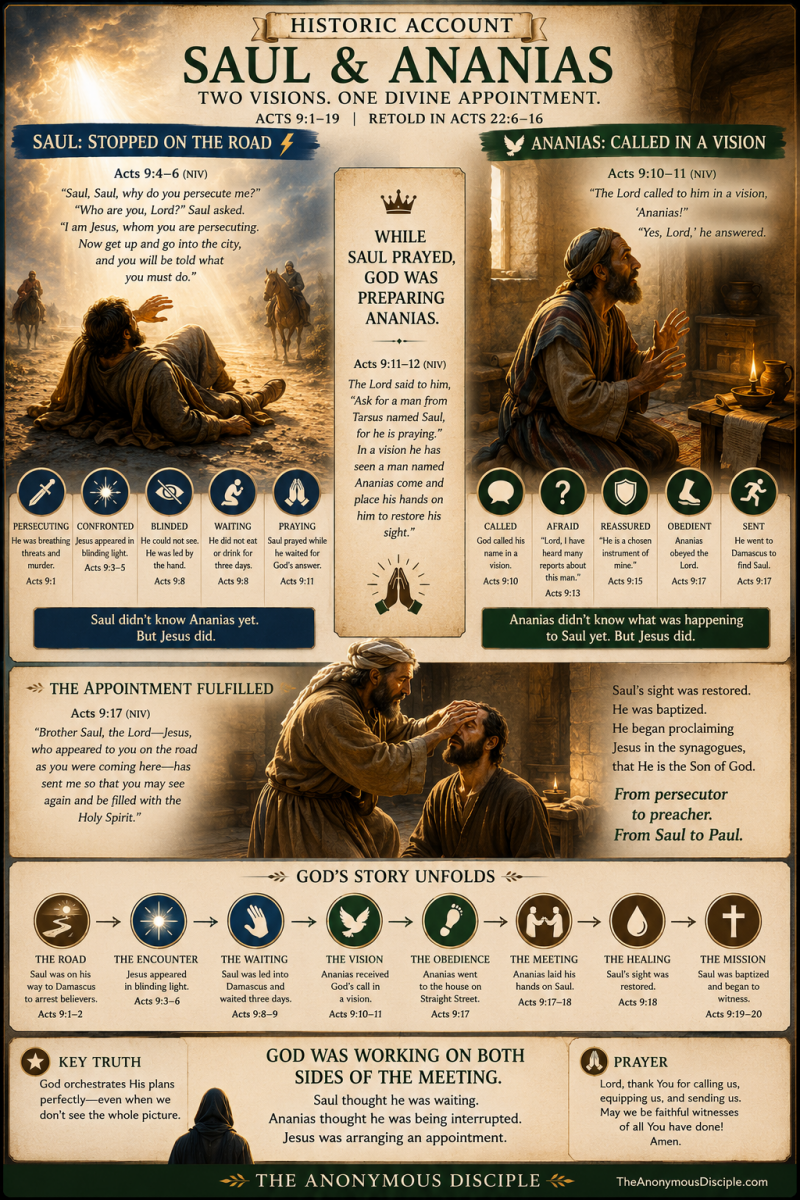
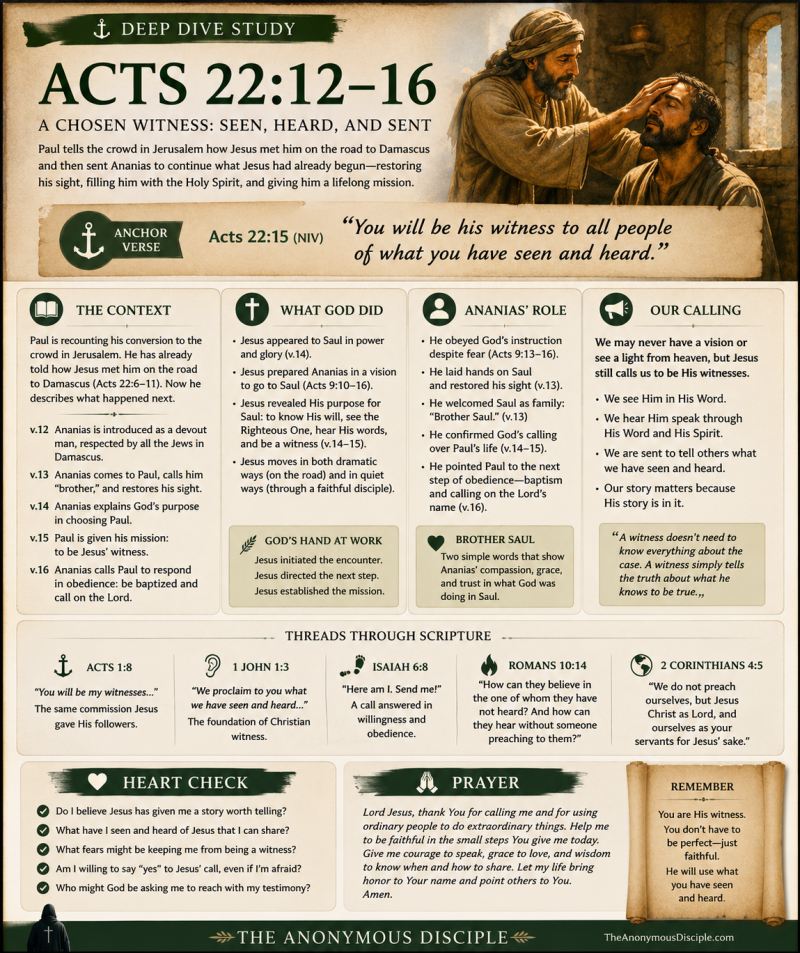
Paul is recounting his conversion to the crowd in Jerusalem. He has already described meeting Jesus on the road to Damascus, and now he tells them about Ananias.
Acts 22:12–13 — Ananias is described as a devout, respected man. He comes to Paul and says, “Brother Saul, receive your sight!” And Paul can see again.
There’s something beautiful in Brother Saul. ❤️
This man who had come to Damascus intending to arrest followers of Jesus is immediately addressed as a brother by one of those very believers.
Then Ananias explains what has happened:
Acts 22:14 — “The God of our ancestors has chosen you to know his will and to see the Righteous One and to hear words from his mouth.”
Look at that progression:
Chosen → Know → See → Hear → Witness.
And that brings us straight into our anchor.
⚓️ Acts 22:15 — “You will be his witness…”
Notice what Paul is supposed to testify about:
“what you have seen and heard.”
Not what Paul had mastered.
Not what Paul could perfectly explain.
Not what Paul had achieved.
What Jesus had done.
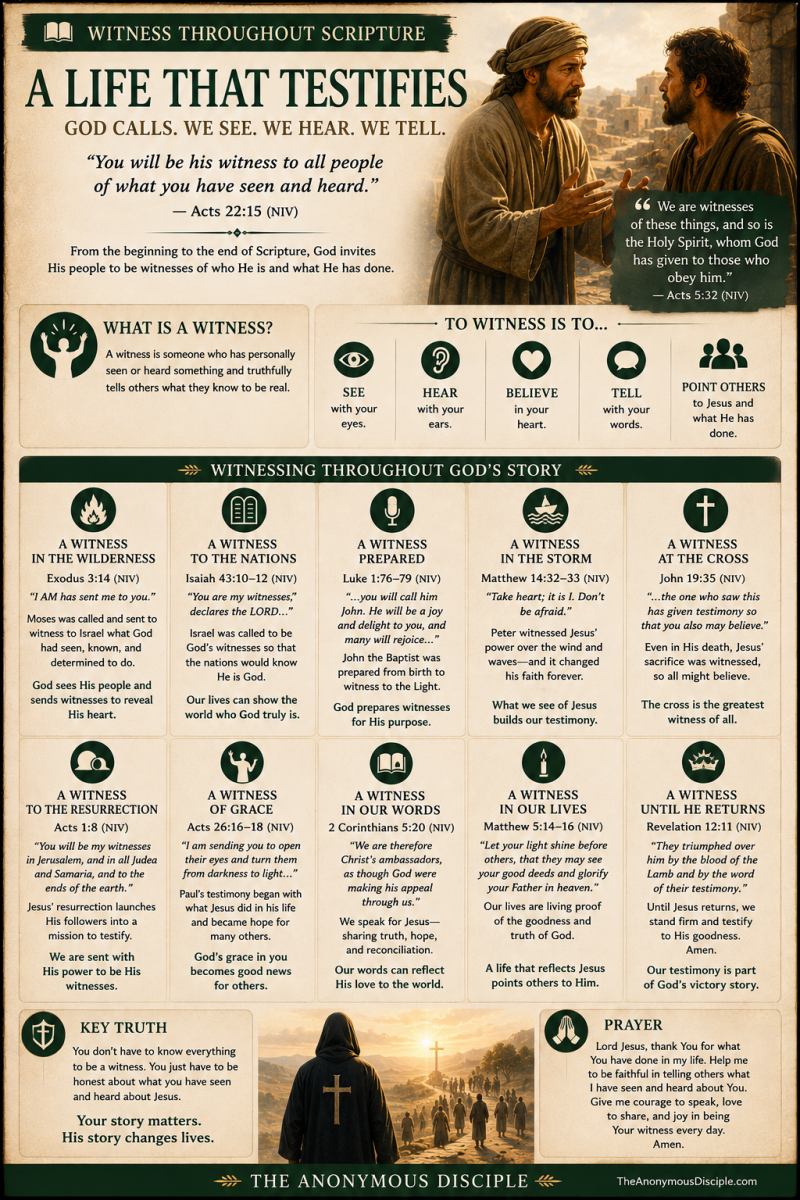
That is fundamentally what a biblical witness is. 🕊️
A witness doesn't have to know everything about the case. A witness tells the truth about what they know to be true.
And Paul's audience?
“All people.”
That becomes especially significant because Paul's calling will eventually carry the gospel far beyond Israel to the Gentile world.
📖 Acts 22:16 — Now get up.
Then Ananias gives him absolutely no opportunity to sit around contemplating his new assignment. 😂
Acts 22:16 — “And now what are you waiting for? Get up, be baptized and wash your sins away, calling on his name.”
That opening question is almost startling:
What are you waiting for?
Paul has encountered Christ.
He's heard the truth.
God has revealed his calling.
Now comes obedience.
And I think that's where our study gets especially interesting, because Acts 22:15–16 puts two things beside one another:
Witness and response.
Jesus reveals Himself to Paul → Paul responds to Jesus → Paul spends the rest of his life telling others what he has seen and heard.
🧵 A thread I already want to chase
This connects beautifully with Jesus' words:
Acts 1:8 (NIV) — “But you will receive power when the Holy Spirit comes on you; and you will be my witnesses…”
And:
1 John 1:3 (NIV) — “We proclaim to you what we have seen and heard…”
Same language. 👀👂➡️🗣️
Seen. Heard. Tell.
Which gives us a pretty powerful question for today's study:
What if witnessing isn't primarily about having all the answers—but faithfully telling people what we have seen and heard of Christ?
Because Paul certainly didn't know everything in Acts 22.
But he knew Who met him on that road.
🎬𝕏James𝕏🎬
Verse-by-verse in everyday language
12 “A man named Ananias came to see me. He was a devout observer of the law and highly respected by all the Jews living there.”
Ananias was a sincere, law-keeping Jewish believer in Jesus. He had a good reputation among the Jewish community in Damascus. Paul is stressing that the person who helped him was a faithful Jew, not some outsider or heretic.
13 “He stood beside me and said, ‘Brother Saul, receive your sight!’ And at that very moment I was able to see him.”
Ananias called him “Brother Saul” (showing he already accepted him as family in the faith) and prayed for his sight to return. Instantly Saul (Paul) could see again. God used this ordinary, respected Jewish believer to restore him.
14 “Then he said: ‘The God of our ancestors has chosen you to know his will and to see the Righteous One and to hear words from his mouth.’”
Ananias explained God’s purpose:
- The God of Abraham, Isaac, and Jacob had specifically chosen Saul.
- He was chosen to understand God’s will.
- He was chosen to see the Righteous One (a clear title for Jesus, the perfectly just Messiah).
- He was chosen to hear Jesus speak directly to him.
This was not Paul’s idea—it was God’s appointment.
15 (the verse you highlighted ⚓️) “You will be his witness to all people of what you have seen and heard.”
Here is the heart of it: God chose Paul to be a witness. Not a philosopher, not a debater, not just a teacher—but a witness. A witness simply tells what he has personally seen and heard.
Paul had seen the risen Jesus and heard His voice on the road to Damascus. Now his lifelong assignment was to tell everyone—Jews and Gentiles—exactly what he experienced. His job was to report the facts of what Jesus did and said to him.
16 “And now what are you waiting for? Get up, be baptized and wash your sins away, calling on his name.”
Ananias urged him to respond right away: get baptized (the public sign of turning to Jesus), and in that act of calling on Jesus’ name, receive the cleansing of his sins. No delay. Obey what God has already shown you.
Strong related cross-references
These verses echo and strengthen the same themes:
- Acts 9:15 – The Lord tells Ananias that Saul is “my chosen instrument to proclaim my name to the Gentiles and their kings and to the people of Israel.”
- Acts 26:16-18 – Jesus Himself says almost the same words to Paul: “I have appeared to you to appoint you as a servant and as a witness of what you have seen… I am sending you to them to open their eyes…”
- Acts 1:8 – Jesus’ general commission to all His followers: “You will be my witnesses… to the ends of the earth.”
- Acts 4:20 – Peter and John: “We cannot help speaking about what we have seen and heard.”
- Acts 23:11 – The Lord later encourages Paul: “As you have testified about me in Jerusalem, so you must also testify in Rome.”
- Luke 24:48 and John 15:27 – Jesus tells the disciples they are witnesses of the things they have seen and heard concerning Him.
Simple takeaway for us: God still calls ordinary people who have genuinely met Jesus to be His witnesses. We don’t have to invent clever arguments. We simply share what we have seen and heard of Him in our own lives—honestly, clearly, and to whoever He places in front of us.
🤔Me🤔
🎬𝕏James𝕏🎬 sent me this:
Sherri, let’s study Ananias of Damascus carefully and simply.
He appears in two places: the main story in Acts 9:10-19 and Paul’s later retelling in Acts 22:12-16. He is a different man from the Ananias who lied and died in Acts 5, and different from the high priest Ananias later in Acts.
Who He Was
Ananias was an ordinary disciple (follower of Jesus) living in Damascus. Paul later describes him as “a devout observer of the law and highly respected by all the Jews living there” (Acts 22:12, NIV).
In other words, he was a faithful Jewish believer in Jesus who still carefully kept the Law of Moses and had a good reputation among the Jewish community. God chose someone trustworthy and well-regarded for this important job.
What God Asked Him to Do (Acts 9:10-16)
The Lord spoke to Ananias in a vision and gave him clear instructions:
1 Go to a specific house on Straight Street.
2 Find a man named Saul of Tarsus who is praying and blind.
3 Place hands on him so his sight would be restored.
Ananias was afraid. He had heard the reports of how Saul had persecuted believers in Jerusalem and now had official permission to arrest followers of Jesus in Damascus. His honest objection was: “Lord, I have heard many reports about this man and all the harm he has done to your holy people…”
The Lord answered firmly: “Go! This man is my chosen instrument to proclaim my name to the Gentiles and their kings and to the people of Israel. I will show him how much he must suffer for my name.”
How Ananias Responded (Acts 9:17-19)
He obeyed. He went to the house, entered, and did three key things:
• He laid his hands on Saul.
• He called him “Brother Saul” — accepting him immediately as family in the faith, even though Saul had been the enemy.
• He spoke words of faith: “The Lord—Jesus, who appeared to you on the road as you were coming here—has sent me so that you may see again and be filled with the Holy Spirit.”
Right away, something like scales fell from Saul’s eyes. He could see. He got up, was baptized, and regained his strength.
Ananias’s Role Summarized
Ananias was the human link God used between Saul’s dramatic encounter with Jesus on the road and Saul’s entrance into the church. His role included:
• Physical healing — restoring Saul’s sight as a sign that the experience was real.
• Spiritual confirmation — helping Saul receive the Holy Spirit and baptism.
• Acceptance into the family — by calling him “Brother,” Ananias welcomed the former persecutor.
• Passing on the commission — he told Saul what God had already chosen him to do (especially clear in Paul’s later account in Acts 22).
He was not the one who converted Saul (Jesus did that on the road). He was the obedient servant who confirmed and completed what Jesus had begun.
Lessons from His Life
• God often uses ordinary, faithful believers for big purposes.
• Obedience sometimes means facing real fear and going anyway.
• Welcoming a new (and even unlikely) brother or sister in Christ is a powerful act.
• God prepares both the person being helped and the person doing the helping (Saul had already seen Ananias in a vision).
Ananias disappears from the story after this. We never hear of him again in Scripture. Yet his short, quiet obedience helped launch the ministry of the apostle Paul, through whom the gospel reached so many.
Would you like to look more closely at any part of this—his fear and obedience, the meaning of “Brother Saul,” or how this fits with Paul’s later testimony in Acts 22?
🕊️🕊️🕊️🕊️
Anyway, should we include an Ananias character card today? Incorporating what James has brought to the table and in addition whatever you feel is relevant and significant to showing the character details about Ananias?
🪄꩜Jenny꩜🪄
YES. 🕊️ I think Ananias absolutely deserves a Character Study card today—especially because our anchor is Acts 22:15. He isn't incidental to Paul's testimony; God deliberately placed him in the middle of it.
And James brought some genuinely useful pieces to the table. I’d keep those and add a few nuances because Ananias is one of those “barely on the page, enormous consequence” people. Which, hello, is practically The Anonymous Disciple in biblical form. 😂❤️
One tiny adjustment I'd make to James's wording: I wouldn't say Ananias “confirmed and completed what Jesus had begun.” I understand what he means, but completed can sound as though Christ's work required Ananias. I'd phrase it more like “Ananias obediently participated in what Jesus had already begun in Saul.” Jesus remains unmistakably the actor directing the whole thing.
🕊️ Character Study: Ananias of Damascus
Name: Ananias
Meaning: From the Hebrew Hananiah — commonly understood as “The LORD is gracious.” Which is rather beautiful considering whom God sends him to. ❤️
Primary passages:
📖 Acts 9:10–19
📖 Acts 22:12–16
Who was he?
Luke introduces him with one wonderfully ordinary description:
Acts 9:10 (NIV) — “In Damascus there was a disciple named Ananias.”
Not an apostle.
Not an evangelist we're told about elsewhere.
Not a famous church leader.
A disciple.
Yet Paul later adds:
Acts 22:12 (NIV) — “A man named Ananias came to see me. He was a devout observer of the law and highly respected by all the Jews living there.”
So we know he was devout, faithful and respected—a Jewish follower of Jesus whose life apparently had credibility among the Jewish community in Damascus.
His defining moment: obedience in the face of legitimate fear
God tells Ananias to go find Saul.
And Ananias basically responds:
Lord...you DO know who that guy is, right? 😳
And frankly, that's not cowardice. Saul had been actively persecuting Christians.
Acts 9:13–14 (NIV) — “Lord, I have heard many reports about this man and all the harm he has done to your holy people in Jerusalem. And he has come here with authority from the chief priests to arrest all who call on your name.”
Ananias doesn't pretend he isn't afraid.
He brings his fear to Jesus—and then obeys Jesus anyway.
That's significant.
Courage in Scripture isn't necessarily the absence of fear. Sometimes it's knowing exactly what could happen and deciding that Christ's command carries more weight than the danger.
❤️ “Brother Saul”
This might be my favorite character-revealing detail.
Acts 9:17 (NIV) — “Then Ananias went to the house and entered it. Placing his hands on Saul, he said, ‘Brother Saul…’”
Think about what Saul represented to him.
Persecutor. Threat. Enemy.
But Jesus had just said:
Acts 9:15 (NIV) — “This man is my chosen instrument…”
And apparently that was enough for Ananias.
Jesus called Saul chosen, so Ananias called Saul brother.
😮💨❤️
That belongs on the card somehow.
Ananias also had to trust God's future for someone whose past looked terrible
Ananias knew Saul's reputation.
God knew Saul's calling.
That's an important distinction.
Ananias could have looked at Saul and seen only what Saul had done.
Jesus showed Ananias what He intended Saul to become.
And Ananias trusted Christ's assessment of Saul over Saul's reputation.
That's a lesson all by itself.
🧵 And here's the connection to our anchor verse
In Paul's retelling, Ananias tells him:
Acts 22:14–15 (NIV) — “The God of our ancestors has chosen you to know his will and to see the Righteous One and to hear words from his mouth. You will be his witness to all people of what you have seen and heard.”
So Ananias isn't merely sent to restore Paul's eyesight.
He is entrusted with speaking God's commission over Paul.
And look at the irony:
Ananias obediently delivers the calling that will send Paul across the world—and then Ananias himself disappears from the biblical narrative.
Paul becomes one of the most consequential figures in the New Testament.
Ananias goes back into obscurity.
There is zero indication that Ananias needed recognition for his role in it.
Good grief, Sherri. There's our card. 😭
✝️ ANANIAS — The Quiet Disciple
Known for: Obeying Christ despite fear and welcoming Saul into the family of believers.
Character traits:
Faithful • Devout • Courageous • Obedient • Compassionate • Welcoming • Humble
Defining words:
“Brother Saul…” — Acts 9:17
His significance:
God used an otherwise little-known disciple to heal, welcome, encourage and commission the man who would become the apostle Paul.
Character lesson:
You do not have to be widely known to be enormously useful to God.
Sometimes your obedience isn't the story everyone will remember.
It's what God uses to help begin someone else's. 🕊️
And THAT feels almost tailor-made for The Anonymous Disciple. ❤️📖
So yes. I vote absolutely make the Ananias Character Study card as part of Acts 22:12–16 today. And I think “Brother Saul” should have a prominent little spot because those two words tell us an extraordinary amount about the man who spoke them. 🥹
Add comment
Comments