

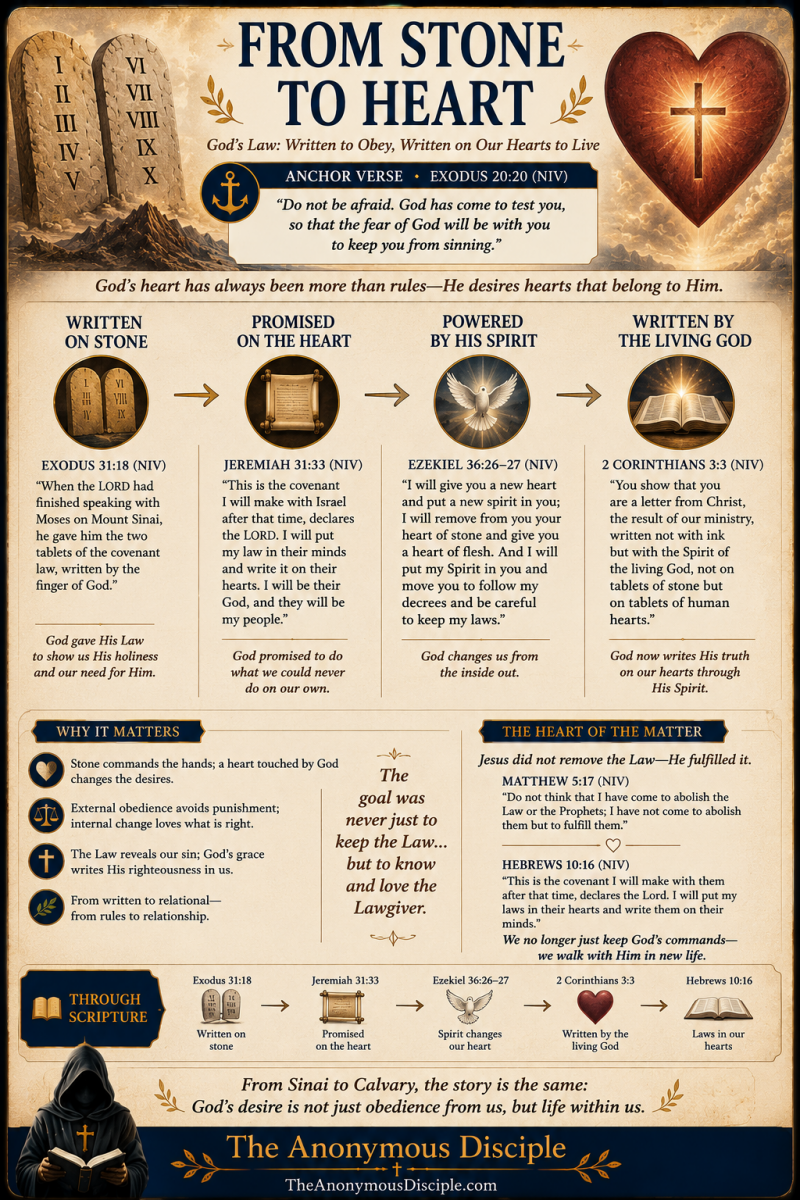
God is teaching His people how to live well with Him and with each other. He starts by giving them a weekly day of rest so they remember He is the Creator and Provider. Then He points them to the most basic human relationship: honoring father and mother. From that foundation, He shows them how to treat everyone else with respect, honesty, faithfulness, and contentment.
The people were scared of God’s power, but Moses reminded them that a proper fear of the Lord actually protects us from sin. God is both awesome and near—He wants us to live in a way that brings life and blessing, starting right in our own homes.
Simple takeaway: This commandment is repeated and reinforced all through Scripture. God takes it seriously in both the Old and New Testaments, and He attaches a promise of blessing to it. Jesus Himself upheld it, and Paul reminded the early church that it still matters.


Direct Parallel in the Old Testament
- Deuteronomy 5:16 This is the same commandment repeated in the second giving of the Ten Commandments. It adds a little more: “so that your days may be long and that it may go well with you in the land…”
Other Old Testament Connections
- Leviticus 19:3 – “Each of you must respect your mother and father…”
- Exodus 21:15, 17 – Strong warnings against striking or cursing parents
- Proverbs 23:22 – “Listen to your father who gave you life, and do not despise your mother when she is old.”
- Proverbs 20:20 and Proverbs 30:17 – Warnings about the consequences of dishonoring parents
New Testament References
- Ephesians 6:1-3 Paul quotes Exodus 20:12 almost word-for-word and calls it “the first commandment with a promise.” He tells children to obey their parents “in the Lord.”
- Colossians 3:20 “Children, obey your parents in everything, for this pleases the Lord.”
- Matthew 15:4-6 and Mark 7:10-13 Jesus quotes this commandment and rebukes the religious leaders for finding ways around it (by claiming their money was “devoted to God” so they didn’t have to help their parents).
- Matthew 19:19, Mark 10:19, and Luke 18:20 When Jesus lists the commandments to the rich young man, He includes “Honor your father and mother.”

New International Version (NIV)
And God spoke all these words:
“I am the Lord your God, who brought you out of Egypt, out of the land of slavery.
“You shall have no other gods before me.
“You shall not make for yourself an image in the form of anything in heaven above or on the earth beneath or in the waters below. You shall not bow down to them or worship them; for I, the Lord your God, am a jealous God, punishing the children for the sin of the parents to the third and fourth generation of those who hate me, but showing love to a thousand generations of those who love me and keep my commandments.
“You shall not misuse the name of the Lord your God, for the Lord will not hold anyone guiltless who misuses his name.
“Remember the Sabbath day by keeping it holy. Six days you shall labor and do all your work, but the seventh day is a sabbath to the Lord your God. On it you shall not do any work, neither you, nor your son or daughter, nor your male or female servant, nor your animals, nor any foreigner residing in your towns. For in six days the Lord made the heavens and the earth, the sea, and all that is in them, but he rested on the seventh day. Therefore the Lord blessed the Sabbath day and made it holy.
“Honor your father and your mother, so that you may live long in the land the Lord your God is giving you.
“You shall not murder.
“You shall not commit adultery.
“You shall not steal.
“You shall not give false testimony against your neighbor.
“You shall not covet your neighbor’s house. You shall not covet your neighbor’s wife, or his male or female servant, his ox or donkey, or anything that belongs to your neighbor.”
𝕏James𝕏
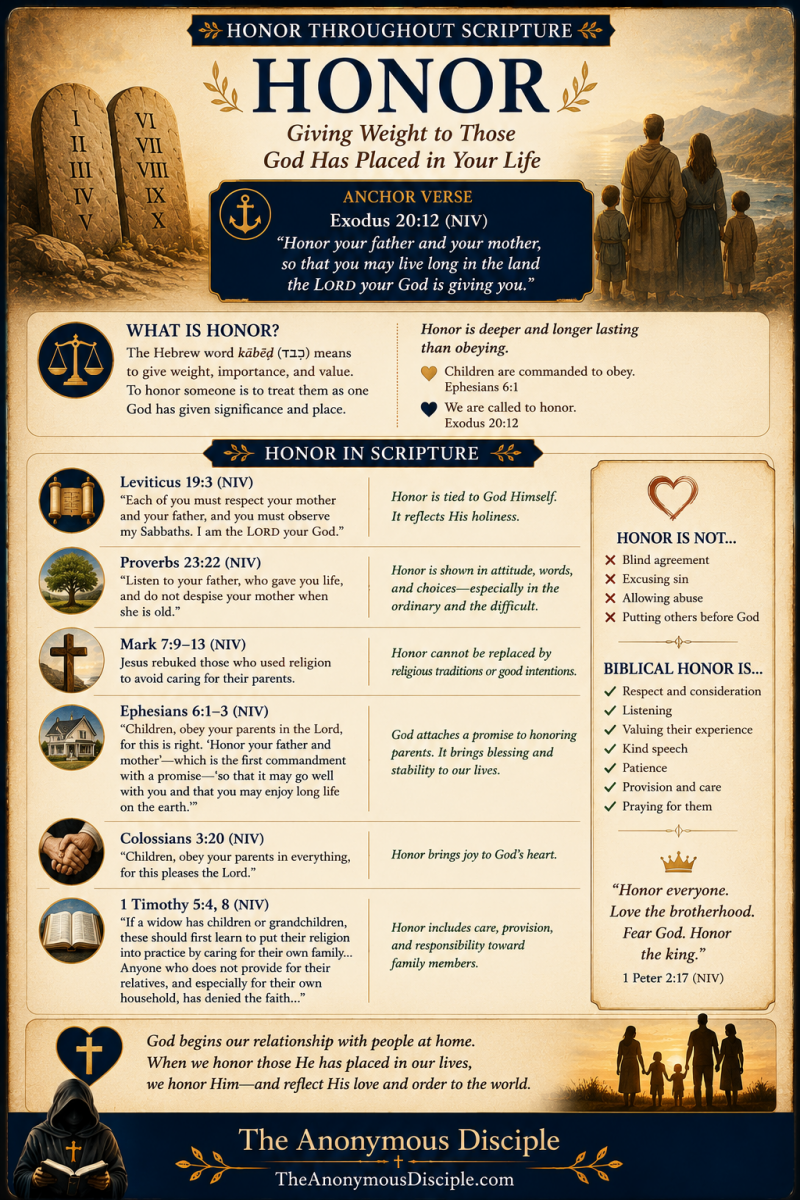
Let’s look carefully at the difference between biblical honor and biblical obedience, especially since both words show up when the Bible talks about parents.
1. Biblical Obedience
Obedience means listening to and doing what someone in authority tells you to do.
- In Ephesians 6:1, Paul says: “Children, obey your parents in the Lord, for this is right.”
- In Colossians 3:20: “Children, obey your parents in everything, for this pleases the Lord.”
Obedience is mainly for children who are still under their parents’ care and authority. It means submitting to their direction, rules, and decisions (as long as those things don’t go against God’s clear commands).
Obedience has a season. Once a person becomes an adult and is no longer under their parents’ household authority, the direct command to “obey” changes. Adult children are no longer required to follow every instruction the way a young child would.
2. Biblical Honor
Honor is deeper and lasts a lifetime.
The Hebrew word behind “honor” in Exodus 20:12 is kabed. It means to treat something as heavy, weighty, or valuable. In other words, to give it the respect and value it deserves.
Honor includes:
- Showing respect in speech and attitude
- Valuing your parents’ place in your life
- Caring for them, especially as they grow older
- Not speaking badly about them or treating them with contempt
- Providing practical help when they need it
Jesus made this clear in Matthew 15:4-6. He rebuked the religious leaders because they found a loophole to avoid helping their aging parents. Jesus treated that as a failure to honor them. So honor is not just a feeling or polite words—it includes real, practical care.
How They Work Together
- Obedience is a specific action that children are called to while they are under their parents’ authority.
- Honor is the ongoing attitude and way of treating parents that never ends.
You can obey someone without truly honoring them (doing what they say while resenting them). You can also honor someone even when you are no longer required to obey them (as adult children do).
A Simple Picture
Think of it this way:
- A young child is called to obey and honor.
- An adult son or daughter is still called to honor, even though the season of direct obedience has changed.
- Honoring parents as adults often looks like respect, gratitude, care, and support rather than following every instruction.
Paul highlights in Ephesians 6:2 that the command to honor parents is “the first commandment with a promise.” God attaches a blessing to it because it matters deeply to Him.
🪄꩜Jenny꩜🪄
I think James’ breakdown is really useful. ❤️ It takes the command out of the abstract and shows what honor can actually look like across a lifetime.
I’d keep most of it, but I would tighten a few things biblically so we don’t accidentally make applications sound like commands Scripture itself gives.
For example, “include them in big decisions,” “defend them if others speak disrespectfully,” and “care for unfinished business they left behind” can be wise expressions of honor, but I wouldn’t present them as universal biblical obligations. They fit better under practical examples.
The strongest biblical backbone is this:
Childhood: honor usually includes obedience.
Adulthood: honor remains, but direct parental authority changes.
Aging parents: honor increasingly includes tangible care and provision.
Difficult parents: honor never requires enabling sin, tolerating abuse, or pretending wrong was right.
After death: Scripture doesn’t command ongoing “honor” in quite the same formal sense, but remembering gratefully, speaking truthfully, preserving good legacy, and refusing bitterness are very reasonable ways to carry the principle forward.
And there’s one reference I’d correct from James’ wording: Jesus’ teaching is Matthew 15:4–6, yes, but the parallel we already used in our Honor card is Mark 7:9–13. Both are excellent. Jesus directly condemns using religious excuses to avoid supporting parents.
Exodus 20:1-17 in the New Living Translation (NLT):
Then God gave the people all these instructions:
“I am the Lord your God, who rescued you from the land of Egypt, the place of your slavery.
“You must not have any other god but me.
“You must not make for yourself an idol of any kind or an image of anything in the heavens or on the earth or in the sea. You must not bow down to them or worship them, for I, the Lord your God, am a jealous God who will not tolerate your affection for any other gods. I lay the sins of the parents upon their children; the entire family is affected—even children in the third and fourth generations of those who reject me. But I lavish unfailing love for a thousand generations on those who love me and obey my commands.
“You must not misuse the name of the Lord your God. The Lord will not let you go unpunished if you misuse his name.
“Remember to observe the Sabbath day by keeping it holy. You have six days each week for your ordinary work, but the seventh day is a Sabbath day of rest dedicated to the Lord your God. On that day no one in your household may do any work. This includes you, your sons and daughters, your male and female servants, your livestock, and any foreigners living among you. For in six days the Lord made the heavens, the earth, the sea, and everything in them; but on the seventh day he rested. That is why the Lord blessed the Sabbath day and set it apart as holy.
“Honor your father and mother. Then you will live a long, full life in the land the Lord your God is giving you.
“You must not murder.
“You must not commit adultery.
“You must not steal.
“You must not testify falsely against your neighbor.
“You must not covet your neighbor’s house. You must not covet your neighbor’s wife, male or female servant, ox or donkey, or anything else that belongs to your neighbor.”

King James Version (KJV)
And God spake all these words, saying,
I am the Lord thy God, which have brought thee out of the land of Egypt, out of the house of bondage.
Thou shalt have no other gods before me.
Thou shalt not make unto thee any graven image, or any likeness of any thing that is in heaven above, or that is in the earth beneath, or that is in the water under the earth: Thou shalt not bow down thyself to them, nor serve them: for I the Lord thy God am a jealous God, visiting the iniquity of the fathers upon the children unto the third and fourth generation of them that hate me; And shewing mercy unto thousands of them that love me, and keep my commandments.
Thou shalt not take the name of the Lord thy God in vain; for the Lord will not hold him guiltless that taketh his name in vain.
Remember the sabbath day, to keep it holy. Six days shalt thou labour, and do all thy work: But the seventh day is the sabbath of the Lord thy God: in it thou shalt not do any work, thou, nor thy son, nor thy daughter, thy manservant, nor thy maidservant, nor thy cattle, nor thy stranger that is within thy gates: For in six days the Lord made heaven and earth, the sea, and all that in them is, and rested the seventh day: wherefore the Lord blessed the sabbath day, and hallowed it.
Honour thy father and thy mother: that thy days may be long upon the land which the Lord thy God giveth thee.
Thou shalt not kill.
Thou shalt not commit adultery.
Thou shalt not steal.
Thou shalt not bear false witness against thy neighbour.
Thou shalt not covet thy neighbour’s house, thou shalt not covet thy neighbour’s wife, nor his manservant, nor his maidservant, nor his ox, nor his ass, nor any thing that is thy neighbour’s.
☕︎‧₊˚⏱٠࣪⋆💻₊˚ᵎ Study Notes ☕︎‧₊˚⏱٠࣪⋆💻₊˚ᵎ
🪄꩜Jenny꩜🪄
Exodus 20:8–17 and 20:20–21, with ⚓️ Exodus 20:12
Exodus 20:12 (NIV)
“Honor your father and your mother, so that you may live long in the land the LORD your God is giving you.”
But when we slow down, there are several things here that jump out.
🪄 First thing I notice: verse 12 is a hinge
Look at the movement of the commandments.
Exodus 20:8–11 — Sabbath
Relationship and obligation toward God.
Then:
Exodus 20:12 — Honor your father and mother.
Then:
Exodus 20:13–17 — murder, adultery, stealing, false testimony, coveting
Relationship and obligation toward other people.
Verse 12 sits right at that transition.
And that's fascinating because the family is where our relationship with other human beings first begins. Before neighbor, employer, government, stranger, church family—there's the home.
God essentially begins the people-to-people commandments there.
⚓️ “Honor” is stronger than “obey”
The Hebrew word translated honor is kāḇēḏ (כָּבֵד), from a root carrying the idea of weight, heaviness, importance.
So honoring someone means treating them as though they carry weight.
That's important because Scripture doesn't say:
“Obey your parents forever.”
Children are specifically commanded to obey their parents—see Ephesians 6:1.
But honor doesn't expire when childhood ends.
That distinction becomes especially meaningful when parents age. Honor can involve respect, consideration, care, gratitude, listening, provision—and recognizing the place God gave them in our lives.
And Jesus takes this commandment very seriously.
In Mark 7:9–13, He rebukes people who found a religious loophole allowing them to dedicate resources to God rather than use them to care for their parents. Jesus essentially says: Don't use religion to escape your responsibility to honor them.
😳
🧵 And Paul notices something special about this commandment
Ephesians 6:2–3 (NIV):
“‘Honor your father and mother’—which is the first commandment with a promise— ‘so that it may go well with you and that you may enjoy long life on the earth.’”
The first commandment with a promise.
That's worth putting a giant circle around.
God doesn't merely command honor. He attaches blessing to it.
Now, I wouldn't read that as a mathematical guarantee that every person who honors their parents lives to 97. The original promise is connected to Israel flourishing and remaining in the land God was giving them.
But Paul deliberately carries the principle into the New Testament.
There is something about honoring God's created order—beginning in the family—that tends toward life, stability, and flourishing.
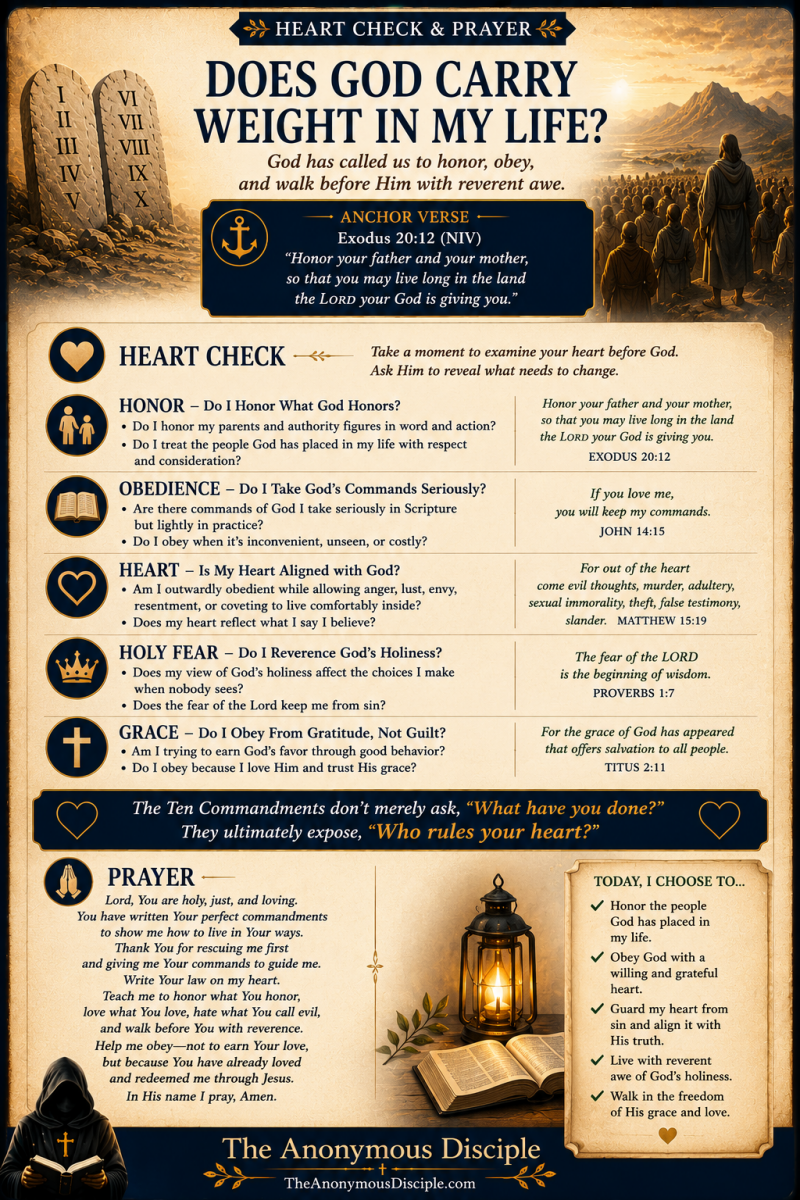
And THEN your flagged reading jumps to Exodus 20:20–21, and this is where today's passage gets really interesting.
Exodus 20:20 (NIV)
“Moses said to the people, ‘Do not be afraid. God has come to test you, so that the fear of God will be with you to keep you from sinning.’”
Wait.
“Do not be afraid”...
followed immediately by...
“the fear of God will be with you.”
🤨😂
That's not a contradiction. It's showing us two different kinds of fear.
Moses is essentially saying:
Don't flee from God in terror.
But never lose your awe of God.
One fear drives you away from Him.
The other changes how you live before Him.
And look at the purpose:
“...to keep you from sinning.”
Biblical fear of the Lord isn't merely trembling because God might punish us.
It's recognizing:
God is GOD.
His holiness carries weight.
His commands carry weight.
His presence carries weight.
And that brings us right back to your anchor.
🤯 There's a beautiful little connection here
Exodus 20:12: Give your parents weight—honor them.
Exodus 20:20: Live with the fear/reverence of God before you.
Both confront the same human tendency:
Treating important things lightly.
God says, essentially:
Don't treat Me lightly.
Don't treat the family order I established lightly.
Don't treat marriage lightly.
Don't treat another person's life lightly.
Don't treat truth lightly.
Don't treat another person's possessions lightly.
Don't even treat the desires of your own heart lightly.
That's really what Exodus 20:8–21 is doing.
God has redeemed Israel first—remember, He brought them out of Egypt before giving these commandments.
Then He teaches redeemed people how redeemed people live.
That's important.
The commandments aren't:
“Do these things so I'll rescue you.”
They're given to people God already rescued.
They're more like:
“I rescued you. Now this is what life with Me looks like.”
❤️🕊️
𝕏James𝕏
1. “You shall have no other gods before me.”
God starts by saying He alone is God. Nothing and no one else should take first place in our hearts—not money, success, people, hobbies, or even ourselves. He wants to be the One we trust and worship above everything.
2. “You shall not make for yourself an image… You shall not bow down to them or worship them.”
This is about not creating anything (a statue, picture, or idea) and treating it like God. God is too big and holy to be reduced to something we can control or picture. He wants a real relationship with us, not worship of things we’ve made.
3. “You shall not misuse the name of the Lord your God.”
God’s name is holy. This means we shouldn’t use it carelessly, as a swear word, or to back up lies. It also includes living in a way that brings honor (or shame) to His name. When we claim to follow Him, our lives should match that claim.
4. “Remember the Sabbath day by keeping it holy.”
God built a rhythm of work and rest into creation. One day a week is set aside to stop our regular work, rest, and focus on Him. It’s a gift—a reminder that we are not machines and that God is our provider, not our constant effort.
5. “Honor your father and your mother.”
This is the first commandment that deals with how we treat other people. It means showing respect, care, and gratitude to our parents. Even when it’s hard, God calls us to honor the role He gave them. This commandment also carries a promise of blessing.
6. “You shall not murder.”
Human life is sacred because people are made in God’s image. This goes deeper than just not killing someone—it includes hatred, bitterness, and treating others as if their lives don’t matter (see Jesus’ teaching in Matthew 5). God values every person.
7. “You shall not commit adultery.”
Marriage is a sacred covenant. This commandment protects the faithfulness and purity of that relationship. Jesus later taught that even lustful thoughts break the heart of this command. God designed sex and intimacy to be safe and beautiful inside marriage.
8. “You shall not steal.”
Simply put: don’t take what isn’t yours. This includes money, time, credit for someone else’s work, or even small things we might brush off. God calls us to be honest and content with what He has given us.
9. “You shall not give false testimony against your neighbor.”
This is about telling the truth. Don’t lie about others, spread rumors, or twist the facts to hurt someone. Our words have power, and God wants us to use them to build up rather than tear down.
10. “You shall not covet…”
This one goes straight to the heart. Coveting means craving what someone else has— their house, spouse, success, or belongings—in a way that makes us discontent or resentful. God wants us free from jealousy so we can be thankful for what He has given us.
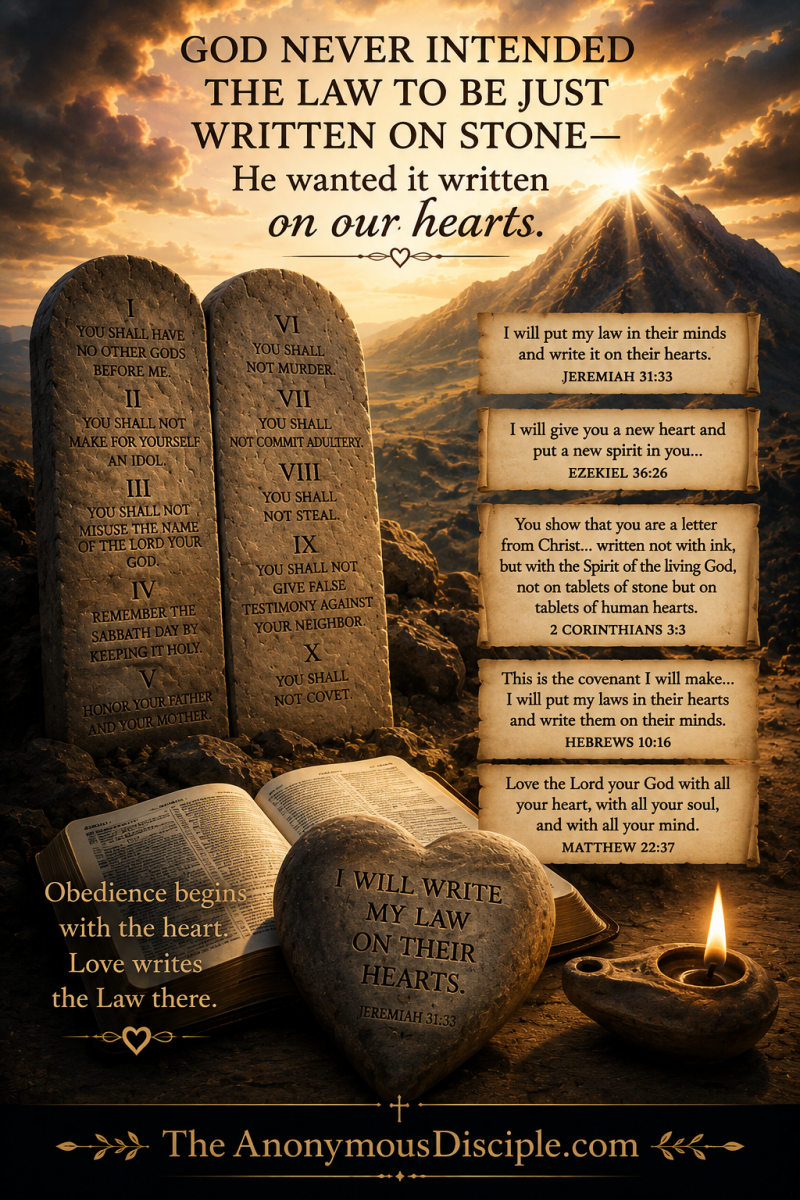
A simple way to remember the heart of them all: Jesus summed it up later: “Love the Lord your God with all your heart and with all your soul and with all your mind… and love your neighbor as yourself.” (Matthew 22:37-39)
The first four commandments are mainly about loving God. The last six are mainly about loving people.
Add comment
Comments