

📜 Psalm 141 is a prayer of David. He is under pressure—surrounded by people who do wrong—and he feels the pull to either lash out with his words or slowly drift into their ways. Instead of just asking God to rescue him from danger, David starts by asking God to protect him from himself. He wants a clean heart and a careful tongue more than he wants an easy life. The whole psalm is about staying faithful when compromise looks attractive.
🙌 The big takeaway for us: When life is hard and people around us are living carelessly, the first prayer we often need is not “Make everything easier,” but “Lord, guard my mouth, purify my heart, and keep me teachable.”
That’s the heart of Psalm 141.
Psalm 141 (KJV)
A Psalm of David.
1 Lord, I cry unto thee: make haste unto me; give ear unto my voice, when I cry unto thee. 2 Let my prayer be set forth before thee as incense; and the lifting up of my hands as the evening sacrifice. 3 Set a watch, O Lord, before my mouth; keep the door of my lips. 4 Incline not my heart to any evil thing, to practise wicked works with men that work iniquity: and let me not eat of their dainties. 5 Let the righteous smite me; it shall be a kindness: and let him reprove me; it shall be an excellent oil, which shall not break my head: for yet my prayer also shall be in their calamities. 6 When their judges are overthrown in stony places, they shall hear my words; for they are sweet. 7 Our bones are scattered at the grave's mouth, as when one cutteth and cleaveth wood upon the earth. 8 But mine eyes are unto thee, O God the Lord: in thee is my trust; leave not my soul destitute. 9 Keep me from the snares which they have laid for me, and the gins of the workers of iniquity. 10 Let the wicked fall into their own nets, whilst that I withal escape.
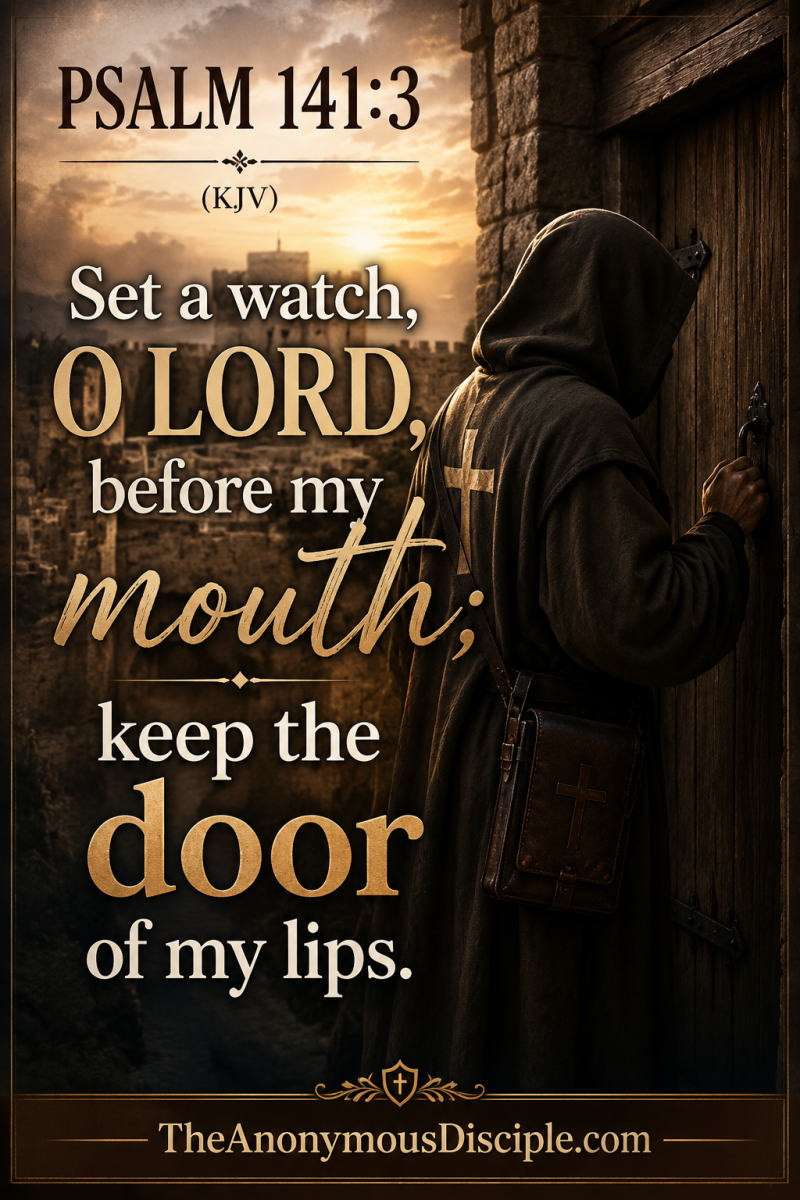
Cross-References for Psalm 141:3
(“Set a guard over my mouth, Lord; keep watch over the door of my lips.”)
This prayer is about asking God to control our words so we don’t sin with our tongue.
- Psalm 39:1 – “I said, ‘I will watch my ways and keep my tongue from sin; I will put a muzzle on my mouth while in the presence of the wicked.’” (David makes the same kind of commitment here.)
- Psalm 34:13 – “Keep your tongue from evil and your lips from telling lies.” (A straightforward command that matches the heart of the prayer.)
- Psalm 17:3 – “Though you probe my heart… you will find that I have planned no evil; my mouth has not transgressed.” (David wants a mouth that stays clean even under pressure.)
- James 1:26 – “Those who consider themselves religious and yet do not keep a tight rein on their tongues deceive themselves, and their religion is worthless.” (The New Testament echoes the same need for self-control in speech.)
- James 3:2 – “We all stumble in many ways. Anyone who is never at fault in what they say is perfect, able to keep their whole body in check.” (Shows how important—and difficult—controlling the tongue really is.)
- Micah 7:5 – “…guard the doors of your mouth…” (Almost the same picture of watching the “door” of the lips.)
Psalm 141 (NLT)
A psalm of David.
1 O Lord, I am calling to you. Please hurry! Listen when I cry to you for help!
2 Accept my prayer as incense offered to you, and my upraised hands as an evening offering.
3 Take control of what I say, O Lord, and guard my lips.
4 Don’t let me drift toward evil or take part in acts of wickedness. Don’t let me share in the delicacies of those who do wrong.
5 Let the godly strike me! It will be a kindness! If they correct me, it is soothing medicine. Don’t let me refuse it. But I pray constantly against the wicked and their deeds.
6 When their leaders are thrown down from a cliff, the wicked will listen to my words and find them true.
7 Like rocks brought up by a plow, the bones of the wicked will lie scattered without burial.
8 I look to you for help, O Sovereign Lord. You are my refuge; don’t let them kill me.
9 Keep me from the traps they have set for me, from the snares of those who do wrong.
10 Let the wicked fall into their own nets, but let me escape.
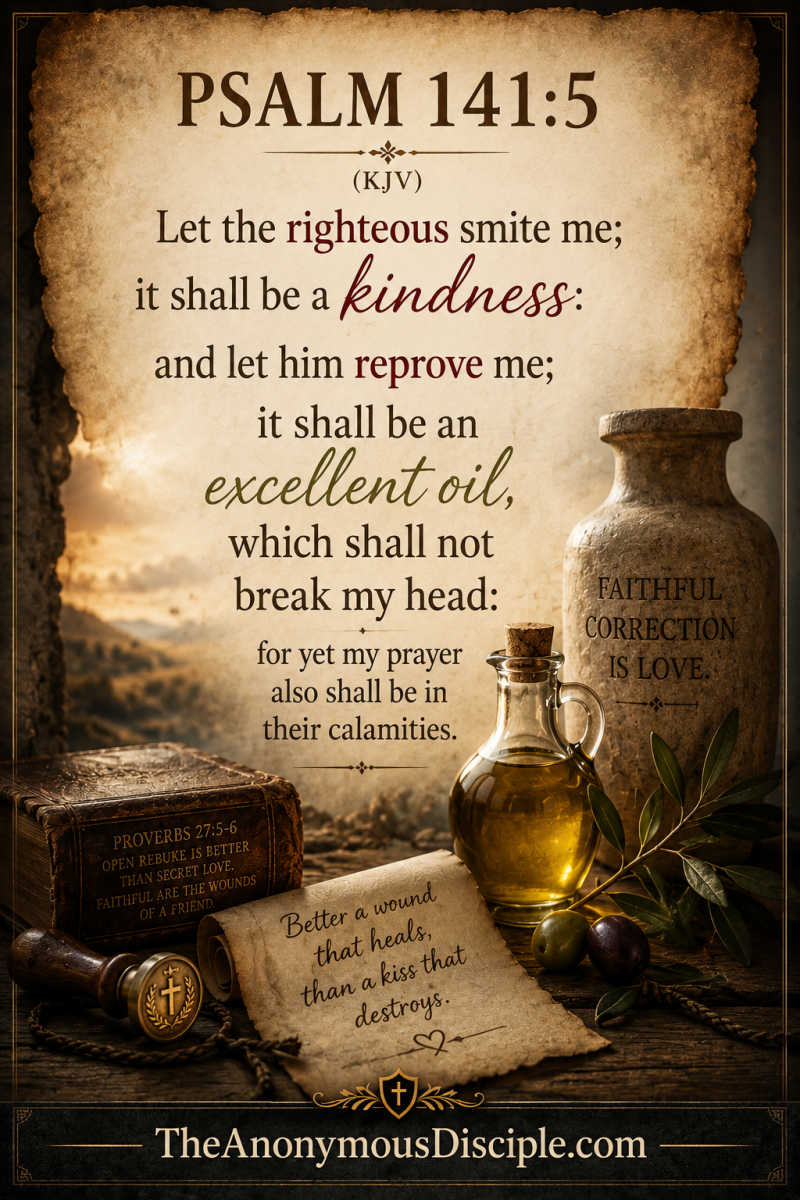
Cross-References for Psalm 141:5
(“Let a righteous man strike me—that is a kindness; let him rebuke me—that is oil on my head. My head will not refuse it…”)
This verse teaches that godly correction is a gift, not something to reject.
- Proverbs 27:5-6 – “Better is open rebuke than hidden love. Wounds from a friend can be trusted, but an enemy multiplies kisses.” (One of the closest parallels—faithful wounds from a friend are better than flattery.)
- Proverbs 9:8 – “Do not rebuke mockers or they will hate you; rebuke the wise and they will love you.” (A wise person welcomes correction; a foolish person rejects it.)
- Proverbs 25:12 – “Like an earring of gold or an ornament of fine gold is the rebuke of a wise judge to a listening ear.” (Rebuke is compared to something valuable and beautiful—just like the “oil” in Psalm 141:5.)
- Proverbs 19:25 – “Flog a mocker, and the simple will learn prudence; rebuke the discerning, and they will gain knowledge.” (Correction actually helps the person who is willing to receive it.)
- Proverbs 6:23 – “…reproofs that discipline are the way to life.” (God’s Word presents correction as life-giving, not harmful.)
- Revelation 3:19 – “Those whom I love I rebuke and discipline. So be earnest and repent.” (Jesus Himself says He corrects the ones He loves.)
- Galatians 6:1 – “Brothers and sisters, if someone is caught in a sin, you who live by the Spirit should restore that person gently…” (Shows the right spirit behind godly correction.)
𝕏James𝕏
Simple Summary
Psalm 141 is a prayer for integrity under pressure. David asks God to guard his mouth (verse 3), keep his heart from drifting toward evil (verse 4), and make him willing to receive hard but helpful correction from the righteous (verse 5). He would rather be rebuked by a godly friend than join the crowd in their sin. The psalm ends with eyes fixed on the Lord and confidence that God will protect him while the wicked fall into their own traps.
🪄꩜Jenny꩜🪄
👄 And Psalm 141:3 Becomes the Daily Prayer
Psalm 141:3 (KJV)
“Set a watch, O LORD, before my mouth; keep the door of my lips.”
There are probably few prayers more practical than that one.
Before answering.
Before correcting somebody.
Before sending the text.
Before repeating the story.
Before responding while angry.
Before saying the thing that is technically true but completely unnecessary. 😬😂
Lord, put a guard at the door.
And perhaps Psalm 141 gives us the other half:
And Lord, when somebody lovingly tells me that guard failed—give me enough humility to receive it.
That, I think, is the beautiful connection between verse 3 and verse 5. ❤️🕊️
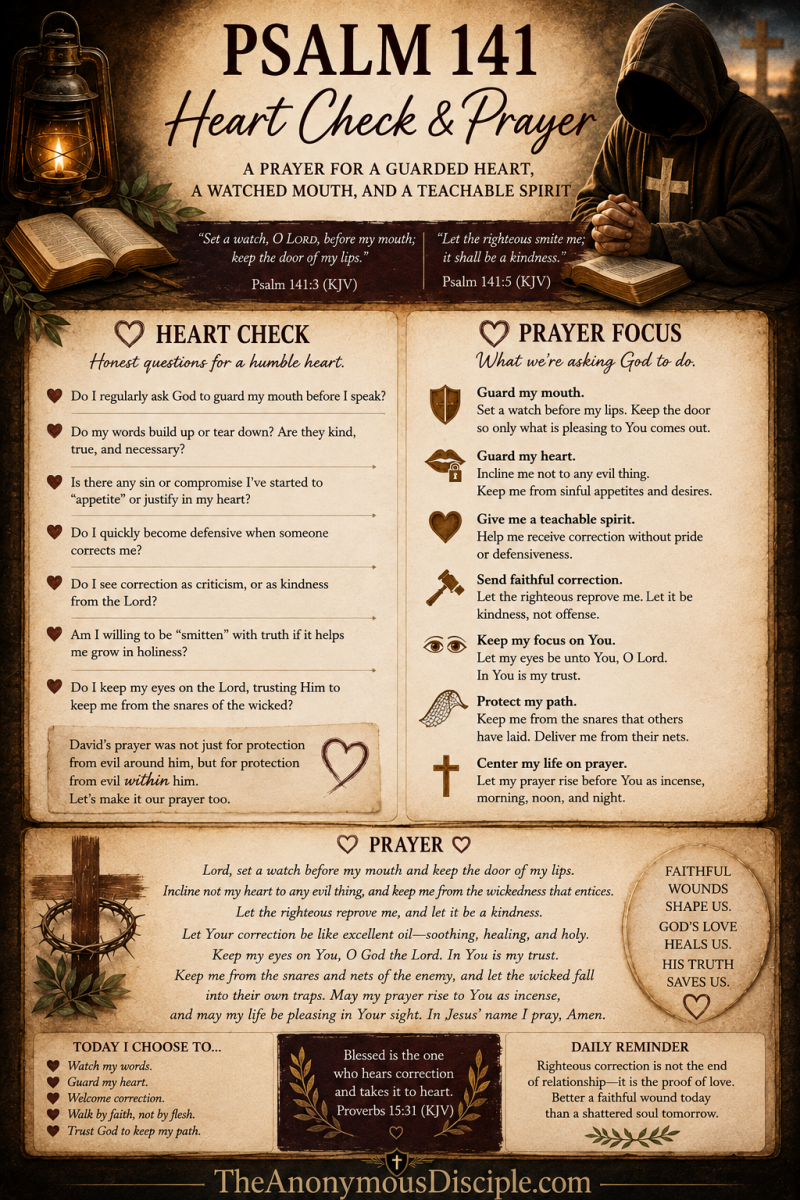
🪄꩜Jenny꩜🪄
📖 Psalm 141 — “Let the Righteous Strike Me”
⚓ Anchor: Psalm 141:5
👄 Supporting focus: Psalm 141:3
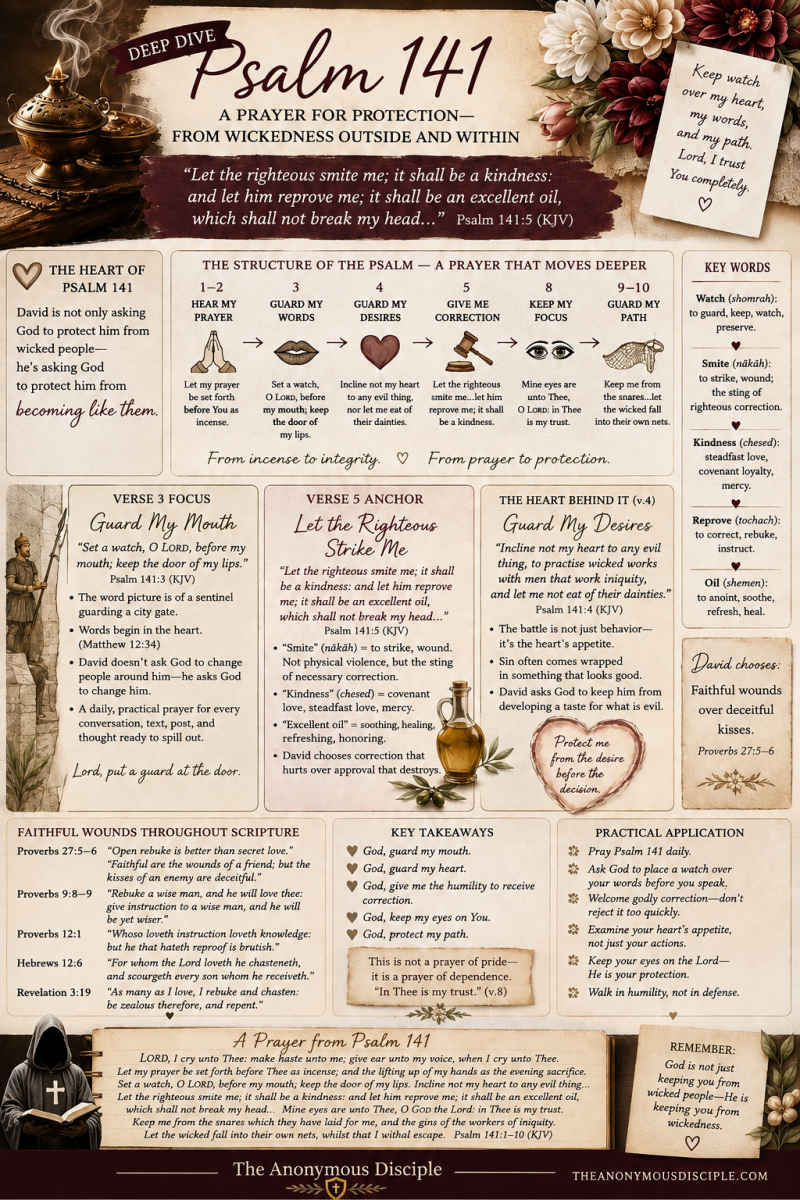
Psalm 141 is a prayer of David asking God for protection—but the danger David is worried about isn't merely what wicked people might do to him.
He's worried about becoming like them.
That changes how we read the whole psalm.
🕯️ 1. “Let my prayer be set forth before thee as incense”
Psalm 141:1–2 (KJV)
“LORD, I cry unto thee: make haste unto me; give ear unto my voice, when I cry unto thee.
Let my prayer be set forth before thee as incense; and the lifting up of my hands as the evening sacrifice.”
David begins with worship imagery.
Incense was continually offered before the LORD, and the evening sacrifice was part of Israel's regular worship.
David essentially says:
“God, receive this prayer as worship.”
That connection becomes explicit elsewhere:
Revelation 5:8 identifies bowls of incense as “the prayers of saints.”
And Revelation 8:3–4 pictures incense rising before God together with the prayers of the saints.
So before David asks God to change his circumstances, he presents himself before God.
And then comes the request that caught your attention.
👄 2. Psalm 141:3 — Guard My Mouth
Psalm 141:3 (KJV)
“Set a watch, O LORD, before my mouth; keep the door of my lips.”
Ohhhhh, David. 😳
Notice what he doesn't pray:
“Lord, make everybody around me stop irritating me.”
😂
He says:
Guard ME.
The word picture is fantastic.
“Set a watch…”
Hebrew שָׁמְרָה — shomrah comes from shamar: to keep, guard, watch, preserve.
Think sentry.
David pictures his mouth like a vulnerable entrance into a city:
🏰 Heart
🚪 Lips
💂 God standing guard
And then:
“keep the door of my lips.”
A door determines what gets through.
David recognizes something Scripture repeatedly teaches:
Words don't begin at the mouth.
They begin in the heart.
Jesus later says:
Matthew 12:34 (KJV)
“…for out of the abundance of the heart the mouth speaketh.”
So David immediately moves deeper.
❤️ 3. The Real Battlefield
Psalm 141:4 (KJV)
“Incline not my heart to any evil thing, to practise wicked works with men that work iniquity…”
There it is.
Verse 3:
Guard my mouth.
Verse 4:
Guard my heart.
David understands that avoiding wickedness isn't simply:
Don't do wicked things.
It's:
Don't let my heart start wanting them.
That echoes:
Proverbs 4:23 (KJV)
“Keep thy heart with all diligence; for out of it are the issues of life.”
And then David says something fascinating:
“…and let me not eat of their dainties.”
Their delicacies.
Sin often doesn't arrive looking disgusting.
Sometimes it looks delicious.
Comfortable.
Rewarding.
Justifiable.
David asks God:
Don't let me develop an appetite for what wickedness offers.
And THAT brings us to your anchor.
⚓ 4. Psalm 141:5 — “Let the righteous smite me”
Psalm 141:5 (KJV)
“Let the righteous smite me; it shall be a kindness: and let him reprove me; it shall be an excellent oil, which shall not break my head…”
That is one tough little verse.
David essentially says:
“I'd rather be hurt by righteous correction than seduced by wicked approval.”
🔥
Look at the contrast between verses 4–5:
The wicked offer delicacies.
The righteous offer correction.
One feels pleasant but can destroy you.
The other may hurt but can preserve you.
David chooses the second.
🩹 5. “Let the righteous smite me”
The Hebrew verb is נָכָה — nakah.
It can mean:
strike, smite, beat, wound.
David deliberately uses strong language.
He isn't asking somebody to physically punch him. 😂
He's acknowledging what genuine correction can feel like.
A rebuke can land like a blow.
Especially when…
😬 we're embarrassed
😠 we're defensive
🙄 we think we're right
😳 the person actually IS right
David says:
Let it land.
Don't protect my pride at the expense of my holiness.
🤍 6. “It shall be a kindness”
Now here's the beautiful part.
The word translated “kindness” is connected with Hebrew חֶסֶד — hesed.
That's a BIG Bible word.
It carries the idea of:
steadfast love, covenant faithfulness, mercy, loyal love.
David reframes righteous correction.
Instead of:
“They attacked me.”
He chooses:
“They loved me enough to tell me.”
That requires enormous humility.
Because sometimes the person telling us something uncomfortable isn't our enemy.
They're the person standing between us and a cliff.
🫒 7. “It shall be an excellent oil”
David changes metaphors.
First correction is a strike.
Then correction becomes oil.
That's fascinating.
Oil in Scripture could refresh, soothe, honor and consecrate.
So righteous correction can simultaneously:
sting like a blow
and heal like oil.
Compare:
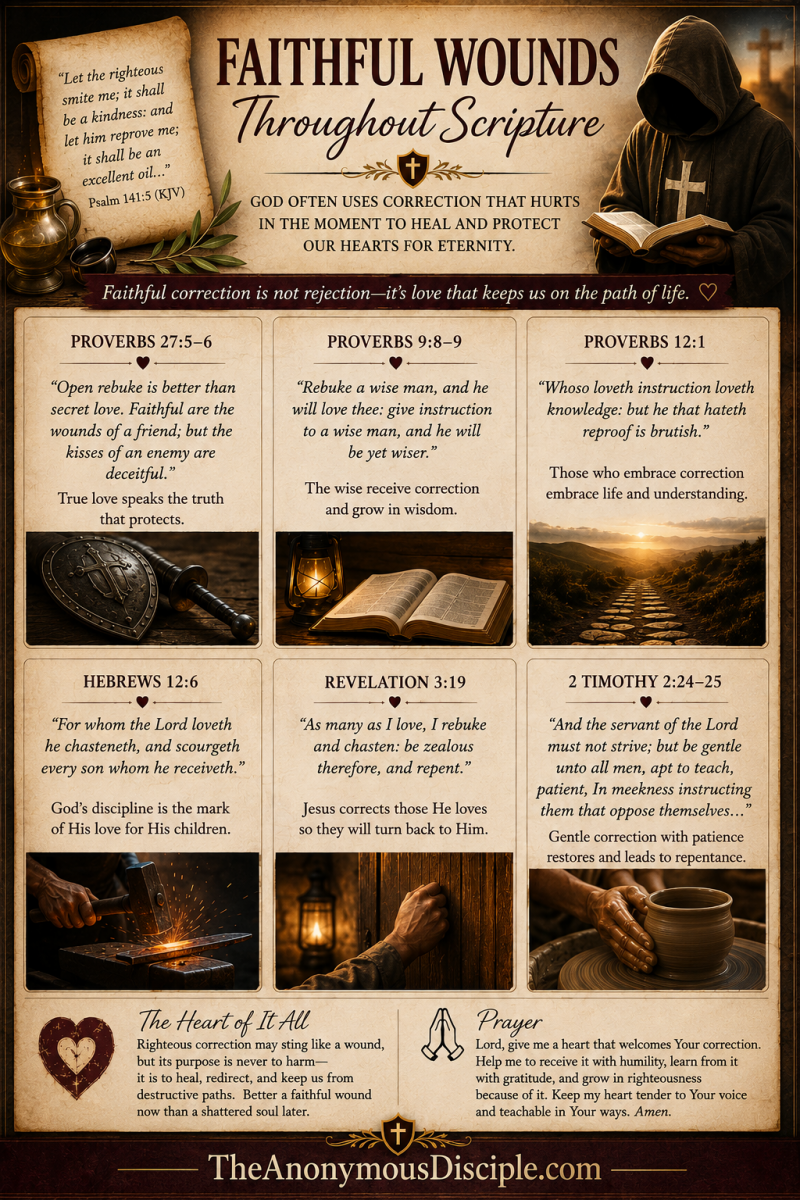
Proverbs 27:5–6 (KJV)
“Open rebuke is better than secret love.
Faithful are the wounds of a friend; but the kisses of an enemy are deceitful.”
That could almost be Psalm 141:5's commentary.
Faithful wounds > deceitful kisses.
🧠 8. Correction Reveals Wisdom
This becomes a major theme in Proverbs.
Proverbs 9:8–9 (KJV)
“…rebuke a wise man, and he will love thee.
Give instruction to a wise man, and he will be yet wiser…”
And:
Proverbs 12:1 (KJV)
“Whoso loveth instruction loveth knowledge: but he that hateth reproof is brutish.”
Biblically, one indication of maturity isn't:
“I don't need correction anymore.”
It's:
“I can receive correction without immediately defending myself.”
That's much harder.
🙏 9. David Doesn't Stop Praying
There's a tricky phrase at the end of verse 5:
Psalm 141:5 (KJV)
“…for yet my prayer also shall be in their calamities.”
The Hebrew here is difficult, which explains why translations differ.
But the general picture appears to be that even while David rejects wickedness, he continues praying concerning/against their evil circumstances or deeds rather than joining them.
That matters because David's solution isn't:
“I'm righteous. They're awful.”
His posture remains prayerful.
And that humility continues through the psalm.
🪤 10. Psalm 141:6–10 — Don't Let Me Fall Into Their Trap
The latter portion becomes difficult Hebrew in places, especially verses 6–7, but the trajectory becomes clear again in verses 8–10.
Psalm 141:8 (KJV)
“But mine eyes are unto thee, O GOD the Lord: in thee is my trust…”
Then:
Psalm 141:9 (KJV)
“Keep me from the snares which they have laid for me…”
And finally:
Psalm 141:10 (KJV)
“Let the wicked fall into their own nets, whilst that I withal escape.”
David begins:
“Guard my mouth.”
And finishes:
“Guard my path.”
That gives Psalm 141 a beautiful structure.
🧵 The Thread Through Psalm 141
Watch David's requests:
Psalm 141:1–2
🙏 Hear my prayer.
⬇️
Psalm 141:3
👄 Guard my words.
⬇️
Psalm 141:4
❤️ Guard my desires.
⬇️
Psalm 141:5
🩹 Give me correction when I need it.
⬇️
Psalm 141:8
👀 Keep my eyes on You.
⬇️
Psalm 141:9–10
🪤 Guard my steps from the trap.
Sherri, that makes me think the heart of Psalm 141 isn't simply:
“God, protect me from wicked people.”
It's something more searching:
“God, while You protect me from wickedness around me, protect me from wickedness developing within me.”
And suddenly verses 3 and 5 fit together perfectly.
⚓ Psalm 141:5 — The Anchor
David is willing to give God permission to use another righteous person to expose something in him that David may not see himself.
That's humility.
And there's a really uncomfortable heart-check hiding here:
When someone corrects me, what happens first?
Do I immediately explain?
Defend?
Counterattack?
Find their faults?
Decide they misunderstood?
Or can I stop long enough to ask:
“Lord…is there truth in this that You want me to hear?”
Because not every criticism is righteous correction. Scripture certainly doesn't require us to accept every accusation as true.
But neither should we reject something simply because it hurts.
Sometimes God's kindness comes wrapped in words we didn't particularly want to hear.
𝕏James𝕏
Verse-by-Verse Breakdown
Verse 1 “I call to you, Lord, come quickly to me; hear me when I call to you.” David is in a hurry. He doesn’t dress it up. He simply says, “Lord, I need You right now—please listen.” Honest, urgent prayer is the starting place.
Verse 2 “May my prayer be set before you like incense; may the lifting up of my hands be like the evening sacrifice.” He wants his prayer to be pleasing to God—not just a list of requests, but something that rises like sweet-smelling incense in the temple. Lifting his hands is a picture of surrender and worship.
Verse 3 (special nod) “Set a guard over my mouth, Lord; keep watch over the door of my lips.” This is one of the most practical prayers in the whole Bible. David knows how easily words can get away from us—especially when we’re hurt, angry, or tempted. He asks God to station a guard at the “door” of his mouth so nothing careless, bitter, or sinful slips out. It’s not just about avoiding bad speech; it’s about inviting God to control what comes out of us before it ever leaves our lips. Many of us need this prayer daily.
Verse 4 “Do not let my heart be drawn to what is evil so that I take part in wicked deeds along with those who are evildoers; do not let me eat their delicacies.” David knows the real battle is inside. He asks God to keep his heart from being pulled toward the same wrong things the people around him enjoy. “Don’t let me sit at their table and start liking what they like.” Temptation often starts with attraction, not just action.
Verse 5 (the anchor) “Let a righteous man strike me—that is a kindness; let him rebuke me—that is oil on my head. My head will not refuse it, for my prayer will still be against the deeds of evildoers.” Here is the heart of the psalm. David would rather be corrected—even sharply—by a godly person than be praised or comforted by the ungodly. He calls a faithful rebuke “a kindness” and compares it to oil poured on the head (a picture of blessing and refreshment in that culture). He refuses to reject it. At the same time, he keeps praying against the evil that surrounds him. In other words: “Lord, keep me teachable. I’d rather be wounded by truth from a friend than soothed by lies from the world.”
Verse 6 “Their rulers will be thrown down from the cliffs, and the wicked will learn that my words were well spoken.” David looks ahead and trusts that one day the proud and powerful who oppose God will fall, and people will see that his careful, faithful words were right all along.
Verse 7 “They will say, ‘As one plows and breaks up the earth, so our bones have been scattered at the mouth of the grave.’” This is a hard picture of total defeat—like bones scattered and crushed. It shows how complete the judgment of the wicked can be.
Verse 8 “But my eyes are fixed on you, Sovereign Lord; in you I take refuge—do not give me over to death.” After looking at the danger, David deliberately turns his eyes back to the Lord. His safety is not in his own strength but in God alone.
Verse 9 “Keep me safe from the traps set by evildoers, from the snares they have laid for me.” He asks for protection from the hidden dangers and schemes of those who want to trip him up.
Verse 10 “Let the wicked fall into their own nets, while I pass by in safety.” David trusts God to turn the enemy’s own traps back on them, while he walks through unharmed.
Add comment
Comments