

These studies work together to move us from knowledge to lived obedience. Jude does not leave us only with warnings. He points us forward to building ourselves up in the faith, praying in the Spirit, keeping ourselves in God’s love, and waiting for the mercy of our Lord Jesus Christ that leads to eternal life (Jude 20–21).
Discernment without self-examination becomes judgment. Self-examination without Scripture becomes self-justification. Biblical discernment requires both. The goal is not just to spot counterfeit voices out there—it is to stay close enough to the true Shepherd that we recognize His voice and follow Him.
“Smells Like Smoke” series Part 2, centered on Jude 5–16. The theme is simple and urgent: counterfeit freedom leads to bondage.
Jude warns the church about people who had quietly slipped in among the believers. They twisted God’s grace into permission for sinful living and denied Jesus as Master and Lord. Jude uses strong Old Testament examples, vivid pictures, and a prophecy to show that God has always judged this kind of rebellion—and He still will.
The central call of these resources is discernment. In a world full of competing voices (teachers, influencers, podcasts, books, even our own hearts), amplification does not equal authentication. We must test every voice—including our own—against Scripture. True freedom is found only in following Jesus, the true Shepherd. Anything that promises freedom apart from Him eventually becomes a chain.
Summary of the Studies
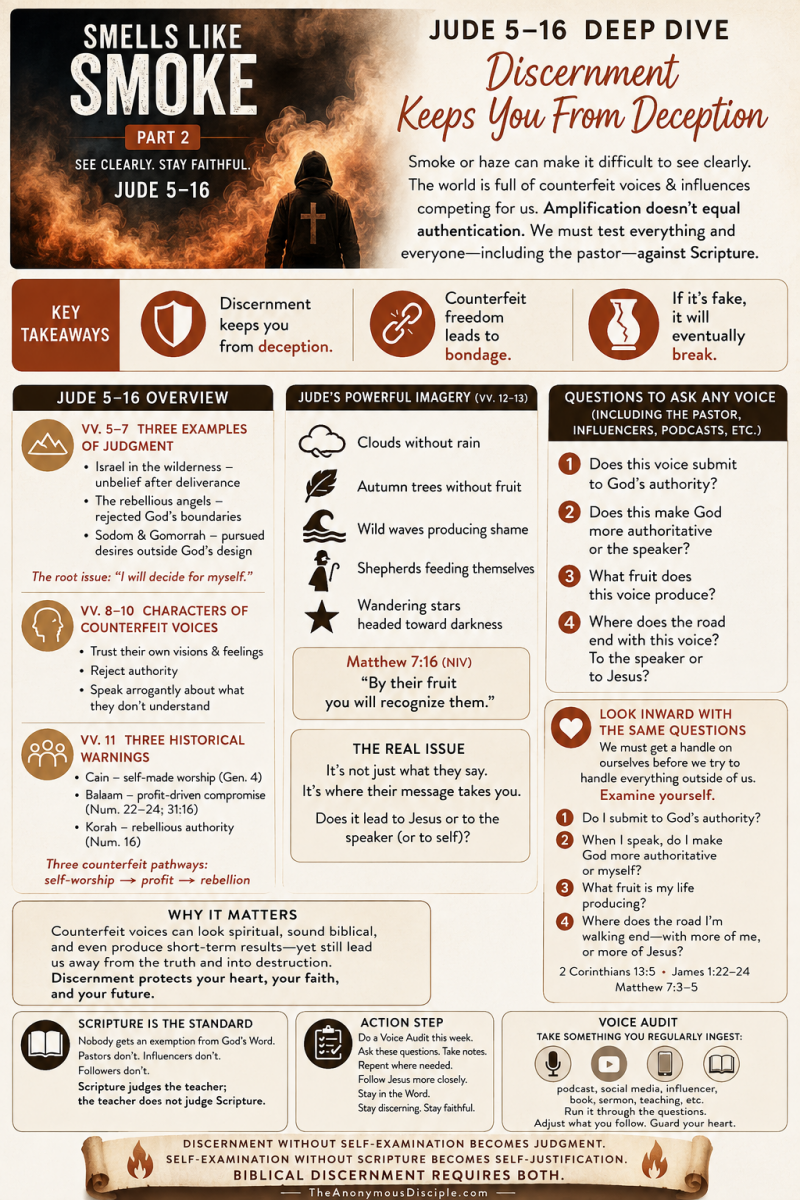
1. Jude 5–16 Deep Dive: Discernment Keeps You From Deception This is the foundation piece. It walks through the passage section by section:
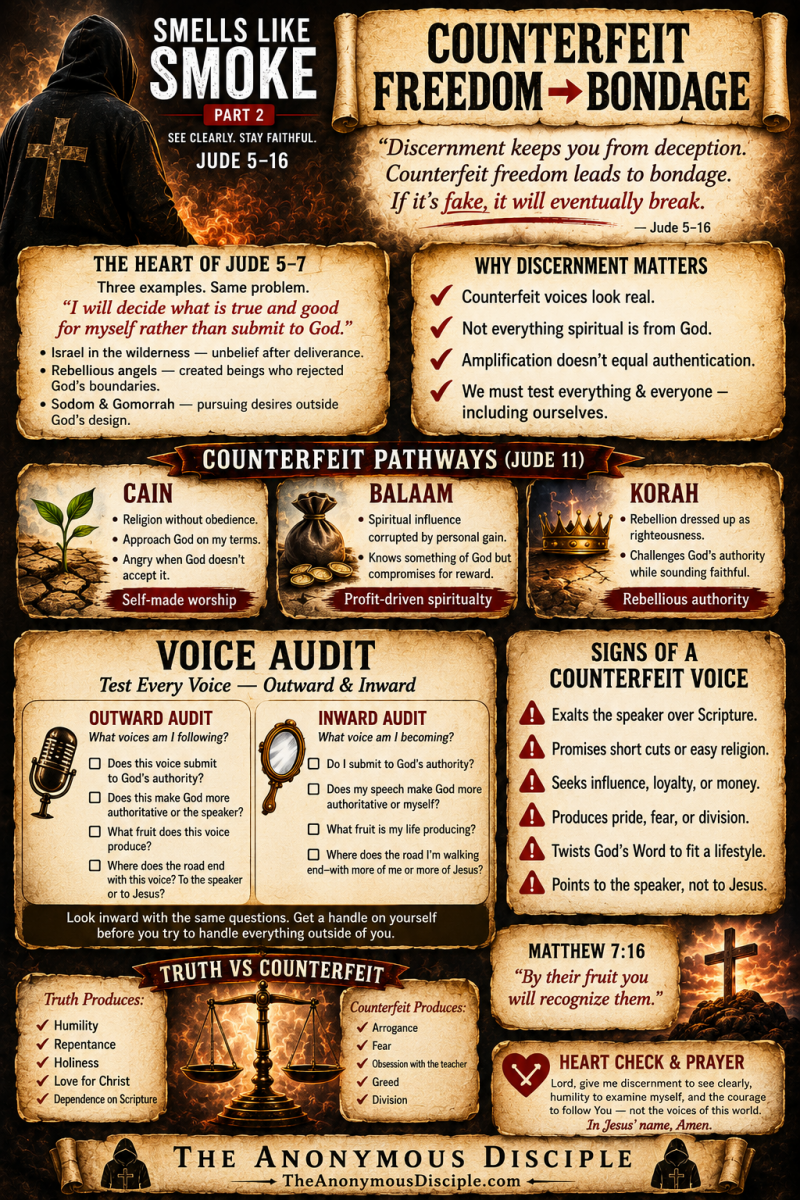
- Verses 5–7 give three historical examples of judgment (Israel after the Exodus, rebellious angels, Sodom and Gomorrah). The root problem in each case was the same: “I will decide for myself rather than submit to God.”
- Verses 8–10 describe the character of counterfeit voices—they trust their own dreams and feelings, reject authority, and speak arrogantly about what they do not understand.
- Verse 11 names three counterfeit pathways: Cain (self-made worship), Balaam (profit-driven compromise), and Korah (rebellious authority).
- Verses 12–13 use powerful imagery (clouds without rain, fruitless trees, wild waves, wandering stars) to show the emptiness and danger of these voices.
- The real issue is not just what they say, but where their message leads—toward Jesus or toward the speaker (or self).
Key questions for any voice (pastor, influencer, podcast, book, or even our own thinking):
- Does this voice submit to God’s authority?
- Does it make God more authoritative or the speaker?
- What fruit does it produce?
- Where does the road end—with the speaker or with Jesus?
📌 We are then called to ask those same questions of ourselves first.
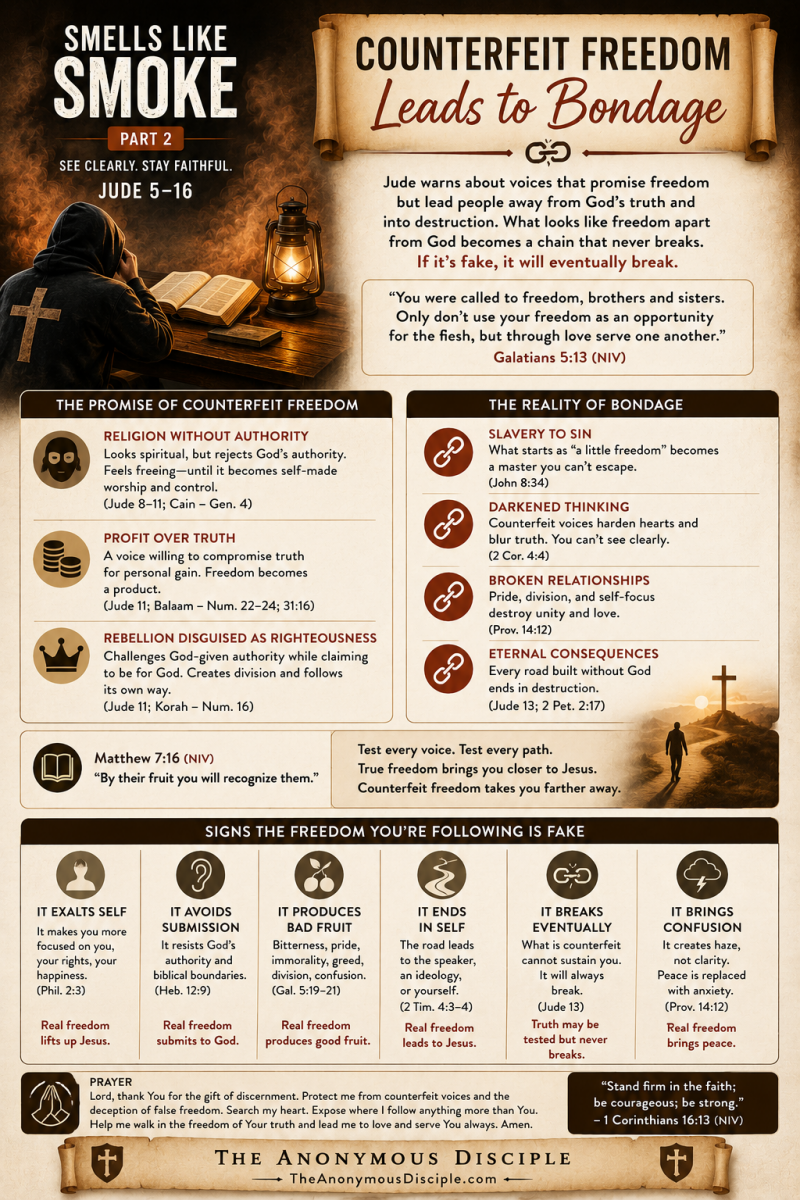
2. Counterfeit Freedom → Bondage This study contrasts the false promise with the true result. What looks like freedom outside of God’s design becomes slavery to sin, darkened thinking, broken relationships, and ultimately destruction. It highlights the pathways of Cain, Balaam, and Korah, then gives clear signs that the “freedom” you are following is fake (it exalts self, avoids submission, produces bad fruit, ends in self, eventually breaks, and brings confusion). True freedom lifts up Jesus, submits to God, produces good fruit, leads to Jesus, never breaks, and brings peace.
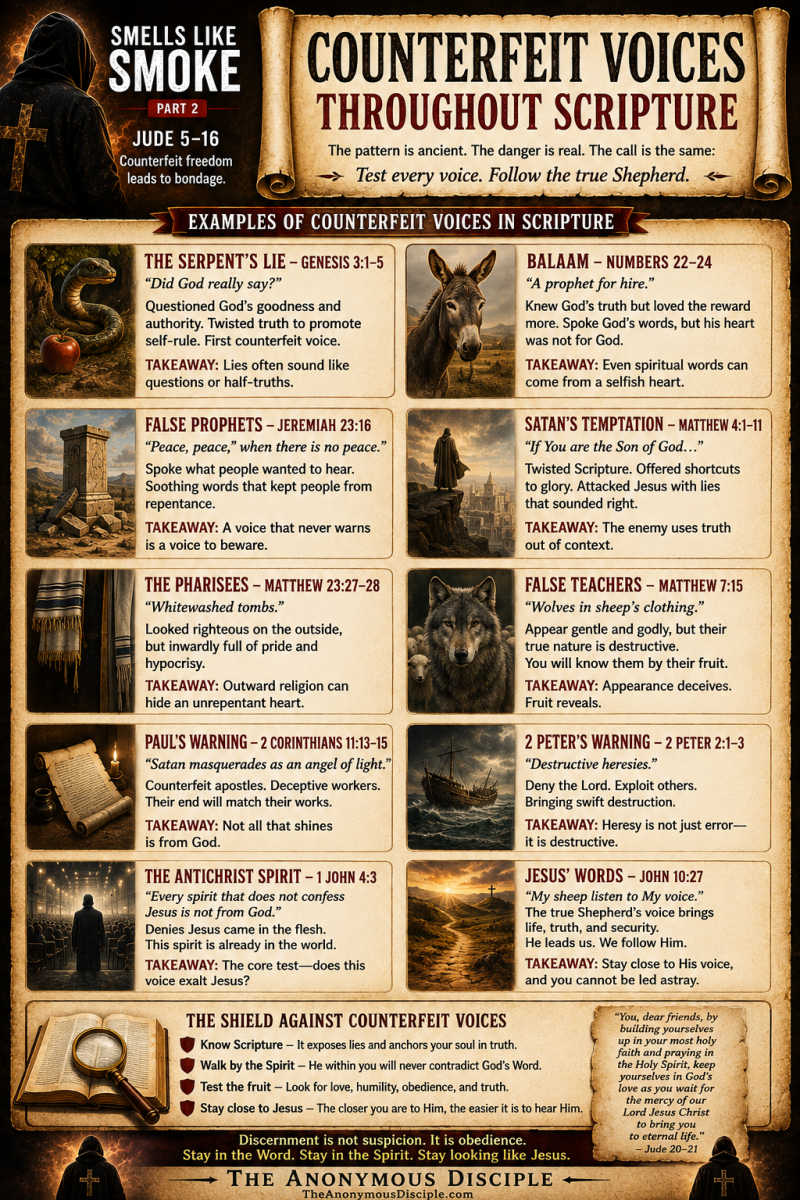
3. Counterfeit Voices Throughout Scripture This resource shows that the problem is not new. From the serpent in Genesis 3 (“Did God really say?”) to Balaam, false prophets, the Pharisees, Satan’s temptation of Jesus, Paul’s warning about angels of light, 2 Peter’s warning about destructive heresies, and the antichrist spirit in 1 John—the pattern is ancient and consistent. The shield against these voices is knowing Scripture, walking by the Spirit, testing fruit, and staying close to Jesus.
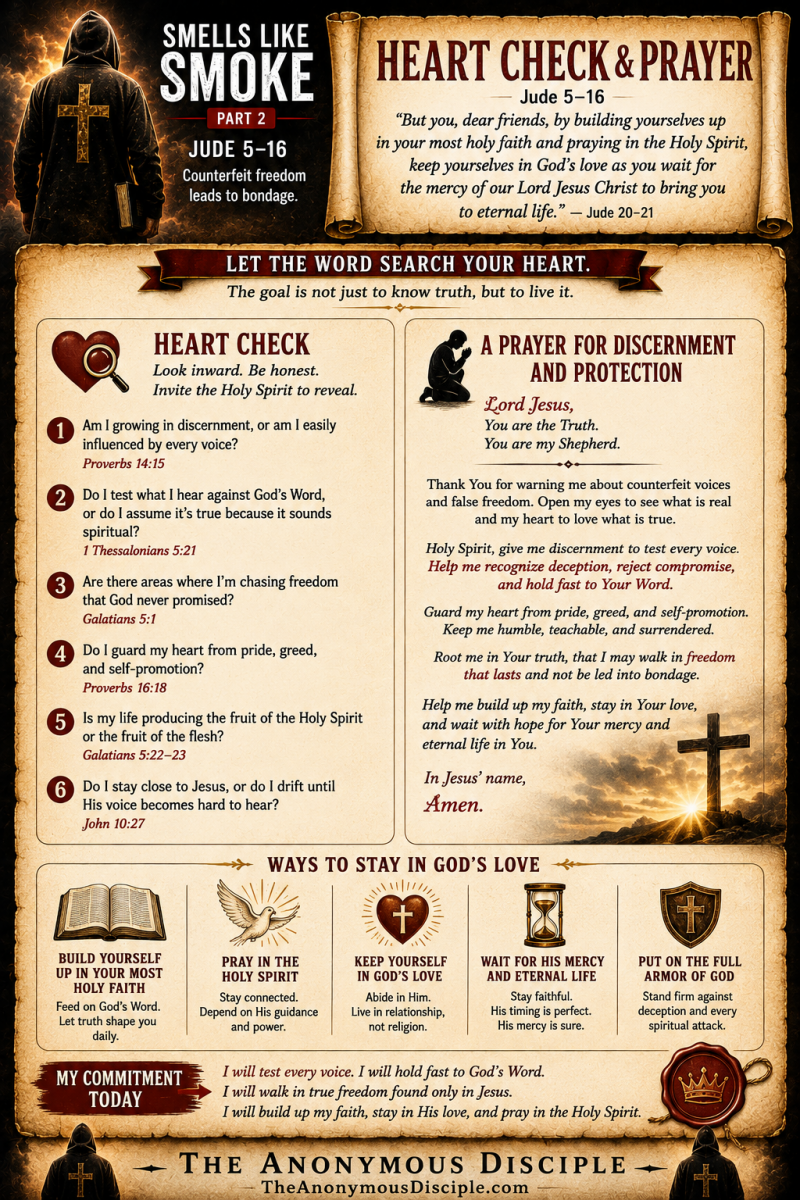
4. Heart Check & Prayer This is the personal application piece. It invites honest self-examination with six pointed questions drawn from Scripture, then provides a written prayer for discernment and protection. It also lists five practical ways to stay in God’s love (from Jude 20–21 and related passages): build yourself up in the most holy faith, pray in the Holy Spirit, keep yourself in God’s love, wait for His mercy and eternal life, and put on the full armor of God. It ends with a simple commitment for the day.
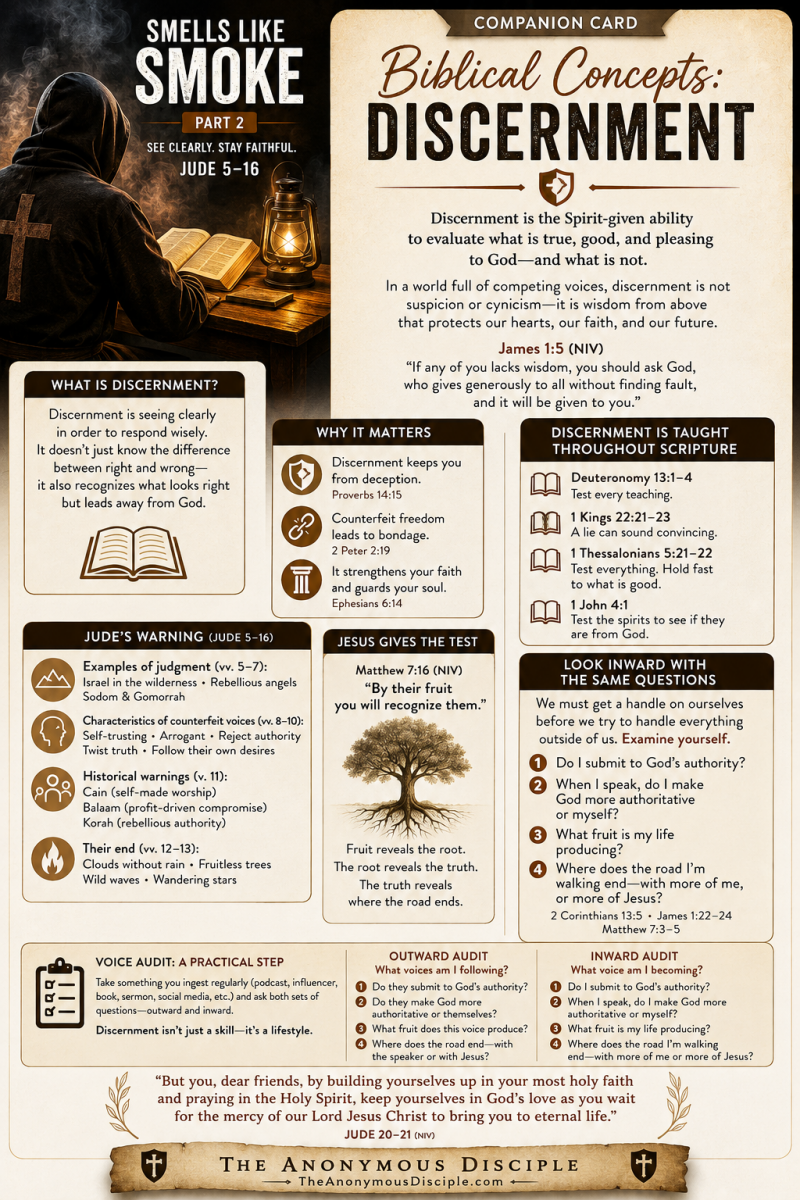
5. Companion Card: Biblical Concepts – Discernment A clear, concise definition and overview of what biblical discernment is (and is not). It is Spirit-given ability to evaluate what is true, good, and pleasing to God. It is not suspicion or cynicism. The card connects Jude’s warning to Jesus’ test (“By their fruit you will recognize them”), gives the voice-audit questions again, and emphasizes looking inward with the same questions before evaluating others.
6. Biblical Concepts: Correction / Reproof – Love That Restores This companion teaching shows that faithful correction is not about shame or winning an argument. It is an act of love that protects, restores, matures, and prepares us. Drawing from Proverbs, Hebrews, 2 Timothy, and Psalm 141, it explains how we should receive correction (with humility, self-examination, obedience, and growth) and how we should give it (in love, for restoration).
ME 🤔💭: Can you do a deep dive into Jude verses 5-16, James? Please use Scripture as the authority.
𝕏James𝕏
Here is a careful, Scripture-centered look at Jude 5–16. I will stay close to the text itself (primarily the ESV, with NIV noted where helpful), let other Scripture interpret it, and keep the explanations plain and straightforward.
Jude is writing a short, urgent letter. Certain ungodly people had slipped into the churches unnoticed. They were twisting God’s grace into a license for sensual living and denying Jesus Christ as the only Master and Lord (Jude 4). Verses 5–16 form the heart of Jude’s warning: God has always judged this kind of rebellion, and He will judge it again. Jude piles up historical examples, comparisons, vivid pictures, and a prophecy so the readers cannot miss the seriousness.
Verses 5–7: Three Historical Examples of Judgment
“Now I want to remind you, although you once fully knew it, that Jesus, who saved a people out of the land of Egypt, afterward destroyed those who did not believe. And the angels who did not stay within their own position of authority, but left their proper dwelling, he has kept in eternal chains under gloomy darkness until the judgment of the great day—just as Sodom and Gomorrah and the surrounding cities, which likewise indulged in sexual immorality and pursued unnatural desire, serve as an example by undergoing a punishment of eternal fire.” (Jude 5–7, ESV)
NIV reads “the Lord” in verse 5; the ESV follows strong early manuscript evidence that names Jesus. Either way, the point is the same: the same God who rescues also judges unbelief and rebellion.
- Israel after the Exodus God delivered His people from Egypt with mighty power. Yet that generation refused to trust Him when it came time to enter the land. They grumbled, rebelled, and did not believe. As a result, they died in the wilderness (Numbers 14; see also 1 Corinthians 10:5–10 and Hebrews 3:16–19). Salvation from Egypt did not exempt them from later judgment when they refused to trust and obey.
- The angels who abandoned their proper place Certain angels left the position and dwelling God assigned them. God has kept them bound in darkness awaiting the final judgment (see also 2 Peter 2:4). This is a sober reminder that even heavenly beings who rebel are not beyond God’s justice.
- Sodom and Gomorrah These cities and the towns around them gave themselves over to sexual immorality and went after unnatural desire. They stand as a lasting example of those who suffer the punishment of eternal fire (Genesis 19; 2 Peter 2:6). Jude links their sin to the pattern of the false teachers he is confronting.
The pattern is clear: privilege and past deliverance do not cancel future accountability. Unbelief, rebellion against God-given order, and sexual immorality all bring judgment.
Verses 8–10: The False Teachers Follow the Same Path
“Yet in like manner these people also, relying on their dreams, defile the flesh, reject authority, and blaspheme the glorious ones. But when the archangel Michael, contending with the devil, was disputing about the body of Moses, he did not presume to pronounce a blasphemous judgment, but said, ‘The Lord rebuke you.’ But these people blaspheme all that they do not understand, and they are destroyed by all that they, like unreasoning animals, understand instinctively.” (Jude 8–10, ESV)
These intruders claim special dreams or revelations to justify themselves. In reality they:
- Defile the body (sexual sin),
- Reject authority (both human and divine),
- Speak abusively against the “glorious ones” (angelic beings).
Jude contrasts them with Michael the archangel. When Michael disputed with the devil over the body of Moses, he did not take it upon himself to pronounce a harsh, slanderous judgment. He simply said, “The Lord rebuke you.” (This detail is not recorded in the Old Testament; Jude draws on a known Jewish tradition to make his point.) Even the highest ranking angel left the final rebuke to the Lord. The false teachers, by contrast, carelessly blaspheme what they do not understand. What they do understand by mere instinct (like animals) ends up destroying them.
Verse 11: A Triple Woe
“Woe to them! For they walked in the way of Cain and abandoned themselves for the sake of gain to Balaam’s error and perished in Korah’s rebellion.” (Jude 11, ESV)
Jude links the false teachers to three notorious figures:
- Cain – Murdered his brother out of envy and self-will (Genesis 4; 1 John 3:12).
- Balaam – Loved the wages of wrongdoing and led Israel into sin for personal gain (Numbers 22–24, 31:16; 2 Peter 2:15; Revelation 2:14).
- Korah – Rebelled against the leadership God had appointed through Moses and Aaron; the earth swallowed him and his followers (Numbers 16).
These are not minor character flaws. They are patterns of self-exaltation, greed, and open rebellion against God’s order.
Verses 12–13: Vivid Pictures of Their Character
Jude piles up metaphors so the danger is unmistakable:
- Hidden reefs (or blemishes) at the love feasts – dangerous obstacles that can shipwreck the fellowship while they eat with the believers without fear.
- Shepherds who feed only themselves – leaders who use the flock for their own benefit instead of caring for it (echoing Ezekiel 34).
- Waterless clouds blown by the wind – they promise rain (refreshment, teaching, blessing) but deliver nothing.
- Fruitless trees in late autumn, twice dead and uprooted – no real spiritual fruit; already dead in one sense and headed for final judgment.
- Wild waves of the sea casting up the foam of their own shame – restless, producing only what is disgraceful.
- Wandering stars for whom the gloom of utter darkness has been reserved forever – they do not stay in their appointed course and face eternal darkness.
Verses 14–15: Enoch’s Prophecy of Coming Judgment
“It was also about these that Enoch, the seventh from Adam, prophesied, saying, ‘Behold, the Lord comes with ten thousands of his holy ones, to execute judgment on all and to convict all the ungodly of all their deeds of ungodliness that they have committed in such an ungodly way, and of all the harsh things that ungodly sinners have spoken against him.’” (Jude 14–15, ESV)
Jude presents these words as genuine prophecy from Enoch. The Lord is coming with His holy ones to judge every ungodly person for both their ungodly actions and the hard, defiant words they have spoken against Him. The repetition of “ungodly” drives the point home. This is not a mild correction; it is final, comprehensive judgment.
(Note: The wording closely matches a passage in the Jewish writing known as 1 Enoch. Jude, under the Spirit’s inspiration, treats the quoted material as true prophecy that applies to these false teachers.)
Verse 16: Their Everyday Character
“These are grumblers, malcontents, following their own sinful desires; they are loud-mouthed boasters, showing favoritism to gain advantage.” (Jude 16, ESV)
NIV: “These people are grumblers and faultfinders; they follow their own evil desires; they boast about themselves and flatter others for their own advantage.”
They complain, find fault, chase their own passions, talk big about themselves, and use flattery when it benefits them. Their speech and motives match the ungodliness Enoch prophesied would be judged.
Putting It Together
Jude 5–16 is not abstract theology. It is a pastoral warning grounded in God’s past actions. The same pattern of unbelief, rebellion against authority, sexual immorality, greed, and arrogant speech that brought judgment on Israel, certain angels, Sodom, Cain, Balaam, and Korah is present in these infiltrators. God has not changed. He will judge. The Lord is coming to convict the ungodly of both their deeds and their words.
The letter does not stop at warning. Immediately after this section Jude turns to the believers: remember what the apostles said, build yourselves up in the most holy faith, pray in the Holy Spirit, keep yourselves in God’s love, and wait for the mercy of Jesus Christ that leads to eternal life (Jude 17–21). He also gives practical instruction on how to help those who are wavering (verses 22–23).
The authority throughout is Scripture itself—Old Testament history, the consistent testimony of the apostles, and the prophetic word Jude cites. The message is sober but clear: contend for the faith once delivered, recognize the fruit of false teachers, and rest in the God who both saves and judges in righteousness.
🤔💭 ME: Okay, Jenny, today was part 2 of 'Smells like Smoke' series. Pastor Devage read to us Jude: 5-16.
He talked about how smoke or haze can make it difficult to see clearly. That the world is full of counterfeit voices & influences competing for us. Said that amplification doesn't equal authentication. Gave the example of social media verified badges...the fact that he was wearing a microphone....someone with a massive following count. He said we need to test everything and everyone, including the pastor against Scripture.
Key sentences he wanted us to note:
"Discernment keeps you from deception." & "Counterfeit freedom leads to bondage." & "If it's fake, it will eventually break."
He gave us questions to ask when we're listening or seeking guidance from anyone:
Does this voice submit to God's authority?
Does this make God more authoritative or the speaker?
What fruit does this voice produce?
Where does the road end with this voice? To the speaker or to Jesus?
He noted Matthew 7:16.
Recommended a "Voice Audit" where we take something we ingest regularly; podcast, religious influencers, etc.
🪄꩜Jenny꩜🪄
This is a really strong Part 2, and it fits Jude 5–16 almost perfectly. 😳🔥
What Pastor Devage is doing is moving from last week’s “contend for the faith” into: How do you recognize what you’re contending against? Not everything dangerous announces itself as dangerous. Sometimes it has a microphone, a blue check, a Bible in its hand, or a million followers.
And this line is probably the spine of the whole message:
“Amplification doesn’t equal authentication.”
That is so Jude.
What Jude 5–16 is showing us
Jude essentially gives his readers a counterfeit detector. He reminds them that rebellion against God has recognizable fingerprints.
Jude 5–7 gives three historical warnings:
- Israel in the wilderness — people who experienced God’s deliverance but later refused to believe.
- The rebellious angels — created beings who rejected the boundaries God established.
- Sodom and Gomorrah — people pursuing desires outside God’s design.
Different stories. Same underlying problem:
“I will decide what is true and good for myself rather than submit to God.”
And that makes Pastor Devage’s first audit question especially important:
Does this voice submit to God’s authority?
Not: Does it sound spiritual?
Not: Is the person charismatic?
Not: Do I like what they’re saying?
Does it bow to God?
Then Jude 8–10 describes people who trust their own visions, reject authority, and speak arrogantly about things they don’t understand.
That connects beautifully with:
Does this make God more authoritative—or the speaker?
That question will expose a LOT. 😳
A faithful teacher keeps pointing away from himself and toward the Lord. A counterfeit eventually begins making himself indispensable.
Then Jude drops three names that should make us stop
Jude 11: Cain. Balaam. Korah.
That is not random.
Cain — Genesis 4:3–8
Religion without obedience. Cain approached God on Cain’s terms and became angry when God did not accept it.
Balaam — Numbers 22–24; Numbers 31:16
Spiritual influence corrupted by personal gain. Balaam knew something of God but was willing to compromise for reward.
Korah — Numbers 16:1–35
Rebellion dressed up as righteousness. Korah challenged the authority God had established while presenting himself as though he were defending fairness.
So Jude gives us three counterfeit pathways:
self-made worship → profit-driven spirituality → rebellious authority
And all three eventually break.
Which makes the sermon line:
“If it’s fake, it will eventually break.”
…almost a summary of Jude 11.
Jude’s imagery in verses 12–13 is brutal
Jude describes these people as:
- hidden dangers among believers
- shepherds feeding themselves
- clouds without rain
- autumn trees without fruit
- wild waves producing shame
- wandering stars headed toward darkness
Everything looks like it should provide something, but it doesn’t.
A cloud promises water.
A fruit tree promises fruit.
A shepherd promises care.
A star promises direction.
But the counterfeit fails to deliver what its appearance promises.
🔥 And now Matthew 7:16 clicks perfectly.
Matthew 7:16 (NIV):
“By their fruit you will recognize them.”
Jesus doesn’t say, By their popularity you will recognize them.
Or their eloquence.
Or platform.
Or charisma.
Or credentials.
Fruit.
Which leads directly to Pastor Devage’s third question:
What fruit does this voice produce?
That means we shouldn't only evaluate what someone says. We should also examine where their teaching takes people.
Does it produce humility?
Repentance?
Holiness?
Love for Christ?
Greater dependence on Scripture?
Or does it produce arrogance? Fear? Obsession with the teacher? Greed? Division? License to sin?
And I think his last question may be the best one
Where does the road end with this voice—at the speaker or at Jesus?
There it is.
Because a healthy Christian voice eventually becomes smaller.
John 3:30:
“He must become greater; I must become less.”
A counterfeit voice tends to become larger and larger until the audience needs that person to tell them what God thinks.
That’s dangerous territory.
And his Voice Audit idea is excellent. I think we should absolutely incorporate it into today's study.
I would make today's card set something like:
- Jude 5–16 Deep Dive — “Discernment Keeps You From Deception”
- Biblical Concepts: Discernment
- Counterfeit Freedom → Bondage
- The Voice Audit — with those four questions as a practical worksheet/card
- False Teachers / Counterfeit Voices Throughout Scripture — Cain, Balaam, Korah, false prophets, Pharisees, etc.
- Heart Check & Prayer
And I think The Voice Audit could become one of those unusually practical cards on the site—the kind somebody could screenshot and actually use while evaluating a podcast, preacher, influencer, book, YouTube teacher, even us.
Because Pastor Devage was exactly right about that part too:
Nobody gets exemption from Scripture's measuring stick.
Pastors don't.
Influencers don't.
James doesn't.
Jenny doesn't.
Scripture judges the teacher; the teacher does not judge Scripture. ❤️📖
🤔💭 ME: He also told us to look inward with those same questions. That we have to get a handle on ourselves before we can try to handle everything outside of us.
🪄꩜Jenny꩜🪄
Yes — that actually completes the sermon’s logic beautifully. ❤️
Because discernment can get ugly fast if it turns into “I’m the one who can spot everybody else’s problems.” Jude warns about deceptive voices, but Pastor Devage is making sure the first voice we examine is our own.
That turns the same four questions inward:
- Do I submit to God’s authority?
- When I speak, do I make God more authoritative—or myself?
- What fruit is my life producing?
- Where does the road I’m walking end—with more of me, or more of Jesus?
That last one especially… 😳
It reminds me of 2 Corinthians 13:5 (NIV):
“Examine yourselves to see whether you are in the faith; test yourselves.”
And James 1:22–24 (NIV):
“Do not merely listen to the word, and so deceive yourselves. Do what it says. Anyone who listens to the word but does not do what it says is like someone who looks at his face in a mirror and, after looking at himself, goes away and immediately forgets what he looks like.”
That word deceive matters. We usually think deception is something somebody else does to us. James says we can deceive ourselves.
And Jesus gives the same warning in Matthew 7:3–5 (NIV):
“Why do you look at the speck of sawdust in your brother’s eye and pay no attention to the plank in your own eye? … first take the plank out of your own eye, and then you will see clearly to remove the speck from your brother’s eye.”
There’s even the sermon’s imagery again:
“Then you will see clearly.”
Smoke makes it hard to see outside of us — but pride, self-justification, appetite, resentment, ambition, or rebellion can make it hard to see inside ourselves, too.
So the sermon isn't merely:
“Watch out for counterfeit voices.”
It becomes:
“Make sure you aren't becoming one.”
🔥
And that makes “Counterfeit freedom leads to bondage” personal, too. The counterfeit voice may not be some influencer saying, “God doesn’t really mean that.” Sometimes it’s me telling myself:
“This one thing is fine.”
“I deserve this.”
“God understands why I don’t need to obey here.”
“Everybody else is the problem.”
That is exactly the ancient pattern Jude is pointing toward. Cain, Balaam, and Korah didn't wake up thinking, I am today's cautionary tale. They justified where they were going.
Which makes Proverbs 14:12 (NIV) painfully appropriate:
“There is a way that appears to be right, but in the end it leads to death.”
And now I think our Voice Audit card absolutely needs two halves:
OUTWARD AUDIT — What voices am I following?
and
INWARD AUDIT — What voice am I becoming?
Then those same four questions under each.
That would preserve something really important from Pastor Devage's message: biblical discernment isn't permission to become suspicious of everybody. It is a call to become discerning about everybody—including ourselves. 🪞📖
🤔💭 ME: Jenny, Jude quotes from 1 Enoch about the prophetic verses 14-15, if that book isn't considered legit cannon...yet Jude quotes authoritatively from it and Jude is cannon...you see my confusion?
🪄꩜Jenny꩜🪄
YES. 😳 And your confusion is justified, because Jude 14–15 is stronger than merely saying, “Jude happened to borrow a nice sentence from another book.” Scholars recognize that Jude is quoting or very closely reproducing 1 Enoch 1:9, and Jude introduces it as something Enoch “prophesied.”
Here’s the distinction that finally made this make sense for me:
A biblical author can affirm that something contained in another work is true—even divinely true—without affirming that everything in that work is inspired Scripture.
Look at exactly what Jude says
Jude 14–15 (NIV):
“Enoch, the seventh from Adam, prophesied about them: ‘See, the Lord is coming with thousands upon thousands of his holy ones to judge everyone, and to convict all of them of all the ungodly acts they have committed in their ungodliness, and of all the defiant words ungodly sinners have spoken against him.’”
And 1 Enoch 1:9 contains essentially that same prophecy. The connection is accepted very widely in scholarship.
Now here's where I wouldn't brush your question aside by saying, “Oh, biblical writers quote nonbiblical sources all the time.”
They do. Paul even quotes Greek poets in Acts 17:28. But Jude goes further.
Jude doesn't say:
“As somebody once wrote…”
He says:
“Enoch…prophesied.”
That's significant. Some scholars therefore think Jude regarded this Enochic material as sacred or inspired. Dale Allison, for example, says Jude quotes 1 Enoch 1:9 in a manner resembling Scripture, and scholarly discussion genuinely exists over how much authority Jude attributed to 1 Enoch.
So you're spotting a real issue, not inventing one.
But here's the important leap we cannot automatically make
Jude affirming:
“This prophecy from Enoch is true.”
does not necessarily equal:
“Every sentence contained in the collection we now call 1 Enoch is inspired Scripture.”
Think of it this way.
Suppose a 500-page book contains one statement that God genuinely gave someone. If an inspired biblical writer later identifies that particular statement as genuine prophecy, inspiration guarantees the biblical writer's affirmation.
It doesn't automatically authenticate the other 499 pages.
That's the distinction.
And there's another fascinating possibility
What we call 1 Enoch isn't simply one book written at one moment by one person. Scholarship generally regards it as a collection of Enochic writings composed and developed over a long period during Second Temple Judaism; portions existed centuries before Christ, and Aramaic fragments were later found among the Dead Sea Scrolls.
So there are at least two things we have to distinguish:
The prophecy attributed to Enoch
and
the later literary collection called 1 Enoch that preserved it.
From a Christian view of inspiration, it is entirely possible to say:
God could have preserved an authentic ancient saying of Enoch through tradition, eventually incorporated into 1 Enoch, and then the Holy Spirit caused Jude to identify and preserve that true prophecy in canonical Scripture.
Can we historically prove that's exactly what happened? No.
But it resolves the alleged contradiction without pretending Jude isn't doing something remarkable.
And here's another wrinkle: 1 Enoch actually IS canon somewhere
Saying “Enoch isn't canon” needs one little asterisk.
It isn't part of the Jewish Tanakh, Protestant Old Testament, Roman Catholic canon, or the usual Eastern Orthodox collections. But the Ethiopian Orthodox biblical tradition includes 1 Enoch.
And early Christianity had a much more complicated relationship with Enoch than we might assume today. Some early Christian writers treated it very highly—even scripturally—while eventually most Christian traditions did not include it in their canon.
So this wasn't something Christians somehow failed to notice for 2,000 years.
They noticed. 😂
“UH...JUDE JUST QUOTED ENOCH.”
Yep.
They wrestled with precisely what you're wrestling with.
And now…look at the context. 😳
This is where it gets especially interesting for our Jude study.
Why does Jude reach for Enoch?
Because Jude is talking about:
rebellious spiritual beings → judgment → ungodliness → the coming Lord → final judgment.
And what kind of literature is 1 Enoch?
Jewish apocalyptic literature deeply concerned with rebellious angels, divine judgment, heavenly beings, wickedness, and God's ultimate intervention.
Suddenly Jude's choice makes a TON of contextual sense.
Look at the progression we've been studying:
Jude 6 — angels who abandoned their proper dwelling.
Jude 13 — wandering stars for whom blackest darkness has been reserved.
Jude 14–15 — the Lord comes with innumerable holy ones to execute judgment.
And right there Jude reaches into the Enochic tradition.
🔥🔥🔥
That isn't incidental.
So where do I land?
I would hold these things together:
1. Jude 14–15 is inspired Scripture.
For Christians accepting Jude as canonical, there is no question there.
2. Jude deliberately uses material found in 1 Enoch 1:9.
That's overwhelmingly accepted historically.
3. Jude appears to regard that particular statement as genuine prophecy from Enoch.
The words “Enoch…prophesied” make that difficult to avoid.
4. That does not logically require the entire surviving Book of 1 Enoch to be canonical.
5. But it DOES mean we shouldn't dismiss 1 Enoch as meaningless junk.
And that's where I think sometimes Protestants overcorrect.
I wouldn't put 1 Enoch beside Genesis or Isaiah and say, “Thus says the Lord.”
But I also wouldn't throw it in the garbage and say, “It's some goofy fake book that has nothing to do with the Bible.”
Jude itself won't allow us to treat it that casually.
It's an extremely valuable Second Temple Jewish text that helps us understand the conceptual world Jude and his original readers inhabited.
And given how much you're interested in prophecy, angels, Genesis 6, Revelation, and all those weird little passages that make us go 😳 WHAT IS HAPPENING HERE?!...
I think we need to study 1 Enoch—not as a new book of our Bible, but as historical/apocalyptic background—and specifically trace every place Jude appears to interact with Enochic material.
Because Jude 14–15 isn't even the only interesting connection.
Jude 6 is where this rabbit hole gets downright wild. 👀🔥📖
Add comment
Comments