

Paul’s final words to Timothy carry the weight of a man who knows his race is nearly finished. In 2 Timothy 4, he looks honestly at what lies ahead—people turning from truth, hardship for those who remain faithful, abandonment, opposition, and ultimately his own approaching death. Yet Paul does not sound defeated. He sounds certain. He has kept the faith, Christ has stood beside him, and a crown awaits.
Right in the middle of that farewell comes our anchor: 2 Timothy 4:5—“But you…” Whatever others choose, Timothy is responsible for his own faithfulness. Keep your head. Endure hardship. Share the Gospel. Fulfill your ministry. Today we’re looking at what it means to remain steady when truth becomes unpopular, to resist the pull of “itching ears,” and to keep running until the assignment God has given us is finished. ❤️📖 -🪄Jenny🪄 —


Today's study:
- NLT v ESV side by side comparison
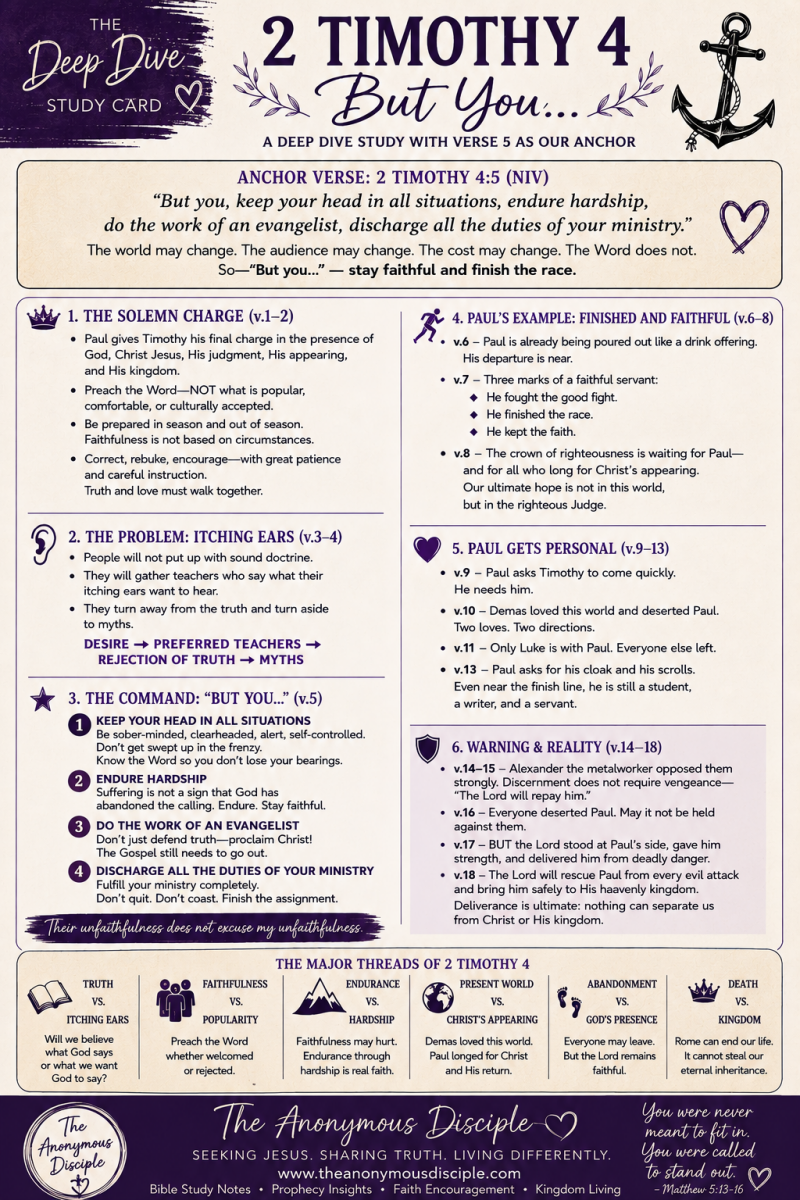
- Deep Dive card
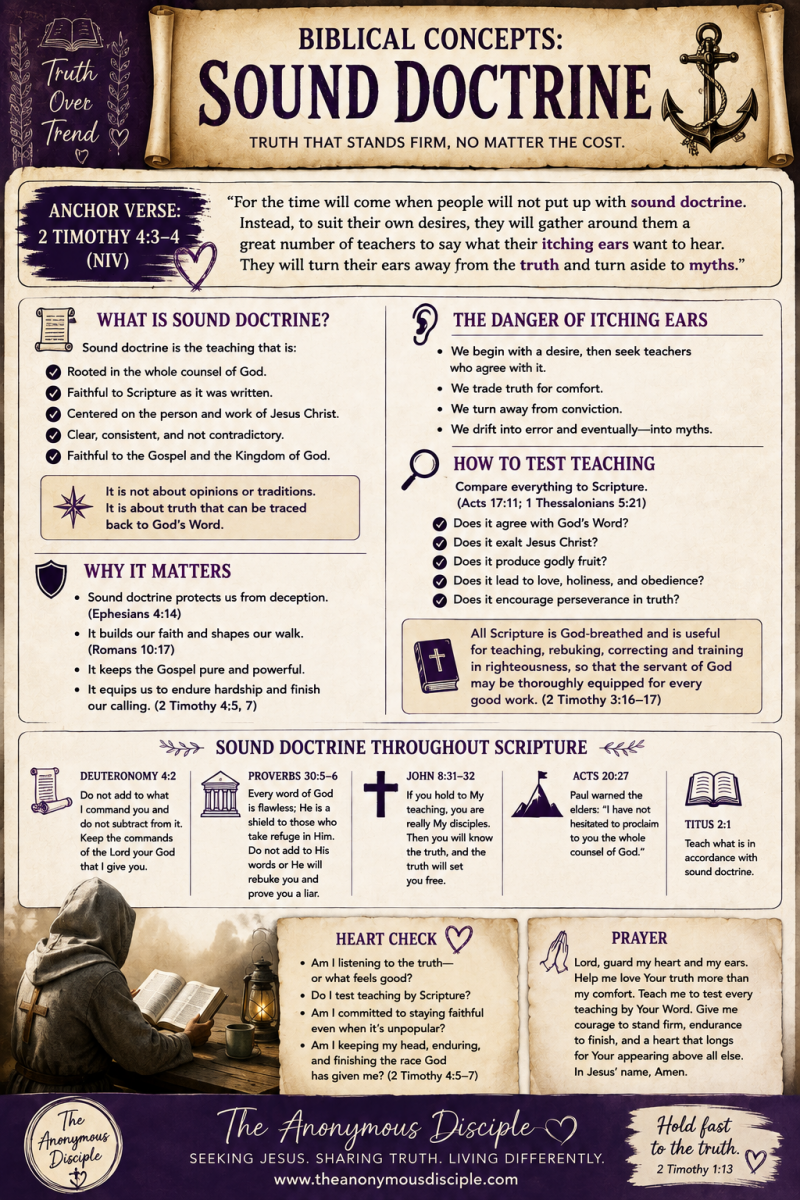
- Biblical Concepts: Sound Doctrine card
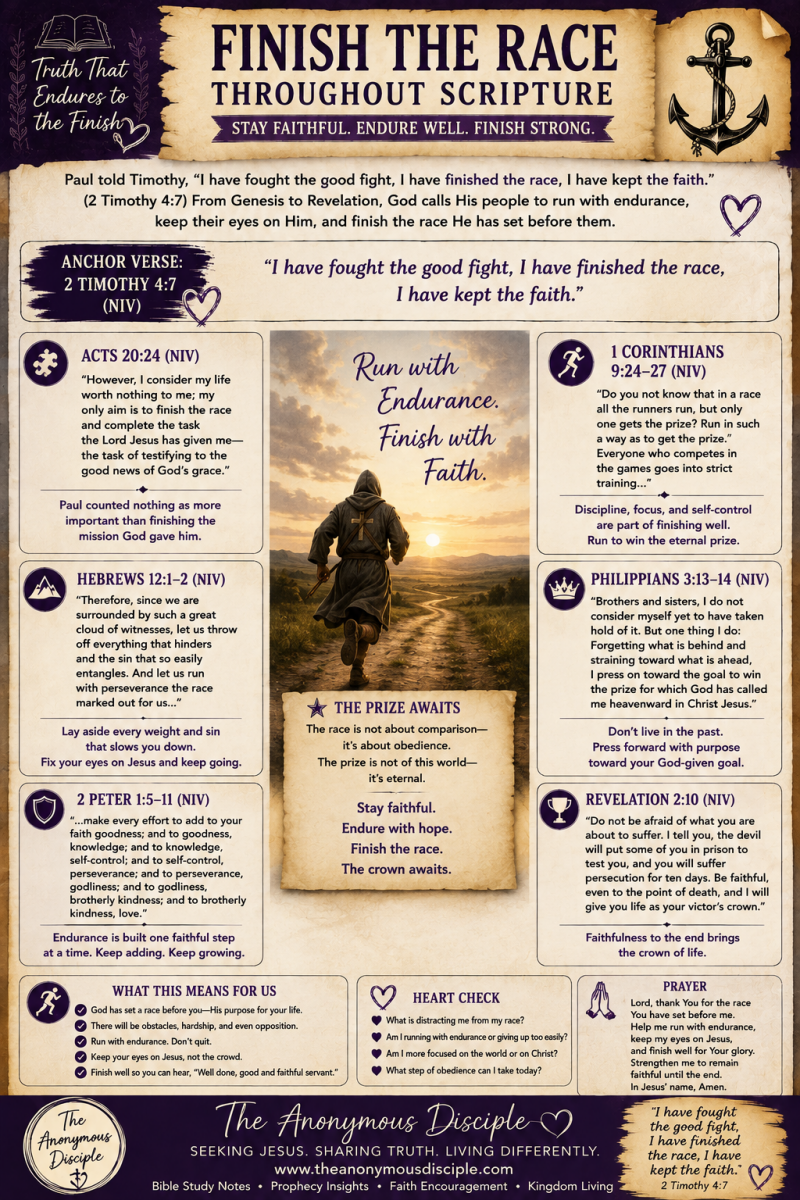
- Finish the Race Throughout Scripture card
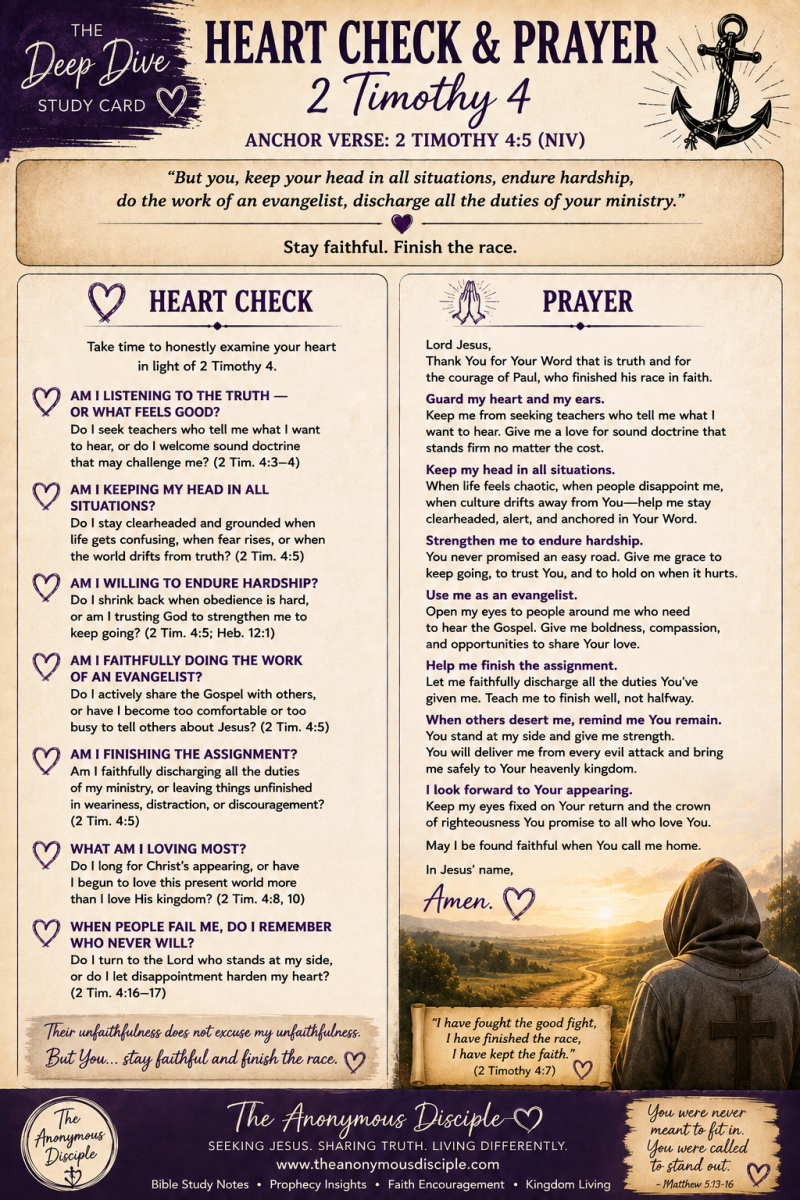
- Heart Check & Prayer card (plus pdf)
- Cross References
- Study Notes
Paul wrote 2 Timothy from a Roman prison during his second imprisonment, most likely between AD 66–67 (some place it as late as early 68).
This was near the end of Emperor Nero’s reign. Nero was actively persecuting Christians after the great fire of Rome in AD 64, and Paul was one of the victims of that crackdown.
Unlike his first Roman imprisonment (described at the end of Acts, around AD 60–62), where he lived under house arrest and could receive visitors freely, this second imprisonment was much harsher. Paul was in a cold, damp dungeon (possibly the Mamertine Prison), chained like a common criminal, and expecting imminent execution.
Key context
- Paul’s situation: He knows his death is very near. In chapter 4 he says, “the time of my departure has come” and “I am already being poured out as a drink offering.” This is his final letter—his last will and testament to Timothy.
- Timothy’s situation: Timothy was still in Ephesus (or nearby in Asia Minor), leading the church there. He was younger, sometimes timid, and facing pressure from false teachers and difficult people.
- Purpose of the letter: Paul is handing the baton to Timothy. He urges him to stay faithful, keep preaching sound doctrine even when people don’t want to hear it, endure hardship, and finish the race. The personal requests in chapter 4 (come quickly, bring the cloak, the books, Mark, etc.) show Paul is lonely, cold, and still thinking about ministry right up to the end.
- Tone: It is both tender and urgent—like a spiritual father writing his last words to a beloved son in the faith.
In short: Paul is in a dark Roman prison cell, facing execution under Nero, writing his final charge to Timothy to keep the faith and finish well no matter the cost. - 𝕏James𝕏

New Living Translation (NLT)
1 I solemnly urge you in the presence of God and Christ Jesus, who will someday judge the living and the dead when he comes to set up his Kingdom: 2 Preach the word of God. Be prepared, whether the time is favorable or not. Patiently correct, rebuke, and encourage your people with good teaching.
3 For a time is coming when people will no longer listen to sound and wholesome teaching. They will follow their own desires and will look for teachers who will tell them whatever their itching ears want to hear. 4 They will reject the truth and chase after myths.
5 But you should keep a clear mind in every situation. Don’t be afraid of suffering for the Lord. Work at telling others the Good News, and fully carry out the ministry God has given you.
6 As for me, my life has already been poured out as an offering to God. The time of my death is near. 7 I have fought the good fight, I have finished the race, and I have remained faithful. 8 And now the prize awaits me—the crown of righteousness, which the Lord, the righteous Judge, will give me on the day of his return. And the prize is not just for me but for all who eagerly look forward to his appearing.
9 Timothy, please come as soon as you can. 10 Demas has deserted me because he loves the things of this life and has gone to Thessalonica. Crescens has gone to Galatia, and Titus has gone to Dalmatia. 11 Only Luke is with me. Bring Mark with you when you come, for he will be helpful to me in my ministry. 12 I sent Tychicus to Ephesus. 13 When you come, be sure to bring the coat I left with Carpus at Troas. Also bring my books, and especially my papers.
14 Alexander the coppersmith did me much harm, but the Lord will judge him for what he has done. 15 Be careful of him, for he fought against everything we said.
16 The first time I was brought before the judge, no one came with me. Everyone abandoned me. May it not be counted against them. 17 But the Lord stood with me and gave me strength so that I might preach the Good News in its entirety for all the Gentiles to hear. And he rescued me from certain death. 18 Yes, and the Lord will deliver me from every evil attack and will bring me safely into his heavenly Kingdom. All glory to God forever and ever! Amen.
19 Give my greetings to Priscilla and Aquila and those living in the household of Onesiphorus. 20 Erastus stayed at Corinth, and I left Trophimus sick at Miletus. 21 Do your best to get here before winter. Eubulus sends you greetings, and so do Pudens, Linus, Claudia, and all the brothers and sisters.
22 May the Lord be with your spirit. And may his grace be with all of you.
English Standard Version (ESV)
1 I charge you in the presence of God and of Christ Jesus, who is to judge the living and the dead, and by his appearing and his kingdom: 2 preach the word; be ready in season and out of season; reprove, rebuke, and exhort, with complete patience and teaching.
3 For the time is coming when people will not endure sound teaching, but having itching ears they will accumulate for themselves teachers to suit their own passions, 4 and will turn away from listening to the truth and wander off into myths.
5 As for you, always be sober-minded, endure suffering, do the work of an evangelist, fulfill your ministry.
6 For I am already being poured out as a drink offering, and the time of my departure has come. 7 I have fought the good fight, I have finished the race, I have kept the faith. 8 Henceforth there is laid up for me the crown of righteousness, which the Lord, the righteous judge, will award to me on that day, and not only to me but also to all who have loved his appearing.
9 Do your best to come to me soon. 10 For Demas, in love with this present world, has deserted me and gone to Thessalonica. Crescens has gone to Galatia, Titus to Dalmatia. 11 Luke alone is with me. Get Mark and bring him with you, for he is very useful to me for ministry. 12 Tychicus I have sent to Ephesus. 13 When you come, bring the cloak that I left with Carpus at Troas, also the books, and above all the parchments.
14 Alexander the coppersmith did me great harm; the Lord will repay him according to his deeds. 15 Beware of him yourself, for he strongly opposed our message.
16 At my first defense no one came to stand by me, but all deserted me. May it not be charged against them! 17 But the Lord stood by me and strengthened me, so that through me the message might be fully proclaimed and all the Gentiles might hear it. So I was rescued from the lion’s mouth. 18 The Lord will rescue me from every evil deed and bring me safely into his heavenly kingdom. To him be the glory forever and ever. Amen.
19 Greet Prisca and Aquila, and the household of Onesiphorus. 20 Erastus remained at Corinth, and I left Trophimus, who was ill, at Miletus. 21 Do your best to come before winter. Eubulus sends greetings to you, as do Pudens and Linus and Claudia and all the brothers.
22 The Lord be with your spirit. Grace be with you.
Cross References
𝕏James𝕏 -
Here are the main cross-references for 2 Timothy 4, organized by section so they’re easy to look up. These come from standard study Bibles and cross-reference tools. They show how other parts of Scripture connect to what Paul is saying.
Verses 1–2 – The Solemn Charge to Preach the Word
- Acts 10:42 – Jesus is the one appointed by God to judge the living and the dead.
- 1 Timothy 5:21 and 2 Timothy 2:14 – Paul uses similar strong “I charge you” language before God.
- 1 Timothy 4:13 – Devote yourself to public reading of Scripture, preaching, and teaching.
- Titus 1:13 and Titus 2:15 – Rebuke and exhort with authority.
- 1 Timothy 5:20 – Rebuke those who sin so others will take warning.
- Matthew 16:27 and Acts 17:31 – Jesus will return to judge and reward.
Verses 3–4 – People Turning Away from Sound Teaching
- 1 Timothy 1:4, 1 Timothy 4:7, and Titus 1:14 – Warnings against myths, endless genealogies, and Jewish myths that turn people from the truth.
- 2 Peter 1:16 – We did not follow cleverly invented myths.
- Zechariah 7:11 and Acts 7:57 – People who stop their ears and refuse to listen to the truth.
- 1 Timothy 6:20 – Guard the deposit and avoid godless chatter.
Verse 5 – Stay Clear-Headed, Endure Hardship, Fulfill Your Ministry
- 2 Timothy 1:8 and 2 Timothy 2:3 – Do not be ashamed; share in suffering as a good soldier of Christ.
- Acts 21:8 – Philip the evangelist.
- Ephesians 4:11 – Christ gave some to be evangelists.
- Colossians 4:17 – Fulfill the ministry you have received in the Lord.
- 2 Timothy 3:10–12 – Follow Paul’s example of endurance through persecution.
Verses 6–8 – Paul Has Finished the Race; the Crown of Righteousness
- 1 Timothy 6:12 – Fight the good fight of the faith.
- 1 Corinthians 9:24–27 – Run the race to win an imperishable crown; discipline yourself.
- Acts 20:24 – I want to finish my course and the ministry I received from the Lord Jesus.
- Philippians 3:13–14 – Press on toward the goal for the prize.
- Hebrews 12:1–2 – Run with endurance the race set before us, looking to Jesus.
- Titus 2:13 – Waiting for our blessed hope, the appearing of our great God and Savior Jesus Christ.
Verses 9–13 – Personal Requests (Come Quickly, Bring Mark, the Cloak, the Books)
- 2 Timothy 1:15 – All who are in Asia turned away from me.
- Colossians 4:14 and Philemon 24 – Luke the beloved physician is with Paul.
- Acts 15:37–39 and Colossians 4:10 – Mark (who once left Paul but is now useful again).
- Ephesians 6:21 and Colossians 4:7 – Tychicus, the faithful minister.
- 2 Timothy 1:16–18 – Onesiphorus (mentioned later in greetings) who was not ashamed of Paul’s chains.
Verses 14–15 – Alexander the Coppersmith
- 1 Timothy 1:20 – Hymenaeus and Alexander, whom Paul handed over to Satan (possibly the same Alexander).
- Psalm 28:4 and Romans 2:6 – God will repay people according to their deeds.
- 2 Timothy 3:8 – Men who oppose the truth.
Verses 16–18 – Deserted at His First Defense, but the Lord Stood with Him
- Acts 7:60 and Luke 23:34 – Stephen and Jesus praying that the sin of those who deserted or opposed them would not be held against them.
- Psalm 31:11–13 and Mark 14:50 – Being abandoned by friends in time of trouble.
- John 16:32 – Jesus said the disciples would leave Him alone, yet He was not alone because the Father was with Him.
- Psalm 22:21 and Daniel 6:22 – Deliverance from the mouth of the lion (language Paul uses).
- 2 Timothy 4:8 (earlier) and 2 Timothy 1:12 – The Lord will keep what has been entrusted to Him.
Verses 19–22 – Final Greetings and Benediction
- Acts 18:2 and Romans 16:3 – Priscilla (Prisca) and Aquila, Paul’s fellow workers.
- 2 Timothy 1:16–18 – The household of Onesiphorus.
- Acts 19:22 and Romans 16:23 – Erastus.
- Acts 20:4 and Acts 21:29 – Trophimus.
- Galatians 6:18, Philippians 4:23, and Philemon 25 – Similar closing: “The Lord be with your spirit. Grace be with you.”
These cross-references help show that Paul’s words here are woven tightly into the rest of Scripture—especially his other letters to Timothy and Titus, the book of Acts, and themes of endurance, judgment, and the return of Christ.
study notes
𝕏James𝕏 -
Here’s a simple, verse-by-verse walk through of 2 Timothy 4 (NIV). I’ll keep the language plain and straightforward, the way you’d explain it to a friend over coffee. Scripture itself is the final authority, so I’ll stick close to what the text actually says and let it speak.
Verses 1–2
“In the presence of God and of Christ Jesus, who will judge the living and the dead, and in view of his appearing and his kingdom, I give you this charge: Preach the word; be prepared in season and out of season; correct, rebuke and encourage—with great patience and careful instruction.”
Paul is putting Timothy under a solemn, weighty charge. He’s saying, “I’m speaking this with God and Jesus watching. One day Jesus will return and judge everyone.” Because of that, Timothy’s job is clear: keep preaching God’s Word. Do it when it’s convenient and when it’s not. Sometimes people need gentle correction, sometimes a firm rebuke, and sometimes simple encouragement. Do all of it patiently and carefully.
In plain terms: Don’t wait for the “perfect moment.” Just keep sharing the truth of Scripture, no matter the season.
Verses 3–4
“For the time will come when people will not put up with sound doctrine. Instead, to suit their own desires, they will gather around them a great number of teachers to say what their itching ears want to hear. They will turn their ears away from the truth and turn aside to myths.”
Paul warns that a day is coming (and in many ways is already here) when people won’t want solid, healthy teaching from the Bible. They’ll look for teachers who tell them what they already want to hear—things that make them feel good instead of calling them to change. Eventually they’ll stop listening to the truth altogether and chase after made-up stories and ideas.
This is a clear warning: sound doctrine (healthy, biblical teaching) won’t always be popular. People will prefer what scratches their itching ears.
Verse 5
“But you, keep your head in all situations, endure hardship, do the work of an evangelist, discharge all the duties of your ministry.”
Paul turns the spotlight back on Timothy: “But you…” Stay clear-headed. Don’t panic or get pulled off course. Expect hard times and keep going through them. Keep sharing the good news about Jesus, and finish the work God gave you to do.
Simple version: Stay steady. Keep doing what God called you to do, even when it’s hard.
Verses 6–8
“For I am already being poured out like a drink offering, and the time for my departure is near. I have fought the good fight, I have finished the race, I have kept the faith. Now there is in store for me the crown of righteousness, which the Lord, the righteous Judge, will award to me on that day—and not only to me, but also to all who have longed for his appearing.”
Paul knows his death is close. He pictures his life as a drink offering being poured out for the Lord. Looking back, he can honestly say he fought the good fight, finished the race, and stayed true to the faith. Because of that, a crown of righteousness is waiting for him—and for every believer who has loved and looked forward to Jesus’ return.
This is one of the most beautiful “finish-line” statements in the Bible. Paul isn’t bragging. He’s simply saying, “I stayed faithful to the end, and Jesus will reward that faithfulness.”
Verses 9–13
“Do your best to come to me quickly, for Demas, because he loved this world, has deserted me and has gone to Thessalonica. Crescens has gone to Galatia, and Titus to Dalmatia. Only Luke is with me. Get Mark and bring him with you, because he is helpful to me in my ministry. I sent Tychicus to Ephesus. When you come, bring the cloak that I left with Carpus at Troas, and my scrolls, especially the parchments.”
Paul is lonely and practical. He asks Timothy to hurry and visit. Demas had left because he loved the comforts of this world more than the hard road of following Jesus. Others had gone to different places for ministry. Only Luke (the doctor and writer of Luke and Acts) is still with him. He also asks for Mark (the same Mark who once left Paul and Barnabas, but has now become useful again) and for a warm cloak and some important writings.
Even the great apostle needed friends, a coat, and books. Ministry is real life.
Verses 14–15
“Alexander the metalworker did me a great deal of harm. The Lord will repay him for what he has done. You too should be on your guard against him, because he strongly opposed our message.”
Paul names someone who hurt him badly and opposed the gospel. He leaves justice in the Lord’s hands, but he still warns Timothy to be careful around this man.
Forgiveness doesn’t mean being naïve. We can leave vengeance to God and still stay wise.
Verses 16–18
“At my first defense, no one came to my support, but everyone deserted me. May it not be held against them. But the Lord stood at my side and gave me strength, so that through me the message might be fully proclaimed and all the Gentiles might hear it. And I was delivered from the lion’s mouth. The Lord will rescue me from every evil attack and will bring me safely to his heavenly kingdom. To him be glory for ever and ever. Amen.”
At his first court hearing, every human friend abandoned him. Paul chooses not to hold it against them. Instead he points to the real Helper: the Lord stood with him, gave him strength, and the gospel still went out. He trusts that the same Lord will keep rescuing him—all the way into heaven.
Even when people fail us, Jesus never does.
Verses 19–22
“Greet Priscilla and Aquila and the household of Onesiphorus. Erastus stayed in Corinth, and I left Trophimus sick in Miletus. Do your best to get here before winter. Eubulus greets you, and so do Pudens, Linus, Claudia and all the brothers and sisters. The Lord be with your spirit. Grace be with you all.”
Paul ends with personal greetings and one last practical request: “Try to get here before the weather turns bad.” He sends love from the believers who are with him, and closes with a simple blessing: “The Lord be with your spirit. Grace be with you all.”
Bottom line in plain words
Paul is saying to Timothy (and to us): Keep preaching the Word no matter what people want to hear. Stay clear-headed when times get hard. Finish the race God gave you. People may leave you, but the Lord never will. And one day He will give the crown of righteousness to everyone who has loved His appearing.
That’s the heart of the chapter. Scripture is clear, honest, and deeply encouraging.
🪄Jenny🪄 —
This chapter is loaded, and verse 5 is an excellent anchor because Paul essentially tells Timothy: Whatever everyone else does, you stay steady and finish what God gave you to do.
📖 2 Timothy 4 — Deep Dive
⚓ Anchor Verse: 2 Timothy 4:5
2 Timothy 4:5 (NIV)
“But you, keep your head in all situations, endure hardship, do the work of an evangelist, discharge all the duties of your ministry.”
That little opening phrase—“But you…”—may be the hinge of the whole chapter.
The culture may turn away.
Teachers may distort truth.
People may chase whatever tells them what they want to hear.
But you, Timothy…
Stay clearheaded.
Endure.
Evangelize.
Finish your assignment.
And then Paul immediately shows Timothy what that looks like by pointing to his own finished race.
🕯️ Setting the Scene
Second Timothy reads like Paul's final preserved letter. Paul is imprisoned, facing death, and he knows his earthly ministry is almost finished.
This isn't Paul writing from comfortable retirement.
He's handing the torch to Timothy while awaiting execution.
Look at what he says just one verse after our anchor:
2 Timothy 4:6 (NIV)
“For I am already being poured out like a drink offering, and the time for my departure is near.”
That changes the weight of everything Paul says in this chapter.
He's essentially telling Timothy:
“I'm leaving. You're staying. Don't let the message change after I'm gone.”
🥺 And that makes verses 1–5 feel almost like Paul's final charge to the next generation.
⚔️ 2 Timothy 4:1–2 — The Solemn Charge
2 Timothy 4:1–2 (NIV)
“In the presence of God and of Christ Jesus, who will judge the living and the dead, and in view of his appearing and his kingdom, I give you this charge: Preach the word; be prepared in season and out of season; correct, rebuke and encourage—with great patience and careful instruction.”
Notice who Paul calls as witnesses:
God.
Christ Jesus.
His judgment.
His appearing.
His kingdom.
This isn't merely pastoral career advice.
It's an eternal commission.
“Preach the word”
Not:
“Preach what attracts the biggest audience.”
Not:
“Preach whatever culture currently accepts.”
Not:
“Preach whatever makes people comfortable.”
Paul says:
Preach the Word.
That word must remain the fixed point while everything around Timothy moves.
⏰ “In Season and Out of Season”
2 Timothy 4:2 — “be prepared in season and out of season…”
Meaning:
When people welcome it—preach it.
When people reject it—preach it.
When Christianity is culturally acceptable—preach it.
When Christianity is unpopular—preach it.
When you feel ready—remain faithful.
When circumstances are inconvenient—remain faithful.
The truth does not become less true because it has become less popular.
❤️ Correction Has More Than One Face
Paul gives Timothy three actions:
Correct.
Rebuke.
Encourage.
We sometimes gravitate toward only one.
Some believers only encourage and never correct.
Others only rebuke and rarely encourage.
Paul includes all three, and then adds:
2 Timothy 4:2 — “with great patience and careful instruction.”
That qualifier matters.
Biblical correction isn't supposed to be:
angry, arrogant, humiliating, impatient, or reckless.
Truth and patience belong together.
👂 2 Timothy 4:3–4 — Itching Ears
Now Paul explains why Timothy must remain so grounded.
2 Timothy 4:3–4 (NIV)
“For the time will come when people will not put up with sound doctrine. Instead, to suit their own desires, they will gather around them a great number of teachers to say what their itching ears want to hear. They will turn their ears away from the truth and turn aside to myths.”
There's something especially interesting here.
Paul doesn't primarily say teachers will force false teaching onto unwilling people.
He says people will seek teachers who tell them what they already want to believe.
The problem begins with desire:
“to suit their own desires…”
Then they find teachers.
Then those teachers affirm those desires.
Then eventually:
“They will turn their ears away from the truth.”
That's a frightening progression.
Desire → preferred teachers → rejection of truth → myths.
False teaching often succeeds because it offers something the human heart already wants.
⚓ And Then Comes Our Anchor
After describing people turning away from truth, Paul says:
2 Timothy 4:5 (NIV)
“But you, keep your head in all situations, endure hardship, do the work of an evangelist, discharge all the duties of your ministry.”
BUT YOU.
I think this is the heartbeat of the passage.
Timothy cannot control what everybody else does.
He cannot control what doctrines become fashionable.
He cannot control who abandons the truth.
He cannot control what teachers become popular.
He can control whether Timothy remains faithful.
And Paul gives him four commands.
🧠 1. “Keep Your Head in All Situations”
The Greek verb is νήφω — nēphō.
Literally associated with being sober, and figuratively with being:
clearheaded, watchful, self-controlled, alert.
In other words:
Don't get swept up in the frenzy.
When everyone else is panicking—stay grounded.
When everyone is chasing the newest teaching—stay grounded.
When people become emotionally manipulated—stay grounded.
When prophecy speculation gets wild—stay grounded.
When fear spreads—stay grounded.
When popularity pressures you—stay grounded.
Know the Word well enough that you don't lose your bearings.
That applies enormously to discernment.
🪨 2. “Endure Hardship”
Greek:
κακοπαθέω — kakopatheō
Meaning to suffer hardship, endure trouble, or bear difficulty.
Paul isn't promising Timothy:
“Stay faithful and God will make everything easy.”
Almost the opposite.
He says:
Faithfulness may hurt. Stay faithful anyway.
And Timothy has Paul's life right in front of him as evidence.
Paul has been beaten, imprisoned, opposed, abandoned, and now faces death.
Yet Paul still says:
2 Timothy 4:7 (NIV)
“I have fought the good fight, I have finished the race, I have kept the faith.”
Faithfulness isn't measured by the absence of hardship.
Sometimes endurance through hardship is the evidence of faithfulness.
📣 3. “Do the Work of an Evangelist”
Paul doesn't tell Timothy merely to defend truth from error.
He also tells him to spread the Gospel.
That's important.
Christians can become so focused on identifying false teaching that they forget the mission isn't merely:
❌ expose darkness.
It's also:
✅ proclaim Christ.
The Gospel still needs to be spoken.
Jesus died.
Jesus was buried.
Jesus rose.
Jesus saves.
People need to hear it.
🏁 4. “Discharge All the Duties of Your Ministry”
The idea here carries the sense of fully accomplishing or completing one's service.
Not halfway.
Not until it gets uncomfortable.
Not until somebody criticizes you.
Not until you're tired of it.
Finish the assignment.
And notice what Paul says immediately afterward.
Timothy:
2 Timothy 4:5 — fulfill your ministry.
Paul:
2 Timothy 4:7 — “I have finished the race.”
Paul is essentially saying:
“Timothy, now you finish yours.”
That connection is beautiful.
🏃 2 Timothy 4:6–8 — Paul's Finish Line
This may be one of the most moving passages Paul ever wrote.
2 Timothy 4:6–7 (NIV)
“For I am already being poured out like a drink offering, and the time for my departure is near. I have fought the good fight, I have finished the race, I have kept the faith.”
Three images.
⚔️ A fight
“I have fought the good fight.”
The Christian life involves struggle.
🏃 A race
“I have finished the race.”
Faithfulness requires endurance.
🛡️ A trust
“I have kept the faith.”
Paul didn't invent a new Gospel.
He guarded what had been entrusted to him.
And now he hands it forward.
👑 The Crown of Righteousness
2 Timothy 4:8 (NIV)
“Now there is in store for me the crown of righteousness, which the Lord, the righteous Judge, will award to me on that day—and not only to me, but also to all who have longed for his appearing.”
And there is our prophecy connection. 👀
Paul is looking beyond his execution.
He's expecting Christ's appearing.
The Roman government might condemn Paul.
But Rome isn't Paul's final judge.
Paul says:
“the Lord, the righteous Judge…”
Human courts may execute him.
Christ will reward him.
That's why death doesn't sound victorious in this passage.
Paul almost speaks about it as simply departure.
His race is over.
He's going home.
🧳 2 Timothy 4:9–13 — And Suddenly Paul Becomes Very Human
Then the tone shifts.
2 Timothy 4:9 (NIV)
“Do your best to come to me quickly…”
Paul wants Timothy.
And then:
2 Timothy 4:10 — “Demas, because he loved this world, has deserted me…”
That hurts.
Demas had previously been listed among Paul's fellow workers.
But now:
he loved the present world.
Compare that with verse 8:
Paul loves Christ's appearing.
Demas loves the present world.
That contrast may be intentional.
Two loves.
Two directions.
📜 “Bring My Scrolls”
One of my favorite little details:
2 Timothy 4:13 (NIV)
“When you come, bring the cloak that I left with Carpus at Troas, and my scrolls, especially the parchments.”
Paul is awaiting death.
And apparently he still wants:
his cloak,
his books,
his parchments.
🥹
Even near the finish line, Paul hasn't stopped reading, learning, writing, and studying.
I love that little glimpse of him.
⚠️ 2 Timothy 4:14–15 — Alexander the Metalworker
2 Timothy 4:14–15 (NIV)
“Alexander the metalworker did me a great deal of harm. The Lord will repay him for what he has done. You too should be on your guard against him, because he strongly opposed our message.”
Notice what Paul does not say:
“I'll get even.”
He warns Timothy appropriately.
But judgment belongs to God:
“The Lord will repay him.”
That's an important biblical distinction.
Discernment does not require vengeance.
You can recognize danger.
You can warn someone.
You can establish boundaries.
And still leave final judgment with God.
💔 2 Timothy 4:16 — “Everyone Deserted Me”
2 Timothy 4:16 (NIV)
“At my first defense, no one came to my support, but everyone deserted me. May it not be held against them.”
That's extraordinary.
Paul knows what abandonment feels like.
And yet:
“May it not be held against them.”
That sounds remarkably like Jesus:
Luke 23:34 — “Father, forgive them…”
And Stephen:
Acts 7:60 — “Lord, do not hold this sin against them.”
Paul has become increasingly Christlike even in the way he suffers rejection.
🦁 2 Timothy 4:17 — “But the Lord Stood at My Side”
And here is another magnificent BUT.
People deserted Paul.
2 Timothy 4:17 (NIV)
“But the Lord stood at my side and gave me strength…”
Everyone may leave.
But the Lord remained.
There's practically an entire study hiding in those words.
Paul doesn't say:
“The Lord prevented me from ever feeling abandoned.”
He says:
when everyone abandoned me, the Lord stood beside me.
Those aren't the same promise.
Christianity doesn't promise that people will never fail us.
It promises something much stronger:
Christ will not.
🦁 “Delivered From the Lion's Mouth”
Paul continues:
2 Timothy 4:17 — “And I was delivered from the lion’s mouth.”
There are different interpretations.
It could refer figuratively to deadly danger, perhaps his legal proceedings or hostile opposition. Some have wondered whether Paul means literal lions, but Paul was a Roman citizen, making execution by wild beasts less likely.
The safest reading is:
God delivered Paul from mortal danger long enough for his mission to continue.
But notice the next verse.
👑 2 Timothy 4:18 — Ultimate Deliverance
2 Timothy 4:18 (NIV)
“The Lord will rescue me from every evil attack and will bring me safely to his heavenly kingdom.”
Wait.
Paul expects to die.
So how can he say God will rescue him?
Because biblical rescue does not always mean:
“God will prevent my physical death.”
Sometimes it means:
“evil will never succeed in separating me from Christ.”
Rome may kill Paul.
But Rome cannot keep Paul out of Christ's kingdom.
That's ultimate deliverance.
🔥 That's huge.
🧵 The Major Threads Running Through 2 Timothy 4
Everything begins fitting together:
Truth vs. itching ears
→ Will we believe what God says or what we want God to say?
Faithfulness vs. popularity
→ Timothy must preach whether welcomed or rejected.
Endurance vs. hardship
→ Suffering does not cancel the calling.
Present world vs. Christ's appearing
→ Demas loved this world; Paul longed for Christ.
Abandonment vs. God's presence
→ Everyone deserted Paul; the Lord stood beside him.
Death vs. kingdom
→ Rome can end Paul's earthly life but cannot touch his eternal inheritance.
And sitting right in the center:
⚓ 2 Timothy 4:5
“But you…”
That's the challenge.
🔍 A Particularly Important Connection
Look at the progression:
2 Timothy 4:3
People reject sound doctrine.
2 Timothy 4:4
They turn away from truth.
2 Timothy 4:5
But you remain faithful.
2 Timothy 4:6–7
Paul demonstrates what lifelong faithfulness looks like.
2 Timothy 4:8
Christ rewards those who remain faithful.
That's basically the structure of the passage.
Departure from truth → command to endure → example of endurance → reward from Christ.
🪞 Heart Check
2 Timothy 4 doesn't really allow us to ask only:
“Who are the itching-ear teachers?”
It forces a harder question:
“Are my ears ever itching?”
Do I approach Scripture asking:
“What does God say?”
Or:
“Can I find someone who agrees with what I already want?”
And then verse 5 turns the attention back onto our own assignment:
When others compromise—but you…
When others abandon truth—but you…
When Christianity becomes unpopular—but you…
When obedience costs something—but you…
When others walk away—but you…
Keep your head.
Endure hardship.
Share Christ.
Finish what God has put before you.
❤️ My anchor thought for today's study
If we build the whole study around one sentence, I'd use:
“Their unfaithfulness does not excuse my unfaithfulness.”
Or, a little more in our Anonymous Disciple language:
The world may change. The audience may change. The cost may change. The Word does not. So—“But you…”—stay faithful and finish the race.
2 Timothy 4:5 — BUT YOU: Keep Your Head. Endure. Evangelize. Finish. ❤️📖⚓
Add comment
Comments