

Paul is writing from house arrest in Rome to the church in Ephesus—a young group of believers living in a city famous for idol worship, magic, and a culture that ran on anger, greed, and harsh words. He has just told them they are no longer the old self they used to be. They have put on the new self, created to be like God in true righteousness and holiness (verses 22-24).
Now he shows them what that new life actually looks like in everyday relationships.
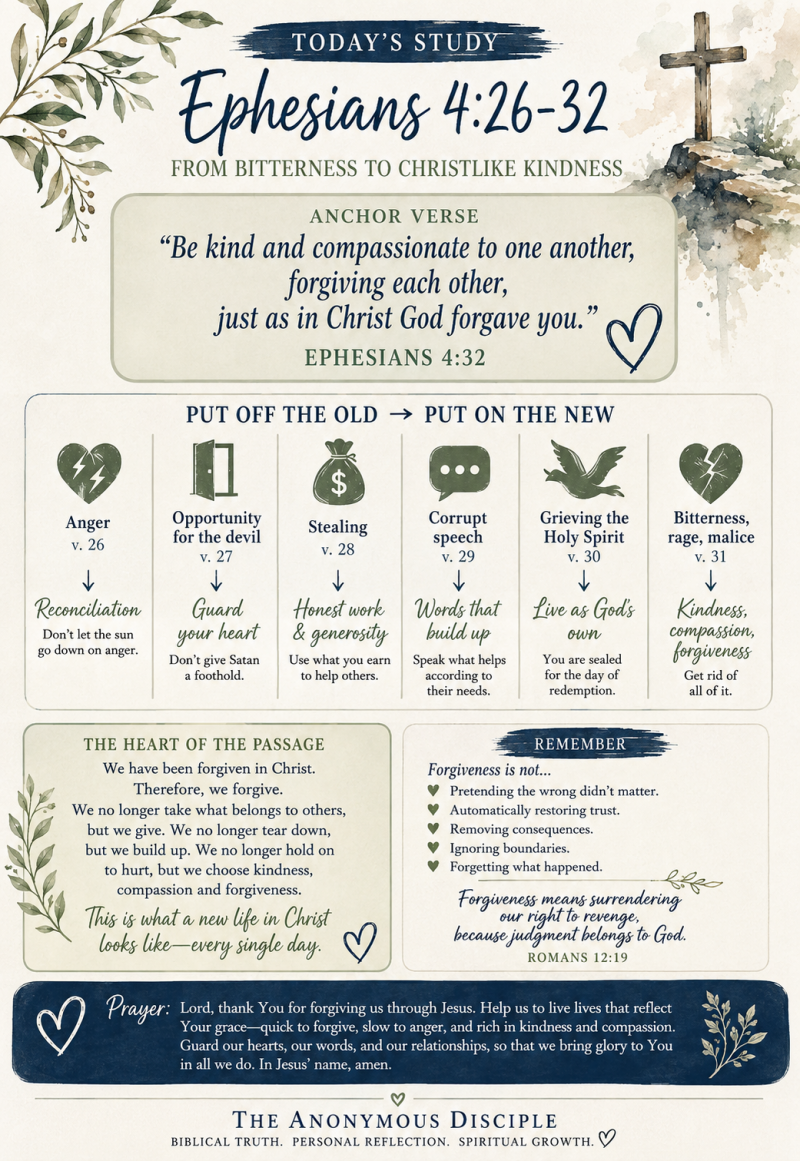
- Handle anger without sinning and without giving the devil a foothold (vv. 26-27).
- Stop taking and start working so you can give (v. 28).
- Use your words to build people up instead of tearing them down (v. 29).
- Do not grieve the Holy Spirit who has sealed you (v. 30).
- Get rid of all bitterness, rage, slander, and malice (v. 31).
Then he lands on the heart of it all—the verse we are anchoring in today:
“Be kind and compassionate to one another, forgiving each other, just as in Christ God forgave you.” (Ephesians 4:32)
This is the new way of living. Kindness, a tender heart, and real forgiveness flow from the fact that God has already forgiven us completely in Christ. That is the pattern and the power for every hard relationship we face.

Today's Study:
- Historical Background
- KJV v ESV side by side comparison
- Deep Dive study card
- ⚓︎ Anchor verse breakdown Ephesians 4:32
- Forgiveness, Reconciliation & Trust study card
- Do Not give the Devil a Foothold study card
- Forgiveness Throughout Scripture study card
- Heart Check & Prayer card (plus pdf)
- Study notes
The Apostle Paul wrote the letter. Most Bible teachers place it around AD 60–62. That was during his first imprisonment in Rome. He was under house arrest—not in a dark dungeon, but living in his own rented house with a soldier guarding him (Acts 28:16, 30). He could receive visitors and write letters. This group of letters is often called the “Prison Epistles” (Ephesians, Philippians, Colossians, and Philemon). Paul calls himself “a prisoner of Christ Jesus” and “an ambassador in chains” in this very letter (Ephesians 3:1; 4:1; 6:20).
Where it was written: From Rome. Tychicus, one of Paul’s co-workers, carried the letter to the churches (Ephesians 6:21-22).
Who it was written to: The church in Ephesus, a major city on the west coast of what is now Turkey. Some early copies of the letter do not have the words “in Ephesus,” so it may have been a circular letter meant to be read in several churches in that region, with Ephesus as the main one. Either way, it was written to believers Paul knew well.
What was going on in Ephesus and the church: Paul had already spent about three years in Ephesus on his third missionary journey (Acts 19–20). The city was wealthy, busy, and famous for the Temple of Artemis (the Roman name was Diana)—one of the Seven Wonders of the ancient world. The whole economy was tied to that temple: pilgrims, silver idols, and magic practices. After many people believed the gospel, they publicly burned their expensive magic books (Acts 19:19). The silversmiths even started a riot because their business was being hurt (Acts 19:23-41).
The church itself was a mix of Jews and Gentiles who had come out of that dark, occult, and idolatrous background. They needed to learn how to live as one new people in Christ instead of slipping back into the old ways of anger, stealing, filthy talk, bitterness, and unforgiveness that were normal in the surrounding culture.
King James Version (KJV)
26 Be ye angry, and sin not: let not the sun go down upon your wrath: 27 Neither give place to the devil. 28 Let him that stole steal no more: but rather let him labour, working with his hands the thing which is good, that he may have to give to him that needeth. 29 Let no corrupt communication proceed out of your mouth, but that which is good to the use of edifying, that it may minister grace unto the hearers. 30 And grieve not the holy Spirit of God, whereby ye are sealed unto the day of redemption. 31 Let all bitterness, and wrath, and anger, and clamour, and evil speaking, be put away from you, with all malice: 32 And be ye kind one to another, tenderhearted, forgiving one another, even as God for Christ's sake hath forgiven you.

English Standard Version (ESV)
26 Be angry and do not sin; do not let the sun go down on your anger, 27 and give no opportunity to the devil. 28 Let the thief no longer steal, but rather let him labor, doing honest work with his own hands, so that he may have something to share with anyone in need. 29 Let no corrupting talk come out of your mouths, but only such as is good for building up, as fits the occasion, that it may give grace to those who hear. 30 And do not grieve the Holy Spirit of God, by whom you were sealed for the day of redemption. 31 Let all bitterness and wrath and anger and clamor and slander be put away from you, along with all malice. 32 Be kind to one another, tenderhearted, forgiving one another, as God in Christ forgave you.
𝕏James𝕏-
We’re anchoring right here in Ephesians 4:32 today. That’s a good place to sit. This one verse is the “put on” that answers everything Paul just told us to put off in verse 31. Let’s walk through it slowly, phrase by phrase, and let Scripture itself show us what it means.
Ephesians 4:32 (NIV) “Be kind and compassionate to one another, forgiving each other, just as in Christ God forgave you.”
ESV “Be kind to one another, tenderhearted, forgiving one another, as God in Christ forgave you.”
1. “Be kind and compassionate to one another”
Kindness here is not just being polite. It is a useful, gentle, helpful way of treating people—the opposite of the harsh, cutting spirit in verse 31. Compassion (or “tenderhearted”) means having a soft heart that actually feels for the other person, especially when they are weak, hurting, or have failed.
Paul says almost the same thing in Colossians 3:12: “Therefore, as God’s chosen people, holy and dearly loved, clothe yourselves with compassion, kindness…”
We put these on like clothes. They do not come naturally from the old self. They come because we belong to Jesus and the Holy Spirit is changing us.
2. “Forgiving each other”
This is not optional. It is the practical fruit of kindness and a tender heart. The word Paul uses means to give freely, to cancel the debt, to pardon. We do not wait until the other person “deserves” it or has paid enough. We release them.
Look at the matching verse in Colossians 3:13: “Bear with each other and forgive one another if any of you has a grievance against someone. Forgive as the Lord forgave you.”
Jesus Himself taught this over and over. In Matthew 6:14-15 He said: “For if you forgive other people when they sin against you, your heavenly Father will also forgive you. But if you do not forgive others their sins, your Father will not forgive your sins.”
And in Mark 11:25: “And when you stand praying, if you hold anything against anyone, forgive them, so that your Father in heaven may forgive you your sins.”
Forgiveness is not pretending the wrong never happened. It is choosing not to hold it against the person any longer. It is handing the account over to God.
3. “Just as in Christ God forgave you”
This is the heart of the verse and the reason we can obey it. Our standard is not “how much they hurt me” or “whether they said they were sorry.” Our standard is how God treated us.
He forgave us:
- Freely — we did not earn it (Ephesians 2:8-9).
- Completely — every sin, past, present, and future, was nailed to the cross (Colossians 2:13-14).
- While we were still sinners — Romans 5:8 says, “But God demonstrates his own love for us in this: While we were still sinners, Christ died for us.”
- At great cost — Jesus paid the debt we owed.
When we remember how much we have been forgiven, the smaller debts others owe us look different. Jesus told the parable of the unforgiving servant in Matthew 18:21-35 to make this exact point. The man who had been forgiven a huge debt refused to forgive a tiny one. Jesus said that is not how the kingdom works.
So the command in Ephesians 4:32 is really this: Treat others the way God has already treated you in Christ.
That is the whole verse. Kindness and a tender heart that leads to real forgiveness, all flowing from the forgiveness we have already received at the cross.
We can sit with this today and ask the Lord to show us anyone we are still holding something against, and then choose to release them the same way He released us. The Holy Spirit will help us do what we cannot do in our own strength.
𝕏James𝕏-
Let’s look at how this actually works when the relationship is hard—when the hurt is deep, the person may not be sorry, or trust has been broken. We’ll stay with Ephesians 4:32 and let the rest of Scripture show us the difference between what God commands and what He does not.
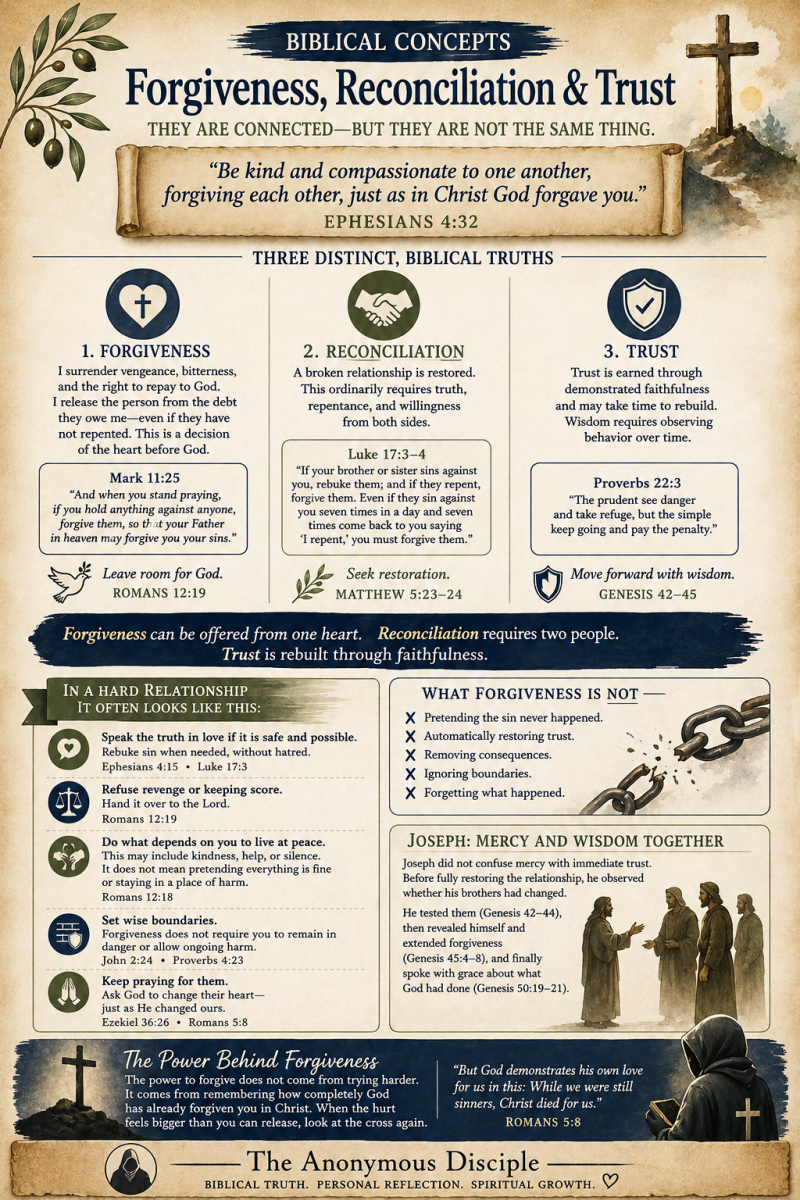
Forgiveness is first a decision of the heart before God. You release the person from the debt they owe you. You stop demanding they pay you back with an apology, changed behavior, or pain of their own. You hand the account to the Lord. That is what “forgiving each other, just as in Christ God forgave you” means. God cancelled our enormous debt while we were still sinners (Romans 5:8). We do the same, even when the other person has not earned it.
This part does not wait for feelings. Feelings often come later, sometimes much later. You may have to choose it more than once—Jesus told Peter “seventy-seven times” (Matthew 18:22). Each time bitterness tries to grow back (Hebrews 12:15), you take it back to the cross and release it again.
Forgiveness is not the same as reconciliation or instant trust. Luke 17:3-4 is important here: “If your brother or sister sins against you, rebuke them; and if they repent, forgive them. Even if they sin against you seven times in a day and seven times come back to you saying ‘I repent,’ you must forgive them.”
Notice the “if they repent.” Full restoration of the relationship usually needs a change of heart and action on their side. You can forgive from the heart even if they never admit they were wrong. Reconciliation—going back to close, open relationship—normally waits for that repentance. Joseph forgave his brothers long before he trusted them again (Genesis 45 and 50). He tested them first.
In a hard relationship it often looks like this:
- You speak the truth in love if it is safe and possible (Ephesians 4:15, Luke 17:3). You do not pretend the sin never happened.
- You refuse to take revenge or keep score (Romans 12:19): “Do not take revenge, my dear friends, but leave room for God’s wrath, for it is written: ‘It is mine to avenge; I will repay,’ says the Lord.”
- You do what depends on you to live at peace (Romans 12:18). That may mean kind words, practical help, or simply not stirring the pot. It does not mean pretending everything is fine or staying in a place of ongoing harm.
- You set wise boundaries. Forgiveness does not require you to keep putting yourself in the same danger. Jesus did not entrust Himself to everyone (John 2:24). Kindness and compassion can exist alongside caution.
- You keep praying for them and asking God to change their heart, because that is what He did for us.
The power to do any of this does not come from trying harder. It comes from remembering how completely God has already forgiven you in Christ. When the hurt feels bigger than you can release, you look at the cross again. That is why Paul put the “just as” at the end of the verse. The same grace that cancelled your debt is the grace that enables you to cancel theirs.
This is hard work. It is not a one-time prayer that makes the pain disappear. But it is the way of the new self. Bitterness keeps the wound open; forgiveness, even when the relationship stays limited, lets the Holy Spirit begin to heal your heart.
🪄Jenny🪄-
I actually think it fills an important gap in today’s study, because Ephesians 4:32 can get reduced to “just forgive and move on,” which is not a careful enough picture of everything Scripture says about forgiveness, repentance, reconciliation, wisdom, and trust.
They are connected—but they are not the same thing.
I like most of what James brought to the table. I would tighten two theological points, though.
1. I’d be a little more careful with “forgiveness means releasing the debt even if they never repent.”
Christians genuinely differ on exactly how to describe this because Scripture gives us both kinds of language.
Jesus says:
Mark 11:25
“And when you stand praying, if you hold anything against anyone, forgive them, so that your Father in heaven may forgive you your sins.”
That certainly sounds like something we can do before God regardless of what the offender does.
But Jesus also says:
Luke 17:3–4
“If your brother or sister sins against you, rebuke them; and if they repent, forgive them.”
So rather than making the card declare that one side settles the entire question, I'd teach the distinction this way:
The believer can always relinquish vengeance, bitterness, and personal retaliation before God.
Romans 12:19
“Do not take revenge, my dear friends, but leave room for God’s wrath…”
But relational forgiveness and restoration are connected to repentance elsewhere in Scripture.
That gives us a very clean biblical framework without forcing two passages to compete with each other.
2. I'd tweak the Joseph statement.
James wrote:
“Joseph forgave his brothers long before he trusted them again. He tested them first.”
The second sentence is absolutely right—Joseph definitely tested them.
But Scripture doesn't explicitly tell us, “Joseph had already forgiven them before the testing began.”
What we can safely say is:
Genesis 42–44
Joseph did not immediately restore intimacy or reveal himself to his brothers. He tested their character and watched how they responded when Benjamin was endangered.
Then:
Genesis 45:4–8
Joseph reveals himself and interprets what happened through God's providence.
And later:
Genesis 50:19–21
“Don’t be afraid. Am I in the place of God? You intended to harm me, but God intended it for good…”
That is an extraordinary picture of mercy without denying that what they did was genuinely evil.
So I'd word it:
Joseph did not confuse mercy with immediate trust. Before fully restoring the relationship, he observed whether his brothers had changed. — Genesis 42–45
That's stronger because we don't have to infer what Scripture doesn't explicitly tell us.
And this distinction is REALLY worth teaching
❤️ FORGIVENESS
I surrender vengeance and bitterness to God.
Romans 12:19; Mark 11:25
🤝 RECONCILIATION
A broken relationship is restored. This ordinarily requires truth, repentance, and willingness from both sides.
Luke 17:3–4; Matthew 5:23–24
🛡️ TRUST
Trust is earned through demonstrated faithfulness and may take time to rebuild.
Genesis 42–45; Proverbs 22:3
Forgiveness can be offered from one heart. Reconciliation requires two people. Trust is rebuilt through faithfulness.
One more piece I'd definitely keep from James
This:
Forgiveness does not mean pretending the sin never happened.
Amen.
Because biblical forgiveness isn't amnesia.
Paul says:
Ephesians 4:15
“speaking the truth in love…”
Jesus Himself says:
Luke 17:3
“If your brother or sister sins against you, rebuke them…”
So Christianity does not teach:
“Nothing happened. It's fine. Don't talk about it.”
It teaches something much harder:
Tell the truth without hatred.
Reject vengeance without denying justice.
Show mercy without becoming foolish.
Forgive without calling evil good.
And THAT fits Ephesians 4:32 beautifully. ❤️
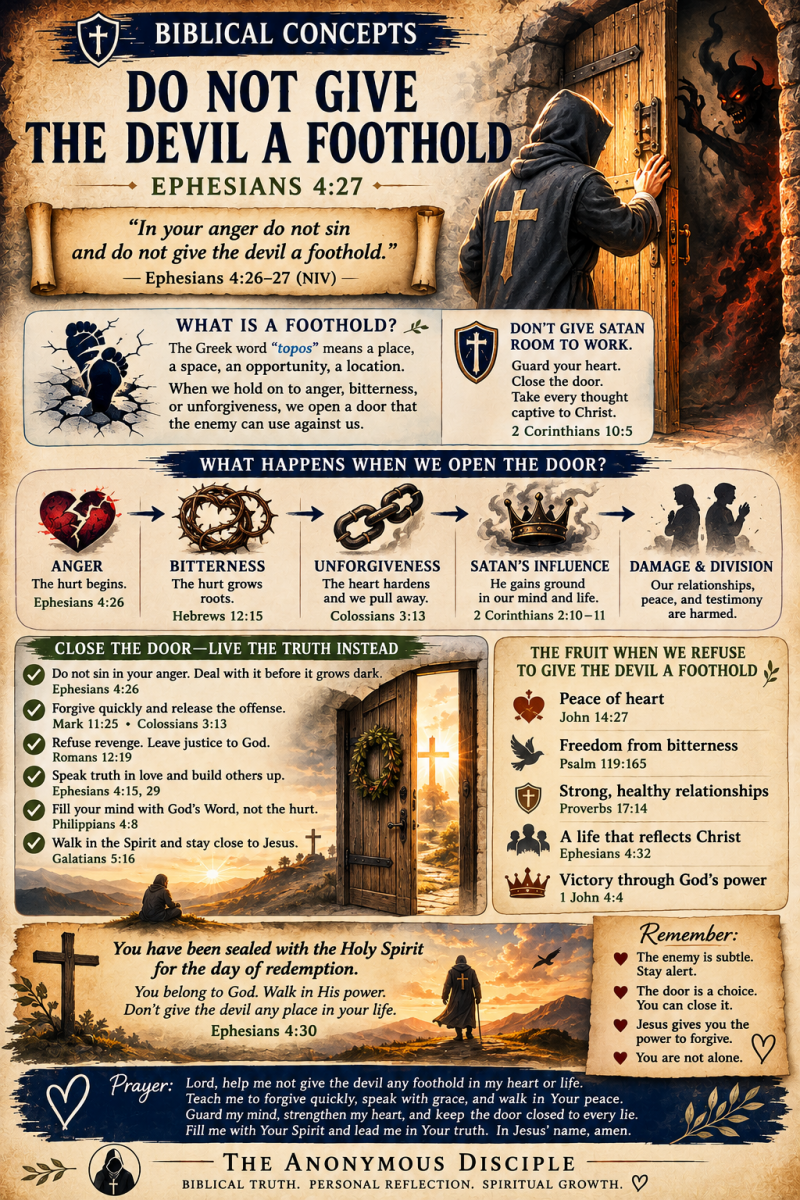
How unresolved anger, bitterness, and sin can give the enemy an opportunity—and how Scripture teaches believers to guard their hearts. 👇
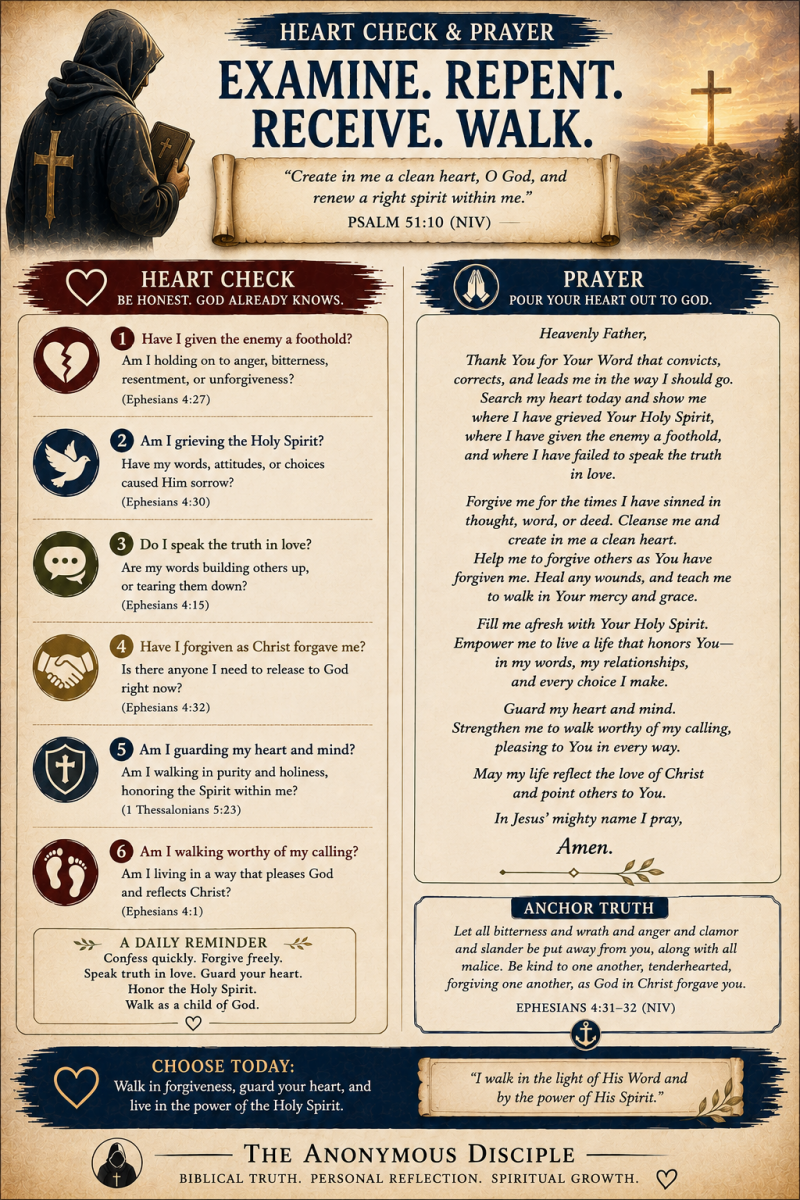
study notes
📖 Ephesians 4:26–32 — From Bitterness to Christlike Kindness
⚓ Anchor Verse — Ephesians 4:32
“Be kind and compassionate to one another, forgiving each other, just as in Christ God forgave you.”
— Ephesians 4:32 (NIV)
That last phrase is everything:
“just as in Christ God forgave you.”
Paul doesn't merely say, Be nicer people.
He says:
Remember what God has done for you—and treat other people from that place.
🪄Jenny🪄 Deep Dive
📍 Context: Ephesians 4
The first half of Ephesians is largely about what God has done for us in Christ.
Then Paul turns:
Ephesians 4:1
“I urge you to live a life worthy of the calling you have received.”
In other words:
Because this is who you now are in Christ… live like it.
Then immediately before today's passage, Paul describes taking off the old self and putting on the new self:
Ephesians 4:22–24
Put off the old way of life, be renewed in your thinking, and put on the new self created to be like God in righteousness and holiness.
So verses 26–32 are examples of what that change actually looks like.
Paul gets incredibly practical.
🔥 Ephesians 4:26–27 — Anger Without Sin
Ephesians 4:26
“In your anger do not sin…”
Notice something important:
Paul doesn't say:
“Never become angry.”
He says:
“When you are angry, do not sin.”
There is such a thing as righteous anger.
Jesus Himself became angry at hardened hearts:
Mark 3:5
“He looked around at them in anger and, deeply distressed at their stubborn hearts…”
But righteous anger can very quickly become sinful anger.
Paul therefore adds:
Ephesians 4:26
“…Do not let the sun go down while you are still angry.”
This isn't necessarily a rigid rule that every disagreement must be settled before bedtime.
The deeper warning is:
Don't nurture anger.
Don't feed it.
Don't rehearse the offense.
Don't build a home for it inside you.
Because Paul immediately tells us why.
🚪 Ephesians 4:27 — Don't Give the Devil a Foothold
Ephesians 4:27
“and do not give the devil a foothold.”
😳 There it is.
Unresolved anger isn't merely a relationship problem.
Paul sees a spiritual danger in it.
The Greek word translated “foothold” is topos (τόπος), meaning place, location, opportunity, room.
Think:
Don't give Satan room to work.
Anger can become:
anger → resentment → bitterness → hatred → revenge → division.
And Satan loves division.
Compare:
2 Corinthians 2:10–11
Paul connects forgiveness with not allowing Satan to outwit believers.
That makes forgiveness part of spiritual warfare, too.
🛠️ Ephesians 4:28 — From Taking to Giving
Paul suddenly seems to change subjects:
Ephesians 4:28
The thief must stop stealing, work honestly, and use what he earns to help someone in need.
But watch the transformation:
Old self:
“I take what belongs to you.”
⬇️
New self:
“I work for what I have.”
⬇️
Christlike self:
“I use what I have to bless you.”
That's more than behavior modification.
That's heart transformation.
The gospel doesn't merely make the thief stop stealing.
It transforms the thief into a giver.
❤️ That's beautiful.
🗣️ Ephesians 4:29 — Words That Build
Ephesians 4:29
Paul says not to allow corrupt or destructive speech to come from our mouths, but instead to speak what helps build others up according to their needs.
That gives us a pretty powerful filter:
Before speaking, ask:
Is this true?
But also:
Is this helpful?
Is this necessary?
Will this build someone up—or tear them down?
Paul doesn't say Christians should never say difficult things.
Sometimes love requires correction.
Proverbs 27:6
“Wounds from a friend can be trusted…”
But the purpose should still be building, not destroying.
🕊️ Ephesians 4:30 — Do Not Grieve the Holy Spirit
This is the line that makes the passage suddenly very personal.
Ephesians 4:30
“And do not grieve the Holy Spirit of God…”
Notice Paul doesn't say:
“Don't anger the Spirit.”
He says:
“Don't grieve Him.”
That language communicates relationship.
The Holy Spirit isn't presented as an impersonal force.
He can be grieved.
And look at the surrounding sins:
anger
harmful speech
bitterness
rage
malice
Our treatment of other people affects our relationship with God.
Then Paul reminds believers:
Ephesians 4:30
They have been sealed for the day of redemption.
That's important.
Paul isn't saying:
“Behave yourself so God might save you.”
He's saying:
You belong to God. You have been sealed by His Spirit. Therefore live like someone who belongs to Him.
🗑️ Ephesians 4:31 — Get Rid of It
Paul gives us quite the garbage pile:
Ephesians 4:31
Bitterness
Rage
Anger
Brawling
Slander
Malice
And he says:
Get rid of all of it.
There's almost a progression here.
Bitterness
The offense is stored internally.
Rage
It begins boiling.
Anger
It becomes settled hostility.
Brawling / clamor
It erupts outward.
Slander
Our mouth begins attacking.
Malice
We actually desire harm for the person.
That is what unchecked hurt can become.
And then comes one of those glorious Bible words:
Instead…
❤️ Ephesians 4:32 — The Christian Alternative
⚓ Ephesians 4:32
“Be kind and compassionate to one another, forgiving each other, just as in Christ God forgave you.”
Look at Paul's replacement:
Bitterness → kindness
Hardheartedness → compassion
Resentment → forgiveness
But here's the part I don't want us to miss:
Paul does not ground forgiveness in whether the other person deserves it.
He grounds forgiveness in:
what Christ has already done for us.
That changes everything.
✝️ “Just As in Christ God Forgave You”
Christian forgiveness is fundamentally cross-shaped.
Jesus taught the same principle:
Matthew 6:14
“For if you forgive other people when they sin against you, your heavenly Father will also forgive you.”
Colossians 3:13
“Forgive as the Lord forgave you.”
And look at Jesus Himself:
Luke 23:34
“Father, forgive them…”
Spoken while He was being crucified.
Christian forgiveness doesn't mean:
❌ The wrong didn't matter.
❌ Trust must immediately be restored.
❌ Consequences disappear.
❌ Boundaries are forbidden.
❌ Reconciliation can happen without repentance or safety.
Forgiveness means something more profound:
I surrender my right to personally exact vengeance, because judgment belongs to God.
Romans 12:19
“Do not take revenge… ‘It is mine to avenge; I will repay,’ says the Lord.”
That's why forgiveness can coexist with wisdom, boundaries, justice and consequences.
🔗 Look at the Whole Passage Together
Paul gives us a series of PUT OFF → PUT ON transformations:
Old SelfNew Life in ChristSinful angerReconciliationGiving Satan opportunityGuarding spiritual groundStealingHonest workTakingGivingCorrupt speechWords that buildGrieving the SpiritLiving as God's sealed peopleBitternessKindnessRageCompassionMaliceForgiveness
And that takes us directly back to:
Ephesians 4:22–24
Put off the old self.
Be renewed.
Put on the new self.
Today's passage is what putting on the new self looks like on Tuesday afternoon when somebody gets on your nerves. 🤭
And that's where Christianity becomes very real.
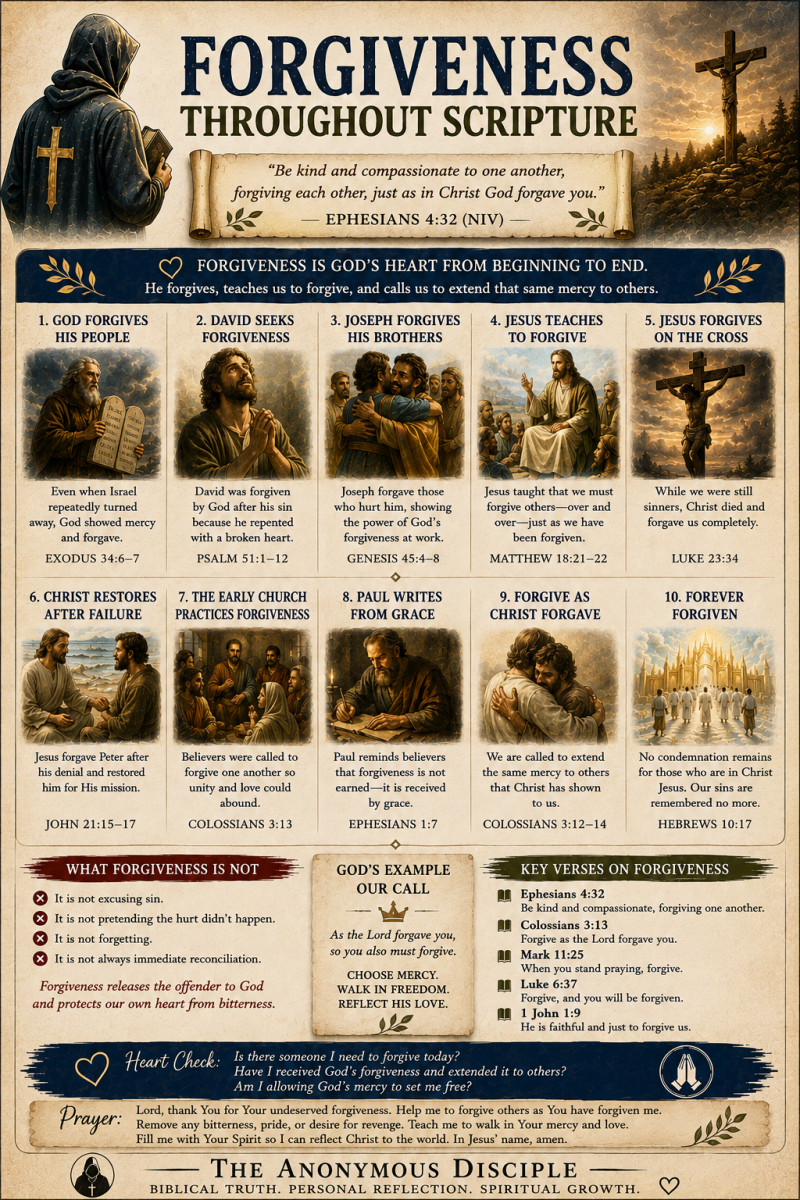
🌿 Forgiveness Throughout Scripture
A few especially strong connections for today's study:
Genesis 50:20–21 — Joseph
Joseph forgives the brothers who sold him into slavery and chooses kindness instead of vengeance.
1 Samuel 24:6–7 — David
David refuses to kill Saul even when Saul has repeatedly tried to kill him.
Matthew 18:21–22 — Jesus
Peter asks how often he must forgive. Jesus answers with extravagant, repeated forgiveness.
Luke 23:34 — Jesus
Jesus prays for forgiveness for His executioners.
Acts 7:59–60 — Stephen
While being stoned, Stephen asks God not to hold the sin against his killers.
Colossians 3:12–13 — Paul
Compassion, kindness, humility, gentleness and patience culminate in:
“Forgive as the Lord forgave you.”
That sounds awfully familiar. ❤️
🔎 Something I Think Is Especially Important
There is a beautiful theological sequence running through Ephesians 4:26–32:
What Christ did IN us
We were made new.
⬇️
What the Spirit does WITH us
He seals us and lives within us.
⬇️
What Christ now does THROUGH us
Kindness, compassion, generosity, gracious speech and forgiveness begin appearing in our relationships.
So good works aren't the price of salvation.
They are the fruit of salvation.
❤️ Heart Check
This passage gives us some uncomfortable but useful questions:
Am I nursing anger against someone?
Have I given bitterness somewhere to live?
Do my words usually build people—or wound them?
When I'm hurt, do I seek healing or rehearse the offense?
Is there someone I've decided doesn't deserve forgiveness?
And perhaps the hardest question:
Am I measuring someone else's debt to me while forgetting the debt Christ forgave in me?
Oof. 😳
That one reaches me too.
🙏 Prayer
Father,
Thank You for the mercy You have shown us through Jesus Christ. Guard our hearts from bitterness, rage, anger and malice. Help us not to give the enemy room to work through unresolved hurt.
Teach us to speak words that give grace, to work with generous hands, and to treat others with kindness and compassion.
When forgiveness is difficult, turn our eyes toward the cross. Remind us how completely You have forgiven us in Christ, and give us the strength to extend that mercy to others without abandoning wisdom, truth or healthy boundaries.
May our lives show that the old self is being put away and that Your Spirit is making us new.
In Jesus' name, amen.
𝕏James𝕏-
Here is a simple, verse-by-verse look at Ephesians 4:26-32. We’ll stay close to the words of Scripture itself (NIV first, with ESV noted where it helps), and let other verses of the Bible explain what these verses mean. This whole section sits right after Paul tells believers to put off the old way of living and put on the new self that is created to be like God (Ephesians 4:22-24). These verses show what that new life actually looks like in everyday relationships.
Verse 26 NIV: “In your anger do not sin”: Do not let the sun go down while you are still angry. ESV: Be angry and do not sin; do not let the sun go down on your anger.
Paul is quoting Psalm 4:4. God knows we will feel anger—sometimes even right anger at real wrong (Jesus Himself showed righteous anger in the temple, John 2:13-17). The command is not “never feel angry.” It is “do not let that anger turn into sin.” Do not nurse it, stew on it, or let it sit overnight. Deal with it the same day. Unresolved anger quickly becomes something else.
Verse 27 NIV: and do not give the devil a foothold. ESV: and give no opportunity to the devil.
If we let anger linger, it becomes a door the enemy can use. Scripture warns us that Satan looks for any opening (1 Peter 5:8; 2 Corinthians 2:10-11). Bitterness left overnight is one of his favorite footholds. The Bible’s answer is to settle the matter quickly so he has nothing to work with.
Verse 28 NIV: Anyone who has been stealing must steal no longer, but must work, doing something useful with their own hands, that they may have something to share with those in need.
The old life took from others. The new life works honestly and then gives. This is not just “stop stealing.” It is a complete turnaround: use your own hands to produce something good so you can help people who are in need. Paul says the same thing in 1 Thessalonians 4:11-12 and 2 Thessalonians 3:10-12—work quietly, earn your own living, and have extra to share. That is what the new self looks like.
Verse 29 NIV: Do not let any unwholesome talk come out of your mouths, but only what is helpful for building others up according to their needs, that it may benefit those who listen. ESV: Let no corrupting talk come out of your mouths, but only such as is good for building up, as fits the occasion, that it may give grace to those who hear.
“Unwholesome” or “corrupting” talk is anything rotten—gossip, harsh words, tearing people down, crude jokes, complaining that spreads. Instead, our words should do two things: (1) build the other person up, and (2) fit what they actually need at that moment. Colossians 4:6 says our speech should always be gracious, “seasoned with salt.” Jesus said we will give account for every careless word (Matthew 12:36-37). The new life uses the tongue to give grace, not to wound.
Verse 30 NIV: And do not grieve the Holy Spirit of God, with whom you were sealed for the day of redemption.
When we keep bitterness, angry outbursts, or rotten talk, we sadden the Holy Spirit who lives in us. He is a Person, not a force. Isaiah 63:10 shows that God’s people can grieve Him by rebellion. At the same time, Paul reminds us of the wonderful truth: the Spirit has already sealed us—He is God’s own mark of ownership on us until the day Jesus returns and we are fully redeemed (see also Ephesians 1:13-14). We do not want to hurt the One who has marked us as His forever.
Verse 31 NIV: Get rid of all bitterness, rage and anger, brawling and slander, along with every form of malice.
This is a clear “put it off” list.
- Bitterness is the sour root that grows when we refuse to let a hurt go (Hebrews 12:15 warns that a bitter root defiles many).
- Rage and anger are the explosions and the simmering heat.
- Brawling (or clamor) is loud quarreling.
- Slander is speaking evil of someone to damage them.
- Malice is wishing harm on another person.
Colossians 3:8 says the same thing: put all these away. They belong to the old life, not the new.
Verse 32 NIV: Be kind and compassionate to one another, forgiving each other, just as in Christ God forgave you. ESV: Be kind to one another, tenderhearted, forgiving one another, as God in Christ forgave you.
Here is the “put on” that replaces everything in verse 31. Kindness, tenderheartedness (a soft heart toward others), and forgiveness. The standard is not “forgive if they deserve it” or “forgive if they apologize first.” The standard is how God treated us in Christ. He forgave us when we were still sinners (Romans 5:8; Colossians 3:13). We forgive because we have already been forgiven a far greater debt.
That is the whole passage in plain language. Scripture keeps pointing us back to the same two movements: take off the old ways that hurt people and grieve the Spirit, and put on the new ways that look like Jesus—truth, honest work, gracious speech, kindness, and forgiveness that flows from the cross.
Add comment
Comments