

**Exodus 14:10-18 – “The Lord Will Fight for You”**
The Israelites had just been set free from Egypt, but now they found themselves trapped. The Red Sea was in front of them, and Pharaoh’s army was coming fast behind them. Panic set in. They cried out to God, then turned on Moses with fear and complaints, saying they would rather have stayed slaves than die in the desert.
Moses answered their fear with strong words of faith: “Do not be afraid. Stand firm and you will see the deliverance the Lord will bring you today.” Then he spoke the words that become our anchor:
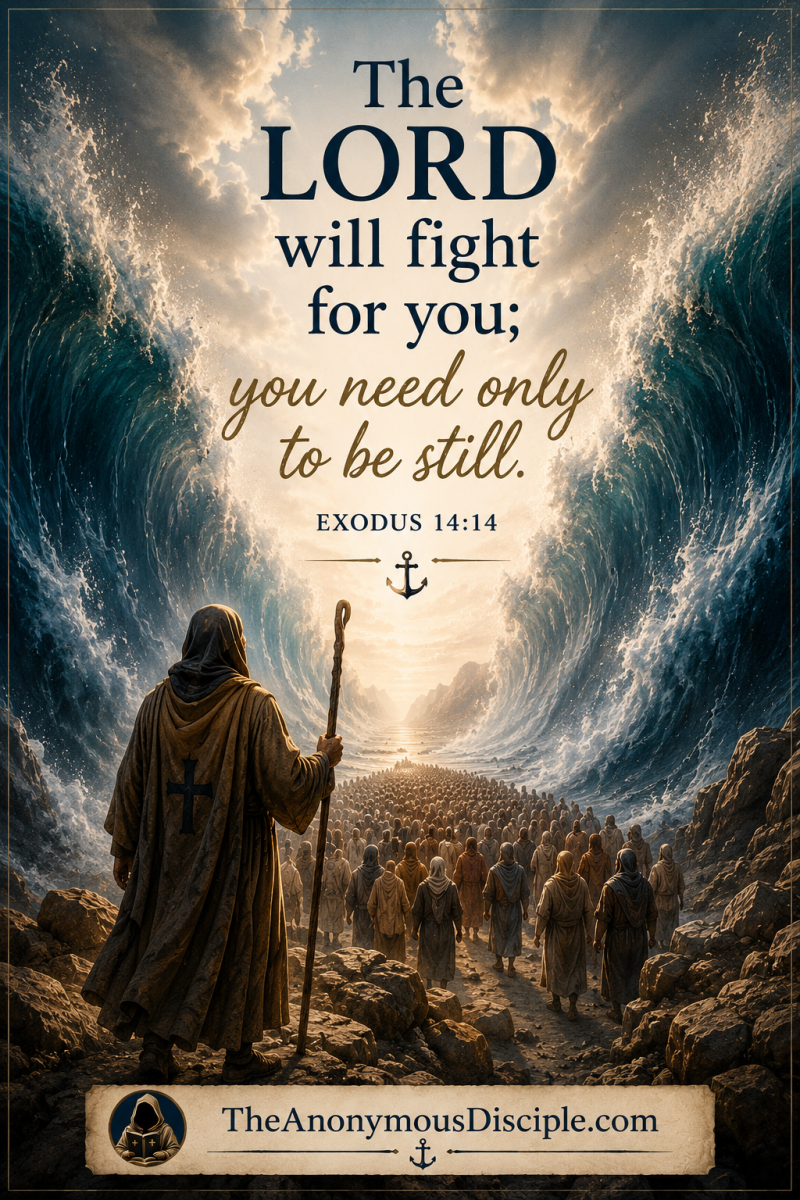
**“The Lord will fight for you; you need only to be still.”** (Exodus 14:14, NIV)
That is the center of this whole moment. God was not asking them to figure out a clever escape or fight their own battle. He was asking them to stop striving, quiet their panic, and trust Him to do what only He could do.
Right after that promise, the Lord told Moses to stop crying out and start moving forward. He would part the sea, lead His people through on dry ground, and gain glory over Pharaoh and the Egyptian army. What looked like certain defeat became the stage for God’s mighty deliverance.
This passage reminds us that when we feel trapped and afraid, our first and best response is not more effort—it is quiet trust. The Lord still fights for His people. We need only to be still and watch Him work. -𝕏James𝕏
Today's Study:
- Miscellaneous passage tidbits
- Historical/Cultural notes
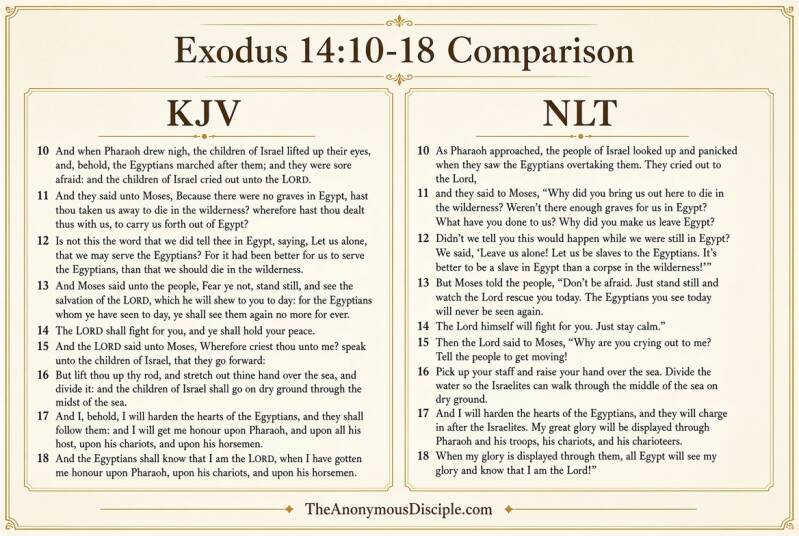
- KJV v NLT side by side comparison
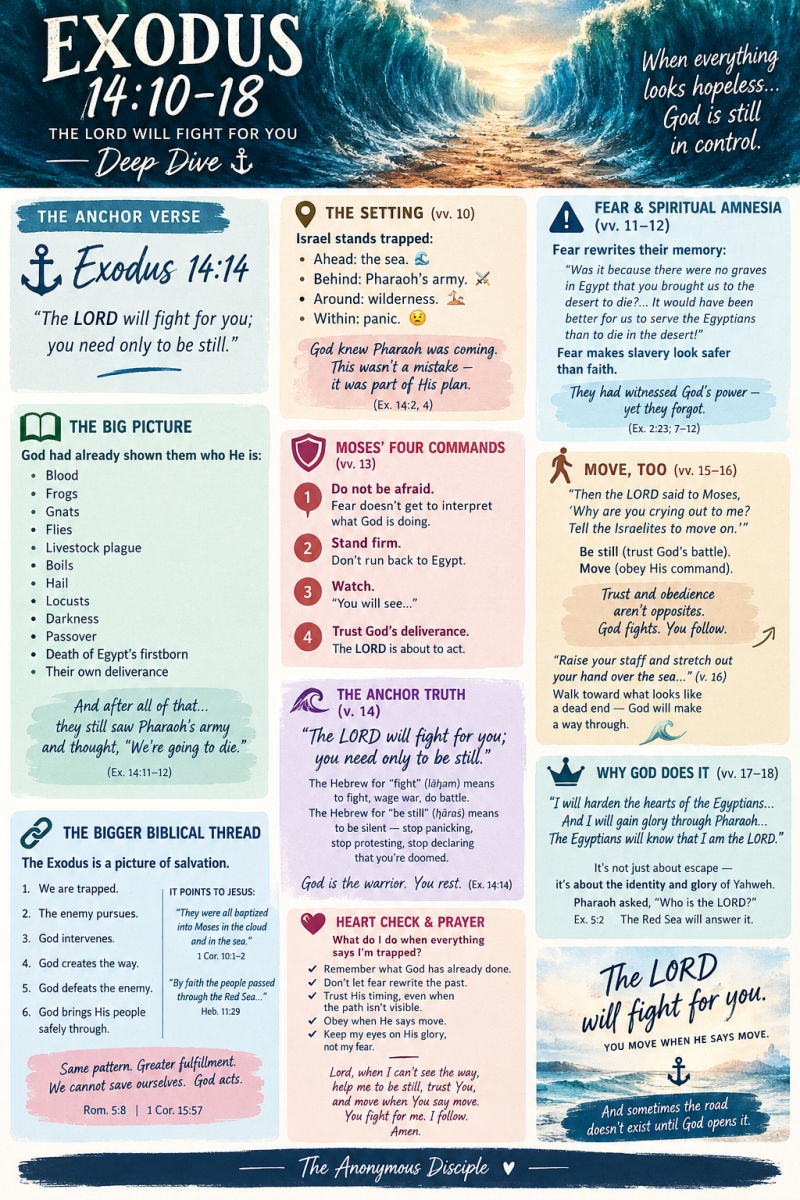
- Deep Dive study card
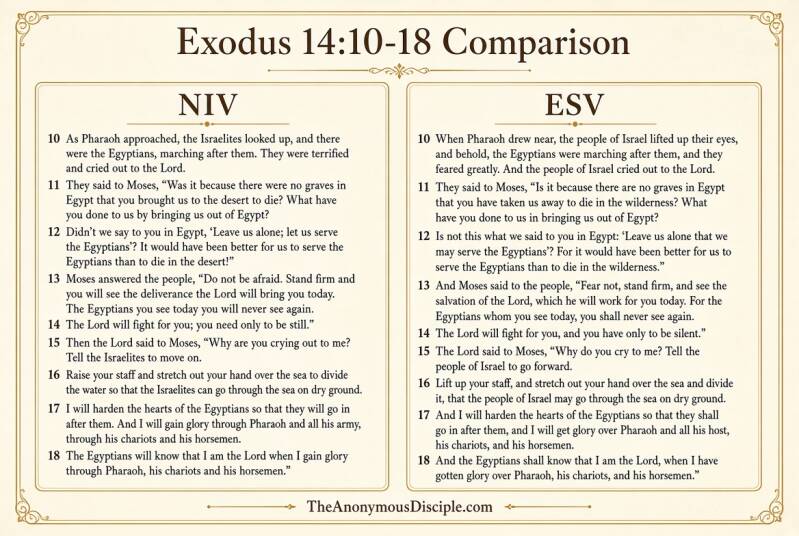
- NIV v ESV side by side comparison
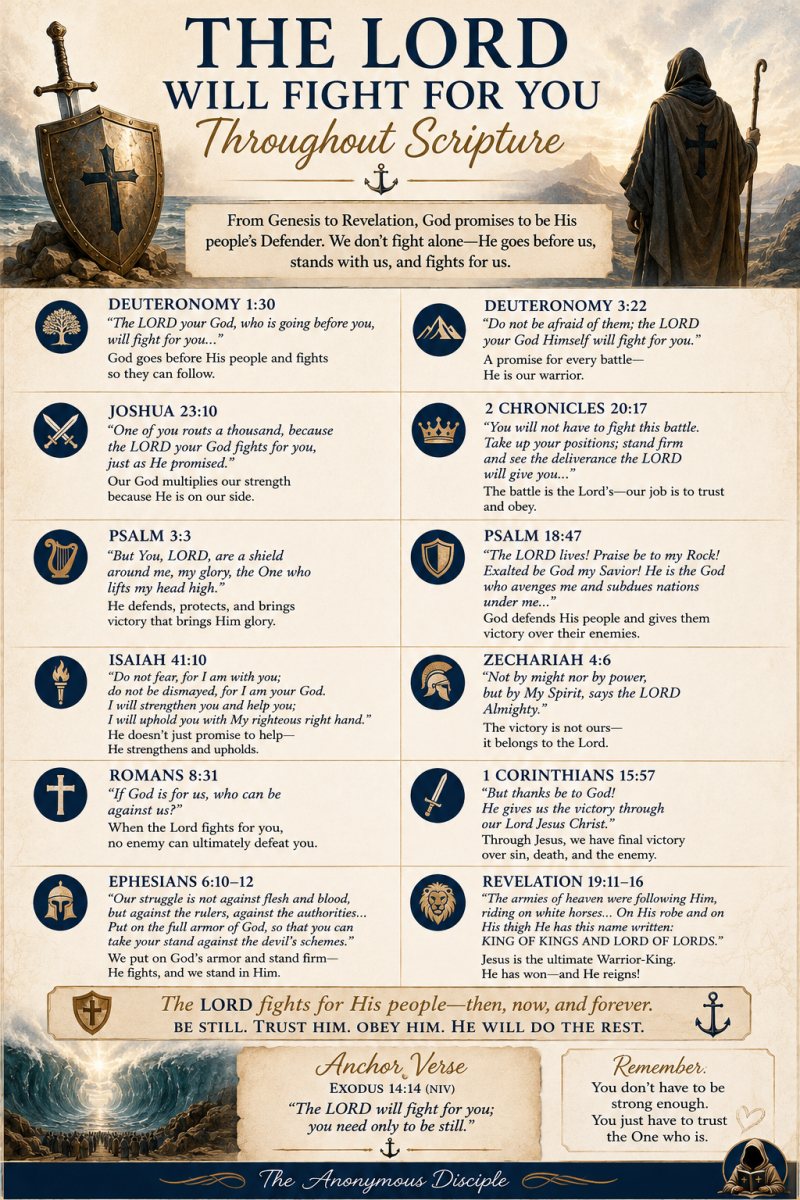
- The Lord will Fight For You Throughout Scripture card
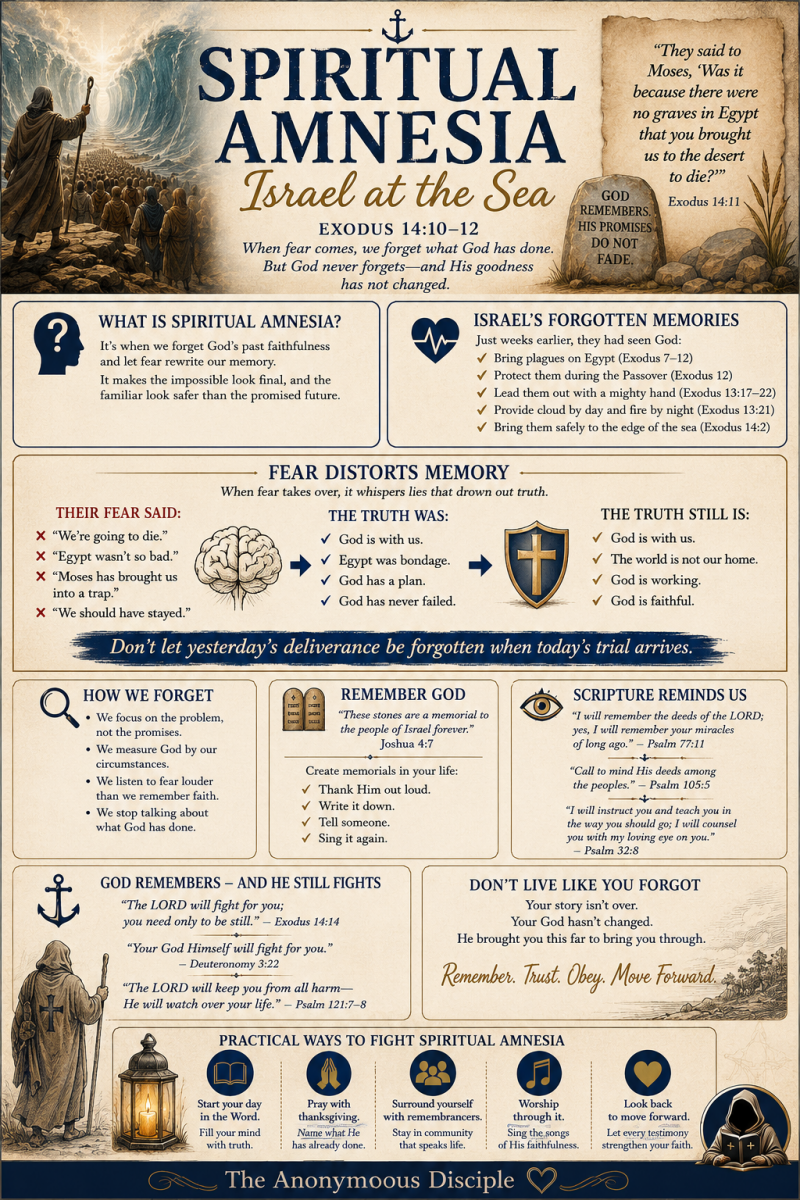
- Spiritual Amnesia card
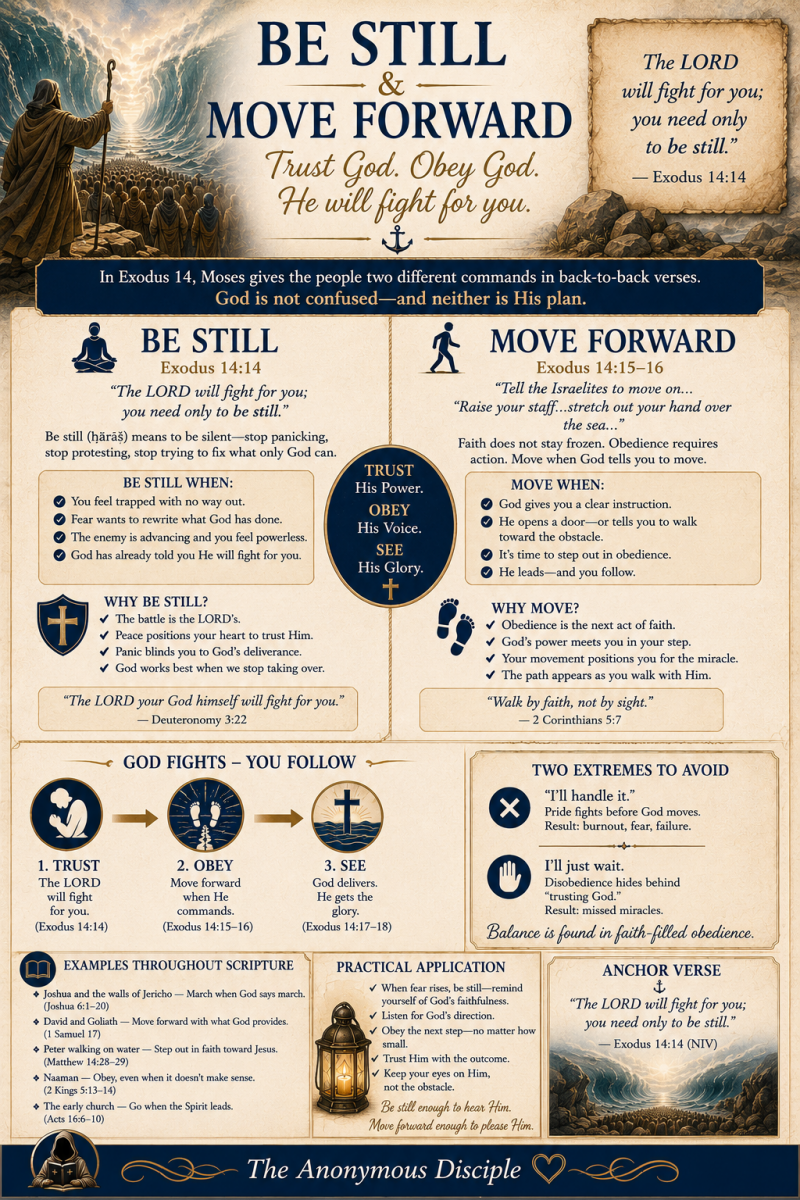
- Be Still & Move Forward card
- Cross References for both passage and ⚓ verse
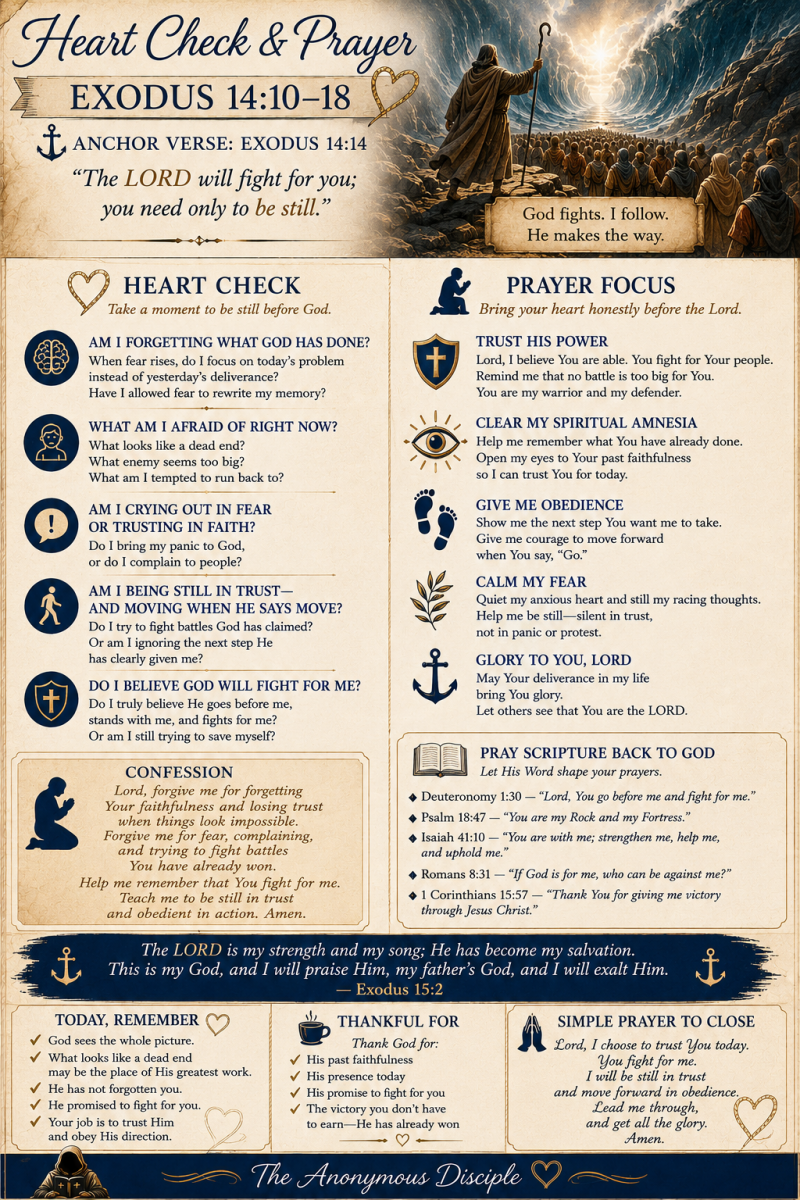
- Heart Check & Prayer card (plus pdf)
- Study notes from both 🪄Jenny🪄 & 𝕏James𝕏
The Hebrew Word
In Exodus 14:14 the phrase is:
יְהוָה יִלָּחֵם לָכֶם וְאַתֶּם תַּחֲרִישׁוּן
(YHWH yillāḥēm lāḵem wəʾattem taḥărîšûn)
The word translated “still / silent / hold your peace” is תַּחֲרִישׁוּן (taḥărîšûn).
- It comes from the root חָרַשׁ (ḥāraš / charash), Strong’s H2790.
- In this form (Hiphil imperfect), it means to be silent, to keep quiet, to hold one’s peace, to be still.
The basic idea is “stop speaking / stop making noise / be quiet.” It can carry the sense of remaining still and not taking action, because the root also has connections to being deaf or silent like someone who cannot hear or speak.
How Translations Reflect It
- KJV: “ye shall hold your peace” – very close to the idea of stopping speech/complaint.
- ESV: “you have only to be silent” – emphasizes quietness.
- NIV: “you need only to be still” – broadens it slightly to include calm stillness.
- NLT: “Just stay calm” – modern, practical wording of the same idea.
- NASB: “while you keep silent.”
All of these are legitimate. The Hebrew points most strongly to silence — stopping the complaining, the panic, and the talking — while trusting God to act.
The Greek (Septuagint)
The ancient Greek translation of the Old Testament (the Septuagint) uses σιγήσετε (sigēsete), from the verb sigaō, which simply means “you shall be silent” or “keep quiet.”
So both the Hebrew and the Greek lean toward the idea of deliberate quietness and restraint rather than frantic activity or loud protest.
In short: God was telling the people, “Stop the noise of fear and complaint. Be quiet. I will do the fighting.”
🕰️ When
Most Bible-believing scholars place the Exodus in one of two time frames:
- Early date – around 1446 BC. This comes from working backward from 1 Kings 6:1, which says the temple was begun 480 years after the Exodus.
- Late date – around the 13th century BC (roughly 1250–1220 BC), during the reign of a powerful pharaoh like Ramesses II.
Either way, this happened during the height of Egypt’s power as a world empire. The exact year is still debated, but the event itself sits firmly in the New Kingdom period of Egyptian history.
🌍 Where
The Israelites had left the area of Rameses (in the eastern Nile Delta, the land of Goshen) and were heading toward the wilderness. God specifically told them to turn and camp in a tight spot:
- In front of Pi-hahiroth
- Between Migdol and the sea
- Opposite Baal-zephon
The body of water is called Yam Suph in Hebrew — literally “Sea of Reeds” (or “Reed Sea”). English Bibles traditionally translate it “Red Sea,” but the original wording points more to a reedy, marshy body of water than the deep open Red Sea we think of today.
Most scholars who take the biblical account seriously lean toward the lakes and marshlands in the eastern Nile Delta / northern Isthmus of Suez area (places like the ancient Ballah Lakes or Lake Timsah region). These were near Egypt’s eastern border defenses. A minority view places the crossing farther south at the Gulf of Suez or even the Gulf of Aqaba. The exact spot is still discussed, but the Bible’s geography places them trapped between water and the Egyptian army with no natural escape route.
🤔 Why
After the ten plagues and the death of the firstborn, Pharaoh finally let the Israelites go. But very quickly he and his officials regretted it. They said, in effect, “What have we done? We just lost our free labor force!”
God also hardened Pharaoh’s heart so that he would chase after them. The Lord’s purpose was clear: He wanted to gain glory over Pharaoh and the Egyptian army, and He wanted the Egyptians (and Israel) to know that He alone is the Lord (Exodus 14:4, 17-18).
What looked like a trap was actually God’s setup for a mighty deliverance.
Interesting Cultural Notes
- Egyptian chariots were the tanks of the ancient world — fast, powerful, and terrifying. Pharaoh took 600 of his best chariots plus the rest of the chariot force. That was a serious military response.
- The language of God “hardening” Pharaoh’s heart fits the way people in the ancient Near East talked about the gods directing human decisions. Scripture is clear that both Pharaoh’s stubborn will and God’s sovereign purpose were at work.
- The Israelites were camping in a military-border zone. Migdol means “tower” or “fortress,” and Baal-zephon was a known place connected to a Canaanite storm god. Egypt had border forts and watchtowers in this region.
- The pillar of cloud and fire that had been leading them moved behind them during the night, standing between the two camps. This was both protection and a visible sign of God’s presence.
In short: the Israelites were deliberately led into a dead-end so that when God opened the way, no one could take credit for the rescue. The Lord Himself would fight for them — which brings us right back to our anchor verse. - 𝕏James𝕏
Cross References for the Full Passage (Exodus 14:10-18)
These connect to the larger themes of fear, complaint, God’s deliverance, and His glory over enemies:
- Exodus 14:25 – The Egyptians themselves recognize that the Lord is fighting against them.
- Exodus 15:1-3 – The song of Moses after the crossing: “The Lord is a warrior; the Lord is his name.”
- Deuteronomy 1:30 – Moses later reminds the people: “The Lord your God, who is going before you, will fight for you, as he did for you in Egypt.”
- Joshua 24:6-7 – Joshua recalls how God put darkness between Israel and the Egyptians and brought the sea over them.
- Nehemiah 9:9-11 – A prayer that remembers God hearing their cry at the Red Sea and dividing the waters.
- Psalm 106:7-12 – A psalm that recounts Israel’s fear and God’s mighty deliverance at the sea.
- 2 Chronicles 20:15-17 – Jehoshaphat’s battle: “The battle is not yours, but God’s… Stand firm and see the deliverance the Lord will give you.”
- Isaiah 41:10-13 – “Do not fear, for I am with you… I will help you.”
Cross References Specifically for the Anchor Verse (Exodus 14:14)
These focus on the two key ideas: “The Lord will fight for you” and “be still / be silent.”
The Lord fights for His people:
- Deuteronomy 3:22 – “Do not be afraid of them; the Lord your God himself will fight for you.”
- Deuteronomy 20:4 – “For the Lord your God is the one who goes with you to fight for you against your enemies to give you victory.”
- Joshua 23:3, 10 – “It was the Lord your God who fought for you… One of you routs a thousand, because the Lord your God fights for you.”
- Nehemiah 4:20 – “Our God will fight for us!”
- 2 Chronicles 20:29 – The surrounding nations feared when they heard the Lord had fought against Israel’s enemies.
Be still / silent / quiet before the Lord:
- 2 Chronicles 20:17 – “You will not have to fight this battle. Take up your positions; stand firm and see the deliverance the Lord will give you.”
- Psalm 46:10 – “Be still, and know that I am God.”
- Isaiah 30:15 – “In repentance and rest is your salvation, in quietness and trust is your strength.”
- Psalm 37:7 – “Be still before the Lord and wait patiently for him.”
These verses show that the promise in Exodus 14:14 is not a one-time event. It becomes a repeated pattern throughout Scripture: when God’s people face impossible situations, He calls them to quiet trust while He Himself fights on their behalf. -𝕏James𝕏
🪄Jenny🪄 -
📖 DEEP DIVE — EXODUS 14:10–18
⚓️ Anchor Verse: Exodus 14:14
Exodus 14:14 (NIV)
“The LORD will fight for you; you need only to be still.”
That is beautiful.
But what makes it powerful is where Israel is standing when God says it.
They aren't safely across the Red Sea yet.
They are trapped between Pharaoh and the water.
🌊 THE SETTING — Exodus 14:10
Exodus 14:10 (NIV)
“As Pharaoh approached, the Israelites looked up, and there were the Egyptians, marching after them. They were terrified and cried out to the LORD.”
Picture their geography.
Ahead: the sea. 🌊
Behind: Pharaoh's army. ⚔️
Around them: wilderness. 🏜️
Within them: panic.
And here's something important from immediately before our passage:
Exodus 14:4 (NIV)
“And I will harden Pharaoh’s heart, and he will pursue them. But I will gain glory for myself through Pharaoh and all his army, and the Egyptians will know that I am the LORD.”
😳 God knew Pharaoh was coming.
Israel thought:
“Something has gone terribly wrong.”
God knew:
This is exactly where the story is going.
That's a major theme of this passage.
Being in an impossible situation did not mean Israel had wandered outside God's plan.
In fact, God had specifically directed them there.
Exodus 14:2 (NIV)
“Tell the Israelites to turn back and encamp near Pi Hahiroth, between Migdol and the sea.”
God deliberately brought them to a place where human escape looked impossible.
Why?
Because what was about to happen could not reasonably be credited to Israel.
😨 EXODUS 14:11–12 — FEAR REWRITES THEIR MEMORY
Exodus 14:11–12 (NIV)
“They said to Moses, ‘Was it because there were no graves in Egypt that you brought us to the desert to die? What have you done to us by bringing us out of Egypt? Didn’t we say to you in Egypt, “Leave us alone; let us serve the Egyptians”? It would have been better for us to serve the Egyptians than to die in the desert!’”
Oh, Israel. 🤦🏼♀️
But I don't want to judge them too quickly.
Because fear does something very human here:
Fear makes slavery look safer than faith.
Egypt suddenly doesn't sound so terrible anymore.
They had cried out because of their bondage:
Exodus 2:23 (NIV)
“The Israelites groaned in their slavery and cried out, and their cry for help because of their slavery went up to God.”
Yet now:
“Maybe Egypt wasn't so bad.”
Yes. It was.
Fear is distorting their memory.
And look at what they have already witnessed:
Blood.
Frogs.
Gnats.
Flies.
Livestock plague.
Boils.
Hail.
Locusts.
Darkness.
Passover.
The death of Egypt's firstborn.
Their own deliverance.
And after ALL OF THAT…
they see Pharaoh's army and conclude:
We're going to die.
That's spiritual amnesia.
And considering the Remembering Truth / Spiritual Amnesia work we were just doing yesterday, this passage fits almost ridiculously well. 😳
🛡️ EXODUS 14:13 — MOSES' FOUR COMMANDS
Exodus 14:13 (NIV)
“Moses answered the people, ‘Do not be afraid. Stand firm and you will see the deliverance the LORD will bring you today. The Egyptians you see today you will never see again.’”
Watch the progression:
1. Do not be afraid.
Fear does not get to interpret what God is doing.
2. Stand firm.
Don't run backward to Egypt.
3. Watch.
“You will see…”
4. Trust God's deliverance.
The LORD is about to act.
And then comes our anchor.
⚓️ EXODUS 14:14
Exodus 14:14 (NIV)
“The LORD will fight for you; you need only to be still.”
🔥🔥🔥
The Hebrew behind “fight” is from לָחַם — lāḥam, meaning to fight, wage war, do battle.
This isn't passive language about God vaguely helping them.
Yahweh Himself is Israel's warrior.
This theme appears repeatedly throughout Scripture.
Deuteronomy 1:30 (NIV)
“The LORD your God, who is going before you, will fight for you…”
Deuteronomy 3:22 (NIV)
“Do not be afraid of them; the LORD your God himself will fight for you.”
Joshua 23:10 (NIV)
“One of you routs a thousand, because the LORD your God fights for you, just as he promised.”
But there's another fascinating word here.
The NIV says:
“you need only to be still.”
The Hebrew verb is חָרַשׁ — ḥāraš, which in this construction carries the idea of being silent or keeping quiet.
Some translations make that especially visible:
ESV: “you have only to be silent.”
KJV: “and ye shall hold your peace.”
So Moses isn't necessarily telling Israel:
🧘🏼♀️ Sit peacefully and contemplate God.
It's closer to:
“Stop panicking. Stop protesting. Stop declaring that you're doomed. God is going to handle this.”
Which makes the next verse VERY interesting.
🚶🏼 EXODUS 14:15 — “WHY ARE YOU CRYING OUT TO ME?”
Exodus 14:15 (NIV)
“Then the LORD said to Moses, ‘Why are you crying out to me? Tell the Israelites to move on.’”
WAIT.
Verse 14:
Be still.
Verse 15:
Move.
🤭
And that tells us something crucial about interpreting verse 14.
“Be still” does not mean “never take action.”
It means Israel isn't going to defeat Pharaoh.
God will.
But Israel still must obey when God says:
MOVE.
There's an entire theology of faith sitting between those two verses:
Don't fight the battle God has claimed as His.
But…
don't use “trusting God” as an excuse to ignore the step He tells you to take.
Sometimes faith stands still.
Sometimes faith walks forward.
The question is always:
What has God told me to do?
🌊 EXODUS 14:16
Exodus 14:16 (NIV)
“Raise your staff and stretch out your hand over the sea to divide the water so that the Israelites can go through the sea on dry ground.”
Now consider what God is asking them to do.
Walk toward the thing that appears to be blocking their escape.
😳
They don't need another route.
God is going to make a route through the obstacle.
That's different.
Israel sees:
SEA = dead end.
God sees:
SEA = road.
And even better…
the very road God creates for Israel's salvation becomes the place of judgment against their enemy.
Same sea.
Deliverance for one.
Judgment for another.
That's going to become important biblical imagery later.
⚔️ EXODUS 14:17–18 — WHY GOD DOES IT
Exodus 14:17–18 (NIV)
“I will harden the hearts of the Egyptians so that they will go in after them. And I will gain glory through Pharaoh and all his army, through his chariots and his horsemen. The Egyptians will know that I am the LORD when I gain glory through Pharaoh, his chariots and his horsemen.”
Notice the repeated purpose:
“They will know that I am the LORD.”
This whole confrontation ultimately concerns the identity and glory of Yahweh.
Pharaoh had earlier asked:
Exodus 5:2 (NIV)
“Who is the LORD, that I should obey him and let Israel go?”
There it is.
“Who is the LORD?”
Exodus 5 asks the question.
Exodus 14 answers it.
The plagues have been answering it.
Passover answered it.
And now the Red Sea will answer it decisively.
Pharaoh thought he was pursuing escaped slaves.
He was actually riding into the final demonstration that Yahweh is LORD.
🧵 THERE'S AN EVEN BIGGER BIBLICAL THREAD
The Exodus becomes one of Scripture's foundational pictures of salvation.
God's people cannot save themselves.
They are trapped.
The enemy pursues.
God intervenes.
God creates the way.
God defeats the enemy.
God brings His people safely through.
Centuries later, Paul deliberately points Christians back to this event:
1 Corinthians 10:1–2 (NIV)
“For I do not want you to be ignorant of the fact, brothers and sisters, that our ancestors were all under the cloud and that they all passed through the sea. They were all baptized into Moses in the cloud and in the sea.”
And Hebrews remembers the crossing as an act of faith:
Hebrews 11:29 (NIV)
“By faith the people passed through the Red Sea as on dry land; but when the Egyptians tried to do so, they were drowned.”
But there's something else I think belongs in our study.
✝️ “THE LORD WILL FIGHT FOR YOU”
Israel's fundamental problem here is one they cannot solve themselves.
And that pattern reaches its fullest expression in salvation.
We cannot defeat sin ourselves.
We cannot conquer death ourselves.
We cannot reconcile ourselves to God through our own righteousness.
So God acts.
Romans 5:8 (NIV)
“But God demonstrates his own love for us in this: While we were still sinners, Christ died for us.”
And:
1 Corinthians 15:57 (NIV)
“But thanks be to God! He gives us the victory through our Lord Jesus Christ.”
The Red Sea isn't the crucifixion, and we shouldn't flatten the two events into the same thing.
But the pattern resonates beautifully:
Human helplessness → divine intervention → deliverance → God's glory.
💡 LOOK AT VERSES 14–15 TOGETHER
This may be my favorite discovery in today's passage:
Exodus 14:14
“The LORD will fight for you…”
Then:
Exodus 14:15
“…Tell the Israelites to move on.”
Trust and obedience aren't opposites.
Israel doesn't create the miracle.
God does.
But Israel still has to walk through the opening He provides.
That guards us against two opposite mistakes:
“Everything depends on me.” ❌
and
“Since God is sovereign, I don't have to obey.” ❌
Biblical faith says:
God fights. I follow.
And sometimes following Him means walking toward water before you understand exactly how you're getting across it.
❤️ HEART TRUTH
There are moments when everything visible says:
You're trapped.
Everything behind you says:
Go back.
Everything ahead says:
There's no way through.
And God may be doing something you cannot yet see.
Israel's mistake wasn't that they couldn't see the path.
There genuinely wasn't a path yet.
That's important.
They weren't overlooking an obvious solution.
God hadn't made the road yet.
And THAT makes Exodus 14:14 hit differently:
Exodus 14:14 (NIV)
“The LORD will fight for you; you need only to be still.”
They weren't being asked to trust God because they could see how this would work.
They were being asked to trust the God who had already shown them who He was.
And then, when He said move…
they moved.
⚓️ The LORD will fight for you.
🚶🏼 You move when He says move.
❤️ And sometimes the road doesn't exist until God opens it.
∘₊✧──────✧₊∘∘₊✧──────✧₊∘∘₊✧──────✧₊∘∘₊✧──────✧₊∘∘₊✧──────✧₊∘∘₊✧──────✧₊∘∘₊✧──────✧₊∘∘₊✧───✧₊∘
𝕏James𝕏-
Here’s a simple, clear verse-by-verse look at Exodus 14:10-18 (using the NIV, with a quick note from the ESV where it helps). We’ll walk through it slowly, then spend extra time on our anchor verse.
Verse 10
“As Pharaoh approached, the Israelites looked up, and there were the Egyptians, marching after them. They were terrified and cried out to the Lord.”
The people finally see the Egyptian army coming. Panic hits hard. They cry out to God — which is good — but fear is driving them.
Verses 11-12
“They said to Moses, ‘Was it because there were no graves in Egypt that you brought us to the desert to die? What have you done to us by bringing us out of Egypt? Didn’t we say to you in Egypt, “Leave us alone; let us serve the Egyptians”? It would have been better for us to serve the Egyptians than to die in the desert!’”
Fear turns into blaming and complaining. They start rewriting history: “We told you we wanted to stay slaves!” They’re choosing slavery over trusting God in a hard place.
Verse 13
“Moses answered the people, ‘Do not be afraid. Stand firm and you will see the deliverance the Lord will bring you today. The Egyptians you see today you will never see again.’”
Moses steps in with calm faith. He tells them two things:
- Stop being afraid.
- Stand still and watch what God is about to do.
He promises that this is the last time they will ever see this enemy.
Verse 14 (our anchor)
“The Lord will fight for you; you need only to be still.”
(ESV: “The Lord will fight for you, and you have only to be silent.”)
This is the heart of the passage.
God doesn’t say, “You fight and I’ll help.” He says, “I will fight. Your part is to be still / be silent.”
In other words:
- Stop panicking.
- Stop trying to figure out your own escape.
- Stop the complaining and arguing.
- Quiet your heart and let God do the work only He can do.
This is a strong word for any of us when we’re trapped between a hard place and an enemy. Sometimes the most faith-filled thing we can do is stop striving and trust that the battle belongs to the Lord.
Verse 15
“Then the Lord said to Moses, ‘Why are you crying out to me? Tell the Israelites to move on.’”
Interesting. God basically says, “Enough crying out — now obey.” Prayer is good, but there comes a time when God says, “I’ve heard you. Now take the next step of faith.”
Verse 16
“Raise your staff and stretch out your hand over the sea to divide the water so that the Israelites can go through the sea on dry ground.”
God gives Moses a clear action. Moses has to raise the staff in faith, but God is the One who will actually part the water.
Verses 17-18
“I will harden the hearts of the Egyptians so that they will go in after them. And I will gain glory through Pharaoh and all his army, through his chariots and his horsemen. The Egyptians will know that I am the Lord when I gain glory through Pharaoh, his chariots and his horsemen.”
God is not only rescuing His people — He is also revealing who He is to the Egyptians. His glory and His name matter. The same event that saves Israel will show Egypt that the Lord alone is God.
Simple takeaway for today:
When fear rises and the enemy seems too close, remember verse 14.
The Lord will fight for you.
Your part is to be still — to quiet the panic, stop the striving, and trust Him to make a way.
Add comment
Comments