

🗝️ This is the longest and most detailed of the four “Servant Songs” in Isaiah. It was written about 700 years before Jesus was born. God is describing His special Servant—someone who would suffer terribly, die for the sins of others, and then be highly exalted.
The New Testament repeatedly shows that this Servant is Jesus (see Acts 8:32–35, Matthew 8:17, 1 Peter 2:22–25, and Jesus’ own words in Luke 22:37).

Today's Study:
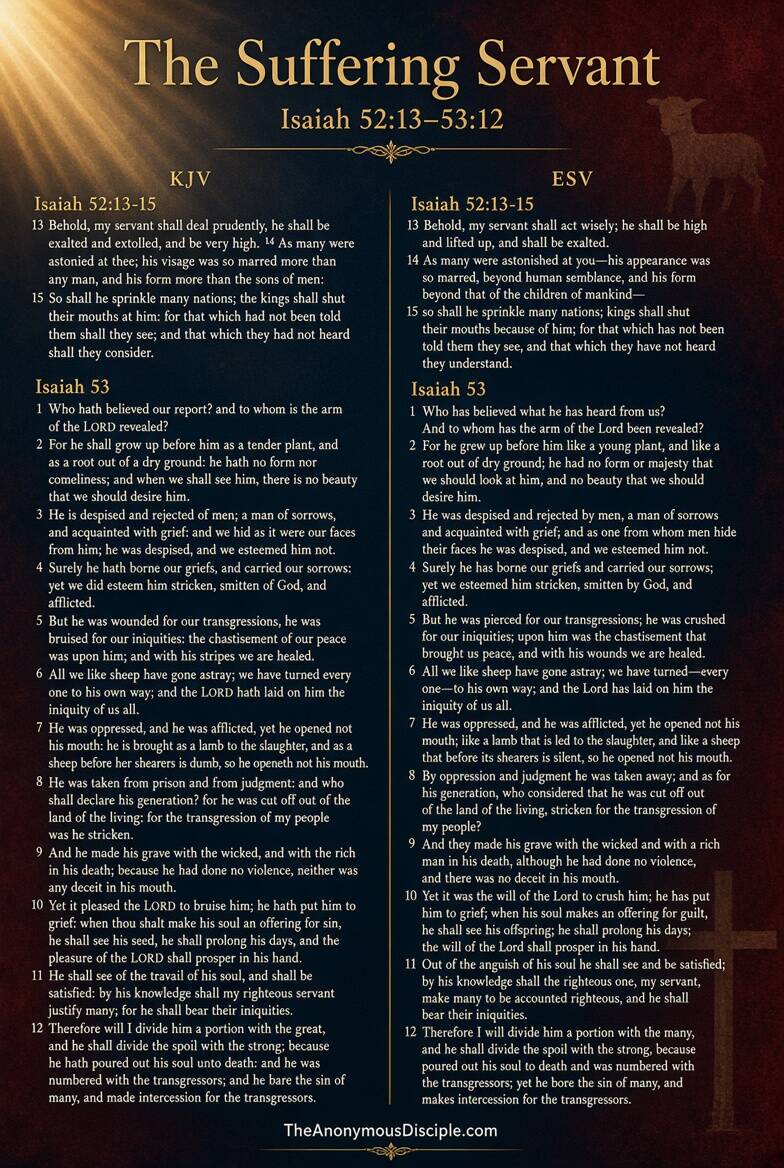
- The Passage in KJV v ESV side by side comparison
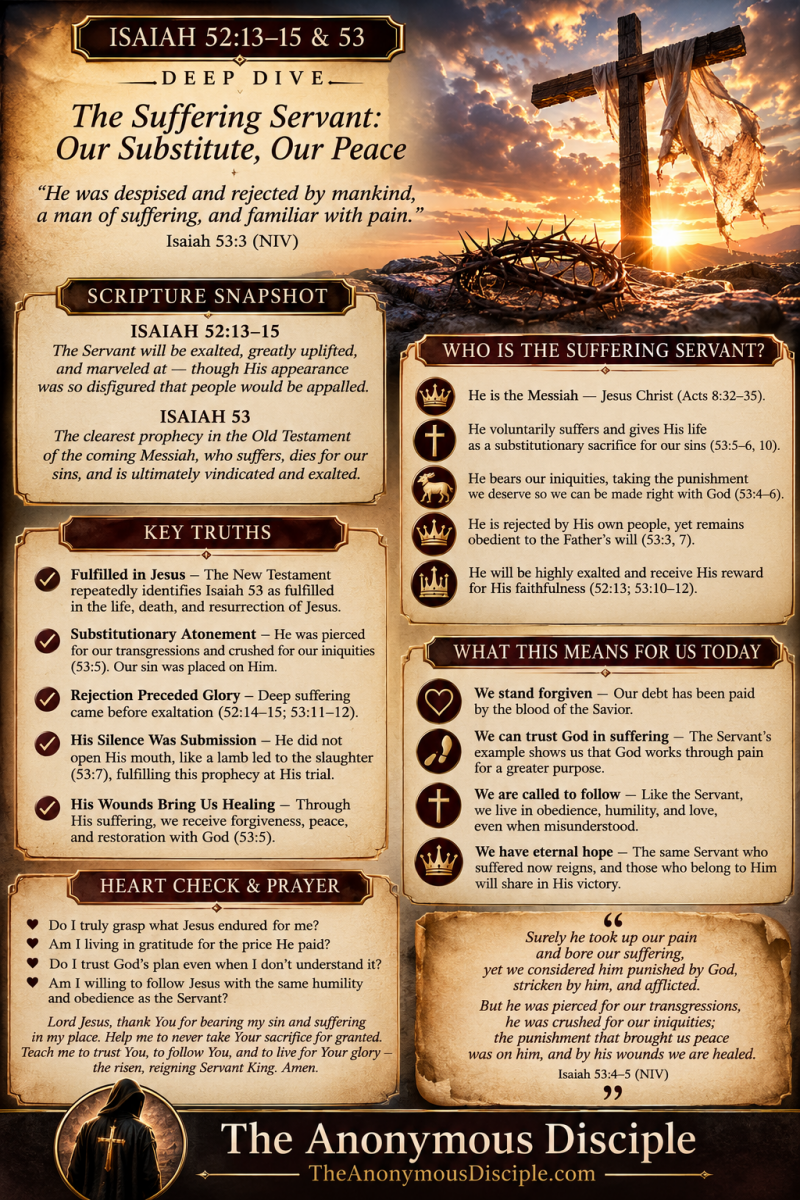
- Deep Dive study card
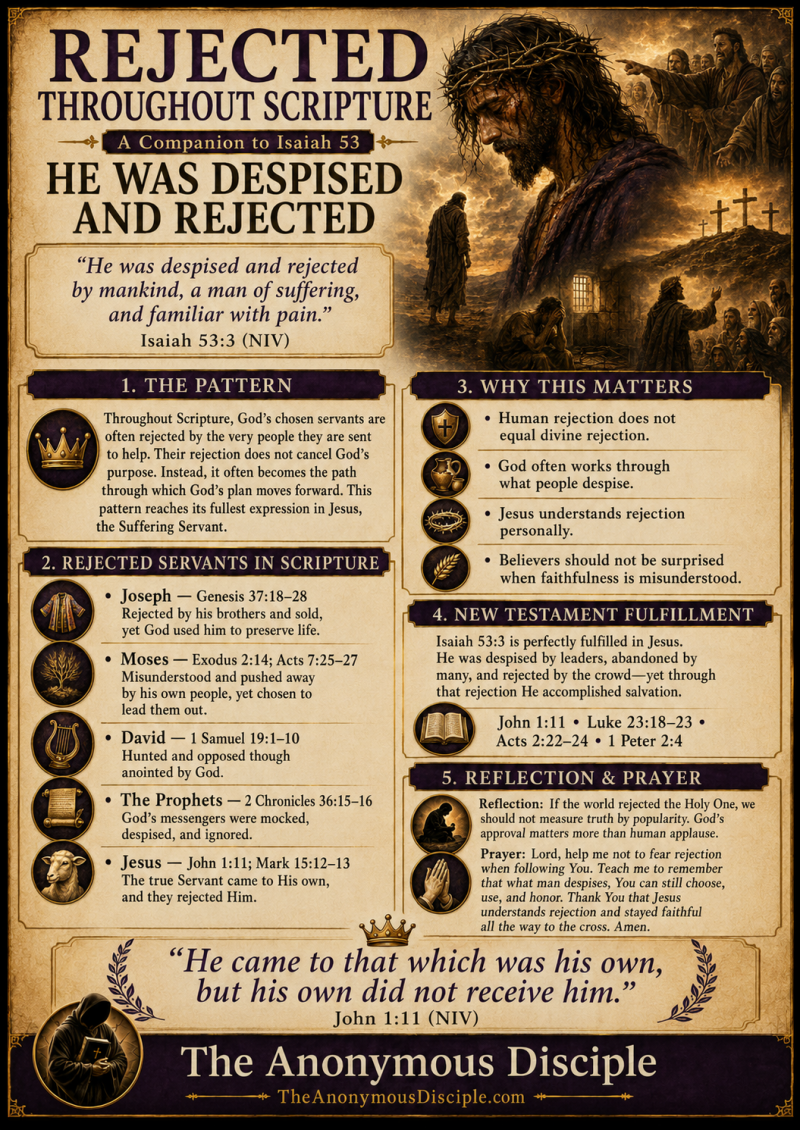
- Rejected Throughout Scripture card
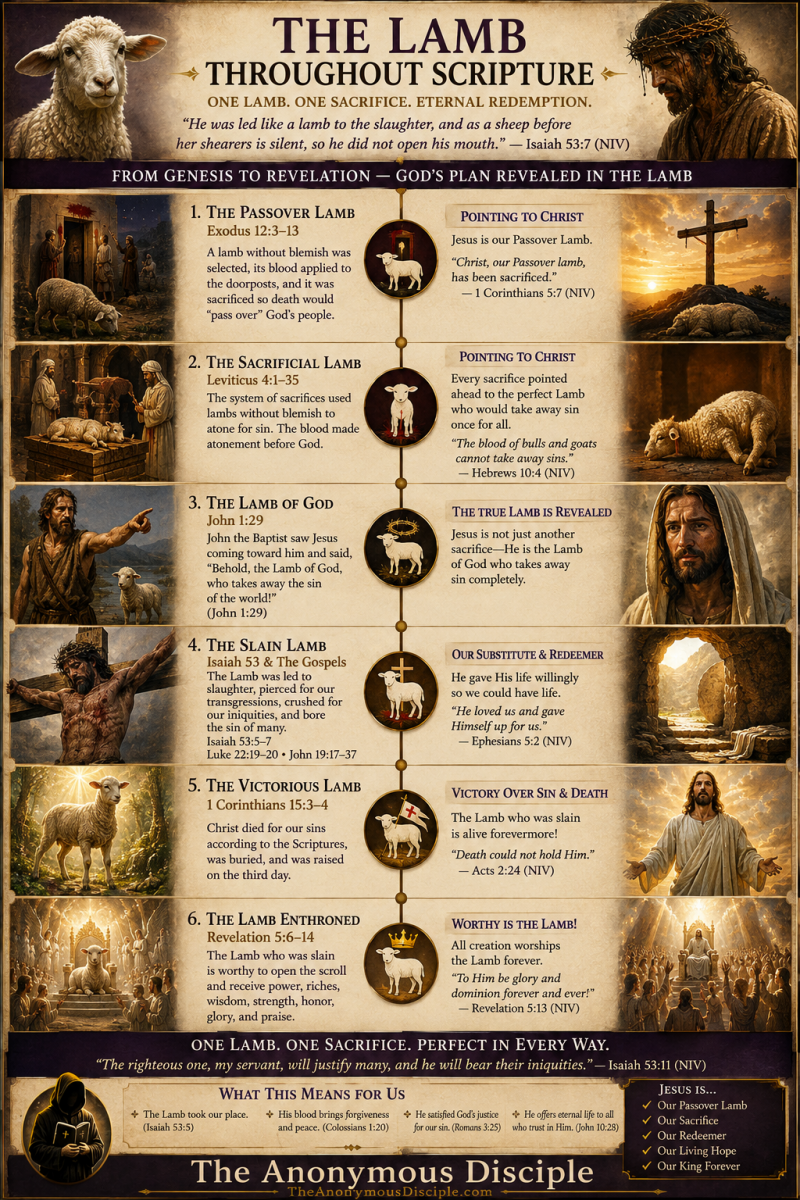
- The Lamb Throughout Scripture card
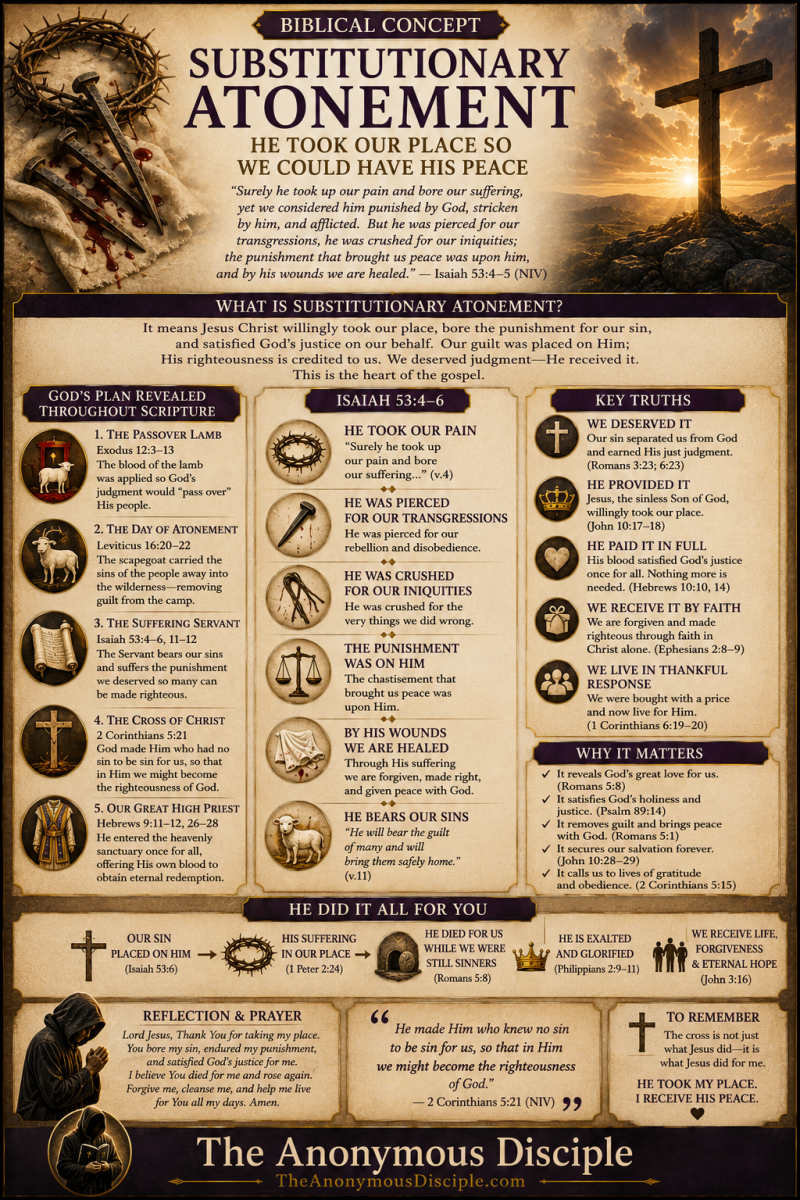
- Biblical Concepts: Substitutionary Atonement card
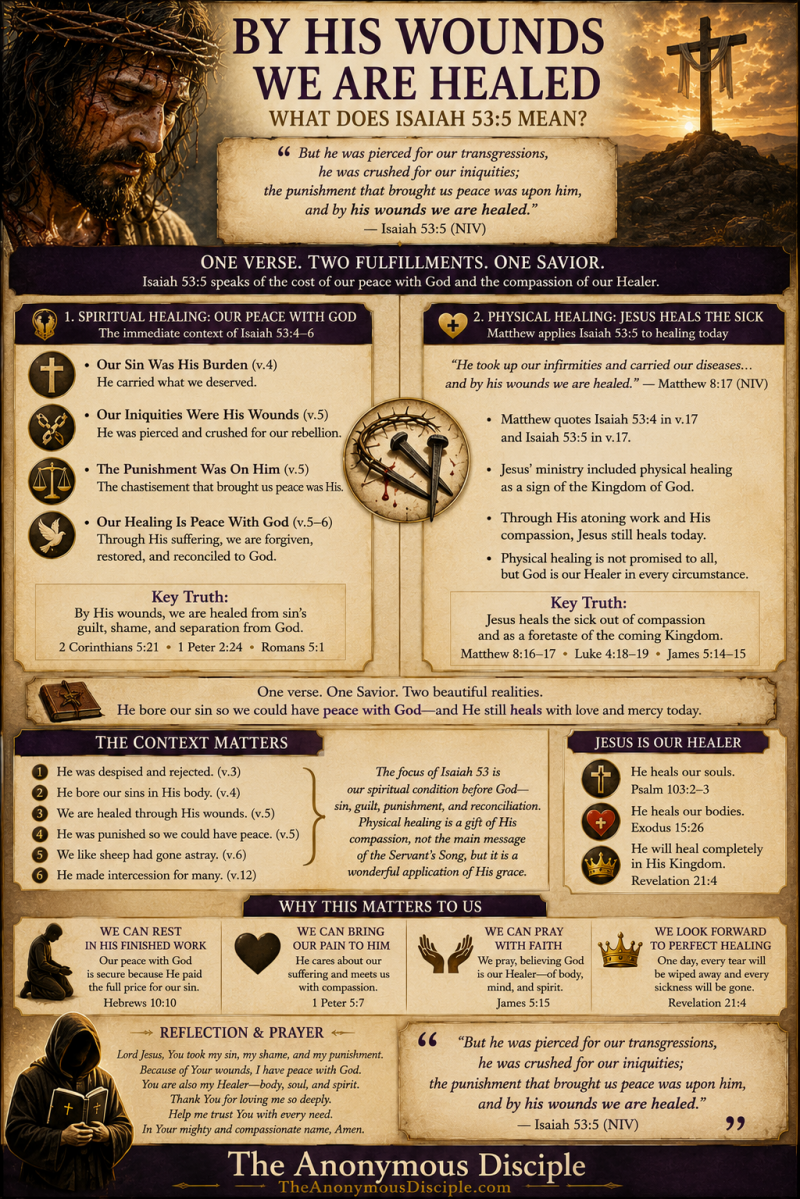
- By His Wounds We Are Healed card
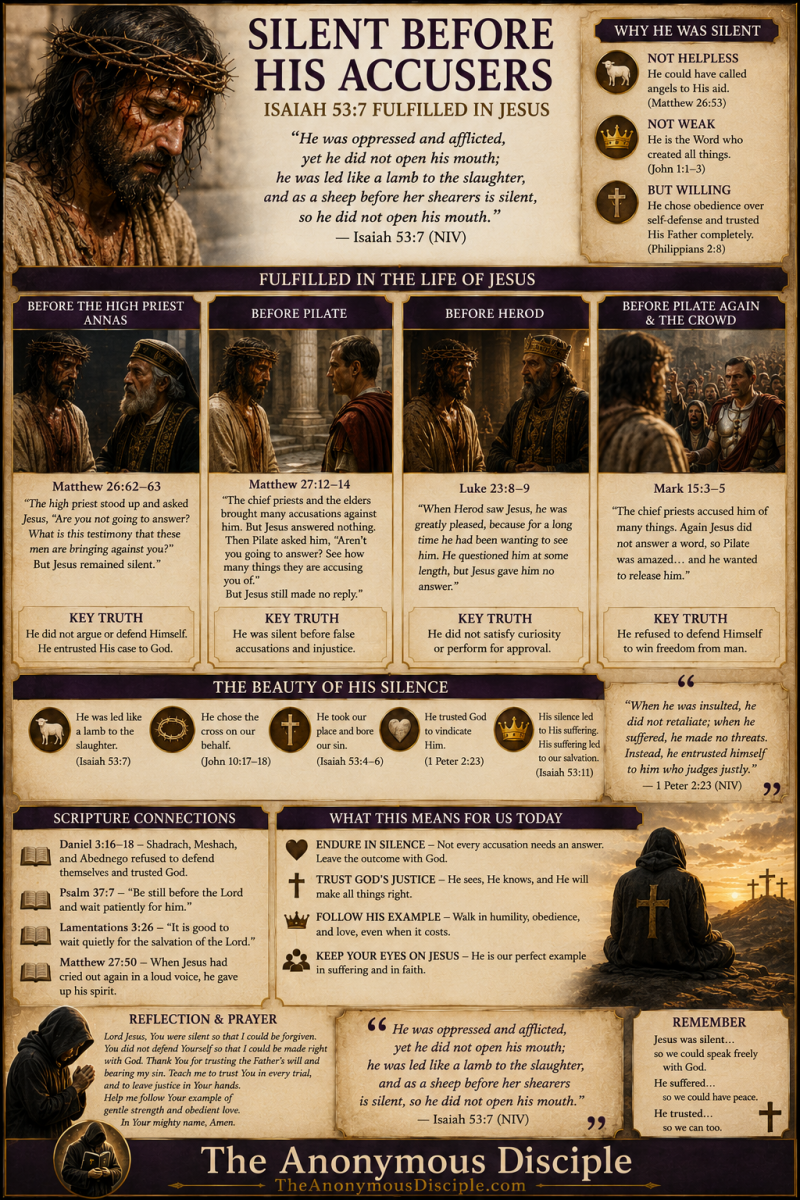
- Silent Before His Accusers card
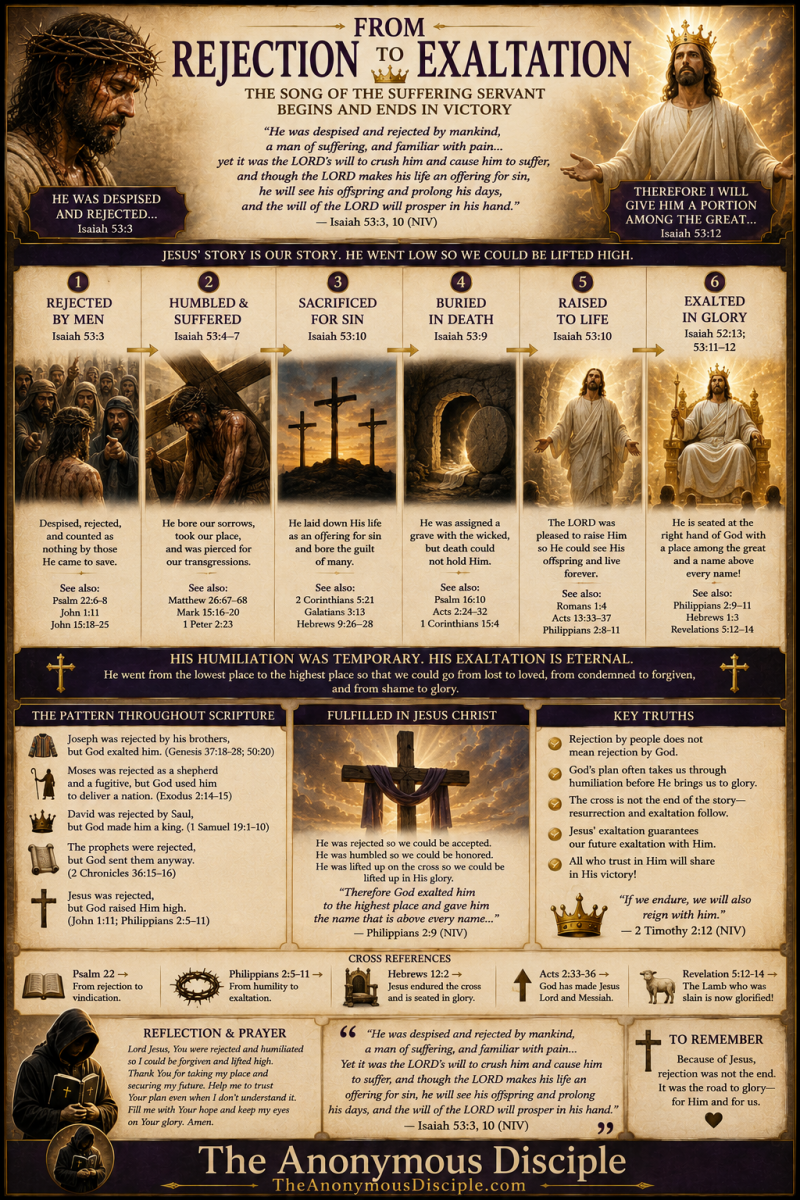
- From Rejection to Exaltation card
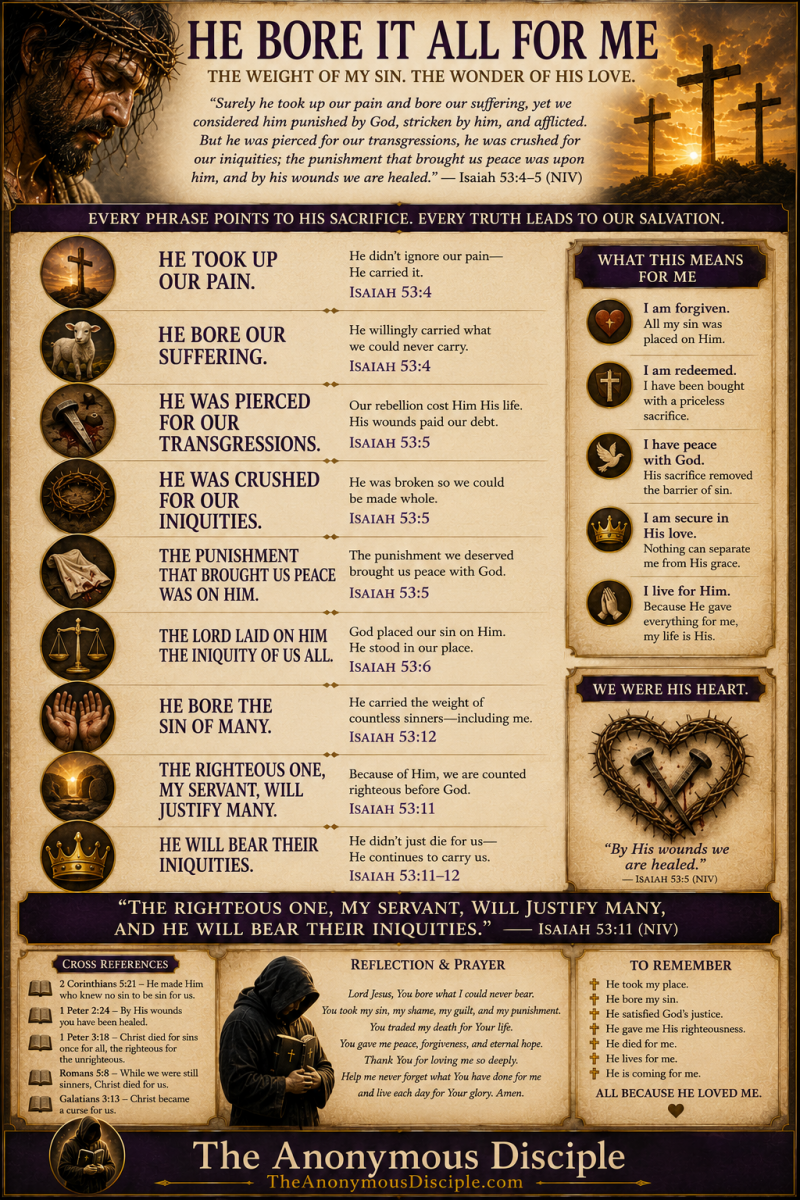
- He Bore It All For Me card
- Study Notes
The Heart of the Message
This passage shows us the heart of the gospel in the Old Testament:
An innocent Servant willingly takes the place of guilty people. He carries their sin, suffers their punishment, dies, and is raised and exalted. Through Him, many are made right with God and find peace and healing.
It is one of the clearest pictures in all of Scripture of what Jesus would do on the cross—and why.

𝕏James𝕏-
Those verses right before chapter 53 are Isaiah 52:13–15. They open the same “Servant Song” that continues into Isaiah 53. They give us the big picture first: this Servant will suffer terribly, then be lifted high.
We’ll use the NIV again, keep it in everyday language, and let Scripture interpret Scripture.
Isaiah 52:13
“See, my servant will act wisely; he will be raised and lifted up and highly exalted.”
God is speaking: “Look at My Servant.” He will handle His work with perfect wisdom (or “prosper,” as some translations note). After everything He goes through, God will raise Him up, lift Him high, and give Him the highest honor.
This is the same Servant Isaiah will describe in detail in chapter 53. The New Testament shows Jesus as that Servant who was crucified, then raised from the dead and exalted to the highest place (Philippians 2:8-11; Acts 2:32-33). The “raised and lifted up” language also echoes how Jesus Himself spoke of being “lifted up” on the cross so He could draw people to Himself (John 12:32).
Isaiah 52:14
“Just as there were many who were appalled at him—his appearance was so disfigured beyond that of any human being and his form marred beyond human likeness—”
Many people would be shocked and horrified when they saw Him. His face and body would be so beaten, bruised, and torn that He barely looked human.
This points straight to the physical suffering Jesus endured—the flogging, the crown of thorns, the beating, and the crucifixion itself (Matthew 27:26-31; Isaiah 50:6 also describes the Servant being struck and spat upon). People looking at the cross would have been appalled at how badly He was treated.
Isaiah 52:15
“so he will sprinkle many nations, and kings will shut their mouths because of him. For what they were not told, they will see, and what they have not heard, they will understand.”
The same Servant who was so disfigured will “sprinkle” many nations. In the Old Testament, sprinkling blood or water was how priests made people clean before God (see Leviticus 16 and Numbers 19). Here it means His suffering will cleanse people from many nations, not just Israel.
Kings and rulers who never heard this message will be so stunned they fall silent. Things they were never taught, they will suddenly see and understand.
This is fulfilled in Jesus. His blood “sprinkles” (cleanses) people from every nation who trust Him (Hebrews 9:13-14; 10:22; 1 Peter 1:2). The gospel went out to the Gentiles, and even kings and leaders have been brought to silence and faith before Him (Acts 8:32-35 already used the next verses to explain Jesus to a Gentile official). Romans 15:21 quotes this very verse to show that people who had never heard would come to understand the good news about Christ.
Putting these three verses with chapter 53:
First we see the Servant’s final glory (v. 13), then the shocking cost of that glory—His body ruined (v. 14), then the worldwide result: cleansing for many nations and even kings coming to understand (v. 15). Chapter 53 then fills in the details of how He suffered and why (for our sins).
It’s one continuous picture: the Servant who looks ruined on the outside is the very One God uses to make people clean and to be exalted forever. That Servant is Jesus.
Here’s a simple, verse-by-verse walk through Isaiah 53 in everyday language. We’ll use the NIV (with a few ESV notes where the wording is especially clear). Scripture itself is the final authority, so I’ll stick close to what the text says and point to other places in the Bible that help us understand it—especially how the New Testament shows this chapter is about Jesus.
This whole section (really starting in Isaiah 52:13) is about God’s “Servant.” The prophet is describing someone who would suffer deeply, not for His own wrongs, but for ours—and then be raised and exalted.
Verse 1
“Who has believed our message and to whom has the arm of the Lord been revealed?”
In plain words: Who actually believed this report? Who recognized that God’s mighty power (“the arm of the Lord”) was being shown through this Servant?
Most people did not. The message of a suffering Savior seemed foolish or unexpected. John 12:37-38 quotes this exact verse to explain why so many still rejected Jesus even after seeing His miracles.
Verse 2
“He grew up before him like a tender shoot, and like a root out of dry ground. He had no beauty or majesty to attract us to him, nothing in his appearance that we should desire him.”
The Servant grew up quietly, like a fragile young plant in hard, dry soil—nothing impressive about His beginnings or looks. He didn’t come with royal pomp or movie-star appearance. People weren’t drawn to Him because He looked special.
Jesus was born in a manger, raised in ordinary Nazareth, and had no outward glory that made people automatically follow Him (see John 1:46; Philippians 2:7).
Verse 3
“He was despised and rejected by mankind, a man of suffering, and familiar with pain. Like one from whom people hide their faces he was despised, and we held him in low esteem.”
People looked down on Him, turned away, and rejected Him. He was a man who knew sorrow and pain up close. We didn’t value Him.
This matches Jesus’ life: rejected by His own people, abandoned by friends, and treated as worthless (John 1:11; Luke 23:18-21).
Verse 4
“Surely he took up our pain and bore our suffering, yet we considered him punished by God, stricken by him, and afflicted.”
He carried our pain and sorrows. But people watching thought God was punishing Him for something He had done wrong.
Matthew 8:17 applies this verse to Jesus’ healing ministry—showing He was already carrying the effects of our brokenness even before the cross.
Verse 5
“But he was pierced for our transgressions, he was crushed for our iniquities; the punishment that brought us peace was on him, and by his wounds we are healed.”
Here is the heart of it. He was pierced (wounded) and crushed—not for His own sins, but for ours. The punishment that brings us peace with God fell on Him. His wounds bring us healing (spiritual healing first—forgiveness and restored relationship with God).
1 Peter 2:24 quotes this directly: “by his wounds you have been healed,” explaining that Jesus bore our sins in His body on the cross.
Verse 6
“We all, like sheep, have gone astray, each of us has turned to our own way; and the Lord has laid on him the iniquity of us all.”
Every one of us has wandered off like stubborn sheep, choosing our own path instead of God’s. And the Lord placed the guilt and punishment for all our wandering onto this Servant.
This is the clear picture of substitution—He took what we deserved. 1 Peter 2:25 echoes the same sheep language about us returning to the Shepherd.
Verse 7
“He was oppressed and afflicted, yet he did not open his mouth; he was led like a lamb to the slaughter, and as a sheep before its shearers is silent, so he did not open his mouth.”
Even while being treated cruelly, He stayed silent. He went to death like a quiet lamb.
Jesus did exactly this before His accusers (Matthew 26:63; 27:12-14; Acts 8:32-35—Philip explains this very passage to the Ethiopian and says it is about Jesus).
Verse 8
“By oppression and judgment he was taken away. Yet who of his generation protested? For he was cut off from the land of the living; for the transgression of my people he was punished.”
He was unfairly condemned and removed from life. Almost no one spoke up for Him. He was cut off (killed) because of the sins of God’s people.
Jesus was tried unjustly, crucified, and died for the sins of others (Acts 8:33 quotes this).
Verse 9
“He was assigned a grave with the wicked, and with the rich in his death, though he had done no violence, nor was any deceit in his mouth.”
He was supposed to be buried with criminals, yet He ended up in a rich man’s tomb. He never did violence or spoke lies.
Jesus was crucified between two criminals, yet Joseph of Arimathea (a rich man) buried Him in his own new tomb (Matthew 27:57-60). 1 Peter 2:22 quotes the “no deceit” part about Jesus.
Verse 10
“Yet it was the Lord’s will to crush him and cause him to suffer, and though the Lord makes his life an offering for sin, he will see his offspring and prolong his days, and the will of the Lord will prosper in his hand.”
It was actually the Lord’s plan for the Servant to suffer and give His life as a guilt offering for sin. But death would not be the end—He would live again (“prolong his days”), see spiritual children (those who believe), and God’s purposes would succeed through Him.
This points to both the cross and the resurrection. Jesus rose, and through Him many become children of God (Hebrews 2:10, 13).
Verse 11
“After he has suffered, he will see the light of life and be satisfied; by his knowledge my righteous servant will justify many, and he will bear their iniquities.”
After the suffering, He will see life again and be satisfied with the result. This righteous Servant will make many people right with God (justify them) because He carried their sins.
Romans 5:18-19 and 2 Corinthians 5:21 show Jesus doing exactly this—His obedience and sacrifice make many righteous.
Verse 12
“Therefore I will give him a portion among the great, and he will divide the spoils with the strong, because he poured out his life unto death, and was numbered with the transgressors. For he bore the sin of many, and made intercession for the transgressors.”
Because He poured out His life, was counted among sinners, carried the sins of many, and still prayed for them, God will highly exalt Him and give Him the victory.
Jesus Himself quoted the “numbered with the transgressors” part about Himself (Luke 22:37). He intercedes for us even now (Hebrews 7:25; Romans 8:34).
Putting it all together simply:
Isaiah 53 tells us the Servant would be ordinary-looking, rejected, silent under suffering, die for our sins as a substitute, be buried in an unexpected way, rise again, and bring many people into right standing with God. The New Testament repeatedly shows that Jesus is this Servant.
This chapter is pure gospel written hundreds of years before the cross. It shows both the depth of our sin and the depth of God’s love in providing a perfect Substitute.
Add comment
Comments