

Amos 9 holds two truths together:
⚖️ God’s judgment is thorough and unavoidable for those who refuse Him.
⚖️ His final word is restoration, hope, and a rebuilt kingdom through the Son of David that reaches the nations.
That is the thread that runs from Amos all the way into the New Testament and the gospel we live under today.

Today's Study:
- ⚓ Amos 9:4
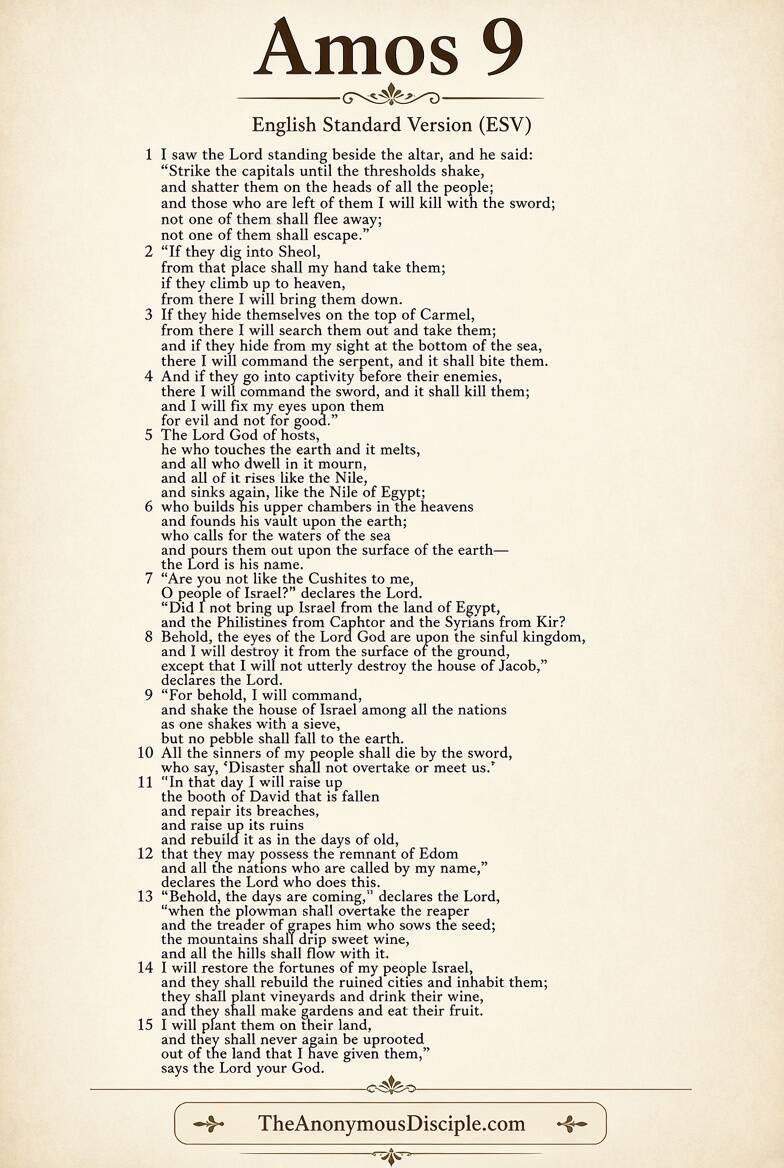
- Full chapter ESV
- Verse by verse breakdown Amos 9
- Amos 9 Deep Dive study card
- Main Themes & Cross References
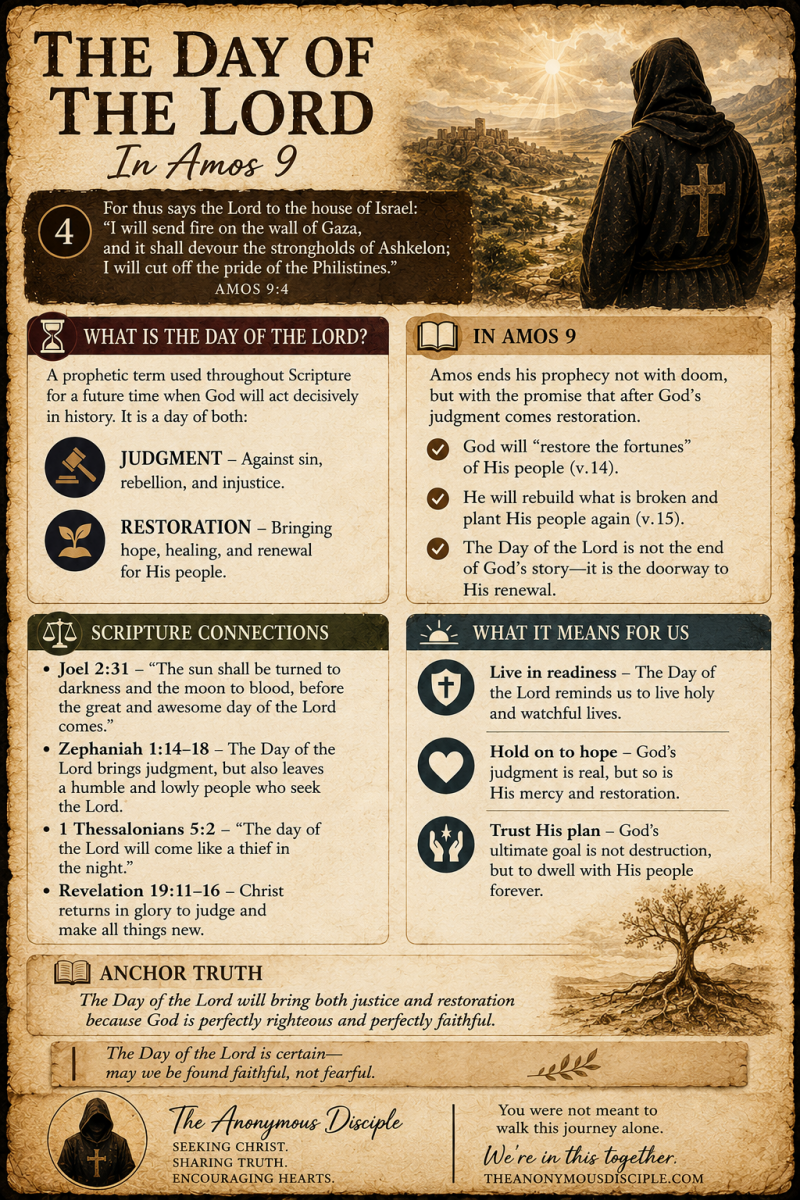
- Day of The Lord card
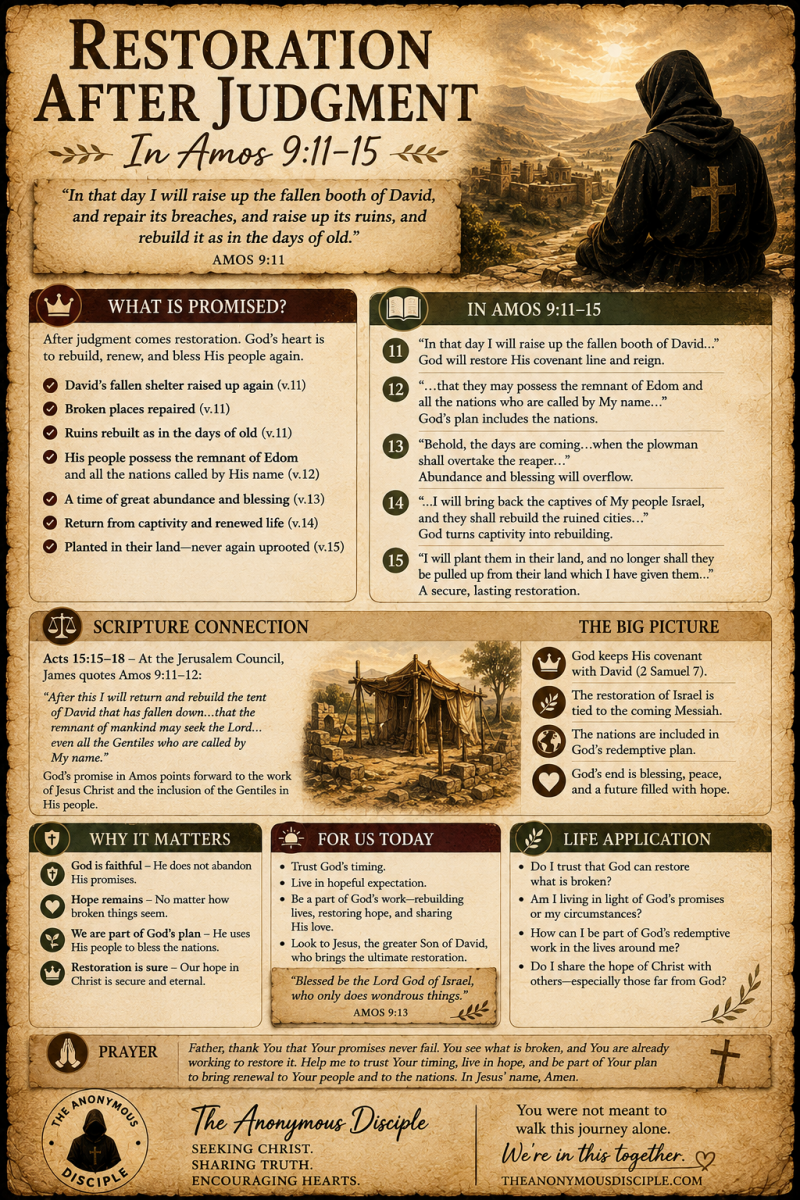
- Restoration after Judgment card
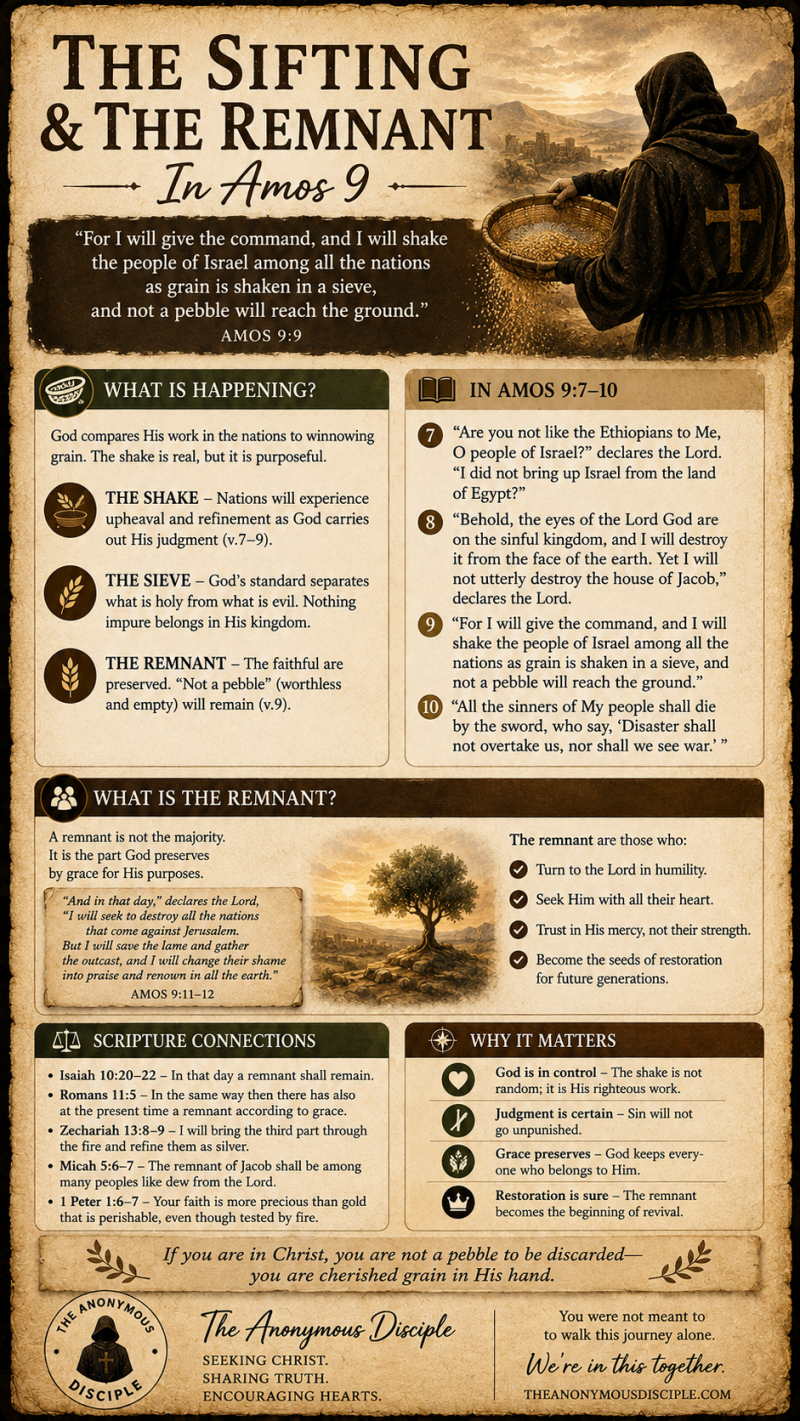
- The Sifting and The Remnant card
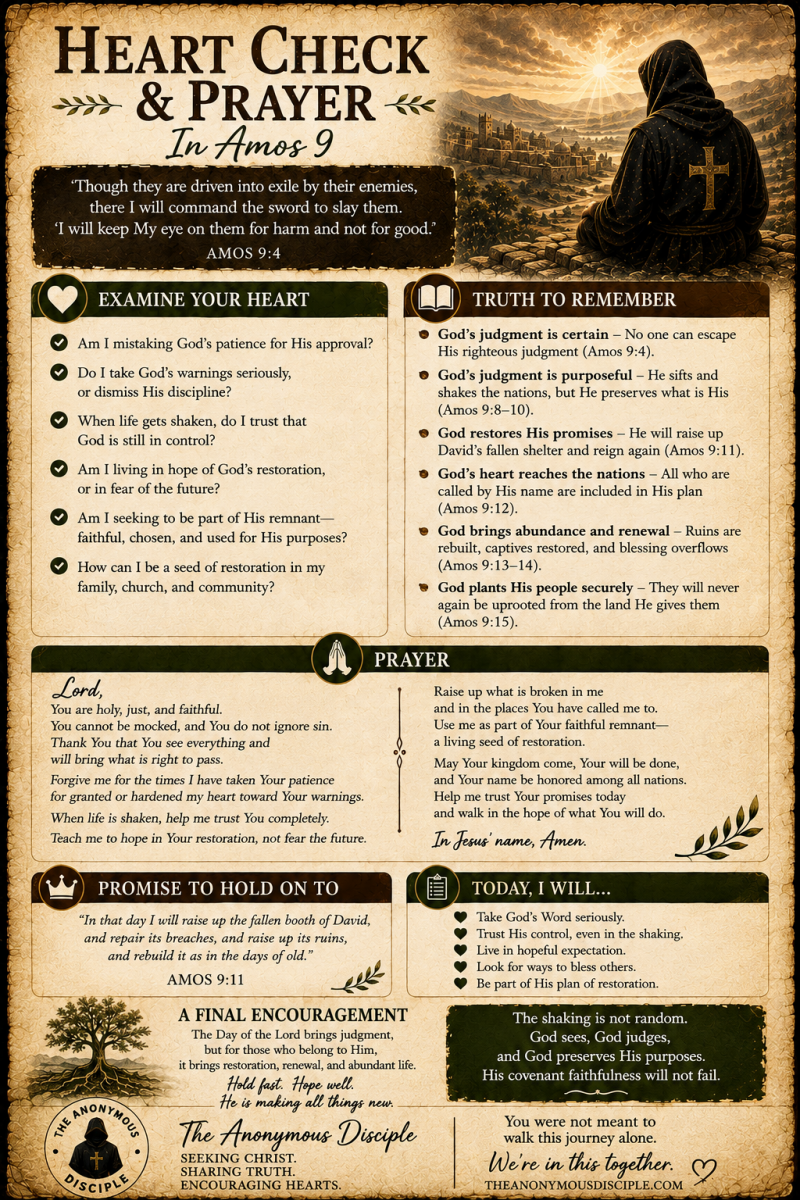
- Heart Check & Prayer card (plus pdf)
- Study Notes

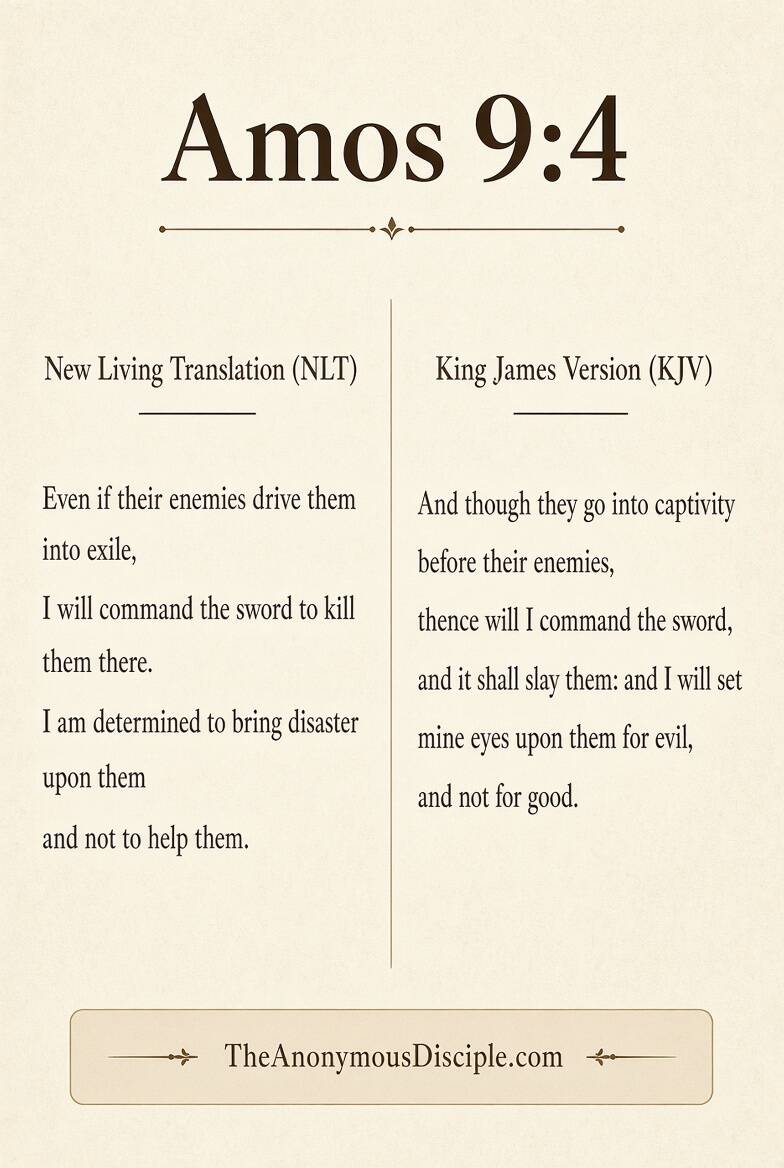
Amos 9:4 (NIV)
“Though they are driven into exile by their enemies, there I will command the sword to slay them.
‘I will keep my eye on them for harm and not for good.’”
In simple, everyday language
The second half is the heart of it:
God is saying, “I am watching them—but not to protect or bless them. My eyes are set against them for judgment.”
This is the opposite of the comforting truth we usually hear. Normally Scripture says God’s eyes are on His people for good—to watch over them, guard them, and help them. Here, because of their stubborn rebellion, His watchful eye is turned the other way: it is fixed on them for harm.
Why this is significant
- God sees everything, and His seeing is never neutral.
He is not a distant observer. When people keep refusing Him, His gaze itself becomes a judgment. There is no place—home, mountain, sea, or even foreign exile—where His eye cannot reach. - Exile is not the end of the story, nor is it safety.
Israel thought being carried off to another land might be the worst that could happen. God says even there the sword will still find them because He is the One sending it. Geographic distance does not create spiritual distance from God. - This is the dark side of a truth that runs all the way through the Bible.
The same “eyes of the Lord” that bring comfort to the faithful become a terrifying reality to the unrepentant.
How this theme is threaded throughout Scripture
- Psalm 34:15-16 (NIV)
“The eyes of the Lord are on the righteous, and his ears are attentive to their cry;
but the face of the Lord is against those who do evil…”
Same idea: God’s eyes/face are for the righteous and against the wicked. - Proverbs 15:3
“The eyes of the Lord are everywhere, keeping watch on the wicked and the good.”
He never stops watching—whether for blessing or for judgment. - Leviticus 26:17 (in the covenant curses)
“I will set my face against you so that you will be defeated by your enemies…”
Almost the same language as Amos 9:4. - 1 Peter 3:12 (quoting Psalm 34)
The New Testament repeats it: God’s eyes are on the righteous, but His face is against those who do evil. - The flip side in the gospel
In Christ the direction of God’s eyes is reversed for those who turn to Him. Instead of “for harm and not for good,” we hear promises like:
“The Lord will keep you from all harm” (Psalm 121:7) and “He who watches over you will not slumber” (Psalm 121:3).
Bottom line for today
Amos 9:4 is a sober reminder that God’s attention is never casual.
When we walk with Him, His eyes are our greatest comfort.
When we persistently walk away from Him, those same eyes become our greatest danger—no matter where we try to hide.
That is the weight of this anchor verse. -𝕏James𝕏
𝕏James𝕏-
Here’s a clear, verse-by-verse breakdown of Amos 9 in everyday language. I’ll stick close to the NIV wording and keep it simple and honest, the way Scripture itself speaks.
Verses 1–4 – Nowhere to Hide from God’s Judgment
Verse 1
Amos sees the Lord standing right by the altar (the place of worship in the northern kingdom’s temple at Bethel). God says, “Strike the tops of the pillars so the whole building shakes and collapses on the people’s heads. Whoever is left, I’ll kill with the sword. No one will escape.”
In plain terms: Judgment starts at the very place they thought was safe—their own religious center. God Himself is overseeing the destruction. There is no safe spot left.
Verse 2
Even if they dig down into the deepest place under the earth (Sheol, the realm of the dead), God’s hand will still pull them out. Even if they climb up to the heavens, He will bring them down.
In plain terms: You cannot go too low or too high to get away from God.
Verse 3
If they hide on the highest mountain (Carmel), God will hunt them down. If they try to hide at the bottom of the sea, He will command a sea serpent to bite them.
In plain terms: Mountains and oceans offer no protection. God controls every place.
Verse 4
Even if their enemies drag them away into exile, God will still command the sword to find them there. He says, “I will keep my eye on them for harm and not for good.”
In plain terms: Exile won’t save them either. God’s watchful eye is now set against them because of their persistent sin.
Verses 5–6 – Who Is Doing This?
Verse 5
The Lord, the Lord Almighty, is the One who can touch the earth and make it melt. The land rises and falls like the Nile River flooding and then receding.
In plain terms: This is not some weak local god. This is the all-powerful Creator who controls the very ground we stand on.
Verse 6
He builds His palace in the heavens and sets its foundation on the earth. He calls the waters of the sea and pours them out over the land. The Lord is His name.
In plain terms: He is the God of heaven and earth. When He speaks, nature itself obeys. That is why no one can escape Him.
Verses 7–10 – Israel Is Not Special in the Way They Thought
Verse 7
God asks, “Are you Israelites any different to Me than the Cushites (people from far-off Africa)?” He also reminds them that He moved the Philistines and the Arameans from one place to another, just as He brought Israel out of Egypt.
In plain terms: Being God’s chosen people does not give automatic protection when you live in open rebellion. God moves nations according to His purposes. Israel is not exempt from accountability.
Verse 8
The eyes of the Sovereign Lord are on this sinful kingdom, and He will destroy it from the face of the earth. Yet He will not totally destroy the descendants of Jacob.
In plain terms: The northern kingdom (Israel) will be wiped out as a nation. But God still has a remnant plan for the people of Jacob. Complete annihilation is not the final word.
Verse 9
God will shake the people of Israel among the nations the way a farmer shakes grain in a sieve. The good grain stays; the pebbles and trash fall through.
In plain terms: God will scatter them, but He will carefully separate the true remnant from the rebellious. Not everything (or everyone) will be lost.
Verse 10
All the sinners among His people who keep saying, “Disaster will never touch us,” will die by the sword.
In plain terms: The people who were confident that judgment would never come—because they were “God’s people”—will be the ones who fall.
Verses 11–15 – The Beautiful Promise of Restoration
This is the sudden turn at the end of the book. After all the judgment, God speaks of hope.
Verse 11
“In that day I will restore David’s fallen shelter (or tent/booth). I will repair its broken walls, restore its ruins, and rebuild it as it used to be.”
In plain terms: God promises to raise up the house of David again—the royal line that had fallen into ruins. This points forward to the Messiah, Jesus, who comes from David’s line and restores God’s kingdom.
Verse 12
So that they may possess the remnant of Edom and all the nations that bear My name.
In plain terms: The restored kingdom will reach beyond Israel to include other nations—people who belong to the Lord. (The New Testament sees this fulfilled in the gospel going to the Gentiles—see Acts 15:16-17.)
Verse 13
The days are coming when the harvest will be so abundant that the person plowing the next crop will catch up with the person still harvesting the last one. New wine will drip from the mountains and flow from the hills.
In plain terms: Picture a land so fruitful that planting and harvesting almost overlap. Mountains and hills overflow with blessing. This is a picture of overflowing abundance and joy.
Verse 14
God will bring His people Israel back from exile. They will rebuild the ruined cities and live in them. They will plant vineyards and drink the wine. They will make gardens and eat the fruit.
In plain terms: Real restoration—home, security, work that bears fruit, and the joy of enjoying what they have planted.
Verse 15
“I will plant Israel in their own land, never again to be uprooted from the land I have given them,” says the Lord your God.
In plain terms: The final promise is permanence. God Himself will plant them securely. No more exile. No more being pulled out of the land He gave them.
The Big Picture
Amos 9 starts with the hardest, most inescapable judgment and ends with one of the most beautiful pictures of restoration in the Old Testament. God is both just and merciful. He will not ignore sin, but He also will not abandon His ultimate purpose to restore His people and extend His blessing to the nations through the line of David—fulfilled in Jesus.
That is the heart of the chapter: judgment is real and thorough, but it is not the last word. Hope and restoration are.
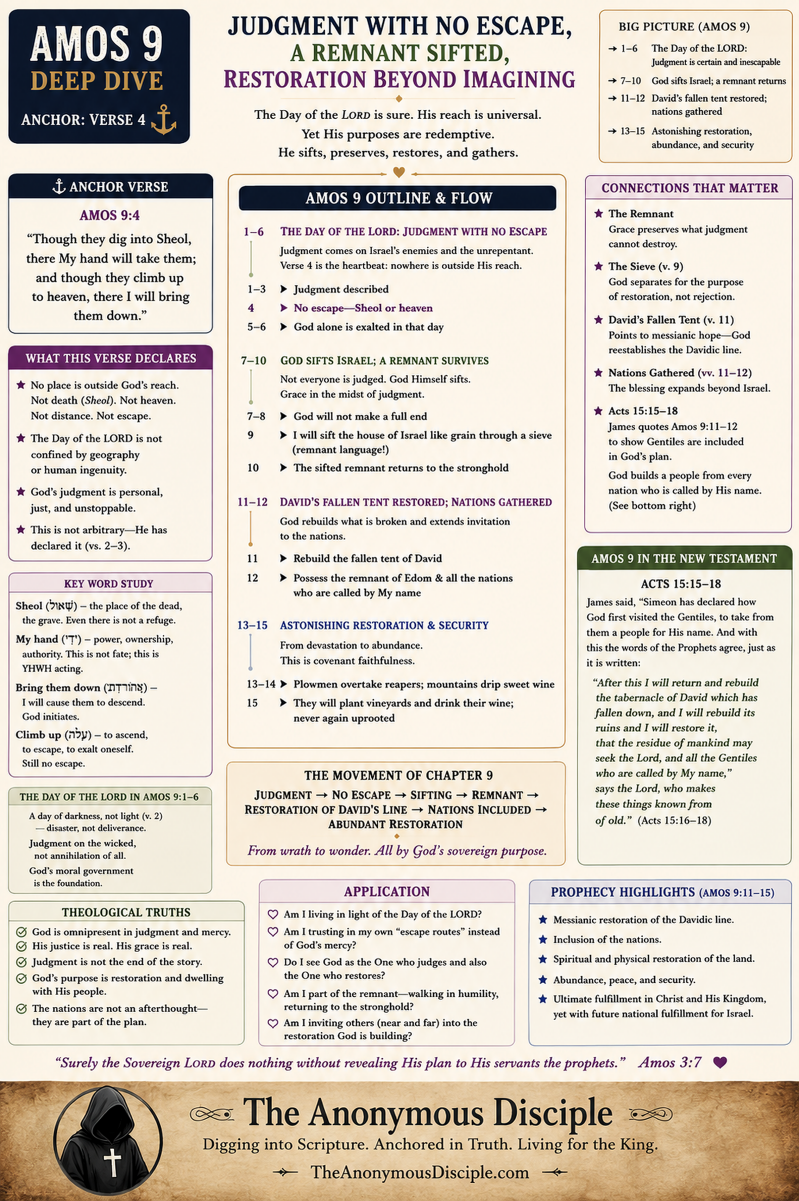
Main Themes in Amos 9
- God’s Judgment Is Inescapable (verses 1–4, 8–10)
No one can hide from the Lord—whether in the depths of the earth, the heights of heaven, the mountains, the sea, or even in exile. His eyes are set against the unrepentant. - God Is Sovereign Over All Nations and Creation (verses 5–7)
The Lord is not just Israel’s private God. He controls the earth, the seas, and the movements of every nation (including the Philistines and Syrians). Israel is not automatically special just because of its history. - God Will Sift His People but Preserve a Remnant (verses 8–10)
He will destroy the sinful kingdom, yet He will not completely wipe out the house of Jacob. The “sieve” picture shows that the true people of God will remain while the rebels fall away. - Restoration of the House of David (verses 11–12)
God promises to rebuild the fallen “booth” (or tent) of David. This is a clear messianic promise pointing to Jesus, the Son of David, and the inclusion of the nations (Gentiles) who are called by His name. - Future Abundance and Permanent Security (verses 13–15)
A picture of overflowing blessing: harvests so rich they overlap, mountains dripping with sweet wine, people rebuilding cities, planting vineyards, and never again being uprooted from the land God gives them.
Key Cross-References
On no place to hide from God
- Psalm 139:7–12 – “Where can I go from your Spirit? Where can I flee from your presence?”
- Jeremiah 23:24 – “Can anyone hide in secret places so that I cannot see him?”
- Job 34:22 – Darkness and the shadow of death cannot hide the wicked from Him.
On God setting His eyes for harm / judgment
- Jeremiah 44:11, 27 – “I will set my face against you for harm and not for good.”
- Similar language appears in Leviticus 26:17 and other covenant-curse passages.
On the “booth / tent of David” being raised up
- Acts 15:16–17 – James quotes Amos 9:11–12 at the Jerusalem Council to show that the inclusion of the Gentiles in the church is the fulfillment of this promise.
- Isaiah 9:6–7; Isaiah 11:1–10 – The coming King from David’s line.
- Jeremiah 23:5–6 – “I will raise up for David a righteous Branch.”
- Luke 1:32–33 – The angel tells Mary that Jesus will sit on the throne of His father David.
On abundant blessing and restoration
- Joel 3:18 – Mountains dripping with sweet wine (almost the same picture).
- Leviticus 26:5 – The threshing lasting until the grape harvest.
- Isaiah 65:21–22 – Building houses and planting vineyards again.
- Jeremiah 30:3, 18 – Restoring the fortunes of God’s people and rebuilding.
On the remnant being preserved
- Jeremiah 30:11 – God will not make a full end of His people.
- Romans 9:27 and 11:5 – Paul speaks of a remnant chosen by grace.
🪄Jenny🪄-
I think the biggest thing to carry from Amos 9 is this:
God’s judgment is never careless, and His restoration is never accidental. He sees, He sifts, He preserves, and He keeps His promises.
There is something sobering in Amos 9:4. God is telling a people who have persistently rejected Him that they cannot outrun His righteous judgment. Even exile will not put them outside His reach. The heart lesson for me would be: never mistake God’s patience for God’s approval. He is merciful, but He is holy.
But then look at where the chapter goes. ❤️
Amos 9:8 says God will judge the sinful kingdom, “yet I will not totally destroy the descendants of Jacob.” Judgment does not mean God has forgotten His covenant.
Then Amos 9:9 gives us the sieve: Israel will be shaken among the nations. The shaking is severe, but it is purposeful. God knows exactly what He is doing.
And then comes that extraordinary turn:
Amos 9:11 — God will raise up “David’s fallen shelter.”
Amos 9:12 — His purpose expands outward to the nations who bear His name.
Amos 9:13–14 — devastation gives way to extraordinary abundance and rebuilding.
And finally:
Amos 9:15 —
“I will plant Israel in their own land, never again to be uprooted…”
So if I had to write one sentence in the margin of your Bible beside Amos 9, it would be:
The shaking does not mean God has lost control. Sometimes the shaking is part of how He brings His purposes to completion.
And there is another piece I think especially matters for us as Christians. Acts 15:15–18 deliberately reaches back to Amos 9:11–12. James sees the restoration of David’s fallen tent as connected to what God is doing through Christ—including bringing the Gentiles into a people for His name.
So Amos 9 doesn't ultimately leave us staring at judgment.
It leaves us staring at the faithfulness of God.
Sin matters.
Holiness matters.
God cannot be escaped or manipulated.
But neither can His covenant faithfulness be defeated.
Add comment
Comments