

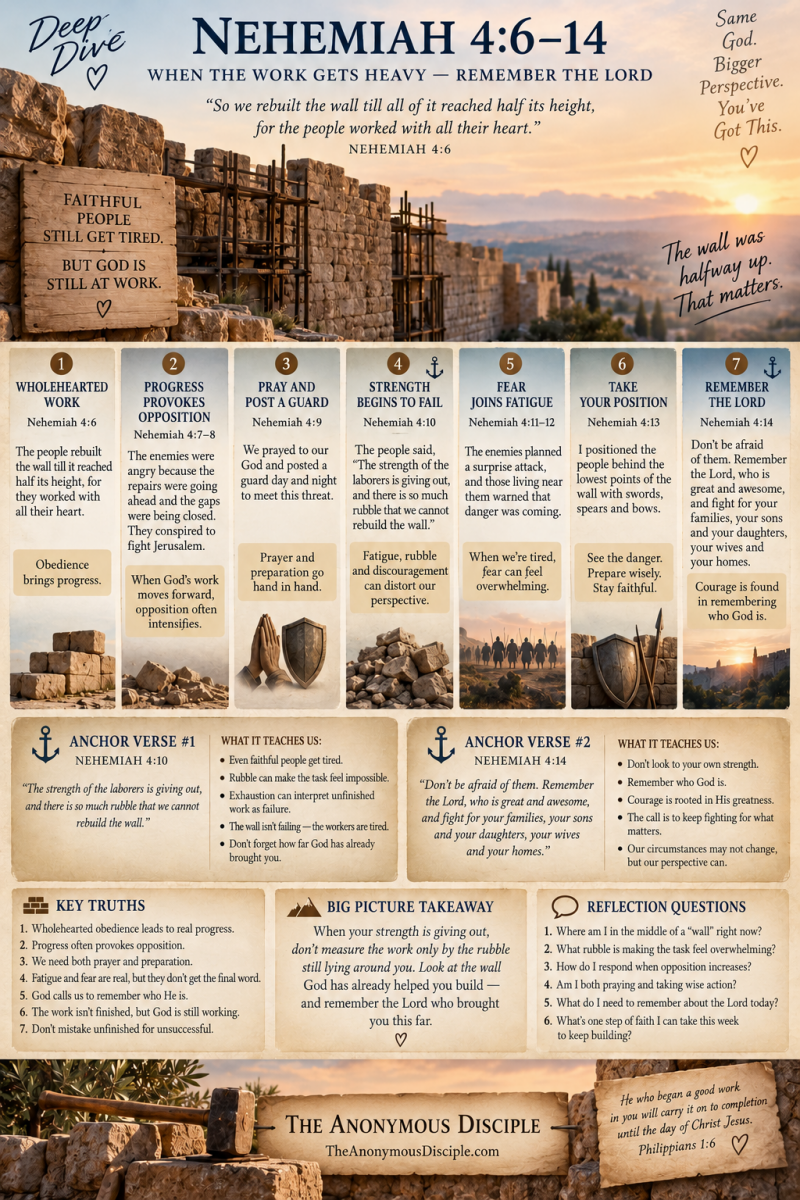
Nehemiah 4:6–14 brings us into the messy middle of rebuilding. The wall was already halfway up. The people had worked with all their hearts. The gaps were closing—and that was exactly when opposition intensified, strength began to fail, and fear threatened to stop the work.
But Nehemiah shows us what faith looks like when the work gets heavy. The people prayed to God and posted a guard (Nehemiah 4:9). They acknowledged the danger without surrendering to it. And when weary workers began staring at the rubble and saying, “We cannot rebuild the wall” (Nehemiah 4:10), Nehemiah redirected their eyes: “Don’t be afraid of them. Remember the Lord, who is great and awesome” (Nehemiah 4:14).
This study is a reminder that unfinished does not mean unsuccessful. Faithful people get tired. Opposition can intensify when the gaps are closing. And sometimes exhaustion makes the rubble still lying around us look bigger than the wall God has already helped us build.
When our strength is giving out, we don't have to pretend the rubble isn't there. We pray. We prepare. We take our position. We keep building.
And above all—we remember the Lord. 🧱⚓️🙏
Today's Study:
-
⚓ Anchor Verses
-
✨📖 KJV v NIV Passage Comparison
- 📖 The Story Behind the Book
- 🧱 Deep Dive card — Nehemiah 4:6–14
-
🕯️ Verse by Verse Breakdown with 𝕏James𝕏
- 🪨 When All You Can See Is the Rubble card — Nehemiah 4:10
-
🏺 Culture & Tradition Notes
- 🙏🛡️ Pray & Post a Guard card — Nehemiah 4:9
-
🔗 Cross References for Passage & Anchor verses
- 🧱 The Wall Was Halfway Up card — Discouragement in the Middle
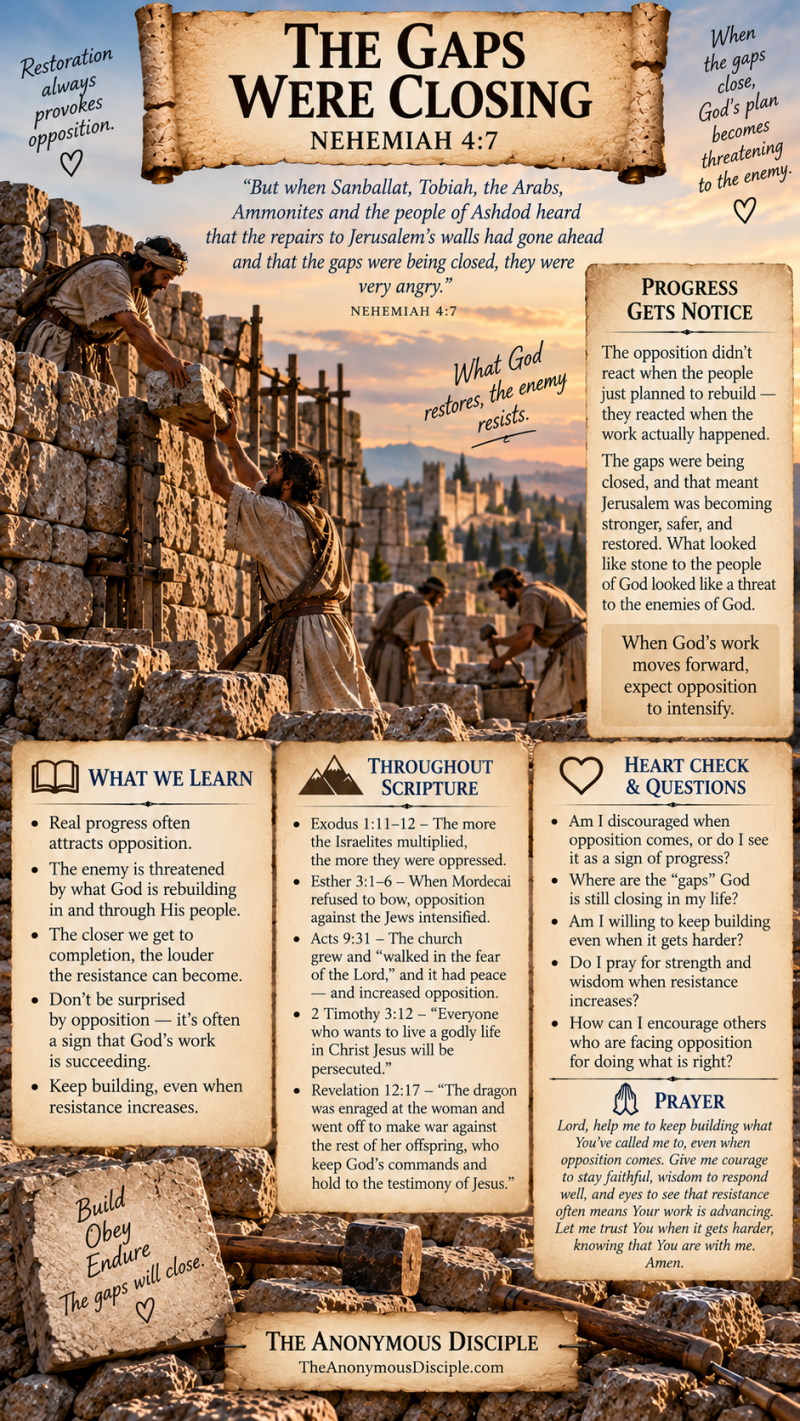
- ⚔️ The Gaps Were Closing card— Nehemiah 4:7
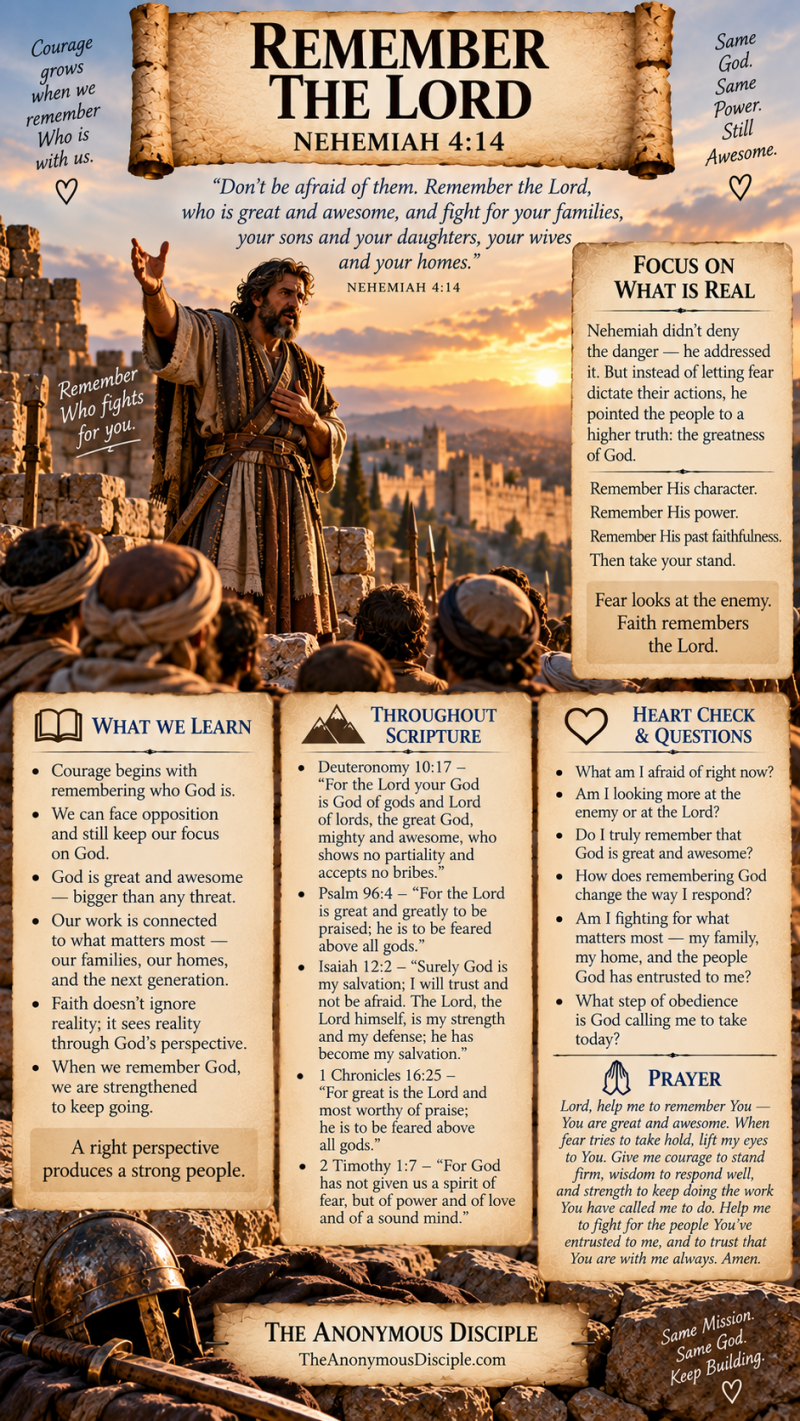
- 🛡️ Remember the Lord card — Nehemiah 4:14
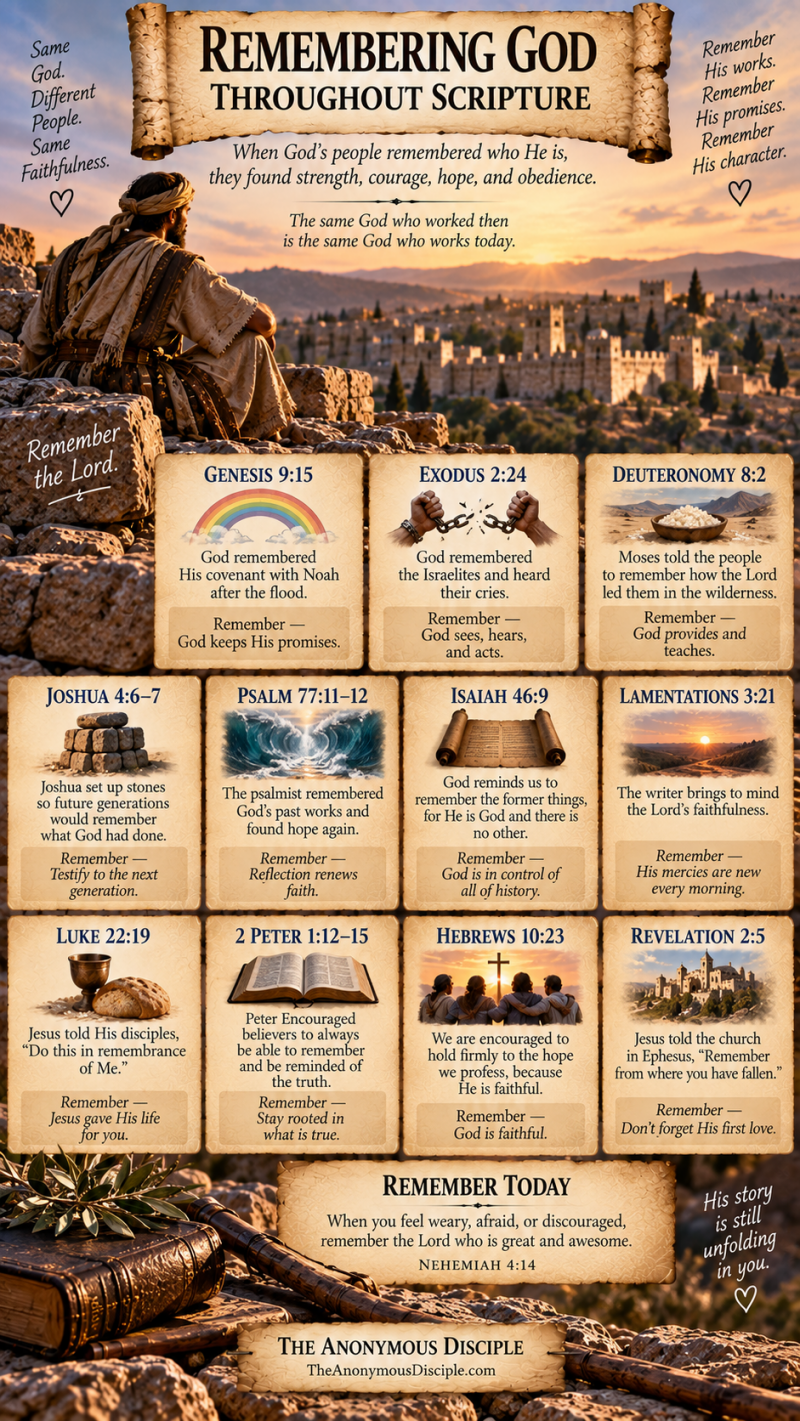
- 🧵 Remembering God Throughout Scripture card
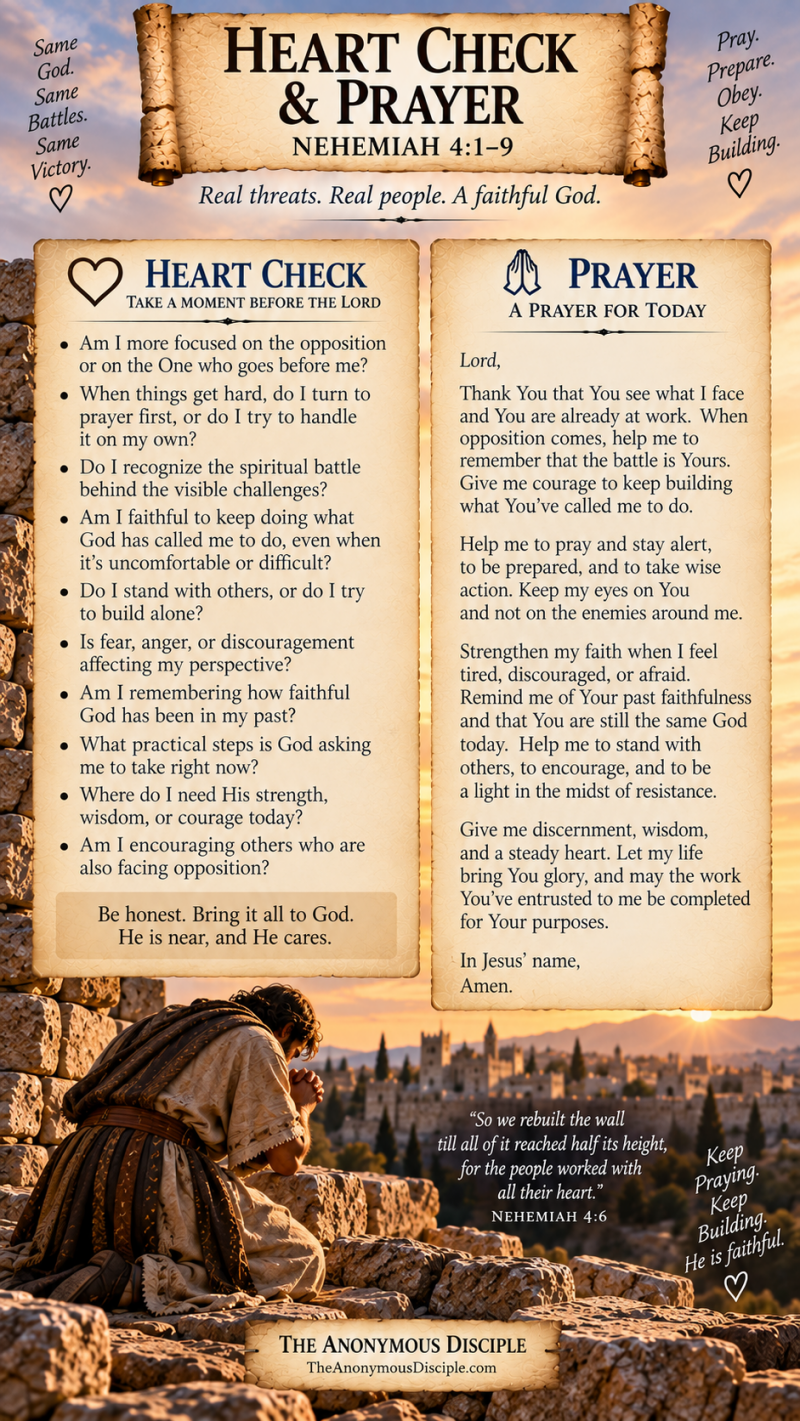
- ❤️ Heart Check & Prayer card (plus pdf)
-
🌿Dive Study Notes with 🪄Jenny🪄
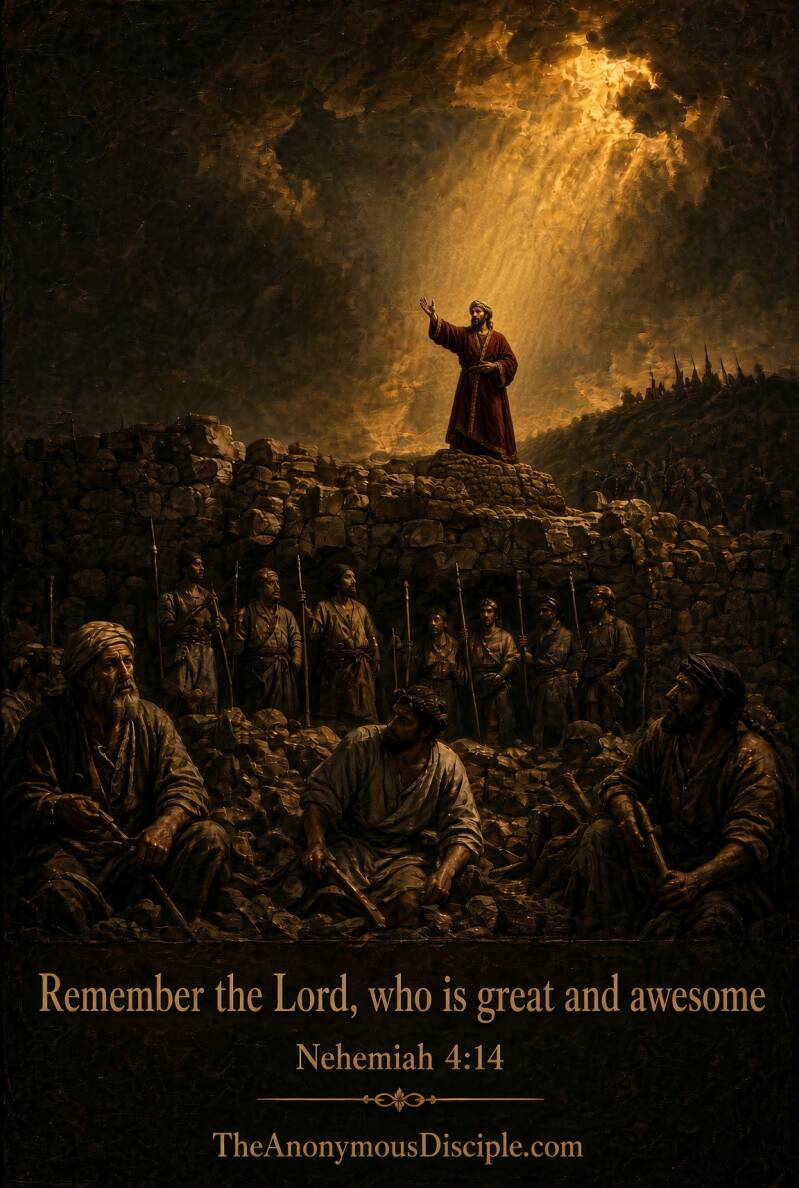
⚓ verse 10
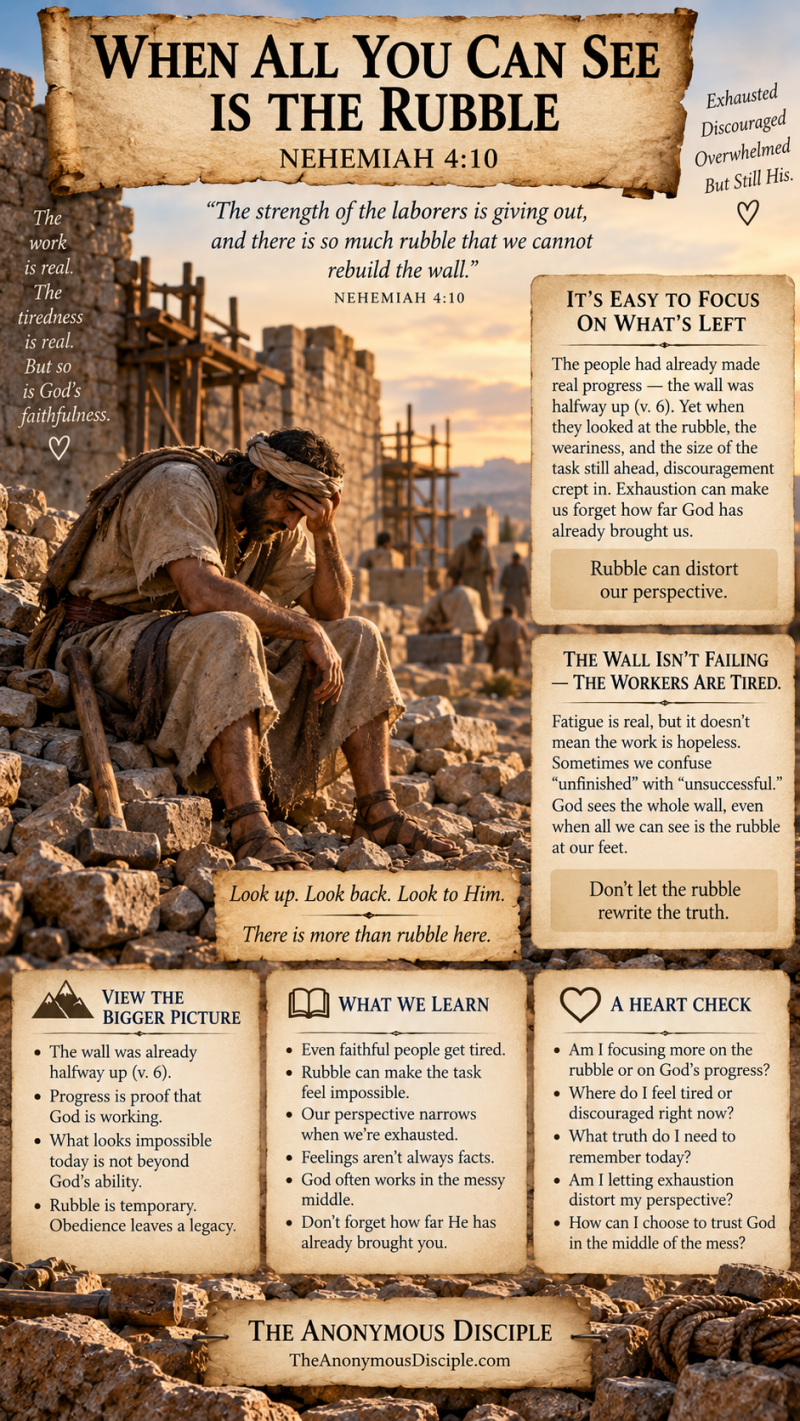
“The strength of the laborers is giving out, and there is so much rubble that we cannot rebuild the wall.”
Nehemiah 6:9
The enemy still tries to make your hands go weak. Ask God to strengthen them anyway.
Isaiah 40:29–31
Tired people are exactly whom God offers strength to. Wait on Him; He is not worn out.
Isaiah 35:3–4
When hands hang down and hearts are scared, the word is: “Be strong. Your God is coming.”
Psalm 73:26
Body and heart can fail. That does not mean God has failed.
2 Corinthians 4:7–9, 16
We are clay jars. We get knocked around. The treasure inside is still His, and the inner person can be renewed.
Galatians 6:9
Do not quit the good work just because you are tired today. Harvest comes later.
Numbers 13:31–33
“We cannot” is an old sentence. It is what people say when they measure the rubble and forget the Lord.

⚓ verse 14
“Don’t be afraid of them. Remember the Lord, who is great and awesome, and fight for your families, your sons and your daughters, your wives and your homes.”
Nehemiah 1:5; 9:32
Nehemiah uses the same name for God he used on his knees. Remember is not a new idea. It is going back to who he already knew God to be.
Deuteronomy 7:21; 10:17
“Great and awesome” is covenant language. He is not a small helper. He is the God of gods.
Deuteronomy 1:29–30; 20:1–4
Do not panic at the size of the enemy. The Lord goes with you into the fight.
Joshua 1:9
Courage is commanded because God is present, not because the job looks easy.
2 Chronicles 20:15–17
Some battles are the Lord’s. Your part is to stand, not to pretend you are unafraid by yourself.
2 Chronicles 32:7–8
There are more with us than with them — if the Lord is with us.
Isaiah 41:10
Fear not. I am with you. I will strengthen you. That is God talking, not a pep talk.
2 Samuel 10:12
Be brave for your people and leave the outcome with the Lord.
Numbers 14:9
Do not fear them. Their cover is gone. The Lord is with us.
Hebrews 13:6
The Lord is my helper. I will not be afraid. What can people finally do?
Psalm 20:7
Some trust what they can count. We trust the name of the Lord.
Verse 10 tells the truth about being worn out.
Verse 14 tells the truth about who God is, and who is worth standing for.
Both can be on the same wall, on the same morning.
📜 Nehemiah 4:6-14📜
King James Version (KJV)
6 So built we the wall; and all the wall was joined together unto the half thereof: for the people had a mind to work.
7 But it came to pass, that when Sanballat, and Tobiah, and the Arabians, and the Ammonites, and the Ashdodites, heard that the walls of Jerusalem were made up, and that the breaches began to be stopped, then they were very wroth,
8 And conspired all of them together to come and to fight against Jerusalem, and to hinder it.
9 Nevertheless we made our prayer unto our God, and set a watch against them day and night, because of them.
10 And Judah said, The strength of the bearers of burdens is decayed, and there is much rubbish; so that we are not able to build the wall.
11 And our adversaries said, They shall not know, neither see, till we come in the midst among them, and slay them, and cause the work to cease.
12 And it came to pass, that when the Jews which dwelt by them came, they said unto us ten times, From all places whence ye shall return unto us they will be upon you.
13 Therefore set I in the lower places behind the wall, and on the higher places, I even set the people after their families with their swords, their spears, and their bows.
14 And I looked, and rose up, and said unto the nobles, and to the rulers, and to the rest of the people, Be not ye afraid of them: remember the Lord, which is great and terrible, and fight for your brethren, your sons, and your daughters, your wives, and your houses.


New International Version (NIV)
6 So we rebuilt the wall till all of it reached half its height, for the people worked with all their heart.
7 But when Sanballat, Tobiah, the Arabs, the Ammonites and the people of Ashdod heard that the repairs to Jerusalem’s walls had gone ahead and that the gaps were being closed, they were very angry.
8 They all plotted together to come and fight against Jerusalem and stir up trouble against it.
9 But we prayed to our God and posted a guard day and night to meet this threat.
10 Meanwhile, the people in Judah said, “The strength of the laborers is giving out, and there is so much rubble that we cannot rebuild the wall.”
11 Also our enemies said, “Before they know it or see us, we will be right there among them and will kill them and put an end to the work.”
12 Then the Jews who lived near them came and told us ten times over, “Wherever you turn, they will attack us.”
13 Therefore I stationed some of the people behind the lowest points of the wall at the exposed places, posting them by families, with their swords, spears and bows.
14 After I looked things over, I stood up and said to the nobles, the officials and the rest of the people, “Don’t be afraid of them. Remember the Lord, who is great and awesome, and fight for your families, your sons and your daughters, your wives and your homes.”
📖The Story Behind the Book
Who wrote it?
Large parts of the book are Nehemiah’s own words—he writes “I” and tells what he saw and did. Many faithful teachers also believe Ezra (the priest and scribe) later gathered Nehemiah’s records together with other material, because Ezra and Nehemiah were originally one book in the Hebrew Bible. So: Nehemiah’s memoir, likely finished and arranged by Ezra.
When was it written?
The events happen around 445–430 BC. Nehemiah first came to Jerusalem in 445 BC (the 20th year of King Artaxerxes). The book as we have it was probably put together a little later, roughly 430–400 BC.
Where was it written?
Most of the story takes place in Jerusalem. Nehemiah started in the Persian palace at Susa, then came to Judah. The writing itself was done in and around Jerusalem after the wall was up and the community was being restored.
Why was it written?
To show that God keeps His word. He brought His people back from exile, helped them rebuild the wall in the face of mockery and threats, and called them back to His law. It is a record of God’s help, the people’s hard work, and the need to stay faithful after the work is done.
To whom was it written?
To the Jewish people who had returned from Babylon and were living in Judah—especially those in Jerusalem. It was meant to encourage that remnant: God had not forgotten them, the work was His, and they needed to remember Him and protect what He had given them (homes, families, worship, and the city itself).
That last part sits right next to your anchor verses. Verse 10 is the weary “we cannot.” Verse 14 is the call to remember the Lord and fight for the people closest to you. The whole book is written so that tired, threatened people would not forget either one.
Verse by verse breakdown with 𝕏James𝕏
Verse 6
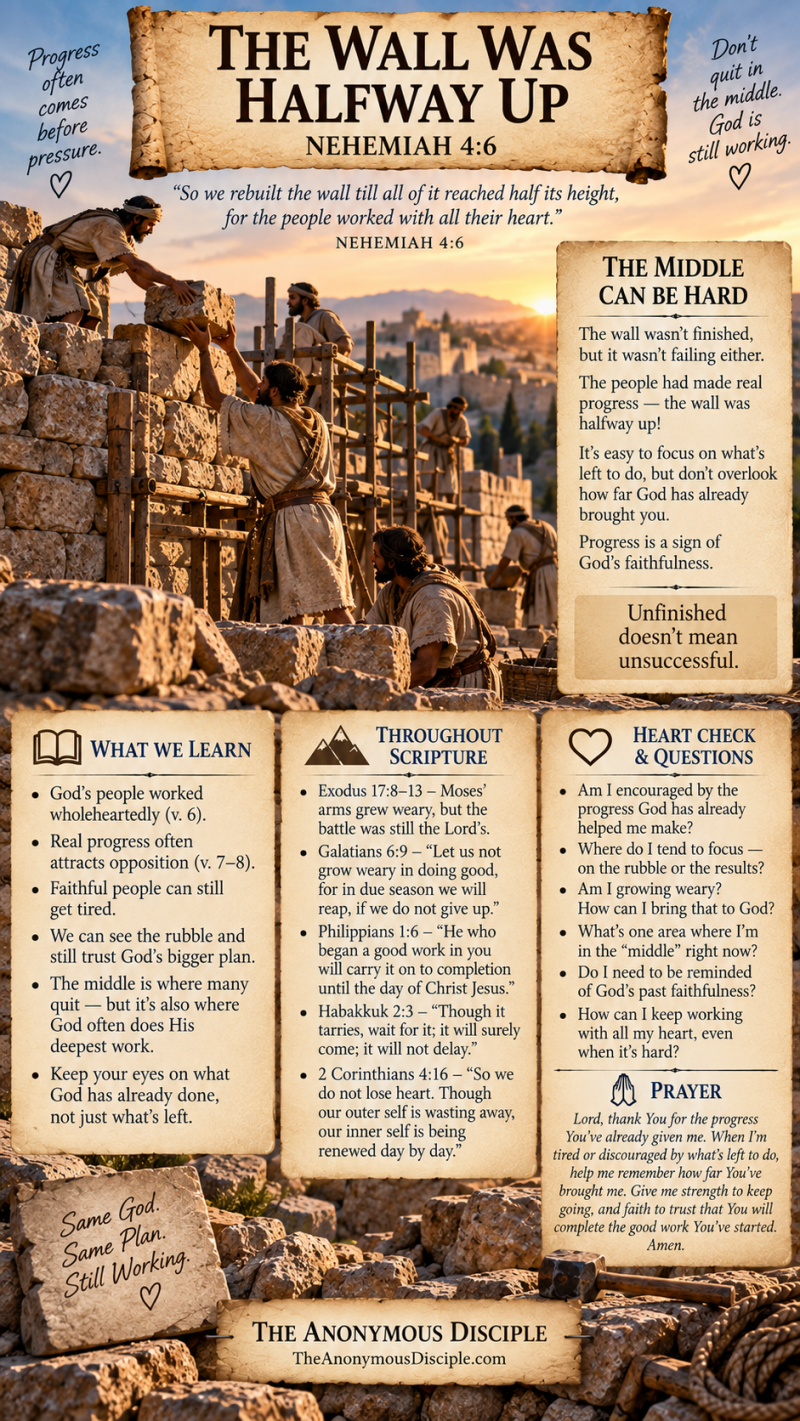
So we rebuilt the wall till all of it reached half its height, for the people worked with all their heart.
They weren’t just dabbling. The people put their whole heart into the work, and it showed—the wall was already halfway up.
Today: When God’s people actually throw their heart into what He’s given them to do, progress happens. Half-done work is still real work when the heart is in it.
Verse 7
But when Sanballat, Tobiah, the Arabs, the Ammonites and the people of Ashdod heard that the repairs to Jerusalem’s walls had gone ahead and that the gaps were being closed, they were very angry.
The moment the work started looking successful, the enemies got furious.
Today: Opposition often shows up not when you start, but when something begins to actually change. Progress can make people who don’t want God’s work to succeed very angry.
Verse 8
They all plotted together to come and fight against Jerusalem and stir up trouble against it.
They didn’t just complain. They made a plan to attack and create chaos.
Today: The enemy doesn’t only talk. He organizes. Trouble is often planned, not accidental.
Verse 9
But we prayed to our God and posted a guard day and night to meet this threat.
They did two things at once: they prayed, and they watched. Faith and practical action together.
Today: Prayer is not a substitute for wisdom, and watching is not a substitute for prayer. Do both. Talk to God, and also stay alert.
Verse 10 — anchor verse
Meanwhile, the people in Judah said, “The strength of the laborers is giving out, and there is so much rubble that we cannot rebuild the wall.”
The workers were worn out. The mess looked bigger than their energy. They started saying, “We can’t.”
Today: This is the honest middle of a hard assignment. Tired bodies, leftover mess, and the voice that says it’s too much. Feeling spent does not mean God has quit. It means the work is real, and so is the weariness. Don’t let “we cannot” be the last word.
Verse 11
Also our enemies said, “Before they know it or see us, we will be right there among them and will kill them and put an end to the work.”
The enemy’s plan was surprise and destruction—stop the work by taking the people out.
Today: The enemy still prefers ambush. He wants the work of God to stop, and he often tries to do it quietly, from the inside, before anyone is ready.
Verse 12
Then the Jews who lived near them came and told us ten times over, “Wherever you turn, they will attack us.”
Even their own people kept repeating the fear: “They’re coming. They’re coming. They’re coming.” Ten times.
Today: Fear loves repetition. Sometimes the discouraging voices aren’t strangers—they’re people close by who keep saying the same dark thing until it starts to feel like fact.
Verse 13
Therefore I stationed some of the people behind the lowest points of the wall at the exposed places, posting them by families, with their swords, spears and bows.
Nehemiah didn’t ignore the threat. He put people at the weakest spots, family by family, armed and ready.
Today: Wisdom looks at the low places—the exposed parts of a life, a home, a church—and stations people there on purpose. Families standing together, not scattered and unarmed.
Verse 14 — anchor verse
After I looked things over, I stood up and said to the nobles, the officials and the rest of the people, “Don’t be afraid of them. Remember the Lord, who is great and awesome, and fight for your families, your sons and your daughters, your wives and your homes.”
Nehemiah looked the situation over, stood up, and pointed them away from fear and toward two things: remember who God is, and fight for the people right in front of you.
Today: This is the turning word. Look the situation in the face. Stand up. Do not let fear have the last say. Remember the Lord—He is great and awesome, not small and distant. Then fight for what He has already given you: your family, your children, your home. The battle is not abstract. It is personal, and it is worth it.
Those two anchors sit right in the middle of the struggle: “We are worn out and the rubble is too much”… and then, “Remember the Lord. Fight for your people.” Both can be true on the same day. Weariness does not cancel the call to remember God and stand for your own.
Culture & Tradition Notes
When and where this sat
This is about 445 BC, in the Persian Empire. Judah was a small province called Yehud. Jerusalem had been wrecked by Babylon more than 140 years earlier. The temple was already rebuilt (about 516 BC), but the city wall was still broken. A city without a wall was open, shamed, and easy to raid. Walls meant safety for homes, families, and worship.
Nehemiah was cupbearer to King Artaxerxes I in Susa, then sent as governor with royal letters. That mattered: he was not a rebel. He had the king’s paper in his hand.
Who stood against them
The enemies in chapter 4 were not random bandits. They were neighboring officials under the same Persian umbrella:
- Sanballat — likely governor of Samaria, north of Judah
- Tobiah — an Ammonite official, east of the Jordan
- Arabs (Geshem’s people) — south
- Ashdodites — west, old Philistine coast
Judah was boxed in on every side. A strong Jerusalem threatened their power and trade. Mocking first (“even a fox could knock that wall down”), then a plan to attack, was how politics often worked: shame the work, then stop it.
What “rubble” really meant
Verse 10 is not just a tired mood. The old wall had been burned and thrown down. Builders were hauling charred stones and dump piles. Strength “giving out” is the sound of people doing heavy labor in heat, with half a wall up and a mountain of debris still in the way. Families often worked by sections of the wall that sat near their own houses (chapter 3). So the work was personal: you were repairing the stretch that protected your street.
Prayer and a watch
In that world you did not choose between faith and common sense. You prayed to the Lord and posted a guard. Day-and-night watch was normal for a threatened city. Nehemiah later splits the crew: half build, half hold spear, shield, and bow. That is not “unbelief.” That is covenant people using the means God put in their hands.
Why families with weapons
Verse 13 — people posted by families at the low, open spots — fits the culture. Clan and household were the basic unit. A man fought for his brothers, sons, daughters, wives, and houses because those were the covenant community. Nehemiah’s speech in verse 14 is not abstract patriotism. “Remember the Lord, who is great and awesome” is temple language: the God who is holy, feared, and able. Then: fight for the people under your own roof.
A few tradition notes
Jewish memory holds Nehemiah as the man who restored the city’s honor and, with Ezra, pulled the people back to the Law. The wall finished in 52 days (Neh 6:15) became a marker of God’s help so clear that even the enemies “lost their self-confidence.” Later readers — synagogue and church — have often paired this chapter with “pray and watch,” and with Psalm 127: unless the Lord guards the city, the watchman stays awake in vain.
So your two anchors sit in real dust: worn-out laborers saying “we cannot,” and a governor saying “Remember the Lord… fight for your families.” Same day. Same wall. Same God.

🔗Cross References🔗
For the whole passage (Nehemiah 4:6–14)
Heart to work (v. 6)
- Nehemiah 6:15 — the wall finished in 52 days
- Psalm 110:3 — people willing in the day of God’s power
- Philippians 2:13 — God works in us to will and to act
Opposition and plots (vv. 7–8)
- Nehemiah 2:10, 19 — same enemies first angry, then mocking
- Ezra 4:4–5 — earlier attempts to frighten the builders
- Psalm 2:1–2 — nations plot against the Lord’s work
Pray and watch (v. 9)
- Nehemiah 4:20 — “Our God will fight for us”
- Psalm 127:1 — unless the Lord watches the city, the watchman stays awake in vain
- Matthew 26:41 — watch and pray
- Ephesians 6:18 — pray in the Spirit, stay alert
Weariness, rubble, fear (vv. 10–12)
- Isaiah 35:3–4 — strengthen weak hands; say to the fearful, “Be strong”
- Galatians 6:9 — do not grow weary in doing good
- Numbers 13:31–33 — “We can’t… they are stronger than we are”
Posted by families, armed (v. 13)
- Nehemiah 4:16–18 — half work, half hold weapons
- Ephesians 6:11–17 — put on the full armor of God
Anchor verse 10
“The strength of the laborers is giving out, and there is so much rubble that we cannot rebuild the wall.”
- Nehemiah 6:9 — enemies try to weaken their hands; Nehemiah prays, “Strengthen my hands.”
- Isaiah 40:29–31 — He gives strength to the weary.
- 2 Corinthians 4:7–9, 16 — treasure in jars of clay; outwardly wasting, inwardly renewed.
- Psalm 73:26 — my flesh and heart may fail, but God is my strength.
- Galatians 6:9 — we will reap if we do not give up.
Verse 10 is the honest middle: the mess looks bigger than the muscle. Scripture keeps answering that sentence with God’s strength, not with “just try harder.”
Anchor verse 14
“Don’t be afraid of them. Remember the Lord, who is great and awesome, and fight for your families, your sons and your daughters, your wives and your homes.”
Do not be afraid
- Deuteronomy 1:29–30; 20:1–4 — do not fear them; the Lord goes with you
- Joshua 1:9 — be strong and courageous
- 2 Chronicles 20:15–17 — the battle is the Lord’s; stand firm
- 2 Chronicles 32:7–8 — more with us than with them
- Isaiah 41:10 — do not fear, I am with you
- Hebrews 13:6 — the Lord is my helper; I will not be afraid
Remember the Lord, great and awesome
- Nehemiah 1:5; 9:32 — same title Nehemiah already used in prayer
- Deuteronomy 7:21; 10:17 — the Lord your God is great and awesome
- Psalm 20:7 — some trust horses; we trust the name of the Lord
Fight for your people
- 2 Samuel 10:12 — be courageous for our people and the cities of our God
- Numbers 14:9 — do not fear them; the Lord is with us
Verse 14 turns the tired sentence of verse 10 around: look at the Lord first, then stand for the people He already gave you.
Deep Dive Study Notes with 🪄Jenny🪄
📜 Nehemiah 4:6–14
⚓️ Anchors: Nehemiah 4:10 & 4:14
Theme: When the Work Gets Heavy — Remember the Lord
What grabs me is where the discouragement happens. They aren't discouraged before they begin. They're discouraged after they've made real progress.
Nehemiah 4:6 — “So we rebuilt the wall till all of it reached half its height, for the people worked with all their heart.”
Halfway.
That's important. ❤️
They had already obeyed. They had already worked. They had already seen progress.
And then came exhaustion, opposition, fear, and the feeling that the job was simply too much.
🧱 THE FLOW OF NEHEMIAH 4:6–14
1. 🛠️ They Worked With All Their Heart — Nehemiah 4:6
The wall reaches half its height because the people “worked with all their heart.”
This isn't halfhearted obedience. They're committed.
But wholehearted people can still become exhausted.
Faithfulness doesn't make us immune to fatigue.
That distinction could make a beautiful companion card.
2. ⚔️ Progress Provokes Opposition — Nehemiah 4:7–8
Sanballat, Tobiah, the Arabs, Ammonites and people of Ashdod become angry because:
Nehemiah 4:7 — “…the repairs to Jerusalem’s walls had gone ahead and that the gaps were being closed…”
Notice what bothers the enemy:
The gaps are closing.
👀 There's something there, Sherri.
The opposition intensifies precisely because restoration is actually happening.
They conspire to fight Jerusalem and create trouble.
3. 🙏⚔️ They Prayed AND Posted a Guard — Nehemiah 4:9
Nehemiah 4:9 — “But we prayed to our God and posted a guard day and night to meet this threat.”
Ohhhh, I love this verse.
They didn't say:
“We prayed, so we don't need guards.”
Nor:
“We have guards, so we don't need prayer.”
They prayed and acted wisely.
Prayer was not a substitute for action.
Action was not a substitute for dependence on God.
That's another entire card.
⚓️ ANCHOR ONE
Nehemiah 4:10 — When Strength Begins to Fail
Nehemiah 4:10 — “Meanwhile, the people in Judah said, ‘The strength of the laborers is giving out, and there is so much rubble that we cannot rebuild the wall.’”
This may be the emotional center of the passage.
There are three pressures:
Strength is failing.
They're tired.
Rubble is everywhere.
They're trying to build something new while surrounded by the wreckage of what was destroyed.
The task feels impossible.
“We cannot rebuild the wall.”
And notice:
The wall isn't failing.
The workers are tired.
That's different.
Sometimes exhaustion interprets unfinished work as failed work.
But verse 6 already told us the truth:
The wall was halfway up.
Their feelings said:
“We cannot.”
The evidence said:
“Look how far God has already brought us.”
❤️❤️❤️
4. 🗡️ Then Fear Joins Fatigue — Nehemiah 4:11–12
Their enemies plan a surprise attack:
Nehemiah 4:11 — “…before they know it or see us, we will be right there among them and will kill them and put an end to the work.”
And the Jews living near the enemy repeatedly warn them danger is coming.
Now you've got:
fatigue + rubble + threats + fear.
That's exactly when people are tempted to abandon the wall.
5. 🛡️ Nehemiah Doesn't Pretend the Threat Isn't Real — Nehemiah 4:13
He positions people behind the lowest points of the wall with:
swords, spears and bows.
Biblical faith isn't pretending danger doesn't exist.
Nehemiah sees the danger clearly, prepares appropriately—and then directs everyone's attention somewhere higher.
Which brings us to anchor #2.
⚓️ ANCHOR TWO
Nehemiah 4:14 — Remember the Lord
Nehemiah 4:14 — “After I looked things over, I stood up and said to the nobles, the officials and the rest of the people, ‘Don’t be afraid of them. Remember the Lord, who is great and awesome, and fight for your families, your sons and your daughters, your wives and your homes.’”
Nehemiah doesn't tell them:
Remember how strong YOU are.
He tells them:
REMEMBER THE LORD.
That's the answer to verse 10.
“Our strength is giving out.”
Okay.
Then don't anchor your courage in your strength.
Remember His.
🔥
Their circumstances haven't changed between verses 10 and 14.
The rubble is still there.
The enemy is still there.
The workers are still tired.
The wall is still unfinished.
What changes is where they're looking.
🧵 THE THREAD
I think our study almost builds itself:
Nehemiah 4:6
❤️ Wholehearted work
↓
Nehemiah 4:7–8
⚔️ Opposition increases
↓
Nehemiah 4:9
🙏🛡️ Pray & post a guard
↓
Nehemiah 4:10
⚓️ Our strength is giving out
↓
Nehemiah 4:11–12
😨 Threats magnify exhaustion
↓
Nehemiah 4:13
🛡️ Take your position
↓
Nehemiah 4:14
⚓️ REMEMBER THE LORD
And I think our central takeaway is:
When your strength is giving out, don't measure the work only by the rubble still lying around you. Look at the wall God has already helped you build—and remember the Lord who brought you this far.
Add comment
Comments