

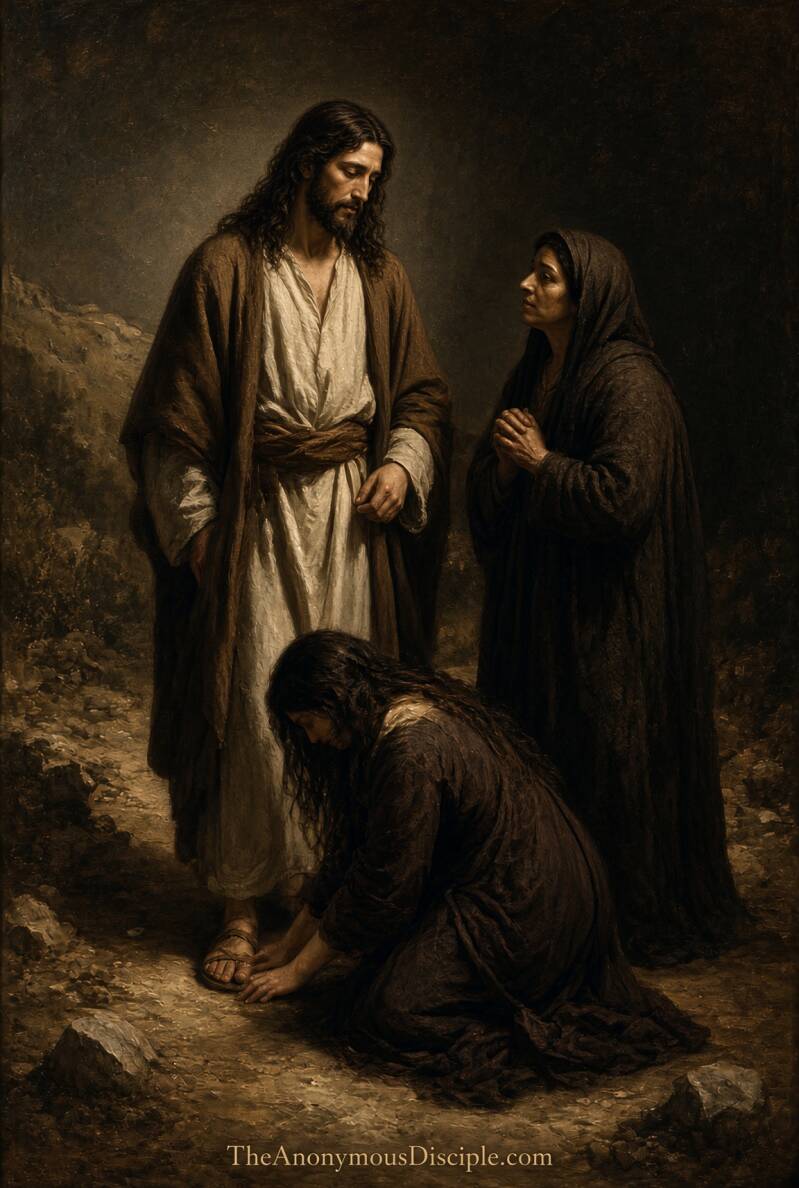
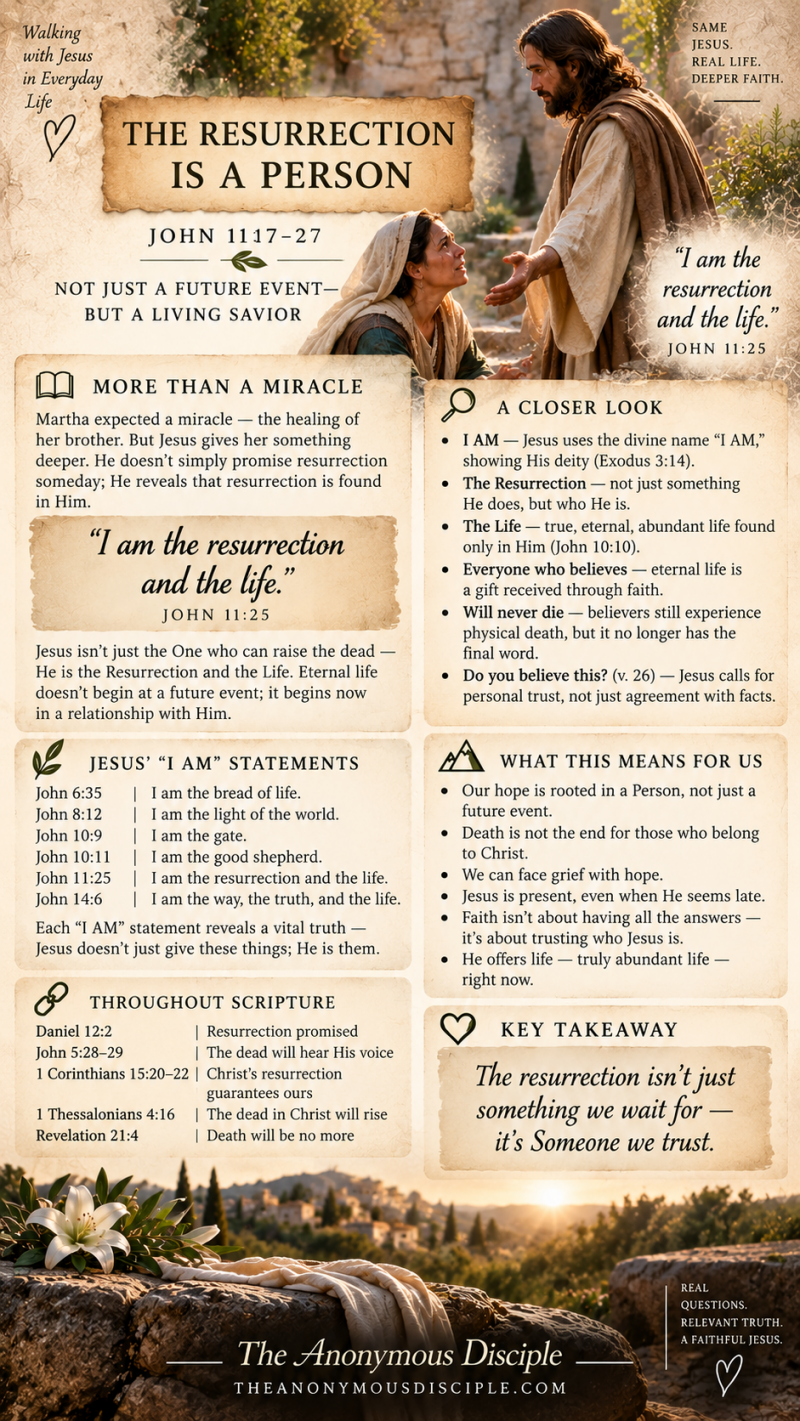
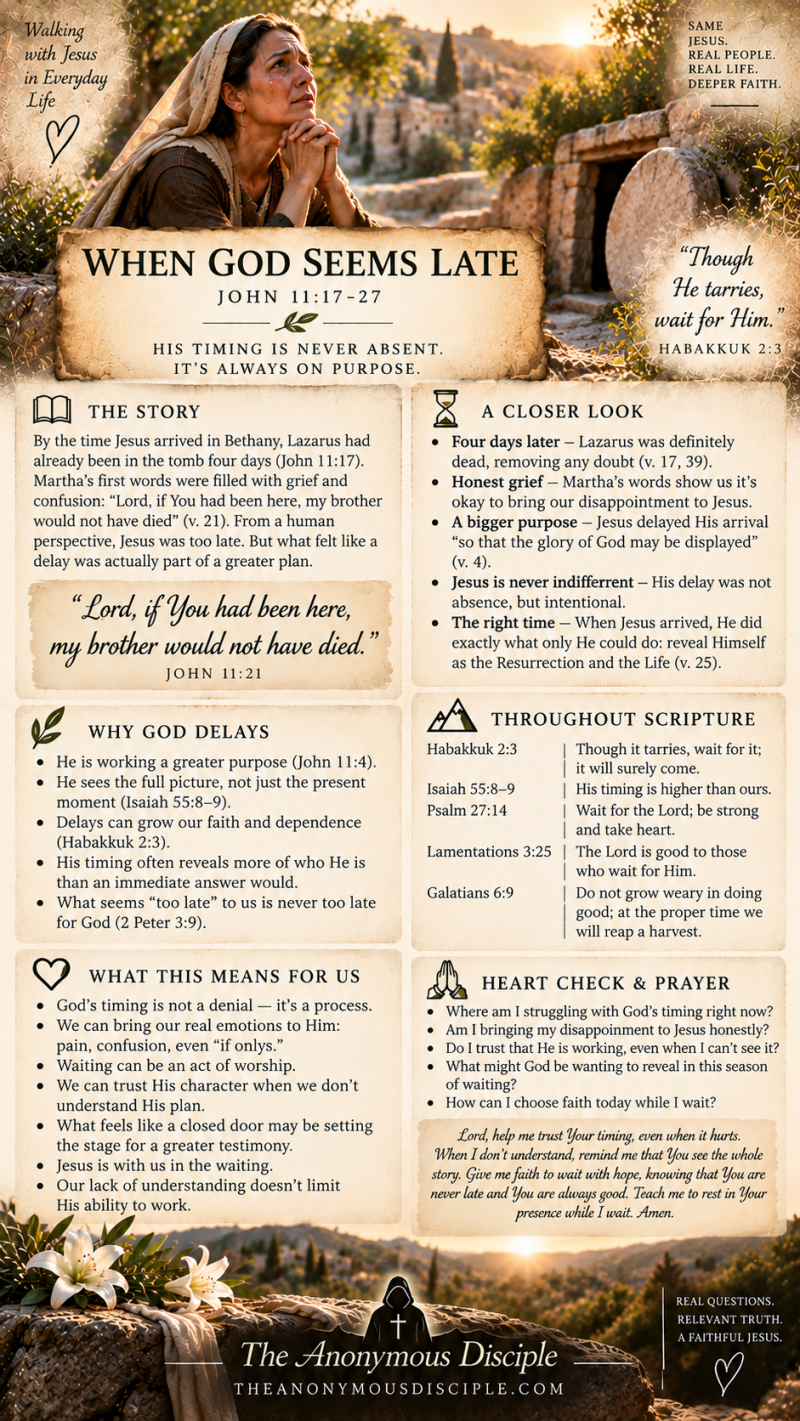
In John 11:17–27, Jesus meets Martha in the middle of grief, disappointment, and a situation that appears far beyond repair. Lazarus has been in the tomb for four days, and Martha cannot understand why Jesus did not come sooner (John 11:17, 21). Yet Jesus gently leads her beyond the question of what He could have done and toward the deeper truth of who He is: “I am the resurrection and the life” (John 11:25).
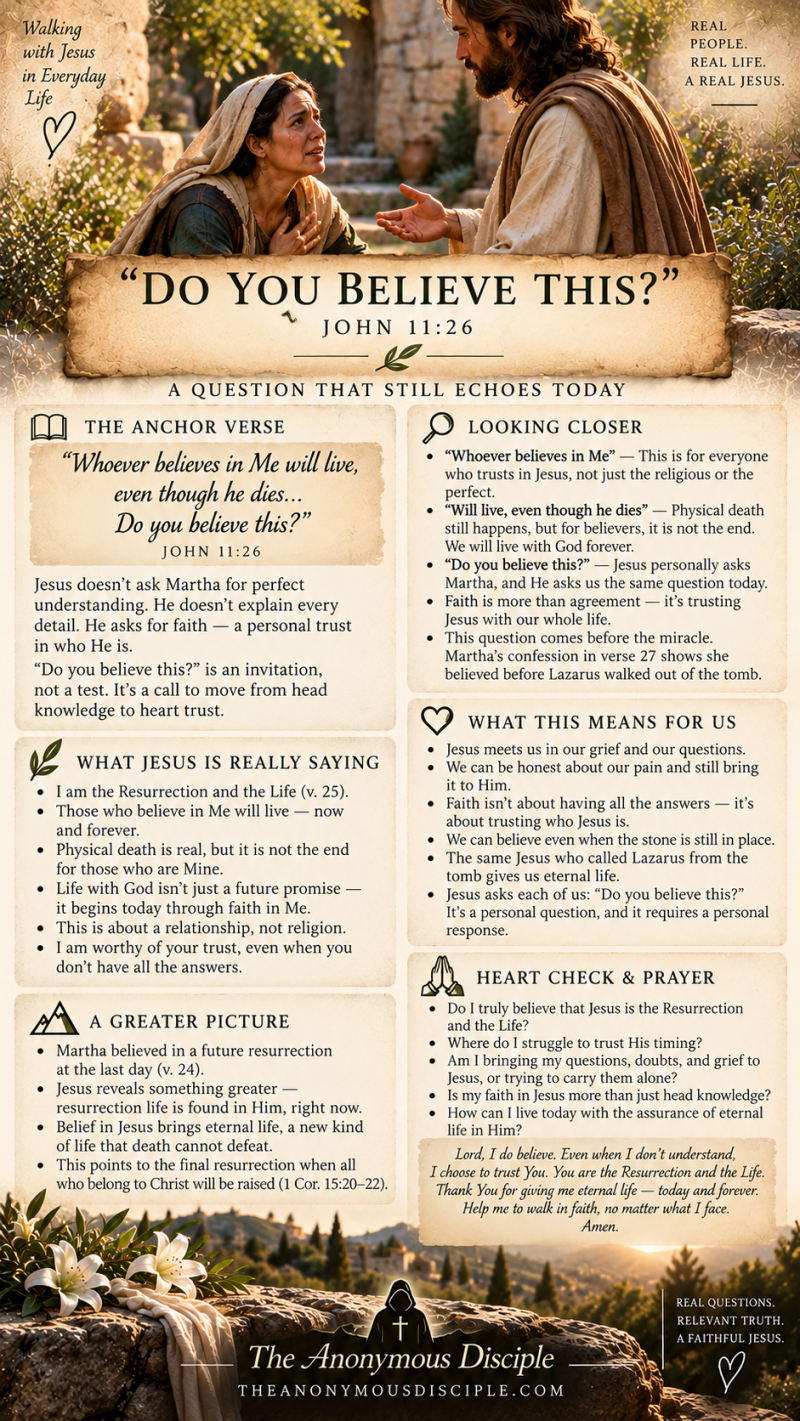
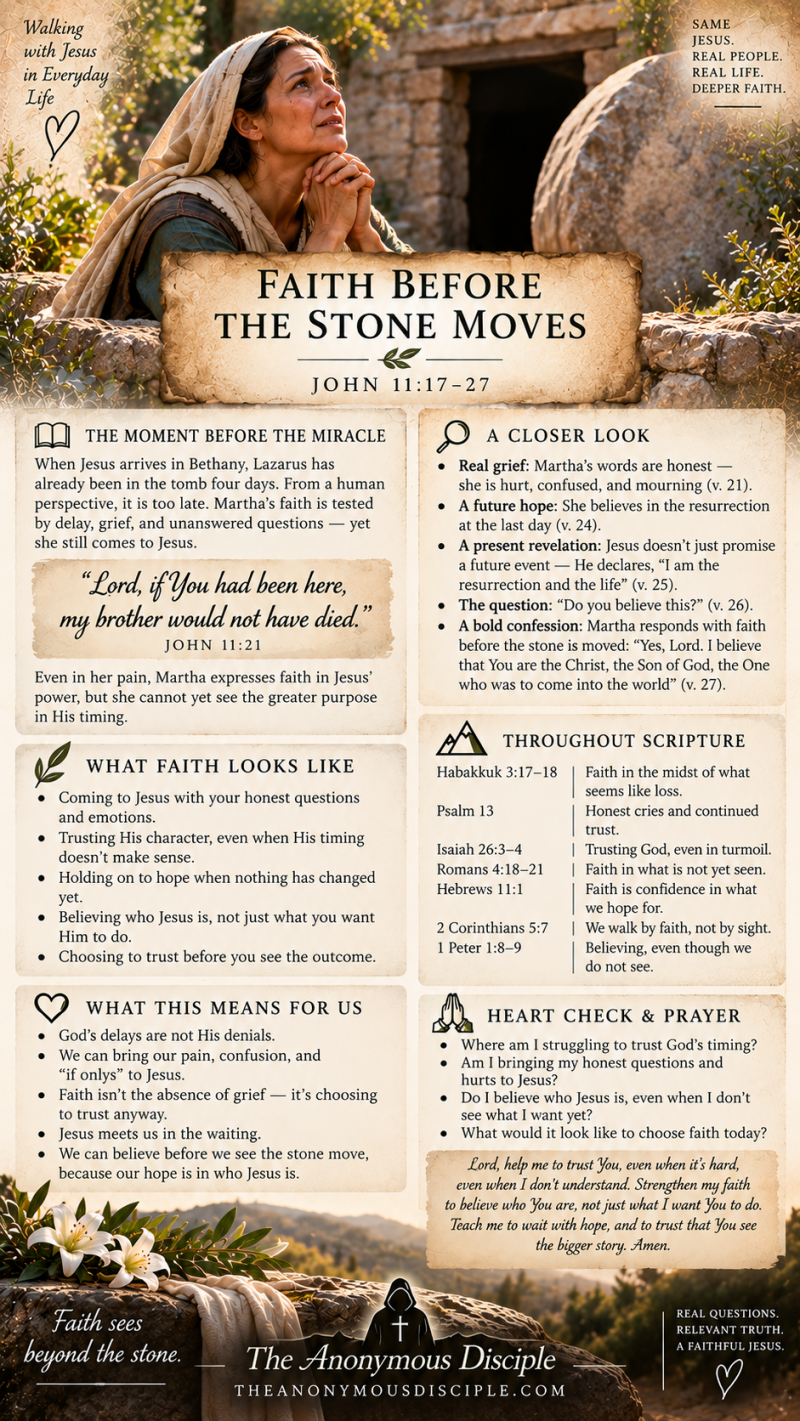
Anchoring in John 11:26, this study asks the same personal question Jesus asked Martha: “Do you believe this?” Before the stone moves and before Lazarus walks out of the tomb, Martha chooses to confess her faith in Christ (John 11:27). Her story reminds us that faith does not require us to understand God’s timing or deny our grief. We can bring our questions honestly to Jesus, trust Him while we wait, and rest in the truth that death does not have the final word. Our hope is not merely in a future resurrection—it is in Jesus Himself, the Resurrection and the Life.
📜John 11:17-27📜
King James Version (KJV)
17 Then when Jesus came, he found that he had lain in the grave four days already.
18 Now Bethany was nigh unto Jerusalem, about fifteen furlongs off:
19 And many of the Jews came to Martha and Mary, to comfort them concerning their brother.
20 Then Martha, as soon as she heard that Jesus was coming, went and met him: but Mary sat still in the house.
21 Then said Martha unto Jesus, Lord, if thou hadst been here, my brother had not died.
22 But I know, that even now, whatsoever thou wilt ask of God, God will give it thee.
23 Jesus saith unto her, Thy brother shall rise again.
24 Martha saith unto him, I know that he shall rise again in the resurrection at the last day.
25 Jesus said unto her, I am the resurrection, and the life: he that believeth in me, though he were dead, yet shall he live:
26 And whosoever liveth and believeth in me shall never die. Believest thou this?
27 She saith unto him, Yea, Lord: I believe that thou art the Christ, the Son of God, which should come into the world.

English Standard Version (ESV)
17 Now when Jesus came, he found that Lazarus had already been in the tomb four days.
18 Bethany was near Jerusalem, about two miles off,
19 and many of the Jews had come to Martha and Mary to console them concerning their brother.
20 So when Martha heard that Jesus was coming, she went and met him, but Mary remained seated in the house.
21 Martha said to Jesus, “Lord, if you had been here, my brother would not have died.
22 But even now I know that whatever you ask from God, God will give you.”
23 Jesus said to her, “Your brother will rise again.”
24 Martha said to him, “I know that he will rise again in the resurrection on the last day.”
25 Jesus said to her, “I am the resurrection and the life. Whoever believes in me, though he die, yet shall he live,
26 and everyone who lives and believes in me shall never die. Do you believe this?”
27 She said to him, “Yes, Lord; I believe that you are the Christ, the Son of God, who is coming into the world.”
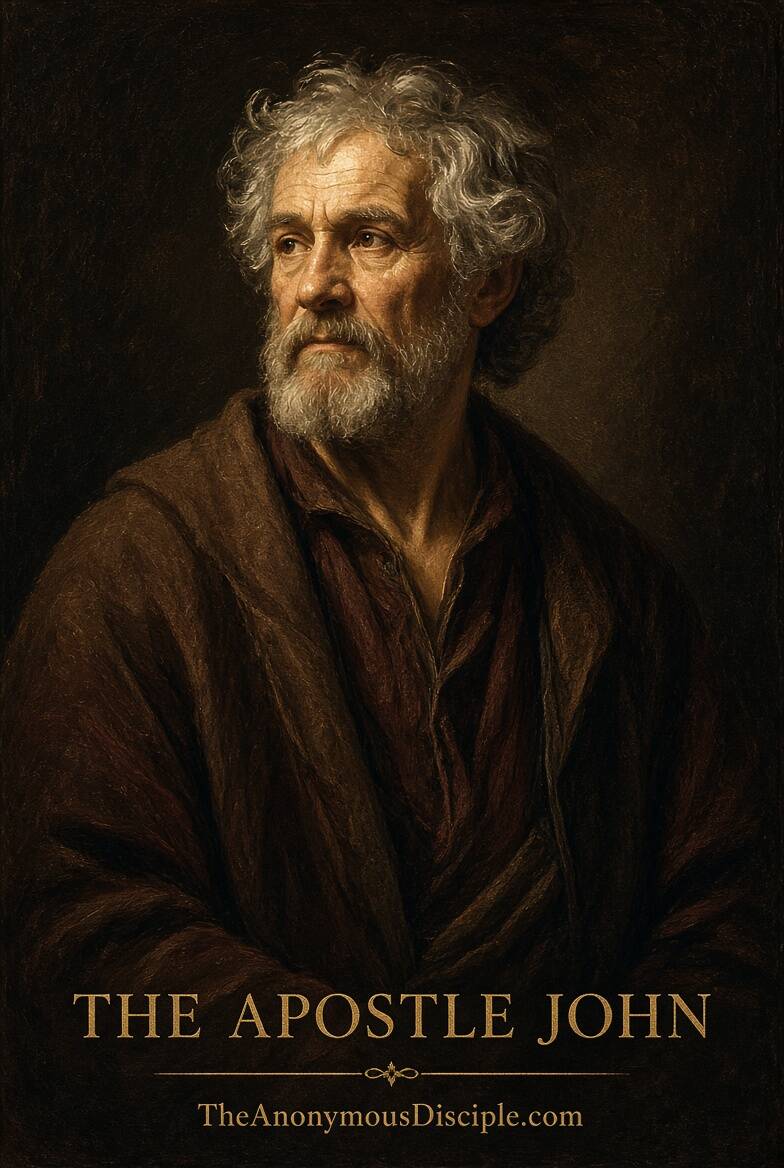
Who wrote it?
The early church said it was John the apostle—the fisherman, son of Zebedee, brother of James, and one of Jesus’ closest three (with Peter and James). He is the one the Gospel calls “the disciple whom Jesus loved.”
The book itself never puts John’s name on the cover. That was normal then. But the men who knew John, or who learned from men who knew him (especially Irenaeus, who learned from Polycarp, who knew John), said John wrote it. That is the view most Bible-believing Christians have held for 1,900 years.
When was it written?
Most teachers place it late in the first century, around A.D. 85–95. That would be 50–60 years after Jesus rose from the dead, when John was an old man.
A smaller group of scholars think it could have been written earlier, in the 60s, before Jerusalem was destroyed in A.D. 70. We cannot pin the exact year. What we can say is: it was written while people who had seen Jesus were still alive, or while their teaching was still fresh.
Where was it written?
The old, consistent report is Ephesus—a big city on the west coast of what is now Turkey. That is where John is said to have lived and served in his later years after leaving Jerusalem.
Why was it written?
John tells us himself. Near the end of the book he writes:
“These are written so that you may believe that Jesus is the Christ, the Son of God, and that by believing you may have life in his name.”
—John 20:31 (ESV)
In other words:
He did not write a full life story of Jesus. He picked certain signs and conversations (including this one with Martha) so that readers would come to the same conclusion Martha did: Jesus is the Messiah, the Son of God—and so that they would have life by trusting Him.
That is why chapter 11 matters so much. Martha’s words in verse 27—“Yes, Lord; I believe that you are the Christ, the Son of God”—are exactly the faith John wants every reader to reach.
Verse by verse breakdown with 𝕏James𝕏
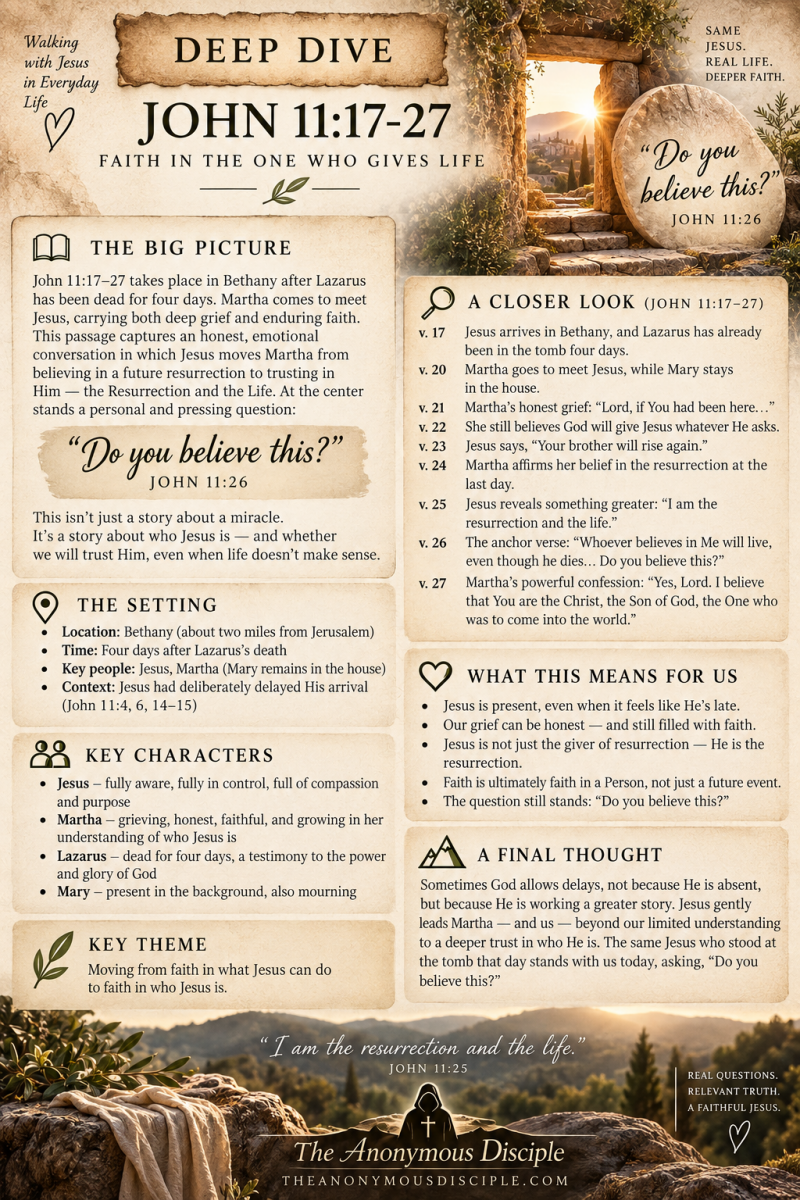
Here is John 11:17–27 in simple, everyday language, using the ESV as the main text. I’ll go verse by verse, then add a short note on why it still matters today.
17
Jesus finally arrives. Lazarus has already been in the tomb four days.
Plain meaning: Jesus did not rush. By the time He got there, everyone knew Lazarus was truly dead—not just “maybe sleeping.” Four days meant the body had begun to decay. There was no natural hope left.
Today: Sometimes God lets a situation get past the point where we can fix it ourselves. That is not because He is late. It is so we will see that only He can do what comes next.
18–19
Bethany was only about two miles from Jerusalem. Many Jewish friends had come to sit with Martha and Mary and comfort them.
Plain meaning: This was a real funeral. Real people. Real grief. The house was full of mourners.
Today: Grief is not something we hide from God. He walks into rooms that smell like death and sit with people who are hurting.
20
When Martha heard Jesus was coming, she went out to meet Him. Mary stayed in the house.
Plain meaning: The two sisters handled pain differently. Martha moved toward Jesus. Mary sat still.
Today: Some of us run to the Lord when it hurts. Some of us freeze. Jesus meets both.
21–22
Martha said, “Lord, if You had been here, my brother would not have died. But even now I know that whatever You ask from God, God will give You.”
Plain meaning: She is honest and still believing at the same time. She tells Jesus, “You could have stopped this.” Then she adds, “But I still trust You can do something.”
Today: Faith is not pretending we are not disappointed. Real faith can say both: “This hurts, Lord” and “I still believe You.”
23
Jesus said, “Your brother will rise again.”
Plain meaning: He does not first explain why He waited. He gives her a promise.
Today: Jesus often answers our “why” with a “who”—Himself—and a promise we can hold onto.
24
Martha said, “I know he will rise again in the resurrection on the last day.”
Plain meaning: She believes the right doctrine. She knows there will be a last-day resurrection. She just thinks that hope is far off.
Today: We can believe true things about God and still miss that He wants to work now, not only someday.
25–26
Jesus said, “I am the resurrection and the life. Whoever believes in Me, though he die, yet shall he live, and everyone who lives and believes in Me shall never die. Do you believe this?”
Plain meaning: Jesus does not say, “I will bring resurrection later.” He says, “I am the resurrection.” Life is not just a future event. Life is a Person standing in front of her. Anyone who trusts Him will live—even if their body dies. Then He looks at her and asks a personal question: “Do you believe this?”
Today: This is the center of the Christian hope. Eternal life is not only a place we go after we die. It is Jesus Himself. The question is still the same: Do you believe Him?
27
She said, “Yes, Lord; I believe that You are the Christ, the Son of God, who is coming into the world.”
Plain meaning: Martha does not have every detail figured out. She simply confesses who Jesus is: the promised Messiah, the Son of God.
Today: God does not wait for perfect understanding. He receives honest trust. “Yes, Lord. I believe You are who You say You are.”
The thread that runs through the whole passage
Jesus walked into a house of death and asked a grieving woman to trust that He Himself is life. He still does that. He still comes near our graves—literal ones and the ones we carry in our hearts—and says, “I am the resurrection and the life. Do you believe this?”
Cultural and tradition notes for John 11:17–27
- Burial was the same day
In that time, a body was usually buried within hours, not days later. Heat made decay start quickly. So “four days in the tomb” means Lazarus was buried right after he died. By the time Jesus arrived, everyone knew he was truly gone. - Why “four days” mattered
Scripture itself never teaches that a soul hovers near the body for three days. That idea shows up in later Jewish writings (after the time of Jesus). Those writings say the soul stays near the body about three days, hoping to return, and then leaves when the face begins to change. People also sometimes checked a grave for three days in case someone had been buried too soon.
We cannot prove every person in Bethany believed that exact idea. What we can say is this: by day four, decay was obvious. Martha later says there will be a smell (John 11:39). John wants us to know this was not a faint, a coma, or a “maybe he is only sleeping.” Lazarus was dead.
- The house of mourning
Friends and neighbors were expected to come sit with the family. That is why “many of the Jews” had come to comfort Martha and Mary. It was a duty of love, not nosiness.
The heaviest mourning lasted seven days (later called shiva). During that week the family stayed home, sat low to the ground, and received visitors. If a mourner left the house, people assumed she was going to the tomb to weep. That is exactly what the crowd thinks when Mary gets up in verse 31.
- Why Martha went out and Mary stayed in
Martha hears Jesus is coming and goes to meet Him. Mary stays seated in the house. That fits the custom: the main mourners received people at home. Martha is the one who moves first. Mary comes later and falls at Jesus’ feet. Different sisters. Same grief. Jesus meets both. - Bethany was close to Jerusalem
About two miles (fifteen furlongs). Close enough that many people from Jerusalem could walk over to sit shiva. Close enough that this miracle would be talked about in the city very quickly. That matters for the rest of the chapter, when the leaders start planning to kill Jesus. - What Martha already believed
When Jesus says, “Your brother will rise again,” Martha answers with good Jewish hope: he will rise “in the resurrection on the last day.”
Many Jews in Jesus’ day, especially those who sided with the Pharisees, believed God would raise the dead at the end of history. Daniel 12:2 is the clearest Old Testament verse for that. The Sadducees said there was no resurrection. Martha is not a Sadducee. She already believes the right last-day doctrine. Jesus then takes her further: the resurrection is not only a future day. It is a Person standing in front of her.
- Rock tombs and uncleanness
Family tombs were often cut into limestone. A stone closed the opening. Touching a dead body made a person ceremonially unclean under the Law (Numbers 19). Jesus walking toward that tomb, and later telling them to take the stone away, is not a small thing. He is willing to step into the place of death. - “Never die” in a culture that knew people still died
Martha had just buried her brother. She knew bodies die. So Jesus is not saying believers will never have a funeral. He is saying the one who lives by trusting Him will not face the death that separates a person from God forever. Physical death remains. The second death does not, for the one who believes in Him.
A simple way to say it
Their world said: wait for the last day.
Their mourning said: he is gone, and the house is full of comfort that cannot raise the dead.
Jesus said: I am the resurrection and the life—now. Do you believe this?
cross references
John 11:17–27 and John 11:26
Cross-references
Anchor verse (ESV):
“and everyone who lives and believes in me shall never die. Do you believe this?” — John 11:26
CROSS-REFERENCES FOR THE WHOLE PASSAGE (John 11:17–27)
The delay / four days in the tomb
John 11:6
John 11:39
Martha going out to meet Jesus; Mary staying
John 11:28–32
Luke 10:38–42
“If You had been here…”
John 11:32 (Mary says the same words)
Rising again on the last day
Daniel 12:2
John 5:28–29
John 6:39–40
John 6:44
John 6:54
“I am the resurrection and the life”
John 5:21
John 5:25–29
John 14:6
1 John 5:11–12
Confessing Jesus as the Christ, the Son of God
John 1:49
John 6:69
John 20:31
1 John 5:1
1 John 5:20
Why John wrote this
John 20:30–31
CROSS-REFERENCES FOR VERSE 26
Never die / eternal life already given
John 3:15–16 — whoever believes will not perish but have eternal life
John 5:24 — has already passed from death to life
John 6:50–51, 54 — eat this bread and not die
John 8:51–52 — keep My word and never taste death
John 10:28 — I give them eternal life, and they will never perish
John 14:6 — I am the way, the truth, and the life
Romans 8:11 — the Spirit who raised Jesus will give life to your mortal body
1 Thessalonians 4:13–14 — those who die in Christ will rise
1 John 5:11–13 — this life is in His Son; you may know you have it
“Do you believe this?”
John 9:35 — “Do you believe in the Son of Man?”
Matthew 9:28 — “Do you believe that I am able to do this?”
Mark 9:23 — “All things are possible for one who believes.”
Simple takeaway
Verse 25 says: even if the body dies, the believer lives.
Verse 26 says: the one who already lives by trusting Jesus will never die the death that matters—separation from God. Physical death is real. Eternal death is not, for the one who believes in Him.
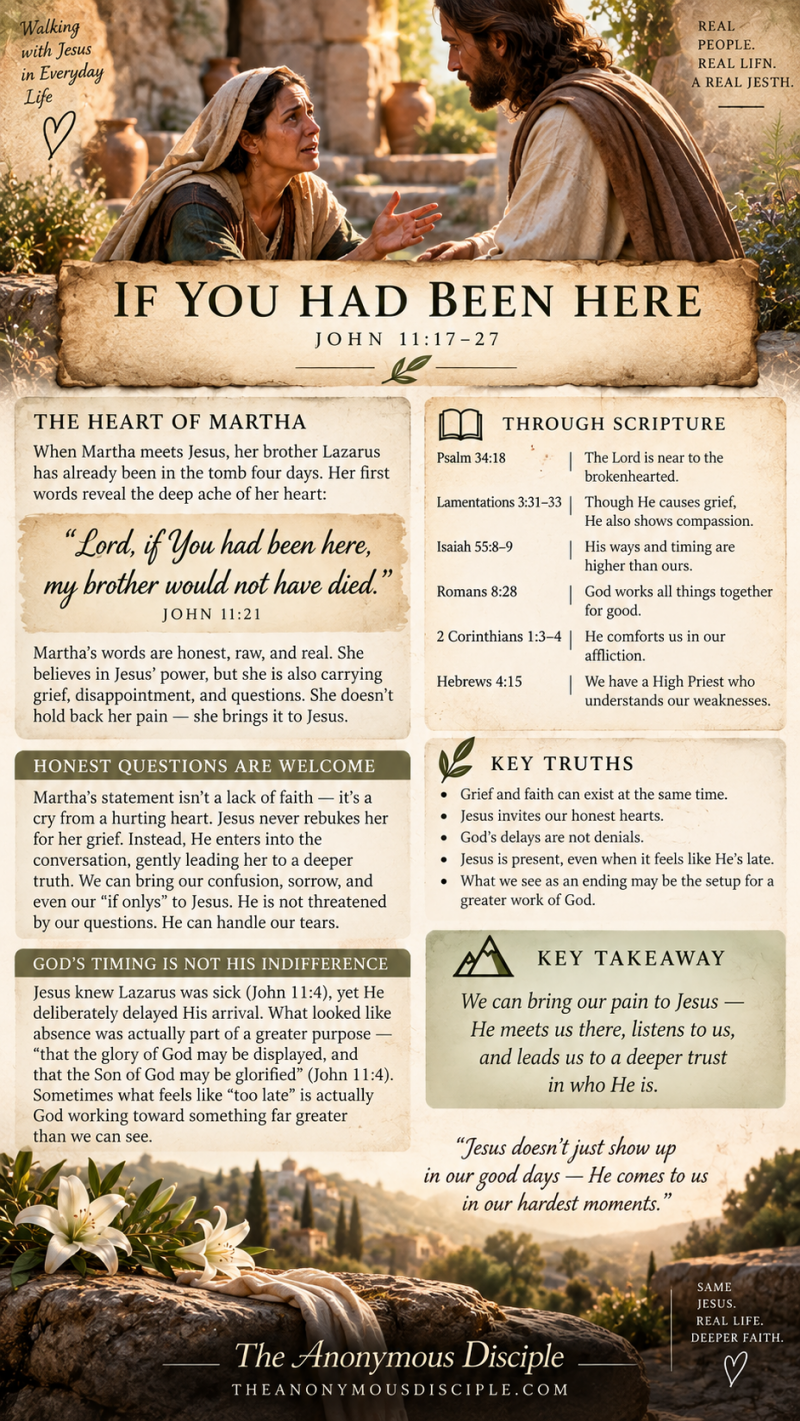
Deep Dive Study Notes with 🪄Jenny🪄
This is Martha standing in the wreckage of what she thinks is a story that ended too late for Jesus to fix.
📜 John 11:17–27 — “Do You Believe This?”
By the time Jesus arrives in Bethany, Lazarus has already been in the tomb four days.
📖 John 11:17
That detail matters.
This is no near-death recovery. Lazarus is unquestionably dead. Humanly speaking, the situation has moved completely beyond repair.
And Jesus deliberately arrived after that point.
Earlier, Jesus had already said:
📖 John 11:4
Lazarus's sickness would ultimately serve the glory of God and glorify the Son.
So the delay was not indifference.
Jesus knew exactly what He was doing.
That doesn't mean the waiting didn't hurt.
And Martha's first words show it.
💔 “Lord, If You Had Been Here…”
📖 John 11:21
Martha tells Jesus that if He had been there, her brother would not have died.
That sentence carries faith and grief at the same time.
She believes Jesus had the power to heal Lazarus.
But she cannot yet imagine that Jesus might do something greater than the healing she had hoped for.
That is such a human place to stand:
“Lord, I know what You could have done…but now it's too late.”
Except with Jesus…
“too late” isn't always what it appears to be.
🕊️ Faith Through Tears
What Martha says next is remarkable.
📖 John 11:22
Even in her disappointment, she still believes God will hear Jesus.
Her faith is wounded, but it isn't gone.
She doesn't understand Jesus' plan.
She doesn't understand His timing.
But she still comes to Him.
That alone could preach.
Biblical faith isn't pretending something doesn't hurt.
Sometimes faith looks like standing before Jesus with tears in your eyes and saying:
“I don't understand this…but I'm still here.”
🌅 “Your Brother Will Rise Again”
📖 John 11:23–24
Jesus tells Martha Lazarus will rise again.
Martha responds with solid Jewish resurrection theology:
She knows he will rise “at the resurrection at the last day.”
And she's right.
Daniel had spoken of resurrection:
📖 Daniel 12:2
Those who sleep in the dust will awaken.
Jesus Himself teaches a coming resurrection:
📖 John 5:28–29
A time is coming when those in the graves will hear His voice and come out.
So Martha believes in a future resurrection.
But Jesus is about to move her from believing merely in an event…
to trusting a Person.
👑 “I Am the Resurrection and the Life”
📖 John 11:25
Jesus doesn't simply say:
“I can perform a resurrection.”
He says:
“I AM the resurrection and the life.”
That is enormous.
Resurrection is not merely something Jesus does.
Resurrection life is found in Him.
He isn't standing there pointing Martha toward some distant future hope.
He is essentially saying:
“Martha, the resurrection you are waiting for is standing in front of you.”
🔥
And this fits John's Gospel beautifully.
Jesus repeatedly identifies Himself with things humanity desperately needs:
📖 John 6:35
Bread of Life
📖 John 8:12
Light of the World
📖 John 10:9
The Gate
📖 John 10:11
The Good Shepherd
📖 John 11:25
The Resurrection and the Life
📖 John 14:6
The Way, the Truth, and the Life
Jesus doesn't merely distribute these things.
They are bound up in who He is.
⚓ John 11:26 — “Do You Believe This?”
Now we reach our anchor.
📖 John 11:26
Jesus tells Martha that whoever lives by believing in Him will ultimately never be conquered by death.
Then He asks:
“Do you believe this?”
And I think those may be the most important four words in the entire passage.
Jesus doesn't ask Martha:
“Do you understand everything I'm doing?”
He doesn't ask:
“Do you understand why I waited?”
He doesn't ask:
“Can you explain resurrection theology perfectly?”
He asks:
Do you believe Me?
That shifts everything.
⚓ What Does “Never Die” Mean?
Because believers certainly experience physical death.
Lazarus himself would eventually die physically again.
So Jesus is speaking about ultimate death — separation from God and death's final dominion.
For the believer, physical death is no longer the end.
Paul puts it beautifully:
📖 1 Corinthians 15:54–55
Death will ultimately be swallowed up in victory.
And Jesus says:
📖 John 5:24
The one who hears and believes has crossed from death into life.
So for someone who belongs to Christ:
death still happens…
but it no longer wins.
❤️
👩 Martha's Confession
And now look what happens.
📖 John 11:27
Martha responds that she believes Jesus is:
the Messiah,
the Son of God,
the One who was to come into the world.
That is one of the strongest confessions of faith in John's Gospel.
And notice when she says it.
Before Lazarus walks out of the tomb.
She believes before she sees the miracle.
That's important.
Martha's faith isn't:
“I'll believe after You prove it.”
She confesses who Jesus is while Lazarus is still dead.
That is powerful.
🪨 The Four-Day Tomb
There's another layer here.
Later in the chapter Martha warns Jesus that Lazarus's body will have begun decomposing.
📖 John 11:39
John is deliberately removing every natural explanation.
Lazarus isn't sleeping.
He hasn't fainted.
He's dead.
And Jesus will stand before the tomb and simply call him out.
That gives us a preview of something much larger.
📖 John 5:28
One day all who are in their graves will hear His voice.
Lazarus becomes almost a miniature preview of the final resurrection.
Jesus calls:
“Lazarus, come out!”
And one day the voice of Christ will summon the dead again.
Only that resurrection will be permanent.
🌿 The Deeper Lesson
There is a progression in Martha's faith:
“If You had been here…”
⬇️
“I know he will rise someday.”
⬇️
“I am the resurrection.”
⬇️
“Do you believe this?”
⬇️
“Yes, Lord. I believe who You are.”
That's beautiful.
Jesus gently moves Martha from:
faith in what Jesus might do
to:
faith in who Jesus is.
And sometimes that's exactly where God brings us.
We come asking:
“Lord, what are You going to do?”
And He draws us deeper:
“Do you trust who I am?”
❤️ Something Else I Don't Want Us to Miss
Jesus already knows He's about to raise Lazarus.
And yet a few verses later:
📖 John 11:35
Jesus weeps.
That tells us something profound about God.
Knowing the resurrection is coming does not make grief meaningless.
Jesus does not scold Mary and Martha for mourning.
He enters their grief.
The Christian hope isn't:
“Don't cry because heaven exists.”
It's:
We grieve with hope because death does not get the final word.
That distinction matters deeply.
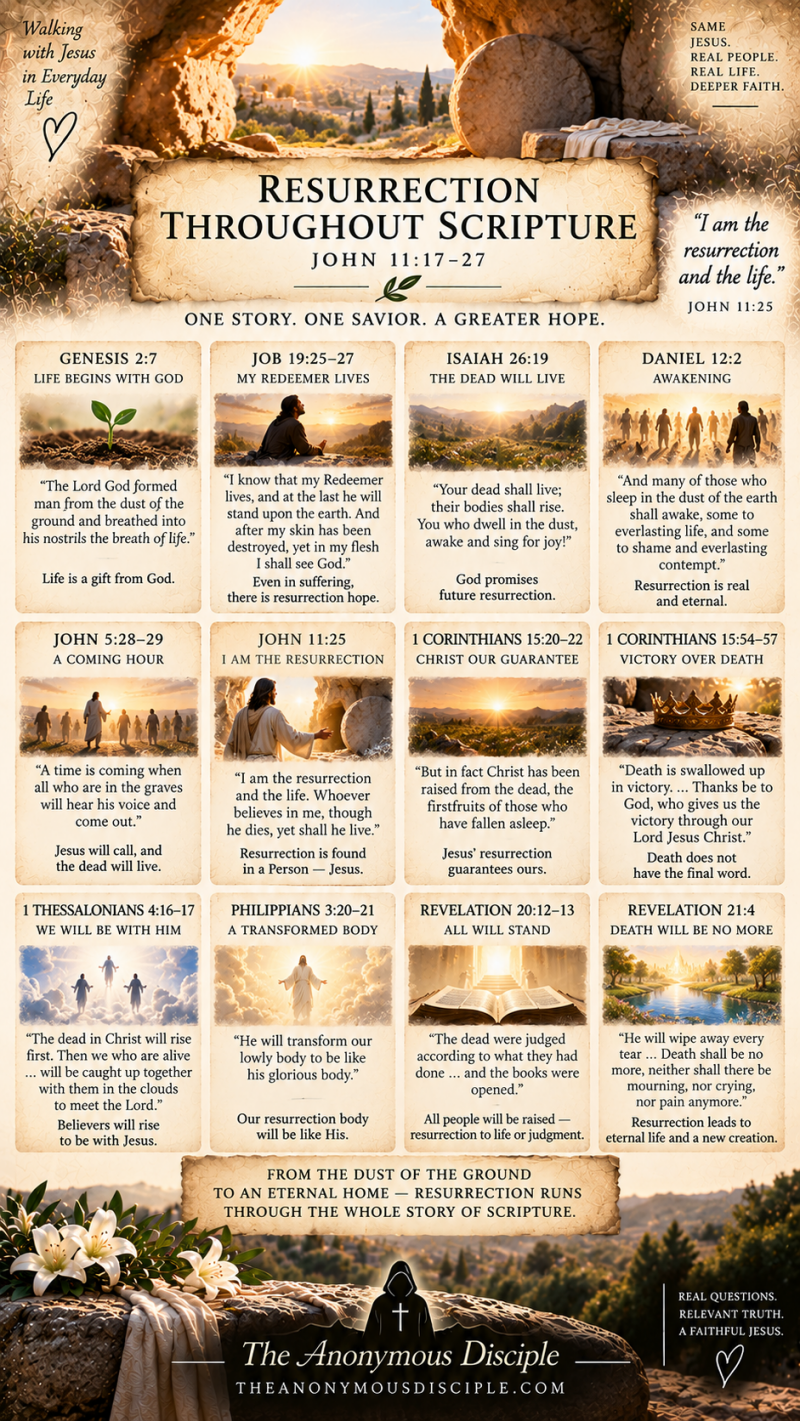
📜 Resurrection Throughout Scripture
This thread runs beautifully through the Bible.
📖 Job 19:25–27
Job expresses hope that his Redeemer lives and that he will ultimately see God.
📖 Isaiah 26:19
God promises that the dead will live and rise.
📖 Daniel 12:2
Those sleeping in the dust awaken.
📖 John 5:28–29
Jesus says the dead will hear His voice.
📖 1 Corinthians 15:20–22
Christ's resurrection guarantees the resurrection hope of those who belong to Him.
📖 1 Thessalonians 4:16
The dead in Christ will rise.
📖 Revelation 21:4
Death itself will finally be gone.
So John 11 isn't merely the story of one man coming out of one tomb.
It points toward the day when death itself loses its kingdom.
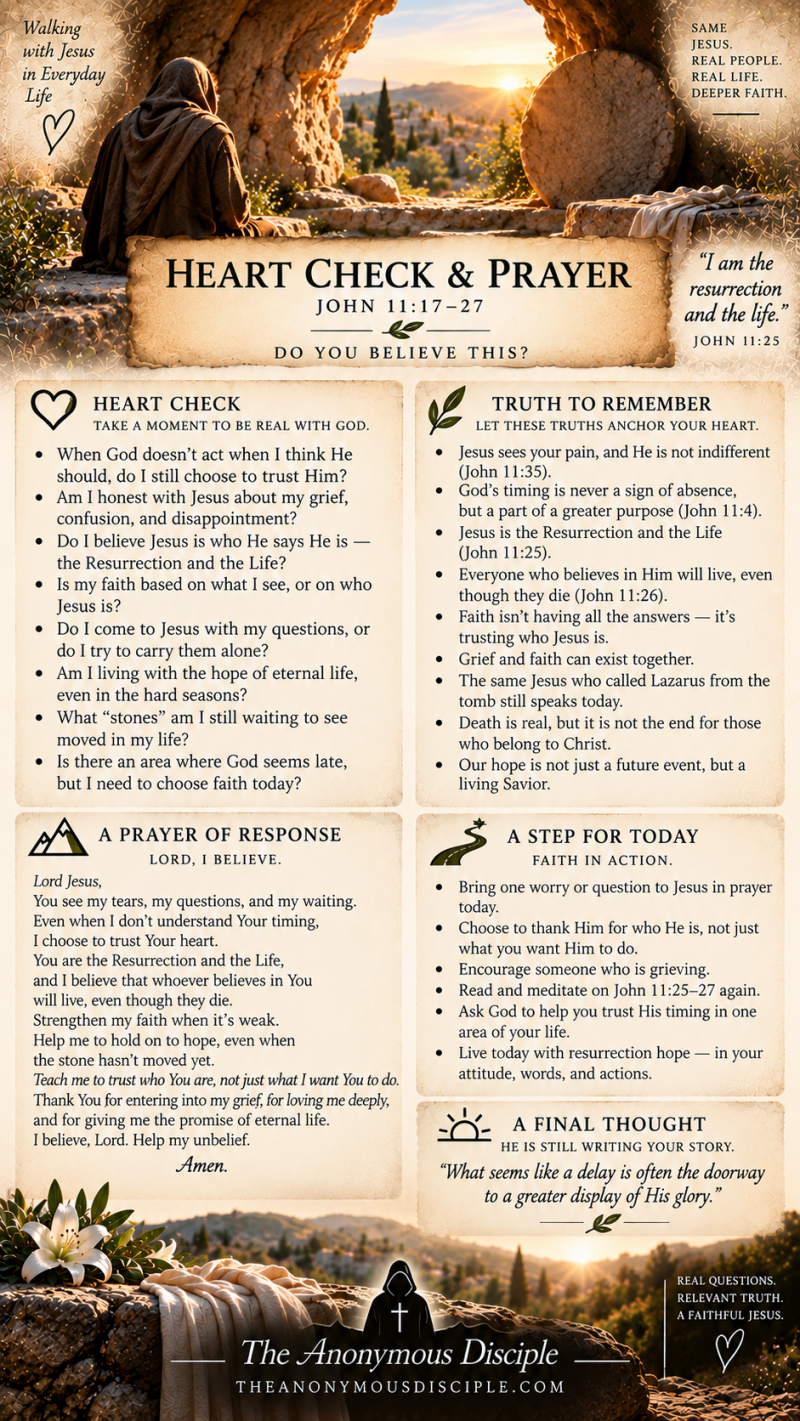
⚓ Our Anchor Thought
I think the heart of John 11:26 is this:
Jesus does not ask us whether we understand every delay, every loss, or every circumstance.
He asks:
“Do you believe this?”
Do you believe He is the resurrection?
Do you believe He is the life?
Do you believe death cannot keep what belongs to Him?
Do you believe Him even while the stone is still covering the tomb?
That's where Martha stood.
And she answered:
📖 John 11:27
“Yes, Lord… I believe.”
❤️🕊️
Add comment
Comments