

📜 1 John 3:18–24 | ⚓️ Verse 20
God Is Greater Than Your Heart
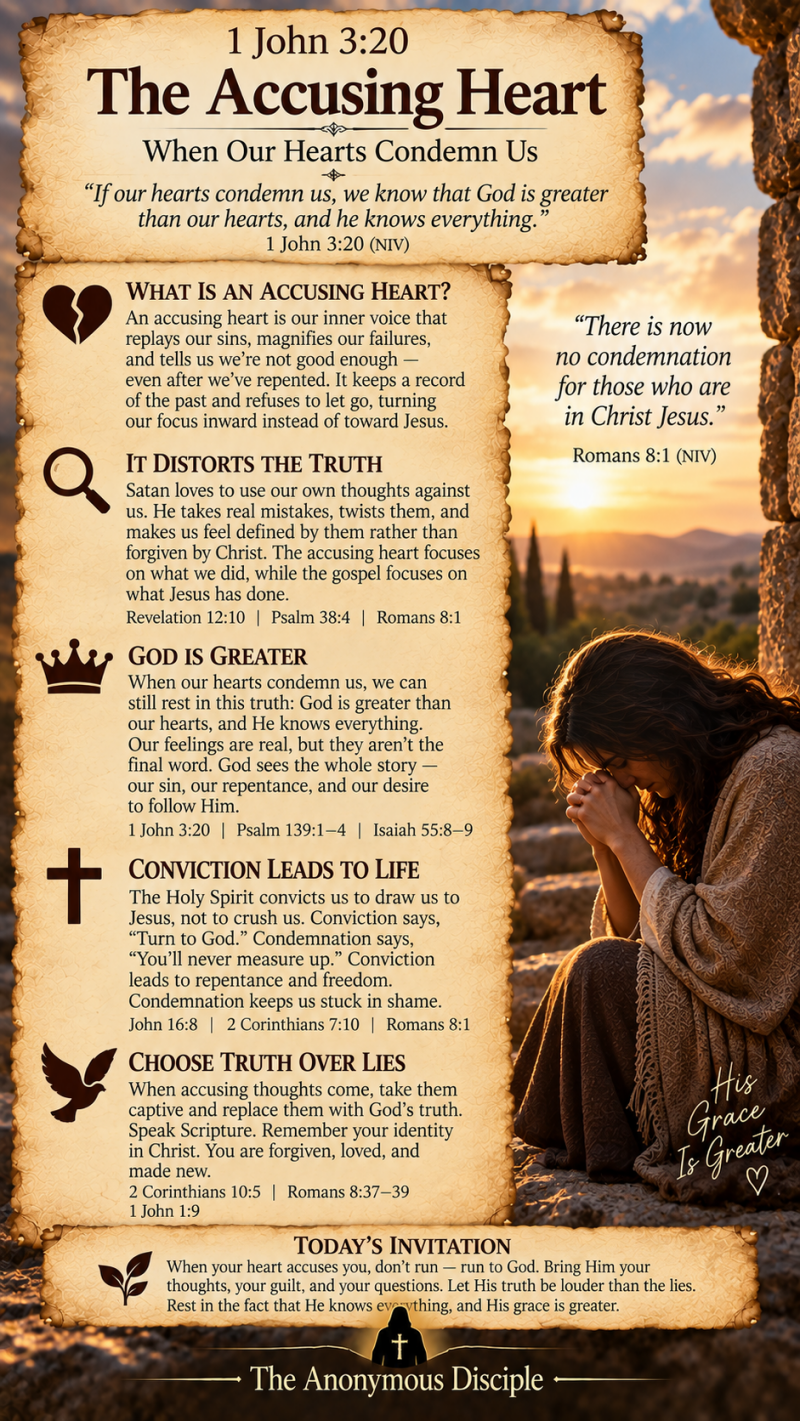
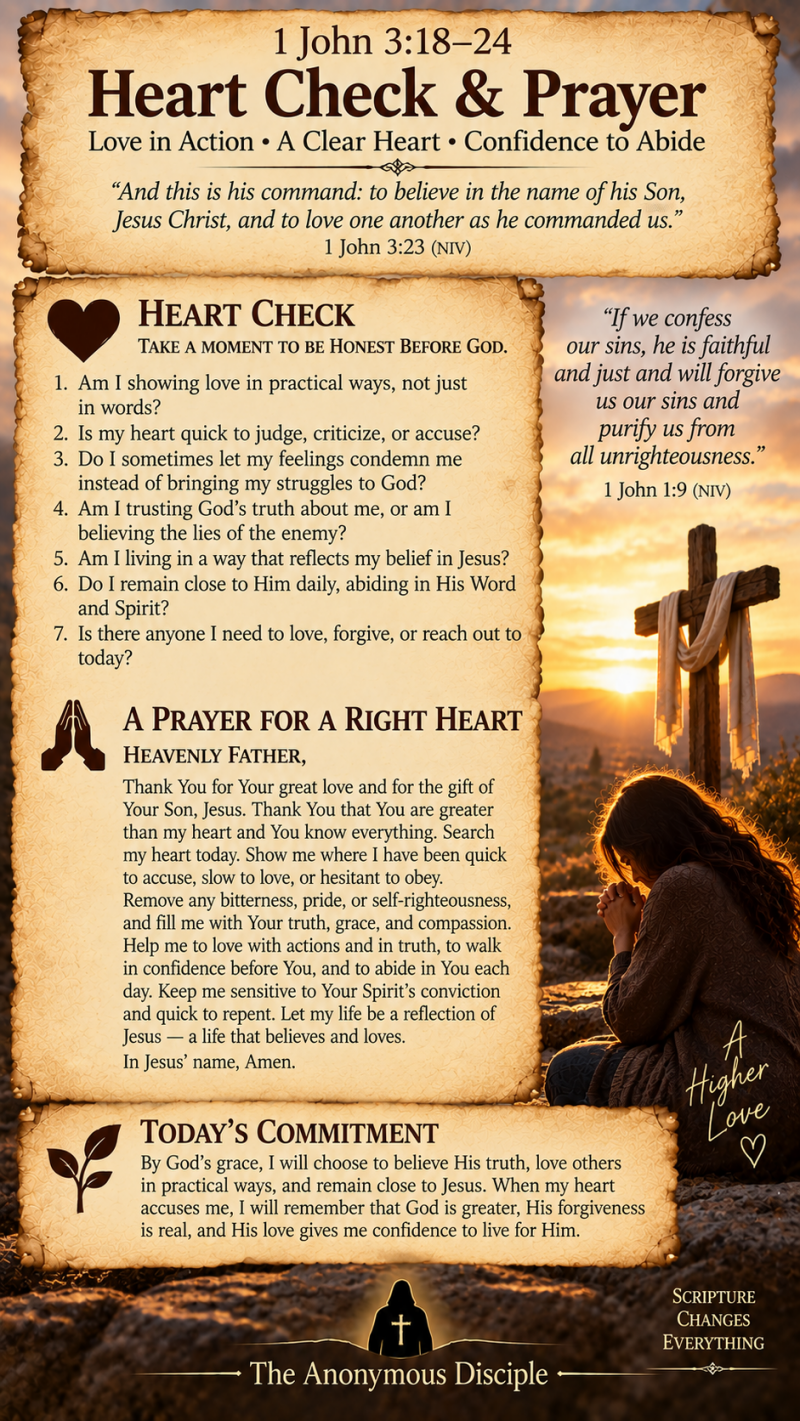
What do we do when our own heart becomes our accuser? In 1 John 3:18–24, John reminds believers that our assurance does not rest on feelings alone. We are called to love not merely with words, but “with actions and in truth” (1 John 3:18), trusting that even when our hearts condemn us, God is greater than our hearts and knows everything (1 John 3:20).
This passage leads us from love in action → an accusing heart → confidence before God → faith in Jesus → love for one another → abiding in Him through the Holy Spirit. It also helps us recognize the important difference between conviction that draws us toward repentance and condemnation that drives us into shame.
At the center is a beautiful assurance: God knows us more completely than we know ourselves. Our feelings may fluctuate, our conscience may trouble us, and our hearts may sometimes speak louder than truth—but none of them outrank God. In Christ, we can bring our hearts honestly before Him, receive His grace, and continue walking in obedient love.
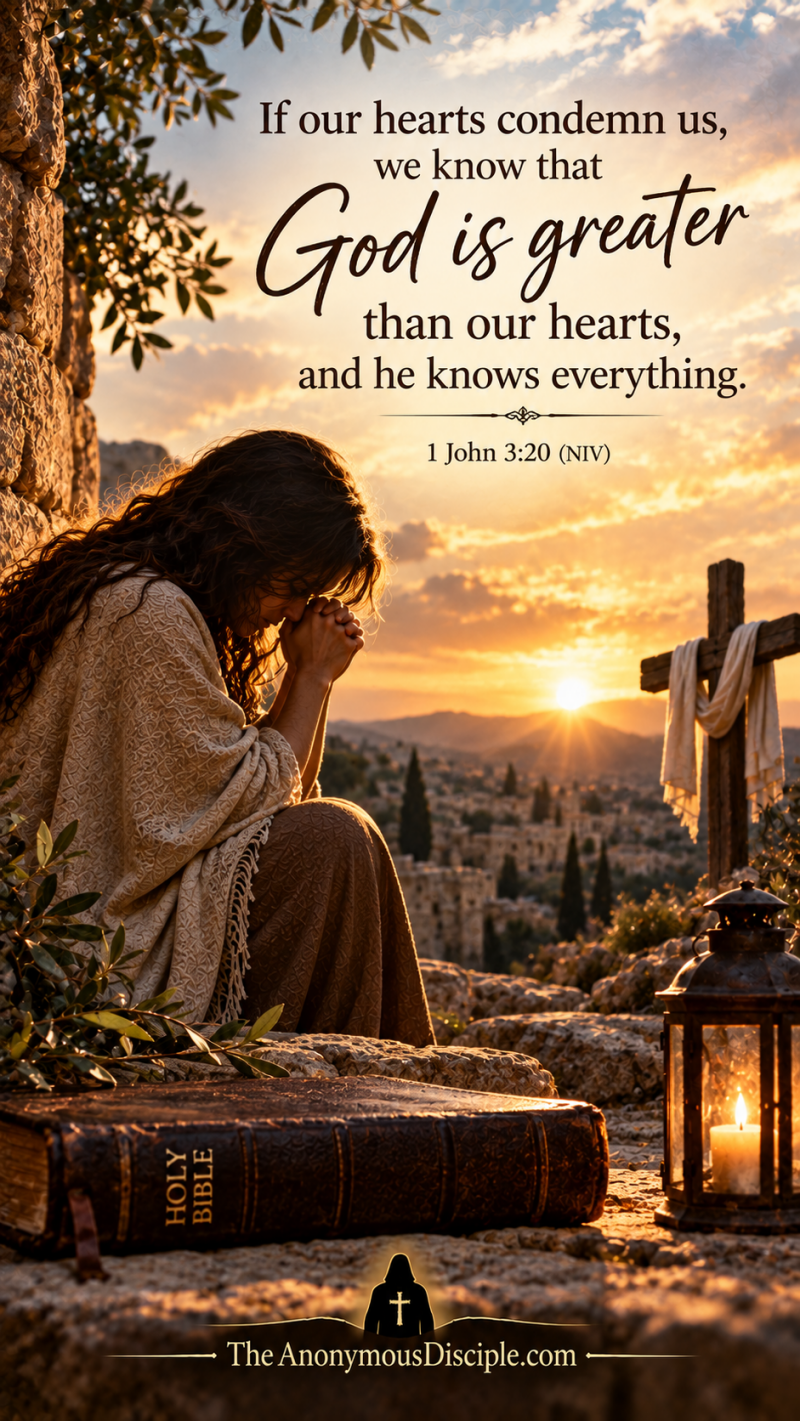
1 John 3:20 — “If our hearts condemn us, we know that God is greater than our hearts, and he knows everything.” ❤️⚓️
When your heart accuses you, bring it to the One who knows the whole story. 🕊️
📜 1 John 3:18–24
King James Version
18 My little children, let us not love in word, neither in tongue; but in deed and in truth.
19 And hereby we know that we are of the truth, and shall assure our hearts before him.
20 For if our heart condemn us, God is greater than our heart, and knoweth all things.
21 Beloved, if our heart condemn us not, then have we confidence toward God.
22 And whatsoever we ask, we receive of him, because we keep his commandments, and do those things that are pleasing in his sight.
23 And this is his commandment, That we should believe on the name of his Son Jesus Christ, and love one another, as he gave us commandment.
24 And he that keepeth his commandments dwelleth in him, and he in him. And hereby we know that he abideth in us, by the Spirit which he hath given us.
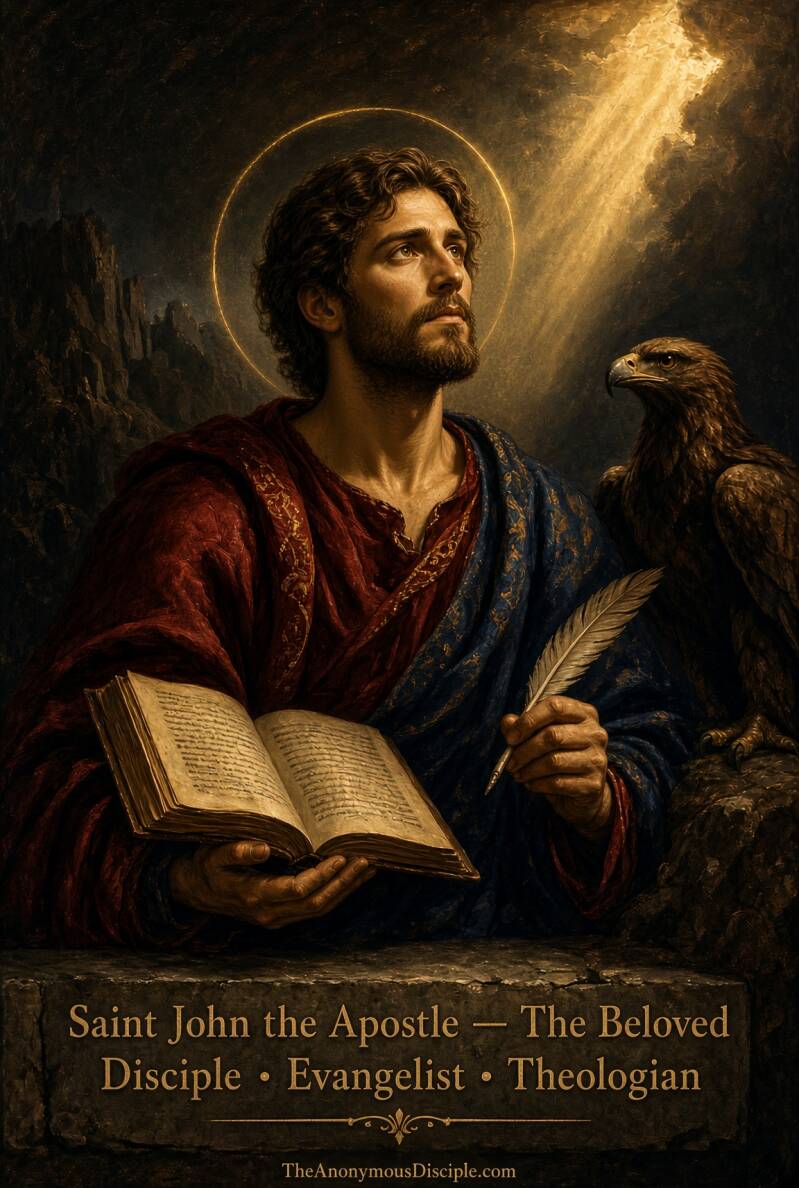
John is the disciple Jesus loved (John 13:23), the one who leaned close at the Last Supper, stood at the foot of the cross with Mary, and later wrote the Gospel that so clearly shows Jesus as the Word made flesh. Traditional titles often used for him are Apostle, Beloved Disciple, Evangelist, and Theologian.
English Standard Version
18 Little children, let us not love in word or talk but in deed and in truth.
19 By this we shall know that we are of the truth and reassure our heart before him;
20 for whenever our heart condemns us, God is greater than our heart, and he knows everything.
21 Beloved, if our heart does not condemn us, we have confidence before God;
22 and whatever we ask we receive from him, because we keep his commandments and do what pleases him.
23 And this is his commandment, that we believe in the name of his Son Jesus Christ and love one another, just as he has commanded us.
24 Whoever keeps his commandments abides in God, and God in him. And by this we know that he abides in us, by the Spirit whom he has given us.
Who wrote it
The Apostle John — the same John who wrote the Gospel of John. He is the “disciple whom Jesus loved,” the one who leaned on Jesus at the Last Supper and stood at the cross with Mary. The early church (Irenaeus and others who knew people who knew John) said he wrote this letter. The language and themes match his Gospel so closely that it is the natural conclusion.
When he wrote it
Late in his life, most likely between AD 85 and 95. The Gospel of John was probably written first; this letter came afterward, when John was an old man.
Where he wrote it
Tradition places him in Ephesus (in modern-day Turkey). After Jerusalem fell and the church there scattered, John settled in Ephesus and shepherded the churches in that region until he was very old.
To whom
Not one named church, but a group of churches in Asia Minor — the believers around Ephesus and nearby towns. These were people John knew and loved. Some of them were being pulled away by false teachers.
Why he wrote it
False teachers had come in. They denied that Jesus had truly come in the flesh, claimed they had special “knowledge,” and did not live in love or obedience. Some had left the churches. John wrote so the remaining believers would:
- know they really belonged to God
- hold fast to the truth about Jesus
- love one another in action, not just words
- have confidence before God
That is exactly what 1 John 3:18–24 is doing. John is saying: real love shows up in deeds, and when we believe in Jesus and love one another, we can rest our hearts and know the Spirit lives in us.
In short: an aging apostle, writing from Ephesus near the end of the first century, to churches he loved that were being confused by false teaching — so they would stay in the truth and in love.
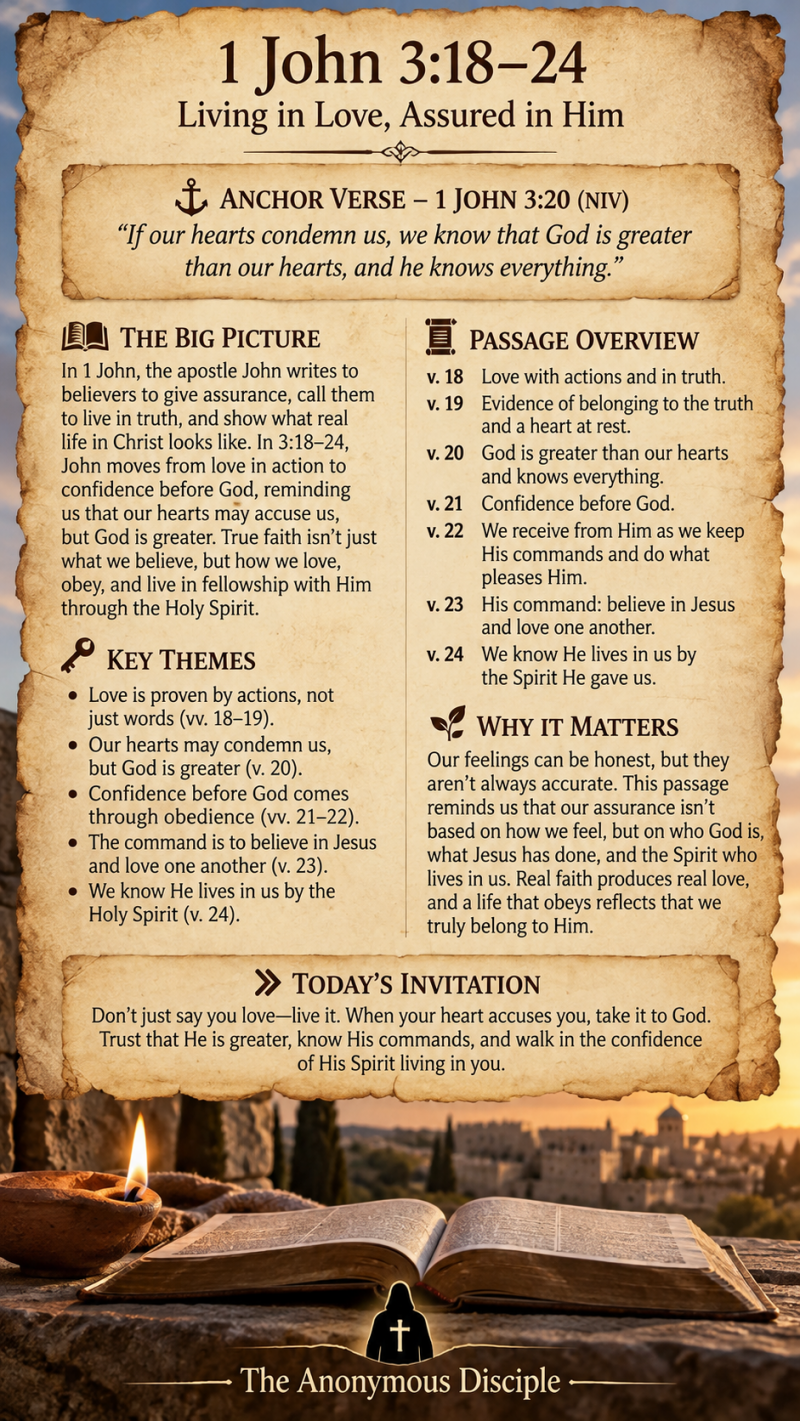
Verse by verse breakdown with 𝕏James𝕏
Verse 18
Little children, let us not love in word or talk but in deed and in truth.
Don’t just say “I love you.” Show it. Real love does something and it is honest.
Verse 19
By this we shall know that we are of the truth and reassure our heart before him;
When our love is real (not just talk), we can look at ourselves and say, “Yes, I really do belong to God.” It settles our heart.
Verse 20
for whenever our heart condemns us, God is greater than our heart, and he knows everything.
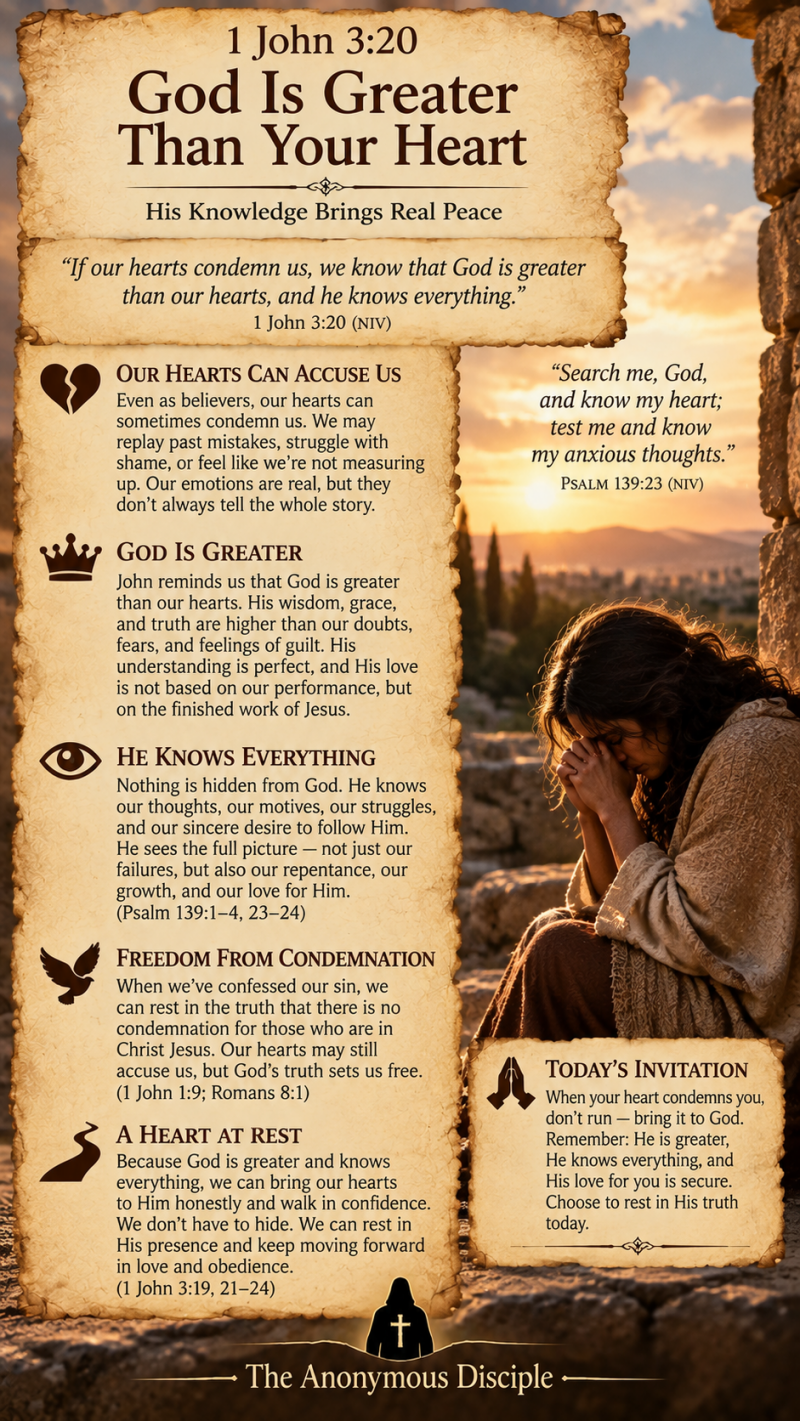
Sometimes our own heart accuses us — “You’re not good enough.” God is bigger than that voice. He sees the whole picture, including the faith and love that are really there.
Verse 21
Beloved, if our heart does not condemn us, we have confidence before God;
When our heart is at rest (because we are living in real love and truth), we can come to God without hiding. We can talk to Him freely.
Verse 22
and whatever we ask we receive from him, because we keep his commandments and do what pleases him.
This is not a blank check. It means when we are walking with Him — obeying and wanting what He wants — our prayers line up with His heart, and He answers.
Verse 23
And this is his commandment, that we believe in the name of his Son Jesus Christ and love one another, just as he has commanded us.
God’s big command in two parts: trust Jesus (who He is and what He has done) and love each other. That is the whole thing in a nutshell.
Verse 24
Whoever keeps his commandments abides in God, and God in him. And by this we know that he abides in us, by the Spirit whom he has given us.
When we keep trusting Jesus and loving people, we live in God and He lives in us. How do we know? He gave us His Spirit — that inner witness that we are His.
Here’s why these verses still matter right now — in plain words.
We live in a world full of words. Posts, comments, “thoughts and prayers,” likes, and slogans. John says that is not enough. Love has to show up in what we actually do for people — the phone call, the meal, the quiet help no one sees, the willingness to stay when it costs us. That is still the test.
A lot of believers walk around with a condemning heart. “I should be further along. God is disappointed in me.” John says God is greater than that inner voice. He knows the whole story. When we keep turning to Jesus and keep trying to love people, we can stop beating ourselves up and come to Him with a settled heart.
Prayer gets practical here too. Confidence before God is not about being perfect. It grows when our lives are pointed in the same direction as His — trusting His Son and loving the people in front of us. Then what we ask starts to match what He wants.
The two-part command has not changed: believe in Jesus (who He is, what He did) and love one another. That is still how we stay close to God, and how we know He is close to us — by His Spirit living in us.
In a noisy, divided, word-heavy time, John is still saying the same simple thing: stop talking about love and start living it. Trust Jesus. Love people. Rest your heart. That is how we know we are His today.
Culture & Tradition Notes
Here are some historical and tradition notes for the time 1 John was written (about AD 85–95), kept simple.
The world around them
Rome was under Emperor Domitian (AD 81–96). He demanded honor like a god. Most ordinary people just went along with emperor worship and the old pagan temples. Christians who would not burn incense to Caesar or join the local gods could be looked at with suspicion. It was not yet the huge empire-wide hunts of later years, but pressure was real, especially in the cities.
The church at that moment
Almost all the original apostles were gone. Peter and Paul had been killed in Rome years earlier. Jerusalem had been destroyed in AD 70. The church was no longer centered there. Believers were now scattered in cities like Ephesus, Smyrna, and the towns of Asia Minor (western Turkey). John, now an old man, was the last living eyewitness of Jesus among the Twelve. People looked to him.
What was going wrong inside the churches
New teachers had appeared. They used Christian words but changed the meaning. Some said Jesus only seemed to have a real body (later called Docetism). Others said the man Jesus and the divine Christ were two different things — the Christ-spirit came on Jesus at baptism and left before the cross. That kind of teaching is often linked to a man named Cerinthus, who was active in the same region. If Jesus did not really come in the flesh, then the cross and the resurrection lose their meaning, and “love” can become just talk or secret knowledge instead of real life.
That is why John keeps saying “Jesus Christ has come in the flesh” and “love in deed and in truth.” He is answering what was actually being taught in those churches.
Ephesus itself
Ephesus was a big, busy port city. It had the famous Temple of Artemis, lots of trade, and a mix of Greeks, Romans, Jews, and now Christians. The church there was one of the strongest, but it was also a place where new ideas traveled fast. Tradition says John lived there in his last years and that a young man named Polycarp (later a famous bishop and martyr) learned from him.
A well-known tradition
Irenaeus (who knew Polycarp) tells this story: John once went into a public bathhouse in Ephesus, saw Cerinthus inside, and ran out saying he was afraid the building would collapse because “the enemy of the truth” was there. Whether every detail is exact, the story shows how seriously the early church treated these false teachers — and why John wrote so firmly.
Why it fits the letter
The believers John wrote to had seen some people leave the church. They were confused, their hearts condemned them, and they needed to know who really belonged to God. John’s answer was not complicated: keep believing the real Jesus, keep loving one another in action, and trust the Spirit God has given you. That was the test in the 90s, and it is still a clear test now.
🔗Cross References🔗
For the whole passage (1 John 3:18–24)
- Love in action, not just words
James 2:15–17 — Faith without deeds is dead.
1 John 3:16–17 — Love laid down His life; we should lay down ours in practical help.
Romans 12:9 — Love must be genuine. - A settled heart and confidence before God
1 John 4:17–18 — Perfect love casts out fear; we have confidence on the day of judgment.
Hebrews 4:16 — Come boldly to the throne of grace.
Hebrews 10:22 — Draw near with a true heart in full assurance of faith. - Asking and receiving
John 15:7 — If you abide in Me and My words abide in you, ask whatever you wish.
1 John 5:14–15 — If we ask anything according to His will, He hears us. - The two-part command: believe and love
John 6:29 — This is the work of God, that you believe in Him whom He has sent.
John 13:34–35 — A new commandment: love one another.
1 John 4:21 — Whoever loves God must also love his brother. - Abiding and the Spirit’s witness
John 14:16–17 — The Spirit of truth lives with you and will be in you.
John 15:4–10 — Abide in Me, and I in you.
Romans 8:16 — The Spirit Himself bears witness with our spirit that we are children of God.
Specific to the anchor verse — 1 John 3:20
“for whenever our heart condemns us, God is greater than our heart, and he knows everything.”
- Psalm 139:1–4 — Lord, You have searched me and known me… You know my thoughts.
- Jeremiah 17:10 — I the Lord search the heart and test the mind.
- Hebrews 4:13 — No creature is hidden from His sight; all are naked and exposed to His eyes.
- 1 Corinthians 4:4–5 — My conscience is clear, but that does not make me innocent. It is the Lord who judges.
- Psalm 44:21 — Would not God discover this? For He knows the secrets of the heart.
- John 21:17 — Lord, You know everything; You know that I love You. (Peter after his failure)
- Romans 8:1 — There is therefore now no condemnation for those who are in Christ Jesus.
Verse 20 is the comfort in the middle: when your own heart points the finger at you, God already knows the whole truth — the weakness and the faith — and He is greater than that accusing voice.

Deep Dive Study Notes with 🪄Jenny🪄
📜 1 John 3:18–24
⚓️ Anchor: 1 John 3:20
When Your Heart Condemns You — God Is Greater
🌿 The Setting
John has been talking about what it actually looks like to belong to Jesus.
Immediately before our passage, he points to Christ:
1 John 3:16 — “This is how we know what love is: Jesus Christ laid down his life for us.”
Then John refuses to leave love as merely a feeling or something Christians talk about.
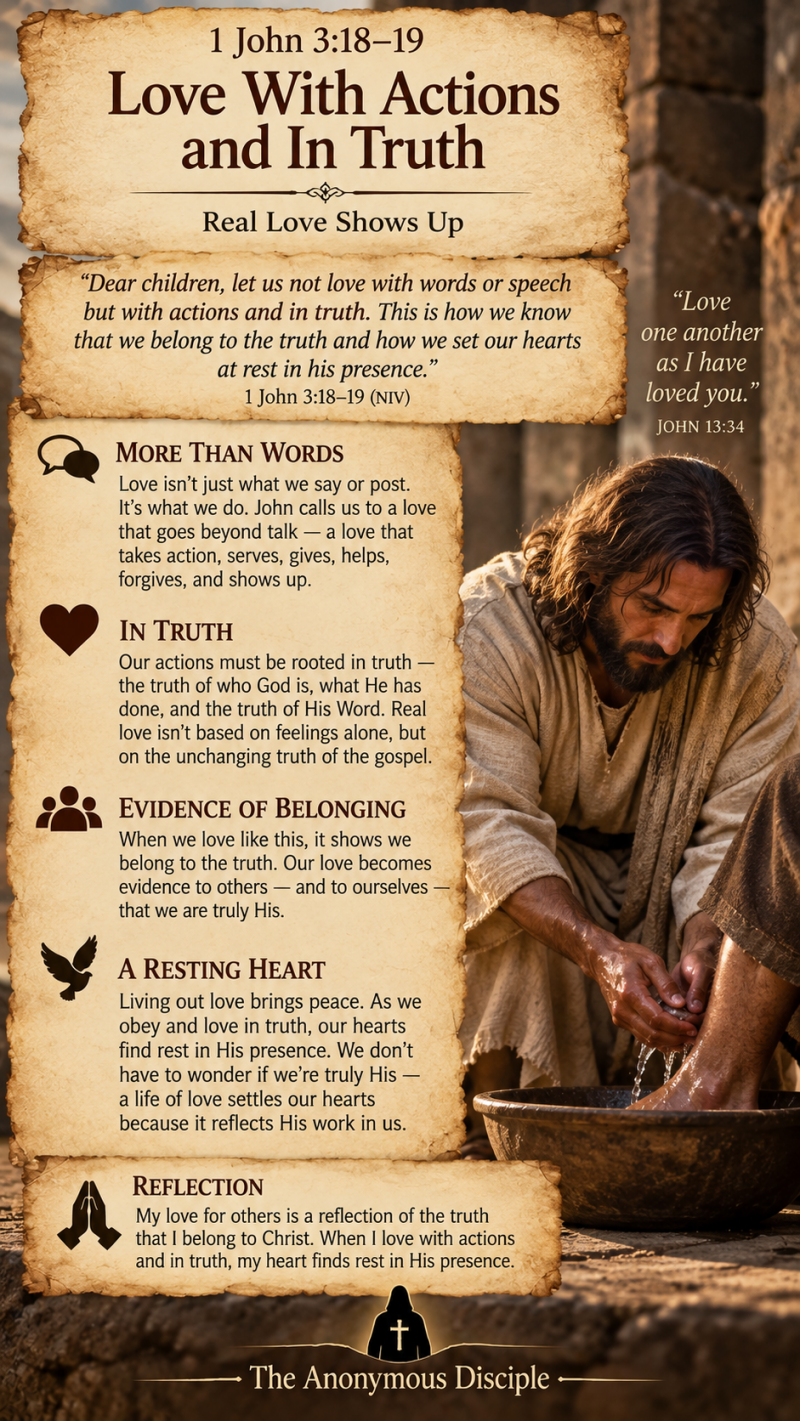
1 John 3:18 — “Dear children, let us not love with words or speech but with actions and in truth.”
That gives us the doorway into the whole passage:
Jesus' love for us becomes the pattern for our love toward others.
But then John does something fascinating. He moves from how we love others to what happens inside our own hearts.
❤️ 1 John 3:18–19 — Love With Actions and Truth
1 John 3:18–19
“Dear children, let us not love with words or speech but with actions and in truth. This is how we know that we belong to the truth and how we set our hearts at rest in his presence.”
John isn't saying words don't matter.
He's saying genuine Christian love doesn't stop with words.
Love becomes visible.
Jesus didn't merely say He loved us.
He came.
He served.
He touched.
He washed feet.
He suffered.
He gave Himself.
And John says that when Christ's love begins producing that kind of love in us, it becomes evidence that we “belong to the truth.”
Notice where that leads:
“…we set our hearts at rest in His presence.”
That's important because of what comes next.
⚓️ 1 John 3:20 — When Your Heart Condemns You
1 John 3:20
“If our hearts condemn us, we know that God is greater than our hearts, and he knows everything.”
Oh, Sherri.
There is so much packed into this little verse. ❤️
John knows believers sometimes look inward and their own hearts become their accusers.
I should have done more.
I shouldn't have said that.
Why am I still struggling with this?
Maybe my faith isn't strong enough.
Maybe God is disappointed in me.
Maybe I'm not who I thought I was.
Our hearts can hold grief, regret, shame, fear, memories, doubts and accusations.
And John doesn't tell us:
“Trust your heart.”
He tells us something far safer:
God is greater than your heart.
Your feelings are real.
But they are not omniscient.
God is.
Your heart sees fragments.
God sees everything.
Your heart remembers failures.
God knows your repentance.
Your heart may question whether you belong to Him.
God knows those who are His.
And that final phrase matters enormously:
“…and He knows everything.”
At first that could sound frightening.
Everything?! 😳
Yes.
Everything.
But in context, that's actually comforting.
God doesn't merely know the thing your heart is accusing you about.
He knows the entire story.
He knows motives.
He knows weakness.
He knows wounds.
He knows repentance.
He knows the love for Him that you sometimes struggle to see clearly in yourself.
God's verdict isn't based on incomplete evidence.
He knows everything.
🕊️ 1 John 3:21–22 — Confidence Before God
1 John 3:21–22
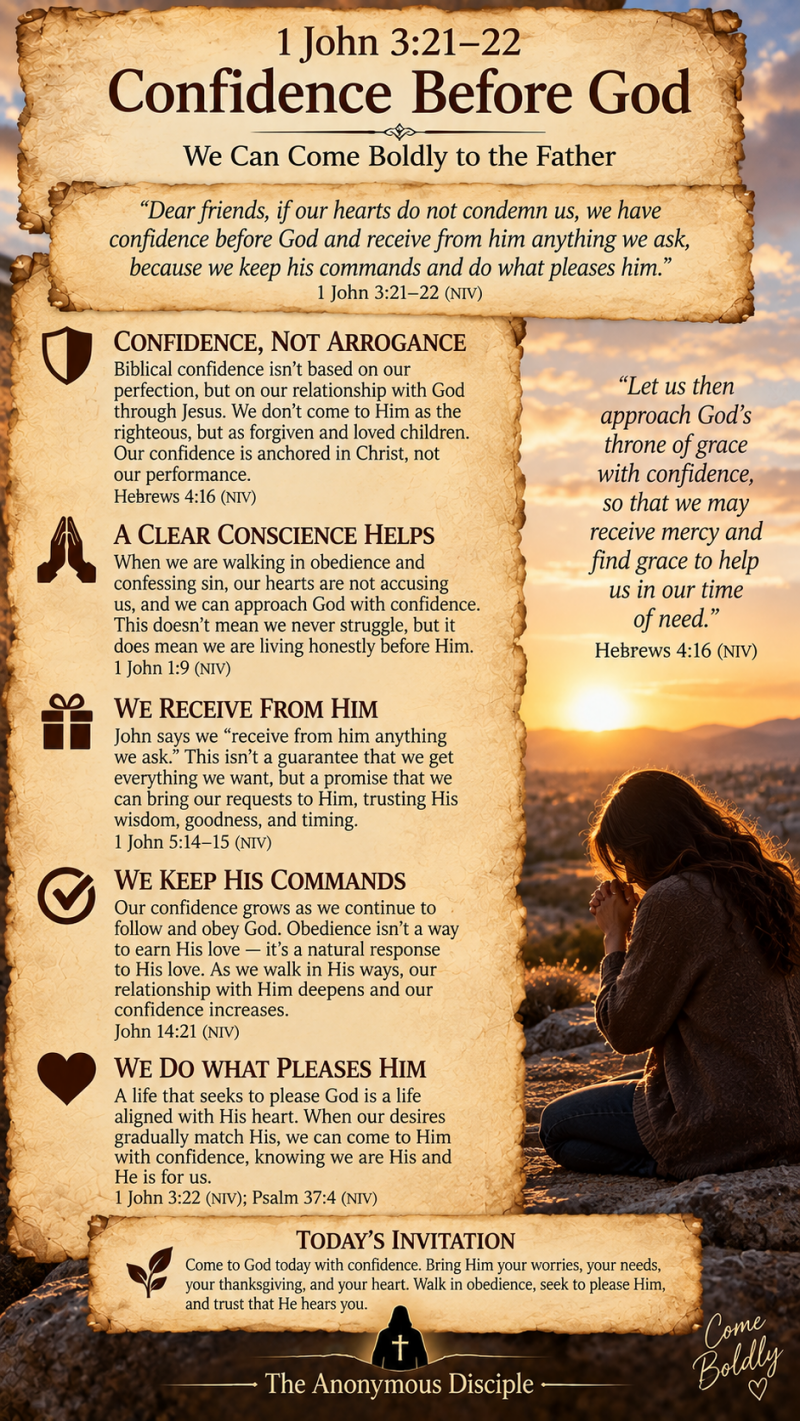
“Dear friends, if our hearts do not condemn us, we have confidence before God and receive from him anything we ask, because we keep his commands and do what pleases him.”
John moves from condemnation → confidence.
Not arrogance.
Not “I've behaved perfectly, therefore God owes me.”
It's the confidence of someone living in relationship with the Father.
The word picture is almost courtroom-like.
Instead of hiding from God because our heart is accusing us, Christ allows us to come before Him confidently.
That echoes:
Hebrews 4:16
“Let us then approach God's throne of grace with confidence…”
Not because we're flawless.
Because Jesus is sufficient.
✝️ 1 John 3:23 — John Boils It Down
Then John gives an amazingly concise description of God's command:
1 John 3:23
“And this is his command: to believe in the name of his Son, Jesus Christ, and to love one another as he commanded us.”
Look at the two directions:
✝️ BELIEVE IN JESUS
⬇️
❤️ LOVE ONE ANOTHER
Faith produces love.
John doesn't separate doctrine from life.
Believe rightly about Jesus → live differently because of Jesus.
And notice he doesn't say merely believe that Jesus existed.
“Believe in the name of His Son, Jesus Christ.”
His name represents who He is.
Son of God.
Messiah.
Savior.
Lord.
We entrust ourselves to Him.
🕊️ 1 John 3:24 — How Do I Know He Lives in Me?
1 John 3:24
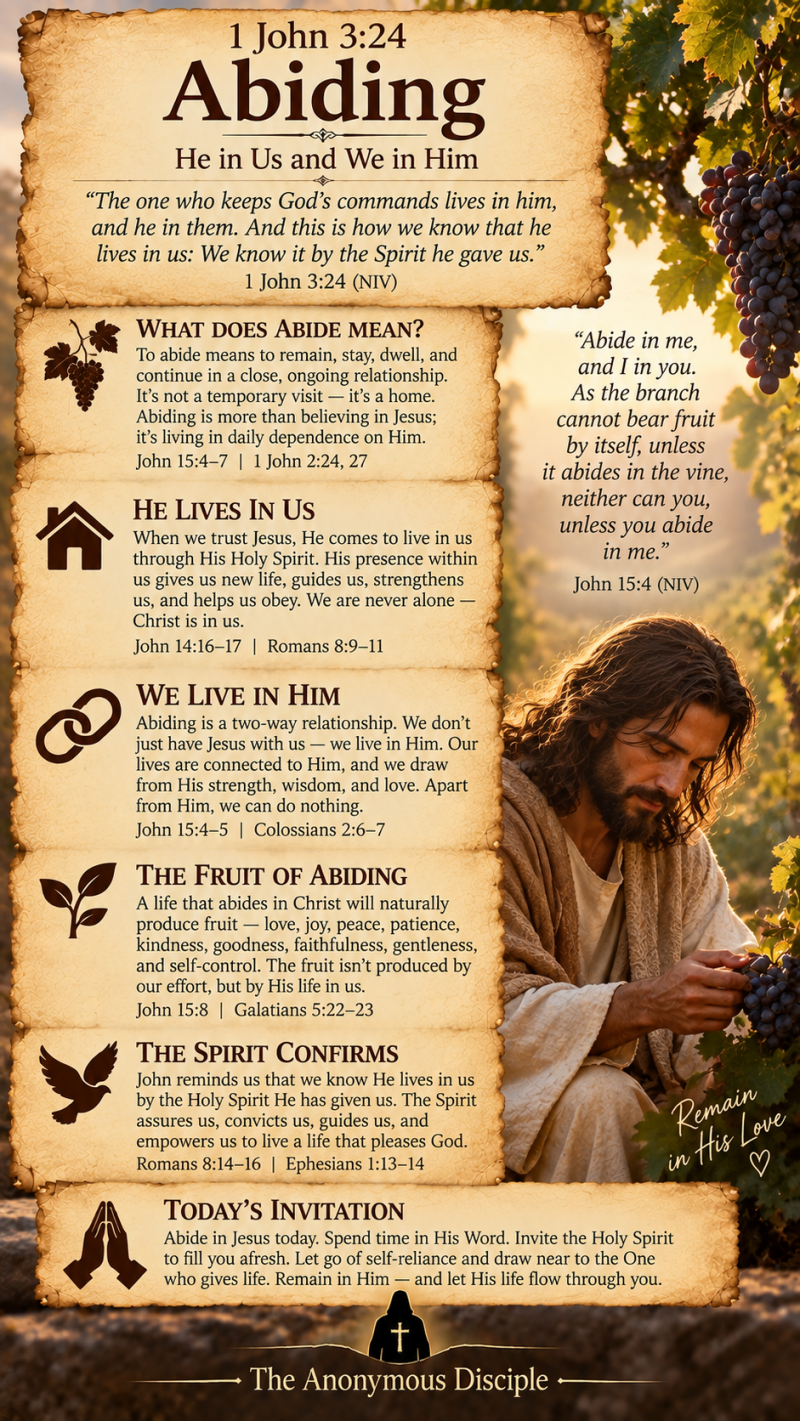
“The one who keeps God's commands lives in him, and he in them. And this is how we know that he lives in us: We know it by the Spirit he gave us.”
Now we reach something huge in John's theology:
Mutual abiding.
We live in Him.
He lives in us.
And John points to the Holy Spirit as God's confirming presence within believers.
This prepares us directly for 1 John 4, where John begins talking about discerning spirits and confessing the truth about Jesus Christ.
So the passage forms a beautiful progression:
LOVE IN ACTION
↓
ASSURANCE THAT WE BELONG TO THE TRUTH
↓
THE HEART MAY STILL ACCUSE US
↓
⚓️ GOD IS GREATER THAN OUR HEART
↓
CONFIDENCE BEFORE GOD
↓
BELIEVE IN JESUS
↓
LOVE ONE ANOTHER
↓
ABIDE IN HIM
↓
🕊️ THE SPIRIT CONFIRMS HIS PRESENCE
🔥 Something I Really Don't Want Us to Miss
Sherri, verse 20 is not saying:
“Whatever you feel guilty about doesn't matter.”
John takes sin very seriously throughout this letter.
Earlier he wrote:
1 John 1:9
“If we confess our sins, he is faithful and just and will forgive us our sins and purify us from all unrighteousness.”
So there is a difference between:
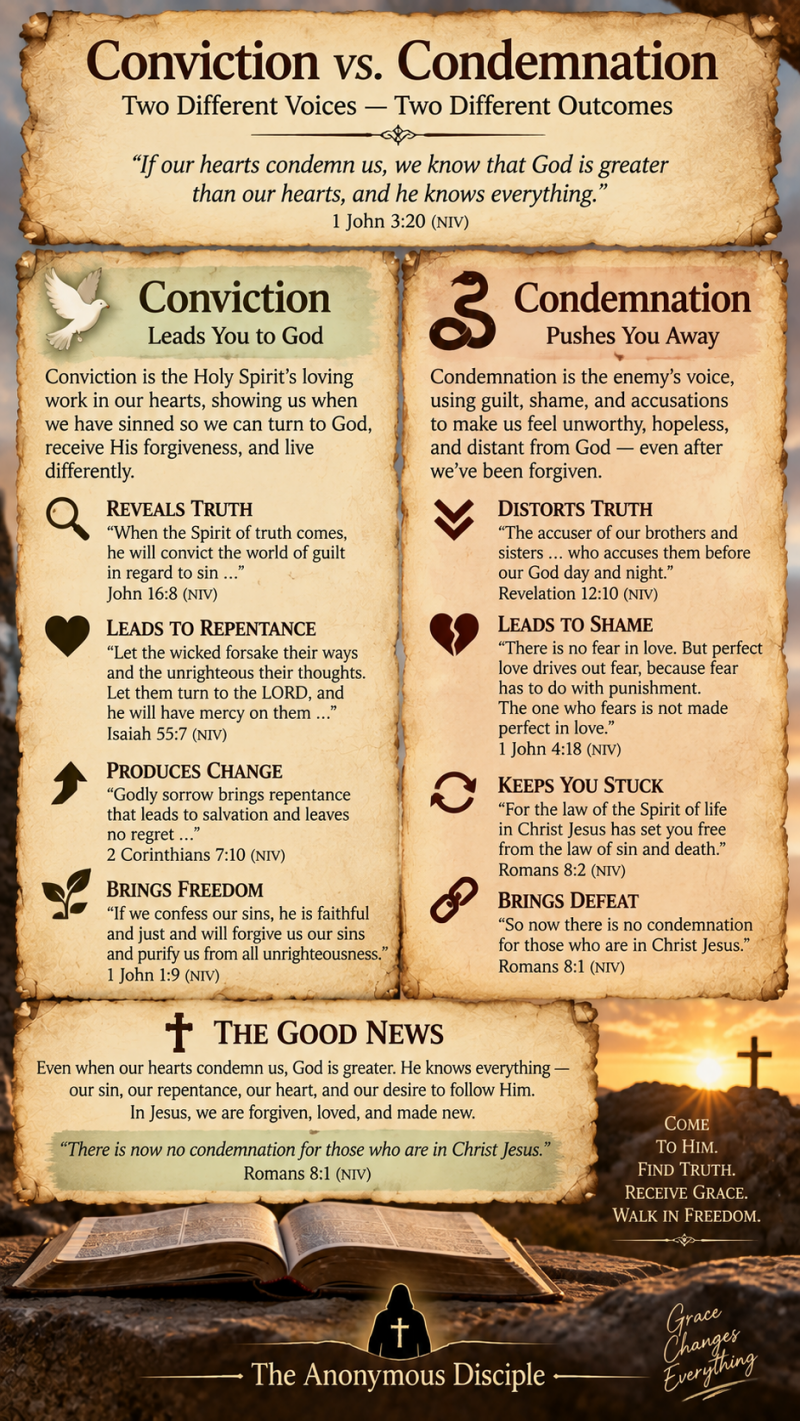
conviction that leads us toward God
and
condemnation that makes us want to hide from God.
The Holy Spirit can expose sin so that we confess it and return to God.
But after confession and forgiveness, our hearts may continue prosecuting a case that God has already dealt with through Christ.
That's when 1 John 3:20 becomes precious:
⚓️ GOD IS GREATER THAN YOUR HEART.
Compare that with:
Romans 8:1
“Therefore, there is now no condemnation for those who are in Christ Jesus.”
And:
Romans 8:33–34
“Who will bring any charge against those whom God has chosen? It is God who justifies. Who then is the one who condemns? No one.”
Add comment
Comments