

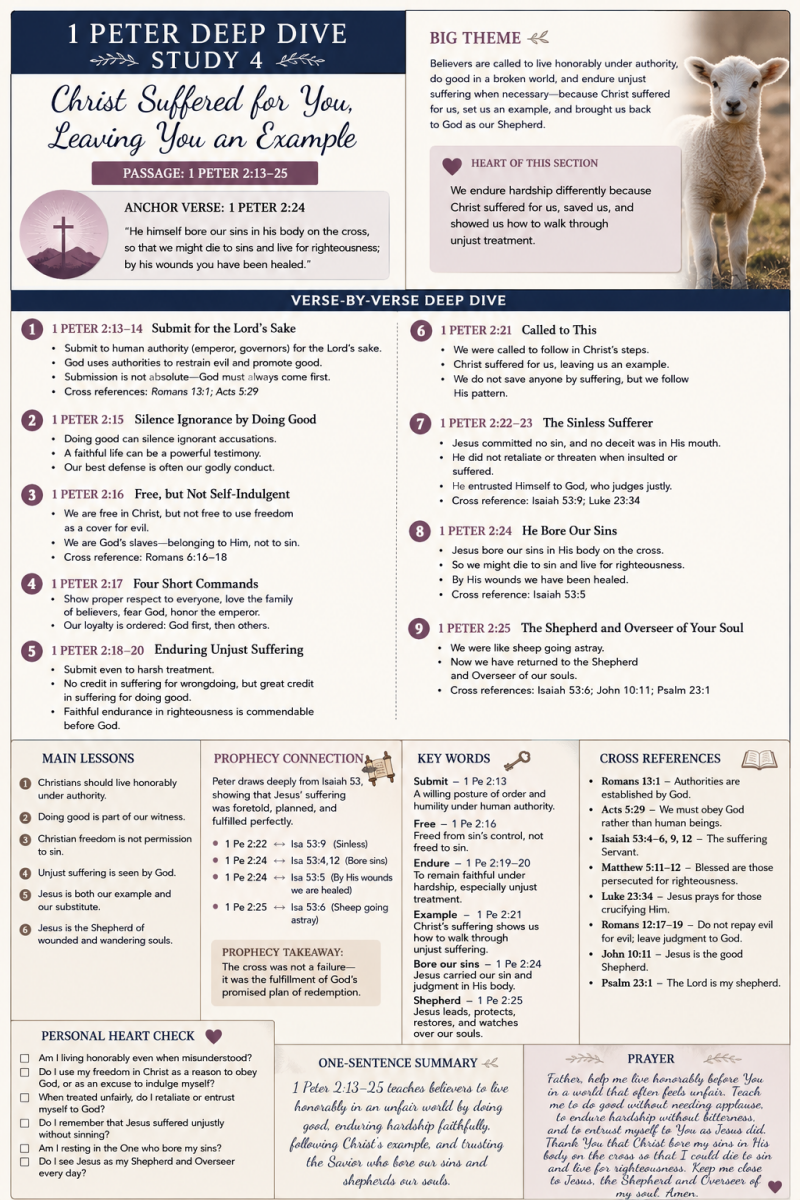
Christ Suffered for You, Leaving You an Example
Passage: 1 Peter 2:13–25
Anchor Verse: 1 Peter 2:24
1 Peter 2:24
“He himself bore our sins in His body on the cross, so that we might die to sins and live for righteousness; “by his wounds you have been healed.”
This section is powerful because Peter moves from:
- living honorably among unbelievers
to - submitting rightly in a hard world
to - looking directly at Jesus as both Savior and example.
The heartbeat of this section is:
Believers endure hardship differently because Christ suffered for us, saved us, and showed us how to walk through unjust treatment.
Big Theme of the Section
Peter is teaching believers how to live under authority and how to respond when treated unfairly.
But this is not just a lesson on submission.
It is really a lesson on this:
How do Christians live faithfully when the world is unfair?
Peter’s answer is:
- honor authority where obedience to God is not violated,
- do good even when misunderstood,
- endure unjust suffering when necessary,
- and keep your eyes on Jesus.
Verse-by-Verse Deep Dive
1 Peter 2:13–14 — Submit for the Lord’s Sake
"Submit yourselves for the Lord's sake to every human authority; whether to the emperor, as the supreme authority, or to governors, who are sent by Him to punish those who do wrong and to commend those who do right."
Peter says believers are to submit themselves for the Lord’s sake to human authority, whether to the emperor or to governors.
This is important:
Peter does not say authority is always righteous.
He says believers should have an attitude of submission and order because they belong to God.
Why?
Because civil order restrains evil and supports what is good.
Heart meaning:
Christians are not called to be rebellious troublemakers. We are called to be people whose conduct reflects God’s order, humility, and peace.
Important balance:
Submission to human authority is real, but it is not absolute.
If human authority commands disobedience to God, believers obey God first.
Cross references:
- Acts 5:29 — “Peter and the other apostles replied: 'We must obey God rather than human beings!'”
- Romans 13:1 — "Let everyone be subject to the governing authorities, for there is no authority except that which God has established. The Authorities that exist have been established by God." Authorities are established by God.
1 Peter 2:15 — Silence Ignorance by Doing Good
"For it is God's will that by doing good you should silence the ignorant talk of foolish people."
Peter says it is God’s will that by doing good believers should silence the ignorant talk of foolish people.
This is such a practical truth.
Peter does not say:
“Win every argument.”
He says:
Live so well that slander loses credibility.
That does not mean unbelievers will stop accusing.
It means your life becomes a testimony against false claims.
Heart meaning:
Sometimes your clearest defense is not a louder voice, but a holier life.
1 Peter 2:16 — Free, but Not Self-Indulgent
"Live as free people, but do not use your freedom as a cover-up for evil; live as God's slaves."
Peter says believers are to live as free people, but not to use freedom for evil; instead, live as God’s slaves.
Christian freedom is never permission for sin.
We are free:
- from condemnation,
- from slavery to sin,
- from empty living,
but we are not free:
- to dishonor God,
- to indulge fleshly desires,
- to use grace carelessly.
Heart meaning:
True freedom is not doing whatever I want.
True freedom is belonging to God and being able to live rightly before Him.
1 Peter 2:17 — Four Short Commands
Peter gives four compact instructions:
1 Peter 2:17
- Show proper respect to everyone
- Love the family of believers
- Fear God
- Honor the emperor
This is a beautiful order.
Respect everyone
Every person bears dignity as one made in God’s image.
Love believers
There is a special family bond among God’s people.
Fear God
God alone gets ultimate reverence.
Honor the emperor
Even rulers are to be treated with proper respect, though not worshiped.
Heart meaning:
A Christian’s loyalties are ordered properly when reverence for God governs how they treat everyone else.
1 Peter 2:18–20 — Enduring Unjust Suffering
Peter then addresses household servants, telling them to submit even to harsh masters.
This is not Peter approving cruelty.
He is speaking into a broken world and showing believers how to live righteously inside painful circumstances.
He says if someone suffers for doing wrong, there is no credit in that. But if someone suffers for doing good and endures it, this is commendable before God.
That is one of the hardest teachings in the passage.
The principle is:
There is a difference between suffering for wrongdoing and suffering for righteousness.
Peter is not glorifying abuse.
He is honoring faithfulness under unjust treatment.
Heart meaning:
God sees when His people suffer unfairly. Quiet endurance in righteousness is never invisible to Him.
1 Peter 2:21 — Called to This
Peter says:
1 Peter 2:21
“To this you were called, because Christ suffered for you, leaving you an example, that you should follow in his steps.”
This is strong.
Believers are called not only to believe in Christ’s suffering for salvation, but also to follow His pattern when suffering comes.
Now, of course, Jesus’ suffering is unique. We do not save anyone by our suffering.
But Peter says Christ’s suffering also leaves us an example.
Heart meaning:
When we suffer unjustly, we are not walking an unknown road. Jesus has already walked it.
1 Peter 2:22–23 — The Sinless Sufferer
Peter describes Jesus:
1 Peter 2:22
“He committed no sin, and no deceit was found in his mouth.”
1 Peter 2:23 — He Entrusted Himself to God
1 Peter 2:23 — “When they hurled their insults at him, he did not retaliate; when he suffered, he made no threats.”
Jesus was insulted, mocked, falsely accused, beaten, and crucified — yet He did not answer evil with evil.
But Peter tells us what Jesus did do:
1 Peter 2:23 — “Instead, he entrusted himself to him who judges justly.”
That is the key.
Jesus was not passive because injustice was okay.
He was not silent because the evil did not matter.
He entrusted Himself to the Father, knowing God judges perfectly.
Heart meaning:
Jesus shows us that we do not have to take revenge to be safe in God’s hands. God sees, God knows, and God judges justly.
1 Peter 2:24 — He Bore Our Sins
Now Peter moves from Jesus as our example to Jesus as our Savior.
1 Peter 2:24 — “He himself bore our sins” in His body on the cross."
This is the anchor verse.
Jesus did not merely suffer near sin.
He bore our sins.
He carried the guilt, judgment, and weight of sin in His own body on the cross.
Peter says the purpose was:
1 Peter 2:24 — “so that we might die to sins and live for righteousness.”
So Jesus’ death does not only forgive us.
It also changes the direction of our lives.
We die to sin.
We live for righteousness.
Then Peter says:
1 Peter 2:24 — “by his wounds you have been healed.”
This echoes Isaiah 53:5, where the suffering servant is pierced for our transgressions and crushed for our iniquities.
Isaiah 53:5 - "But he was pierced for our transgressions, he was crushed for our iniquities; the punishment that brought us peace was on him, and by his wounds we are healed."
Important note:
The deepest healing Peter is talking about here is spiritual healing — healing from sin, separation, guilt, and wandering from God. God can absolutely heal physically, but in this passage Peter is focusing on salvation and restoration of the soul.
Heart meaning:
Jesus was wounded so sinners could be forgiven, cleansed, restored, and made alive to righteousness.
1 Peter 2:25 — The Shepherd and Overseer of Your Soul
Peter closes this section tenderly:
1 Peter 2:25 — “For you were like sheep going astray, but now you have returned to the Shepherd and Overseer of your souls.”
That is beautiful.
Peter says we were wandering sheep.
But now, through Christ, we have returned.
And Jesus is called:
The Shepherd
He leads, feeds, protects, corrects, and restores.
The Overseer of your soul
He watches over what is deepest and most eternal in you.
This verse ties beautifully to:
Isaiah 53:6 — “We all, like sheep, have gone astray…”
John 10:11 — Jesus says, “I am the good shepherd. The good shepherd lays down his life for the sheep.”
Psalm 23:1 — “The Lord is my shepherd, I lack nothing.”
Heart meaning:
Jesus did not suffer for you and then leave you unattended. He saved you, brought you back, and now watches over your soul.
Main Lessons of 1 Peter 2:13–25
Christians should live honorably under authority
1 Peter 2:13–14 calls believers to submit for the Lord’s sake.
But our highest loyalty is always to God.
Acts 5:29 — “We must obey God rather than human beings!”
So Christian submission is humble and orderly, but never idolatrous.
Doing good is part of our witness
1 Peter 2:15 says doing good can silence ignorant accusations.
Not every argument needs to be answered with more words. Sometimes a faithful life becomes the answer.
Christian freedom is not permission to sin
1 Peter 2:16 says not to use freedom as a cover-up for evil.
Grace does not make sin safer.
Grace makes obedience possible.
Unjust suffering is seen by God
1 Peter 2:19–20 teaches that God sees when someone suffers for doing good.
That does not make injustice good.
It means faithful endurance is precious to God.
Jesus is both our example and our substitute
This is the heart of the section.
1 Peter 2:21 — Jesus suffered, leaving us an example.
1 Peter 2:24 — Jesus bore our sins in His body on the cross.
We follow His steps, but we do not copy His saving work. Only Jesus can bear sin. Only Jesus can save.
Jesus is the Shepherd of wounded and wandering souls
1 Peter 2:25 reminds us that Jesus brings wandering sheep home.
He does not only forgive.
He shepherds.
Prophecy Connection
This section connects strongly to Isaiah 53, one of the clearest Old Testament prophecies of the suffering Messiah.
Peter’s language echoes Isaiah repeatedly:
1 Peter 2:22 — “He committed no sin…”
Isaiah 53:9 — "He was assigned a grave with the wicked, and with the rich in his death, though he had done no violence nor was any deceit in his mouth."
1 Peter 2:24 — “He himself bore our sins…”
Isaiah 53:4 - "Surely he took up our pain and bore our suffering, yet we considered him punished by God, stricken by him, and afflicted."
53:12 — "Therefore I will give him a portion among the great, and he will divide the spoils with the strong, because he poured out his life unto death, and was numbered with the transgressors. For he bore the sin of many, and made intercession for the transgressors." The Servant bears grief, carries sorrows, and bears the sin of many.
1 Peter 2:24 — “By his wounds you have been healed.”
Isaiah 53:5 — “By his wounds we are healed.”
1 Peter 2:25 — “You were like sheep going astray…”
Isaiah 53:6 — “We all, like sheep, have gone astray.”
Prophecy takeaway:
Peter is showing that Jesus’ suffering was not a failure. It was fulfillment.
The cross was not Jesus losing control.
It was God’s promised plan of redemption unfolding exactly as Scripture foretold.
Key Words
Submit — 1 Peter 2:13
A willing posture of order and humility under human authority, for the Lord’s sake.
Free — 1 Peter 2:16
Believers are free in Christ, but not free to use grace as a cover for evil.
Endure — 1 Peter 2:19–20
To remain faithful under hardship, especially when treated unfairly.
Example — 1 Peter 2:21
Christ’s suffering shows believers how to walk through unjust suffering without sinning.
Bore our sins — 1 Peter 2:24
Jesus carried our sin and judgment in His body on the cross.
Shepherd — 1 Peter 2:25
Jesus is the One who brings wandering souls home and watches over them.
Cross References
Isaiah 53:5 — The suffering Servant is pierced for our transgressions, and by His wounds we are healed.
Isaiah 53:6 — We all, like sheep, have gone astray.
Isaiah 53:9 — The Servant had done no violence, and no deceit was in His mouth.
Matthew 5:11–12 — Blessed are those insulted and persecuted because of righteousness.
Matthew 5:44 — Jesus teaches His followers to love their enemies and pray for those who persecute them.
Luke 23:34 — Jesus prays for those crucifying Him.
Romans 12:17–19 — Do not repay evil for evil; leave room for God’s wrath.
Acts 5:29 — We must obey God rather than human beings.
John 10:11 — Jesus is the good Shepherd who lays down His life for the sheep.
Psalm 23:1 — The Lord is my shepherd.
Personal Heart Check
This passage asks us:
Am I living honorably even when the world feels unfair?
Do I use my freedom in Christ as a reason to obey God, or as an excuse to indulge myself?
When I am misunderstood or mistreated, do I retaliate, threaten, stew, or entrust myself to God?
Do I remember that Jesus suffered unjustly without sinning?
Am I trying to “save myself” through control and revenge, or am I resting in the One who bore my sins?
Do I see Jesus not only as Savior, but as the Shepherd and Overseer of my soul?
One-Sentence Summary
1 Peter 2:13–25 teaches believers to live honorably in an unfair world by doing good, enduring hardship faithfully, following Christ’s example, and trusting the Savior who bore our sins and shepherds our souls.
Prayer
Father, help me live honorably before You in a world that often feels unfair. Teach me to do good without needing applause, to endure hardship without bitterness, and to entrust myself to You as Jesus did. Thank You that Christ bore my sins in His body on the cross so that I could die to sin and live for righteousness. Keep me close to Jesus, the Shepherd and Overseer of my soul. Amen. 🕊️
Add comment
Comments