

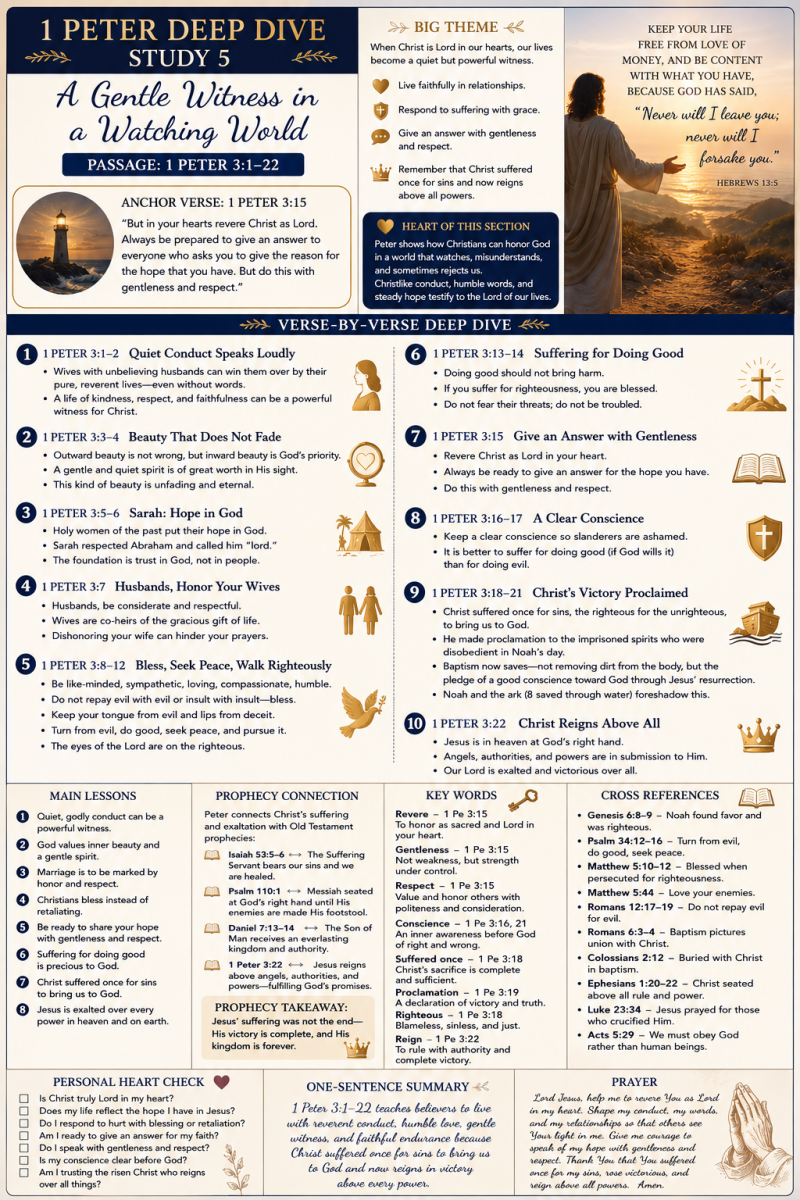
A Gentle Witness in a Watching World
Passage: 1 Peter 3:1–22
Anchor Verse: 1 Peter 3:15
1 Peter 3:15
“But in your hearts revere Christ as Lord.” Peter says to always be ready to give an answer for the hope you have — but to do this with gentleness and respect.
This section is tender, practical, and strong. Peter teaches believers how to live faithfully in marriage, in relationships, in suffering, and in witness — all while keeping Christ as Lord in the heart. 🕊️
Big Theme of the Section
Peter is teaching this:
When Christ is Lord in your heart, your life becomes a quiet but powerful witness.
This chapter is not about putting on a religious performance.
It is about having a life so shaped by Christ that people can see Him in your conduct, your words, your endurance, your humility, and your hope.
The flow is:
1 Peter 3:1–7 — Faithful witness in marriage
1 Peter 3:8–12 — Unity, humility, blessing, and peace
1 Peter 3:13–17 — Suffering for doing good and answering with gentleness
1 Peter 3:18–22 — Christ suffered, triumphed, and reigns above all powers
Verse-by-Verse Deep Dive
1 Peter 3:1–2 — Quiet Conduct Can Speak Loudly
1 Peter 3:1–2 speaks to wives with unbelieving or disobedient husbands, saying their reverent and pure conduct can become a witness even “without words.”
This does not mean a wife has no voice.
It does not mean sin, cruelty, abuse, or danger should be ignored.
It does not mean a husband is above accountability.
Peter is addressing a situation where a believing wife is trying to live faithfully before a husband who does not obey the Word. His counsel is that her life can testify to Christ even when her words are being resisted.
Heart meaning:
Sometimes the strongest witness is not more arguing. Sometimes it is steady faith, reverence for God, purity, peace, and Christlike conduct over time.
1 Peter 3:3–4 — Beauty That Does Not Fade
1 Peter 3:3–4 contrasts outward adornment with “the unfading beauty of a gentle and quiet spirit.”
Peter is not forbidding all outward care or beauty. The point is priority.
He is saying:
Do not let external appearance become the center of your worth.
The beauty God prizes is inward:
- a gentle spirit
- a quiet spirit
- a heart settled before God
- a life not ruled by vanity, fear, or performance
Peter says this kind of beauty is of great worth in God’s sight.
Heart meaning:
The world praises beauty that fades. God praises beauty that grows deeper as the heart becomes more like Christ.
1 Peter 3:5–6 — Sarah as an Example of Trust
1 Peter 3:5–6 points to holy women of the past who put their hope in God. Peter specifically mentions Sarah, who respected Abraham.
This can be misunderstood if we isolate it. Sarah was not weak, brainless, or invisible. In Genesis, Sarah speaks, laughs, struggles, makes mistakes, is protected by God, and is included in God’s covenant promise.
The key phrase is:
“They put their hope in God.”
That is the foundation.
Peter is not saying, “Put your ultimate hope in your husband.”
He is saying faithful women honor God first, and their trust in God shapes how they live in marriage.
Heart meaning:
Biblical submission is not fear-driven weakness. It is God-centered trust expressed through humility, honor, and faithfulness.
1 Peter 3:7 — Husbands Must Honor Their Wives
1 Peter 3:7 tells husbands to be considerate and respectful toward their wives, recognizing them as co-heirs of the gracious gift of life.
This is very strong.
Peter warns husbands that mistreating their wives can hinder their prayers.
That means God is not impressed by a man’s religious talk if he dishonors his wife.
Heart meaning:
God watches how husbands treat their wives. A man cannot be careless, harsh, selfish, or dishonoring at home and expect God to ignore it.
1 Peter 3:8 — The Family Character of Believers
1 Peter 3:8 calls believers to be like-minded, sympathetic, loving one another, compassionate, and humble.
Peter now moves from marriage to the whole church family.
These qualities are beautiful:
- Like-minded — united around Christ
- Sympathetic — able to care about another’s pain
- Loving — treating believers as family
- Compassionate — tenderhearted, not cold
- Humble — not self-important or easily offended
Heart meaning:
A strong Christian life is not only doctrinally alert; it is also tender, humble, and compassionate.
1 Peter 3:9 — Bless Instead of Retaliating
1 Peter 3:9 says not to repay evil with evil or insult with insult, but with blessing.
This is hard.
Peter is not saying evil is fine.
He is saying Christians do not answer evil by becoming evil.
This echoes Jesus:
Matthew 5:44 — Jesus teaches His followers to love their enemies and pray for those who persecute them.
And Paul says:
Romans 12:17 — Do not repay anyone evil for evil.
Heart meaning:
Retaliation feels powerful in the moment, but blessing shows that Christ rules the heart more than anger does.
1 Peter 3:10–12 — The Lord Sees the Righteous
1 Peter 3:10–12 quotes Psalm 34:12–16.
Peter says the one who loves life and wants to see good days should:
- keep the tongue from evil
- keep lips from deceit
- turn from evil
- do good
- seek peace
- pursue it
Then he reminds them:
1 Peter 3:12 — The eyes of the Lord are on the righteous, and His ears are attentive to their prayer.
But the face of the Lord is against those who do evil.
Heart meaning:
God sees both the faithful and the wicked. Your obedience is not invisible, and evil is not ignored.
1 Peter 3:13–14 — Suffering for Doing Good
1 Peter 3:13–14 says that generally, doing good should not bring harm. But even if believers suffer for what is right, they are blessed.
Peter is realistic.
Sometimes righteousness is respected.
Sometimes righteousness is hated.
But Peter says suffering for what is right does not mean God has abandoned you.
Cross reference:
Matthew 5:10 — Blessed are those who are persecuted because of righteousness.
Heart meaning:
Being mistreated for righteousness is painful, but it does not make you cursed. In Christ, it can be a place of blessing.
1 Peter 3:15 — Revere Christ as Lord
This is the anchor verse.
1 Peter 3:15 says, “In your hearts revere Christ as Lord.”
That comes before answering anyone.
Before apologetics, before defense, before explaining your faith — Christ must be set apart as Lord in the heart.
Then Peter says to always be prepared to give an answer to everyone who asks for the reason for the hope you have.
But he adds:
“With gentleness and respect.”
That matters.
A Christian witness should not be arrogant, mocking, cruel, panicked, or combative.
Truth does not need ugliness to make it strong.
Heart meaning:
The best witness is truth spoken from a heart surrendered to Christ — steady, clear, gentle, and respectful.
1 Peter 3:16–17 — A Clear Conscience Matters
1 Peter 3:16 says believers should keep a clear conscience so that those who speak maliciously against their good behavior in Christ may be ashamed of their slander.
This connects back to 1 Peter 2:12 — live such good lives among unbelievers that they see your good deeds.
Peter is teaching that conduct and witness belong together.
Then 1 Peter 3:17 says it is better, if God wills it, to suffer for doing good than for doing evil.
Heart meaning:
If you suffer, let it not be because you were foolish, harsh, dishonest, or sinful. Let your conscience be clean before God.
1 Peter 3:18 — Christ Suffered Once for Sins
1 Peter 3:18 says Christ suffered once for sins, the righteous for the unrighteous, to bring us to God.
This is the gospel in one verse.
Jesus is:
- the righteous One
- suffering for the unrighteous
- once for sins
- to bring us to God
That phrase “to bring us to God” is so tender.
Jesus did not die merely to improve our lives.
He died to reconcile us to God.
Heart meaning:
The goal of the cross is not only forgiveness; it is nearness. Jesus suffered to bring wandering sinners home to the Father.
1 Peter 3:19–20 — The Spirits in Prison
This is one of the most difficult passages in 1 Peter.
1 Peter 3:19–20 says Christ made proclamation to “the imprisoned spirits” who were disobedient long ago in the days of Noah.
Faithful Bible teachers have different views on this passage. The main views are:
View 1: Christ proclaimed victory to fallen spirits
This view says after His death and resurrection, Christ proclaimed His victory over evil spiritual powers connected to the rebellion in Noah’s day.
View 2: Christ preached through Noah’s witness
This view says Christ, by the Spirit, preached through Noah to the disobedient people of Noah’s generation while the ark was being prepared.
View 3: Christ announced triumph after His suffering
This view focuses less on the exact identity of the spirits and more on Peter’s main point: Christ suffered, but He was vindicated and victorious.
The safest main point is this:
Christ’s suffering did not end in defeat. It ended in victory.
Peter brings up Noah because Noah was a righteous minority in a wicked generation. That fits Peter’s audience: believers living faithfully in a hostile world.
Heart meaning:
God knows how to preserve His people in judgment, and Christ’s victory reaches over every hostile power.
1 Peter 3:20–21 — Noah, the Ark, and Baptism
1 Peter 3:20 says only a few people, eight in all, were saved through water.
Then 1 Peter 3:21 says this water symbolizes baptism that now saves you — not the removal of dirt from the body, but the pledge or appeal of a clear conscience toward God through the resurrection of Jesus Christ.
This verse needs care.
Peter is not saying the physical act of water has magical saving power.
He clarifies that it is not about washing dirt from the body. It is about a conscience turned toward God, through Christ’s resurrection.
Baptism is the outward sign of inward faith — identification with Christ’s death, burial, and resurrection.
Cross references:
Romans 6:3–4 — Baptism pictures being united with Christ in His death and raised to new life.
Colossians 2:12 — Believers are buried with Christ in baptism and raised with Him through faith.
Heart meaning:
Baptism points to the rescue God gives through Christ — passing from judgment into life through the risen Savior.
1 Peter 3:22 — Christ Reigns Above All Powers
1 Peter 3:22 says Jesus has gone into heaven and is at God’s right hand, with angels, authorities, and powers in submission to Him.
This is the victory note.
The suffering Christ is now the exalted Christ.
He is above:
- angels
- authorities
- powers
- every spiritual force
This is huge in a letter written to suffering believers.
Peter is saying: you may feel small, outnumbered, and pressured — but your Lord reigns over all.
Heart meaning:
No earthly hostility and no spiritual power outranks Jesus Christ.
Main Lessons of 1 Peter 3:1–22
1. Quiet faithfulness can be a powerful witness
1 Peter 3:1–2 shows that conduct matters, especially when words are resisted.
2. God values inward beauty
1 Peter 3:3–4 reminds us that gentle, quiet, God-trusting character is precious to Him.
3. Marriage must be marked by honor
1 Peter 3:7 makes it clear that husbands must treat wives with respect as co-heirs before God.
4. Believers should bless, not retaliate
1 Peter 3:9 calls Christians to break the cycle of insult and revenge.
5. Christian witness must be ready, gentle, and respectful
1 Peter 3:15 gives the pattern: Christ as Lord in the heart, truth on the lips, gentleness in the manner.
6. Suffering for good is not wasted
1 Peter 3:17 says it is better to suffer for doing good than for evil.
7. Christ suffered once to bring us to God
1 Peter 3:18 is the center of hope: the righteous One suffered for the unrighteous.
8. Christ is victorious over every power
1 Peter 3:22 shows Jesus exalted above angels, authorities, and powers.
Prophecy Connection
This section has a strong kingdom-and-victory thread.
1 Peter 3:18 points to Christ’s once-for-all suffering for sins.
1 Peter 3:22 points to His exaltation at the right hand of God, where angels, authorities, and powers are in submission to Him.
This connects beautifully to:
Psalm 110:1 — The Lord says to David’s Lord, “Sit at my right hand until I make your enemies a footstool for your feet.”
Daniel 7:13–14 — One like a son of man receives authority, glory, sovereign power, and an everlasting kingdom.
Ephesians 1:20–22 — God seated Christ at His right hand, far above all rule, authority, power, and dominion.
Prophecy takeaway:
Jesus’ suffering was not the end of the story. The crucified Christ is the risen, exalted, reigning King — and every power will ultimately bow beneath Him.
Key Words
Reverent conduct — 1 Peter 3:1–2
A life shaped by respect for God that can witness even when words are resisted.
Gentle and quiet spirit — 1 Peter 3:4
Inner strength, humility, and peace before God.
Co-heirs — 1 Peter 3:7
Husbands and wives share equal spiritual inheritance in Christ.
Blessing — 1 Peter 3:9
Responding to insult or evil in a way that reflects God’s grace.
Answer — 1 Peter 3:15
A reasoned defense or explanation of Christian hope.
Gentleness and respect — 1 Peter 3:15
The manner that should mark Christian witness.
Once for sins — 1 Peter 3:18
Christ’s sacrifice is complete and sufficient.
Right hand of God — 1 Peter 3:22
The place of authority, victory, and exaltation.
Cross References
Genesis 6:8–9 — Noah found favor in God’s eyes and was righteous in his generation.
Psalm 34:12–16 — Turn from evil, do good, seek peace, and pursue it.
Psalm 110:1 — The Messiah is seated at God’s right hand until His enemies are made His footstool.
Daniel 7:13–14 — The Son of Man receives an everlasting kingdom.
Matthew 5:10 — Blessed are those persecuted because of righteousness.
Matthew 5:44 — Love your enemies and pray for those who persecute you.
Romans 6:3–4 — Baptism pictures union with Christ in death and resurrection.
Romans 12:17–18 — Do not repay evil for evil; live at peace as much as possible.
Ephesians 1:20–22 — Christ is seated far above all rule, authority, power, and dominion.
Colossians 2:12 — Believers are buried with Christ in baptism and raised with Him through faith.
Personal Heart Check
This passage asks us:
Am I trying to win people by pressure, or am I letting my life quietly testify to Christ?
Do I value the beauty God values — a gentle, settled, faithful spirit?
Am I careful to bless instead of retaliate when I feel insulted?
Is Christ truly revered as Lord in my heart, not just mentioned with my mouth?
Could I explain the hope I have in Christ with gentleness and respect?
Is my conscience clear before God in how I speak, respond, and suffer?
Do I remember that Jesus suffered once for sins to bring me to God?
Am I living like Jesus truly reigns above every power?
One-Sentence Summary
1 Peter 3:1–22 teaches believers to live with reverent conduct, humble love, gentle witness, and faithful endurance because Christ suffered once for sins, rose in victory, and now reigns above every power.
Prayer
Father, help me revere Christ as Lord in my heart. Shape my conduct, my words, my marriage, my relationships, and my witness so that my life points to You. Teach me to answer with gentleness and respect, to bless instead of retaliate, and to suffer for doing good without losing hope. Thank You that Jesus, the righteous One, suffered for the unrighteous to bring me to You. Remind me that He is risen, exalted, and reigning over every power. Amen. 🕊️
Add comment
Comments