

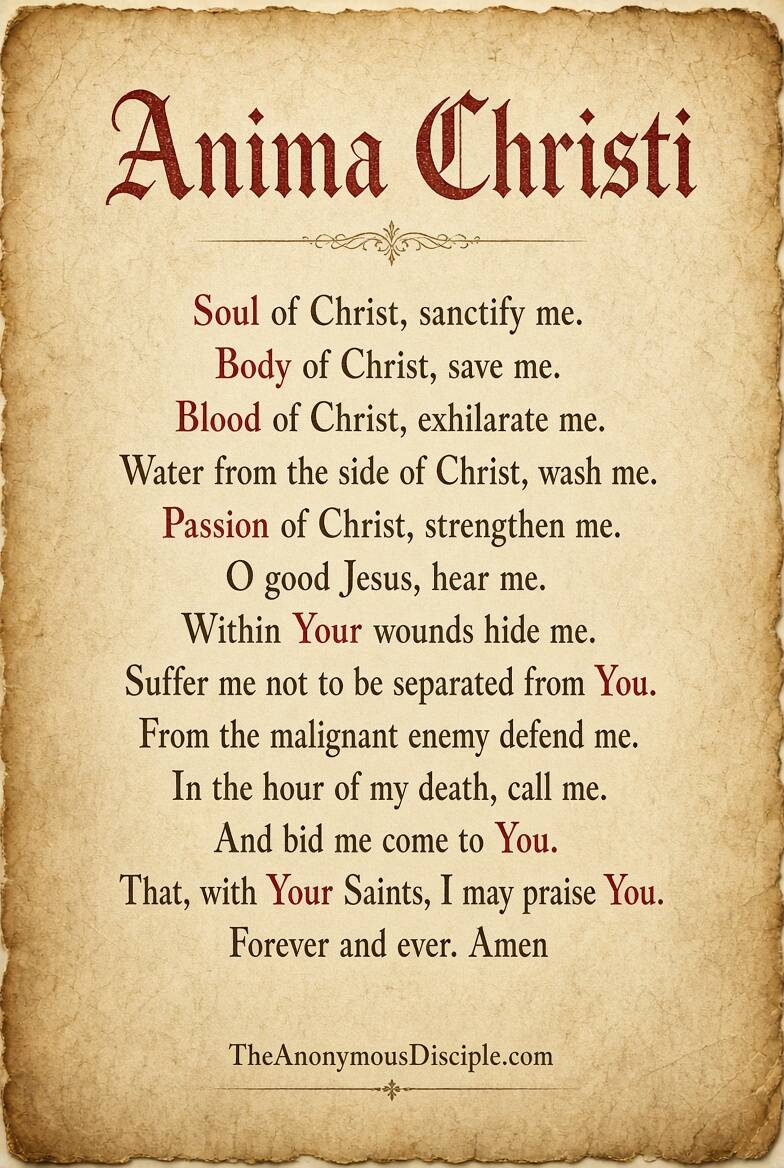
**This prayer is not a Bible verse itself—it comes from the 1300s—but every line is rooted in Scripture. “Water from the side of Christ” points straight to John 19:34 (ESV): “But one of the soldiers pierced his side with a spear, and at once there came out blood and water.” The rest asks Jesus to do what He already promised: make us holy, hide us in His wounds, keep us from the enemy, and call us home so we can praise Him forever with the saints.
Who wrote it?
We do not know. The author is anonymous. For a long time people thought St. Ignatius of Loyola wrote it because he loved it and put it at the front of his Spiritual Exercises. That is a mistake. The prayer was already old when Ignatius was born in 1491. Some have guessed Pope John XXII because he attached an indulgence to it in 1330, but scholars say that is only a guess and probably wrong. Other names that have been floated (Thomas Aquinas, Blessed Bernardine of Feltre) do not fit the dates. Honest answer: an unknown Christian in the early 1300s.
When was it written?
First half of the 1300s (14th century). The earliest solid landmarks are:
- Pope John XXII granted an indulgence for saying it in 1330.
- It appears in English manuscripts around 1330–1370 (It survives in several medieval manuscripts. One example held by the British Library is Harley MS 2445, which contains the Anima Christi with a rubric associating it with Pope John XXII.)
- It is carved on a gate of the Alcázar of Seville from the time of Pedro the Cruel (about 1350–1369).
- Cardinal Pierre de Luxembourg’s prayer book (he died 1387) already has nearly the same wording we use today.
- The German mystic Margaret Ebner (died 1351) knew it.
So it was already circulating across England, France, Spain, and Germany more than 150 years before Ignatius.
Which church used it—and who still uses it?
It began as a medieval Catholic prayer, especially after Communion. It grew in the wave of Eucharistic devotion that followed the feast of Corpus Christi (established in the 1200s). Catholics still use it that way: thanksgiving after receiving the Lord’s Supper, personal prayer, and Jesuit retreats. It is in the Roman Missal tradition and still carries a partial indulgence in Catholic practice. Pius IX renewed the indulgence in 1854.
It is not only Catholic. Because the words themselves stay close to the cross and do not require uniquely Catholic doctrines, some Protestants have used it too:
- Anglican bishop Lancelot Andrewes (1555–1626) put a version in his private prayers.
- A German rhymed expansion circulated among Pietists; John Wesley knew that tradition.
- Some Lutherans have noted that its language about Christ’s body, blood, and passion fits their understanding of the real presence and the wounds of Christ.
Eastern Orthodox Christians do not treat it as one of their standard liturgical prayers, though individual Orthodox believers sometimes use it privately because it is so focused on Jesus’ passion.
In simple biblical terms
The prayer is extra-biblical (not a verse from Scripture), but every petition leans on the Gospels and the letters:
- Water and blood from Jesus’ side — John 19:34 (ESV): “one of the soldiers pierced his side with a spear, and at once there came out blood and water.”
- Hide me in Your wounds — the risen Jesus still bears the scars (John 20:27) and Isaiah 53’s suffering servant.
- Do not let me be separated from You — Romans 8:38–39.
- Call me at the hour of death — Philippians 1:23; 2 Timothy 4:18.
That is why it has lasted: it is a short way of asking Jesus to do for us what He already did on the cross.
Add comment
Comments