

The Jesus Prayer
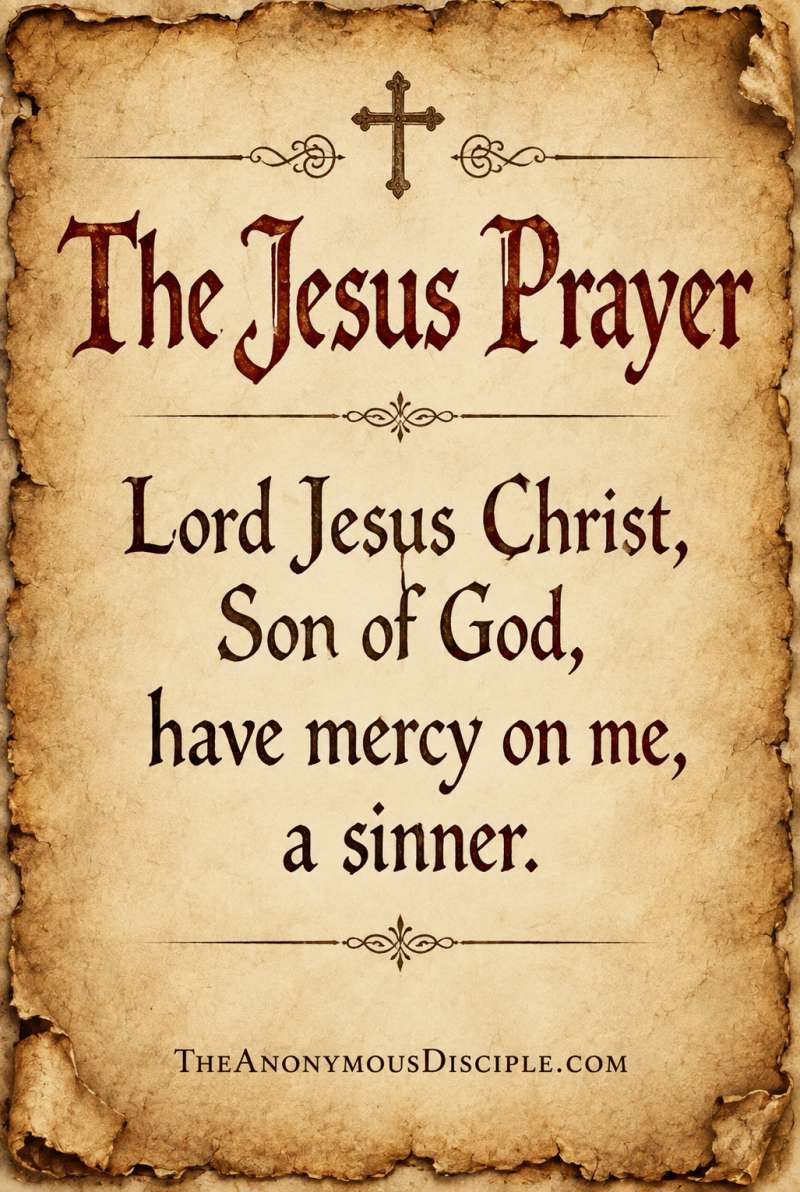
“Lord Jesus Christ, Son of God, have mercy on me, a sinner.”
Who wrote it?
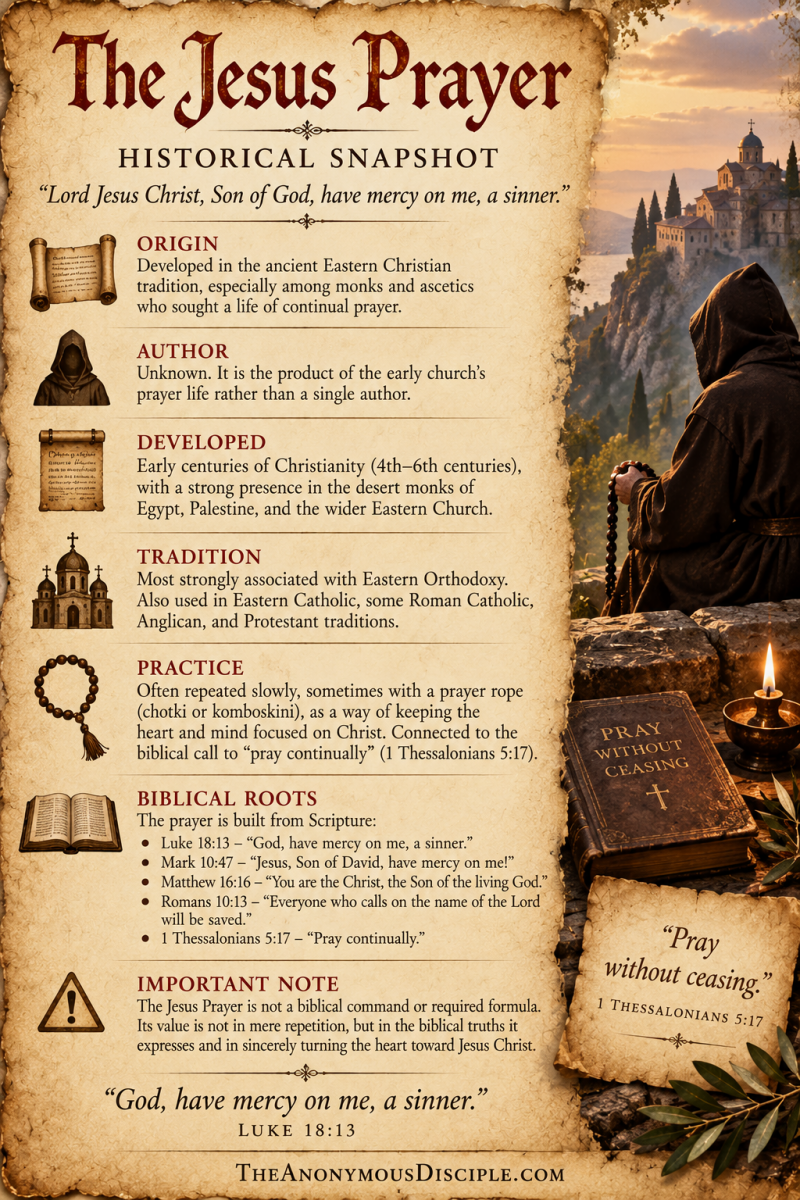
There is no known single author.
The Jesus Prayer developed gradually in the Eastern Christian monastic tradition, especially among early monks and ascetics who wanted to practice continual prayer and keep their attention fixed on Christ.
Its language grew out of very simple biblical cries for mercy. Over time, phrases such as “Lord Jesus Christ, Son of God, have mercy on me” became joined with “a sinner,” producing the familiar form used today.
So unlike something such as Luther’s Morning Prayer, we can’t point to one person and say, “He wrote this.” It belongs more broadly to the prayer life of the ancient Eastern Church.
When did it develop?
Its biblical ingredients are obviously first-century, but the recognizable devotional practice developed in the early centuries of Christianity.
By roughly the 4th–6th centuries, monks in Egypt, Palestine, and the wider Eastern Christian world were practicing short, repeated prayers centered on the name of Jesus.
The prayer eventually became especially associated with Eastern Orthodox spirituality and the tradition called hesychasm—from the Greek idea of stillness or quietness before God.
Later writings, particularly the collection known as the Philokalia, helped spread the practice.
But an important distinction:
The Bible never commands Christians to use this exact formula.
It is a historical Christian prayer built almost entirely from biblical language.
Where does it come from in Scripture?
This is where I think the prayer becomes really interesting. ❤️
Nearly every piece can be traced directly to Scripture.
“Lord Jesus Christ”
The early church confessed Jesus as Lord.
Philippians 2:10–11
“That at the name of Jesus every knee should bow, in heaven and on earth and under the earth,
and every tongue acknowledge that Jesus Christ is Lord, to the glory of God the Father.”
And:
Romans 10:13
“For, ‘Everyone who calls on the name of the Lord will be saved.’”
So the prayer begins not merely by addressing Jesus, but by confessing who He is.
“Son of God”
That is another direct confession of Christ.
Matthew 16:16
“Simon Peter answered, ‘You are the Messiah, the Son of the living God.’”
And even the centurion at the cross declared:
Matthew 27:54
“Surely he was the Son of God!”
So in just the first few words, the person praying is already confessing fundamental Christian truth:
Jesus is Lord.
Jesus is the Christ.
Jesus is the Son of God.
That’s a lot of theology packed into six words. 😊
“Have mercy on me”
Here we get very close to the exact biblical language.
Remember blind Bartimaeus?
Mark 10:47
“When he heard that it was Jesus of Nazareth, he began to shout, ‘Jesus, Son of David, have mercy on me!’”
And again:
Mark 10:48
“He shouted all the more, ‘Son of David, have mercy on me!’”
The Jesus Prayer sounds remarkably similar.
A helpless person sees Christ as the only One who can help and cries:
Have mercy on me.
“A sinner”
And here is probably the strongest biblical connection of all.
Jesus told the parable of the Pharisee and the tax collector.
The Pharisee proudly listed his righteousness.
But the tax collector wouldn't even lift his eyes toward heaven.
Luke 18:13
“But the tax collector stood at a distance. He would not even look up to heaven, but beat his breast and said, ‘God, have mercy on me, a sinner.’”
Then Jesus says something incredibly important:
Luke 18:14
“I tell you that this man, rather than the other, went home justified before God. For all those who exalt themselves will be humbled, and those who humble themselves will be exalted.”
There it is.
The closing half of the Jesus Prayer is practically Luke 18:13 turned into personal prayer.
Why do Eastern Christians repeat it?
This part needs a little explanation because Protestants sometimes hear “repeated prayer” and immediately think of Jesus' warning against repetition.
Eastern Orthodox Christians traditionally pray the Jesus Prayer repeatedly as a way of focusing their heart and mind upon Christ.
Some use a prayer rope, traditionally called a chotki or komboskini, to keep track without having to count mentally.
The idea is connected with:
1 Thessalonians 5:17
“Pray continually.”
And:
Psalm 105:4
“Look to the LORD and his strength; seek his face always.”
The goal is eventually for prayer to become less something you stop and do and more the continual orientation of your heart toward Christ.
But didn't Jesus warn against repetitive prayers?
Yes—and this is an important distinction.
Jesus said:
Matthew 6:7–8
“And when you pray, do not keep on babbling like pagans, for they think they will be heard because of their many words.
Do not be like them, for your Father knows what you need before you ask him.”
The issue wasn't simply saying words more than once.
The warning concerns empty, mechanical speech used as though multiplying words forces a deity to respond.
Scripture itself contains repetition.
Jesus prayed again in Gethsemane:
Matthew 26:44
“So he left them and went away once more and prayed the third time, saying the same thing.”
And Psalm 136 repeats:
“His love endures forever”
twenty-six times.
So repetition itself isn't automatically wrong.
The danger comes when prayer becomes mindless technique instead of genuine communion with God.
And frankly, that caution applies whether someone prays the Jesus Prayer 100 times or gives one spontaneous five-minute prayer while their mind is somewhere else.
❤️
Which churches use it?
The prayer is most strongly associated with Eastern Orthodox Christianity.
It is also used among:
Eastern Catholics — particularly churches sharing Byzantine spirituality.
Some Roman Catholics — especially people interested in ancient contemplative prayer.
Some Anglicans and Protestants — who appreciate its strongly biblical and Christ-centered language.
But it isn't normally a standard part of evangelical Protestant worship.
Why has such a tiny prayer survived?
Because it essentially summarizes the Gospel relationship between Christ and the sinner.
Look at the movement:
Lord — I submit to You.
Jesus — the One who saves.
Christ — God's promised Messiah.
Son of God — who You truly are.
Have mercy — what I desperately need.
On me — this isn't theoretical.
A sinner — I come without pretending I deserve anything.
That is remarkably close to the posture Jesus praised in Luke 18:9–14.
It's not:
“Look what I've done for You.”
It's:
“Jesus, look upon me with mercy.”
And that is probably why Christians have continued praying it for well over a thousand years.
Add comment
Comments