

This one has one of the best “Wait…WHAT?” church-history stories in our collection so far, because the prayer everybody calls “The Prayer of St. Francis” was almost certainly not written by St. Francis of Assisi.
The Prayer Traditionally Called “The Prayer of St. Francis”
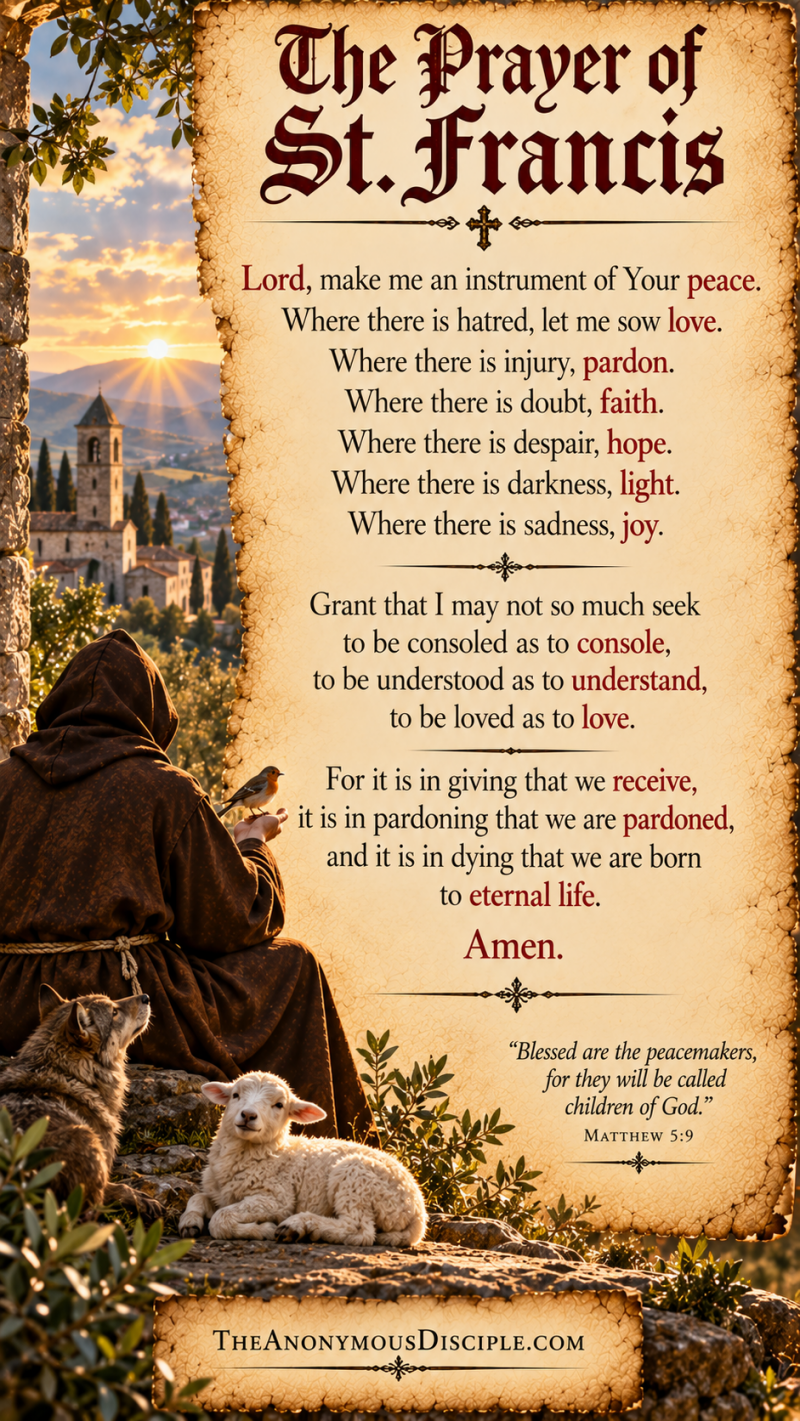
Most people know it by the opening:
“Lord, make me an instrument of Your peace…”
It goes on to ask God to make the believer someone who brings love into hatred, forgiveness into injury, faith into doubt, hope into despair, light into darkness, and joy into sadness.
Then the prayer turns inward:
Help me seek to console rather than be consoled, understand rather than merely be understood, and love rather than demand to be loved.
And finally it ends with those memorable paradoxes:
in giving, receiving;
in forgiving, being forgiven;
in dying, being born to eternal life.
Beautiful prayer.
But Francis? Nope. 😳
Did St. Francis write it?
Almost certainly not.
Francis of Assisi lived roughly AD 1181/82–1226.
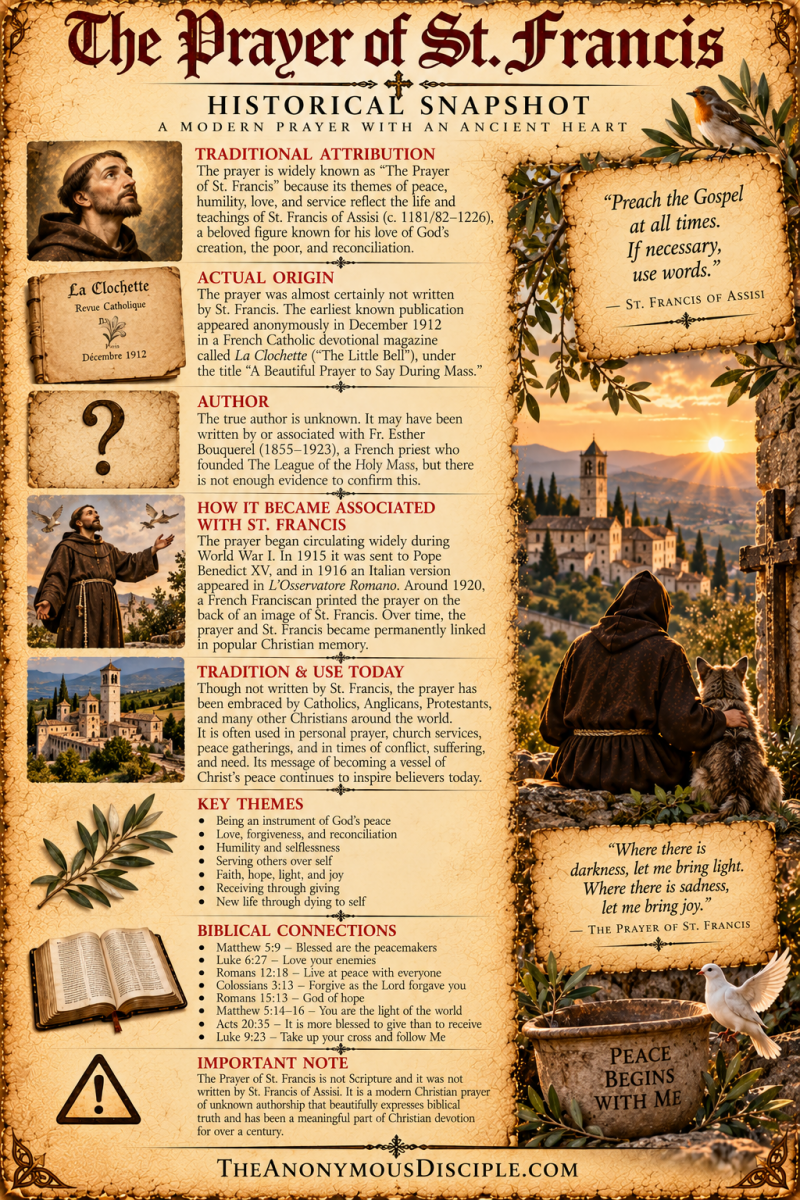
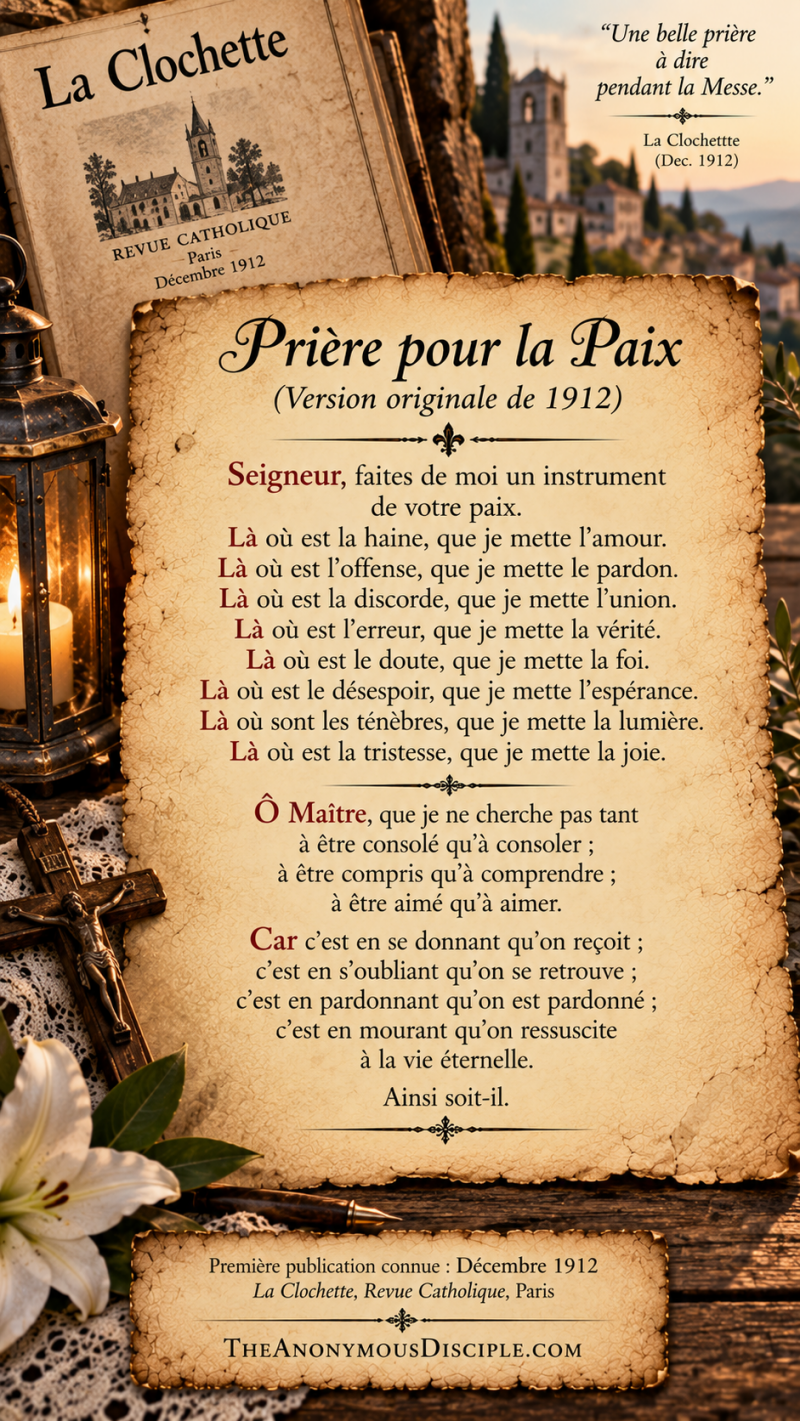
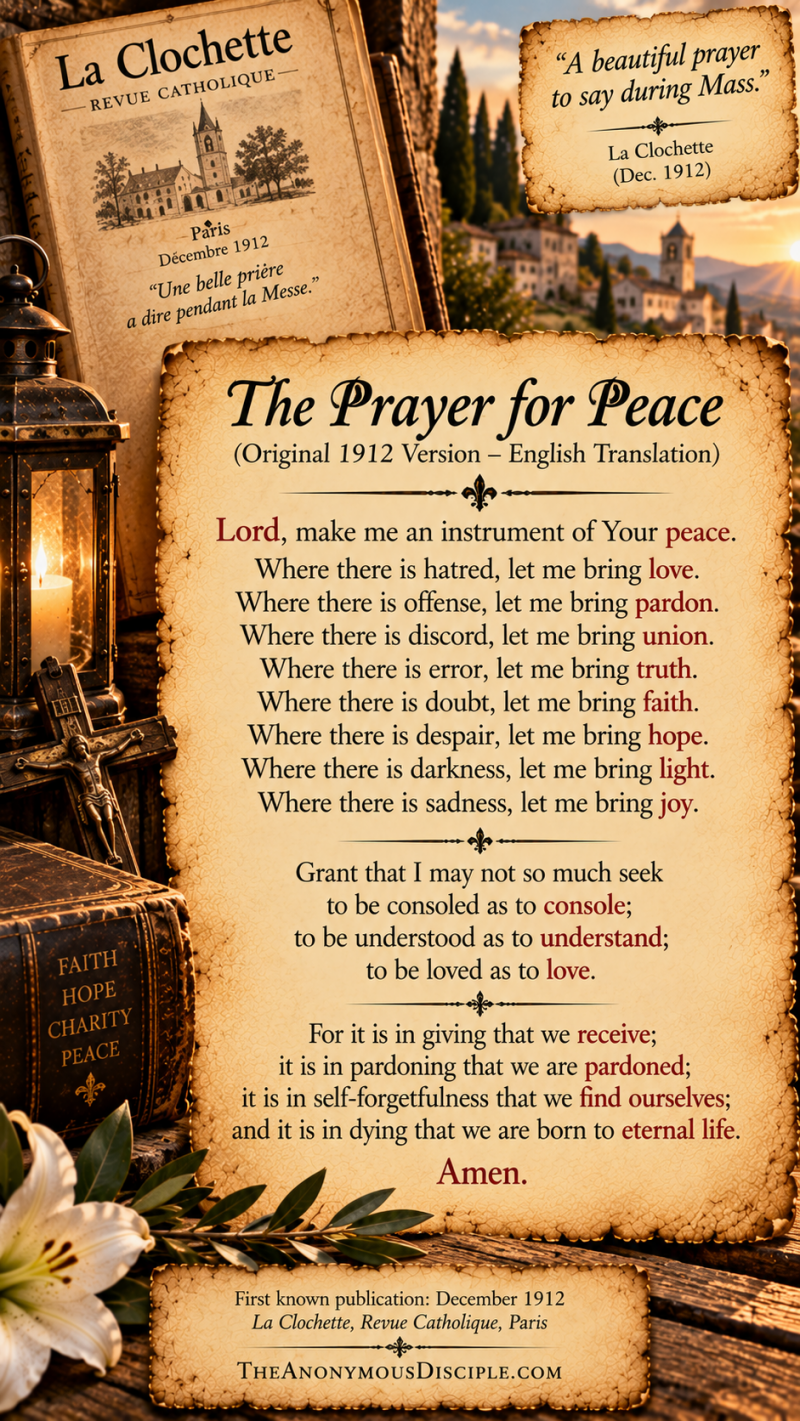
The earliest known appearance of this prayer is December 1912—nearly 700 years after Francis died. It appeared anonymously in a little French Catholic devotional magazine called La Clochette (“The Little Bell”), under the title “A Beautiful Prayer to Say During Mass.” No author was named. Franciscan scholars themselves acknowledge that the prayer does not appear among Francis's writings.
That makes this one different from St. Patrick's Breastplate, where we have an ancient text traditionally associated with a much earlier saint.
Here the chronological gap is enormous.
So who wrote it?
We don't know.
The magazine was published by a Catholic association called The League of the Holy Mass, founded by French priest Fr. Esther Bouquerel (1855–1923). Bouquerel may have written it, but there isn't enough evidence to say that confidently.
For our page I would use:
Author: Anonymous
First known publication: France, 1912
Traditional attribution: St. Francis of Assisi — historically incorrect
That is wonderfully straightforward.
Then how on earth did Francis get attached to it? 😂
This is the fun part.
The prayer began circulating during the years surrounding World War I, when prayers for peace naturally had enormous appeal. In 1915 it was sent to Pope Benedict XV, and in 1916 an Italian version appeared in L'Osservatore Romano. Around 1920, a French Franciscan printed the prayer on the back of an image of St. Francis of Assisi. It was called a Prayer for Peace, although it still wasn't necessarily being presented as something Francis himself had written.
You can see how the association happened:
peace prayer + picture of Francis + Francis's reputation as a man of peace = “Prayer of St. Francis.”
Eventually the picture and prayer became inseparable in popular Christian memory.
By the mid-20th century it was being widely circulated under Francis's name.
Franciscan Media puts it nicely: Francis didn't write it, but the prayer sounds very much like the kind of Christian life Francis sought to live.
So the attribution is wrong.
The spiritual resemblance isn't crazy.
“Lord, make me an instrument of Your peace”
This is a beautiful biblical concept.
Notice the prayer doesn't merely say:
Lord, give me peace.
It says:
Lord, use me to bring Your peace somewhere else.
That immediately brings us to Jesus:
Matthew 5:9
“Blessed are the peacemakers, for they will be called children of God.”
Not merely peace-keepers.
Peace-makers.
And Paul writes:
Romans 12:18
“If it is possible, as far as it depends on you, live at peace with everyone.”
The prayer is asking:
Lord, make me someone through whom reconciliation enters a situation rather than someone who makes the conflict worse.
That's a pretty serious prayer. ❤️
“Where there is hatred, let me sow love”
Jesus takes us even farther than loving people who love us.
Luke 6:27
“But to you who are listening I say: Love your enemies, do good to those who hate you.”
Christian love doesn't simply mirror what it receives.
Someone gives hatred.
Christ's disciple answers differently.
Not because hatred is acceptable—but because Jesus refuses to let another person's sin determine who His disciple becomes.
“Where there is injury, pardon”
This reflects forgiveness.
Colossians 3:13
“Forgive as the Lord forgave you.”
Again, that doesn't mean pretending wrongdoing didn't happen or remaining in an unsafe situation.
Biblical forgiveness means relinquishing personal vengeance and entrusting judgment to God.
Romans 12:19
“Do not take revenge… ‘It is mine to avenge; I will repay,’ says the Lord.”
So the prayer asks:
When I've been wounded, don't let bitterness have the final word.
“Where there is despair, hope”
That one is beautiful.
Romans 15:13
“May the God of hope fill you with all joy and peace as you trust in him…”
Christian hope isn't naïve optimism.
It's not:
Everything will work out exactly how I want.
It's:
God remains faithful, Christ remains risen, and the story isn't finished.
That kind of hope can enter very dark places.
“Where there is darkness, light”
Now we're practically standing in the Sermon on the Mount.
Matthew 5:14
“You are the light of the world.”
And Jesus continues:
Matthew 5:16
“Let your light shine before others, that they may see your good deeds and glorify your Father in heaven.”
Notice the light isn't supposed to make us famous.
It points people toward the Father.
That's exactly how I'd interpret the prayer.
“Grant that I may not so much seek to be consoled as to console”
Now the prayer gets uncomfortable. 😳
Because most of us naturally enter relationships thinking:
Does this person understand me?
Does this person appreciate me?
Does this person care about what I'm going through?
The prayer turns the questions around:
Do I understand them?
Am I caring for them?
Can I comfort them?
Paul writes:
2 Corinthians 1:3–4
God “comforts us in all our troubles, so that we can comfort those in any trouble…”
God's comfort isn't supposed to terminate with us.
We're supposed to pass it along.
“To be understood as to understand”
This resembles Paul's command:
Philippians 2:4
“Not looking to your own interests but each of you to the interests of the others.”
It doesn't mean your own needs never matter.
It means Christianity begins breaking the tyranny of:
ME FIRST.
That's a recurring theme throughout this prayer.
“To be loved as to love”
And there is Jesus again.
John 13:34
“As I have loved you, so you must love one another.”
The measure isn't:
Love people as well as they love you.
The measure is:
As I have loved you.
That's infinitely harder.
And infinitely more beautiful. ❤️
“For it is in giving that we receive”
This echoes something Jesus Himself taught.
Acts 20:35
“It is more blessed to give than to receive.”
The Christian life reverses the world's instinct.
The world says:
Acquire. Protect. Accumulate.
Jesus repeatedly teaches:
Give. Serve. Pour yourself out.
Not because possessions or receiving good things are sinful—but because our lives stop revolving around ourselves.
“It is in pardoning that we are pardoned”
⚠️ This line deserves explanation on our page.
Taken carelessly, someone could hear:
God forgives me because I have earned forgiveness by forgiving other people.
That's not the Gospel.
Ephesians 2:8–9
“For it is by grace you have been saved, through faith… not by works.”
Our forgiveness rests upon Christ's work, not ours.
But Jesus does connect receiving mercy with becoming merciful.
Matthew 6:14
“For if you forgive other people when they sin against you, your heavenly Father will also forgive you.”
And Jesus repeatedly warns that a permanently unforgiving heart is inconsistent with someone who claims to have received enormous mercy from God—think of the unforgiving servant in Matthew 18:21–35.
So I would explain the prayer's line as:
We don't earn God's forgiveness by forgiving others; rather, those who have truly received God's mercy should increasingly become merciful themselves.
That distinction matters. ❤️
“It is in dying that we are born to eternal life”
This could also be misunderstood.
Christianity does not teach that simply physically dying earns eternal life.
Eternal life comes through Jesus Christ.
John 3:16
“Whoever believes in him shall not perish but have eternal life.”
But Jesus also describes discipleship as a kind of death to self.
Luke 9:23
“Whoever wants to be my disciple must deny themselves and take up their cross daily and follow me.”
And:
Galatians 2:20
“I have been crucified with Christ and I no longer live, but Christ lives in me.”
So spiritually:
self-rule dies,
Christ becomes Lord,
and the believer receives life in Him.
And physically, for a believer, death isn't the end.
John 11:25
“I am the resurrection and the life. The one who believes in me will live, even though they die.”
That's the biblical foundation I would put underneath that closing line.
Something else I really like about this prayer
Look at all the verbs:
Make me.
Let me sow.
Let me pardon.
Let me bring faith.
Let me bring hope.
Let me bring light.
Let me bring joy.
Let me console.
Let me understand.
Let me love.
The prayer isn't primarily:
Lord, fix everybody around me.
It's:
Lord, change what I bring into the room.
🔥
That reminds me very much of what we noticed with St. Ephrem's prayer.
Instead of praying:
Lord, make everybody less difficult…
😂
we pray:
Lord, make me more like Christ.
One more historical nugget I LOVE for our page
The original 1912 French version wasn't identical to the familiar modern English prayer.
Among other differences, it included a petition about bringing truth where there is error, and one of its concluding lines concerned finding oneself through self-forgetfulness. Over time, translations and adaptations produced the familiar English wording most Christians recognize today.
So we should probably use the familiar traditional English version on our prayer card, then explain in the historical notes that wording varies.
In simple biblical terms
I'd summarize the whole prayer this way:
Lord, make my life useful to You. Where people hate, help me love. Where people hurt, help me forgive. Where people despair, let me carry hope. Where darkness is present, let Christ's light show through me. Teach me to care more about loving, understanding, giving, and serving than constantly demanding those things for myself. Make me more like Jesus.
That is why the prayer has endured.
Not because Francis wrote it.
He didn't.
But because so much of what it asks for sounds like the life Jesus calls His disciples to live. ❤️✝️
For our Historical Snapshot
- Common name: The Prayer of St. Francis / Peace Prayer
- Actual author: Unknown
- First known publication: La Clochette, Paris, December 1912
- Original title: “A Beautiful Prayer to Say During Mass”
- Tradition: Roman Catholic origin; later widely used across Catholic, Anglican, Protestant, ecumenical, and other Christian settings
- Francis attribution: Incorrect; Francis died almost 700 years earlier
- Biblical connections: Matthew 5:9 • Luke 6:27 • Romans 12:18 • Colossians 3:13 • Romans 15:13 • Matthew 5:14–16 • Acts 20:35 • Luke 9:23 • John 11:25
- Important note: Its spiritual value doesn't depend upon Francis having written it. We can appreciate its Christlike petitions while being truthful about its history.
TRADITION SAYS: ST. FRANCIS
HISTORY SAYS: ANONYMOUS
Like us!
Add comment
Comments