

The Wesley Covenant Prayer is one of those prayers that sounds simple at first and then you realize it is asking for everything.
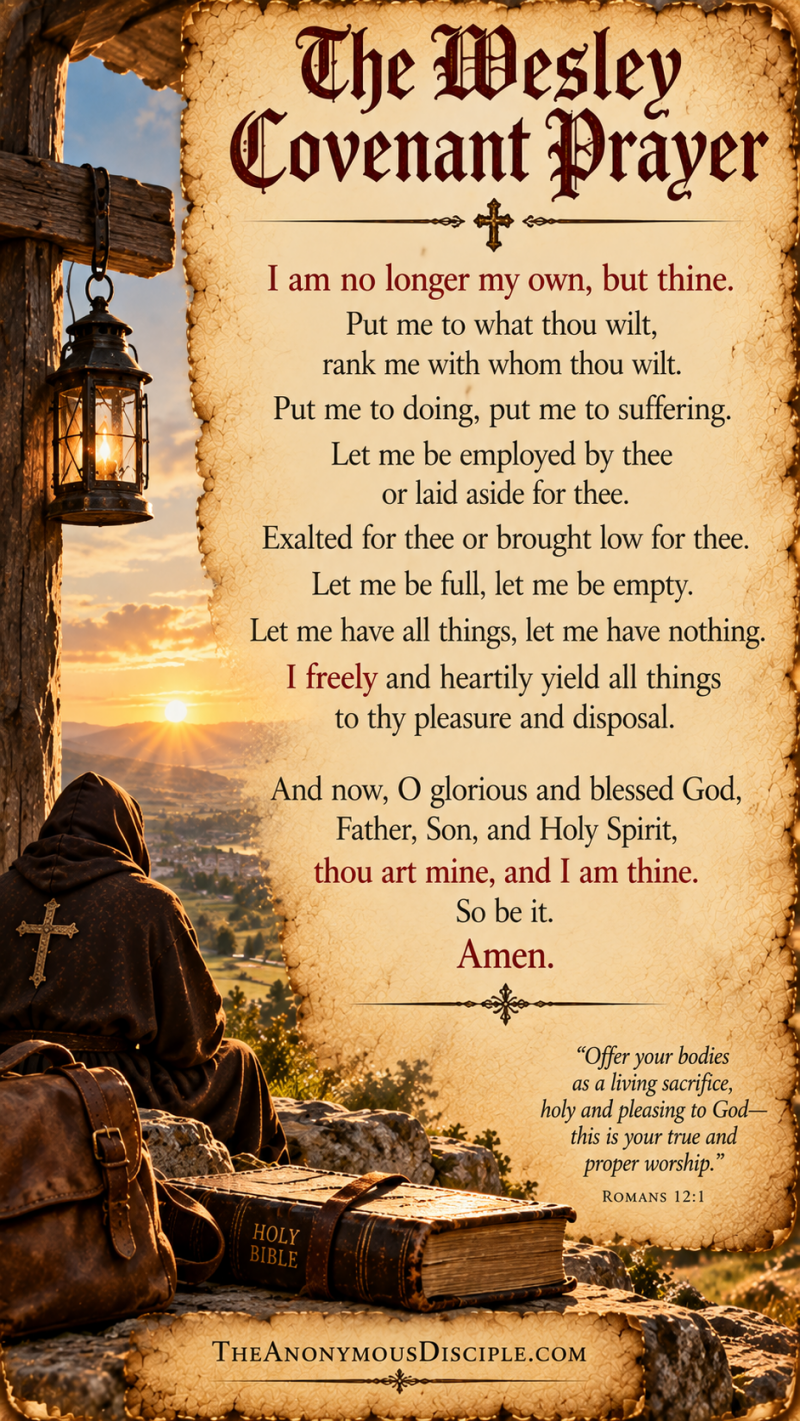
Its most familiar form begins:
“I am no longer my own, but thine.”
And from there it becomes a prayer of complete surrender.
Where did it come from?
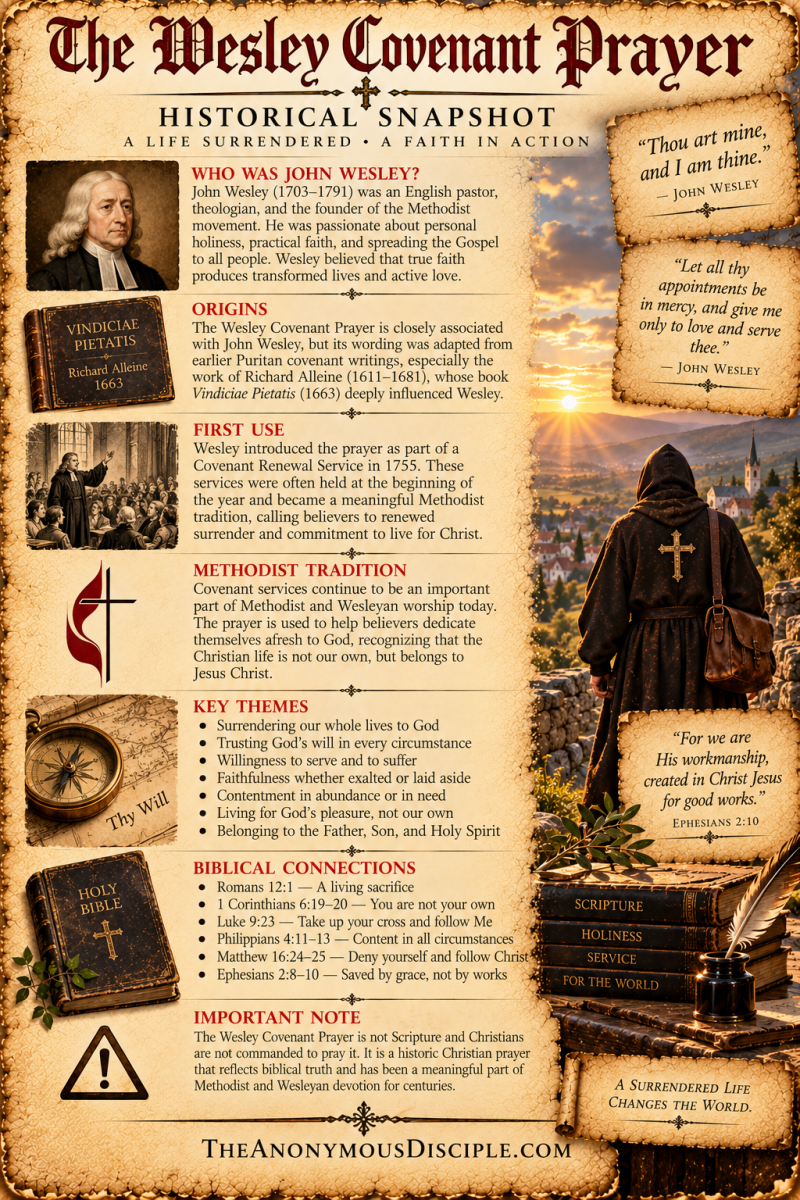
The prayer is closely associated with John Wesley and the Methodist movement, but Wesley did not create it entirely from scratch.
He adapted material from earlier Puritan covenant writings, especially the work of Richard Alleine. Alleine had published Vindiciae Pietatis in 1663, and Wesley later incorporated material from that tradition into Methodist covenant renewal. The first major Methodist Covenant Service is generally dated to 1755.
So:
Associated with: John Wesley
Roots: Earlier Puritan covenant theology, especially Richard Alleine
Methodist use: Covenant Renewal Service beginning in the mid-18th century
That gives Wesley the proper credit without implying every word originated with him.
What is a “covenant prayer”?
This isn't “covenant” in the sense that a person bargains with God:
“I'll do this if You do that.”
It is much closer to:
“Because I belong to Christ, I consciously give myself back to Him.”
Wesley regarded covenant as fundamental to Christian discipleship. Methodist Covenant Services became occasions for believers to renew their commitment to live wholly for Christ, often around the beginning of the year.
That makes me think immediately of:
Romans 12:1
“Offer your bodies as a living sacrifice, holy and pleasing to God—this is your true and proper worship.”
That's the heart of the prayer.
Here I am, Lord. All of me.
“I am no longer my own, but thine”
This is probably the line people remember most.
And Scripture couldn't be clearer about the underlying idea.
1 Corinthians 6:19–20
“You are not your own; you were bought at a price. Therefore honor God with your bodies.”
That's almost the prayer in biblical form.
The Christian is saying:
My life doesn't ultimately belong to me anymore. Christ redeemed me.
And:
Romans 14:7–8
“If we live, we live for the Lord; and if we die, we die for the Lord.”
So Wesley begins with ownership.
Not God's ownership in a cold sense.
Redeemed belonging.
❤️
“Put me to what thou wilt, rank me with whom thou wilt”
Modern ears hear this strangely, but it basically means:
Lord, put me wherever You want me. Let me serve alongside whoever You choose.
That's surrender of position.
Philippians 2:3
“Do nothing out of selfish ambition or vain conceit. Rather, in humility value others above yourselves.”
And:
1 Corinthians 12:18
“But in fact God has placed the parts in the body, every one of them, just as he wanted them to be.”
In other words:
I don't need the most important seat.
That's harder to pray sincerely than it sounds. 😳
“Put me to doing, put me to suffering”
This line needs careful explanation.
It does not mean:
“God, please hurt me.”
The Methodist Church itself specifically cautions against reading it that way. The traditional wording means more like:
Let me actively serve when You give me work to do, and let me faithfully endure when obedience involves hardship.
That is much closer to:
Philippians 1:29
“For it has been granted to you on behalf of Christ not only to believe in him, but also to suffer for him.”
And Jesus says:
Luke 9:23
“Whoever wants to be my disciple must deny themselves and take up their cross daily and follow me.”
Christian surrender includes:
Lord, I will follow You when it is easy and when it costs me something.
But we should definitely explain this line on the page so nobody reads it as glorifying suffering for its own sake.
“Let me be employed by thee or laid aside for thee”
This one is almost painfully relevant.
😳❤️
We often want:
Use me, Lord!
But the prayer goes farther:
And if You don't visibly use me the way I expected, I still belong to You.
That's surrender of usefulness and recognition.
Paul learned something similar.
Philippians 4:11–12
“I have learned to be content whatever the circumstances.”
Sometimes faithfulness looks like public ministry.
Sometimes it looks like waiting.
Sometimes it looks like quiet obedience nobody sees.
The prayer says:
My value does not depend upon how impressive my assignment looks.
“Exalted for thee or brought low for thee”
Again, not:
Make me miserable.
Rather:
Whether my circumstances lift me up or humble me, let both belong to You.
Philippians 4:12
“I know what it is to be in need, and I know what it is to have plenty.”
And:
James 4:10
“Humble yourselves before the Lord, and he will lift you up.”
The central issue isn't position.
It's faithfulness.
“Let me be full, let me be empty”
Oof. ❤️
This is surrender of circumstances.
Philippians 4:12–13
“I know what it is to be in need, and I know what it is to have plenty… I can do all this through him who gives me strength.”
That famous verse about doing “all things” is actually about exactly this:
Following Christ in abundance and scarcity.
So Wesley's prayer isn't:
Lord, make me successful.
It is:
Lord, whether I have much or little, keep me Yours.
“Let me have all things, let me have nothing”
Now the prayer really starts stepping on toes. 😂
Philippians 3:8
Paul says:
“I consider everything a loss because of the surpassing worth of knowing Christ Jesus my Lord…”
That doesn't mean possessions are inherently evil.
It means:
Christ is worth more than everything else.
The prayer tests whether we believe that.
Could I still say:
Christ is enough
if everything else disappeared?
That's not an easy question.
“I freely and heartily yield all things”
Notice freely.
Not:
God took everything away and I reluctantly surrendered.
But:
I consciously place everything in Your hands.
Jesus said:
Matthew 16:24–25
“Whoever wants to be my disciple must deny themselves and take up their cross and follow me.”
Christian discipleship contains a voluntary relinquishing of self-rule.
Not loss of personality.
Not loss of dignity.
But surrender of lordship.
Jesus becomes Lord.
Then the prayer becomes Trinitarian
The traditional form says:
“O glorious and blessed God, Father, Son, and Holy Spirit…”
So this isn't vague surrender to “the universe.”
It is covenant devotion to the Triune God.
Matthew 28:19
“In the name of the Father and of the Son and of the Holy Spirit.”
And then comes:
“Thou art mine, and I am thine.”
That's covenant language.
❤️
God has graciously given Himself to His people.
And His people respond:
I belong to You.
“So be it”
That's essentially:
Amen.
Not merely:
“Pretty words.”
But:
I mean this.
That is why the Methodist Covenant Service historically treated this prayer seriously rather than casually. Methodist guidance still emphasizes that the Covenant Prayer represents a substantial commitment to God and should be approached thoughtfully.
Why is it often used around New Year?
Methodists historically developed the practice of holding a Covenant Renewal Service, frequently around New Year's Eve or New Year's Day.
Rather than making resolutions like:
lose weight
save money
organize the closet 😂
the spiritual question became:
Am I still wholly Christ's?
Many Methodist congregations continue that practice today.
That's actually a beautiful idea.
Not:
New year, new me.
But:
New year, same Lord—renewed surrender.
One theological caution I would include
This prayer should not be understood as though our surrender earns God's acceptance.
That's crucial.
The Gospel order is:
God's grace → salvation in Christ → our response of surrender.
Not:
My complete surrender → therefore God saves me.
Ephesians 2:8–10
“For it is by grace you have been saved, through faith… not by works…”
And then Paul says we are created in Christ for good works.
Grace comes first.
Obedience follows.
That distinction keeps the prayer firmly grounded in the Gospel.
In simple biblical terms
I would summarize it this way:
Lord, I belong to You. Put me wherever You choose and use my life however You desire. Whether I have much or little, whether I am noticed or unseen, whether obedience is easy or costly, keep me faithful. Everything I have and everything I am is Yours. Father, Son, and Holy Spirit—you are mine, and I am Yours. Amen.
This one is serious. ❤️
The Jesus Prayer says:
Have mercy on me.
St. Ephrem says:
Change my heart.
Luther says:
Keep me faithful today.
The Prayer of Humble Access says:
I come because of Your mercy, not my righteousness.
And Wesley says:
Now take the whole life.
Tradition: Methodist / Wesleyan
Associated with: John Wesley
Roots: Richard Alleine and 17th-century Puritan covenant spirituality
Methodist Covenant Service: 1755 onward
Purpose: Renewed consecration and discipleship
Biblical connections: Romans 12:1 • 1 Corinthians 6:19–20 • Luke 9:23 • Philippians 4:11–13 • Matthew 16:24–25 • Ephesians 2:8–10
Important note: This prayer does not earn salvation; it expresses the believer's response to God's grace in Christ.
Add comment
Comments