

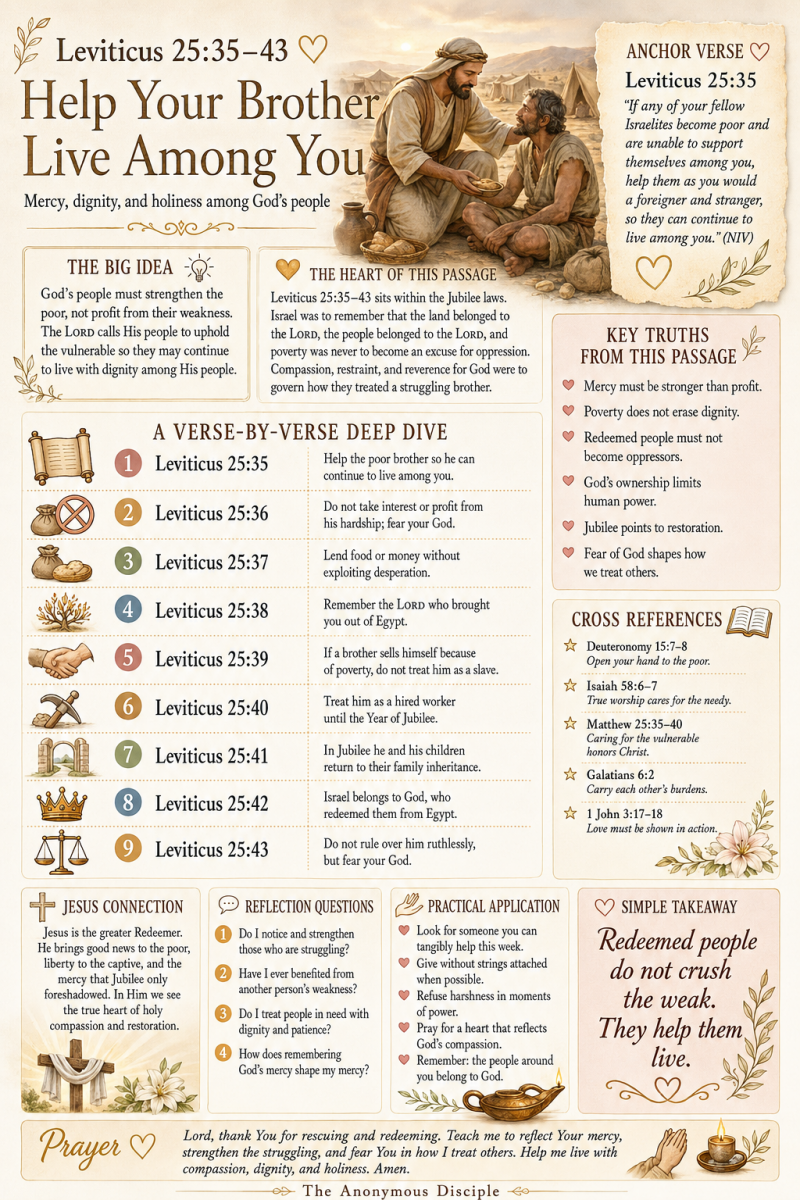
Study Notes
Leviticus 25:35-43 shows God’s heart for mercy, dignity, redemption, and holy community.
Deep Dive: Leviticus 25:35-43
Anchor Verse: Leviticus 25:35
Leviticus 25:35 — “If any of your fellow Israelites become poor and are unable to support themselves among you, help them as you would a foreigner and stranger, so they can continue to live among you.”
The Setting: The Year of Jubilee
Leviticus 25 is about the Sabbath Year and the Year of Jubilee. Every 50th year, debts, land loss, and servitude were addressed in a way that reminded Israel:
Nothing ultimately belonged to them.
The land belonged to God.
The people belonged to God.
And redeemed people were not to treat each other as disposable.
This passage moves from property and debt into something much more personal: what happens when your brother becomes poor and vulnerable?
God’s answer is not, “Take advantage of him.”
It is: hold him up.
Anchor Verse Meaning: “Help Them… So They Can Continue to Live”
Leviticus 25:35 is the heart of the passage.
God says when someone becomes poor and cannot support themselves, His people are not to look away, exploit them, shame them, or push them out. They are to help them remain among the people.
That phrase matters:
“so they can continue to live among you.”
This is not just charity. It is preservation of dignity, place, belonging, and life.
The idea is:
Do not let someone fall so far that they are crushed beneath their weakness. Strengthen them before they collapse.
God Forbids Profit from Desperation
Leviticus 25:36-37 — God commands them not to take interest or profit from the poor, but to fear God and let their fellow Israelite live among them.
This is powerful. God is not condemning honest business in general here. He is condemning profiting from someone’s desperation.
When a fellow Israelite was already sinking, God’s people were not to say, “How can I benefit from his weakness?” They were to say, “How can I help him stand?”
That reveals a lot about God’s character.
God cares not only that help is given, but how it is given. He sees whether we are rescuing someone or using them.
The Reason: “I Am the LORD Your God”
Leviticus 25:38 — “I am the LORD your God, who brought you out of Egypt to give you the land of Canaan and to be your God.”
This is the theological foundation of the whole passage.
God is saying, in essence:
“Remember who rescued you.”
“Remember you were once helpless.”
“Remember Egypt.”
“Do not become like the oppressor I delivered you from.”
Israel had been enslaved. They knew what ruthless treatment felt like. So God commands them not to recreate Egypt inside the promised land.
That is a serious warning. A redeemed people must not become a ruthless people.
Servitude Was Not to Become Slavery Among God’s People
Leviticus 25:39-40 — If a fellow Israelite became poor and sold himself to another Israelite, he was not to be treated as a slave, but as a hired worker or temporary resident until the Year of Jubilee.
This part can feel uncomfortable to modern readers, and honestly, it should make us slow down.
The passage is dealing with an ancient system where poverty could force someone into debt-servitude. But God places limits and protections around the vulnerable Israelite. The poor person was not to be treated as property. He was to be treated with dignity, as a worker, not as a thing.
The larger heart of the command is clear:
Poverty does not erase someone’s humanity.
Debt does not erase someone’s worth.
Need does not give others permission to dominate.
Jubilee Means Restoration
Leviticus 25:41 — In the Jubilee, the poor Israelite and his children were to be released and return to their own clan and ancestral property.
This is beautiful. God built restoration into Israel’s life.
The goal was not permanent bondage.
The goal was not generational crushing.
The goal was return, restoration, and renewed inheritance.
Jubilee said:
Your failure is not the final word.
Your poverty is not the final word.
Your bondage is not the final word.
God’s redemption gets the final word. 🕊️
The Key Theological Statement
Leviticus 25:42 — “Because the Israelites are my servants, whom I brought out of Egypt, they must not be sold as slaves.”
This is one of the strongest lines in the passage.
God says, “They are My servants.”
That means no Israelite had the right to treat another Israelite as ultimate property, because they already belonged to God.
This connects beautifully to the New Testament:
1 Corinthians 6:19-20 — “You are not your own; you were bought at a price.”
For believers, this becomes even deeper. We are not our own. We belong to the Lord Jesus, who redeemed us by His blood.
So we do not treat people as tools, burdens, projects, or property. We treat them as people made by God and accountable to God.
“Do Not Rule Over Them Ruthlessly”
Leviticus 25:43 — “Do not rule over them ruthlessly, but fear your God.”
This is the sharp edge of the passage.
The word behind “ruthlessly” is connected with harsh, crushing labor — the kind of treatment Israel experienced in Egypt.
Exodus 1:13-14 — The Egyptians worked the Israelites ruthlessly and made their lives bitter with harsh labor.
So God is basically saying:
“You know what Egypt did to you. Do not do that to each other.”
And the reason is not merely social kindness. It is fear of God.
When people have power over someone vulnerable, God is watching.
Jesus Connection
Jesus fulfills the deeper hope behind Jubilee.
Luke 4:18-19 — Jesus reads from Isaiah and announces good news to the poor, freedom for prisoners, recovery of sight for the blind, and the year of the Lord’s favor.
That “year of the Lord’s favor” carries Jubilee language. Jesus is the greater Redeemer who releases captives, restores inheritance, and brings the poor and broken near.
Also:
Matthew 25:35-40 — Jesus identifies care for the hungry, thirsty, stranger, naked, sick, and imprisoned as service done unto Him.
So Leviticus 25 is not just ancient law. It reveals the heart of the King.
God’s people should be the kind of people who help the struggling continue to live among them.
Heart Message
The heart of Leviticus 25:35-43 is this:
When someone is sinking, God’s people are called to strengthen them, not exploit them. We remember that we were rescued, so we become merciful rescuers. We fear God by treating the vulnerable with dignity, because every redeemed person belongs first to Him.
Cross References
Deuteronomy 15:7-8 — If anyone among God’s people is poor, do not be hardhearted or tightfisted, but be openhanded.
Proverbs 19:17 — Whoever is kind to the poor lends to the LORD, and He will reward them.
Isaiah 58:6-7 — True worship includes loosing chains, sharing food, sheltering the poor, and clothing the naked.
Matthew 5:7 — Blessed are the merciful, for they will be shown mercy.
Matthew 25:35-40 — Whatever is done for “the least of these” is received by Christ as done for Him.
Acts 4:34-35 — The early believers cared for one another so that there were no needy persons among them.
Galatians 6:2 — Carry each other’s burdens, and in this way fulfill the law of Christ.
James 2:15-17 — Faith without mercy-filled action toward a needy brother or sister is dead.
1 John 3:17-18 — Love should not be only words, but action and truth.
Simple Summary
Leviticus 25:35-43 teaches that God’s redeemed people must not take advantage of the weak, poor, indebted, or vulnerable. Because God rescued Israel from Egypt, they were to treat one another with mercy, dignity, and holy restraint. The anchor, Leviticus 25:35, shows God’s heart clearly: when someone is falling, help them live among you.
Add comment
Comments