

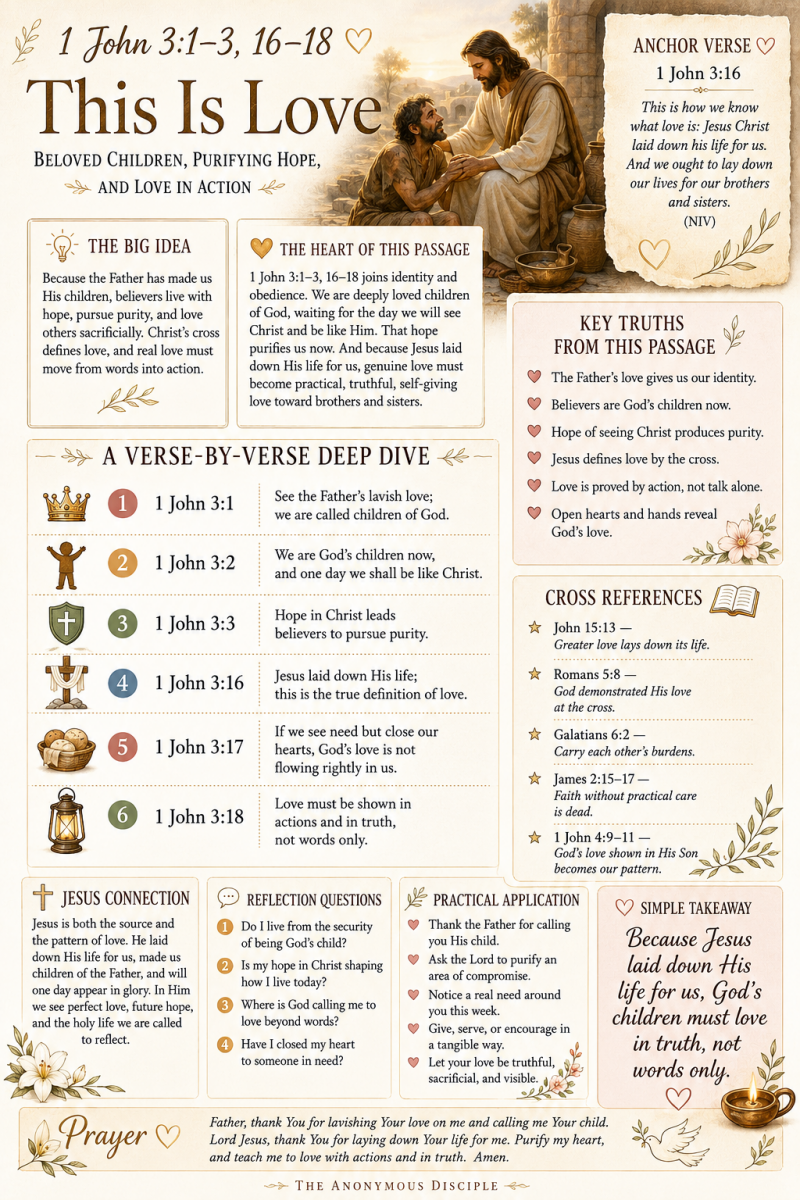
Study Notes
Deep Dive: 1 John 3:1-3, 16-18
Anchor Verse: 1 John 3:16
1 John 3:16 — “This is how we know what love is: Jesus Christ laid down his life for us. And we ought to lay down our lives for our brothers and sisters.”
The Big Picture
This passage has two beautiful movements:
1 John 3:1-3 shows us who we are:
We are dearly loved children of God, waiting for the day we will see Christ and be made like Him.
1 John 3:16-18 shows us how we live:
Because Jesus laid down His life for us, real love must move beyond words into sacrificial action.
So the flow is:
Loved by the Father → transformed by hope → shaped by Jesus’ sacrifice → proven by love in action.
That is powerful.
Context of 1 John
John wrote this letter to strengthen believers against confusion, false teaching, and empty claims of faith.
Throughout 1 John, he gives repeated tests of genuine faith:
Do we believe rightly about Jesus?
Do we obey God?
Do we love one another?
Not because obedience earns salvation, but because true fellowship with God produces visible fruit.
John is very direct: real Christianity cannot remain only in religious language. It must show up in truth, holiness, and love.
Verse-by-Verse Deep Dive
1 John 3:1 — “See what great love the Father has lavished on us…”
John begins with wonder.
He is not casually saying, “God loves us.” He is saying, “Look at this. Behold this. Stand amazed at this.”
God does not merely tolerate His people. He calls them His children.
That matters deeply. Our Christian identity begins not with our performance, our past, our fear, or our failures, but with the Father’s love.
The world does not fully understand believers because it did not recognize Christ. If we belong to Him, we should not be shocked when the world does not understand us either.
1 John 3:2 — “Now we are children of God…”
This verse holds two truths together:
Already: We are God’s children now.
Not yet: What we will be has not been fully revealed.
That is the Christian life. We are truly adopted and loved now, but we are still waiting for the fullness of what God will make us.
Then John says:
1 John 3:2 — “But we know that when Christ appears, we shall be like him, for we shall see him as he is.”
That is prophetic hope 🕊️
When Christ appears, believers will be changed. We will see Him clearly, and we will be made like Him — not becoming God, but being fully conformed to His holiness, purity, and glory.
1 John 3:3 — Hope Purifies
1 John 3:3 — “All who have this hope in him purify themselves, just as he is pure.”
Biblical hope is not wishful thinking. It is confident expectation rooted in God’s promise.
John says the hope of seeing Jesus does something in us now. It purifies us.
In other words:
Future hope produces present holiness.
If I truly believe I will see Jesus, I will not want to live casually with sin. I will want my life to become more and more aligned with Him.
This is not fear-based striving. It is love-shaped preparation.
Anchor Verse: The Definition of Love
1 John 3:16 — “This is how we know what love is: Jesus Christ laid down his life for us.”
John does not define love by emotion, sentiment, romance, or words.
He points to the cross.
The cross is the clearest definition of love ever given.
Love is not merely feeling warmly toward someone. Love gives. Love sacrifices. Love moves toward need. Love absorbs cost for the good of another.
Jesus did not love us from a safe distance. He laid down His life.
Then John says:
1 John 3:16 — “And we ought to lay down our lives for our brothers and sisters.”
This does not only mean being willing to die physically, though that may be included. In daily life, it means dying to selfishness, convenience, pride, greed, indifference, and harshness so another person may be strengthened.
That connects beautifully with Leviticus 25:35-43 (full study card and notes located in Verses & Passages Home Tab)
Leviticus 25:35 says help your poor brother live among you.
1 John 3:16 says lay down your life for your brothers and sisters.
Old covenant mercy pointed forward.
Christ’s cross shows the fullness.
Love Must Become Practical
1 John 3:17 — If someone has material possessions and sees a brother or sister in need but has no pity, how can God’s love be in that person?
John gets very practical here.
He does not allow us to keep love vague.
He gives a real-life test:
You have enough.
You see someone in need.
You close your heart.
John asks: how can God’s love be living there?
That is convicting, but it is also clarifying. God’s love softens the heart. It opens the hand. It notices need.
This does not mean we can solve every problem, fund every need, or ignore wisdom and boundaries. But it does mean a hardened, indifferent heart does not reflect the love of Christ.
Words Are Not Enough
1 John 3:18 — “Dear children, let us not love with words or speech but with actions and in truth.”
This is one of John’s most practical lines.
Words matter. Encouragement matters. Prayer matters. But John warns against love that stops at speech.
Real love becomes visible.
In actions means love does something.
In truth means love is sincere, not performative.
So Christian love is not fake niceness. It is not flattery. It is not social politeness. It is truthful, costly, active compassion.
Jesus Connection
Jesus is not merely our example of love. He is the source of it.
John 10:11 — “I am the good shepherd. The good shepherd lays down his life for the sheep.”
Romans 5:8 — “But God demonstrates his own love for us in this: While we were still sinners, Christ died for us.”
Ephesians 5:2 — “Walk in the way of love, just as Christ loved us and gave himself up for us…”
Jesus loved first. We love because we have been loved.
That is why John later says:
1 John 4:19 — “We love because he first loved us.”
So the command to love is not God saying, “Try harder to become lovable.”
It is God saying, “You have been loved by Christ. Now let that love flow through you.”
Prophecy Connection: “When Christ Appears”
This passage has a beautiful future-looking hope.
1 John 3:2 — “When Christ appears, we shall be like him…”
John is pointing to the return and revelation of Christ. Believers are waiting for the day when we see Him as He is.
Cross references:
Colossians 3:4 — “When Christ, who is your life, appears, then you also will appear with him in glory.”
Philippians 3:20-21 — Our citizenship is in heaven, and Jesus will transform our lowly bodies to be like His glorious body.
1 Corinthians 15:49 — “And just as we have borne the image of the earthly man, so shall we bear the image of the heavenly man.”
This is why Christian hope is not escapism. It is transformation. We are waiting for Jesus, and that hope changes how we live today.
Heart Message
The heart of this passage is:
The Father has loved us and made us His children. Because we will one day see Christ and be made like Him, we should live purified lives now. And because Jesus laid down His life for us, our love must become more than words — it must become sacrificial, practical, truthful action.
Simple Summary
1 John 3:1-3 tells us who we are: beloved children of God with a future hope of becoming like Christ. 1 John 3:16-18 tells us how that identity should live: by loving others in the same sacrificial pattern Jesus showed us. The anchor, 1 John 3:16, defines love by the cross — Jesus laid down His life for us, so we are called to lay down our lives for one another.
Cross References
John 13:34-35 — Jesus commands His disciples to love one another as He has loved them.
John 15:13 — Greater love has no one than to lay down one’s life for friends.
Romans 5:8 — God demonstrated His love by Christ dying for sinners.
2 Corinthians 8:9 — Though Christ was rich, He became poor for our sake.
Galatians 6:2 — Carry each other’s burdens and fulfill the law of Christ.
James 2:15-17 — Faith that sees need but gives no help is dead.
1 John 4:9-11 — God showed His love by sending His Son, and because He loved us, we ought to love one another.
Personal Reflection Questions
- Do I truly rest in being called a child of God?
- Does the hope of seeing Jesus make me want purity now?
- Is my love mostly words, or does it become action?
- Where might I be closing my heart to someone’s need?
- What would “laying down my life” look like in my home, family, church, or friendships this week?
Prayer
Father, thank You for lavishing Your love on me and calling me Your child. Lord Jesus, thank You for laying down Your life for me. Teach me to love not only with words, but with actions and truth. Purify my heart with the hope of seeing You, and make my life reflect Your mercy, sacrifice, and love. Amen.
Add comment
Comments