

This passage is so rich because David moves from trembling fear before God’s holiness to unashamed joy before God’s presence.
"David was afraid of the LORD that day and said, 'How can the ark of the LORD ever come to me?' He was not willing to take the ark of the LORD to be with him in the City of David. Instead, he took it to the house of Obed-Edom the Gittite. The ark of the LORD remained in the house of Obed-Edom the Gittite for three months, and the LORD blessed him and his entire household.
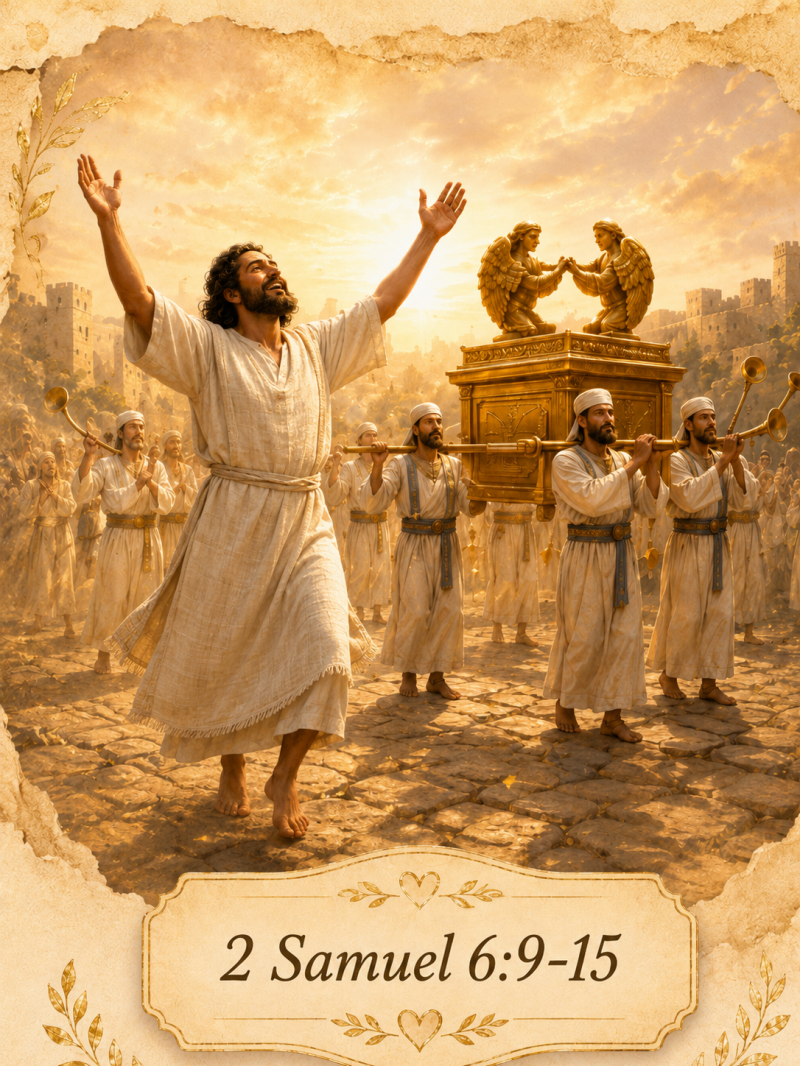
Now King David was told, 'The LORD has blessed the household of Obed-Edom and everything he has, because of the ark of God.' So David went to bring up the ark of God from the house of Obed-Edom to the city of David with rejoicing. When those who were carrying the ark of the LORD had taken six steps, he sacrificed a bull and a fattened calf. Wearing a linen ephod, David was dancing before the LORD with all his might, while he and all Israel were bringing up the ark of the LORD with shouts and the sound of trumpets."
Study Card
Study Notes
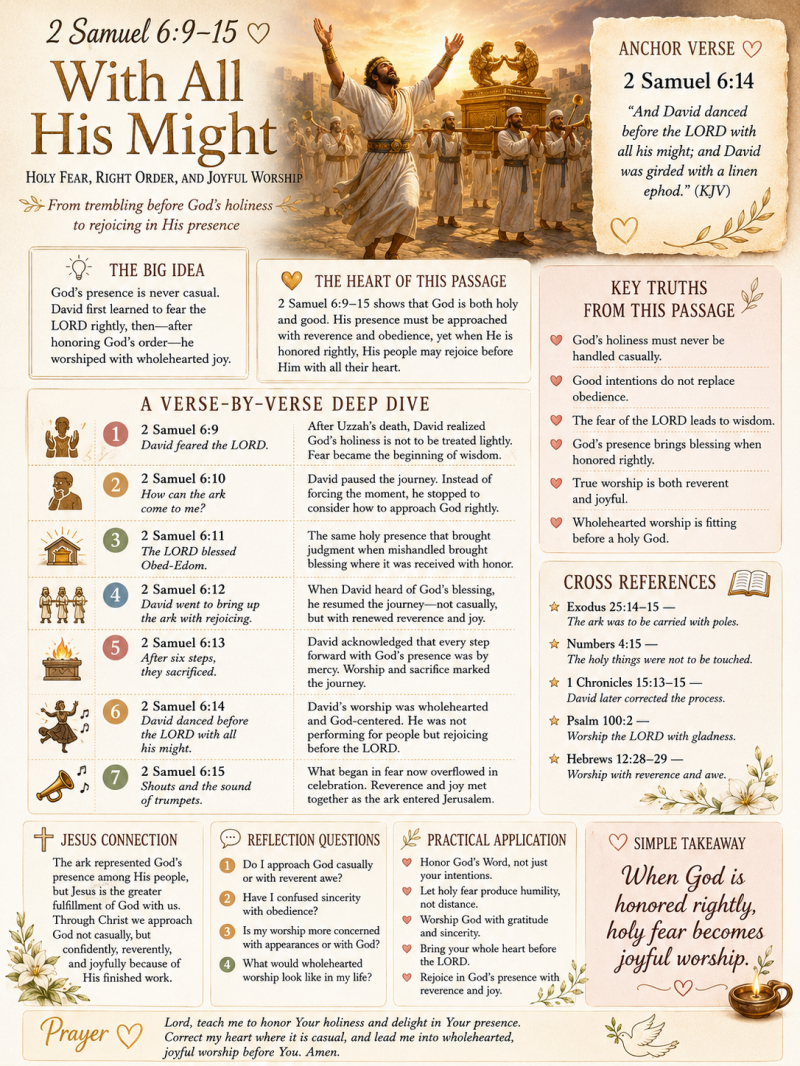
Passage: 2 Samuel 6:9-15
Anchor: 2 Samuel 6:14
2 Samuel 6:14 — “Wearing a linen ephod, David was dancing before the LORD with all his might.”
The setting: God’s presence is not casual
Right before this passage, David was bringing the ark of God to Jerusalem. The ark represented the covenant presence and throne of the LORD among His people.
But in 2 Samuel 6:6-7, Uzzah reached out and touched the ark when the oxen stumbled, and God struck him down. That feels severe to us, but the deeper issue is that God had already given instructions for how the ark was to be carried.
The ark was not supposed to be transported like common cargo. It was to be carried by the Levites using poles.
Exodus 25:14-15 — The poles were to remain in the rings of the ark and not be removed.
Numbers 4:15 — The holy things were not to be touched, or death would result.
Numbers 7:9 — The Kohathites were not given carts because they were to carry the holy things on their shoulders.
So the passage begins with this heavy lesson:
God’s presence is a gift, but His holiness is not negotiable.
That matters. Worship is not just “I meant well.” Worship must honor who God says He is.
2 Samuel 6:9 — David’s fear
2 Samuel 6:9 says David was afraid of the LORD that day and asked, “How can the ark of the LORD ever come to me?”
That question is honest. David realizes this is not merely a religious parade. He is dealing with the holy God.
This is the right kind of fear — not hatred of God, not running from God forever, but trembling awareness that God is not ordinary.
A helpful cross-reference:
Proverbs 9:10 — “The fear of the LORD is the beginning of wisdom…”
David’s fear becomes wisdom. He stops. He does not keep forcing the moment forward. That is important.
Sometimes the godly response is not “push through.” Sometimes it is “pause and let God correct me.”
2 Samuel 6:10-11 — Obed-Edom’s house is blessed
David leaves the ark at the house of Obed-Edom.
2 Samuel 6:11 says the ark remained there three months, and “the LORD blessed him and his entire household.”
That is beautiful because it shows both sides clearly:
God is holy — but He is not cruel.
God is dangerous to treat casually — but He is a blessing to those who receive Him rightly.
The ark brought judgment when treated carelessly, but blessing when honored rightly.
That is such a powerful picture of God’s presence. The same holy presence that exposes sin also blesses surrendered hearts.
2 Samuel 6:12 — David tries again, but differently
When David hears that Obed-Edom’s household has been blessed, he brings the ark up to Jerusalem with rejoicing.
But this time, David does not come casually. According to the fuller account in 1 Chronicles 15:13-15, David admits that they had not inquired of the LORD “in the prescribed way,” and then the Levites carry the ark properly.
That is huge.
David’s joy in 2 Samuel 6:14 is not reckless emotion. It is corrected worship.
He learned. He humbled himself. He returned to God’s Word.
That is the difference between emotional religion and biblical worship.
2 Samuel 6:13 — Sacrifice after six steps
2 Samuel 6:13 says that when those carrying the ark had taken six steps, David sacrificed a bull and a fattened calf.
That detail shows reverence. David is not just celebrating that the procession is moving again. He is acknowledging that they are only able to move forward by God’s mercy.
Six steps. Stop. Sacrifice. Worship.
It is almost like David is saying:
“Lord, we do not take one more step with Your presence lightly.”
That is a heart posture we need too. 🙏
Anchor verse: 2 Samuel 6:14
2 Samuel 6:14 — “Wearing a linen ephod, David was dancing before the LORD with all his might.”
This is the turning point.
David has gone from fear to joy — but not cheap joy. This joy has passed through reverence.
“Wearing a linen ephod”
The linen ephod was a simple priestly-style garment associated with service before the LORD.
David is king, but here he does not emphasize his royal robes. He lowers himself before God.
The king of Israel becomes a worshiper first.
That is the heart of the verse.
David is not trying to look dignified. He is trying to honor God.
“Dancing before the LORD”
That phrase matters: before the LORD.
David is not performing for Israel.
He is not building his brand.
He is not trying to look spiritual.
He is worshiping in the presence of God.
This is why Michal’s criticism later in 2 Samuel 6:16-23 is so serious. She sees David’s worship through the lens of appearance and status. David sees it through the lens of God’s glory.
“With all his might”
David’s worship is not half-hearted.
He gives physical, visible, wholehearted praise to God.
This does not mean everyone must worship exactly like David danced. But it does mean true worship should not be cold, prideful, or image-managed.
David’s body, strength, emotions, and public identity were all submitted to the LORD.
That is a beautiful picture of whole-life worship.
2 Samuel 6:15 — Reverence becomes celebration
2 Samuel 6:15 says David and all Israel brought up the ark with shouts and the sound of trumpets.
The passage that began with fear now ends with rejoicing.
That is not contradiction. That is maturity.
Biblical worship holds both together:
Reverence without joy becomes cold.
Joy without reverence becomes careless.
True worship has both.
David learned that God’s presence should never be handled casually, but it should also never be approached joylessly.
Heart meaning
This passage teaches us that God’s presence is holy, weighty, and worthy of careful obedience — but when we come to Him rightly, His presence is also the source of deep joy.
David’s dance was not emotional chaos. It was worship corrected by God’s Word.
He had been humbled. He had learned. Then he rejoiced with everything in him.
A good lesson for us:
God does not want casual familiarity that forgets His holiness.
But He also does not want distant fear that refuses His joy.
He wants reverent, surrendered, wholehearted worship. ❤️
Jesus connection
The ark pointed to God’s presence among His people.
But Jesus is the greater fulfillment of God’s presence with us.
John 1:14 — “The Word became flesh and made his dwelling among us.”
Matthew 1:23 — “They will call him Immanuel,” which means “God with us.”
In David’s day, the ark came into Jerusalem with shouting and trumpets. But in Christ, God’s presence came even nearer — not in a gold-covered chest, but in the Son of God Himself.
And through Jesus, we do not approach God’s holiness through fear of being struck down. We approach through His blood, mercy, and finished work.
Hebrews 4:16 — We can approach God’s throne of grace with confidence.
Not arrogance. Confidence.
That is the balance of this whole passage.
Cross-references
Exodus 25:14-15 — The ark was to be carried with poles.
Numbers 4:15 — The holy things were not to be touched.
Numbers 7:9 — The Kohathites carried the holy things on their shoulders.
1 Chronicles 15:13-15 — David later realizes they had not handled the ark according to God’s order.
Psalm 24:3-4 — “Who may ascend the mountain of the LORD?” The answer involves clean hands and a pure heart.
Psalm 100:2 — “Worship the LORD with gladness…”
John 4:23-24 — True worshipers worship the Father in Spirit and truth.
Romans 12:1 — Offer your bodies as a living sacrifice.
Hebrews 12:28-29 — Worship God acceptably with reverence and awe, “for our God is a consuming fire.”
Simple takeaway
2 Samuel 6:14 shows a man who had learned that God is holy — and then worshiped Him with everything he had.
David did not dance because he forgot reverence.
He danced because reverence had purified his joy. 🕊️
Add comment
Comments