

Psalm 90 is one of the most sobering and beautiful prayers in Scripture. It teaches us how to see God, time, death, sin, mercy, and legacy rightly.
"Lord, you have been our dwelling place throughout all generations. Before the mountains were born or you brought forth the whole world, from everlasting to everlasting you are God. You turn people back to dust, saying 'Return to dust, you mortals.' A thousand years in your sight are like a day that has just gone by, or like a watch in the night. Yet you sweep people away in the sleep of death - they are like the new grass of the mourning : In the morning it springs up new, but by evening it is dry and withered. We are consumed by your anger and terrified by your indignation.

Our days may come to Seventy years, or eighty, if our strength endures; yet the best of them are but trouble and sorrow; for they quickly pass, and we fly away. If only we knew the power of your anger! Your wrath is as great as the fear that is your due. Teach us to number our days, that we may gain a heart of wisdom. Relent, LORD! How long will it be? Have compassion on your servants. Satisfy us in the morning with your unfailing love; that we may sing for joy and be glad all our days. Make us glad for as many days as you have afflicted us, for as many years as we have seen trouble. May your deeds be shown to your servants, your splendor to their children. May the favor of the LORD our God rest on us; establish the work of our hands for us - yes, establish the work of our hands.
Study Card
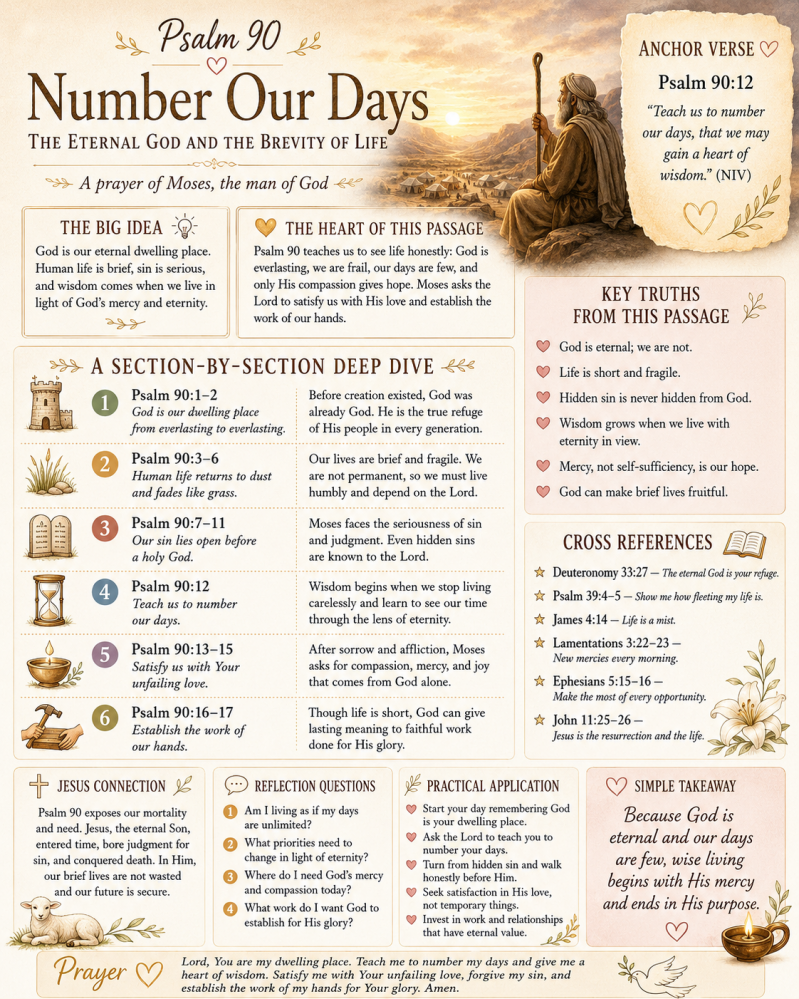
Study Notes
Psalm 90 — Big Picture
Psalm 90:1 — “Lord, you have been our dwelling place throughout all generations.”
This psalm is a prayer of Moses, “the man of God.” That matters. Moses knew what it was to live as a pilgrim: Egypt, wilderness, tents, wandering, waiting, loss, rebellion, judgment, and dependence on God.
The whole psalm says:
God is eternal. We are brief. Sin is serious. Mercy is our only hope. So teach us to live wisely and make our lives count.
God is our eternal home
Psalm 90:1-2
Psalm 90:1 says God has been His people’s “dwelling place” through every generation.
That is tender. Before Moses talks about death, judgment, or the shortness of life, he begins with safety:
God is home.
Not Egypt.
Not the wilderness.
Not Canaan.
Not comfort.
Not health.
Not family.
Not circumstances.
God Himself is the refuge of His people.
Psalm 90:2 lifts our eyes even higher. Before the mountains existed, before the earth was formed, God was already God.
That means God is not aging, weakening, learning, reacting, or catching up.
Psalm 90:2 — “from everlasting to everlasting you are God.”
That is the foundation of the whole psalm. Moses is placing our fragile lives inside the reality of God’s eternal nature.
Cross references:
Genesis 1:1 — "In the beginning God created the heavens and the earth." - God existed before creation.
Isaiah 40:28 — "Do you not know? Have you not heard? The LORD is the everlasting God, the Creator of the ends of the earth. He will not grow tired or weary, and his understanding no one can fathom." - The Lord is everlasting and does not grow tired.
Revelation 1:8 — "'I am the Alpha and the Omega,' says the LORD God, 'who is, and who was, and who is to come, the Almighty,'" - God is the Alpha and the Omega.
Human life is brief and fragile
Psalm 90:3-6
Psalm 90:3 says God returns people to dust.
That reaches all the way back to:
Genesis 3:19 — “By the sweat of your brow you will eat your food until you return to the ground, since from it you were taken; for dust you are and to dust you will return."
This is not cruelty. It is truth after the fall. Human life is not permanent in its current condition.
Then Moses compares human life to:
Psalm 90:4 — a day that passes quickly.
Psalm 90:5 — a dream.
Psalm 90:5-6 — grass that grows in the morning and withers by evening.
That is humbling. Not hopeless — humbling.
Moses is saying:
We feel permanent, but we are not.
We feel in control, but we are not.
We plan as if life belongs to us, but it does not.
James 4:14 says something very similar: "Why, you do not even know what will happen tomorrow. What is your life? You are a mist that appears for a little while and then vanishes."
This is not meant to make us depressed. It is meant to wake us up.
A person who remembers life is short will usually live with more reverence, less pride, more forgiveness, and better priorities.
Sin is not small before a holy God
Psalm 90:7-11
This section is heavy.
Psalm 90:7 says people are consumed by God’s anger.
Psalm 90:8 says God sees even the hidden sins.
That verse is piercing. Moses is not only talking about public rebellion. He says even secret sins are exposed before God.
That means nothing is truly hidden.
Not motives.
Not bitterness.
Not pride.
Not unbelief.
Not private compromise.
Not the sins we excuse because nobody else sees them.
Hebrews 4:13 - "Nothing in all creation is hidden from God's sight. Everything is uncovered and laid bare before the eyes of him to whom we must give account." - Everything is uncovered before the eyes of God.
But here is the important thing: Moses is not accusing God of being harsh. He is acknowledging that God is holy.
A low view of sin always produces a low view of grace.
But when we understand sin honestly, mercy becomes stunning.
Psalm 90:11 asks, in effect, “Who really understands the power of Your anger?”
That is a serious question. We tend to underestimate holiness. Moses does not.
The turning point: wisdom begins with numbered days
Psalm 90:12
This is the hinge verse of the whole psalm.
Psalm 90:12 — “Teach us to number our days, that we may gain a heart of wisdom.”
This does not mean obsess over death.
It means:
Teach me to live awake.
Teach me to stop wasting what You gave me.
Teach me to measure my life by eternity.
Teach me to use my days instead of assuming I have endless ones.
This is one of the most practical prayers in the Bible.
Moses does not say, “Teach us to count our money.”
He does not say, “Teach us to count our achievements.”
He does not say, “Teach us to count our followers, possessions, or opinions.”
He says:
Teach us to number our days.
Because when we understand our days are limited, wisdom starts growing.
Cross references:
Ephesians 5:15-16 — "Be very careful, then, how you live - not as unwise but as wise, making the most of every opportunity, because the days are evil." - Live carefully, making the most of every opportunity.
Psalm 39:4 — "Show me, LORD, my life's end and the number of my days; let me know how fleeting my life is." - David asks God to show him how fleeting his life is.
Proverbs 9:10 — "The fear of the LORD is the beginning of wisdom, and knowledge of the Holy One is understanding." - The fear of the Lord is the beginning of wisdom.
Moses asks for mercy, not more control
Psalm 90:13-15
After facing mortality and sin, Moses does not say, “Lord, make us powerful.”
He says:
Psalm 90:13 — Have compassion.
Psalm 90:14 — Satisfy us with Your unfailing love.
Psalm 90:15 — Give us joy after sorrow.
That is beautiful.
Moses knows human beings cannot fix the deepest problem by being stronger, busier, smarter, or more successful.
We need mercy.
Psalm 90:14 is especially tender. Moses asks God to satisfy His people in the morning with His unfailing love.
That means the soul’s deepest hunger is not for longer life by itself. It is for God’s covenant love.
Long life without God is still empty.
Short life held by God is not wasted.
Psalm 90:15 asks God to bring joy in proportion to the years of suffering.
That is such an honest prayer. Moses does not deny affliction. He asks God to answer sorrow with gladness.
Cross references:
Lamentations 3:22-23 — "Because of the LORD'S great love we are not consumed, for His compassions never fail. They are new every morning; great is your faithfulness." - God’s mercies are new every morning.
Psalm 30:5 — "For his anger lasts only a moment, but his favor lasts a lifetime; weeping may stay for the night, but rejoicing comes in the morning."
Romans 8:18 — "I consider that our present sufferings are not worth comparing with the glory that will be revealed in us." - Present sufferings are not worth comparing with future glory.
The final prayer: establish the work of our hands
Psalm 90:16-17
The psalm ends with legacy.
Psalm 90:16 asks God to show His deeds to His servants and His splendor to their children.
That is generational. Moses is praying that God’s work would not end with one generation.
Then comes the final line:
Psalm 90:17 — “establish the work of our hands for us.”
That phrase is repeated for emphasis.
Moses knows our lives are short, but he also knows God can make temporary lives eternally meaningful.
That is powerful.
Without God, even impressive work fades.
With God, humble obedience can outlast us.
This includes prayer, parenting, repentance, teaching children, loving family, serving quietly, studying His Word, forgiving, encouraging, warning, building, and staying faithful.
The prayer is not, “Lord, make me famous.”
It is:
Lord, make what I do in You matter.
The heart of Psalm 90
Psalm 90 is not saying, “Life is short, so despair.”
It is saying:
Life is short, so live wisely before the eternal God.
It teaches us to pray:
Lord, You are my true home.
My life is brief.
My sin is real.
Your mercy is greater.
Teach me wisdom.
Satisfy me with Your love.
Bring joy after sorrow.
Make my life count for Your glory.
Jesus connection ✝️
Psalm 90 shows the problem: humanity is mortal, sinful, and unable to escape death.
Jesus is the answer.
John 1:14 - "The Word became flesh and made his dwelling among us. We have seen His glory of the one and only Son, who came from the Father, full of grace and truth." - The eternal Word became flesh and lived among us.
The eternal Son entered time.
The everlasting God stepped into human frailty.
The sinless One bore judgment.
The resurrected Christ conquered death.
1 Corinthians 15:54-55 - "When the perishable has been clothed with the imperishable, and the mortal with immortality, then the saying that is written will come true: 'Death has been swallowed up in victory.' 'Where, O death, is your victory? Where , O death, is your sting?'"
So Psalm 90 humbles us, but Jesus gives us hope.
Because in Christ, our short earthly life is not the end.
John 11:25-26 — "Jesus said to her, 'I am the resurrection and the life. The one who believes in me will live, even though they die; and whoever lives by believing in me will never die. Do you believe this?'"
Key takeaways
Psalm 90:1-2 — God is eternal and He is our dwelling place.
Psalm 90:3-6 — Human life is brief and fragile.
Psalm 90:7-11 — Sin is serious before a holy God.
Psalm 90:12 — Wisdom begins when we number our days rightly.
Psalm 90:13-15 — We need mercy, compassion, joy, and God’s unfailing love.
Psalm 90:16-17 — Only God can make our work last.
A simple prayer from Psalm 90
Lord, teach me to number my days. Help me stop wasting what You have entrusted to me. Satisfy my heart with Your unfailing love, not with temporary things. Bring joy where there has been sorrow, mercy where there has been sin, and purpose where I feel small. Establish the work of my hands for Your glory. Amen. 🕊️
Add comment
Comments