

Genesis 50:22–26 teaches us:
God’s promise outlives the person who first receives it.
Joseph died, but the promise lived.
God’s people may remain in a difficult place for a season, but that place does not become their final destiny.
Israel lived in Egypt for generations, but God had already declared their deliverance.
Faith remembers what God said even when circumstances appear to contradict it.
Joseph saw Israel comfortable in Egypt, yet he knew trouble would come—and he also knew rescue would come.
A believer can face death without surrendering hope.
Joseph’s final concern was not fear of dying. It was confidence in what God would do next.
Genesis 50:22–26 (NIV)
22 Joseph stayed in Egypt, along with all his father’s family. He lived a hundred and ten years
23 and saw the third generation of Ephraim’s children, and also the children of Makir son of Manasseh were placed at birth on Joseph’s knees.
24 Then Joseph said to his brothers, “I am about to die. But God will surely come to your aid and take you up out of this land to the land he promised on oath to Abraham, Isaac and Jacob.”
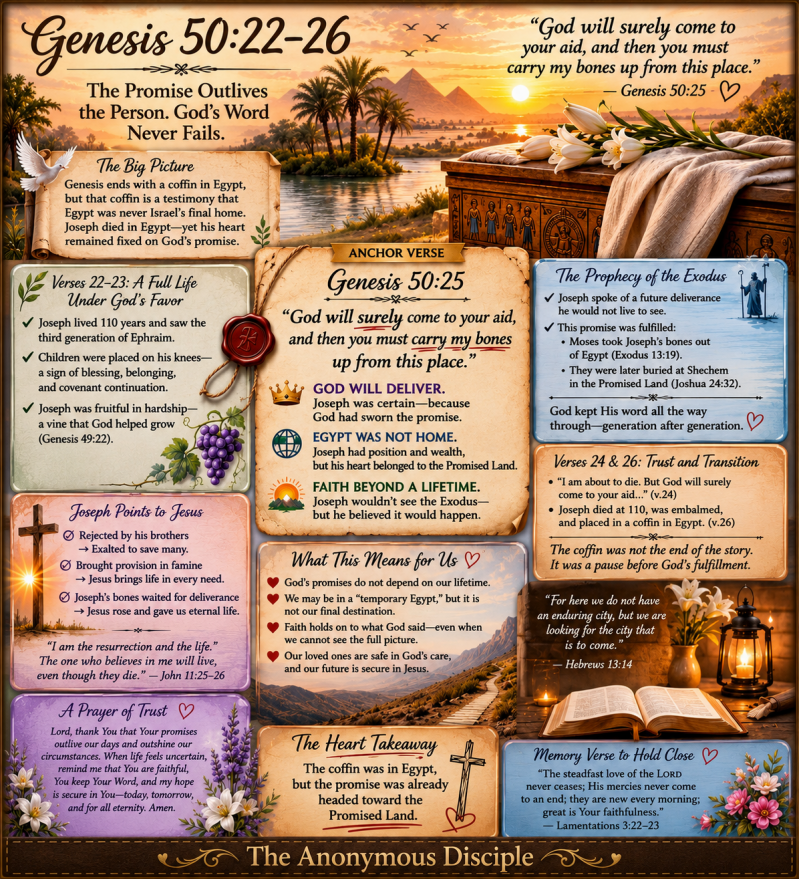
25 And Joseph made the Israelites swear an oath and said, “God will surely come to your aid, and then you must carry my bones up from this place.”
26 So Joseph died at the age of a hundred and ten. And after they embalmed him, he was placed in a coffin in Egypt.


The setting
Genesis began with creation and life, but it ends with a coffin in Egypt.
That sounds somber, but it is not a hopeless ending. Joseph’s coffin becomes a testimony that Egypt was never Israel’s final home.
Joseph died in Egypt, but his heart remained fixed on the promise of God.
Genesis 50:22–23 — A full life under God’s favor
Genesis 50:22–23
“Joseph stayed in Egypt, along with all his father’s family. He lived a hundred and ten years and saw the third generation of Ephraim’s children…”
Joseph had endured betrayal, slavery, false accusation, imprisonment, political responsibility, famine, and family reconciliation. Yet God allowed him to see generations of his family.
In the ancient world, living to 110 was considered a full and honored life. Joseph had spent much of his life in Egypt, but Egypt had never erased his identity as a son of Jacob and an heir of God’s covenant.
The children being placed “on Joseph’s knees” speaks of recognition, family belonging, and inheritance. Joseph was not merely seeing grandchildren and great-grandchildren; he was receiving them as part of the covenant family.
This fulfills something of the blessing Jacob had spoken over Joseph:
Genesis 49:22
“Joseph is a fruitful vine, a fruitful vine near a spring, whose branches climb over a wall.”
Joseph had been fruitful in hardship.
Genesis 50:24 — “God will surely come to your aid”
Genesis 50:24
“I am about to die. But God will surely come to your aid…”
Joseph knew that his own death did not mean the death of God’s promise.
This is one of the great lessons in the passage: God’s faithfulness does not depend on one human life continuing.
Joseph had been the instrument God used to preserve the family during famine, but Joseph understood that he was not the Savior of Israel. God was.
Joseph was essentially saying:
“I am leaving, but God is not.”
That is faith.
Leaders die. Generations pass. Circumstances change. But the covenant-keeping God remains.
The phrase “God will surely come to your aid” carries the sense of God visiting, attending to, or intervening for His people.
Joseph believed that a day would come when God would step into Israel’s suffering and bring them out of Egypt.
That promise was fulfilled when God called Moses.
Exodus 3:16
“The LORD, the God of your fathers—the God of Abraham, Isaac and Jacob—appeared to me and said: ‘I have watched over you and have seen what has been done to you in Egypt.’”
The same idea appears there: God had visited His people and had not forgotten them.
Anchor verse: Genesis 50:25
Genesis 50:25
“God will surely come to your aid, and then you must carry my bones up from this place.”
Joseph’s request about his bones was not sentimentality. It was a confession of faith.
He was declaring three things.
God would deliver Israel
Joseph did not say, “Maybe God will help you.”
He said:
“God will surely come to your aid.”
He was certain because God had sworn the promise.
Joseph’s faith rested not in visible circumstances, but in the word God had given to Abraham, Isaac, and Jacob.
Genesis 15:13–14
“Know for certain that for four hundred years your descendants will be strangers in a country not their own… But I will punish the nation they serve as slaves, and afterward they will come out with great possessions.”
Joseph knew Israel’s future included suffering, but he also knew the suffering would not have the final word.
Egypt was not home
Joseph had wealth, status, influence, and honor in Egypt. Yet he did not want his bones to remain there permanently.
He had lived as Egypt’s second-in-command, but he wanted to be buried as a son of the promise.
Joseph understood the difference between where God had placed him temporarily and where God had promised his people permanently.
That is deeply applicable to us.
We may live fully, serve faithfully, build families, work, suffer, rejoice, and fulfill responsibilities in this world—but this world is not our final home.
Hebrews 13:14
“For here we do not have an enduring city, but we are looking for the city that is to come.”
Joseph believed beyond his lifetime
Joseph would not personally walk out of Egypt in the Exodus.
He would not see Moses raise his staff.
He would not cross the Red Sea.
He would not see the wilderness cloud or fire.
Yet he believed it would happen.
His faith reached farther than his own life.
That is why Joseph is honored in Hebrews.
Hebrews 11:22
“By faith Joseph, when his end was near, spoke about the exodus of the Israelites from Egypt and gave instructions concerning the burial of his bones.”
Notice what Scripture highlights as Joseph’s great final act of faith: not his dreams, not his leadership, not his rise to power—but his confidence in the Exodus.
His bones preached for generations.
Every time an Israelite saw Joseph’s coffin, it silently said:
“God has not forgotten us.”
“We will not remain here forever.”
“The promise still stands.”
The bones were eventually carried out
Joseph’s command was fulfilled.
Exodus 13:19
“Moses took the bones of Joseph with him because Joseph had made the Israelites swear an oath.”
After hundreds of years, Moses honored Joseph’s request.
Joseph’s bones went with Israel through the Exodus and the wilderness.
Then, after Israel entered the promised land, they were finally buried.
Joshua 24:32
“And Joseph’s bones, which the Israelites had brought up from Egypt, were buried at Shechem…”
God kept the promise all the way through.
Joseph’s body waited, but God’s word did not fail.
Genesis 50:26 — A coffin, but not the end
Genesis 50:26
“So Joseph died at the age of a hundred and ten. And after they embalmed him, he was placed in a coffin in Egypt.”
Genesis ends with Joseph in a coffin.
But Exodus begins with Israel multiplying.
The coffin is not the conclusion of the story. It is a pause before fulfillment.
Joseph’s body was in Egypt, but the promise was already moving toward Canaan.
The end of Genesis teaches us that faith can look at a coffin and still speak of deliverance.
Joseph as a picture pointing toward Christ
Joseph is not Jesus, but his life contains strong parallels that point forward to Christ.
Joseph was rejected by his brothers, humiliated, later exalted, and used to save many lives.
Jesus was rejected by His own, suffered unjustly, was exalted, and provides eternal salvation.
Joseph’s bones also remind us of a major difference: Joseph died and waited in a coffin.
Jesus died and rose.
Acts 2:24
“But God raised him from the dead, freeing him from the agony of death…”
Joseph’s bones testified that God would deliver Israel from Egypt.
Jesus’ empty tomb testifies that God has delivered believers from sin and death.
A prophecy of the Exodus
Genesis 50:25 is prophetic because Joseph speaks with certainty about a future event that had not yet happened.
Genesis 50:25
“God will surely come to your aid…”
That statement points directly toward Exodus.
Joseph was looking ahead to:
- the oppression of Israel,
- the call of Moses,
- the plagues,
- the Passover,
- the Red Sea crossing,
- and the journey toward the promised land.
Joseph could not see the details, but he trusted the God who had spoken.
Biblical prophecy often works this way: God gives enough truth for His people to stand on, even when every detail is not yet visible.
A personal application
This passage speaks so tenderly to anyone who has had to trust God through loss, uncertainty, waiting, illness, or the passing of someone deeply loved.
Joseph’s death did not erase God’s plan.
My father’s passing did not place him outside God’s care.
Our bodies may be laid down, but those who belong to Christ are held by a promise stronger than death.
John 11:25–26
“Jesus said to her, ‘I am the resurrection and the life. The one who believes in me will live, even though they die; and whoever lives by believing in me will never die.’”
Joseph said, “Carry my bones up.”
Jesus says, in effect, “I will raise you up.”
That is our greater hope. ❤️
Anchor truth
Genesis 50:25
“God will surely come to your aid…”
The word “surely” matters.
God had not forgotten Israel.
God did not forget Joseph.
God did not forget His covenant.
And He has not forgotten you or me.
The coffin was in Egypt, but the promise was already headed toward the promised land. 🙏🕊️
Add comment
Comments