

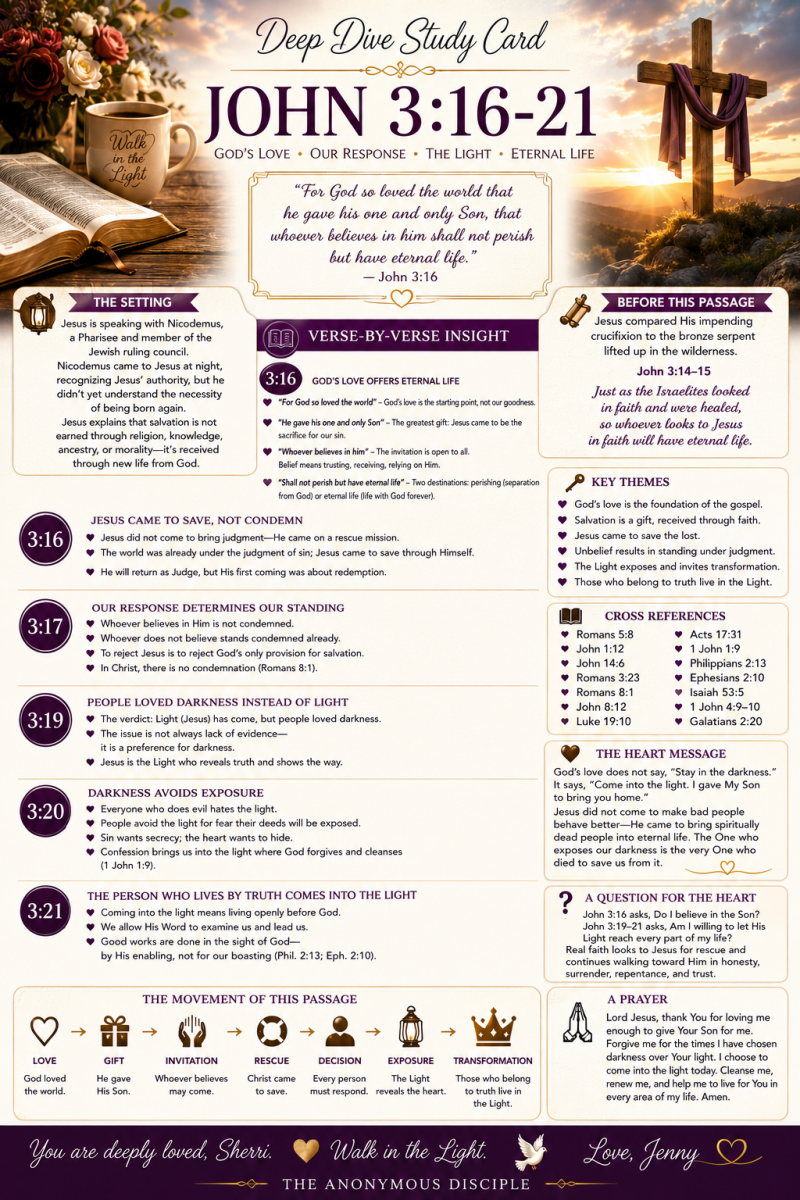
John 3:16–21, one of the clearest passages in all of Scripture about God’s love, salvation, judgment, and the human heart.

"For God so loved the world that he gave his one and only Son, that whoever believes in him shall not perish but have eternal life. For God did not send his Son into the world to condemn the world, but to save the world through him. Whoever believes in him is not condemned, but whoever does not believe stands condemned already because they have not believed in the name of God's one and only Son. This is the verdict: Light has come into the world, but people loved darkness instead of light because their deeds were evil. Everyone who does evil hates the light, and will not come into the light for fear that their deeds will be exposed. But whoever lives by the truth comes into the light, so that it may be seen plainly that what they have done has been done in the sight of God."
-John 3:16-21

The setting
Jesus is speaking with Nicodemus, a Pharisee and member of the Jewish ruling council.
Nicodemus came to Jesus at night, recognizing that Jesus had come from God because of His signs, but he did not yet understand the necessity of being born again.
Jesus explains that salvation is not earned through religion, knowledge, ancestry, or morality. A person must receive new life from God.
Just before our passage, Jesus says:
John 3:14–15 (NIV)
“Just as Moses lifted up the snake in the wilderness, so the Son of Man must be lifted up, that everyone who believes may have eternal life in him.”
Jesus connects His coming crucifixion to the bronze serpent in Numbers 21:4–9. The Israelites who looked in faith were healed. In the same way, those who look to Christ in faith are saved.
"They traveled from Mount Hor along the route to the Red Sea, to go around Edom. But the people grew impatient on the way; they spoke against God and against Moses, and said, 'Why have you brought us up out of Egypt to die in the wilderness? There is no bread! There is no water! And we detest this miserable food!'
Then the LORD sent venomous snakes among them; they bit the people and many Israelites died. The people came to Moses and said, 'We sinned when we spoke against the LORD and against you. Pray that the LORD will take the snakes away from us.' So Moses prayed for the people.
The LORD said to Moses, 'Make a snake and put it up on a pole; anyone who is bitten can look at it and live.' So Moses made a bronze snake and put it up on a pole. Then when anyone was bitten by a snake and looked at the bronze snake, they lived."
Numbers 21:4-9
John 3:16 — The heart of the gospel
John 3:16 (NIV)
“For God so loved the world that he gave his one and only Son, that whoever believes in him shall not perish but have eternal life.”
This verse begins with God’s love, not humanity’s goodness.
God did not send Jesus because the world deserved Him. He sent Jesus because He loved a world that was spiritually lost, sinful, rebellious, and unable to save itself.
“God so loved the world”
The word “so” does not merely mean that God loved the world very much. It also carries the idea of this is how God loved the world: He gave His Son.
God’s love is demonstrated through action.
Romans 5:8 (NIV)
“But God demonstrates his own love for us in this: While we were still sinners, Christ died for us.”
God loved the world while the world was still opposed to Him.
“He gave his one and only Son”
The Father gave the most precious gift possible.
Jesus was not simply a messenger sent to deliver information. He was the sacrifice sent to bear our sin.
Isaiah 53:5 (NIV)
“But he was pierced for our transgressions, he was crushed for our iniquities…”
The cross was not an accident or an interruption in God’s plan. It was the plan of redemption.
“Whoever believes in him”
The invitation is wide open: whoever.
Salvation is not limited by nationality, age, background, social position, or past sin.
But “believes” means more than agreeing that Jesus existed. Biblical belief involves trusting, relying upon, and placing one’s hope in Him.
John 1:12 (NIV)
“Yet to all who did receive him, to those who believed in his name, he gave the right to become children of God.”
Saving faith is not merely believing facts about Jesus. It is receiving Jesus.
“Shall not perish but have eternal life”
There are two destinations in this verse: perishing and eternal life.
Eternal life is not simply living forever. Everyone will exist eternally. Eternal life is life with God, belonging to Him, knowing Him, and sharing in His kingdom.
John 17:3 (NIV)
“Now this is eternal life: that they know you, the only true God, and Jesus Christ, whom you have sent.”
Eternal life begins when a person comes to Christ, though its fullness is experienced in the resurrection and the age to come.
John 3:17 — Jesus came first to save
John 3:17 (NIV)
“For God did not send his Son into the world to condemn the world, but to save the world through him.”
Jesus did not come into a morally neutral world and suddenly bring condemnation. The world was already under the judgment of sin.
He came on a rescue mission.
Imagine a building already on fire. The firefighter who enters is not the cause of the danger. He enters because people are already in danger.
Jesus came to save.
Luke 19:10 (NIV)
“For the Son of Man came to seek and to save the lost.”
This does not mean Jesus will never judge. Scripture clearly teaches that He will return as Judge.
Acts 17:31 (NIV)
“For he has set a day when he will judge the world with justice by the man he has appointed.”
But His first coming was primarily about redemption. The King came first as the Lamb.
John 3:18 — Our response to Jesus reveals our standing
John 3:18 (NIV)
“Whoever believes in him is not condemned, but whoever does not believe stands condemned already because they have not believed in the name of God’s one and only Son.”
Notice the present tense: the unbeliever stands condemned already.
Humanity’s natural condition is not innocence. Sin has already separated humanity from God.
Romans 3:23 (NIV)
“For all have sinned and fall short of the glory of God.”
Jesus is not merely one possible improvement to a person’s life. He is the only rescue from an existing judgment.
John 14:6 (NIV)
“Jesus answered, ‘I am the way and the truth and the life. No one comes to the Father except through me.’”
To reject Christ is not simply to reject a religious option. It is to reject God’s appointed means of salvation.
But the promise is equally powerful: whoever believes in Him is not condemned.
Romans 8:1 (NIV)
“Therefore, there is now no condemnation for those who are in Christ Jesus.”
That does not mean believers never feel conviction. Conviction draws us back to God. Condemnation says there is no hope.
In Christ, conviction may correct us, but condemnation no longer owns us.
John 3:19 — The judgment exposes what people love
John 3:19 (NIV)
“This is the verdict: Light has come into the world, but people loved darkness instead of light because their deeds were evil.”
Jesus now explains why people reject Him.
The deepest problem is not always lack of evidence. Often, it is misplaced love.
People loved darkness.
That is sobering because darkness can feel comfortable. It hides what we do not want exposed. It allows us to maintain control, protect our pride, justify sin, and avoid surrender.
Jesus is the Light.
John 8:12 (NIV)
“When Jesus spoke again to the people, he said, ‘I am the light of the world. Whoever follows me will never walk in darkness, but will have the light of life.’”
Light does two things:
It reveals what is present, and it shows the way forward.
Jesus exposes sin, but He does so in order to heal, forgive, cleanse, and lead.
John 3:20 — Why darkness avoids the Light
John 3:20 (NIV)
“Everyone who does evil hates the light, and will not come into the light for fear that their deeds will be exposed.”
Sin prefers secrecy.
This is why the human heart often hides, minimizes, blames, denies, or makes excuses.
That pattern began in Eden.
Genesis 3:8 (NIV)
“Then the man and his wife heard the sound of the LORD God as he was walking in the garden… and they hid from the LORD God among the trees of the garden.”
Sin says, “Hide.”
God says, “Come into the light.”
The enemy wants exposure to feel like destruction. But when we come willingly to God, exposure becomes the doorway to cleansing.
1 John 1:9 (NIV)
“If we confess our sins, he is faithful and just and will forgive us our sins and purify us from all unrighteousness.”
God already knows what is in us. Confession does not inform Him. It brings us into agreement with Him.
John 3:21 — The person who lives by truth comes into the Light
John 3:21 (NIV)
“But whoever lives by the truth comes into the light, so that it may be seen plainly that what they have done has been done in the sight of God.”
The person who belongs to God does not claim perfection. They become willing to live openly before Him.
Coming into the light means:
- no longer hiding from God,
- allowing Scripture to examine us,
- confessing sin honestly,
- obeying what God reveals,
- and giving God the credit for any good fruit in our lives.
The final phrase is very important: what they have done has been done in the sight of God, or by God’s enabling.
The believer’s good works are not grounds for boasting. They are evidence of God’s work within them.
Philippians 2:13 (NIV)
“For it is God who works in you to will and to act in order to fulfill his good purpose.”
Ephesians 2:10 (NIV)
“For we are God’s handiwork, created in Christ Jesus to do good works…”
We are not saved by good works. We are saved for good works.
The movement of the passage
This passage moves through a beautiful sequence:
Love: God loved the world.
Gift: He gave His Son.
Invitation: Whoever believes may come.
Rescue: Christ came to save.
Decision: Every person must respond to Him.
Exposure: The Light reveals the heart.
Transformation: Those who belong to truth come into the Light.
John 3:16 is comforting, but verses 17–21 keep us from reducing it to a sentimental statement.
God’s love is real, but so are sin, judgment, unbelief, and the need to come into the Light.
The deepest heart message
God’s love does not say, “Stay in the darkness; it does not matter.”
God’s love says, “Come out of the darkness. I gave My Son to bring you home.”
Jesus did not come merely to make bad people behave better. He came to bring spiritually dead people into eternal life.
And He did not wait for us to clean ourselves up before loving us.
1 John 4:9–10 (NIV)
“This is how God showed his love among us: He sent his one and only Son into the world that we might live through him. This is love: not that we loved God, but that he loved us and sent his Son as an atoning sacrifice for our sins.”
A question for the heart
John 3:16 asks, Do I believe in the Son?
John 3:19–21 asks something deeper: Am I willing to let His Light reach every part of my life?
Real faith does not only look toward Jesus for rescue from judgment. It continues walking toward Him in honesty, surrender, repentance, and trust.
And the beautiful truth is this: the One who exposes our darkness is the very One who died to save us from it. ❤️🕊️
Add comment
Comments