

When your heart asks, “Lord, are You really with me?” remember that God’s character is more dependable than your feelings.
You may feel like Gideon—small, hesitant, and unsure—but your weakness does not disqualify you from being used by God.
2 Corinthians 12:9 (NIV)
“My grace is sufficient for you, for my power is made perfect in weakness.”
The deepest lesson of Judges 6:36–40 is not, “Ask God for a fleece.”
It is:
“Trust the God who patiently strengthens fearful people until they can walk in obedience.”
"Gideon said to God, 'If you will save Israel by my hand as you have promised - look, I will place a wool fleece on the threshing floor. If there is dew only on the fleece and all the ground is dry, then I will know that you will save Israel by my hand, as you said.' And that is what happened. Gideon rose early the next day; he squeezed the fleece and wrung out the dew - a bowlful of water.
Then Gideon said to God, 'Do not be angry with me. Let me make just one more request. Allow me one more test with the fleece, but this time make the fleece dry and let the ground be covered with dew.' That night God did so. Only the fleece was dry; all the ground was covered with dew."
- Judges 6:36-40
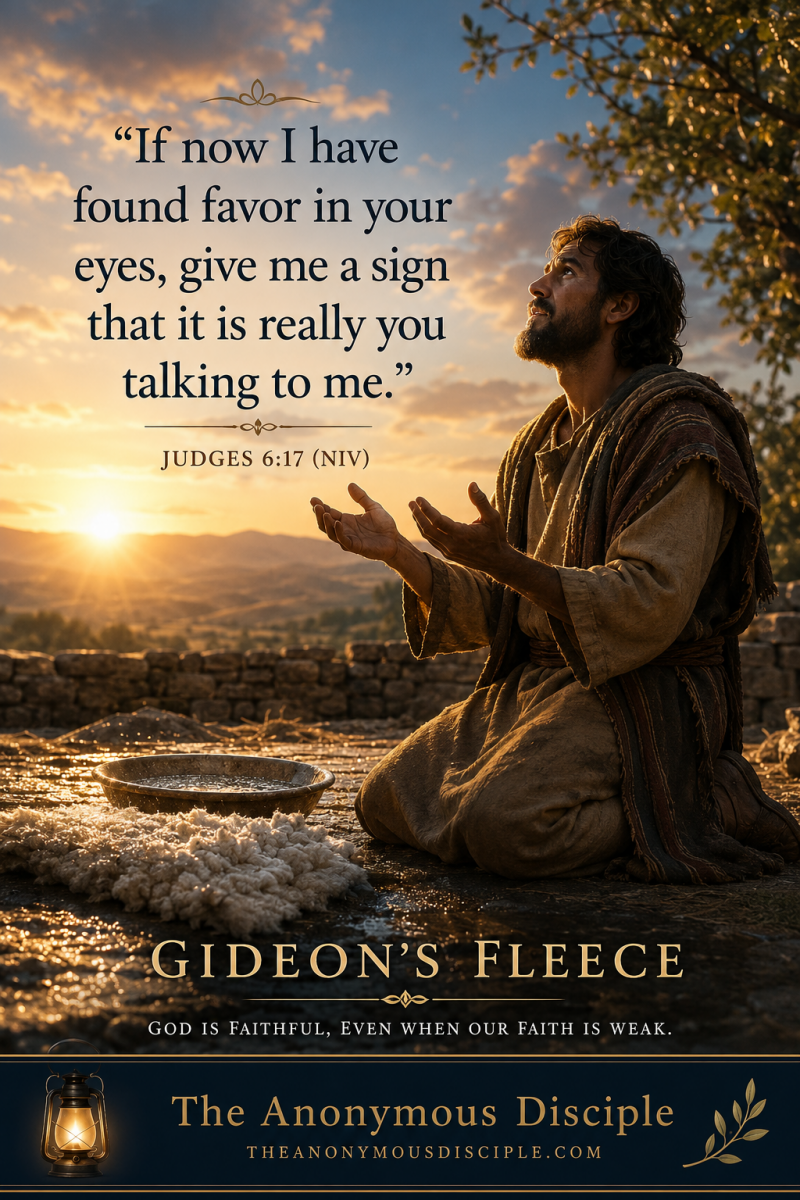
Gideon’s Fleece
Judges 6:36–40, anchored in Judges 6:17
Judges 6:17 (NIV)
“Gideon replied, ‘If now I have found favor in your eyes, give me a sign that it is really you talking to me.’”
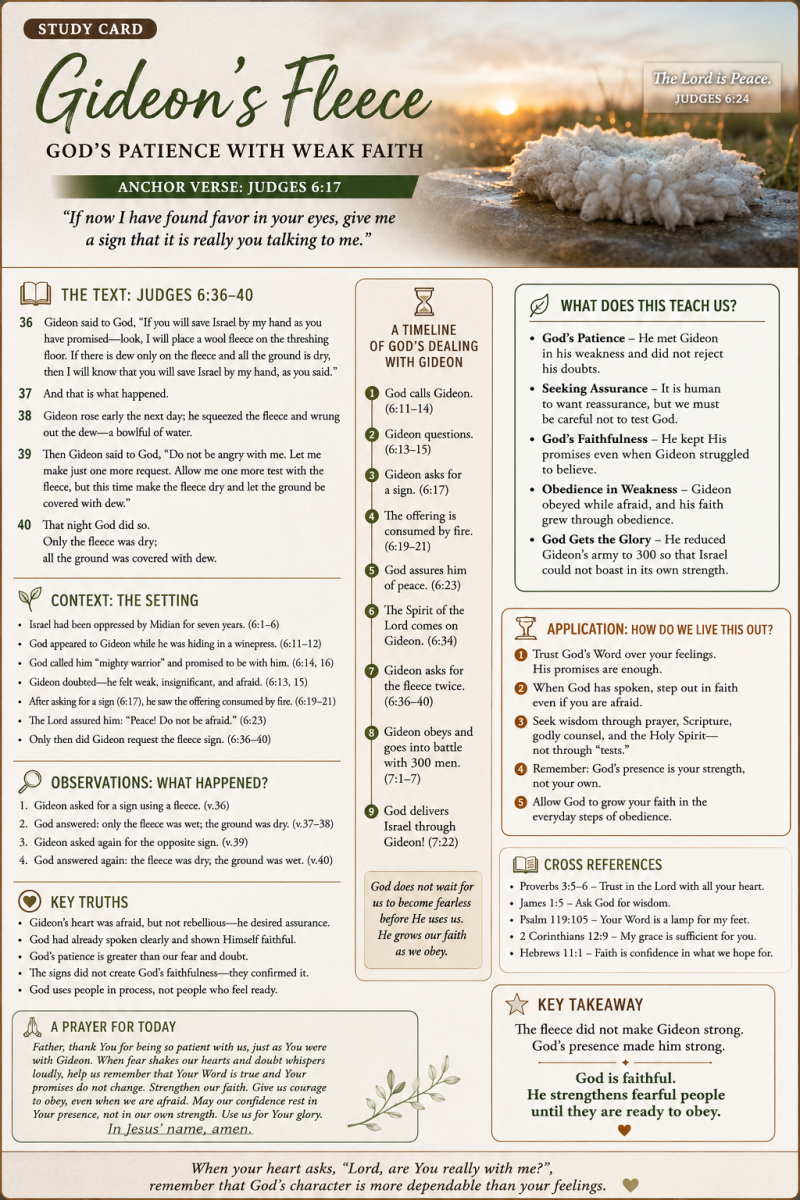
The setting
Israel had been oppressed by Midian for seven years. The Midianites repeatedly invaded the land, destroyed Israel’s crops, and left the people impoverished and afraid.
God then appeared to Gideon while he was threshing wheat in a winepress—an unusual, concealed location—because he was hiding from the Midianites.
The Angel of the Lord greeted him:
Judges 6:12 (NIV)
“The Lord is with you, mighty warrior.”
That greeting described not merely what Gideon appeared to be in that moment, but what God intended to make of him.
Gideon responded with doubt, grief, and honest questions:
Judges 6:13 (NIV)
“Pardon me, my lord,” Gideon replied, “but if the Lord is with us, why has all this happened to us?”
Gideon believed the stories about God’s past deliverance, but he struggled to see God’s presence in Israel’s present suffering.
That is important: Gideon’s faith was not nonexistent. It was wounded, uncertain, and still developing.
The anchor: “Give me a sign”
Judges 6:17 (NIV)
“If now I have found favor in your eyes, give me a sign that it is really you talking to me.”
Gideon’s first request for a sign was not the fleece. It occurred earlier, when he asked the visitor to remain while he prepared an offering.
The Angel of the Lord touched the offering with the tip of His staff, and fire came from the rock and consumed it.
Gideon then realized he had encountered the Angel of the Lord and feared he would die.
But God said:
Judges 6:23 (NIV)
“Peace! Do not be afraid. You are not going to die.”
Gideon built an altar and named it:
Judges 6:24 (NIV)
“The Lord Is Peace.”
In Hebrew, this is often expressed as Yahweh Shalom—the Lord is peace.
Before God sent Gideon into battle, He first dealt with Gideon’s fear and established peace between them.
Judges 6:36–37 — Gideon proposes the fleece
Judges 6:36–37 (NIV)
“Gideon said to God, ‘If you will save Israel by my hand as you have promised—look, I will place a wool fleece on the threshing floor. If there is dew only on the fleece and all the ground is dry, then I will know that you will save Israel by my hand, as you said.’”
Notice Gideon’s wording:
“If you will save Israel by my hand as you have promised…”
God had already spoken clearly:
Judges 6:14 (NIV)
“Go in the strength you have and save Israel out of Midian’s hand. Am I not sending you?”
And again:
Judges 6:16 (NIV)
“I will be with you, and you will strike down all the Midianites, leaving none alive.”
The problem was not that Gideon lacked a word from God. The problem was that Gideon struggled to trust the word he had received.
That makes the fleece less an example of bold faith and more an example of God’s patience with weak faith.
Gideon was asking, “Lord, I heard You—but I am terrified. Will You reassure me again?”
Judges 6:38 — God answers the first request
Judges 6:38 (NIV)
“And that is what happened. Gideon rose early the next day; he squeezed the fleece and wrung out the dew—a bowlful of water.”
God gave Gideon exactly the sign he requested.
The fleece was not merely slightly damp. Gideon wrung out enough water to fill a bowl. The sign was unmistakable.
This shows God’s tenderness. He did not mock Gideon, reject him, or replace him with someone more confident.
God knew Gideon’s weakness before He called him.
And still, God called him.
Judges 6:39 — Gideon asks again
Judges 6:39 (NIV)
“Then Gideon said to God, ‘Do not be angry with me. Let me make just one more request. Allow me one more test with the fleece, but this time make the fleece dry and let the ground be covered with dew.’”
Gideon understood that he was testing God’s patience.
His words, “Do not be angry with me,” show humility and apprehension. He knew God had already answered him.
Why did Gideon reverse the sign?
Possibly because he feared the first result had a natural explanation. Wool can retain moisture, so Gideon asked for the opposite: a dry fleece surrounded by wet ground.
He wanted confirmation that could not be dismissed.
This reveals something deeply human: sometimes even after God answers us, fear says, “But what if that was only a coincidence?”
Judges 6:40 — God answers again
Judges 6:40 (NIV)
“That night God did so. Only the fleece was dry; all the ground was covered with dew.”
God answered without rebuking Gideon.
That does not necessarily mean Gideon’s testing was ideal. It means God was merciful.
The emphasis of this passage is not, “Gideon discovered a method for making decisions.”
The emphasis is:
God remained faithful even while Gideon struggled to believe.
Was Gideon wrong to ask for the fleece?
The passage does not directly say that Gideon sinned, but it does present him as fearful and hesitant.
He had already received:
- A direct command from God.
- A promise of God’s presence.
- A supernatural sign involving fire.
- Assurance of peace.
- The empowering Spirit of the Lord.
Yet Gideon still asked for two more signs.
So the fleece is not mainly a formula to copy. It is a testimony to God’s gracious patience with a frightened servant.
God did not approve Gideon because Gideon had perfect confidence.
God strengthened Gideon until he was ready to obey.
Should Christians “put out a fleece”?
We should be cautious.
Some people say, “God, if You want me to do this, let the phone ring,” or “Let me see a certain color car,” or “Make this particular event happen.”
That can become dangerous because circumstances are easy to misinterpret. We can also unconsciously arrange the outcome we already desire.
Scripture gives us better guidance:
Proverbs 3:5–6 (NIV)
“Trust in the Lord with all your heart and lean not on your own understanding; in all your ways submit to him, and he will make your paths straight.”
James 1:5 (NIV)
“If any of you lacks wisdom, you should ask God, who gives generously to all without finding fault.”
Psalm 119:105 (NIV)
“Your word is a lamp for my feet, a light on my path.”
Romans 12:2 (NIV)
“Then you will be able to test and approve what God’s will is—his good, pleasing and perfect will.”
For us, guidance ordinarily comes through God’s written Word, prayer, wisdom, godly counsel, providence, and the Holy Spirit’s work—not by inventing supernatural tests.
We do not need God to prove Himself repeatedly when He has already spoken clearly in Scripture.
Gideon’s real struggle: “Can God use me?”
Gideon’s hesitation was not only about whether God would defeat Midian. He doubted whether he was the right person.
Judges 6:15 (NIV)
“‘Pardon me, my lord,’ Gideon replied, ‘but how can I save Israel? My clan is the weakest in Manasseh, and I am the least in my family.’”
Gideon looked at:
- His family’s weakness
- His low position
- Israel’s oppression
- Midian’s strength
- His own fear
God answered with one sentence:
Judges 6:16 (NIV)
“I will be with you.”
That was the true basis of Gideon’s victory.
Not Gideon’s strength.
Not the fleece.
Not the size of his army.
God’s presence.
And later God reduced Gideon’s army from thousands to only 300 men so Israel could not boast that its own strength had saved it.
God was teaching Gideon:
The victory does not depend upon how strong you feel. It depends upon who goes with you.
A beautiful progression in Gideon
Gideon’s growth happens gradually:
- He hides in the winepress.
- He questions God.
- He asks for a sign.
- He obeys God at night because he is afraid.
- He asks for the fleece twice.
- He goes into battle with only 300 men.
- God delivers Israel through him.
God did not wait for Gideon to become fearless before using him.
Gideon obeyed while afraid, and through repeated obedience his faith grew.
Courage is not always the absence of fear.
Sometimes courage is trembling—and still doing what God said.
The heart of the passage
The hero of Gideon’s story is not Gideon.
It is God.
Gideon was uncertain. God was certain.
Gideon was fearful. God was patient.
Gideon felt weak. God was strong.
Gideon needed reassurance. God graciously provided it.
The fleece did not create God’s faithfulness. It merely revealed to Gideon what had already been true:
God meant what He said.
Add comment
Comments