

Daniel 6 - Deep Dive into the Lion's Den
Daniel’s greatest victory did not happen when he walked out of the lions’ den.
It happened when he knelt down to pray, knowing it might cost him his life.
The lions’ den revealed what the prayer room had already built.
A faith practiced quietly becomes a faith that can stand courageously.
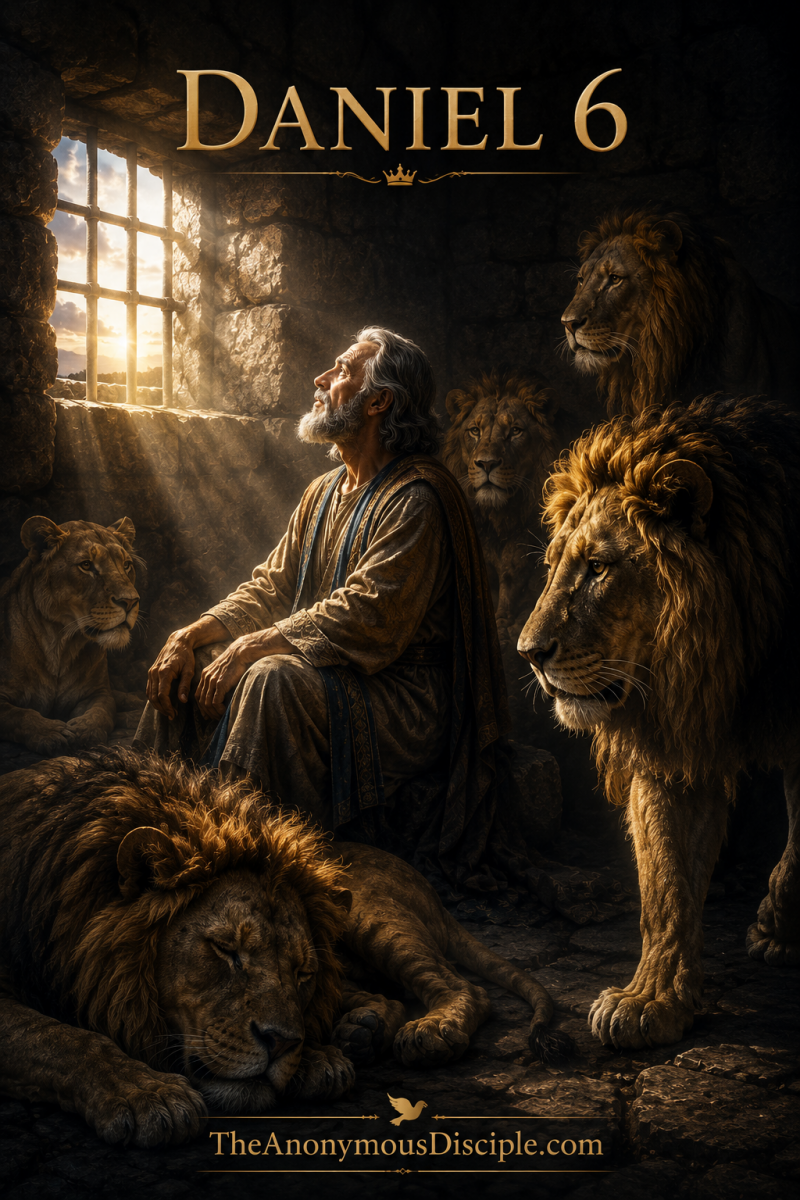
Study Notes at the bottom of page; full chapter breakdown, perspectives, applications & prayers
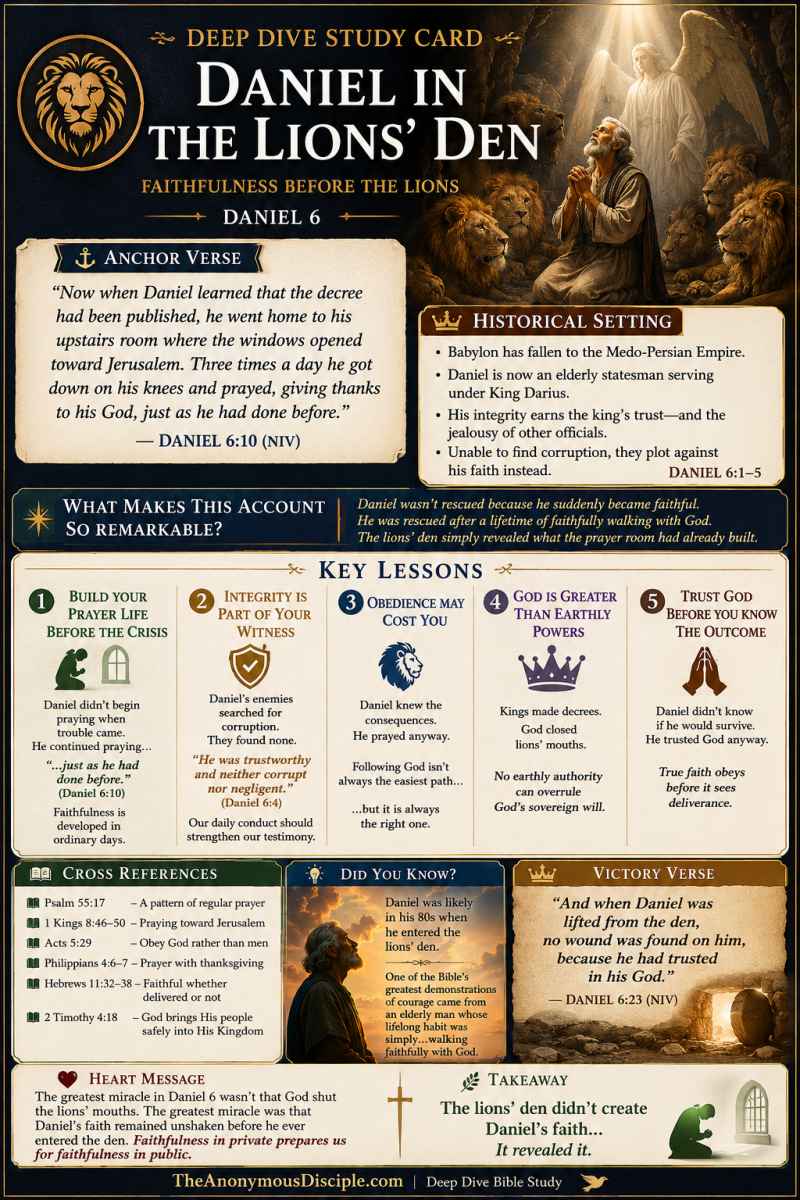

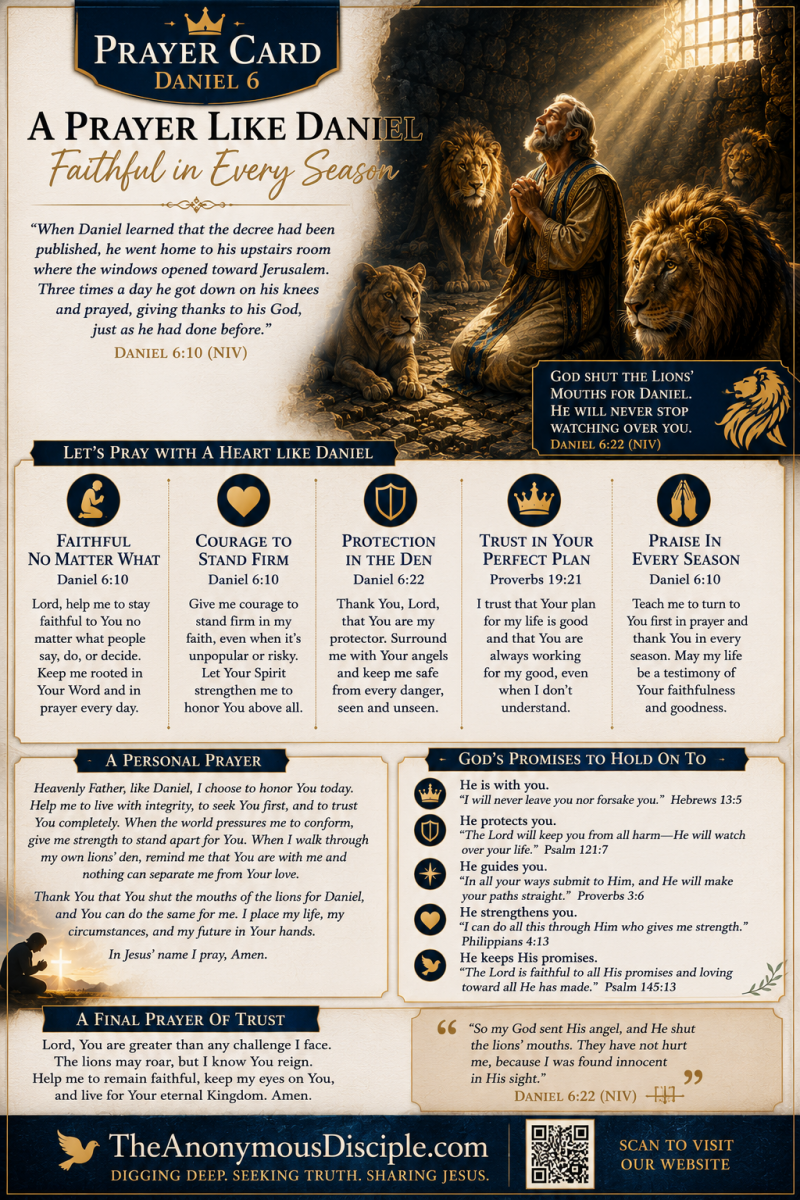
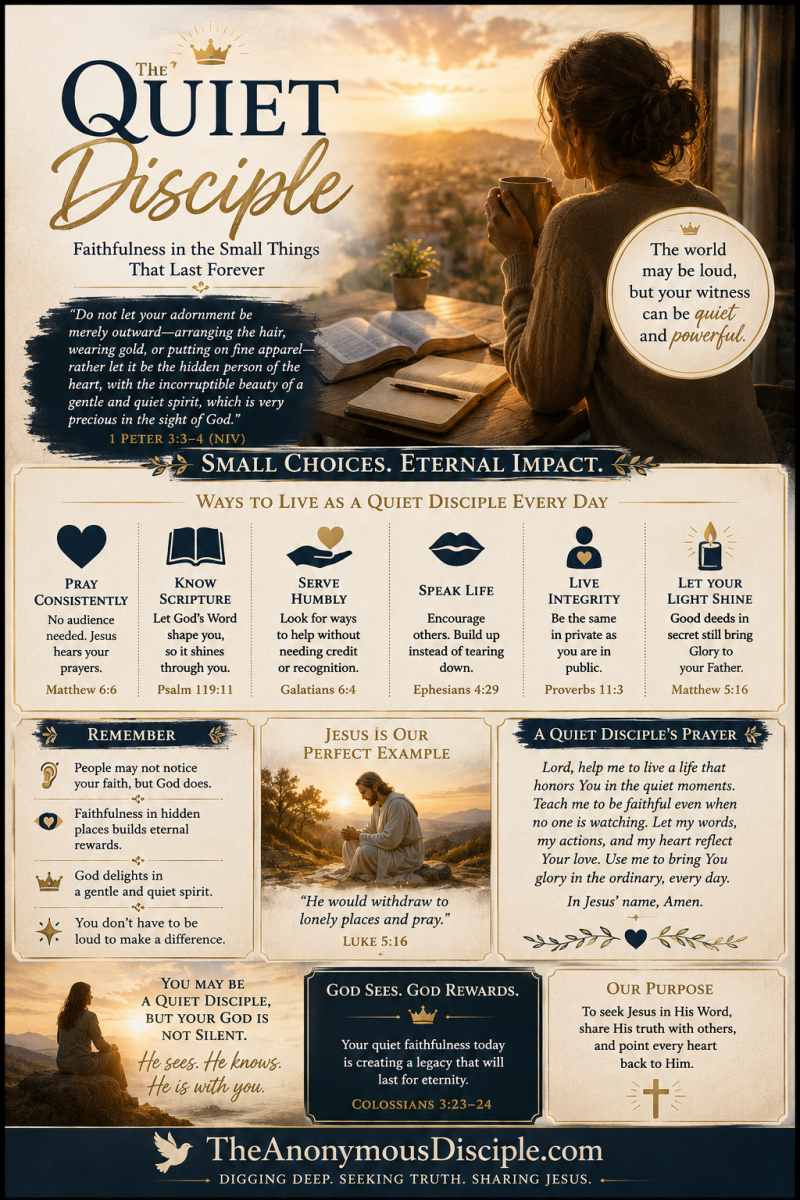
Study notes
Bible Application/Discernment
The primary meaning of Daniel 6 is about God's faithfulness to preserve Daniel as he remained faithful under persecution. But Scripture often invites us to see patterns that point us toward greater truths.
Consider the parallels:
🦁 The lions' den → This fallen world, where danger, sin, temptation, and death surround us.
🙏 Daniel remained faithful → Believers are called to remain faithful to Christ, even when the world pressures us to compromise.
👼 God sent deliverance → God has sent the ultimate Deliverer in Jesus Christ.
⬆️ Daniel was lifted out of the den → One day, believers will be raised and brought safely into the Lord's presence.
❤️ "No wound was found on him..." (Daniel 6:23) → Through Christ, our souls are kept secure. Even if our bodies suffer or die, our eternal life is safe in Him.
That last thought reminds me of Jesus' words:
Matthew 10:28 (NIV)
"Do not be afraid of those who kill the body but cannot kill the soul. Rather, be afraid of the One who can destroy both soul and body in hell."
And Peter writes:
1 Peter 1:3–5 (NIV)
"...In his great mercy he has given us new birth into a living hope through the resurrection of Jesus Christ from the dead... into an inheritance that can never perish, spoil or fade... who through faith are shielded by God's power until the coming of the salvation that is ready to be revealed in the last time."
Another verse that comes immediately to my mind:
John 17:15 (NIV)
"My prayer is not that you take them out of the world but that you protect them from the evil one."
That verse almost feels like a New Testament echo of Daniel. Daniel wasn't spared from being placed into the den; he was preserved within it. Likewise, Jesus doesn't promise that His followers will never enter trials. He promises to be with us through them.
Then, ultimately, there is a day when we are taken completely out of the "den."
1 Thessalonians 4:16–17 (NIV)
"For the Lord himself will come down from heaven... and the dead in Christ will rise first. After that, we who are still alive and are left will be caught up together with them in the clouds to meet the Lord in the air. And so we will be with the Lord forever."
I'm excited and truly enjoy seeing the threads that run from Genesis to Revelation, I think this is another one of those beautiful patterns:
- 🌍 We live in a world that often feels like a lions' den.
- 🙏 We walk with God in the midst of it.
- 🛡️ He keeps what truly matters—our souls.
- 🕊️ One day, He will call us out forever.
Deep Dive Study Notes/Chapter Breakdown
The setting
Daniel 6 takes place after Babylon has fallen. The Medo-Persian Empire is now in power, and Darius the Mede rules the kingdom.
Daniel is no longer a young man here. He has served faithfully through changing kings, governments, and empires. By this point, he is likely elderly—yet his devotion to God has not weakened.
That alone is worth noticing:
Daniel’s faith was not a moment of youthful enthusiasm. It was a lifetime of faithfulness.
Daniel rises above the others
Daniel 6:1–3
Darius appoints 120 satraps over the kingdom and places three administrators over them. Daniel is one of the three.
But Daniel distinguishes himself above the others.
Daniel 6:3 (NIV)
“Now Daniel so distinguished himself among the administrators and the satraps by his exceptional qualities that the king planned to set him over the whole kingdom.”
The phrase “exceptional qualities” can also carry the idea of an extraordinary spirit.
Daniel’s faithfulness to God showed up in the quality of his work.
He was not careless, unreliable, dishonest, or lazy. His spiritual life affected how he handled ordinary responsibilities.
Heart truth
A faithful believer should be trustworthy even when no one is watching.
See also:
- Colossians 3:23–24 - "Whatever you do, work at it with all your heart, as working for the Lord, not for human masters, since you know that you will receive an inheritance from the Lord as a reward. It is the Lord Christ you are serving."
- Proverbs 22:29 - "Do you see someone skilled in their work? They will serve before kings; they will not serve before officials of low rank."
- 1 Corinthians 10:31 - "So whether you eat or drink or whatever you do, do it all for the glory of God."
His enemies search for a weakness
Daniel 6:4–5
The other officials become jealous. They investigate Daniel, hoping to find corruption, negligence, or misconduct.
But they find nothing.
Daniel 6:4 (NIV)
“They could find no corruption in him, because he was trustworthy and neither corrupt nor negligent.”
That is an extraordinary testimony.
Daniel was not sinless, but his public conduct gave his enemies nothing legitimate to use against him.
So they come to a disturbing conclusion:
Daniel 6:5 (NIV)
“We will never find any basis for charges against this man Daniel unless it has something to do with the law of his God.”
His enemies knew that the only reliable way to trap Daniel was through his faithfulness to God.
That raises a searching question:
Would anyone studying our lives know exactly where we refuse to compromise?
The trap: appeal to the king’s pride
Daniel 6:6–9
The officials persuade King Darius to issue a decree:
For thirty days, no one may pray to any god or human being except the king. Anyone who disobeys will be thrown into the lions’ den.
The plan is built on three things:
- jealousy
- deception
- pride
The officials tell the king that everyone agreed, but Daniel clearly did not.
They flatter Darius and make the decree sound like an act of unity and loyalty. In reality, they are using the king’s ego to destroy Daniel.
The law of the Medes and Persians could not easily be revoked once signed.
See:
- Daniel 6:8 - "Now, Your Majesty, issue the decree and put it in writing so that it cannot be altered - in accordance with the law of the Medes and Persians, which cannot be repealed."
- Daniel 6:12 - "So they went to the king and spoke to him about his royal decree: 'Did you not publish a decree that during the next thirty days anyone who prays to any god or human being except to you, Your Majesty, would be thrown into the lions' den?'"
- Daniel 6:15 - "Then the men went as a group to King Darius and said to him, 'Remember, Your Majesty, that according to the law of the Medes and Persians no decree or edict that the king issues can be changed.'"
- Esther 1:19 - "Therefore, if it pleases the king, let him issue a royal decree and let it be written in the laws of Persia and Media, which cannot be repealed, that Vashti is never again to enter the presence of King Xerxes. Also let the king give her royal position to someone else who is better than she.'"
- Esther 8:8 - "Now write another decree in the king's name in behalf of the Jews as seems best to you, and seal it with the king's signet ring - for no document written in the king's name and sealed with his ring can be revoked."
Daniel hears the decree—and prays anyway
Daniel 6:10
This is the anchor of the chapter.
Daniel 6:10 (NIV)
“Now when Daniel learned that the decree had been published, he went home to his upstairs room where the windows opened toward Jerusalem. Three times a day he got down on his knees and prayed, giving thanks to his God, just as he had done before.”
Daniel did not begin praying as an act of protest.
He continued praying “just as he had done before.”
That phrase is crucial.
The crisis did not create Daniel’s prayer life. It revealed it.
He had already built the habit before the danger came.
Why did Daniel pray toward Jerusalem?
Daniel’s prayer toward Jerusalem was rooted in Scripture.
When Solomon dedicated the temple, he prayed that if God’s people were taken captive and later turned toward the land and prayed, God would hear them.
See:
- 1 Kings 8:46–50 - "When they sin against you - for there is no one who does not sin - and you become angry with them and give them over to their enemies, who take them captive to their own lands, far away or near; and if they have a change of heart in the land where they are held captive, and repent and plead with you in the land of their captors and say, 'We have sinned, we have done wrong, we have acted wickedly;' and if they turn back to you with all their heart and soul in the land of their enemies who took them captive, and pray to you toward the land you gave their ancestors, toward the city you have chosen and the temple I have built for your Name; then from heaven, your dwelling place, hear their prayer and their plea, and uphold their cause. And fogive your people, who have sinned against you; forgive all the offenses they have committed against you, and cause their captors to show them mercy."
- 2 Chronicles 6:36–39 - King Solomon reiterates his prayer and dedication from 1 Kings 8:46-50
Daniel was living out the covenant prayer Solomon had spoken centuries earlier.
Even in exile, Daniel prayed with his heart turned toward God’s promises.
Why three times a day?
Scripture does not command all believers to pray exactly three times daily, but this was evidently Daniel’s established discipline.
A similar pattern appears in:
Psalm 55:17
“Evening, morning and noon I cry out in distress…”
The lesson is not that everyone must follow Daniel’s exact schedule.
The lesson is that Daniel had a consistent prayer life.
Daniel gives thanks under threat
One of the most powerful details in Daniel 6:10 is that Daniel was giving thanks.
He was not merely begging for survival.
He thanked God while knowing the lions’ den might be waiting.
That connects beautifully with:
Philippians 4:6–7
Present your requests to God with prayer, petition, and thanksgiving.
Thanksgiving is not denial of danger.
It is confidence that God remains worthy even in danger.
Daniel does not hide
Daniel’s windows were open toward Jerusalem.
This does not necessarily mean he opened them dramatically to provoke the authorities. The text says this was his established custom.
Daniel did not seek persecution, but neither did he rearrange his devotion to avoid it.
There is a difference between:
- recklessly inviting trouble
- refusing to compromise when trouble comes
Daniel chose faithful obedience.
See:
- Acts 5:29 - "Peter and the other apostles replied: 'We must obey God rather than human beings!'"
- Matthew 10:32–33 - "Whoever acknowledges me before others, I will also acknowledge before my Father in heaven. But whoever disowns me before others, I will disown before my Father in heaven."
- 2 Timothy 3:12 - "In fact, everyone who wants to live a godly life in Christ Jesus will be persecuted, while evildoers and imposters will go from bad to worse, deceiving and being deceived."
The officials catch Daniel praying
Daniel 6:11–13
The conspirators go together and find Daniel praying and asking God for help.
They immediately report him to the king.
Notice how they describe him:
Daniel 6:13
“Daniel, who is one of the exiles from Judah…”
They deliberately reduce Daniel to his outsider status.
They do not say:
- Daniel, your trusted administrator
- Daniel, the man you planned to promote
- Daniel, the faithful servant
They call him an exile.
Jealousy often tries to strip a person of honor and reduce them to a label.
Darius realizes he has been manipulated
Daniel 6:14–15
When Darius hears the accusation, he is deeply distressed.
He tries until sunset to rescue Daniel, but the officials remind him that the law cannot be changed.
Darius had authority, but he had trapped himself within his own decree.
This is a strong contrast:
- Darius is a powerful king who cannot undo his own foolish law.
- God is the sovereign King who can overrule lions, rulers, laws, and death.
Human power always has limits.
God’s power does not.
Daniel is thrown into the lions’ den
Daniel 6:16–17
The king gives the order.
Before Daniel is thrown in, Darius says:
Daniel 6:16 (NIV)
“May your God, whom you serve continually, rescue you!”
Even Darius recognizes the consistency of Daniel’s service.
He does not say, “the God you serve occasionally.”
He says, “whom you serve continually.”
What a testimony.
A stone is placed over the mouth of the den and sealed with royal signet rings.
This detail may remind us of another sealed place:
- a stone
- a sealed entrance
- powerful authorities
- apparent death
- divine deliverance
Compare:
- Daniel 6:17 - "A stone was brought and placed over the mouth of the den, and the king sealed it with his own signet ring and with the rings of his nobles, so that Daniel's situation might not be changed."
- Matthew 27:60–66 - "...and placed it in his own new tomb that he had cut out of the rock. He rolled a big stone in front of the entrance to the tomb and went away. Mary Magdalene and the other Mary were sitting there opposite the tomb. The next day, the one after Preparation Day, the chief priests and the Pharisees went to Pilate. 'Sir,' they said, 'we remember that while he was still alive that deceiver said, 'After three days I will rise again.' So give the order for the tomb to be made secure until the third day. Otherwise, his disciples may come and steal the body and tell the people that he has been raised from the dead. This last deception will be worse than the first.' 'Take a guard,' Pilate answered. 'Go, make the tomb as secure as you know how.' So they went and made the tomb secure by putting a seal on the stone, and posting the guard."
- Matthew 28:1–6 - "After the Sabbath, at dawn on the first day of the week, Mary Magdalene and the other Mary went to look at the tomb. There was a violent earthquake, for an angel of the Lord came down from heaven and, going to the tomb, rolled back the stone and sat on it. His appearance was like lightning, and his clothes were white as snow. The guards were so afraid of him that they shook and became like dead men. The angel said to the women, 'Do not be afraid, for I know that you are looking for Jesus, who was crucified. He is not here; he has risen, just as he said. Come and see the place where he lay.'"
Daniel’s deliverance is not the resurrection of Christ, but the imagery creates a striking biblical echo.
The king cannot sleep
Daniel 6:18–20
Darius returns to his palace.
He refuses food and entertainment, and he cannot sleep.
At dawn he hurries to the lions’ den.
He calls out:
Daniel 6:20 (NIV)
“Daniel, servant of the living God, has your God, whom you serve continually, been able to rescue you from the lions?”
Darius calls God “the living God.”
The idols of the nations were lifeless.
Daniel’s God acts, speaks, sees, judges, rescues, and reigns.
See:
- Joshua 3:10 - "This is how you will know that the living God is among you and that he will certainly drive out before you the Canaanites, Hittites, Hivites, Perizzites, girgashites, Amorites and Jebusites."
- 1 Samuel 17:26 - "David asked the men standing near him, 'What will be done for the man who kills this Philistine and removes this disgrace from Israel? Who is this uncircumcised Philistine that he should defy the armies of the living God?'"
- Psalm 42:2 - "My soul thirsts for God, for the living God. When can I go and meet with God?"
- Matthew 16:16 - "Simon Peter answered, 'You are the Messiah, the Son of the living God."
- Hebrews 10:31 - "It is a dreadful thing to fall into the hands of the living God."
God shuts the lions’ mouths
Daniel 6:21–22
Daniel answers:
Daniel 6:22 (NIV)
“My God sent his angel, and he shut the mouths of the lions.”
Daniel gives the glory to God.
He does not praise his own courage, prayer discipline, or righteousness.
God sent His angel.
The chapter does not identify the angel by name.
Daniel says he was found innocent before God and had done no wrong before the king.
This does not mean Daniel claimed complete sinlessness. It means he was innocent of the charge against him and had not acted treasonously.
Was this the Angel of the LORD?
The text says:
“My God sent his angel.”
It does not specifically say “the angel of the LORD.”
Therefore, we should not insist this was a Christophany. (A visible appearance of the pre-incarnate Jesus Christ before His birth in Bethlehem. Search 🔍 Christophany, I've got a card on that, too)
It may have been one of God’s created angels sent to protect Daniel.
Compare:
- Psalm 34:7 - "The angel of the Lord encamps around those who fear him, and he delivers them.
- Psalm 91:11 - "For he will command his angels concerning you to guard you in all your ways."
- Hebrews 1:14 - "Are not all angels ministering spirits sent to serve those who will inherit salvation?"
- Acts 12:6–11 - "The night before Herod was to bring him to trial, Peter was sleeping between two soldiers, bound with two chains, and sentries stood guard at the entrance. Suddenly an angel of the Lord appeared and a light shone in the cell. He struck Peter on the side and woke him up. 'Quick, get up!' he said, and the chains fell off Peter's wrists. Then the angel said to him, 'Put on your clothes and sandals.' And Peter did so. 'Wrap your cloak around you and follow me,' the angel told him. Peter followed him out of the prison, but he had no idea that what the angel was doing was really happening; he thought he was seeing a vision. They passed the first and second guards and came to the iron gate leading to the city. It opened for them by itself, and they went through it. When they had walked the length of one street, suddenly the angel left him. Then Peter came to himself and said, 'Now I know without a doubt that the Lord has sent his angel and rescued me from Herod's clutches and from everything the Jewish people were hoping would happen.'"
Daniel trusted God
Daniel 6:23
Daniel is lifted out of the den.
Daniel 6:23 (NIV)
“And when Daniel was lifted from the den, no wound was found on him, because he had trusted in his God.”
This verse gives the spiritual explanation:
Daniel trusted God.
But we must be careful with how we apply this.
Trusting God does not always mean believers escape physical suffering.
Hebrews 11 describes faithful people who were delivered—and faithful people who suffered and died.
See:
- Hebrews 11:32–35 — some were rescued
- Hebrews 11:35–38 — others suffered
- Revelation 2:10 — faithfulness even unto death
Daniel’s faith was not proven by whether he survived.
His faith was proven when he prayed before he knew the outcome.
That is one of the deepest truths in the chapter:
Faithfulness is obedience before deliverance is visible.
The judgment of Daniel’s accusers
Daniel 6:24
The king orders the men who falsely accused Daniel to be thrown into the den, along with their families.
The lions overpower them before they reach the floor.
This demonstrates that Daniel’s survival was not because the lions were tame, old, or full.
God had truly restrained them.
This verse is difficult because the families were included. The practice reflects the harsh collective punishments of ancient empires. Scripture records what Darius ordered; it does not necessarily present every element of his punishment as God’s moral ideal.
Elsewhere, God’s law says children should not be put to death for the sins of their parents:
- Deuteronomy 24:16 - "Parents are not to be put to death for their children, nor children put to death for their parents; each will die for their own sins."
- Ezekiel 18:20 - "The one who sins is the one who will die. The child will not share the guilt of the parent, nor will the parent share the guilt of the child. The righteousness of the righteous will be credited to them, and the wickedness of the wicked will be charged against them."
The text shows the severity of Persian royal judgment, not a command for believers to imitate it.
Darius honors the God of Daniel
Daniel 6:25–27
Darius issues a decree throughout the kingdom.
He declares that people should fear and reverence Daniel’s God.
Daniel 6:26–27 describes God as:
- the living God
- enduring forever
- ruling a kingdom that will not be destroyed
- rescuing and saving
- performing signs and wonders
This echoes a major theme throughout Daniel:
Human kingdoms rise and fall.
God’s kingdom remains.
See:
- Daniel 2:44 - "In the time of those kings, the God of heaven will set up a kingdom that will never be destroyed, nor will it be left to another people. It will crush all those kingdoms and bring them to an end, but it will itself endure forever."
- Daniel 4:34–35 - "At the end of that time, I, Nebuchadnezzar, raised my eyes toward heaven, and my sanity was restored. Then I praised the Most High; I honored and glorified him who lives forever. His dominion is an eternal dominion; his kingdom endures from generation to generation. All the peoples of the earth are regarded as nothing. He does as he pleases with the powers of heaven and the peoples of the earth. No one can hold back his hand or say to him: 'What have you done?'"
- Daniel 7:13–14 - "In my vision at night I looked, and there before me was one like a son of man, coming with the clouds of heaven. He approached the Ancient of Days and was led into his presence. He was given authority, glory and sovereign power; all nations and peoples of every language worshiped him. His dominion is an everlasting dominion that will not pass away, and his kingdom is one that will never be destroyed."
- Psalm 145:13 - "Your kingdom is an everlasting kingdom, and your dominion endures through all generations. The Lord is trustworthy in all he promises and faithful in all he does."
- Revelation 11:15 - "The seventh angel sounded his trumpet, and there were loud voices in heaven, which said: 'The kingdom of the world has become the kingdom of our Lord and of his Messiah, and he will reign for ever and ever.'"
Did Darius truly become a believer?
The chapter shows that Darius honored Daniel’s God and recognized His power.
But Scripture does not clearly tell us whether Darius entered into full covenant faith or abandoned all other gods.
His decree may reflect genuine awe, political recognition, or perhaps the beginning of faith.
We should not claim more than the text says.
Daniel prospers
Daniel 6:28
Daniel 6:28 (NIV)
“So Daniel prospered during the reign of Darius and the reign of Cyrus the Persian.”
The enemies intended to remove Daniel.
Instead, God preserved him and extended his influence.
What was meant to destroy Daniel became a stage for God’s glory.
Compare:
- Genesis 50:20 - "You intended to harm me, but God intended it for good to accomplish what is now being done, the saving of many lives."
- Psalm 76:10 - "Surely your wrath against mankind brings you praise, and the survivors of your wrath are restrained."
- Romans 8:28 - "And we know that in all things God works for the good of those who love him, who have been called according to his purpose."
Major themes in Daniel 6
1. Consistency before crisis
Daniel’s strength in the lions’ den began in his prayer room.
Private faithfulness prepared him for public pressure.
2. Excellence is part of testimony
Daniel’s enemies could find no corruption or negligence in him.
His work life supported his witness.
3. Pride makes people vulnerable to manipulation
Darius signed the decree because he allowed flattery to overcome wisdom.
4. Prayer is worth the cost
Daniel did not treat prayer as optional when obedience became dangerous.
5. God is sovereign over human law
The king’s decree could bind Darius, but it could not bind God.
6. Deliverance belongs to God
Daniel did not save himself. God shut the lions’ mouths.
7. Faithfulness does not depend on the outcome
Daniel prayed before he knew whether God would rescue him physically.
8. God’s kingdom outlasts every empire
Babylon fell. Persia would fall. God’s kingdom never will.
Daniel as a picture pointing toward Christ
Daniel is not Jesus, but several parallels are worth noticing.
Daniel was:
- innocent of the charges against him — Daniel 6:4, 22
- hated because of righteousness — Daniel 6:5
- targeted by jealous leaders — Daniel 6:4–9
- condemned through manipulation of civil authority — Daniel 6:12–16
- placed in a sealed place of expected death — Daniel 6:17
- found alive at dawn — Daniel 6:19–23
- vindicated publicly — Daniel 6:25–27
Jesus was:
- without sin — Hebrews 4:15
- hated without cause — John 15:25
- handed over through envy — Matthew 27:18
- condemned under political pressure — John 19:12–16
- placed in a sealed tomb — Matthew 27:60–66
- raised and revealed alive — Matthew 28:1–10
- publicly vindicated by resurrection — Romans 1:4
Daniel came out of a den.
Jesus conquered death itself.
A heart check from Daniel 6
Ask yourself:
Is my walk with God consistent enough to sustain me under pressure?
Do I pray mainly when trouble begins, or have I built a life of prayer already?
Would people describe me as trustworthy and neither corrupt nor negligent?
Where am I tempted to quietly compromise because obedience may cost me something?
Can I thank God before I know how He will answer?
Do I trust God only to keep me from the lions, or can I trust Him even if He permits the den?
Anchor verses
I would anchor this study with:
Daniel 6:10 (NIV)
“Three times a day he got down on his knees and prayed, giving thanks to his God, just as he had done before.”
And a powerful companion anchor would be:
Daniel 6:23 (NIV)
“No wound was found on him, because he had trusted in his God.”
Kingdom Perspective Notes
The Kingdom That Cannot Be Destroyed
Daniel ends exactly where prophecy goes.
Daniel survived...
but the chapter ends talking about God's everlasting Kingdom.
Daniel 6:26–27 - "I issue a decree that in every part of my kingdom people must fear and reverence the God of Daniel. 'For he is the living God and he endures forever; his kingom will not be destroyed, his dominion will never end. He rescues and he saves; he performs signs and wonders in the heavens and on the earth. He has rescued Daniel from the power of the lions.'"
Cross references:
- Daniel 2:44 - "In the time of those kings, the God of heaven will set up a kingdom that will never be destroyed, nor will it be left to another people. It will crush all those kingdoms and bring them to an end, but it will itself endure forever."
- Daniel 7:13–14 - "In my vision at night I looked, and there before me was one like a son of man, coming with the clouds of heaven. He approached the Ancient of Days and was led into his presence. He was given authority, glory and sovereign power; all nations and peoples of every language worshiped him. His dominion is an everlasting dominion that will not pass away, and his kingdom is one that will never be destroyed."
- Isaiah 9:6–7 - "For to us a child is born, to us a son is given, and the government will be on his shoulders. And he will be called Wonderful Counselor, Mighty God, Everlasting Father, Prince of Peace. Of the greatness of his government and peace there will be no end. He will reign on David's throne and over his kingdom, establishing and upholding it with justice and righteousness from that time on forever. The zeal of the Lord Almighty will accomplish this."
- Revelation 11:15 - "The seventh angel sounded his trumpet, and there were loud voices in heaven, which said: 'The kingdom of the world has become the kingdom of our Lord and of his Messiah, and he will reign for ever and ever.'"
Every earthly kingdom ends.
God's Kingdom never will.
Quiet Disciple Notes
It isn't really about being quiet.
It's about where your faith is rooted.
The world says:
"Make sure everyone notices you."
Jesus says:
Matthew 6:6 (NIV)
"But when you pray, go into your room, close the door and pray to your Father, who is unseen..."
Daniel simply kept praying.
He didn't organize a protest.
He didn't make speeches.
He didn't announce his faith.
He just kept doing what he'd always done.
That is quiet discipleship.
Then God made his faith public.
That's the pattern woven through Scripture:
- 🌾 Ruth quietly gleaning.
- 🐑 David faithfully tending sheep.
- 👶 Mary humbly saying, "I am the Lord's servant."
- 🪔 Anna quietly worshiping in the temple.
- 🛶 Andrew bringing one person—his brother Peter—to Jesus.
- 🦁 Daniel praying in his room.
- ✝️ Jesus often withdrawing to lonely places to pray.
None of them were trying to build a platform.
They were simply faithful.
And God did extraordinary things through ordinary obedience.
❤️ Think:
"Small Choices. Eternal Impact."
The Kingdom certainly advances through faithful preaching - but Scripture also shows it often advances through ordinary acts of obedience.
- one prayer 🙏
- one conversation 💬
- one act of kindness ❤️
- one chapter read 📖
- one faithful day 🌾
"Who dares despise the day of small things..." - Zechariah 4:10
That's exactly what I'm praying to stay focused and faithful to.
We don't have to be famous to be faithful.
That message is desperately needed today. As a quiet disciple, I hope that's what I convey to others. Stay faithful and keep your eyes on Jesus.
Add comment
Comments