

💡 Integrity acts like a reliable guide v. Double-dealing and crookedness destroy the person who practices them.💡
⚓ The Anchor – Verse 9
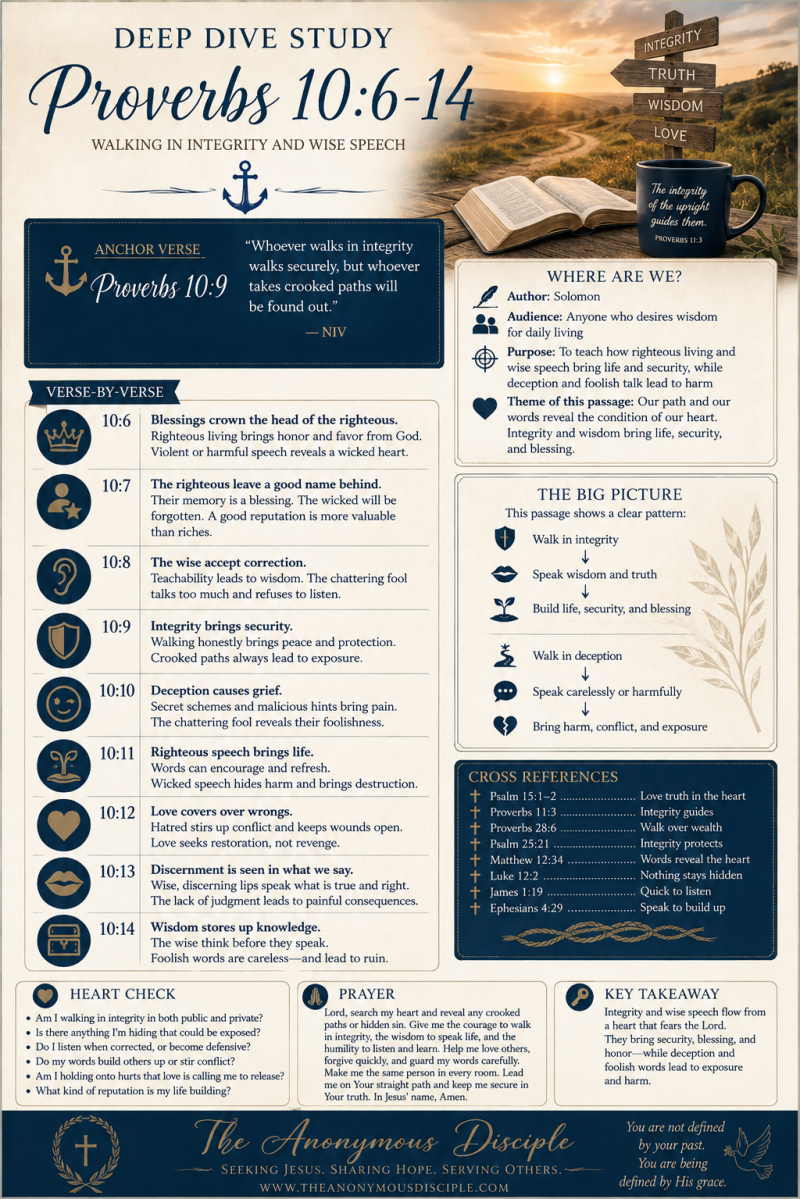
“Whoever walks in integrity walks securely, but whoever takes crooked paths will be found out.”
Integrity means living with nothing to hide—your private life matches your public life, your words match your actions, and you’re the same person whether people are watching or not. The person who walks that way can move through life with a quiet confidence. There’s no constant fear of being exposed because there’s nothing to expose.
The opposite is the person who takes crooked paths—shortcuts, deceit, hidden motives, double standards. Sooner or later those paths get exposed. God sees, and usually people eventually see too. That exposure brings trouble.
Everything else in these verses circles around this same contrast: the secure life of the upright versus the eventual collapse of the crooked.

📌 Main Takeaway
Proverbs 10:6–14 teaches that righteousness is eventually revealed through our speech, reputation, relationships, and daily choices. The person who walks honestly can live with spiritual security, while deception creates crooked paths that eventually expose themselves.
Integrity is not about appearing flawless.
It is about walking openly with God—quick to confess, willing to learn, careful with our words, and determined to keep our private life aligned with our public faith.
📝 study notes 📝
Proverbs 10:6–14
⚓ Anchor Verse: Proverbs 10:9
Proverbs 10:9 (NIV): “Whoever walks in integrity walks securely, but whoever takes crooked paths will be found out.”
Setting the passage
Proverbs 10:1 begins a new section called “The Proverbs of Solomon.” Many of these sayings use sharp contrasts:
- righteous versus wicked
- wise versus foolish
- honest versus deceptive
- life-giving speech versus destructive speech
Proverbs 10:6–14 is especially concerned with two things: the path we walk and the words we speak.
The passage teaches that character cannot remain hidden forever. What is inside a person eventually appears through their choices, speech, relationships, reputation, and consequences.
🌊 Verse-by-Verse Deep Dive 🌊
Proverbs 10:6 — Righteousness produces blessing
6 “Blessings crown the head of the righteous, but violence overwhelms the mouth of the wicked.”
God’s favor rests on those who live right. The wicked, on the other hand, often end up trapped by their own harmful words and actions. Violence (or the consequences of it) ends up covering them.
A crown is visible. It represents honor, favor, and the fruit of a life lived rightly before God.
This does not mean righteous people never experience suffering. It means righteousness produces a kind of blessing that wickedness cannot manufacture: a clear conscience, trustworthy relationships, spiritual stability, and God’s approval.
The second half points to violence associated with the mouth of the wicked. What may be hidden internally eventually appears through threatening, manipulative, cruel, or dishonest speech.
Truth: What fills the heart eventually reaches the mouth.
Luke 6:45: “For the mouth speaks what the heart is full of.”
Proverbs 10:7 — Our lives leave a name behind
7 “The name of the righteous is used in blessings, but the name of the wicked will rot.”
People remember the good person’s name with respect and affection. The wicked person’s reputation eventually decays—people stop speaking well of them, or stop speaking of them at all.
In Scripture, a person’s “name” often represents their character and reputation.
The righteous leave behind memories that bless others. Their life becomes something people thank God for. The wicked may gain attention temporarily, but a reputation built on selfishness, deception, or cruelty eventually decays.
This verse asks a sobering question:
When people remember my life, what will my name represent?
Not perfection—but faithfulness, repentance, kindness, truth, and love for God.
Proverbs 22:1: “A good name is more desirable than great riches…”
Proverbs 10:8 — Wisdom is teachable
8 “The wise in heart accept commands, but a chattering fool comes to ruin.”
A wise person is teachable. They listen and obey instruction. The fool keeps talking, refuses correction, and heads for trouble.
A wise heart is not merely knowledgeable. It is correctable.
The wise person can receive instruction without immediately becoming defensive. They understand that God may use Scripture, circumstances, or another believer to expose something that needs to change.
The “chattering fool” talks instead of listening. Their constant explanations, excuses, opinions, and arguments prevent them from receiving wisdom.
A teachable heart says:
“Lord, show me what I need to hear.”
A foolish heart says:
“Let me explain why this does not apply to me.”
James 1:19: “Everyone should be quick to listen, slow to speak and slow to become angry.”
⚓ Proverbs 10:9 — Walking in Integrity
Proverbs 10:9: “Whoever walks in integrity walks securely, but whoever takes crooked paths will be found out.”
This is the center of the passage. Integrity brings security. Crooked ways get exposed.
“Whoever walks…”
In Scripture, our “walk” means our regular pattern of living—not one isolated decision.
Integrity is not one impressive moment. It is the repeated choice to do what is right when:
- someone is watching
- no one is watching
- obedience is convenient
- obedience is costly
“…in integrity…”
Biblical integrity means wholeness, completeness, and moral consistency.
It is when the different parts of our life agree:
- Our private behavior agrees with our public testimony.
- Our words agree with our actions.
- Our Sunday worship agrees with our Monday choices.
- What we claim to believe agrees with how we treat people.
Integrity does not mean sinless perfection. It means we do not knowingly maintain a double life. When we sin, integrity leads us toward confession and repentance rather than concealment.
“…walks securely…”
The security here is not a promise that nothing painful will happen.
A person of integrity may still be falsely accused, misunderstood, persecuted, or harmed. But they do not have to live under the constant fear that their hidden actions will be exposed.
Integrity brings the security of having:
- nothing deliberately concealed
- no conflicting stories to remember
- no secret path undermining the public one
- a conscience that remains open before God
There is great peace in being the same person in every room.
“…but whoever takes crooked paths…”
A crooked path is indirect, dishonest, or deceptive. Instead of walking openly, the person bends the truth, hides motives, manipulates circumstances, or maintains separate versions of themselves.
Notice that Proverbs says paths, plural. One crooked decision often creates another:
A lie requires another lie.
Concealment requires more concealment.
Compromise creates pressure for further compromise.
“…will be found out.”
Hidden things do not remain hidden forever.
Sometimes exposure comes through another person. Sometimes through natural consequences. Sometimes through a guilty conscience. And even when no human being discovers the truth, nothing is hidden from God.
Luke 12:2: “There is nothing concealed that will not be disclosed…”
This is both a warning and an invitation.
God exposes crookedness not merely to embarrass us, but to call us back to the straight path. Confession brings darkness into the light before the darkness grows.
The central truth of Proverbs 10:9
Integrity gives peace because truth does not require hiding. Deception creates fear because crooked paths eventually expose themselves.
Proverbs 10:10 — Hidden signals can cause real damage
10 “Whoever winks maliciously causes grief, and a chattering fool comes to ruin.”
Secretive, sneaky signals (the wink that means “I’m up to no good”) create pain for others. And once again, the loud-mouthed fool crashes.
The malicious wink represents secret communication, concealed intentions, or deception disguised as innocence.
It could describe someone signaling behind another person’s back, pretending friendship while planning harm, or using subtle behavior to manipulate people.
Sin does not have to be loud to be destructive. Quiet deception can create deep grief.
The repeated warning about the “chattering fool” reinforces the danger of uncontrolled speech. A person may think constant talking gives them control, but foolish speech often becomes the evidence of foolishness.
Proverbs 10:11 — Words can become a fountain of life
11 “The mouth of the righteous is a fountain of life, but the mouth of the wicked conceals violence.”
Good words refresh and give life to the people around you. Wicked words hide harm—they may sound smooth, but destruction sits underneath.
A fountain continually gives fresh water. In the same way, righteous speech should continually bring life.
Life-giving speech can:
- encourage the discouraged
- guide the confused
- correct without humiliating
- calm conflict
- speak truth without cruelty
- remind people of God’s faithfulness
The mouth of the wicked conceals violence. Harmful intentions may be hidden beneath flattering, persuasive, religious, or seemingly harmless words.
The issue is not merely whether our speech sounds pleasant. The issue is whether our words are flowing from righteousness.
Ephesians 4:29: Speak “only what is helpful for building others up according to their needs.”
Proverbs 10:12 — Hatred multiplies conflict; love interrupts it
12 “Hatred stirs up conflict, but love covers over all wrongs.”
Hatred keeps fights going and makes them worse. Love chooses to cover, forgive, and let things go instead of keeping score. (This doesn’t mean ignoring serious sin or injustice—it means refusing to nurse grudges and fan the flames.)
Hatred keeps reaching into the past and pulling offenses back into the present. It rehearses injuries, spreads them, exaggerates them, and uses them as weapons.
Love covers wrongs—not by pretending sin does not matter, enabling abuse, or refusing necessary accountability. Biblical love does not help darkness remain hidden.
Rather, love refuses to:
- delight in another person’s failure
- broadcast every offense
- keep unnecessary records for revenge
- continually reopen forgiven wounds
- stir conflict simply to punish someone
Love seeks restoration rather than humiliation.
1 Peter 4:8: “Love covers over a multitude of sins.”
1 Corinthians 13:5: Love “keeps no record of wrongs.”
Proverbs 10:13 — Discernment becomes visible through speech
13 “Wisdom is found on the lips of the discerning, but a rod is for the back of one who has no sense.”
People who have understanding speak wisely. People who refuse to learn often have to learn the hard way through consequences and discipline.
Discernment is the ability to recognize what is true, right, appropriate, and spiritually significant.
A discerning person does not simply know many facts. They know:
- when to speak
- when to remain silent
- what needs to be said
- how it should be said
- whether their words will heal or unnecessarily wound
The second half warns that someone who lacks judgment may learn through painful consequences what they refused to learn through instruction.
Wisdom listens before consequences become the teacher.
Proverbs 10:14 — Wisdom stores knowledge before speaking
14 “The wise store up knowledge, but the mouth of a fool invites ruin.”
Wise people keep learning and hold onto truth. Fools keep talking without thinking and talk themselves straight into trouble.
Wise people gather truth. They listen, study, remember, and consider before speaking.
They do not feel obligated to immediately express every thought. They understand that knowledge should be stored and used carefully.
The fool’s mouth “invites ruin” because foolish people release words before examining them. Their speech reveals ignorance, creates unnecessary conflict, and brings consequences upon themselves.
Proverbs 18:7: “The mouths of fools are their undoing…”
🧵📖 The Pattern Running Through Proverbs 10:6–14 🧵📖
Six of these nine verses directly mention the mouth, lips, or speech:
- Proverbs 10:6 — the mouth of the wicked
- Proverbs 10:8 — the chattering fool
- Proverbs 10:10 — the chattering fool
- Proverbs 10:11 — the mouth as a fountain of life
- Proverbs 10:13 — wisdom on discerning lips
- Proverbs 10:14 — the mouth inviting ruin
That repetition is intentional.
Our speech is one of the clearest outward signs of the path we are walking.
A crooked path produces deception, concealment, manipulation, gossip, conflict, and reckless talk.
A path of integrity produces truth, wisdom, teachability, encouragement, restraint, and life.
Putting It Together
The whole passage paints two clear paths:
- One path is integrity, teachability, careful speech, love that covers offenses, and a steady gathering of wisdom. That path leads to security, blessing, a good name, and life for others.
- The other path is crooked dealing, constant chatter, hidden motives, hatred, and refusal to learn. That path ends in exposure, conflict, and ruin.
Verse 9 sits right in the middle as the simple test: Are you walking in the open with integrity, or are you taking the crooked path and hoping no one notices? One way brings rest; the other brings the constant fear of being found out.
🔗 Cross-References for Integrity 🔗
Psalm 15:1–2
The person who may dwell in God’s presence is one “whose walk is blameless, who does what is righteous, who speaks the truth from their heart.”
Integrity includes both righteous actions and truthful speech.
Proverbs 11:3
“The integrity of the upright guides them…”
Integrity becomes an internal guide when decisions are difficult.
Proverbs 28:6
“Better the poor whose walk is blameless than the rich whose ways are perverse.”
Material success cannot compensate for crooked character.
Psalm 25:21
“May integrity and uprightness protect me…”
Integrity provides moral protection because it keeps us from creating hidden traps for ourselves.
2 Corinthians 8:21
“For we are taking pains to do what is right, not only in the eyes of the Lord but also…of man.”
Godly integrity cares about being genuinely honest, not merely appearing honest.
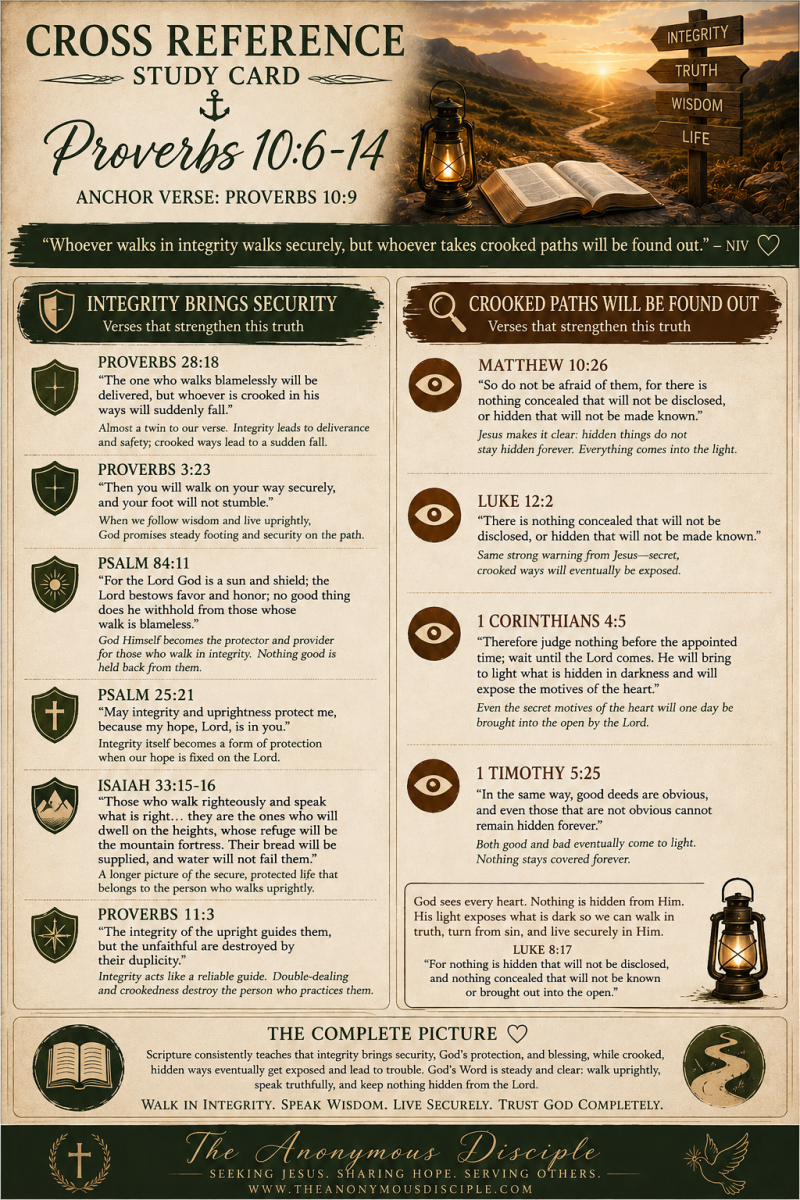
Verses that strengthen the “integrity brings security” side
Proverbs 28:18 “The one who walks blamelessly will be delivered, but whoever is crooked in his ways will suddenly fall.” Almost a twin to our verse. Integrity leads to deliverance and safety; crooked ways lead to a sudden fall.
Proverbs 3:23 “Then you will walk on your way securely, and your foot will not stumble.” When we follow wisdom and live uprightly, God promises steady footing and security on the path.
Psalm 84:11 “For the Lord God is a sun and shield; the Lord bestows favor and honor; no good thing does he withhold from those whose walk is blameless.” God Himself becomes the protector and provider for those who walk in integrity. Nothing good is held back from them.
Psalm 25:21 “May integrity and uprightness protect me, because my hope, Lord, is in you.” Integrity itself becomes a form of protection when our hope is fixed on the Lord.
Isaiah 33:15-16 “Those who walk righteously and speak what is right… they are the ones who will dwell on the heights, whose refuge will be the mountain fortress. Their bread will be supplied, and water will not fail them.” A longer picture of the secure, protected life that belongs to the person who walks uprightly.
Verses that strengthen the “crooked paths will be found out” side
Matthew 10:26 “So do not be afraid of them, for there is nothing concealed that will not be disclosed, or hidden that will not be made known.” Jesus makes it clear: hidden things do not stay hidden forever. Everything comes into the light.
Luke 12:2 “There is nothing concealed that will not be disclosed, or hidden that will not be made known.” Same strong warning from Jesus—secret, crooked ways will eventually be exposed.
1 Corinthians 4:5 “Therefore judge nothing before the appointed time; wait until the Lord comes. He will bring to light what is hidden in darkness and will expose the motives of the heart.” Even the secret motives of the heart will one day be brought into the open by the Lord.
1 Timothy 5:25 “In the same way, good deeds are obvious, and even those that are not obvious cannot remain hidden forever.” Both good and bad eventually come to light. Nothing stays covered forever.
One more strong parallel from Proverbs
Proverbs 11:3 “The integrity of the upright guides them, but the unfaithful are destroyed by their duplicity.” Integrity acts like a reliable guide. Double-dealing and crookedness destroy the person who practices them.
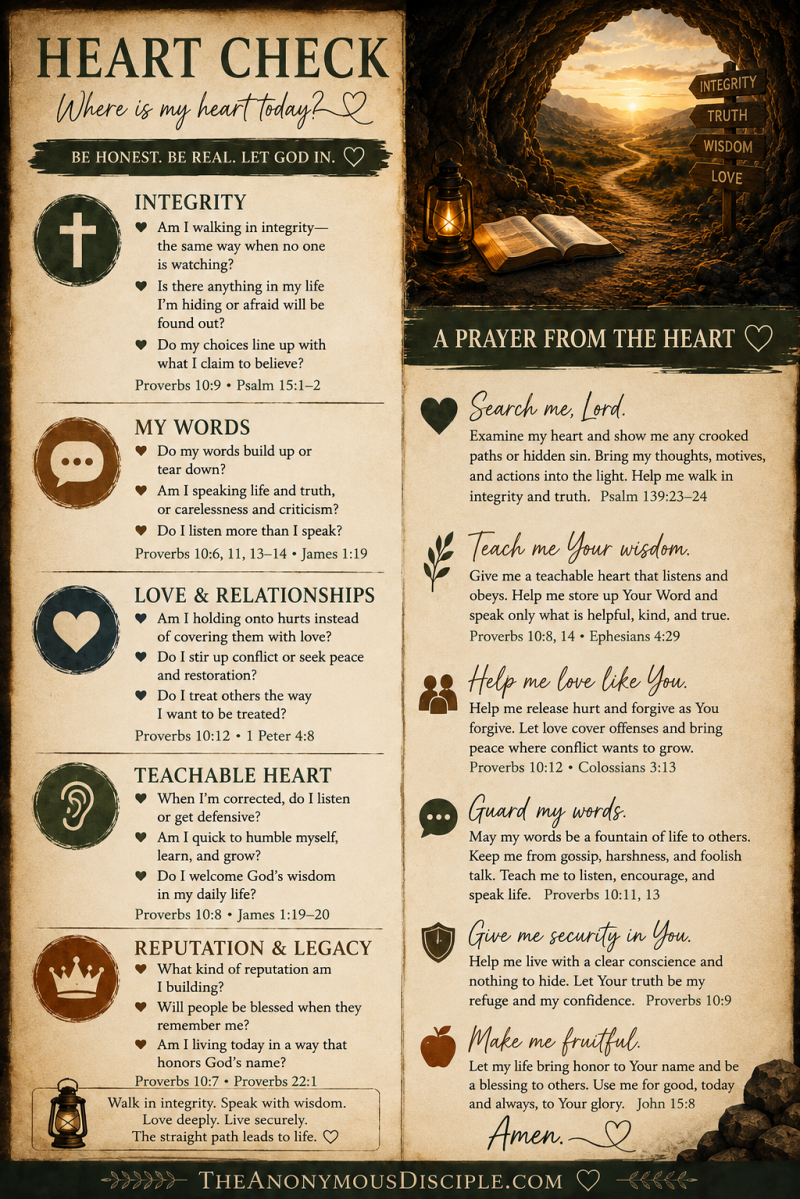
Heart Check ♥️
- Am I the same person privately that I present publicly?
- Is there anything I am hiding because I fear it being discovered?
- When corrected, do I listen—or immediately explain and defend myself?
- Do my words function as a fountain of life or a source of conflict?
- Have I been repeatedly uncovering an offense that love is asking me to release?
- Is God calling me to confess something and return to a straight path?
- What kind of reputation is my present life building?
Integrity often begins with one honest prayer:
“Lord, show me where my life is divided.”
Prayer 🙏
Father, search my heart and show me anything within me that is crooked, divided, or hidden. Give me the courage to walk in integrity, even when obedience is difficult and no one else can see my choices. Help my words become a fountain of life—truthful, wise, gentle, and useful for building others up. Make me teachable when You correct me. Keep hatred, bitterness, deception, and careless speech from taking root in me. Teach me to love without excusing sin, forgive without continually reopening wounds, and live with nothing deliberately hidden from You. Let my private life honor You as sincerely as my public testimony. Guide me along a straight path and give me the security of a clear conscience before You. In Jesus’ name, amen. ♥️
Add comment
Comments